This document describes a study on producing activated carbon from agricultural waste. Researchers tested two types of agricultural waste - rice husk and paper mill waste - as precursors for activated carbon production. They characterized the wastes using CHNS elemental analysis and proximate analysis to determine which was superior. Paper mill waste was found to be a better precursor. It was chemically activated using zinc chloride, potassium hydroxide, and potassium chloride. The researchers optimized production conditions and characterized the activated carbon produced in terms of iodine value, yield percentage, apparent density, ash content, and moisture content. The activated carbon with the highest iodine value of 764.80 mg/g was produced using zinc chloride as the activating agent.
![Production Of Activated Carbon From Agricultural Raw Waste
International organization of Scientific Research 57 | P a g e
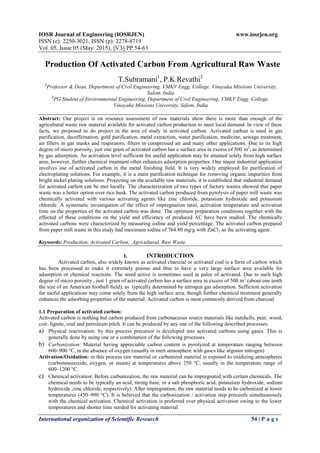
Then the chemical activated product was dried and stored for characterization.
Figure.3.1 Steps involved with the production of activated carbon from paper mill waste.
3.2 Characterization of activated carbon produced:
3.2.1 Iodine value of the activated carbon:
To gain further knowledge of the porous structure of activated carbon, iodine adsorption from liquid
phase was adopted by other researchersin the characterization of waste-based activated carbons. The adsorption
of aqueous I2 is considered a simple and quick test for evaluating the surface area of activated carbons
associated with pores larger than 1 nm. [54]
The iodine value, defined as the amount of iodine adsorbed per gram
of activated carbon at an equilibrium concentration of 0.02 N, was measured according to the procedure
established by the American Society for Testing and Materials (ASTM 2006). The mean values of data for each
experiment were presented. Standard deviation was calculated from triplicate samples. Iodine Number is
accepted as the most fundamental parameter used to characterize activated carbon performance. It gives the
measure of activity level (higher number indicates higher degree of activation). It indicates the microspore (0 –
20 Å) content Reagents used in the iodine value test are as listed below:
0.1N Iodine solution ( 40 gm KI in 1 Ltr of Distilled water ).
0.05N Sodium Thiosulphate solution (12.5 gm Na2S2O3.5H2O in 1 Ltr Distilled water)
1% Starch solution
Activated carbon
3.2.3 Other physical properties of activated carbon:
The apparent density of the material was obtained by weighting five grams of the produced activated
carbon and transferring it into a 10 mL graduated cylinder. The cylinder was tamping with a rubber pad while
activated carbon was being added until the entire original sample was transferred to the cylinder. Tamping was
continued for 5 minutes until there was no further settling produced. The volume was recorded and the apparent
density was calculated on the dry basis: Ash content was measured by burning the produced activated carbon in
a muffle furnace at 973 K. One gram of dry carbon was transferred into a crucible and then placed in the furnace
for four hours. The difference between the original and final weight of the carbon represents the ash content per
gram. Moisture content was also obtained by weighing 10 grams of the carbon and placed in an oven at 105 C
for 3 h. Then the carbon was cooled in the absence of humidity and reweighed again. The difference between the
initial and final mass of the carbon represents the water content in the sample. The yield of activated carbon
product was calculated based on the chemical-impregnated waste dried at 105 C. The composition of C, H and
N in the activated carbon used as raw material was determined using an elemental analyzer (PE-2400 II, Perkin-
Elmer Corp., USA).
3.2.4 X-Ray Diffraction Measurements:
X-ray scattering techniques are a family of non-destructive analytical techniques which reveal
information about the crystallographic structure, chemical composition, and physical properties of materials and
thin films. These techniques are based on observing the scattered intensity of an X-ray beam hitting a sample as
a function of incident and scattered angle, polarization, and wavelength or energy. X-ray diffraction yields the
atomic structure of materials and is based on the elastic scattering of X-rays from the electron clouds of the
individual atoms in the system. The most comprehensive description of scattering from crystals is given by the
dynamical theory of diffraction. Single-crystal X-ray diffraction is a technique used to solve the complete
structure of crystalline materials, ranging from simple inorganic solids to complex macromolecules, such as
proteins. Powder diffraction(XRD) is a technique used to characterise the crystallographic structure,
crystallitesize (grain size), and preferred orientation in polycrystalline or powdered solid samples.](https://image.slidesharecdn.com/g05535463-150613061327-lva1-app6892/85/G05535463-4-320.jpg)
![Production Of Activated Carbon From Agricultural Raw Waste
International organization of Scientific Research 58 | P a g e
3.2.5Fourier Transform Infrared Spectroscopy:
FTIR is most useful for identifying chemicals that are either organic or inorganic. It can be utilized to
quantitate some components of an unknown mixture. It can be applied to the analysis of solids, liquids, and
gasses. The term Fourier Transform Infrared Spectroscopy (FTIR) refers to a fairly recent development in the
manner in which the data is collected and converted from an interference pattern to a spectrum. Today's FTIR
instruments are computerized which makes them faster and more sensitive than the older dispersive instruments.
FTIR is commonly used to identify chemicals from spills, paints, polymers, coatings, drugs and contaminants.
FTIR is perhaps the most powerful tool for identifying types of chemical bonds (functional groups). The
wavelength of light absorbed is characteristic of the chemical bond as can be seen in this annotated spectrum. By
interpreting the infrared absorption spectrum, the chemical bonds in a molecule can be determined. FTIR spectra
of pure compounds are generally so unique that they are like a molecular "fingerprint". While organic
compounds have very rich, detailed spectra, inorganic compounds are usually much simpler. For most common
materials, the spectrum of an unknown can be identified by comparison to a library of known compounds. We
have several infrared spectral libraries including on-line computer libraries. To identify less common materials,
IR will need to be combined with nuclear magnetic resonance, mass spectrometry, emission spectroscopy, X-ray
diffraction, and/or other techniques.
3.2.6 Scanning electron microscope analysis:
A scanning electron microscope (SEM) is a type of electron microscope that images a sample by
scanning it with a high-energy beam of electronsin a raster scan pattern. The electrons interact with the atoms
that make up the sample producing signals that contain information about the sample's surface topography,
composition, and other properties such as electrical conductivity.
IV. RESULTS AND DISCUSSIONS
4.1Result of elemental analysis and proximate analysis of the wastes:
From the CHNS analysis and proximate analysis it was clearly seen that there was not much difference in the
fixed carbon content. Hence both are viable options for activated carbon production. But the mass per unit
volume of paper waste being much higher than that of rice hust, it would be more economical to choose paper
waste as the precursor of activated carbon production. Hence paper waste is fixed as our precursor in the further
production and analysis of activated carbon.
Table 4.1: Result of elemental analysis of rice Table 4. 2. Proximate analysis of the precursor husk and
paper waste
Element Rice husk (%) Paper waste
(%)
Carbon 38.7 39.52
hydrogen 5 4.53
0xygen 36 19.22
Nitrogen .7 .5
Sulphur .1 .11
Chlorine 0 0.2
4.2 Effect of chemical activating agents on activated carbon produced
In chemical activation, different activating agents are expected to significantly affect the extent of
activation .[55]
In the present study, activating with ZnCl2, KOH and KCl were evaluated and compared. The
effect of different activating agents on the iodine value and yield of activated carbon from waste in N2
atmosphere at 600 C for 1 h calculated. The concentration of various chemical activating agents was fixed at 1 N
and the impregnation time for these agents was maintained as 20 h. The iodine values of the activated carbons
changed significantly with activating agents. The activation with ZnCl2 gave the highest yield of 18.4%. More
over, the ZnCl2 activated product had the highest iodine value of 664.8mg/gm, indicating that its pore surface
and structure were the best developed. Thus, ZnCl2 was chosen as the activating agent for subsequent
experiments.
4.3 Effect of concentration of ZnCl2 solution used for producing activated carbons
The yields and iodine values of activated carbons prepared from paper waste in N2 atmosphere at 600C
for 1 h are presented in figure 2 . The impregnation process was carried on with various concentrations of ZnCl2
component Rice husk
(wt%)
Paper waste (wt%)
Volatile
matter
64.7 21.3
Fixed carbon 15.7 50.11
Ash content 19.2 14.5
Moisture
content
.4 14.09](https://image.slidesharecdn.com/g05535463-150613061327-lva1-app6892/85/G05535463-5-320.jpg)
![Production Of Activated Carbon From Agricultural Raw Waste
International organization of Scientific Research 59 | P a g e
solution but identical solid waste by dry weight of 6.2 g for a fixed impregnation time of 20 h prior to activation.
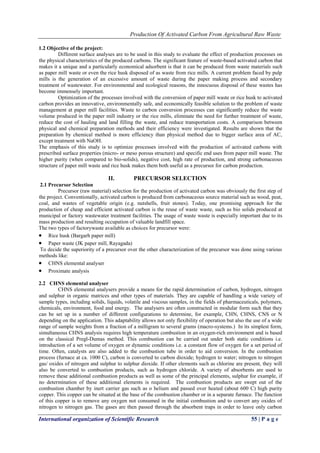
The iodine values of activated carbons produced had an optimum value of 764.8mg/gm, and the corresponding
ZnCl2 concentration was 2N. When the concentration was decreased to 1 M, the iodine value was relatively low
because of insufficient ZnCl2 to react with the waste to efficiently create the internal pore structures. However, if
the concentration of ZnCl2 was as high as 3N or more, the micropore structure of activated carbon deteriorated
due to excessive carbonization. The yield of product decreased steeply from 18.6 to 11.9% in the concentration
range with increasing iodine value, which was probably due to the formation of more micropores in the product.
The extent of decrease in product yield was lower at higher concentrations of activating agents. In all, we
considered the ZnCl2 concentration of 2 N to be optimum. (Figure.4.1)
Figure 4.1 Effect of concentration of activating agent on yield percent and iodine value of activated carbon.
4.4 Effect of time of impregnation on activated carbon products
The effect of impregnation time on the iodine value of the activated carbon product was shown in figure
3 . Paper waste was used and activated at 600 C for 1 h. The iodine values of samples increased gradually with
time of impregnation, and leveled off after 20 h. Long impregnation time would promote the diffusion of ZnCl2
in the waste. When the time was extended to 20 h, equilibrium was attained in the mixture of paper waste and
ZnCl2. Hence, the impregnation time of 20 h was required and was used in subsequent experiments. (Figure.4.2)
Figure 4.2 Effect of impregnation time on iodine value of activated carbon
4.5 Effect of activation temperature on activated carbon products
The activation temperature is a very influential parameter on the pore structure of activated carbon,
which determines the adsorption capacity.[56]
The variation in iodine values of activated carbon product was
investigated as a function of activation temperature. Paper waste was used as raw material and activation time
was fixed at 1 h. As shown in Figure 4, the iodine value increased progressively with activation temperature, and
then decreased when the temperature exceeded 600 C. At higher temperature (.600C), the pore walls between
adjacent pores were probably destroyed and the micropores were destructed, which led to the decrease in iodine
value of the activated carbon. Thus, it can be concluded that the optimum temperature for the production of
activated carbons from paper waste is approximately 600C. (Figure.4.3)](https://image.slidesharecdn.com/g05535463-150613061327-lva1-app6892/85/G05535463-6-320.jpg)
![Production Of Activated Carbon From Agricultural Raw Waste
International organization of Scientific Research 60 | P a g e
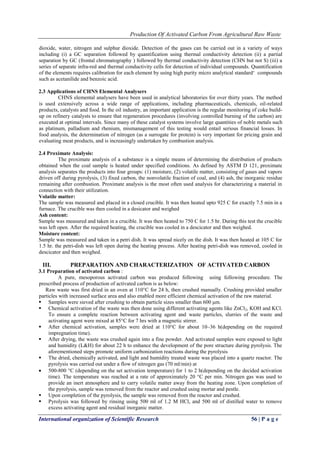
Figure 4.3: Effect of activation temperature on iodine value of the activated carbon
4.6 Effect of activation time on activated carbon products
The variations in iodine value of the activated carbon produced from paper waste versus the activation
time are shown in Figure 5. The iodine values were measured as 690.9 and 764.8mg/ g after 30 min and 1 h of
activation time, respectively. Thereafter, the iodine value gradually dropped to a value of 574.3mg/gm at 3 h.
The decrease in iodine value for the time period of 1– 3 h is considered to be due to the extended activation of
product, resulting in the conversion of some micropores into mesopores and mesopores into macro pores. This
trend indicates that the activation time of 1 h is optimum in our study. (Figure.4.4)
Figure4.4: Effect of activation time on iodine value of activated carbon
4.7 FT-IR analysis:
The FT-IR spectroscopic study of the produced carbon is shown in Figure 4.5. The sample showed four
major absorption bands at 2900-3500 cm-1, 1300-1750 cm-1, 1000-1250 cm-1 and 450-750 cm-1. A wide band
with two maximum peaks can be noticed at 2930 and 3450 cm-1. The band at 3450 cm- 1 is due to the
absorption of water molecules as result of an O-H stretching mode of hydroxyl groups and adsorbed water,
while the band at 2930 is attributed to C-H interaction with the surface of the carbon. However, it must be
indicated that the bands in the range of 3200-3650 cm-1 have also been attributed to the hydrogen-bonded OH
group of alcohols and phenols. [57],[58]
In the region 1300-1750 cm-1, amides can be distinguished on surface of
the activated carbon which has two peaks at 1640 and 1450 cm-1. These functional groups were obtained during
the activation process as a result of the presence of ammonia and primary amines that usually exist in the waste.
Moreover, the band at 1500 cm-1 may be attributed to the aromatic carbon–carbon stretching vibration. The two
peaks at 1125-1150 cm-1 yield the fingerprint of this carbon. The sharp absorption band at 1125 cm-1 is
ascribed to either Si-O [59]
or C-O stretching in alcohol, ether or hydroxyl groups. [60], [61]
The band at 1150 cm-1
can also be associated with ether C-O symmetric and asymmetric stretching vibration (-C-O-C- ring)[62]
. This
band could also be attributed to the anti symmetrical Si-OSi stretching mode as a result of existing alumina and
silica containing minerals within the waste samples [63]
.The region 450-750 cm-1 show two bands in the 480 and
485 cm-1 which are associated with the inplane and out-of-plane aromatic ring deformation vibrations[64]
. Peaks
at 598 and 680 cm- 1 are assigned to the out-of-plane C-H bending mode.](https://image.slidesharecdn.com/g05535463-150613061327-lva1-app6892/85/G05535463-7-320.jpg)
![Production Of Activated Carbon From Agricultural Raw Waste
International organization of Scientific Research 62 | P a g e
activated carbon with a relatively high specific surface area of 737.6m2 /g and high iodine value of 764.8mg/ g
was produced from paper waste by direct chemical activation.
The porosity of the product was comparable with that of commercially achieved carbon. The waste-based
activated carbon had a mean pore diameter of 6.72 nm, and its total pore volume and micro pore volume were
0.19 and 0.15cm3
/g, respectively, indicating its micro porous and meso porous character.
REFERENCES
[1]. Michael M, Brittain M, Nagai J, et al. Phase II study of activated charcoal to prevent irinotecan-induced
diarrhea, J ClinOncol. 22 (21), 4410–7 (2004).
[2]. Baker F. S., Miller C. E., Repic A. J. and Tolles E. D., Activated carbon. Kirk-OthmerEncycolpediaof
Chemical Technology, 4, 1015-1037 (1992).
[3]. El-Hendawy A. A., Influence of HNO3 oxidation on the structured and adsorptive properties of corncob
activated carbon. Carbon, 41, 713-722 (2003).
[4]. Laine J., Calafat A. and Labady M., Preparation and characterization of activated carbons from coconut
shell impregnated with phosphoric acid. Carbon, 27, 191-195 (1989).
[5]. Rodriguez-Reinoso F., Molina-Sobia M. and Gonzalez G. C., Preparation of activated carbon– sepiolite
pellets. Carbon, 39, 771 – 785 (2001).
[6]. L.K. Walhof. Procedure to produce activated carbon from biosolids, Illinois Institute of Technology,
Chicago, IL MS thesis (1998).
[7]. Martin, M. J., Artola, A., Balaguer, M. D. &Rigola, M. Activated carbons developed from surplus sewage
waste for the removal of dyes from dilute aqueous solutions. Chem. Eng. J. 94(3), 231–239 ( 2003).
[8]. Bac¸ aoui, A., Yaacoubi, A., Dahbi, A., Bennouna, C., Phan Tan Luu, R., Maldonado-Hodar, F. J.,
Rivera-Utrilla, J. &Moreno-Castilla, C. Optimization of conditions for the preparation of activated
carbons from olive-waste cakes. Carbon 39(3), 425–432 ( 2001).
[9]. Misra A., Tyagi P. K., Singh M. K., Misra D. S., FTIR studies of nitrogen doped carbon nanotubes.
Diamond and Related Materials, In Press, Corrected Proof, Available online 13 October (2005).
[10]. Park S. H., McClain S., Tian Z. R., Suib S. L. and Karwacki C., Surface and bulk measurements of metals
deposited on activated carbon. Chem Mat., 9: 176-183 (1997).
[11]. Subramani,T and Arulalan.K, “ Evaluation of the Efficiency of Surface Aerator in the Activated Sludge
Process Treatment of Flood Processing Effluent”, International Journal of Modern Engineering
Research,Vol.2, No.4, pp 1518 -1528, 2012.
[12]. Subramani.T, Anitha.P, Sekar.S, “Health-Care Waste Management System”, International Journal of
Engineering Research and Applications, Vol. 4, Issue 6( Version 2), pp.255-258, 2014.
[13]. Subramani.T , Kavitha.D, Tiyagu.R, “Treatment Of Municipal Waste Water In Salem City”, International
Journal of Engineering Research and Applications, Vol. 4, Issue 6( Version 2), pp.259-263, June 2014.
[14]. Subramani.T , Umarani.R, Bharathi Devi.S.K, “Sustainable Decentralized Model For Solid Waste
Management In Urban India”, International Journal of Engineering Research and Applications, Vol. 4,
Issue 6( Version 2), pp.264-269, 2014.
[15]. Subramani.T , Mangaiyarkarasi.M , Kathirvel.C, “ Impact Of Sewage And Industrial Effluent On Soil
Plant Health Act On Environment”, International Journal of Engineering Research and Applications,
Vol. 4, Issue 6( Version 2), pp.270-273, 2014.
[16]. Subramani.T, Rajadurai.C, Prasath.K “Bio-Degradable Plastics Impact On Environment”, International
Journal of Engineering Research and Applications, Volume. 4, Issue. 6 (Version 5), pp 194 -204, 2014.
AUTHOR
Prof. Dr.T.Subramani Working as a Professor and Dean of Civil Engineering in VMKV
Engg. College, Vinayaka Missions University, Salem, Tamilnadu, India. Having more than
25 years of Teaching experience in Various Engineering Colleges. He is a Chartered Civil
Engineer and Approved Valuer for many banks. Chairman and Member in Board of
Studies of Civil Engineering branch. Question paper setter and Valuer for UG and PG
Courses of Civil Engineering in number of Universities. Life Fellow in Institution of
Engineers (India) and Institution of Valuers. Life member in number of Technical
Societies and Educational bodies. Guided more than 400 students in UG projects and 150
students in PG projects. He is a reviewer for number of International Journals and
published 102 International Journal Publications and presented more than 25 papers in
International Conferences.](https://image.slidesharecdn.com/g05535463-150613061327-lva1-app6892/85/G05535463-9-320.jpg)


![5G Explained! A High Level Overview [Introduction]](https://cdn.slidesharecdn.com/ss_thumbnails/5gexplainedahighleveloverview-260119165306-cc137a3e-thumbnail.jpg?width=640&height=640&fit=bounds)


