NASA ASRS:
                           Evolution Toward Full
                           Electronic Processing
                     NASA Aviation Safety Reporting System (ASRS)
                      and Patient Safety Reporting System (PSRS)


                                        PM Challenge 2010
                                           Used with Permission


Linda J. Connell                          Lester Gong
Director, NASA ASRS & PSRS                IT Manager, Booz Allen Hamilton

Elisa Taube                               Jessica Arias
Research Manager, Booz Allen Hamilton     PSRS Deputy PM, Booz Allen Hamilton
Agenda


•   Background: ASRS / PSRS & Report Processing
•   The Evolution Towards Full Electronic Processing
•   Solutions for the Evolution of Report Processing
•   Approach Methodology
•   Before & After: The Evolution of Report Processing
•   Current State of the Evolution
•   Next Steps / Future Enhancements
ASRS and PSRS
What are ASRS and PSRS?

• Two separate incident reporting systems:
   ASRS = Aviation Safety Reporting System
   PSRS = Patient Safety Reporting System
• Managed and operated at NASA Ames Research
  Center, Moffett Field, California
• Based on three guiding principles:
    Voluntary
    Confidential
    Non-punitive
The Aviation Safety Reporting System (ASRS)


• Established in 1976 through interagency
  collaboration between NASA and the Federal
  Aviation Administration (FAA):
    An independent system for aviation safety
    One of the first lines of defense in identifying
     safety issues
    NASA chosen as “Honest Broker”
• ASRS database is a national asset of U.S.
  aviation safety data
The Aviation Safety Reporting System (ASRS)


• Receives, processes and analyzes voluntarily
  submitted incident reports from
    Pilots
    Air Traffic Controllers
    Flight Attendants
    Maintenance Technicians, and others
• Reports submitted to ASRS may describe both
  unsafe occurrences and hazardous situations
• ASRS's particular concern is the quality of
  human performance in the aviation system
The Patient Safety Reporting System (PSRS)


• Initiated in May 2000 via an Interagency Agreement
  with the Department of Veterans Affairs (VA)
• Modeled after the ASRS
• A venue for frontline hospital staff to report patient
  safety issues externally
• Accepts reports from:
    Physicians
    Nurses
    Ancillary staff (Pharmacy, Physical / Respiratory
     Therapy)
    Other
The Patient Safety Reporting System (PSRS)


• Collects and analyzes voluntarily submitted
  patient safety reports including:
   Close Calls
   Events
   Suggestions
• Strengthens the culture of safety
• Supports the foundation of medical human
  factors safety research
Report Processing
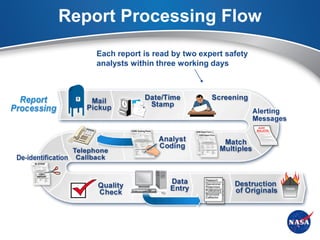
What is Report Processing?

• Report Processing: the methodology for
  codification of incident reports to facilitate
  extraction from the database for learning
  and safety information
• Both programs follow a standard report processing
  model of rapid screening, multiple report matching,
  alert identification and codification
• Begins with the receipt of the report and ends with
  the final coded report entered in either the ASRS or
  PSRS Database
Report Processing Flow
    Each report is read by two expert safety
    analysts within three working days
The Evolution Towards Full
  Electronic Processing
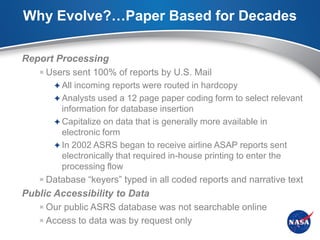
Why Evolve?…Paper Based for Decades

Report Processing
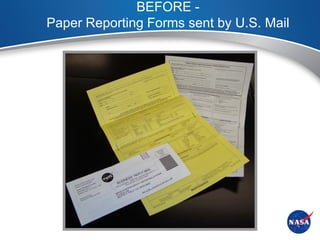
    Users sent 100% of reports by U.S. Mail
        All incoming reports were routed in hardcopy
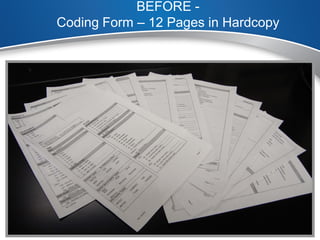
        Analysts used a 12 page paper coding form to select relevant
        information for database insertion
       Capitalize on data that is generally more available in
        electronic form
       In 2002 ASRS began to receive airline ASAP reports sent
        electronically that required in-house printing to enter the
        processing flow
    Database “keyers” typed in all coded reports and narrative text
Public Accessibility to Data
    Our public ASRS database was not searchable online
    Access to data was by request only
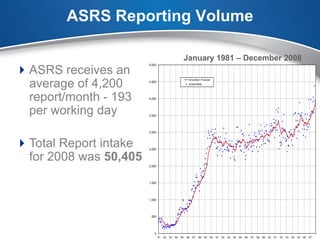
ASRS Reporting Volume

                                                              January 1981 – December 2008
 ASRS receives an
                        5,000


 average of 4,200
                                                                Smoothed / Forecast
                        4,500
                                                                Actual Intake


 report/month - 193     4,000


 per working day        3,500


                        3,000


 Total Report intake   2,500


 for 2008 was 50,405
                        2,000


                        1,500


                        1,000


                         500


                           0
                                '81   '82   '83   '84   '85   '86   '87   '88   '89   '90   '91   '92   '93   '94   '95   '96   '97   '98   '99   '00   '01   '02   '03   '04   '05   '06   '07
Why Evolve?…

• Increasing pressure for:
   Users to submit reports electronically
   Decreasing processing time / cost
     Paper process has limited throughput
     Report Volume continues to increase
   A Method that leverages electronically submitted
    reporting form data and reduces data input costs
   Searchable databases to access relevant reports for
    research, rulemaking, and safety purposes
Why Evolve?…

• Identified Challenges:
   Need a well planned and smooth transition
     Immediate cutover with no effect on high volume report
      production
     No opportunity to cease or pause production for the
      evolution
   Innovative solutions needed to be developed
     Internal staff must shift paradigm for report handling
       including special cases such as alert level reports
Solutions for The Evolution
   of Report Processing
Solutions for Evolution

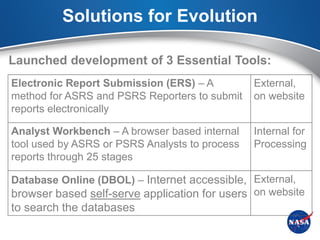
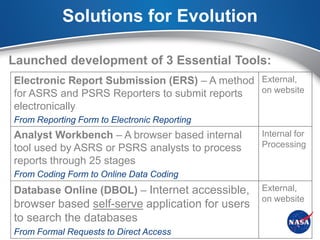
Launched development of 3 Essential Tools:
Electronic Report Submission (ERS) – A          External,
method for ASRS and PSRS Reporters to submit    on website
reports electronically

Analyst Workbench – A browser based internal    Internal for
tool used by ASRS or PSRS Analysts to process   Processing
reports through 25 stages

Database Online (DBOL) – Internet accessible, External,
browser based self-serve application for users on website
to search the databases
Approach Methodology


•       Used Standard Project Management Techniques1:
               Identified requirements
               Established clear and achievable objectives
               Balanced quality, scope, time, and cost concerns
               Accommodated concerns of key stakeholders
•       In order to identify requirements and accommodate
        stakeholders, a Usage-Centered Approach2 was used


1 PMBOK Guide, p. 9, 10
2 Constantine, L., & Lockwood, L. (1999). Software for use.
 Addison-Wesley-Longman, Inc., NY, NY., p. 23-25
Approach Methodology


•        Usage-Centered Approach1 – focuses on the
         work that users are trying to accomplish and on
         what the software will need to supply via the
         user interface to help them accomplish it
         User centered design represents a shift of focus
              from technology to people, from user interfaces
              to users. To design dramatically more usable
              tools, however, it is not just users who must be
              understood, but usage
1 Constantine, L., & Lockwood, L. (1999). Software for use.
    Addison-Wesley-Longman, Inc., NY, NY., p. 23
Approach Methodology


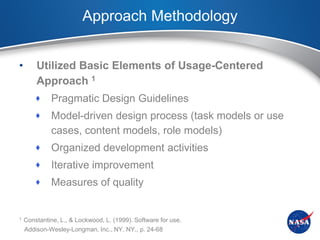
•       Utilized Basic Elements of Usage-Centered
        Approach 1
            Pragmatic Design Guidelines
            Model-driven design process (task models or use
             cases, content models, role models)
            Organized development activities
            Iterative improvement
            Measures of quality


1   Constantine, L., & Lockwood, L. (1999). Software for use.
    Addison-Wesley-Longman, Inc., NY, NY., p. 24-68
Before & After: The Evolution
    of Report Processing
Solutions for Evolution

Launched development of 3 Essential Tools:
Electronic Report Submission (ERS) – A method External,
for ASRS and PSRS Reporters to submit reports on website
electronically
From Reporting Form to Electronic Reporting
Analyst Workbench – A browser based internal     Internal for
tool used by ASRS or PSRS analysts to process    Processing
reports through 25 stages
From Coding Form to Online Data Coding
Database Online (DBOL) – Internet accessible,    External,
                                                 on website
browser based self-serve application for users
to search the databases
From Formal Requests to Direct Access
Electronic Report Submission (ERS)


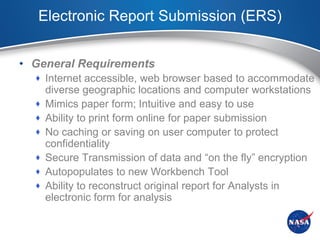
• General Requirements
   Internet accessible, web browser based to accommodate
      diverse geographic locations and computer workstations
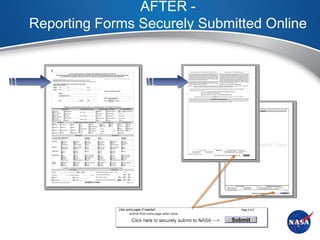
     Mimics paper form; Intuitive and easy to use
     Ability to print form online for paper submission
     No caching or saving on user computer to protect
      confidentiality
     Secure Transmission of data and “on the fly” encryption
     Autopopulates to new Workbench Tool
     Ability to reconstruct original report for Analysts in
      electronic form for analysis
BEFORE -
Paper Reporting Forms sent by U.S. Mail
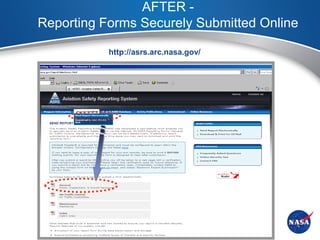
AFTER -
Reporting Forms Securely Submitted Online

           http://asrs.arc.nasa.gov/
AFTER -
Reporting Forms Securely Submitted Online
Analyst Workbench


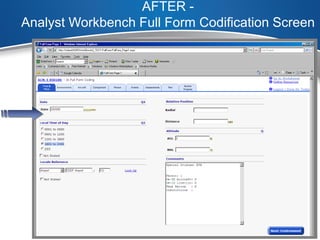
• General Requirements
   Browser based & cross platform
   Customized interface based on role
   Single electronic application for completing
    and tracking 25 steps in report processing
   Leverages staff “mental models” for analyzing
    paper reports
   Reduce errors and keying labor hours by pre-
    populating electronic data
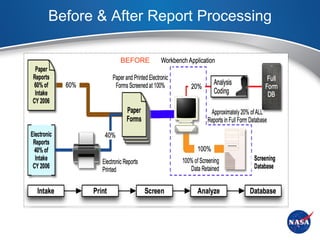
Before & After Report Processing

          BEFORE
           AFTER
BEFORE -
Coding Form – 12 Pages in Hardcopy
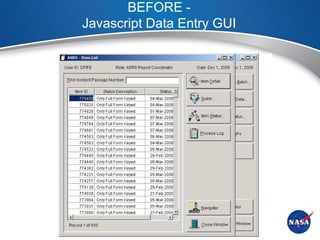
BEFORE -
Javascript Data Entry GUI
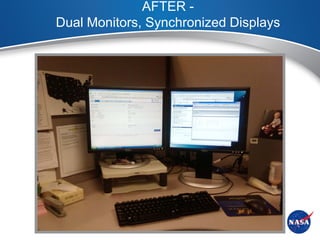
AFTER -
Dual Monitors, Synchronized Displays
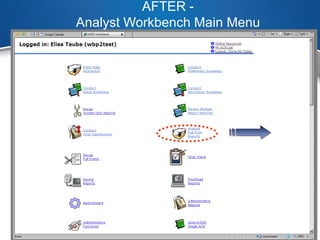
AFTER -
Analyst Workbench Main Menu
AFTER -
Analyst Workbench Full Form Codification Screen
Database Online (DBOL)


• General Requirements:
   Internet accessible, web browser based self-serve
    query application
   Enable stakeholder communities to construct complex
    SQL queries utilizing a simple interface
   Export to variety of formats (Excel, CSV, Word) for
    ease of data manipulation
   Rapid topical searches of over 150,000 records and
    10 million rows of data
     Simple approach (just text) or more advanced queries
      are possible
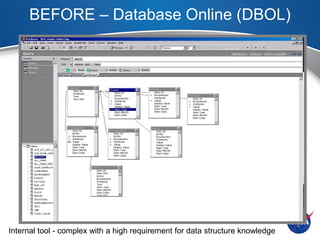
BEFORE – Database Online (DBOL)


Internal tool - complex with a high requirement for data structure knowledge
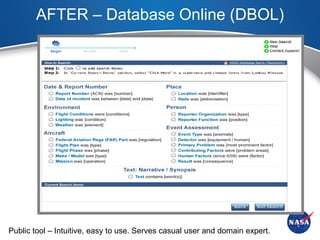
AFTER – Database Online (DBOL)


Public tool – Intuitive, easy to use. Serves casual user and domain expert.
Current State of the Evolution
Current state of
           Electronic Report Submission (ERS)

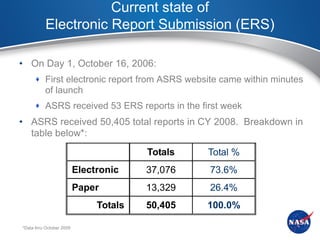
• On Day 1, October 16, 2006:
       First electronic report from ASRS website came within minutes
          of launch
       ASRS received 53 ERS reports in the first week
• ASRS received 50,405 total reports in CY 2008. Breakdown in
  table below*:
                                        Totals   Total %
                          Electronic    37,076   73.6%
                          Paper         13,329   26.4%
                               Totals   50,405   100.0%

*Data thru October 2009
Current State of
                        Database Online (DBOL)


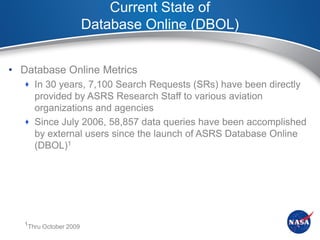
• Database Online Metrics
    In 30 years, 7,100 Search Requests (SRs) have been directly
     provided by ASRS Research Staff to various aviation
     organizations and agencies
    Since July 2006, 58,857 data queries have been accomplished
     by external users since the launch of ASRS Database Online
     (DBOL)1


   1Thru October 2009
Current State of
               Analyst Workbench


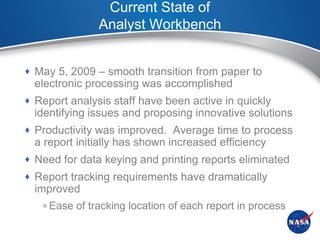
 May 5, 2009 – smooth transition from paper to
  electronic processing was accomplished
 Report analysis staff have been active in quickly
  identifying issues and proposing innovative solutions
 Productivity was improved. Average time to process
  a report initially has shown increased efficiency
 Need for data keying and printing reports eliminated
 Report tracking requirements have dramatically
  improved
   Ease of tracking location of each report in process
Next Steps / Future Enhancements
Next Steps

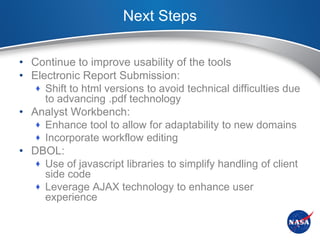
• Continue to improve usability of the tools
• Electronic Report Submission:
    Shift to html versions to avoid technical difficulties due
     to advancing .pdf technology
• Analyst Workbench:
    Enhance tool to allow for adaptability to new domains
    Incorporate workflow editing
• DBOL:
    Use of javascript libraries to simplify handling of client
     side code
    Leverage AJAX technology to enhance user
     experience

Taube

  • 1.
    NASA ASRS: Evolution Toward Full Electronic Processing NASA Aviation Safety Reporting System (ASRS) and Patient Safety Reporting System (PSRS) PM Challenge 2010 Used with Permission Linda J. Connell Lester Gong Director, NASA ASRS & PSRS IT Manager, Booz Allen Hamilton Elisa Taube Jessica Arias Research Manager, Booz Allen Hamilton PSRS Deputy PM, Booz Allen Hamilton
  • 2.
    Agenda • Background: ASRS / PSRS & Report Processing • The Evolution Towards Full Electronic Processing • Solutions for the Evolution of Report Processing • Approach Methodology • Before & After: The Evolution of Report Processing • Current State of the Evolution • Next Steps / Future Enhancements
  • 3.
  • 4.
    What are ASRSand PSRS? • Two separate incident reporting systems:  ASRS = Aviation Safety Reporting System  PSRS = Patient Safety Reporting System • Managed and operated at NASA Ames Research Center, Moffett Field, California • Based on three guiding principles: Voluntary Confidential Non-punitive
  • 5.
    The Aviation SafetyReporting System (ASRS) • Established in 1976 through interagency collaboration between NASA and the Federal Aviation Administration (FAA):  An independent system for aviation safety  One of the first lines of defense in identifying safety issues  NASA chosen as “Honest Broker” • ASRS database is a national asset of U.S. aviation safety data
  • 6.
    The Aviation SafetyReporting System (ASRS) • Receives, processes and analyzes voluntarily submitted incident reports from  Pilots  Air Traffic Controllers  Flight Attendants  Maintenance Technicians, and others • Reports submitted to ASRS may describe both unsafe occurrences and hazardous situations • ASRS's particular concern is the quality of human performance in the aviation system
  • 7.
    The Patient SafetyReporting System (PSRS) • Initiated in May 2000 via an Interagency Agreement with the Department of Veterans Affairs (VA) • Modeled after the ASRS • A venue for frontline hospital staff to report patient safety issues externally • Accepts reports from:  Physicians  Nurses  Ancillary staff (Pharmacy, Physical / Respiratory Therapy)  Other
  • 8.
    The Patient SafetyReporting System (PSRS) • Collects and analyzes voluntarily submitted patient safety reports including:  Close Calls  Events  Suggestions • Strengthens the culture of safety • Supports the foundation of medical human factors safety research
  • 9.
  • 10.
    What is ReportProcessing? • Report Processing: the methodology for codification of incident reports to facilitate extraction from the database for learning and safety information • Both programs follow a standard report processing model of rapid screening, multiple report matching, alert identification and codification • Begins with the receipt of the report and ends with the final coded report entered in either the ASRS or PSRS Database
  • 11.
    Report Processing Flow Each report is read by two expert safety analysts within three working days
  • 12.
    The Evolution TowardsFull Electronic Processing
  • 13.
    Why Evolve?…Paper Basedfor Decades Report Processing  Users sent 100% of reports by U.S. Mail  All incoming reports were routed in hardcopy  Analysts used a 12 page paper coding form to select relevant information for database insertion  Capitalize on data that is generally more available in electronic form  In 2002 ASRS began to receive airline ASAP reports sent electronically that required in-house printing to enter the processing flow  Database “keyers” typed in all coded reports and narrative text Public Accessibility to Data  Our public ASRS database was not searchable online  Access to data was by request only
  • 14.
    ASRS Reporting Volume January 1981 – December 2008  ASRS receives an 5,000 average of 4,200 Smoothed / Forecast 4,500 Actual Intake report/month - 193 4,000 per working day 3,500 3,000  Total Report intake 2,500 for 2008 was 50,405 2,000 1,500 1,000 500 0 '81 '82 '83 '84 '85 '86 '87 '88 '89 '90 '91 '92 '93 '94 '95 '96 '97 '98 '99 '00 '01 '02 '03 '04 '05 '06 '07
  • 15.
    Why Evolve?… • Increasingpressure for:  Users to submit reports electronically  Decreasing processing time / cost Paper process has limited throughput Report Volume continues to increase  A Method that leverages electronically submitted reporting form data and reduces data input costs  Searchable databases to access relevant reports for research, rulemaking, and safety purposes
  • 16.
    Why Evolve?… • IdentifiedChallenges:  Need a well planned and smooth transition Immediate cutover with no effect on high volume report production No opportunity to cease or pause production for the evolution  Innovative solutions needed to be developed Internal staff must shift paradigm for report handling including special cases such as alert level reports
  • 17.
    Solutions for TheEvolution of Report Processing
  • 18.
    Solutions for Evolution Launcheddevelopment of 3 Essential Tools: Electronic Report Submission (ERS) – A External, method for ASRS and PSRS Reporters to submit on website reports electronically Analyst Workbench – A browser based internal Internal for tool used by ASRS or PSRS Analysts to process Processing reports through 25 stages Database Online (DBOL) – Internet accessible, External, browser based self-serve application for users on website to search the databases
  • 19.
  • 20.
    Approach Methodology • Used Standard Project Management Techniques1:  Identified requirements  Established clear and achievable objectives  Balanced quality, scope, time, and cost concerns  Accommodated concerns of key stakeholders • In order to identify requirements and accommodate stakeholders, a Usage-Centered Approach2 was used 1 PMBOK Guide, p. 9, 10 2 Constantine, L., & Lockwood, L. (1999). Software for use. Addison-Wesley-Longman, Inc., NY, NY., p. 23-25
  • 21.
    Approach Methodology • Usage-Centered Approach1 – focuses on the work that users are trying to accomplish and on what the software will need to supply via the user interface to help them accomplish it  User centered design represents a shift of focus from technology to people, from user interfaces to users. To design dramatically more usable tools, however, it is not just users who must be understood, but usage 1 Constantine, L., & Lockwood, L. (1999). Software for use. Addison-Wesley-Longman, Inc., NY, NY., p. 23
  • 22.
    Approach Methodology • Utilized Basic Elements of Usage-Centered Approach 1  Pragmatic Design Guidelines  Model-driven design process (task models or use cases, content models, role models)  Organized development activities  Iterative improvement  Measures of quality 1 Constantine, L., & Lockwood, L. (1999). Software for use. Addison-Wesley-Longman, Inc., NY, NY., p. 24-68
  • 23.
    Before & After:The Evolution of Report Processing
  • 24.
    Solutions for Evolution Launcheddevelopment of 3 Essential Tools: Electronic Report Submission (ERS) – A method External, for ASRS and PSRS Reporters to submit reports on website electronically From Reporting Form to Electronic Reporting Analyst Workbench – A browser based internal Internal for tool used by ASRS or PSRS analysts to process Processing reports through 25 stages From Coding Form to Online Data Coding Database Online (DBOL) – Internet accessible, External, on website browser based self-serve application for users to search the databases From Formal Requests to Direct Access
  • 25.
    Electronic Report Submission(ERS) • General Requirements  Internet accessible, web browser based to accommodate diverse geographic locations and computer workstations  Mimics paper form; Intuitive and easy to use  Ability to print form online for paper submission  No caching or saving on user computer to protect confidentiality  Secure Transmission of data and “on the fly” encryption  Autopopulates to new Workbench Tool  Ability to reconstruct original report for Analysts in electronic form for analysis
  • 26.
    BEFORE - Paper ReportingForms sent by U.S. Mail
  • 27.
    AFTER - Reporting FormsSecurely Submitted Online http://asrs.arc.nasa.gov/
  • 28.
    AFTER - Reporting FormsSecurely Submitted Online
  • 29.
    Analyst Workbench • GeneralRequirements  Browser based & cross platform  Customized interface based on role  Single electronic application for completing and tracking 25 steps in report processing  Leverages staff “mental models” for analyzing paper reports  Reduce errors and keying labor hours by pre- populating electronic data
  • 30.
    Before & AfterReport Processing BEFORE AFTER
  • 31.
    BEFORE - Coding Form– 12 Pages in Hardcopy
  • 32.
  • 33.
    AFTER - Dual Monitors,Synchronized Displays
  • 34.
  • 35.
    AFTER - Analyst WorkbenchFull Form Codification Screen
  • 36.
    Database Online (DBOL) •General Requirements:  Internet accessible, web browser based self-serve query application  Enable stakeholder communities to construct complex SQL queries utilizing a simple interface  Export to variety of formats (Excel, CSV, Word) for ease of data manipulation  Rapid topical searches of over 150,000 records and 10 million rows of data Simple approach (just text) or more advanced queries are possible
  • 37.
    BEFORE – DatabaseOnline (DBOL) Internal tool - complex with a high requirement for data structure knowledge
  • 38.
    AFTER – DatabaseOnline (DBOL) Public tool – Intuitive, easy to use. Serves casual user and domain expert.
  • 39.
    Current State ofthe Evolution
  • 40.
    Current state of Electronic Report Submission (ERS) • On Day 1, October 16, 2006:  First electronic report from ASRS website came within minutes of launch  ASRS received 53 ERS reports in the first week • ASRS received 50,405 total reports in CY 2008. Breakdown in table below*: Totals Total % Electronic 37,076 73.6% Paper 13,329 26.4% Totals 50,405 100.0% *Data thru October 2009
  • 41.
    Current State of Database Online (DBOL) • Database Online Metrics  In 30 years, 7,100 Search Requests (SRs) have been directly provided by ASRS Research Staff to various aviation organizations and agencies  Since July 2006, 58,857 data queries have been accomplished by external users since the launch of ASRS Database Online (DBOL)1 1Thru October 2009
  • 42.
    Current State of Analyst Workbench  May 5, 2009 – smooth transition from paper to electronic processing was accomplished  Report analysis staff have been active in quickly identifying issues and proposing innovative solutions  Productivity was improved. Average time to process a report initially has shown increased efficiency  Need for data keying and printing reports eliminated  Report tracking requirements have dramatically improved Ease of tracking location of each report in process
  • 43.
    Next Steps /Future Enhancements
  • 44.
    Next Steps • Continueto improve usability of the tools • Electronic Report Submission:  Shift to html versions to avoid technical difficulties due to advancing .pdf technology • Analyst Workbench:  Enhance tool to allow for adaptability to new domains  Incorporate workflow editing • DBOL:  Use of javascript libraries to simplify handling of client side code  Leverage AJAX technology to enhance user experience