The Elusive Promise of
Neuroprotection - What Have we
Learned, Where do we go next?
And…….How to develop a successful
research career!
William Barsan, MD
Neuroprotection
• Can apply to any acquired neurological condition
• Implies impeding the injury cascade by targeting
one or multiple molecular pathways
• Can apply to stroke, TBI, global ischemia, etc
• Stroke and TBI have been the most studied
areas
Failure of Neuroprotection
• TBI
– 20 late Phase 2 or Phase 3 trials
– All have failed to show a benefit
– More than 130 monotherapies look good in preclinical
work
• Ischemic stroke
– 15 drugs have advanced to Phase 3 trial testing
– All have failed
Failure of Neuroprotection
• Multiple drug classes have been tested
– Glutamate antagonists
– Calcium channel blockers
– Anti-inflammatories
– Antioxidants
– GABA antagonists
– Opiate antagonists
– Growth factors
– Others
Clinical Trial failures in Stroke
• Drugs were tested too late after stroke onset
• Inadequate sample size to detect a modest treatment
effect
• Studies included too many mild or severe stroke patients
in whom detecting a treatment effect was difficult
• Side effects precluded dosing to achieve adequate
plasma drug concentrations
• Wrong dose?
• Wrong duration of treatment?
What is our typical model?
• Discovery research into pathways, mechanisms
• Preclinical animal models of disease
• Phase 1 toxicity, PK testing
• Phase 2 trials for safety, potential efficacy
• Phase 3 trials
Steps in Traditional Drug Development
• Phase I
– tens of subjects
– first use in humans (with or without target illness)
– generates initial dosing and toxicity information
• Phase II
– one to few hundreds of subjects with target illness
– gain initial information on dose-response relationship
(i.e., “proof of concept”), side effects
• Phase III
– confirm superiority of new treatment
– need two “adequate and well controlled” trials
Challenges in Traditional Approach
• Phase 2
– a wide range of dose strengths may be
possible “best” choices
– may also need to consider combinations of
treatments, different durations of treatment
– may not really know the right patient
population
– Most Phase 2 studies are actually
underpowered Phase 3 trials
– No way of comparing different agents
“successful” in Phase 2
Challenges in Traditional Approach
• Phase III
– often still don’t really know the right dose or
timing of treatment
– don’t really know what to expect in the control
arm
– don’t know the right population
– don’t know anything about rarer side effects
• Yet traditional statistical approaches
require that the trial characteristics be
completely defined prior to enrolling the
first phase III patient
Is the Model broken??
• Preclinical testing
– Typically done in single labs with individual models
– Can’t compare agents from different trials
– Only evaluate one agent
– Often not blinded or randomized
– Outdated statistical methodology
– Models may not be clinically relevant
– Outcomes are not clinically relevant
Is the Model broken??
• Phase 2 trials
– Inadequate data from preclinical trials to know what is
the most promising agent(s)
– Evaluate only one agent at a time
– Outcomes may not be clinically relevant
– Study designs not comparable for different agents
– Often use “best guess” for dosage, duration, time of
treatment
– Underpowered for efficacy
– Unable to predict success in Phase 3
Is the Model broken??
• Phase 3
– Evaluating one agent at a time
– How do we know we’re evaluating the right agent?
– Use of “fixed” trial designs
– Often “guess” at dose, duration, timing
– Wrong patient population
– Very high failure rate
Is the Model broken??
• Errors are compounded by our outmoded
process
• Choosing the wrong agents to test
• Failure to compare multiple agents
• Failure to identify right dose, duration, timing
• Failure to identify target patient population
• A failed trial may be a failed design, not
a failed treatment
Evaluation of combination agents
• Current mechanism is to do one at a time
• Prove efficacy of one agent alone before
evaluating in combination
• It is not logical that a blocking a single pathway
will lead to improved outcome when multiple
injury pathways are active
• Examples from cancer treatment are instructive
• Use of adaptive trial designs
“Philosophy” of Adaptive
Trials
• Clarity of goals
– E.g., proof of concept vs. identification of
dose to carry forward vs. confirmation of
benefit
– A statistically significant p value is not a
goal
• Frequent “looks” at the data and data-
driven modification of the trial
• Adaptive “by design”
• Extensive use of simulation to “fine tune”
key trial characteristics
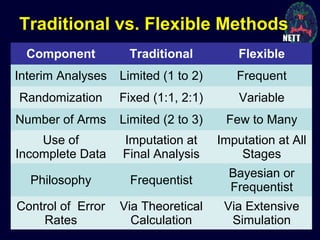
Traditional vs. Flexible Methods
Component Traditional Flexible
Interim Analyses Limited (1 to 2) Frequent
Randomization Fixed (1:1, 2:1) Variable
Number of Arms Limited (2 to 3) Few to Many
Use of
Incomplete Data
Imputation at
Final Analysis
Imputation at All
Stages
Philosophy Frequentist
Bayesian or
Frequentist
Control of Error
Rates
Via Theoretical
Calculation
Via Extensive
Simulation
Adaptation: Definition
• Making planned, well-defined changes in
key clinical trial design parameters, during
trial execution based on data from that trial,
to achieve goals of validity, scientific
efficiency, and safety
– Planned: Possible adaptations defined a
priori
– Well-defined: Criteria for adapting defined
– Key parameters: Not minor inclusion or
exclusion criteria, routine amendments, etc.
– Validity: Reliable statistical inference
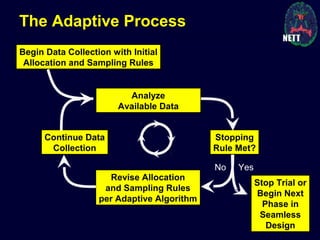
The Adaptive Process
Analyze
Available Data
Continue Data
Collection
Begin Data Collection with Initial
Allocation and Sampling Rules
Stopping
Rule Met?
Stop Trial or
Begin Next
Phase in
Seamless
Design
Revise Allocation
and Sampling Rules
per Adaptive Algorithm
No Yes
Why Do Adaptive Clinical Trials?
• To avoid getting the wrong answer!
– Drawing an incorrect qualitative conclusion
• To avoid taking too long to draw the right
conclusion
– Time, human subjects, and resources
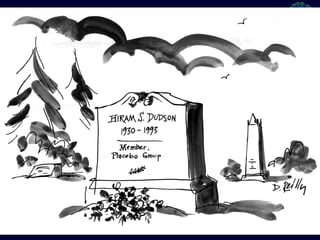
Avoiding Anticipated Regret
• A substantial fraction of all confirmatory trials fail
despite promising “learn phase” results
• Investigators can anticipate the design decisions
they would wish to “take over” after the trial fails
• Areas of “anticipated regret” are promising
targets for adaptations
One Truly Understands Only
What One Can Simulate
• The relative importance and likelihood of
threats to trial validity depends on the
specifics of the situation
• Simulation is the best way to quantify the
different threats to validity and inform rational
trial design
• Frequent interim analyses
• Explicit longitudinal modeling of the
relationship between proximate endpoints
and the primary endpoint of the trial
• Response-adaptive randomization to
efficiently address one or more trial goals
• Explicit decision rules based on predictive
probabilities at each interim analysis
• Dose-response modeling
• Extensive simulations of trial performance
Some Adaptive Strategies
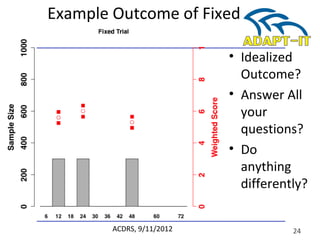
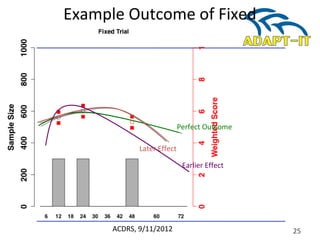
Example Outcome of Fixed
ACDRS, 9/11/2012 24
• Idealized
Outcome?
• Answer All
your
questions?
• Do
anything
differently?
Example Outcome of Fixed
ACDRS, 9/11/2012 25
Perfect Outcome
Later Effect
Earlier Effect
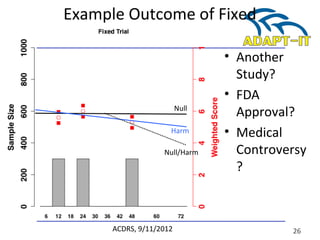
Example Outcome of Fixed
ACDRS, 9/11/2012 26
Null
Harm
Null/Harm
• Another
Study?
• FDA
Approval?
• Medical
Controversy
?
27
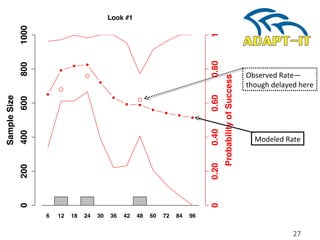
Observed Rate—
though delayed here
Modeled Rate
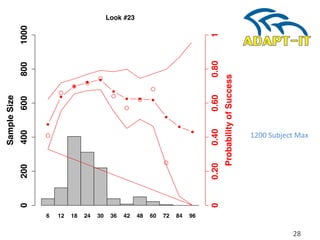
1200 Subject Max
28
Future research in Neuroprotection
• Redesign of preclinical research
• Redesign of the Phase 2 process
• Redesign of the Phase 3 process
Preclinical research
• Much closer collaboration with clinical
researchers
– Clinical researchers need to help with design
• Use of multicenter preclinical trial networks
– Blinding, randomization, data analysis
• Development of “ongoing” trials with different
experimental models
• Use of Adaptive Designs
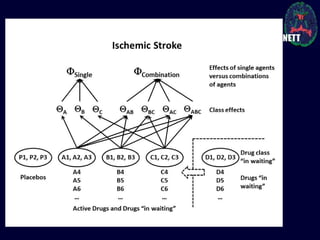
• Test and compare individual agents and
combinations of agents
• Better dose and duration finding
Phase 2 process
• Informed by more adequate preclinical designs
• Use of Adaptive Designs
• Perform “Platform” Phase 2 studies
• Add in different agents or combinations
• Weed out the losers to avoid further waste
• Develop decision rules for proceeding to Phase
3
• Better definition of dose and duration
Phase 3 trials
• Adaptive designs
• Can add exploratory arms with hierarchical
modeling
• Frequent interim analyses
• Enrichment to define optimal population
• Use of longitudinal modeling
• Use of response adaptive randomization
• Avoid “missing” something that works!
Future of Neuroprotection
• Failed translation has created sense of nihilism
regarding neuroprotection
• Our preclinical and clinical trial testing have
significant shortcomings
• Need to develop better screening processes to
identify promising agents & combinations
• Redesigning our approach utilizing flexible trial
designs
• Consider “re-testing” failed agents using this
new approach
And the next question is:
How do you develop a
successful research career?
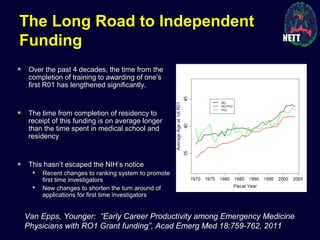
The Long Road to Independent
Funding
Over the past 4 decades, the time from theOver the past 4 decades, the time from the
completion of training to awarding of one’scompletion of training to awarding of one’s
first R01 has lengthened significantly.first R01 has lengthened significantly.
The time from completion of residency toThe time from completion of residency to
receipt of this funding is on average longerreceipt of this funding is on average longer
than the time spent in medical school andthan the time spent in medical school and
residencyresidency
This hasn’t escaped the NIH’s noticeThis hasn’t escaped the NIH’s notice

Recent changes to ranking system to promoteRecent changes to ranking system to promote
first time investigatorsfirst time investigators

New changes to shorten the turn around ofNew changes to shorten the turn around of
applications for first time investigatorsapplications for first time investigators
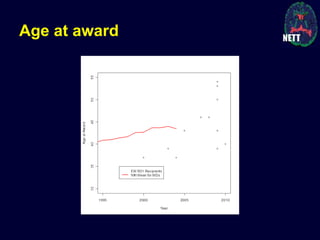
Van Epps, Younger: “Early Career Productivity among Emergency Medicine
Physicians with RO1 Grant funding”, Acad Emerg Med 18:759-762, 2011
Challenges Arising
• For the Chair
– Very long lead time from investment to pay off
– Early stars may fade
– Fraction of faculty ‘going for it’ is small and potentially expensive
– Many EM Chairs have not gone down this road personally, so
expectations may be partly (mostly?) guesswork
• For the faculty member
– Very long lead time from investment to pay off
– May become relatively isolated from other faculty and
departmental activities
– Life outside of work will be threatened by the workload
– Often must look outside of EM for best mentorship
The Annual Performance Evaluation:
So, How’s it Going?
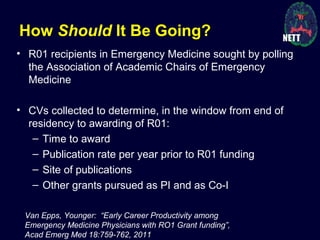
How Should It Be Going?
• R01 recipients in Emergency Medicine sought by polling
the Association of Academic Chairs of Emergency
Medicine
• CVs collected to determine, in the window from end of
residency to awarding of R01:
– Time to award
– Publication rate per year prior to R01 funding
– Site of publications
– Other grants pursued as PI and as Co-I
Van Epps, Younger: “Early Career Productivity among
Emergency Medicine Physicians with RO1 Grant funding”,
Acad Emerg Med 18:759-762, 2011
Age at award
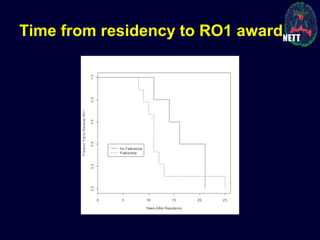
Time from residency to RO1 award
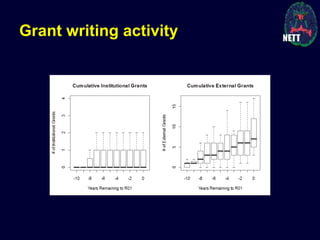
Grant writing activity
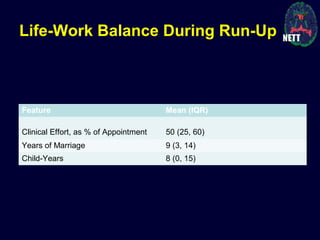
Life-Work Balance During Run-Up
Feature Mean (IQR)
Clinical Effort, as % of Appointment 50 (25, 60)
Years of Marriage 9 (3, 14)
Child-Years 8 (0, 15)
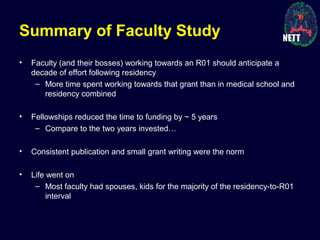
Summary of Faculty Study
• Faculty (and their bosses) working towards an R01 should anticipate a
decade of effort following residency
– More time spent working towards that grant than in medical school and
residency combined
• Fellowships reduced the time to funding by ~ 5 years
– Compare to the two years invested…
• Consistent publication and small grant writing were the norm
• Life went on
– Most faculty had spouses, kids for the majority of the residency-to-R01
interval
My research path…….
How did I get involved in clinical
neurological research?
• I never did a neurology rotation—ever!
• I had no interest in stroke when I began doing
research
• I have never taken a statistics course
• I started as a laboratory researcher
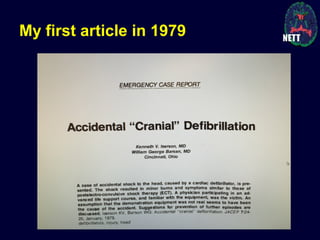
My first article in 1979
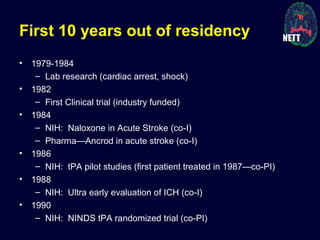
First 10 years out of residency
• 1979-1984
– Lab research (cardiac arrest, shock)
• 1982
– First Clinical trial (industry funded)
• 1984
– NIH: Naloxone in Acute Stroke (co-I)
– Pharma—Ancrod in acute stroke (co-I)
• 1986
– NIH: tPA pilot studies (first patient treated in 1987—co-PI)
• 1988
– NIH: Ultra early evaluation of ICH (co-I)
• 1990
– NIH: NINDS tPA randomized trial (co-PI)
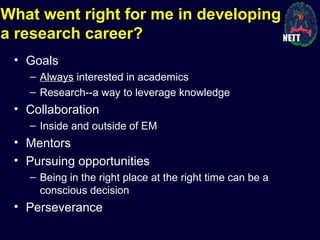
What went right for me in developing
a research career?
• Goals
– Always interested in academics
– Research--a way to leverage knowledge
• Collaboration
– Inside and outside of EM
• Mentors
• Pursuing opportunities
– Being in the right place at the right time can be a
conscious decision
• Perseverance
QUESTIONS??
The Elusive Promise of Neuroprotection - What have we learned, Where do we go next? by William Barsan

The Elusive Promise of Neuroprotection - What have we learned, Where do we go next? by William Barsan

  • 1.
    The Elusive Promiseof Neuroprotection - What Have we Learned, Where do we go next? And…….How to develop a successful research career! William Barsan, MD
  • 2.
    Neuroprotection • Can applyto any acquired neurological condition • Implies impeding the injury cascade by targeting one or multiple molecular pathways • Can apply to stroke, TBI, global ischemia, etc • Stroke and TBI have been the most studied areas
  • 3.
    Failure of Neuroprotection •TBI – 20 late Phase 2 or Phase 3 trials – All have failed to show a benefit – More than 130 monotherapies look good in preclinical work • Ischemic stroke – 15 drugs have advanced to Phase 3 trial testing – All have failed
  • 4.
    Failure of Neuroprotection •Multiple drug classes have been tested – Glutamate antagonists – Calcium channel blockers – Anti-inflammatories – Antioxidants – GABA antagonists – Opiate antagonists – Growth factors – Others
  • 5.
    Clinical Trial failuresin Stroke • Drugs were tested too late after stroke onset • Inadequate sample size to detect a modest treatment effect • Studies included too many mild or severe stroke patients in whom detecting a treatment effect was difficult • Side effects precluded dosing to achieve adequate plasma drug concentrations • Wrong dose? • Wrong duration of treatment?
  • 6.
    What is ourtypical model? • Discovery research into pathways, mechanisms • Preclinical animal models of disease • Phase 1 toxicity, PK testing • Phase 2 trials for safety, potential efficacy • Phase 3 trials
  • 7.
    Steps in TraditionalDrug Development • Phase I – tens of subjects – first use in humans (with or without target illness) – generates initial dosing and toxicity information • Phase II – one to few hundreds of subjects with target illness – gain initial information on dose-response relationship (i.e., “proof of concept”), side effects • Phase III – confirm superiority of new treatment – need two “adequate and well controlled” trials
  • 8.
    Challenges in TraditionalApproach • Phase 2 – a wide range of dose strengths may be possible “best” choices – may also need to consider combinations of treatments, different durations of treatment – may not really know the right patient population – Most Phase 2 studies are actually underpowered Phase 3 trials – No way of comparing different agents “successful” in Phase 2
  • 9.
    Challenges in TraditionalApproach • Phase III – often still don’t really know the right dose or timing of treatment – don’t really know what to expect in the control arm – don’t know the right population – don’t know anything about rarer side effects • Yet traditional statistical approaches require that the trial characteristics be completely defined prior to enrolling the first phase III patient
  • 10.
    Is the Modelbroken?? • Preclinical testing – Typically done in single labs with individual models – Can’t compare agents from different trials – Only evaluate one agent – Often not blinded or randomized – Outdated statistical methodology – Models may not be clinically relevant – Outcomes are not clinically relevant
  • 11.
    Is the Modelbroken?? • Phase 2 trials – Inadequate data from preclinical trials to know what is the most promising agent(s) – Evaluate only one agent at a time – Outcomes may not be clinically relevant – Study designs not comparable for different agents – Often use “best guess” for dosage, duration, time of treatment – Underpowered for efficacy – Unable to predict success in Phase 3
  • 12.
    Is the Modelbroken?? • Phase 3 – Evaluating one agent at a time – How do we know we’re evaluating the right agent? – Use of “fixed” trial designs – Often “guess” at dose, duration, timing – Wrong patient population – Very high failure rate
  • 13.
    Is the Modelbroken?? • Errors are compounded by our outmoded process • Choosing the wrong agents to test • Failure to compare multiple agents • Failure to identify right dose, duration, timing • Failure to identify target patient population • A failed trial may be a failed design, not a failed treatment
  • 14.
    Evaluation of combinationagents • Current mechanism is to do one at a time • Prove efficacy of one agent alone before evaluating in combination • It is not logical that a blocking a single pathway will lead to improved outcome when multiple injury pathways are active • Examples from cancer treatment are instructive • Use of adaptive trial designs
  • 15.
    “Philosophy” of Adaptive Trials •Clarity of goals – E.g., proof of concept vs. identification of dose to carry forward vs. confirmation of benefit – A statistically significant p value is not a goal • Frequent “looks” at the data and data- driven modification of the trial • Adaptive “by design” • Extensive use of simulation to “fine tune” key trial characteristics
  • 16.
    Traditional vs. FlexibleMethods Component Traditional Flexible Interim Analyses Limited (1 to 2) Frequent Randomization Fixed (1:1, 2:1) Variable Number of Arms Limited (2 to 3) Few to Many Use of Incomplete Data Imputation at Final Analysis Imputation at All Stages Philosophy Frequentist Bayesian or Frequentist Control of Error Rates Via Theoretical Calculation Via Extensive Simulation
  • 17.
    Adaptation: Definition • Makingplanned, well-defined changes in key clinical trial design parameters, during trial execution based on data from that trial, to achieve goals of validity, scientific efficiency, and safety – Planned: Possible adaptations defined a priori – Well-defined: Criteria for adapting defined – Key parameters: Not minor inclusion or exclusion criteria, routine amendments, etc. – Validity: Reliable statistical inference
  • 18.
    The Adaptive Process Analyze AvailableData Continue Data Collection Begin Data Collection with Initial Allocation and Sampling Rules Stopping Rule Met? Stop Trial or Begin Next Phase in Seamless Design Revise Allocation and Sampling Rules per Adaptive Algorithm No Yes
  • 19.
    Why Do AdaptiveClinical Trials? • To avoid getting the wrong answer! – Drawing an incorrect qualitative conclusion • To avoid taking too long to draw the right conclusion – Time, human subjects, and resources
  • 21.
    Avoiding Anticipated Regret •A substantial fraction of all confirmatory trials fail despite promising “learn phase” results • Investigators can anticipate the design decisions they would wish to “take over” after the trial fails • Areas of “anticipated regret” are promising targets for adaptations
  • 22.
    One Truly UnderstandsOnly What One Can Simulate • The relative importance and likelihood of threats to trial validity depends on the specifics of the situation • Simulation is the best way to quantify the different threats to validity and inform rational trial design
  • 23.
    • Frequent interimanalyses • Explicit longitudinal modeling of the relationship between proximate endpoints and the primary endpoint of the trial • Response-adaptive randomization to efficiently address one or more trial goals • Explicit decision rules based on predictive probabilities at each interim analysis • Dose-response modeling • Extensive simulations of trial performance Some Adaptive Strategies
  • 24.
    Example Outcome ofFixed ACDRS, 9/11/2012 24 • Idealized Outcome? • Answer All your questions? • Do anything differently?
  • 25.
    Example Outcome ofFixed ACDRS, 9/11/2012 25 Perfect Outcome Later Effect Earlier Effect
  • 26.
    Example Outcome ofFixed ACDRS, 9/11/2012 26 Null Harm Null/Harm • Another Study? • FDA Approval? • Medical Controversy ?
  • 27.
  • 28.
  • 29.
    Future research inNeuroprotection • Redesign of preclinical research • Redesign of the Phase 2 process • Redesign of the Phase 3 process
  • 30.
    Preclinical research • Muchcloser collaboration with clinical researchers – Clinical researchers need to help with design • Use of multicenter preclinical trial networks – Blinding, randomization, data analysis • Development of “ongoing” trials with different experimental models • Use of Adaptive Designs • Test and compare individual agents and combinations of agents • Better dose and duration finding
  • 32.
    Phase 2 process •Informed by more adequate preclinical designs • Use of Adaptive Designs • Perform “Platform” Phase 2 studies • Add in different agents or combinations • Weed out the losers to avoid further waste • Develop decision rules for proceeding to Phase 3 • Better definition of dose and duration
  • 33.
    Phase 3 trials •Adaptive designs • Can add exploratory arms with hierarchical modeling • Frequent interim analyses • Enrichment to define optimal population • Use of longitudinal modeling • Use of response adaptive randomization • Avoid “missing” something that works!
  • 34.
    Future of Neuroprotection •Failed translation has created sense of nihilism regarding neuroprotection • Our preclinical and clinical trial testing have significant shortcomings • Need to develop better screening processes to identify promising agents & combinations • Redesigning our approach utilizing flexible trial designs • Consider “re-testing” failed agents using this new approach
  • 35.
    And the nextquestion is:
  • 36.
    How do youdevelop a successful research career?
  • 37.
    The Long Roadto Independent Funding Over the past 4 decades, the time from theOver the past 4 decades, the time from the completion of training to awarding of one’scompletion of training to awarding of one’s first R01 has lengthened significantly.first R01 has lengthened significantly. The time from completion of residency toThe time from completion of residency to receipt of this funding is on average longerreceipt of this funding is on average longer than the time spent in medical school andthan the time spent in medical school and residencyresidency This hasn’t escaped the NIH’s noticeThis hasn’t escaped the NIH’s notice  Recent changes to ranking system to promoteRecent changes to ranking system to promote first time investigatorsfirst time investigators  New changes to shorten the turn around ofNew changes to shorten the turn around of applications for first time investigatorsapplications for first time investigators Van Epps, Younger: “Early Career Productivity among Emergency Medicine Physicians with RO1 Grant funding”, Acad Emerg Med 18:759-762, 2011
  • 38.
    Challenges Arising • Forthe Chair – Very long lead time from investment to pay off – Early stars may fade – Fraction of faculty ‘going for it’ is small and potentially expensive – Many EM Chairs have not gone down this road personally, so expectations may be partly (mostly?) guesswork • For the faculty member – Very long lead time from investment to pay off – May become relatively isolated from other faculty and departmental activities – Life outside of work will be threatened by the workload – Often must look outside of EM for best mentorship
  • 39.
    The Annual PerformanceEvaluation: So, How’s it Going?
  • 40.
    How Should ItBe Going? • R01 recipients in Emergency Medicine sought by polling the Association of Academic Chairs of Emergency Medicine • CVs collected to determine, in the window from end of residency to awarding of R01: – Time to award – Publication rate per year prior to R01 funding – Site of publications – Other grants pursued as PI and as Co-I Van Epps, Younger: “Early Career Productivity among Emergency Medicine Physicians with RO1 Grant funding”, Acad Emerg Med 18:759-762, 2011
  • 41.
  • 42.
    Time from residencyto RO1 award
  • 43.
  • 44.
    Life-Work Balance DuringRun-Up Feature Mean (IQR) Clinical Effort, as % of Appointment 50 (25, 60) Years of Marriage 9 (3, 14) Child-Years 8 (0, 15)
  • 45.
    Summary of FacultyStudy • Faculty (and their bosses) working towards an R01 should anticipate a decade of effort following residency – More time spent working towards that grant than in medical school and residency combined • Fellowships reduced the time to funding by ~ 5 years – Compare to the two years invested… • Consistent publication and small grant writing were the norm • Life went on – Most faculty had spouses, kids for the majority of the residency-to-R01 interval
  • 46.
  • 47.
    How did Iget involved in clinical neurological research? • I never did a neurology rotation—ever! • I had no interest in stroke when I began doing research • I have never taken a statistics course • I started as a laboratory researcher
  • 48.
  • 49.
    First 10 yearsout of residency • 1979-1984 – Lab research (cardiac arrest, shock) • 1982 – First Clinical trial (industry funded) • 1984 – NIH: Naloxone in Acute Stroke (co-I) – Pharma—Ancrod in acute stroke (co-I) • 1986 – NIH: tPA pilot studies (first patient treated in 1987—co-PI) • 1988 – NIH: Ultra early evaluation of ICH (co-I) • 1990 – NIH: NINDS tPA randomized trial (co-PI)
  • 50.
    What went rightfor me in developing a research career? • Goals – Always interested in academics – Research--a way to leverage knowledge • Collaboration – Inside and outside of EM • Mentors • Pursuing opportunities – Being in the right place at the right time can be a conscious decision • Perseverance
  • 51.