WI-FI SECURITY
                              A gentle introduction to Hacking Wi-Fi


Thursday, February 25, 2010
PRESENTED BY


                    Paul Gillingwater, CISSP, CISM
                    Adjunct Professor of Computer Science
                    Webster University Vienna

                    http://security-risk.blogspot.com

                    Working in IT Security 20+ years


Thursday, February 25, 2010
A BRIEF OVERVIEW

                    Wi-Fi has been around more than 12 years --
                    originally, it lacked any form of security

                    Since 2001, Wireless Encryption Protocol (WEP) has
                    been successfully attacked -- in 2007, it takes no more
                    than 90,000 packets to break keys (due to weaknesses
                    in RC4) -- time to crack less than 1 minute

                    Since 2004, Wi-Fi Protected Access (WPA & WPA2)
                    were introduced to address WEP’s failure -- but even
                    this is not quite enough for full security


Thursday, February 25, 2010
WI-FI HISTORY

                    Originally offered as IEEE 802.11 in 1997 -- security
                    limited due to export restrictions of certain
                    governments

                    Implements Wireless LAN access over 2.4 and 5 GHz
                    bands -- former with 3 channels (and shared with
                    Amateur Radio and Cordless Phones), latter with 19

                    Initial systems 1-2 Mbps, later increased to 11 Mbps
                    with 802.11b, then up to 802.11n with 54-600 Mbps
                    possible (since 2009)


Thursday, February 25, 2010
WIRELESS SIGNALS

                    Any wireless signal can be received by suitable
                    equipment

                    Key-sharing is fundamental issue -- and the more
                    often a key is used, the easier it is to find it due to
                    mathematics of encryption

                    In addition to receiving packets, we can also inject
                    packets -- e.g., ARP or de-auth to create traffic


Thursday, February 25, 2010
SECURING WI-FI

                    In my view, only reliable method for securing Wi-Fi is
                    to run a VPN on top (e.g., OpenVPN)

                    WEP and WPA are easily broken (WPA TKIP cracked
                    in less than 1 minute by Japanese researchers in 2009)

                    WPA is TKIP -- WPA2 is CCMP, which is better (AES)

                    WPA2 is probably secure enough for home usage --
                    but there is still risk of impersonation


Thursday, February 25, 2010
TRAFFIC MONITORING

                    On OSX, from command line (with sudo):
                    /System/Library/PrivateFrameworks/
                    Apple80211.framework/Versions/A/
                    Resources/airport

                    Specify en1 sniff 1 as parameters to capture
                    packets into /tmp/airportSniffxxxx.cap file

                    WireShark is free utility for Windows, OSX or Linux
                    that captures and displays packets


Thursday, February 25, 2010
HOW WPA WORKS

                    WPA tried to fix WEP problems, while WPA2 was a
                    new approach to solving security problem

                    802.1X port access control is key to successful use

                    This “Enterprise” approach depends on separate
                    RADIUS authentication server -- each new session
                    gets a fresh key, good for a short time

                    Home networks don’t use RADIUS, so a “Pre Shared
                    Key” (PSK) is used


Thursday, February 25, 2010
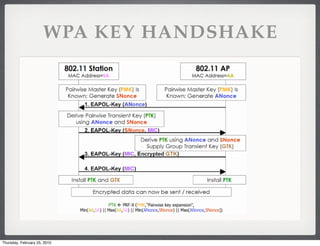
WPA KEY HANDSHAKE


Thursday, February 25, 2010
COW PATTY ATTACK

                    Where 802.1X not available, PSK may be sniffed from
                    other authenticating stations

                    KisMac and coWPAtty use dictionary and other
                    attacks to guess the PSK from captured packets

                    Packet injection can force re-connects to capture

                    coWPAtty with Rainbow Tables (pre-calculated
                    hashes) can test >18,000 pass-phrases per second


Thursday, February 25, 2010
WPA CRACKER

                    Regular WPA-PSK cracking on “business grade”
                    hardware can take up to two weeks

                    “WPA Cracker” is a commercial service using cloud-
                    based computing with 400 nodes, which can crack a
                    WPA key in 20 minutes for $34

                    This is based on 135 million word dictionary attack --
                    therefore a strong password can defeat this class

                    Businesses now know the price of security


Thursday, February 25, 2010
BOGUS HOTSPOTS

                    Any computer can also be a Wireless Access Point

                    Windows 7 has new feature “SoftAP” -- which can be
                    used for Internet Connection Sharing (use Connectify
                    for example -- http://connectify.me/)

                    However, the “bad guys” can capture all of the
                    packets which pass through their system, even if they
                    connect to you with WEP or WPA

                    Bad guys can use similar names, e.g., Webster-Wi-Fi


Thursday, February 25, 2010
MAC SPOOFING


                    Some Access Points allow restriction based on the
                    MAC (Media Access Control) address

                    This is good basic security, but not reliable -- because
                    attackers can simply sniff for “trusted” address and
                    use that in their own systems

                    802.1x makes this more difficult for attackers


Thursday, February 25, 2010
SUPPRESSING SSID


                    Most Wi-Fi networks broadcast
                    their network name -- called the SSID

                    Security may be improved by disabling this feature
                    for a home or business network

                    However, experienced hackers will simply monitor
                    authorized connections to learn the SSID


Thursday, February 25, 2010
MAN IN THE MIDDLE


                    A MITM attack means intruder pretends to be
                    authorized gateway, but intercepts and can change
                    packets (this was used by Japanese team with TKIP)

                    Example: Video of “Cain” tool, with packet capture
                    and WEP cracking
                    cracking-wep-with-airpcap-packet-injection-and-cain-and-abel.wmv


Thursday, February 25, 2010
BYPASSING AIRPORT WI-FI

                    Frequent airport travelers know about airport Wi-Fi

                    Such systems intercept HTTP, redirect to a login page
                    before allowing access (e.g., Boingo Hotspot)

                    Most airport Wi-Fi allows DNS lookups -- some direct,
                    and some via DNS relay

                    If port 53 is allowed, then you can run OpenVPN using
                    UDP port 53 to your home system

                    If DNS relayed, then use DNS tunnel (Linux mostly)


Thursday, February 25, 2010
AIRPORT RISKS

                    “Free” Wi-Fi hotspots in an airport or cafe might
                    belong to a hacker, who is capturing traffic --
                    including, potentially, user names & passwords

                    Hackers can also relay HTTPS -- so don’t assume
                    your password is safe at a public Hot Spot

                    Most hotspots don’t use WEP or WPA -- so most
                    traffic is not encrypted (unless SSH or SSL is used)


Thursday, February 25, 2010
WI-FI SECURITY ADVICE

                    Avoid WEP and WPA/TKIP, use WPA2 or WPA/AES

                    If using in a business, use 802.1X -- otherwise make
                    sure you have PSK length > 20 characters

                    Use MAC access control (restrict connecting devices
                    based on their internal address)

                    Use VPN for truly sensitive information


Thursday, February 25, 2010
COMMERCIAL RISKS

                    TJ Maxx is classic example of Wi-Fi vector: resulted in
                    loss of 45 million customer records (Credit Card details)

                    The weakness was the use of WEP to secure a LAN, which was
                    exploited by the hackers

                    This breach cost the company $12 million in direct costs, not
                    including the subsequent remedial work and loss of PCI
                    compliance

                    Average cost of a Data Breach rose to $200 per customer record in
                    2009, according to Ponemon Institute study -- average total cost
                    rose to $6.75m


Thursday, February 25, 2010
LEGAL ASPECTS

                    In many countries, hacking other’s Wi-Fi is illegal --
                    therefore, do any tests using your OWN gear

                    See NCSL web site for summary of States’ laws

                    “Unauthorized access” can attract serious
                    prosecutions, fines and criminal charges

                    Within Webster University, unauthorized Wi-Fi
                    access could be grounds for expulsion


Thursday, February 25, 2010
LATEST WI-FI TRENDS

                    Passive-Aggressive SSIDs now used by some... e.g.:

                          YOURDOGPOOPSINMYYARD

                          TURNTHEMUSICDOWN

                          CAITLINSTOPUSINGOURINTERNET

                          WECANHEARYOUHAVINGSEX

                          OBAMAISASOCIALIST


Thursday, February 25, 2010
THANK YOU!


                    Any questions?

                    Comments?

                    Discussion....


Thursday, February 25, 2010

Wi-fi Hacking

  • 1.
    WI-FI SECURITY A gentle introduction to Hacking Wi-Fi Thursday, February 25, 2010
  • 2.
    PRESENTED BY Paul Gillingwater, CISSP, CISM Adjunct Professor of Computer Science Webster University Vienna http://security-risk.blogspot.com Working in IT Security 20+ years Thursday, February 25, 2010
  • 3.
    A BRIEF OVERVIEW Wi-Fi has been around more than 12 years -- originally, it lacked any form of security Since 2001, Wireless Encryption Protocol (WEP) has been successfully attacked -- in 2007, it takes no more than 90,000 packets to break keys (due to weaknesses in RC4) -- time to crack less than 1 minute Since 2004, Wi-Fi Protected Access (WPA & WPA2) were introduced to address WEP’s failure -- but even this is not quite enough for full security Thursday, February 25, 2010
  • 4.
    WI-FI HISTORY Originally offered as IEEE 802.11 in 1997 -- security limited due to export restrictions of certain governments Implements Wireless LAN access over 2.4 and 5 GHz bands -- former with 3 channels (and shared with Amateur Radio and Cordless Phones), latter with 19 Initial systems 1-2 Mbps, later increased to 11 Mbps with 802.11b, then up to 802.11n with 54-600 Mbps possible (since 2009) Thursday, February 25, 2010
  • 5.
    WIRELESS SIGNALS Any wireless signal can be received by suitable equipment Key-sharing is fundamental issue -- and the more often a key is used, the easier it is to find it due to mathematics of encryption In addition to receiving packets, we can also inject packets -- e.g., ARP or de-auth to create traffic Thursday, February 25, 2010
  • 6.
    SECURING WI-FI In my view, only reliable method for securing Wi-Fi is to run a VPN on top (e.g., OpenVPN) WEP and WPA are easily broken (WPA TKIP cracked in less than 1 minute by Japanese researchers in 2009) WPA is TKIP -- WPA2 is CCMP, which is better (AES) WPA2 is probably secure enough for home usage -- but there is still risk of impersonation Thursday, February 25, 2010
  • 7.
    TRAFFIC MONITORING On OSX, from command line (with sudo): /System/Library/PrivateFrameworks/ Apple80211.framework/Versions/A/ Resources/airport Specify en1 sniff 1 as parameters to capture packets into /tmp/airportSniffxxxx.cap file WireShark is free utility for Windows, OSX or Linux that captures and displays packets Thursday, February 25, 2010
  • 8.
    HOW WPA WORKS WPA tried to fix WEP problems, while WPA2 was a new approach to solving security problem 802.1X port access control is key to successful use This “Enterprise” approach depends on separate RADIUS authentication server -- each new session gets a fresh key, good for a short time Home networks don’t use RADIUS, so a “Pre Shared Key” (PSK) is used Thursday, February 25, 2010
  • 9.
    WPA KEY HANDSHAKE Thursday,February 25, 2010
  • 10.
    COW PATTY ATTACK Where 802.1X not available, PSK may be sniffed from other authenticating stations KisMac and coWPAtty use dictionary and other attacks to guess the PSK from captured packets Packet injection can force re-connects to capture coWPAtty with Rainbow Tables (pre-calculated hashes) can test >18,000 pass-phrases per second Thursday, February 25, 2010
  • 11.
    WPA CRACKER Regular WPA-PSK cracking on “business grade” hardware can take up to two weeks “WPA Cracker” is a commercial service using cloud- based computing with 400 nodes, which can crack a WPA key in 20 minutes for $34 This is based on 135 million word dictionary attack -- therefore a strong password can defeat this class Businesses now know the price of security Thursday, February 25, 2010
  • 12.
    BOGUS HOTSPOTS Any computer can also be a Wireless Access Point Windows 7 has new feature “SoftAP” -- which can be used for Internet Connection Sharing (use Connectify for example -- http://connectify.me/) However, the “bad guys” can capture all of the packets which pass through their system, even if they connect to you with WEP or WPA Bad guys can use similar names, e.g., Webster-Wi-Fi Thursday, February 25, 2010
  • 13.
    MAC SPOOFING Some Access Points allow restriction based on the MAC (Media Access Control) address This is good basic security, but not reliable -- because attackers can simply sniff for “trusted” address and use that in their own systems 802.1x makes this more difficult for attackers Thursday, February 25, 2010
  • 14.
    SUPPRESSING SSID Most Wi-Fi networks broadcast their network name -- called the SSID Security may be improved by disabling this feature for a home or business network However, experienced hackers will simply monitor authorized connections to learn the SSID Thursday, February 25, 2010
  • 15.
    MAN IN THEMIDDLE A MITM attack means intruder pretends to be authorized gateway, but intercepts and can change packets (this was used by Japanese team with TKIP) Example: Video of “Cain” tool, with packet capture and WEP cracking cracking-wep-with-airpcap-packet-injection-and-cain-and-abel.wmv Thursday, February 25, 2010
  • 16.
    BYPASSING AIRPORT WI-FI Frequent airport travelers know about airport Wi-Fi Such systems intercept HTTP, redirect to a login page before allowing access (e.g., Boingo Hotspot) Most airport Wi-Fi allows DNS lookups -- some direct, and some via DNS relay If port 53 is allowed, then you can run OpenVPN using UDP port 53 to your home system If DNS relayed, then use DNS tunnel (Linux mostly) Thursday, February 25, 2010
  • 17.
    AIRPORT RISKS “Free” Wi-Fi hotspots in an airport or cafe might belong to a hacker, who is capturing traffic -- including, potentially, user names & passwords Hackers can also relay HTTPS -- so don’t assume your password is safe at a public Hot Spot Most hotspots don’t use WEP or WPA -- so most traffic is not encrypted (unless SSH or SSL is used) Thursday, February 25, 2010
  • 18.
    WI-FI SECURITY ADVICE Avoid WEP and WPA/TKIP, use WPA2 or WPA/AES If using in a business, use 802.1X -- otherwise make sure you have PSK length > 20 characters Use MAC access control (restrict connecting devices based on their internal address) Use VPN for truly sensitive information Thursday, February 25, 2010
  • 19.
    COMMERCIAL RISKS TJ Maxx is classic example of Wi-Fi vector: resulted in loss of 45 million customer records (Credit Card details) The weakness was the use of WEP to secure a LAN, which was exploited by the hackers This breach cost the company $12 million in direct costs, not including the subsequent remedial work and loss of PCI compliance Average cost of a Data Breach rose to $200 per customer record in 2009, according to Ponemon Institute study -- average total cost rose to $6.75m Thursday, February 25, 2010
  • 20.
    LEGAL ASPECTS In many countries, hacking other’s Wi-Fi is illegal -- therefore, do any tests using your OWN gear See NCSL web site for summary of States’ laws “Unauthorized access” can attract serious prosecutions, fines and criminal charges Within Webster University, unauthorized Wi-Fi access could be grounds for expulsion Thursday, February 25, 2010
  • 21.
    LATEST WI-FI TRENDS Passive-Aggressive SSIDs now used by some... e.g.: YOURDOGPOOPSINMYYARD TURNTHEMUSICDOWN CAITLINSTOPUSINGOURINTERNET WECANHEARYOUHAVINGSEX OBAMAISASOCIALIST Thursday, February 25, 2010
  • 22.
    THANK YOU! Any questions? Comments? Discussion.... Thursday, February 25, 2010