Connection technology options

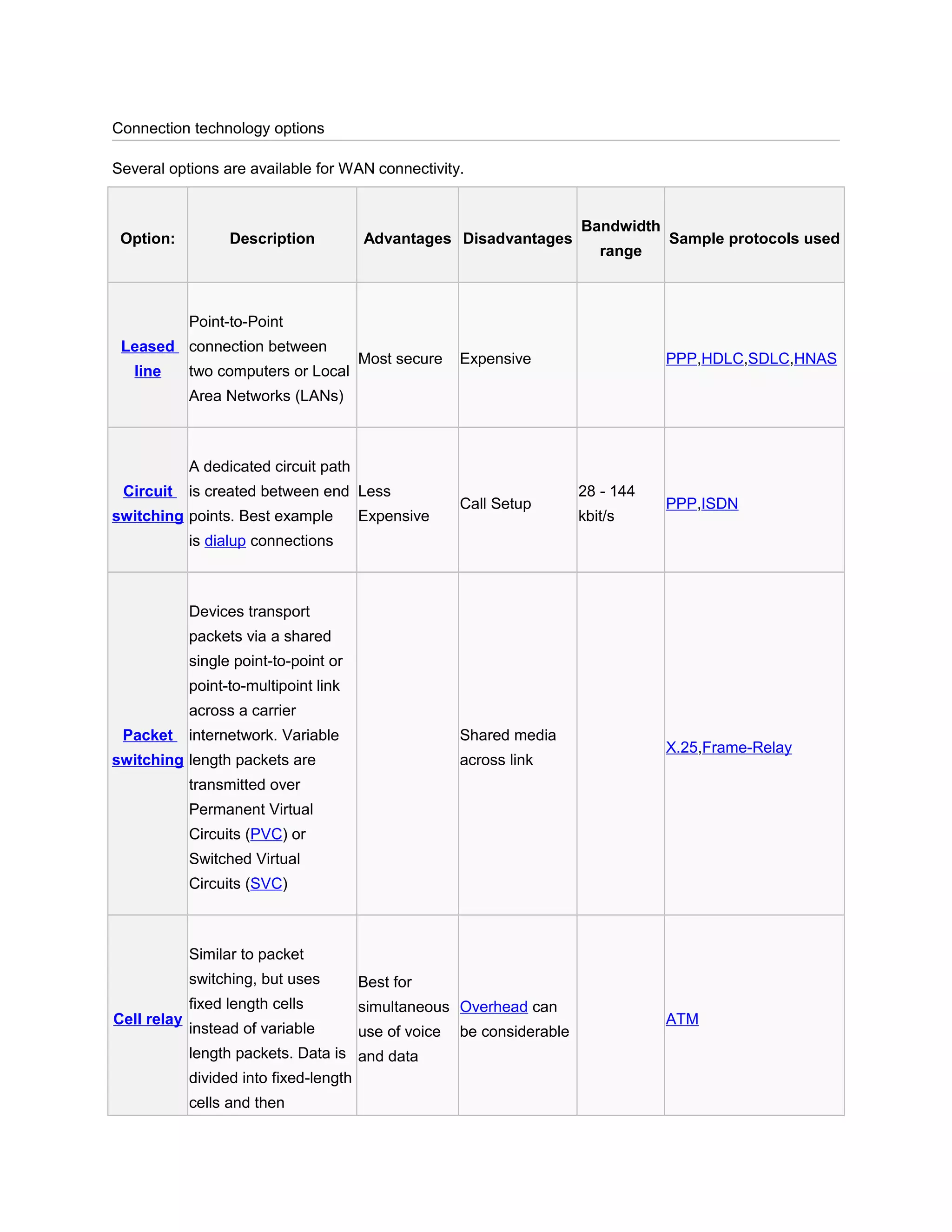
Several options are available for WAN connectivity.


                                                                         Bandwidth
 Option:           Description          Advantages Disadvantages                     Sample protocols used
                                                                            range


             Point-to-Point
 Leased connection between
                                        Most secure    Expensive                     PPP,HDLC,SDLC,HNAS
   line      two computers or Local
             Area Networks (LANs)


             A dedicated circuit path
 Circuit     is created between end Less                                 28 - 144
                                                       Call Setup                    PPP,ISDN
switching points. Best example          Expensive                        kbit/s
             is dialup connections


             Devices transport
             packets via a shared
             single point-to-point or
             point-to-multipoint link
             across a carrier
 Packet      internetwork. Variable                    Shared media
                                                                                     X.25,Frame-Relay
switching length packets are                           across link
             transmitted over
             Permanent Virtual
             Circuits (PVC) or
             Switched Virtual
             Circuits (SVC)


             Similar to packet
             switching, but uses        Best for
             fixed length cells         simultaneous Overhead can
Cell relay                                                                           ATM
             instead of variable        use of voice   be considerable
             length packets. Data is and data
             divided into fixed-length
             cells and then
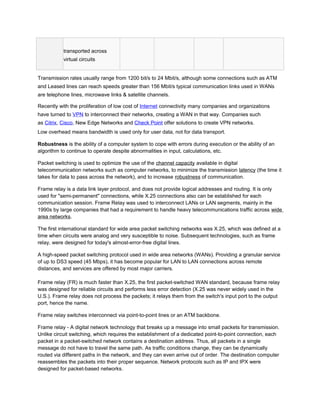
transported across
           virtual circuits


Transmission rates usually range from 1200 bit/s to 24 Mbit/s, although some connections such as ATM
and Leased lines can reach speeds greater than 156 Mbit/s typical communication links used in WANs
are telephone lines, microwave links & satellite channels.

Recently with the proliferation of low cost of Internet connectivity many companies and organizations
have turned to VPN to interconnect their networks, creating a WAN in that way. Companies such
as Citrix, Cisco, New Edge Networks and Check Point offer solutions to create VPN networks.
Low overhead means bandwidth is used only for user data, not for data transport.

Robustness is the ability of a computer system to cope with errors during execution or the ability of an
algorithm to continue to operate despite abnormalities in input, calculations, etc.

Packet switching is used to optimize the use of the channel capacity available in digital
telecommunication networks such as computer networks, to minimize the transmission latency (the time it
takes for data to pass across the network), and to increase robustness of communication.

Frame relay is a data link layer protocol, and does not provide logical addresses and routing. It is only
used for "semi-permanent" connections, while X.25 connections also can be established for each
communication session. Frame Relay was used to interconnect LANs or LAN segments, mainly in the
1990s by large companies that had a requirement to handle heavy telecommunications traffic across wide
area networks.

The first international standard for wide area packet switching networks was X.25, which was defined at a
time when circuits were analog and very susceptible to noise. Subsequent technologies, such as frame
relay, were designed for today's almost-error-free digital lines.

A high-speed packet switching protocol used in wide area networks (WANs). Providing a granular service
of up to DS3 speed (45 Mbps), it has become popular for LAN to LAN connections across remote
distances, and services are offered by most major carriers.

Frame relay (FR) is much faster than X.25, the first packet-switched WAN standard, because frame relay
was designed for reliable circuits and performs less error detection (X.25 was never widely used in the
U.S.). Frame relay does not process the packets; it relays them from the switch's input port to the output
port, hence the name.

Frame relay switches interconnect via point-to-point lines or an ATM backbone.

Frame relay - A digital network technology that breaks up a message into small packets for transmission.
Unlike circuit switching, which requires the establishment of a dedicated point-to-point connection, each
packet in a packet-switched network contains a destination address. Thus, all packets in a single
message do not have to travel the same path. As traffic conditions change, they can be dynamically
routed via different paths in the network, and they can even arrive out of order. The destination computer
reassembles the packets into their proper sequence. Network protocols such as IP and IPX were
designed for packet-based networks.
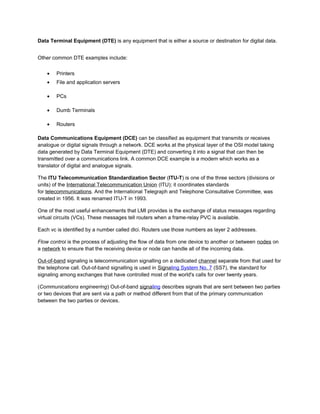
Data Terminal Equipment (DTE) is any equipment that is either a source or destination for digital data.


Other common DTE examples include:


    •   Printers
    •   File and application servers

    •   PCs

    •   Dumb Terminals

    •   Routers

Data Communications Equipment (DCE) can be classified as equipment that transmits or receives
analogue or digital signals through a network. DCE works at the physical layer of the OSI model taking
data generated by Data Terminal Equipment (DTE) and converting it into a signal that can then be
transmitted over a communications link. A common DCE example is a modem which works as a
translator of digital and analogue signals.

The ITU Telecommunication Standardization Sector (ITU-T) is one of the three sectors (divisions or
units) of the International Telecommunication Union (ITU); it coordinates standards
for telecommunications. And the International Telegraph and Telephone Consultative Committee, was
created in 1956. It was renamed ITU-T in 1993.

One of the most useful enhancements that LMI provides is the exchange of status messages regarding
virtual circuits (VCs). These messages tell routers when a frame-relay PVC is available.

Each vc is identified by a number called dlci. Routers use those numbers as layer 2 addresses.

Flow control is the process of adjusting the flow of data from one device to another or between nodes on
a network to ensure that the receiving device or node can handle all of the incoming data.

Out-of-band signaling is telecommunication signalling on a dedicated channel separate from that used for
the telephone call. Out-of-band signalling is used in Signaling System No. 7 (SS7), the standard for
signaling among exchanges that have controlled most of the world's calls for over twenty years.

(Communications engineering) Out-of-band signaling describes signals that are sent between two parties
or two devices that are sent via a path or method different from that of the primary communication
between the two parties or devices.

Connection technology options

  • 1.
    Connection technology options Severaloptions are available for WAN connectivity. Bandwidth Option: Description Advantages Disadvantages Sample protocols used range Point-to-Point Leased connection between Most secure Expensive PPP,HDLC,SDLC,HNAS line two computers or Local Area Networks (LANs) A dedicated circuit path Circuit is created between end Less 28 - 144 Call Setup PPP,ISDN switching points. Best example Expensive kbit/s is dialup connections Devices transport packets via a shared single point-to-point or point-to-multipoint link across a carrier Packet internetwork. Variable Shared media X.25,Frame-Relay switching length packets are across link transmitted over Permanent Virtual Circuits (PVC) or Switched Virtual Circuits (SVC) Similar to packet switching, but uses Best for fixed length cells simultaneous Overhead can Cell relay ATM instead of variable use of voice be considerable length packets. Data is and data divided into fixed-length cells and then
  • 2.
    transported across virtual circuits Transmission rates usually range from 1200 bit/s to 24 Mbit/s, although some connections such as ATM and Leased lines can reach speeds greater than 156 Mbit/s typical communication links used in WANs are telephone lines, microwave links & satellite channels. Recently with the proliferation of low cost of Internet connectivity many companies and organizations have turned to VPN to interconnect their networks, creating a WAN in that way. Companies such as Citrix, Cisco, New Edge Networks and Check Point offer solutions to create VPN networks. Low overhead means bandwidth is used only for user data, not for data transport. Robustness is the ability of a computer system to cope with errors during execution or the ability of an algorithm to continue to operate despite abnormalities in input, calculations, etc. Packet switching is used to optimize the use of the channel capacity available in digital telecommunication networks such as computer networks, to minimize the transmission latency (the time it takes for data to pass across the network), and to increase robustness of communication. Frame relay is a data link layer protocol, and does not provide logical addresses and routing. It is only used for "semi-permanent" connections, while X.25 connections also can be established for each communication session. Frame Relay was used to interconnect LANs or LAN segments, mainly in the 1990s by large companies that had a requirement to handle heavy telecommunications traffic across wide area networks. The first international standard for wide area packet switching networks was X.25, which was defined at a time when circuits were analog and very susceptible to noise. Subsequent technologies, such as frame relay, were designed for today's almost-error-free digital lines. A high-speed packet switching protocol used in wide area networks (WANs). Providing a granular service of up to DS3 speed (45 Mbps), it has become popular for LAN to LAN connections across remote distances, and services are offered by most major carriers. Frame relay (FR) is much faster than X.25, the first packet-switched WAN standard, because frame relay was designed for reliable circuits and performs less error detection (X.25 was never widely used in the U.S.). Frame relay does not process the packets; it relays them from the switch's input port to the output port, hence the name. Frame relay switches interconnect via point-to-point lines or an ATM backbone. Frame relay - A digital network technology that breaks up a message into small packets for transmission. Unlike circuit switching, which requires the establishment of a dedicated point-to-point connection, each packet in a packet-switched network contains a destination address. Thus, all packets in a single message do not have to travel the same path. As traffic conditions change, they can be dynamically routed via different paths in the network, and they can even arrive out of order. The destination computer reassembles the packets into their proper sequence. Network protocols such as IP and IPX were designed for packet-based networks.
  • 3.
    Data Terminal Equipment(DTE) is any equipment that is either a source or destination for digital data. Other common DTE examples include: • Printers • File and application servers • PCs • Dumb Terminals • Routers Data Communications Equipment (DCE) can be classified as equipment that transmits or receives analogue or digital signals through a network. DCE works at the physical layer of the OSI model taking data generated by Data Terminal Equipment (DTE) and converting it into a signal that can then be transmitted over a communications link. A common DCE example is a modem which works as a translator of digital and analogue signals. The ITU Telecommunication Standardization Sector (ITU-T) is one of the three sectors (divisions or units) of the International Telecommunication Union (ITU); it coordinates standards for telecommunications. And the International Telegraph and Telephone Consultative Committee, was created in 1956. It was renamed ITU-T in 1993. One of the most useful enhancements that LMI provides is the exchange of status messages regarding virtual circuits (VCs). These messages tell routers when a frame-relay PVC is available. Each vc is identified by a number called dlci. Routers use those numbers as layer 2 addresses. Flow control is the process of adjusting the flow of data from one device to another or between nodes on a network to ensure that the receiving device or node can handle all of the incoming data. Out-of-band signaling is telecommunication signalling on a dedicated channel separate from that used for the telephone call. Out-of-band signalling is used in Signaling System No. 7 (SS7), the standard for signaling among exchanges that have controlled most of the world's calls for over twenty years. (Communications engineering) Out-of-band signaling describes signals that are sent between two parties or two devices that are sent via a path or method different from that of the primary communication between the two parties or devices.