Er. Jay Nagar
call:+91-96019576520
Communication Networks
www.jaynagarblog.wordpress.com
Outline
 LANs, MANs, and WANs.
 Switching Techniques
 Circuit Switching.
 Packet Switching.
LANs, MANs, and WANs.
 Local area networks (LANs)
 Metropolitan area networks (MANs)
 Wide area networks (WANs) are all examples of
communications networks.
Wide Area Networks
 WANs cover a large geographical area.
 WAN consists of a number of interconnected switching
nodes. A transmission from anyone device is routed
through these internal nodes to the specified destination
device.
 Data rates of 64,000 bps or less have been common.
 Optical fiber facilities has led to the standardization of
much higher data rates for WANs.
 These high-speed WANs provide user connections in the
10s and 100s of Mbps, using a transmission technique
known asynchronous transfer mode (ATM).
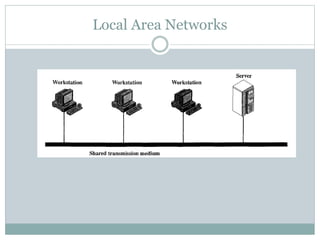
Local Area Networks
Metropolitan area networks
 As the name suggests, a MAN occupies a middle ground
between LANs and WANs.
 The primary market for MANs is the customer that has
high-capacity needs in a metropolitan area.
 A MAN is intended to provide the required capacity at
lower cost and greater efficiency than obtaining an
equivalent service from the local telephone company.
Switching Techniques
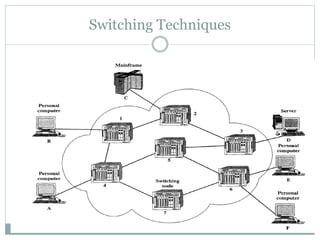
 For transmission of data beyond a local area,
communication is typically achieved by transmitting data
from source to destination through a network of
intermediate switching nodes.
 We will refer to the switching devices whose purpose is to
provide communication as nodes.
 The nodes are connected to each other in some topology by
transmission links.
 Each station attaches to a node, and the collection of nodes
is referred to as a communication network.
Switching Techniques
 Two quite different technologies are used in wide
area switched networks: circuit switching and
packet switching.
 These two technologies differ in the way the nodes
switch information from one link to another on the
way from source to destination.
Circuit switching
 Circuit switching has been the dominant technology for
both voice and data communications.
 Communication via circuit switching implies that there is a
dedicated communication path between two
stations.
 The most common example of circuit switching is the
telephone network.
 Circuit switching involves three phases.
1. Circuit establishment.
2. Information transfer.
3. Circuit disconnect.
Circuit switching - Circuit
establishment.
 Circuit switching was developed to handle voice traffic but is now
also used for data traffic. The best-known example of a circuit-
switching network is the public telephone network.
 A public telecommunications network can be described using
four generic architectural components:
1. Subscribers: The devices that attach to the network.
2. Subscriber line: The link between the subscriber and the
network, also referred to as the local loop.
3. Exchanges: The switching centers in the network. A switching
center that directly supports subscribers is known as an end
office.
4. Thunks: The branches between exchanges. Trunks carry
multiple voice-frequency circuits using either FDM or
synchronous TDM
Packet Switching
 A key characteristic of circuit-switching networks is that
resources within the network are dedicated to a particular
call. For voice connections, the resulting circuit will enjoy a
high percentage of utilization since, most of the time, one
party or the other is talking. two shortcomings became
apparent:
1. In a typical terminal-to-host data connection, much of the
time the line is idle.
2. In a circuit-switching network, the connection provides
for transmission at a constant data rate. Thus each of the
two devices that are connected must transmit and receive
at the same data rate as the other,
Packet Switching
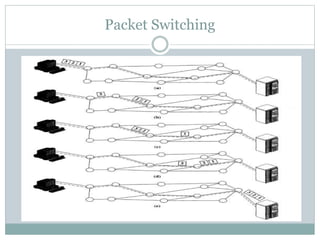
 Summarize packet-switching operation.
 The control information, at a minimum, includes the
information that the network requires in order to be able to
route the packet through the network and deliver it to the
intended destination.
 At each node en route, the packet is received, stored briefly,
and passed on to the next node.
Packet Switching
Packet-switching advantages
 Line efficiency is greater, since a single node-to-node link
can be dynamically shared by many packets over time.
 A packet-switching network can carry out data-rate
conversion. Two stations of different data rates can
exchange packets, since each connects to its node at its
proper data rate.
 When traffic becomes heavy on a circuit-switching network,
some calls are blocked; On a packet-switching network,
packets are still accepted, but delivery delay increases.
 Priorities can be used. Thus, if a node has a number of
packets queued for transmission, it can transmit the
higher-priority packets first.

Communication and Networking

  • 1.
    Er. Jay Nagar call:+91-96019576520 CommunicationNetworks www.jaynagarblog.wordpress.com
  • 2.
    Outline  LANs, MANs,and WANs.  Switching Techniques  Circuit Switching.  Packet Switching.
  • 3.
    LANs, MANs, andWANs.  Local area networks (LANs)  Metropolitan area networks (MANs)  Wide area networks (WANs) are all examples of communications networks.
  • 4.
    Wide Area Networks WANs cover a large geographical area.  WAN consists of a number of interconnected switching nodes. A transmission from anyone device is routed through these internal nodes to the specified destination device.  Data rates of 64,000 bps or less have been common.  Optical fiber facilities has led to the standardization of much higher data rates for WANs.  These high-speed WANs provide user connections in the 10s and 100s of Mbps, using a transmission technique known asynchronous transfer mode (ATM).
  • 5.
  • 6.
    Metropolitan area networks As the name suggests, a MAN occupies a middle ground between LANs and WANs.  The primary market for MANs is the customer that has high-capacity needs in a metropolitan area.  A MAN is intended to provide the required capacity at lower cost and greater efficiency than obtaining an equivalent service from the local telephone company.
  • 7.
    Switching Techniques  Fortransmission of data beyond a local area, communication is typically achieved by transmitting data from source to destination through a network of intermediate switching nodes.  We will refer to the switching devices whose purpose is to provide communication as nodes.  The nodes are connected to each other in some topology by transmission links.  Each station attaches to a node, and the collection of nodes is referred to as a communication network.
  • 8.
  • 9.
    Switching Techniques  Twoquite different technologies are used in wide area switched networks: circuit switching and packet switching.  These two technologies differ in the way the nodes switch information from one link to another on the way from source to destination.
  • 10.
    Circuit switching  Circuitswitching has been the dominant technology for both voice and data communications.  Communication via circuit switching implies that there is a dedicated communication path between two stations.  The most common example of circuit switching is the telephone network.  Circuit switching involves three phases. 1. Circuit establishment. 2. Information transfer. 3. Circuit disconnect.
  • 11.
    Circuit switching -Circuit establishment.  Circuit switching was developed to handle voice traffic but is now also used for data traffic. The best-known example of a circuit- switching network is the public telephone network.  A public telecommunications network can be described using four generic architectural components: 1. Subscribers: The devices that attach to the network. 2. Subscriber line: The link between the subscriber and the network, also referred to as the local loop. 3. Exchanges: The switching centers in the network. A switching center that directly supports subscribers is known as an end office. 4. Thunks: The branches between exchanges. Trunks carry multiple voice-frequency circuits using either FDM or synchronous TDM
  • 12.
    Packet Switching  Akey characteristic of circuit-switching networks is that resources within the network are dedicated to a particular call. For voice connections, the resulting circuit will enjoy a high percentage of utilization since, most of the time, one party or the other is talking. two shortcomings became apparent: 1. In a typical terminal-to-host data connection, much of the time the line is idle. 2. In a circuit-switching network, the connection provides for transmission at a constant data rate. Thus each of the two devices that are connected must transmit and receive at the same data rate as the other,
  • 13.
    Packet Switching  Summarizepacket-switching operation.  The control information, at a minimum, includes the information that the network requires in order to be able to route the packet through the network and deliver it to the intended destination.  At each node en route, the packet is received, stored briefly, and passed on to the next node.
  • 14.
  • 15.
    Packet-switching advantages  Lineefficiency is greater, since a single node-to-node link can be dynamically shared by many packets over time.  A packet-switching network can carry out data-rate conversion. Two stations of different data rates can exchange packets, since each connects to its node at its proper data rate.  When traffic becomes heavy on a circuit-switching network, some calls are blocked; On a packet-switching network, packets are still accepted, but delivery delay increases.  Priorities can be used. Thus, if a node has a number of packets queued for transmission, it can transmit the higher-priority packets first.