Why you think you’re
right– even you’re
wrong ?
By: Julia Galef
MAKING A SOUND JUDGEMENT-
WYN-LOVE N. CAAMPUED
Presented by:
What is Judgement?
 the ability to judge, make a decision,
or form an opinion objectively,
authoritatively, and wisely, especially
in matters affecting action; good
sense; discretion.
 the forming of an opinion, estimate,
notion, or conclusion, as from
circumstances presented to the mind.
Good Judgement
 The ability to use good judgment in
making decisions is one of the most
important skills you can possess. On a
daily basis, you may be barraged by
mundane and potentially life-changing
decisions. Making good decisions applies
to multiple aspects of your life,
including work, health, education,
family and personal relationships. Using
good judgment requires a healthy
mental state, a willingness to think
through issues and confidence in
yourself.
 Good judgement includes
considering the consequences of
one’s decisions, thinking before
acting and speaking and having
the tools to make good decisions
in a variety of situations.
 Good judgement includes
prioritising, meeting deadlines
and carefully planning, which
are tools that enable us to
effectively cope in difficult and
stressful situations. Making
decisions which fail to consider
the future can lead to high
levels of stress when we have to
rush deadlines and deal with
pressing problems.
 So many things in life rely on good
judgment. We often find ourselves
in situations where there are no
right or wrong answers. Our final
decision comes down to a matter
of judgment. There are lots of
examples of good judgement and
bad judgement in current affairs
right now.
 With the benefit of hindsight, it’s
easy to say that a leader did or
didn’t exercise good judgment.
However, in the case of political
leaders, we as voters need to be
able to predict in advance which
candidate has the greatest
potential to exercise good
judgment when leadership
decisions need to be made under
pressure.
 To be able to predict, we first need
to understand what influences our
leaders’ decisions. One of the key
drivers in making decisions and
exercising good judgment is an
individual’s own set of values, that
being a set of deeply held beliefs
about what is good, right and
appropriate. These values are deep-
seated and remain constant over
time, guiding us in our daily actions.
 Our values develop based on many
influences such as culture, parental
guidance, societal expectations
and individual differences. One of
the individual differences that
seem to impact what values we
adhere to is our personality
preference.
 Due to the vast amount of stimuli in
the environment, we cannot take in
and process all information equally.
Therefore our type preference can
influence the values we
develop. This happens when we
consciously or unconsciously pay
attention to judge or hold in higher
regard certain behaviors, attitudes
or characteristics exhibited by
others.
A WORD TO PONDER
 “Never judge others. You both
know good and well how
unexpected events can change
who a person is. Always keep that
in mind. You never know what
someone else is experiencing
within their own life.”
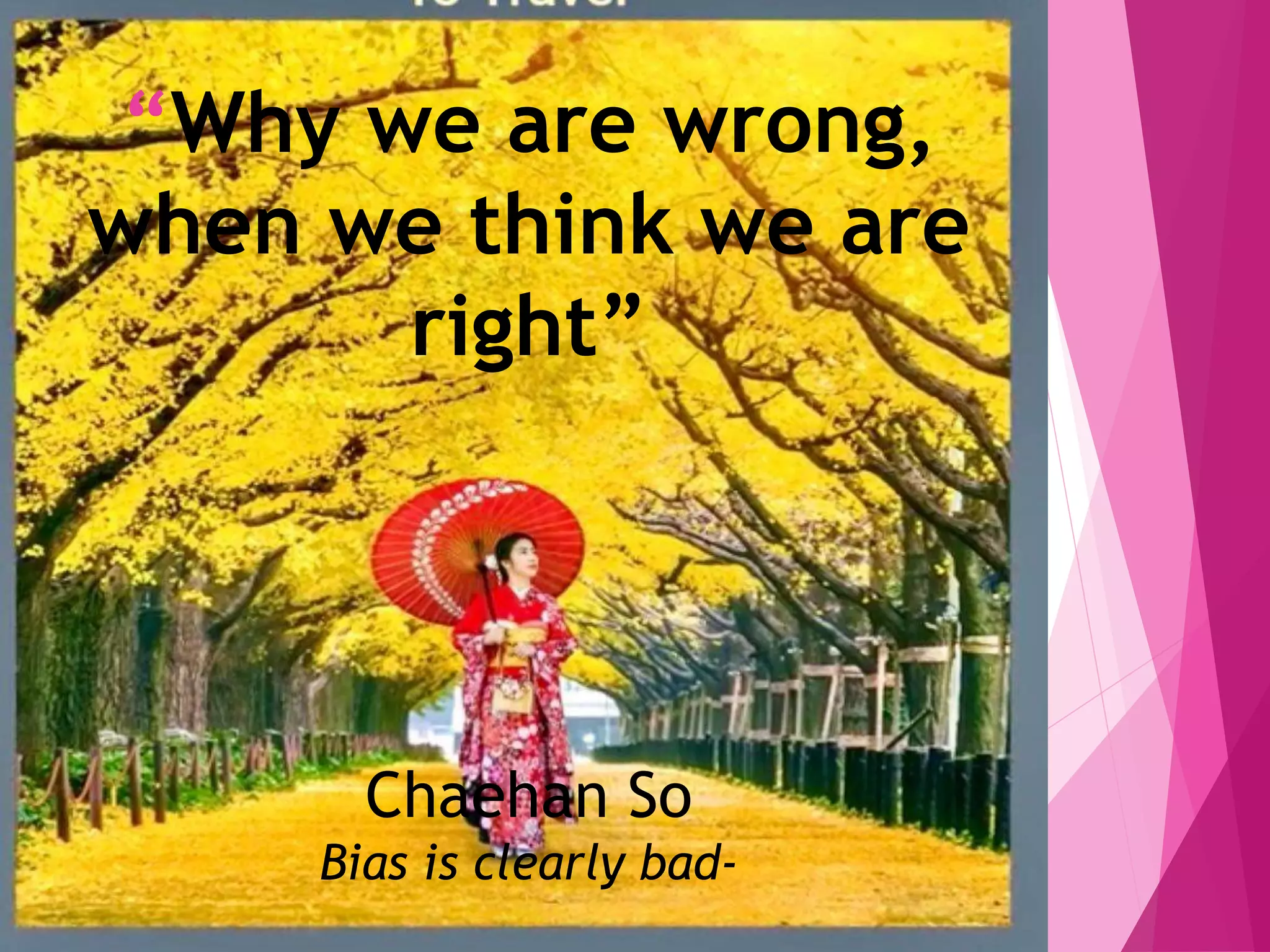
“Why we are wrong,
when we think we are
right”
Chaehan So
Bias is clearly bad-
What is Bias?
 Bias is a disproportionate weight in
favor of or against an idea or thing,
usually in a way that is closed-
minded, prejudicial, or unfair. Biases
can be innate or learned. People may
develop biases for or against an
individual, a group, or a belief.
References: Steinbock, Bonnie (1978). "Speciesism and the Idea of
Equality". Philosophy. 53 (204): 247–256.
What causes people to be biased?
 Starting at a young age, people will
discriminate between those who are
like them, their “ingroup,” and those
who are not like them, “their
outgroup.” On the plus side, they can
gain a sense of identity and safety.
However, taken to the extreme, this
categorization can foster an “us-
versus-them” mentality and lead to
harmful prejudice.
 We always hear that life can
be unfair but mapping
numbers to the unfairness
and bias of life is another
story.
 The first step is acknowledging our
imperfections and being aware of our
own biases, because, yes, each one of
us has their fair share of these. Biases
may have got to us through the
cultural environment where we grew
up, opinions and stereotypes we hear
around us, but also because of our
tendency to generalize our
experiences and jump to
conclusions. As human beings, we
hate gray areas and, for the sake of
simplifying our already-complicated
lives, end up adopting a cause-to-
effect kind of reasoning.
 As we go through our daily busy
lives, we are invited to stop and
catch ourselves in situations
where we are being biased
 Catching bias happening around
us and intervening in the right
time and manner is also key.
 For those who have been subject to
biases, and I’ve been one of you, do
not take it personally and do not
victimize yourself. Do not beat
yourself up and accuse yourself of
not being/doing enough when
actually you are doing everything in
your capacity to integrate.
 Integration does not imply burying your
old self and switching overnight into a
complete conformism mode. Despite
your best efforts, bias can still happen
to you and you will still experience
situations where you are not cool
enough to be around, your name will not
be put forward in many occasions
despite all your credentials, you will
receive over-criticism for minor things.
 Do not hate the person or label
him/her as bad because this is simply
untrue. Instead, let your life journey
and actions shatter all the stereotypes
that contributed to this person’s
biases. And, of course, don’t do it with
a revenge mentality (revenge is a
stupid self-harming idea).
 Do it, as Gandhi said, for the sake of being
the change you want to see in the world.
 From experience, I can tell you: nothing
beats the happiness of hearing someone who
has been biased against you acknowledging
that they misunderstood you, quickly judged
you or underestimated you at some point in
time.
 I learned that good judgment comes
from experience and that experience
grows out of mistakes.
 Pray with your intelligence. Bring
things to GOD that you have thought
out and think them out again with
HIM. For me that is the secret of good
judgment.
 We should learn to be patient with
ourselves. Recognizing our
strengths and our weaknesses, we
should strive to use good judgment
in all of our choices and decisions,
make good use of every
opportunity, and do our best in
every task we undertake.
 We should not be unduly
discouraged nor in despair at
any time when we are doing
the best we can. Rather, we
should be satisfied with our
progress even though it may
comes slowly at times.
Words to ponder…
 No matter what the world throws
at you, its important to strive to
be a better person and inspire
people to do the same along the
way.
Thank you and Keep safe
everyone…

Why you think you're right even when you're wrong

  • 1.
    Why you thinkyou’re right– even you’re wrong ? By: Julia Galef MAKING A SOUND JUDGEMENT- WYN-LOVE N. CAAMPUED Presented by:
  • 2.
    What is Judgement? the ability to judge, make a decision, or form an opinion objectively, authoritatively, and wisely, especially in matters affecting action; good sense; discretion.  the forming of an opinion, estimate, notion, or conclusion, as from circumstances presented to the mind.
  • 3.
    Good Judgement  Theability to use good judgment in making decisions is one of the most important skills you can possess. On a daily basis, you may be barraged by mundane and potentially life-changing decisions. Making good decisions applies to multiple aspects of your life, including work, health, education, family and personal relationships. Using good judgment requires a healthy mental state, a willingness to think through issues and confidence in yourself.
  • 4.
     Good judgementincludes considering the consequences of one’s decisions, thinking before acting and speaking and having the tools to make good decisions in a variety of situations.
  • 5.
     Good judgementincludes prioritising, meeting deadlines and carefully planning, which are tools that enable us to effectively cope in difficult and stressful situations. Making decisions which fail to consider the future can lead to high levels of stress when we have to rush deadlines and deal with pressing problems.
  • 6.
     So manythings in life rely on good judgment. We often find ourselves in situations where there are no right or wrong answers. Our final decision comes down to a matter of judgment. There are lots of examples of good judgement and bad judgement in current affairs right now.
  • 7.
     With thebenefit of hindsight, it’s easy to say that a leader did or didn’t exercise good judgment. However, in the case of political leaders, we as voters need to be able to predict in advance which candidate has the greatest potential to exercise good judgment when leadership decisions need to be made under pressure.
  • 8.
     To beable to predict, we first need to understand what influences our leaders’ decisions. One of the key drivers in making decisions and exercising good judgment is an individual’s own set of values, that being a set of deeply held beliefs about what is good, right and appropriate. These values are deep- seated and remain constant over time, guiding us in our daily actions.
  • 9.
     Our valuesdevelop based on many influences such as culture, parental guidance, societal expectations and individual differences. One of the individual differences that seem to impact what values we adhere to is our personality preference.
  • 10.
     Due tothe vast amount of stimuli in the environment, we cannot take in and process all information equally. Therefore our type preference can influence the values we develop. This happens when we consciously or unconsciously pay attention to judge or hold in higher regard certain behaviors, attitudes or characteristics exhibited by others.
  • 11.
    A WORD TOPONDER  “Never judge others. You both know good and well how unexpected events can change who a person is. Always keep that in mind. You never know what someone else is experiencing within their own life.”
  • 12.
    “Why we arewrong, when we think we are right” Chaehan So Bias is clearly bad-
  • 13.
    What is Bias? Bias is a disproportionate weight in favor of or against an idea or thing, usually in a way that is closed- minded, prejudicial, or unfair. Biases can be innate or learned. People may develop biases for or against an individual, a group, or a belief. References: Steinbock, Bonnie (1978). "Speciesism and the Idea of Equality". Philosophy. 53 (204): 247–256.
  • 14.
    What causes peopleto be biased?  Starting at a young age, people will discriminate between those who are like them, their “ingroup,” and those who are not like them, “their outgroup.” On the plus side, they can gain a sense of identity and safety. However, taken to the extreme, this categorization can foster an “us- versus-them” mentality and lead to harmful prejudice.
  • 15.
     We alwayshear that life can be unfair but mapping numbers to the unfairness and bias of life is another story.
  • 16.
     The firststep is acknowledging our imperfections and being aware of our own biases, because, yes, each one of us has their fair share of these. Biases may have got to us through the cultural environment where we grew up, opinions and stereotypes we hear around us, but also because of our tendency to generalize our experiences and jump to conclusions. As human beings, we hate gray areas and, for the sake of simplifying our already-complicated lives, end up adopting a cause-to- effect kind of reasoning.
  • 17.
     As wego through our daily busy lives, we are invited to stop and catch ourselves in situations where we are being biased  Catching bias happening around us and intervening in the right time and manner is also key.
  • 18.
     For thosewho have been subject to biases, and I’ve been one of you, do not take it personally and do not victimize yourself. Do not beat yourself up and accuse yourself of not being/doing enough when actually you are doing everything in your capacity to integrate.
  • 19.
     Integration doesnot imply burying your old self and switching overnight into a complete conformism mode. Despite your best efforts, bias can still happen to you and you will still experience situations where you are not cool enough to be around, your name will not be put forward in many occasions despite all your credentials, you will receive over-criticism for minor things.
  • 20.
     Do nothate the person or label him/her as bad because this is simply untrue. Instead, let your life journey and actions shatter all the stereotypes that contributed to this person’s biases. And, of course, don’t do it with a revenge mentality (revenge is a stupid self-harming idea).
  • 21.
     Do it,as Gandhi said, for the sake of being the change you want to see in the world.  From experience, I can tell you: nothing beats the happiness of hearing someone who has been biased against you acknowledging that they misunderstood you, quickly judged you or underestimated you at some point in time.
  • 22.
     I learnedthat good judgment comes from experience and that experience grows out of mistakes.  Pray with your intelligence. Bring things to GOD that you have thought out and think them out again with HIM. For me that is the secret of good judgment.
  • 23.
     We shouldlearn to be patient with ourselves. Recognizing our strengths and our weaknesses, we should strive to use good judgment in all of our choices and decisions, make good use of every opportunity, and do our best in every task we undertake.
  • 24.
     We shouldnot be unduly discouraged nor in despair at any time when we are doing the best we can. Rather, we should be satisfied with our progress even though it may comes slowly at times.
  • 25.
    Words to ponder… No matter what the world throws at you, its important to strive to be a better person and inspire people to do the same along the way.
  • 26.
    Thank you andKeep safe everyone…