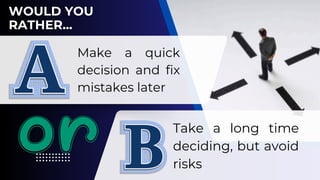
GAME MECHANICS
There willbe options to be flashed on the screen.
All you have to do is choose between the choices,
and explain why you made that decision.
7.
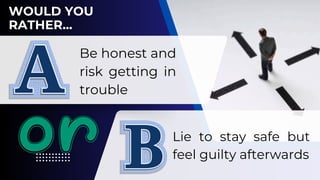
Be honest and
riskgetting in
trouble
Lie to stay safe but
feel guilty afterwards
8.
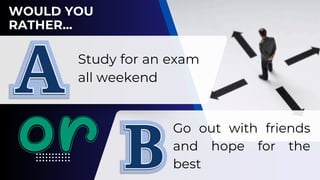
Study for anexam
all weekend
Go out with friends
and hope for the
best
9.
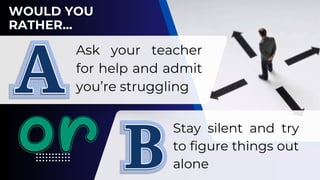
Ask your teacher
forhelp and admit
you’re struggling
Stay silent and try
to figure things out
alone
As human beings,we are gifted with free will—the
ability to think, choose, and act on our own. This gives
us the power to make our own decisions, instead of
being controlled by others or emotions. But with that
power comes responsibility. Every choice has
consequences, not just for ourselves, but for others
too. That’s why we must use our free will wisely—by
thinking carefully and considering how our actions
will affect those around us.
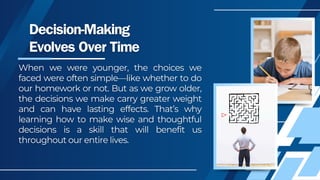
Whether we're awareof it or not, the
decisions we make influence the direction
of our lives. This is why developing strong
decision-making skills is seen as one of the
most important life skills we can have.
19.
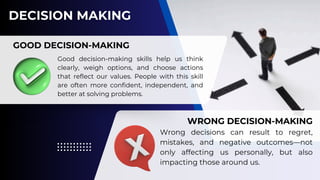
WRONG DECISION-MAKING
GOOD DECISION-MAKING
Gooddecision-making skills help us think
clearly, weigh options, and choose actions
that reflect our values. People with this skill
are often more confident, independent, and
better at solving problems.
Wrong decisions can result to regret,
mistakes, and negative outcomes—not
only affecting us personally, but also
impacting those around us.
Developing decision-making skillsis
essential because our choices affect
nearly every part of life. From simple
decisions like what to eat to major ones
like choosing a career, our ability to
decide wisely shapes our success,
happiness, and personal growth.
REMEMBER
25.
Start by beingmore mindful of the decisions
you make each day. For example, instead of
instantly choosing to watch TV after school,
pause and consider whether finishing your
homework first might lead to a better
outcome. By taking time to think before
acting, you start training your brain to make
more thoughtful decisions.
BEING MINDFUL
26.
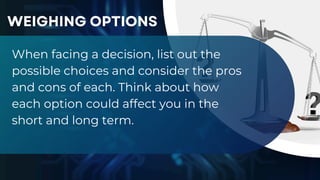
When facing adecision, list out the
possible choices and consider the pros
and cons of each. Think about how
each option could affect you in the
short and long term.
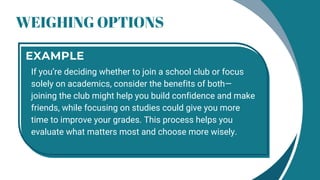
WEIGHING OPTIONS
27.
WEIGHING OPTIONS
If you’redeciding whether to join a school club or focus
solely on academics, consider the benefits of both—
joining the club might help you build confidence and make
friends, while focusing on studies could give you more
time to improve your grades. This process helps you
evaluate what matters most and choose more wisely.
EXAMPLE
28.
Good decision-making becomeseasier
when you have a clear sense of what’s
important to you. If honesty, learning,
or health are among your top values,
you’ll be more likely to make choices
that reflect those.
SET GOALS AND KNOW
YOUR VALUES
29.
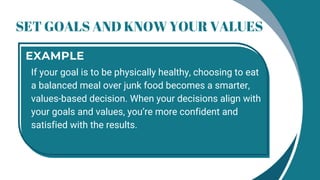
SET GOALS ANDKNOW YOUR VALUES
If your goal is to be physically healthy, choosing to eat
a balanced meal over junk food becomes a smarter,
values-based decision. When your decisions align with
your goals and values, you’re more confident and
satisfied with the results.
EXAMPLE
30.
Everyone makes poorchoices
sometimes, but what matters most is
reflecting on what went wrong and
how to improve.
LEARN FROM PAST
MISTAKES
31.
LEARN FROM PASTMISTAKES
Maybe you once procrastinated on a project and
ended up rushing through it. Instead of just
feeling bad, think about what you could do
differently next time
EXAMPLE
32.
Reaching out totrusted people—like parents,
teachers, or close friends—can offer valuable
insights you might not think of on your own.
With their experience, they can help you
better understand your options and guide
you through tough decisions.
DON’T HESITATE TO
SEEK GUIDANCE
33.
DON’T HESITATE TOSEEK GUIDANCE
The final choice should always be yours. Making
your own decisions, even with advice, helps you
take ownership of the outcome and builds your
confidence, independence, and sense of
responsibility over time.
REMEMBER