Why should consumers be
interested in a competition law?


           Pradeep S. Mehta

        National Conference on
   "Competition Regime – Benefiting the
               Consumer"

         20th October 2010, New Delhi
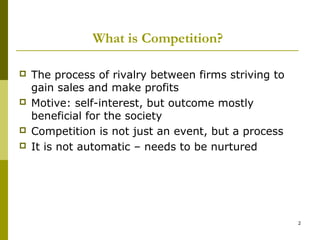
What is Competition?

   The process of rivalry between firms striving to
    gain sales and make profits
   Motive: self-interest, but outcome mostly
    beneficial for the society
   Competition is not just an event, but a process
   It is not automatic – needs to be nurtured


                                                       2
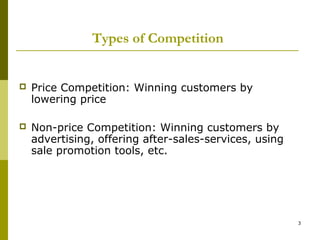
Types of Competition


   Price Competition: Winning customers by
    lowering price

   Non-price Competition: Winning customers by
    advertising, offering after-sales-services, using
    sale promotion tools, etc.


                                                        3
Ways of Competition


   Fair Competition: Fair means such as producing
    quality goods, becoming cost-efficient, optimising
    the use of resources, best technology, research &
    Development, etc.

   Unfair Competition: Unfair means such as fixing
    price with the rivals, predatory pricing,
    disparaging or misleading advertisements, etc.


                                                         4
Benefits from Competition
   Efficiency
   Innovation
   Check on concentration
   Economic growth (wealth and job creation)
   Consumer welfare gains:
       Lower prices,
       Better quality,
       Freedom of choice and
       Easy access


                                                5
Competition Law

   Aims to protect process of competition and not
    competitors
   Consist of a set of rules to curb Anti Competitive
    Practices (ACPs)
   Sets up the Competition Authority:
       Competition Commission of India (CCI) and
       Competition Appellate Tribunal (COMPAT)
   Over 120 countries have adopted Competition Law


                                                         6
Myths & Realities

   Myth: Competition policy and law will allow
    foreign firms to come in and undermine domestic
    firms.

   Reality: Effect of foreign entry depends upon
    capabilities of domestic firms. Competition Law
    protects domestic firms from ACPs of foreign
    firms.

    Example:   Multinational Vitamin Cartel case.
                                                    7
Myths & Realities

   Myth: Competition policy and law are the tools for
    rich and urban societies.

   Reality: Poor do benefit from action against
    competition abuses, if they can access justice.

    Example: Rukmini Devi in Rashmi, Chittorgarh


                                                    8
Myths & Realities

   Myth: Competition law and policy works for the
    rich and affluent sections only.

   Reality: Competition law and policy can also
    benefit the poor

Example: Tied selling at government ration shops


                                                   9
Evolution of Competition Law in India

   The first legislation Monopolies and Restrictive
    Trade Practices Act, 1969, proved inadequate.

   The Competition Act 2002, was subsequently
    enacted due to strong lobbying by the consumer
    movement, lead by CUTS in 1990s.


                                                  10
Action Components of Competition Law
   Anticompetitive practices, such as Cartels
    (Section 3)

   Abuse of Dominance (Section 4)

   Mergers and Acquisitions (Section 5 & 6)

   Competition Advocacy (Section 49)


                                                 11
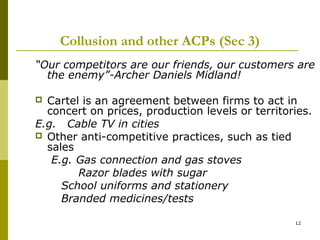
Collusion and other ACPs (Sec 3)
“Our competitors are our friends, our customers are
  the enemy”-Archer Daniels Midland!

 Cartel is an agreement between firms to act in
  concert on prices, production levels or territories.
E.g. Cable TV in cities
 Other anti-competitive practices, such as tied
  sales
   E.g. Gas connection and gas stoves
        Razor blades with sugar
     School uniforms and stationery
     Branded medicines/tests

                                                  12
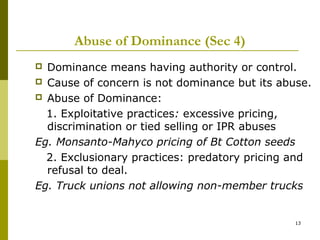
Abuse of Dominance (Sec 4)
 Dominance means having authority or control.
 Cause of concern is not dominance but its abuse.
 Abuse of Dominance:

  1. Exploitative practices: excessive pricing,
  discrimination or tied selling or IPR abuses
Eg. Monsanto-Mahyco pricing of Bt Cotton seeds
  2. Exclusionary practices: predatory pricing and
  refusal to deal.
Eg. Truck unions not allowing non-member trucks


                                               13
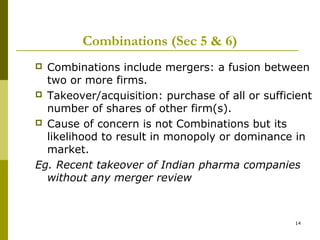
Combinations (Sec 5 & 6)
 Combinations include mergers: a fusion between
  two or more firms.
 Takeover/acquisition: purchase of all or sufficient
  number of shares of other firm(s).
 Cause of concern is not Combinations but its
  likelihood to result in monopoly or dominance in
  market.
Eg. Recent takeover of Indian pharma companies
  without any merger review


                                                 14
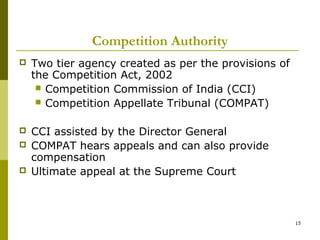
Competition Authority
   Two tier agency created as per the provisions of
    the Competition Act, 2002
      Competition Commission of India (CCI)
      Competition Appellate Tribunal (COMPAT)


   CCI assisted by the Director General
   COMPAT hears appeals and can also provide
    compensation
   Ultimate appeal at the Supreme Court


                                                       15
Other functions of CCI
 Perform the function of competition advocacy
  effectively and promote competition culture
E.g. RBI favouring public sector banks

 Cooperation with other regulatory agencies
E.g. With sector regulators on competition issues

 Cooperation with other competition agencies
E.g. With competition agencies abroad


                                                    16
Challenges for India
   Absence of competition culture
   Lack of competent and experienced staff
   Government support is not always assured
   Vested interests (political-economy aspects)
   Lack of clarity on overlap between the
    competition authority and sector regulators
   Role of consumers/civil society
   Weakness in dissemination/communication


                                                   17
18
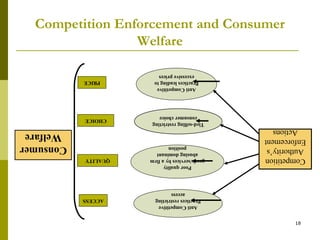
                   Anti Competitive
                  Practices restricting      ACCESS
                         access
                      Poor quality
Competition      goods/services by a firm   QUALITY
                    abusing dominant
Authority’s              position                     Consumer
Enforcement
  Actions                                              Welfare
                 Tied-selling restricting
                    consumer choice         CHOICE
                    Anti Competitive
                   Practices leading to       PRICE
                     excessive prices
                     Welfare
      Competition Enforcement and Consumer
Conclusions
   Competition enforcement leads to consumer
    welfare directly and indirectly
   Stakeholders need to recognise their role in
    promoting competition
   Policymakers/Government need to prioritise
    competition reforms
   CCI to remain independent
   CCI to create a public buy in
   Consumer movement: natural allies of a
    competition regime

                                                   19
THANK YOU!

  psm@cuts.org
www.ccier-cuts.org


                     20

Why should consumers_be_interested_in_a_competition_law-pradeep_s_mehta

  • 1.
    Why should consumersbe interested in a competition law? Pradeep S. Mehta National Conference on "Competition Regime – Benefiting the Consumer" 20th October 2010, New Delhi
  • 2.
    What is Competition?  The process of rivalry between firms striving to gain sales and make profits  Motive: self-interest, but outcome mostly beneficial for the society  Competition is not just an event, but a process  It is not automatic – needs to be nurtured 2
  • 3.
    Types of Competition  Price Competition: Winning customers by lowering price  Non-price Competition: Winning customers by advertising, offering after-sales-services, using sale promotion tools, etc. 3
  • 4.
    Ways of Competition  Fair Competition: Fair means such as producing quality goods, becoming cost-efficient, optimising the use of resources, best technology, research & Development, etc.  Unfair Competition: Unfair means such as fixing price with the rivals, predatory pricing, disparaging or misleading advertisements, etc. 4
  • 5.
    Benefits from Competition  Efficiency  Innovation  Check on concentration  Economic growth (wealth and job creation)  Consumer welfare gains:  Lower prices,  Better quality,  Freedom of choice and  Easy access 5
  • 6.
    Competition Law  Aims to protect process of competition and not competitors  Consist of a set of rules to curb Anti Competitive Practices (ACPs)  Sets up the Competition Authority:  Competition Commission of India (CCI) and  Competition Appellate Tribunal (COMPAT)  Over 120 countries have adopted Competition Law 6
  • 7.
    Myths & Realities  Myth: Competition policy and law will allow foreign firms to come in and undermine domestic firms.  Reality: Effect of foreign entry depends upon capabilities of domestic firms. Competition Law protects domestic firms from ACPs of foreign firms. Example: Multinational Vitamin Cartel case. 7
  • 8.
    Myths & Realities  Myth: Competition policy and law are the tools for rich and urban societies.  Reality: Poor do benefit from action against competition abuses, if they can access justice. Example: Rukmini Devi in Rashmi, Chittorgarh 8
  • 9.
    Myths & Realities  Myth: Competition law and policy works for the rich and affluent sections only.  Reality: Competition law and policy can also benefit the poor Example: Tied selling at government ration shops 9
  • 10.
    Evolution of CompetitionLaw in India  The first legislation Monopolies and Restrictive Trade Practices Act, 1969, proved inadequate.  The Competition Act 2002, was subsequently enacted due to strong lobbying by the consumer movement, lead by CUTS in 1990s. 10
  • 11.
    Action Components ofCompetition Law  Anticompetitive practices, such as Cartels (Section 3)  Abuse of Dominance (Section 4)  Mergers and Acquisitions (Section 5 & 6)  Competition Advocacy (Section 49) 11
  • 12.
    Collusion and otherACPs (Sec 3) “Our competitors are our friends, our customers are the enemy”-Archer Daniels Midland!  Cartel is an agreement between firms to act in concert on prices, production levels or territories. E.g. Cable TV in cities  Other anti-competitive practices, such as tied sales E.g. Gas connection and gas stoves Razor blades with sugar School uniforms and stationery Branded medicines/tests 12
  • 13.
    Abuse of Dominance(Sec 4)  Dominance means having authority or control.  Cause of concern is not dominance but its abuse.  Abuse of Dominance: 1. Exploitative practices: excessive pricing, discrimination or tied selling or IPR abuses Eg. Monsanto-Mahyco pricing of Bt Cotton seeds 2. Exclusionary practices: predatory pricing and refusal to deal. Eg. Truck unions not allowing non-member trucks 13
  • 14.
    Combinations (Sec 5& 6)  Combinations include mergers: a fusion between two or more firms.  Takeover/acquisition: purchase of all or sufficient number of shares of other firm(s).  Cause of concern is not Combinations but its likelihood to result in monopoly or dominance in market. Eg. Recent takeover of Indian pharma companies without any merger review 14
  • 15.
    Competition Authority  Two tier agency created as per the provisions of the Competition Act, 2002  Competition Commission of India (CCI)  Competition Appellate Tribunal (COMPAT)  CCI assisted by the Director General  COMPAT hears appeals and can also provide compensation  Ultimate appeal at the Supreme Court 15
  • 16.
    Other functions ofCCI  Perform the function of competition advocacy effectively and promote competition culture E.g. RBI favouring public sector banks  Cooperation with other regulatory agencies E.g. With sector regulators on competition issues  Cooperation with other competition agencies E.g. With competition agencies abroad 16
  • 17.
    Challenges for India  Absence of competition culture  Lack of competent and experienced staff  Government support is not always assured  Vested interests (political-economy aspects)  Lack of clarity on overlap between the competition authority and sector regulators  Role of consumers/civil society  Weakness in dissemination/communication 17
  • 18.
    18 Anti Competitive Practices restricting ACCESS access Poor quality Competition goods/services by a firm QUALITY abusing dominant Authority’s position Consumer Enforcement Actions Welfare Tied-selling restricting consumer choice CHOICE Anti Competitive Practices leading to PRICE excessive prices Welfare Competition Enforcement and Consumer
  • 19.
    Conclusions  Competition enforcement leads to consumer welfare directly and indirectly  Stakeholders need to recognise their role in promoting competition  Policymakers/Government need to prioritise competition reforms  CCI to remain independent  CCI to create a public buy in  Consumer movement: natural allies of a competition regime 19
  • 20.
    THANK YOU! psm@cuts.org www.ccier-cuts.org 20