Street Design
Towards better designed streets
Background
• India still urbanizing
• Cities still being built
• Cost to ensure “barrier
free”/”universally accessible” low –
compared to retrofit
• Large segment of population will
benefit
• Co-benefits
– Walk/Public Transport
– Safety
• Economic returns on investment high
Background
• Lot of focus on accessible buildings
• Public spaces ignored
– Streets
– Public Transport systems
Situation
Today
• Only width of footpath and width of
carriageway is decided
• All other “engineering” details are
decided
• Storm water drains and other
utilities
• Materials (concrete/UTWT/paving
blocks/curbing etc)
• No attention to detailed design of
the entire road from edge-to-edge
Situation
Today
• Missing elements
– How to deal with trees/utilities on
footpaths
– Footpath continuity (curb cuts)
– Universal accessibility
– Location of street lights, signages, traffic
signals etc
– Location of street vendors
– Bus stops
– Crossings (locations, zebra, pedestrian
refuge etc)
– Auto-rikshaw stands
– Bus stop (design and location)
– Traffic calming designs
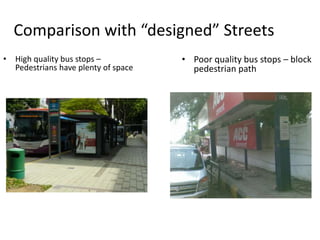
Comparison with “designed” Streets
• High quality bus stops –
Pedestrians have plenty of space
• Poor quality bus stops – block
pedestrian path
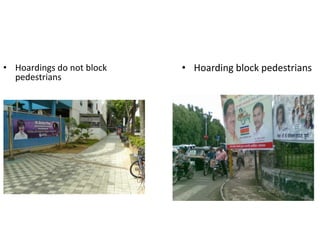
• Hoarding block pedestrians• Hoardings do not block
pedestrians
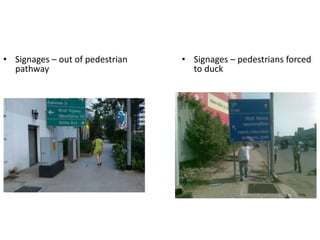
• Signages – out of pedestrian
pathway
• Signages – pedestrians forced
to duck
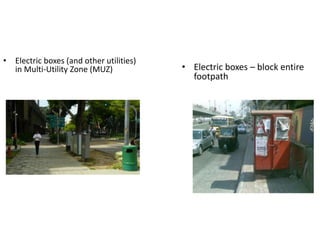
• Electric boxes – block entire
footpath
• Electric boxes (and other utilities)
in Multi-Utility Zone (MUZ)
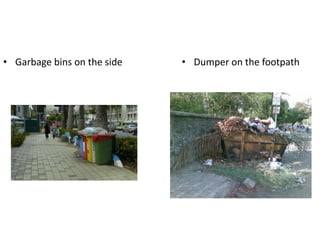
• Garbage bins on the side • Dumper on the footpath
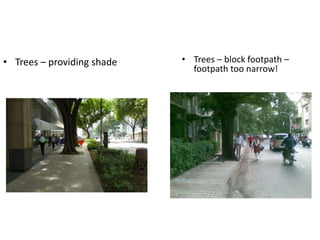
• Trees – providing shade • Trees – block footpath –
footpath too narrow!
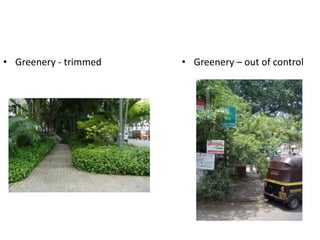
• Greenery - trimmed • Greenery – out of control
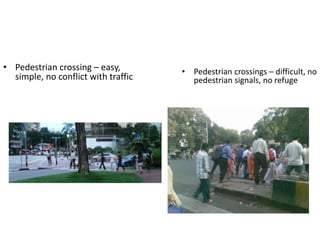
• Pedestrian crossings – difficult, no
pedestrian signals, no refuge
• Pedestrian crossing – easy,
simple, no conflict with traffic
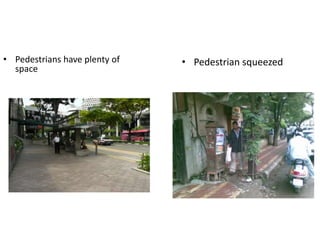
• Pedestrians have plenty of
space
• Pedestrian squeezed
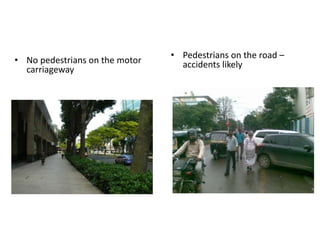
• Pedestrians on the road –
accidents likely• No pedestrians on the motor
carriageway
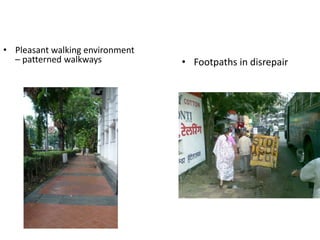
• Pleasant walking environment
– patterned walkways • Footpaths in disrepair
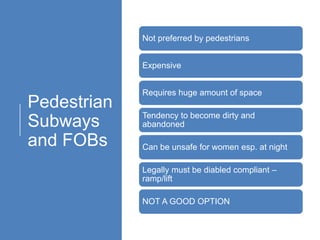
Pedestrian
Subways
and FOBs
Not preferred by pedestrians
Expensive
Requires huge amount of space
Tendency to become dirty and
abandoned
Can be unsafe for women esp. at night
Legally must be diabled compliant –
ramp/lift
NOT A GOOD OPTION
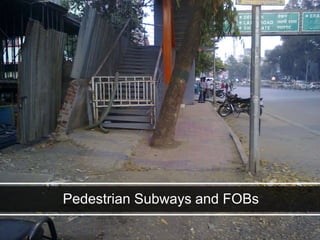
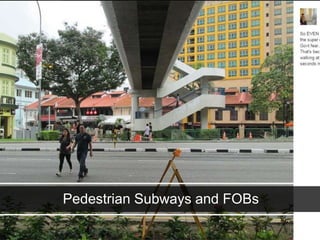
Pedestrian Subways and FOBs
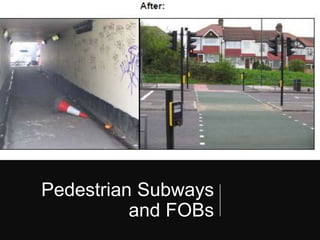
Pedestrian Subways
and FOBs
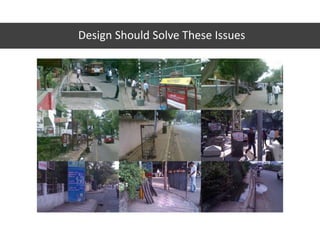
Design Should Solve These Issues
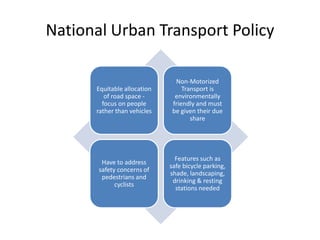
National Urban Transport Policy
Equitable allocation
of road space -
focus on people
rather than vehicles
Non-Motorized
Transport is
environmentally
friendly and must
be given their due
share
Have to address
safety concerns of
pedestrians and
cyclists
Features such as
safe bicycle parking,
shade, landscaping,
drinking & resting
stations needed
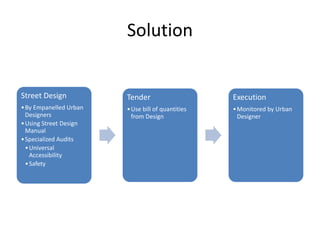
Solution
Street Design
•By Empanelled Urban
Designers
•Using Street Design
Manual
•Specialized Audits
•Universal
Accessibility
•Safety
Tender
•Use bill of quantities
from Design
Execution
•Monitored by Urban
Designer
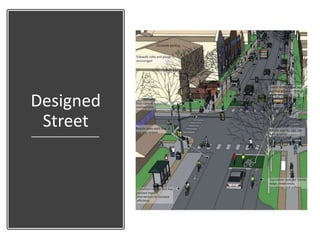
Designed
Street
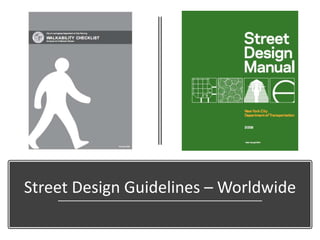
Street Design Guidelines – Worldwide
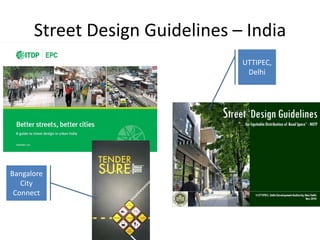
Street Design Guidelines – India
UTTIPEC,
Delhi
Bangalore
City
Connect
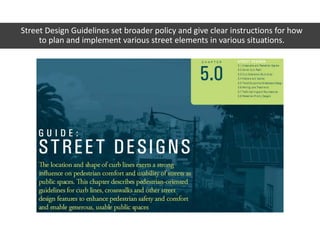
Street Design Guidelines set broader policy and give clear instructions for how
to plan and implement various street elements in various situations.
Street Design Guidelines -
Overview
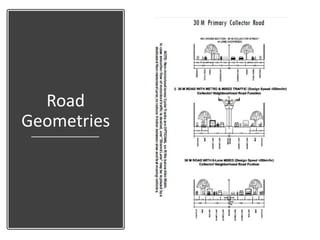
• Road Geometries
defined based on RoW
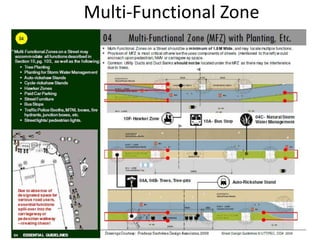
• Concept of MUZ
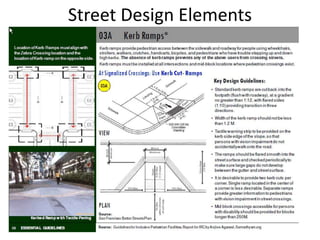
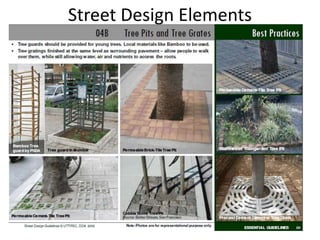
• Street elements
(mandatory +
recommended)
3 Major
Components
Road
Geometries
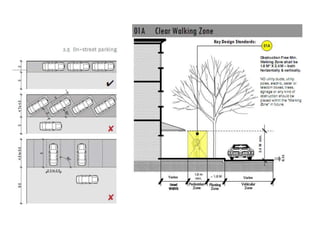
Multi-Functional Zone
Street Design Elements
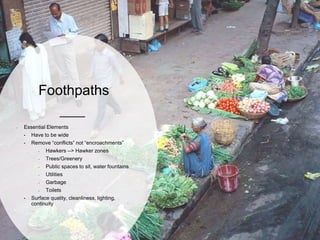
Foothpaths
• Essential Elements
• Have to be wide
• Remove “conflicts” not “encroachments”
• Hawkers --> Hawker zones
• Trees/Greenery
• Public spaces to sit, water fountains
• Utilities
• Garbage
• Toilets
• Surface quality, cleanliness, lighting,
continuity
Expected
Outcomes
• Simple to use guide for engineers,
consultants and contractors
• Fully utilizable RoW / Increased
“people” throughput
• Safety
• Fully handicapped accessibility –
compliance with PwD* Act and
UNCRPD*
• Consistency across whole city
• In line with CMP’s stated goals
* Persons with Disabilities Act & United
Nationals Convention on the Rights of
People with Disabilities
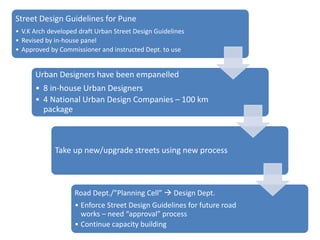
Street Design Guidelines for Pune
• V.K Arch developed draft Urban Street Design Guidelines
• Revised by in-house panel
• Approved by Commissioner and instructed Dept. to use
Urban Designers have been empanelled
• 8 in-house Urban Designers
• 4 National Urban Design Companies – 100 km
package
Take up new/upgrade streets using new process
Road Dept./”Planning Cell”  Design Dept.
• Enforce Street Design Guidelines for future road
works – need “approval” process
• Continue capacity building
Thank You
Ranjit Gadgil – Program
Director, Parisar
ranjit@parisar.org
www.parisar.org
88050 27186

Why Indian Streets need to be designed

  • 1.
  • 2.
    Background • India stillurbanizing • Cities still being built • Cost to ensure “barrier free”/”universally accessible” low – compared to retrofit • Large segment of population will benefit • Co-benefits – Walk/Public Transport – Safety • Economic returns on investment high
  • 3.
    Background • Lot offocus on accessible buildings • Public spaces ignored – Streets – Public Transport systems
  • 4.
    Situation Today • Only widthof footpath and width of carriageway is decided • All other “engineering” details are decided • Storm water drains and other utilities • Materials (concrete/UTWT/paving blocks/curbing etc) • No attention to detailed design of the entire road from edge-to-edge
  • 5.
    Situation Today • Missing elements –How to deal with trees/utilities on footpaths – Footpath continuity (curb cuts) – Universal accessibility – Location of street lights, signages, traffic signals etc – Location of street vendors – Bus stops – Crossings (locations, zebra, pedestrian refuge etc) – Auto-rikshaw stands – Bus stop (design and location) – Traffic calming designs
  • 6.
    Comparison with “designed”Streets • High quality bus stops – Pedestrians have plenty of space • Poor quality bus stops – block pedestrian path
  • 7.
    • Hoarding blockpedestrians• Hoardings do not block pedestrians
  • 8.
    • Signages –out of pedestrian pathway • Signages – pedestrians forced to duck
  • 9.
    • Electric boxes– block entire footpath • Electric boxes (and other utilities) in Multi-Utility Zone (MUZ)
  • 10.
    • Garbage binson the side • Dumper on the footpath
  • 11.
    • Trees –providing shade • Trees – block footpath – footpath too narrow!
  • 12.
    • Greenery -trimmed • Greenery – out of control
  • 13.
    • Pedestrian crossings– difficult, no pedestrian signals, no refuge • Pedestrian crossing – easy, simple, no conflict with traffic
  • 14.
    • Pedestrians haveplenty of space • Pedestrian squeezed
  • 15.
    • Pedestrians onthe road – accidents likely• No pedestrians on the motor carriageway
  • 16.
    • Pleasant walkingenvironment – patterned walkways • Footpaths in disrepair
  • 17.
    Pedestrian Subways and FOBs Not preferredby pedestrians Expensive Requires huge amount of space Tendency to become dirty and abandoned Can be unsafe for women esp. at night Legally must be diabled compliant – ramp/lift NOT A GOOD OPTION
  • 18.
  • 19.
  • 20.
  • 21.
    Design Should SolveThese Issues
  • 22.
    National Urban TransportPolicy Equitable allocation of road space - focus on people rather than vehicles Non-Motorized Transport is environmentally friendly and must be given their due share Have to address safety concerns of pedestrians and cyclists Features such as safe bicycle parking, shade, landscaping, drinking & resting stations needed
  • 23.
    Solution Street Design •By EmpanelledUrban Designers •Using Street Design Manual •Specialized Audits •Universal Accessibility •Safety Tender •Use bill of quantities from Design Execution •Monitored by Urban Designer
  • 24.
  • 25.
  • 26.
    Street Design Guidelines– India UTTIPEC, Delhi Bangalore City Connect
  • 27.
    Street Design Guidelinesset broader policy and give clear instructions for how to plan and implement various street elements in various situations.
  • 29.
    Street Design Guidelines- Overview • Road Geometries defined based on RoW • Concept of MUZ • Street elements (mandatory + recommended) 3 Major Components
  • 30.
  • 31.
  • 32.
  • 33.
  • 34.
    Foothpaths • Essential Elements •Have to be wide • Remove “conflicts” not “encroachments” • Hawkers --> Hawker zones • Trees/Greenery • Public spaces to sit, water fountains • Utilities • Garbage • Toilets • Surface quality, cleanliness, lighting, continuity
  • 35.
    Expected Outcomes • Simple touse guide for engineers, consultants and contractors • Fully utilizable RoW / Increased “people” throughput • Safety • Fully handicapped accessibility – compliance with PwD* Act and UNCRPD* • Consistency across whole city • In line with CMP’s stated goals * Persons with Disabilities Act & United Nationals Convention on the Rights of People with Disabilities
  • 36.
    Street Design Guidelinesfor Pune • V.K Arch developed draft Urban Street Design Guidelines • Revised by in-house panel • Approved by Commissioner and instructed Dept. to use Urban Designers have been empanelled • 8 in-house Urban Designers • 4 National Urban Design Companies – 100 km package Take up new/upgrade streets using new process Road Dept./”Planning Cell”  Design Dept. • Enforce Street Design Guidelines for future road works – need “approval” process • Continue capacity building
  • 37.
    Thank You Ranjit Gadgil– Program Director, Parisar ranjit@parisar.org www.parisar.org 88050 27186