sustainable transport solutionsPhil Jones Associates
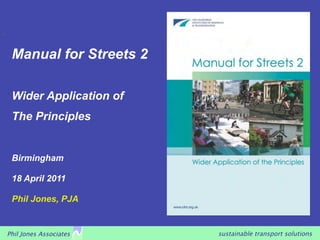
Manual for Streets 2
Wider Application of
The Principles
Birmingham
18 April 2011
Phil Jones, PJA
sustainable transport solutionsPhil Jones Associates
Manual for Streets 2 - Why?
   MfS only applicable to residential streets (?)
   Concerns over HGVs and bus braking
characteristics/SSDs
   Fear of litigation
   Comfort of familiar standards
   Lack of confidence in applying MfS principles
in busier locations
sustainable transport solutionsPhil Jones Associates
MfS1 MfS2
sustainable transport solutionsPhil Jones Associates
DMRB – National Guidance on Roads
•  Applicable to Trunk Roads
•  Highways Agency’s standard (Eng.)
•  Very detailed – covers
•  Horizontal and Vertical Alignment
•  Carriageway widths
•  Design Speeds
•  Junction geometry/detailing
•  Checking and audit procedures
•  Often used by Local Highway Authorities
•  But they don’t have to!
sustainable transport solutionsPhil Jones Associates
What is DMRB for?
Use of the Manual for Trunk Roads
1.4 The documents in the manual have been prepared …
specifically for Trunk Road Works throughout the UK….
Use of the Manual by Other Highway Authorities
1.5 The manual sets a standard of good practice that has been
developed principally for Trunk Roads. It may also be
applicable in part to other roads with similar characteristics.
Where it is used for local road schemes, it is for the local
highway authority to decide on the extent to which the
documents in the manual are appropriate in any particular
situation
Introduction to the DMRB, GD01/08 (our emphasis)
sustainable transport solutionsPhil Jones Associates
DMRB
sustainable transport solutionsPhil Jones Associates
MfS (1 and 2) Key Principles
   Hierarchy – consider pedestrians first
   Strike a balance – traffic is not always paramount
   Respect pedestrian and cycle desire lines
   Permeable and connected networks are preferred
   Collaborative approaches work best
   Innovation is encouraged
sustainable transport solutionsPhil Jones Associates
Speed Limit 20mph 30mph 40mph 50+mph
User Hierarchy ● ● ● ●
Quality Audits ● ● ● ●
Community Function ● ● ● ●
Inclusive Design ● ● ● ●
Ped/Cycle Support ● ● ● ●
Master Plans/Design
Codes
● ● ● ●
Stopping Sight Distance ● ● ● ●
Frontage Access ● ● ● ●
Minimise Signs and
Street Furniture
● ● ● ●
Connectivity/Permeability ● ● ● ●
sustainable transport solutionsPhil Jones Associates
Section A – Context and Process
sustainable transport solutionsPhil Jones Associates
   Two dimensional approach to Hierarchy – Movement and Place
   Design choices need to respect both functions
   Some Movement corridors are more important than others…
   Some Places are more important than others...
Motorway
High Street
Residential Street
Rural Lane
Place Status
MovementStatus
sustainable transport solutionsPhil Jones Associates
Movement
Place
Place
Place
Place
Place
What are streets for?
Movement
Pedestrians
Cyclists
Buses
Cars/HGVs
Deliveries
Parking
Place Shopping Playing Socialising Eating/drinking Sitting
Events
What are streets for?
Movement
Pedestrians
Cyclists
Buses
Cars
Deliveries
Parking
Place Shopping Playing Socialising Eating/drinking Sitting Events
What are streets for?
Movement
Pedestrians
Cyclists
Buses
Cars/HGVs
Deliveries
Parking
Place Shopping Playing Socialising Eating/drinking Sitting Events
What are streets for?
Movement
Pedestrians
Cyclists
Buses
Cars/HGVs
Deliveries
Parking
Place Shopping Playing Socialising Eating/drinking Sitting Events
sustainable transport solutionsPhil Jones Associates
Context: Town and City Centres
Street Type: Multifunctional Streets and Spaces
sustainable transport solutionsPhil Jones Associates
Context: Town and City Centres
Street Type: Multifunctional Streets and Spaces
sustainable transport solutionsPhil Jones Associates
Context: Urban and Suburban Areas
Street Type: Arterial Routes and High Streets
sustainable transport solutionsPhil Jones Associates
Context: Urban and Suburban Areas
Street Type: Arterial Routes and High Streets
sustainable transport solutionsPhil Jones Associates
Context: Urban and Suburban Areas
Street Type: Relief Roads and Ring Roads
sustainable transport solutionsPhil Jones Associates
Context: Urban and Suburban Areas
Street Type: Relief Roads and Ring Roads
sustainable transport solutionsPhil Jones Associates
Context: Urban and Suburban Areas
Street Type: Boulevards
sustainable transport solutionsPhil Jones Associates
Context: Urban and Suburban Areas
Street Type: Boulevards
sustainable transport solutionsPhil Jones Associates
Context: Urban Extensions
Street Type: High Streets, Residential Streets
sustainable transport solutionsPhil Jones Associates
Context: Interchanges
sustainable transport solutionsPhil Jones Associates
Context: Village Centres
sustainable transport solutionsPhil Jones Associates
Context: Village Centres
sustainable transport solutionsPhil Jones Associates
Context: Rural Areas
Street Type Rural Roads
sustainable transport solutionsPhil Jones Associates
Context: Rural Areas
Street Type Rural Lanes
sustainable transport solutionsPhil Jones Associates
Context: Shared Space
sustainable transport solutionsPhil Jones Associates
Context: Shared Space
sustainable transport solutionsPhil Jones Associates
What is Shared Space?
Shared Space: a street or place accessible to both pedestrians
and vehicles that is designed to enable pedestrians to move more
freely by reducing traffic management features that tend to
encourage vehicles to assume priority.
Level surface: a street surface that is not physically divided by
kerb or level differences into areas for particular uses. Level
surface is a feature of some shared space schemes.
Shared Space Research Report, for DfT
sustainable transport solutionsPhil Jones Associates
Increasingly shared
Decreasingly segregated
Guardrails Conventional
kerbs, different
materials
Level Surface,
Minimal/No
delineation
Low kerbs,
common material
Increasingly cooperative
When does a space
become shared?
sustainable transport solutionsPhil Jones Associates
Business as usual
sustainable transport solutionsPhil Jones Associates
Sharing through Re-balancing
sustainable transport solutionsPhil Jones Associates
Shared Space - Link
sustainable transport solutionsPhil Jones Associates
Shared Space -
Junction
sustainable transport solutionsPhil Jones Associates
When does a space
become shared?
sustainable transport solutionsPhil Jones Associates
Total Segregation
sustainable transport solutionsPhil Jones Associates
High Segregation
sustainable transport solutionsPhil Jones Associates
Everyday Segregation
sustainable transport solutionsPhil Jones Associates
Low Segregation
sustainable transport solutionsPhil Jones Associates
Minimal Segregation
sustainable transport solutionsPhil Jones Associates
No Segregation
sustainable transport solutionsPhil Jones Associates
Seven Dials, London
sustainable transport solutionsPhil Jones Associates
Casualty Data Seven Dials, Covent Garden
sustainable transport solutionsPhil Jones Associates
Ashford Ring Road
sustainable transport solutionsPhil Jones Associates
Shared Space DfT Research
   Research being carried out by MVA
- Guidance out in Spring 2011
   Key findings:
   Shared Spaces are no less safe
and can be safer
   Reducing the degree of
segregation between users
produces slower traffic, more
pedestrians using whole of the
space.
   Solutions are emerging that
mitigate the impact of Level
Surfaces on disabled people.
sustainable transport solutionsPhil Jones Associates
Aren’t we going to be liable if someone gets hurt?
sustainable transport solutionsPhil Jones Associates
What’s the Problem?
•  Persistent concerns over potential for highway
authorities – and individual officers/members – to be
held liable for design faults and innovations.
•  No evidence that this is actually a significant problem
in practice.
sustainable transport solutionsPhil Jones Associates
Liability and Good Urban Design
•  Designers often over-estimate their legal responsibilities
•  Designers may therefore be unwilling to consider non-
conventional design initiatives (e.g. removing guard-rails)
•  Irrational fear of liability can be detrimental to good design
•   Need to be more informed about
risk, safety & possible liability
•   Need to balance these concerns
with the benefits of good urban
design
•   Good urban design can be just
as safe as traditional approaches
and sometimes safer
sustainable transport solutionsPhil Jones Associates
Legislative duties and judgements
Highway Risk & Liability Claims
A practical guide to Appendix C
of ‘Well Maintained Highways’
•   Produced by UK Roads Board
•   Advice, case studies and
judgements on liability
sustainable transport solutionsPhil Jones Associates
Legislative duties and judgements
Three Principles:
1.   Court rulings repeatedly state that road
users are responsible for their own safety
and have a duty to take the road as they
find it. This defines the road user as an
intelligent being, able and expected to
exercise their own judgement.
2.   The highway authority should avoid
creating a trap for road users.
3.   The highway authority should not act
irrationally.
sustainable transport solutionsPhil Jones Associates
•  No duty to give warning or maintain
warning of obvious hazards
•  No duty to erect of warning signs
(including markings) for obvious
hazards
•  Cases:
•  Gorringe v Calderdale
•  Stovin v Wise & Norfolk CC
Judgements
sustainable transport solutionsPhil Jones Associates
Gorringe (Appellant) v.
Calderdale Metropolitan
Borough Council (2004)
On 15 July 1996, on a country road in Yorkshire,
Mrs Denise Gorringe drove her car head-on into
a bus. It was hidden behind a sharp crest in the
road until just before she reached the top.
She said that the council caused the accident
by failing to give her proper warning of the
danger involved in driving fast when you could
not see what was coming.
The ‘SLOW’ road marking on the approach to
the crest had become worn.
sustainable transport solutionsPhil Jones Associates
Gorringe (Appellant) v.
Calderdale Metropolitan Borough
Council (2004)The House of Lords
LORD STEYN
•   …the courts must not contribute to the creation of a society bent on
litigation, which is premised on the illusion that for every misfortune
there is a remedy.
LORD HOFFMANN
•   People must accept responsibility for their own actions and take the
necessary care to avoid injuring themselves or others.
•   The users of the highway are expected to look after themselves.
•   Drivers of vehicles must take the highway network as they find it.
LORD RODGER
•   I am satisfied that the duty to maintain the highway
does not include a duty to repaint warning signs on
the surface.
sustainable transport solutionsPhil Jones Associates
Quality Audits
   Quality Audits introduced in MfS1 - a ‘Balanced Audit’ reviewing key
aspects of a design against set objectives
   Some authorities (eg Kent, Solihull) have taken the concept further
Policy Review
Objective Setting
Design
Quality Auditing
sustainable transport solutionsPhil Jones Associates
Design and Implementation Process – LTN 1/08
sustainable transport solutionsPhil Jones Associates
Quality Audit process for
large developments
Council sets out objectives/terms of reference for Quality Audit
Quality Audit to include:
•mobility or access audit
•cycling & pedestrian, equestrian audits
•visual quality and place check audits
•Stage F Road Safety Audit/ Road Safety
Assessment
•maintenance regime audit
•public transport audit
•Transport Assessment
•technical standards audit
•how streets will be used/ community audit
•construction audit
Information Gathering Stage
Facilitator involved to resolve
simple conflicts between audits
Some audits carried out by qualified
independent individuals/ teams,
audit payments negotiated with developer
Draft Quality Audit Report including outstanding
items and recommendations
Resolution of outstanding items
Developer input
Developer, Local
Authority input
Agreed final Quality Audit Report
Subsequent stages of Road Safety Audit on
approved option
Developer, Local
Authority input
Planning Approval by
Council
Risk Assessment
matrix used by
Facilitator to help
resolve
outstanding issues
Quality Audit process for
large developments
Council sets out objectives/terms of reference for Quality Audit
Quality Audit to include:
•mobility or access audit
•cycling & pedestrian, equestrian audits
•visual quality and place check audits
•Stage F Road Safety Audit/ Road Safety
Assessment
•maintenance regime audit
•public transport audit
•Transport Assessment
•technical standards audit
•how streets will be used/ community audit
•construction audit
Information Gathering Stage
Facilitator involved to resolve
simple conflicts between audits
Some audits carried out by qualified
independent individuals/ teams,
audit payments negotiated with developer
Draft Quality Audit Report including outstanding
items and recommendations
Resolution of outstanding items
Developer input
Developer, Local
Authority input
Agreed final Quality Audit Report
Subsequent stages of Road Safety Audit on
approved option
Developer, Local
Authority input
Planning Approval by
Council
Risk Assessment
matrix used by
Facilitator to help
resolve
outstanding issues
sustainable transport solutionsPhil Jones Associates
•   CIHT and DfT working towards guidance note (LTN) on Quality
Audits
•   Current thinking:
•   Team leader for QA
•   Separate reports commissioned
•   Team review all reports leading to balanced recommendations
Quality Audits
sustainable transport solutionsPhil Jones Associates
sustainable transport solutionsPhil Jones AssociatesBeechcroft Road, Oxford
sustainable transport solutionsPhil Jones Associates
Stages to Better Streets – London Mayor’s Strategy
sustainable transport solutionsPhil Jones Associates
Stage 1 – Tidy Up
sustainable transport solutionsPhil Jones Associates
Stage 2 – De-clutter
sustainable transport solutionsPhil Jones Associates
Stage 3 – Relocate/Merge Functions
sustainable transport solutionsPhil Jones Associates
Stage 4 – Rethink Traffic Management
sustainable transport solutionsPhil Jones Associates
Stage 5 – Re-create the Street
sustainable transport solutionsPhil Jones Associates
Some existing kit is plainly useless and can be removed without fear
Stratford-upon-Avon
sustainable transport solutionsPhil Jones Associates
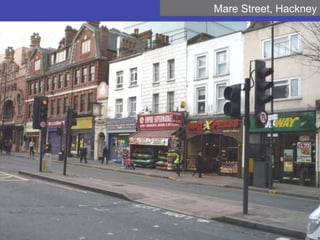
Mare Street, Hackney
sustainable transport solutionsPhil Jones Associates
Maid Marian Way, Nottingham
sustainable transport solutionsPhil Jones Associates
Maid Marian Way, Nottingham
sustainable transport solutionsPhil Jones Associates
Exhibition Road
sustainable transport solutionsPhil Jones Associates
Exhibition Road
sustainable transport solutionsPhil Jones Associates
The Value of Better Streets
  Traditional economic evaluation relies on time saved
  How do we value time spent in better streets?
  Guidance on Urbandesignlondon.tfl.gov.uk
sustainable transport solutionsPhil Jones Associates
Section B – Detailed Design Issues
sustainable transport solutionsPhil Jones Associates
Application of the Detailed Guidance
Two health warnings:
1. Although numerical values are given in this section, designers
are encouraged to take a flexible approach to its interpretation and
application, thinking through for themselves the likely outcome of
any course of action based on experience and local
circumstances.
2. In preparing schemes, designers should consider the layout in
totality, including the relationship of the highway to its
surroundings, both in urban and rural areas. The highway should
not be seen in isolation or simply as a piece of infrastructure.
sustainable transport solutionsPhil Jones Associates
And not forgetting
8.1.1 The design of carriageways...is often based on TD9/93 Highway
Link Design, part of DMRB, but that document has been prepared for
Trunk Roads and may not always be appropriate in other circumstances.
As noted in Chapter 1 it is recommended that designers bear in mind the
key principles of MfS when applying DMRB.
DMRB
sustainable transport solutionsPhil Jones Associates
Pedestrian Needs and Footways
It’s not exactly rocket science...!
   Pedestrians need direct, connected and clutter-free footways of
adequate width along and across multi-functional highways
   Their needs must be considered when designing links and junctions
sustainable transport solutionsPhil Jones AssociatesNewlands Avenue MPR Scheme
sustainable transport solutionsPhil Jones Associates
Newlands Avenue MPR Scheme:
Pinch point widened from 1.1m to 1.6m
Number of pedestrians increased by 59%
sustainable transport solutionsPhil Jones Associates
Cyclists’ Needs
   Cyclists should generally be accommodated
on the carriageway – by making conditions
suitable for them.
   Poor facilities are worse than no facilities –
vehicles travel closer when lanes provided
   Where on-carriageway facilities are provided,
they should be well designed.
   Off-carriageway facilities should be
convenient and not put cyclists at danger at
junctions
sustainable transport solutionsPhil Jones Associates
Design of Cycle Facilities
  MfS2 refers to LTN2/08 – Cycle
Infrastructure Design
  Make space for cycle lanes by reducing
traffic lane widths
sustainable transport solutionsPhil Jones Associates
Design of Cycle Facilities – cont’d
  Coloured surfacing – conspicuity or
visual intrusion?
  Hybrid/protected lanes can be used
  Cycle symbol alone can be useful
  Off-highway shared cycle tracks –
reduce pedestrian amenity, less
favoured.
  Updated LTN on Shared Use Paths in
course of preparation.
sustainable transport solutionsPhil Jones Associates
Cycle parking should be provided at key
destinations –for example in local high streets
sustainable transport solutionsPhil Jones Associates
Bus Facilities
   Bus routes and stops form key elements in walkable
neighbourhoods
   Routes should be direct and reasonably straight
   Bus stops should be high quality, accessible places with
good information
   Bus priority lanes reduce journey times and benefit cyclists
but disadvantage pedestrians
   Bus boarders preferred to laybys
sustainable transport solutionsPhil Jones Associates
Walworth Road - Before
sustainable transport solutionsPhil Jones Associates
Walworth Road - After
sustainable transport solutionsPhil Jones Associates
Carriageways
   Design Speed in urban areas should generally not exceed
30mph (50kph) – and can be less where necessary
   Both MfS1 and DMRB confirm that drivers respond to more
generous geometry by increasing speed.
sustainable transport solutionsPhil Jones Associates
  Various means of reducing speed:
–  Physical features
–  Changes in priority
–  Street dimensions
–  Reduced forward visibility
–  Psychology and perception
Carriageways
sustainable transport solutionsPhil Jones Associates
Horizontal Alignment
  Can adopt curve radii well below DMRB Desirable
Minima in urban areas.
  TD9/93 advises 4 steps below Des Min for speeds of
60kph and below:
Design Speed, kph
Curve Radius, m
4 steps below TD 9/93
Desirable Min
30 16
40 28
48 41
50 44
60 64
sustainable transport solutionsPhil Jones Associates
Lane Widths
   Lanes do not have to be 3.65m (12 feet) wide.
   Narrower lanes will reduce speeds and overall carriageway width, and
require drivers to pull around cyclists.
   Lanes >3m not necessary in most urban situations catering for mixed traffic
   Wide (>4m) lanes allow large vehicles to pass cyclists more easily.
sustainable transport solutionsPhil Jones Associates
Central Medians
   Helpful to pedestrians crossing the carriageway
   Should not fence off unless clear safety justification
   Overrun medians can be a useful feature
sustainable transport solutionsPhil Jones Associates
Kerb Heights
   Typically 125mm – but...
   Lower kerb heights are easier for the
mobility-impaired to cross and reduce
vehicle dominance.
   Higher kerbs appropriate at bus stops.
sustainable transport solutionsPhil Jones Associates
Junctions, Crossings and Accesses
   Junctions often seen as problems – to be minimised
   But can also be seen as opportunities for ‘place’ functions
   Essential to consider pedestrian and cycle needs
   Grade separation almost always makes for poor environments
sustainable transport solutionsPhil Jones Associates
Crossings
   Informal, Zebra, Signalised - all have
advantages and disadvantages
   Informal - minimal clutter, can
encourage courtesy behaviour, little
delay to traffic, but no absolute
priority to pedestrians.
   Zebra – delays can be minimal unless
pedestrian flows high, can be close to
junctions, more clutter.
   Signalised – additional delay, more
clutter, preferred by vulnerable
pedestrians.
sustainable transport solutionsPhil Jones Associates
Crossings
   Two stage signalised crossings can
be straight across.
   Staggered crossings don’t have to
have guardrail.
   X-crossings are possible with simple
all-red stages.
sustainable transport solutionsPhil Jones Associates
Queen Street, City of London
sustainable transport solutionsPhil Jones Associates
Priority Junctions
   Advantages: Simple, legible, can have
low delays, particularly outside peaks
   Minimising number of approach lanes
benefits pedestrians and cyclists. Ghost
island not generally justified at 500 vpd.
   Crossroads have poor accident record at
higher flows and speeds. Tabling a
possible solution.
   Tight corner radii, footway crossovers
should be considered in urban areas.
sustainable transport solutionsPhil Jones Associates
Squares
   Major opportunity for placemaking
and as a traffic/parking solution
   Can be thought of as a series of
displaced informal priority junctions
sustainable transport solutionsPhil Jones Associates
Conventional Roundabouts
   Advantages: High capacity, good safety
record for vehicles, minimal delay
outside peaks.
   Disadvantages - poor safety record for
cyclists, barrier to pedestrians, high land
take, visual impact.
   Particular problem for cyclists –
left turn slip lanes
   Recommended approach – ‘compact’
geometry - as small as possible with
narrow entries and exits.
sustainable transport solutionsPhil Jones Associates
Mini Roundabouts
   Advantages: Small land take, slow
speeds, good safety record, minimal
delay outside peaks, better for
pedestrians and cyclists.
   Disadvantages – Limited traffic capacity,
visual impact.
   No presumption against new mini-
roundabouts on non-trunk roads
   ‘Informal’ mini-roundabouts can work
well, minimal visual impact.
sustainable transport solutionsPhil Jones Associates
St Bride Street, City of London
sustainable transport solutionsPhil Jones Associates
Traffic Signals
   Advantages: High capacity, can
incorporate pedestrian and cycle
facilities
   Disadvantages – Clutter and visual
impact, delays outside peaks
   Tight corner radii preferred – keep
pedestrians on desire lines, reduce
speed of turning vehicles.
   Advanced cycle lanes should usually be
provided in urban areas.
sustainable transport solutionsPhil Jones Associates
Traffic Signals – Cont’d
   Intervisibility requirements from TD 50/04
can significantly affect ability to place
buildings close to corners – is this
always appropriate?
   Left turn slip lanes increase clutter and
pedestrian crossing complexity
   Traffic signal removal experiments –
need to consider pedestrian needs.
sustainable transport solutionsPhil Jones Associates
Traffic Management Systems
   Complex one-way systems often installed to maximise traffic capacity
   Significant disadvantage to cyclists and can cause pedestrian accidents
   Some towns have chosen to simplifying one-way systems.
sustainable transport solutionsPhil Jones Associates
Visibility
Stopping Sight Distance
   Guidance in MfS2 incorporates that of MfS1 –
effectively superseding it
   Based on further research carried out by TMS
Consultancy, plus literature searches
   MfS1 parameters apply to all <60kph links:
   1.5s reaction time
   0.45g deceleration rate
   Except for buses and HGVs (>5% of flow typically)
   1.5s reaction time
   0.375g deceleration rate
sustainable transport solutionsPhil Jones Associates
TMS Consultancy Research
<120m visibility to right from kerb vs "visi" collisions
y = 0.0163x + 3.6442
R2
= 0.0586
0
1
2
3
4
5
6
7
8
9
10
0 10 20 30 40 50 60 70 80 90 100 110 120
Visibility
Collisions
sustainable transport solutionsPhil Jones Associates
Design Speed Vehicle Type Reaction Time Deceleration Rate
60kph and below
Light vehicles 1.5s 0.45g
HGVs 1.5s 0.375g
Buses 1.5s 0.375g
Above 60kph
All vehicles 2s
0.375g
(Absolute Min SSD)
All vehicles 2s
0.25g
(Desirable Min SSD)
sustainable transport solutionsPhil Jones Associates
SSD = vt + v2/2(d+0.1a)
where:
v = speed (m/s)
t = driver perception–reaction time (sec)
d = deceleration (m/s2)
a = longitudinal gradient (%)
(+ for upgrades and – for downgrades)
sustainable transport solutionsPhil Jones Associates
Forward Visibility
   Apply SSD requirements in the horizontal and vertical
plane.
   But in some situations may be desirable to restrict
forward visibility to help control traffic speed.
sustainable transport solutionsPhil Jones Associates
Visibility at Priority Junctions
   X-distance of 2.4m generally appropriate, subject to
capacity considerations
   Y-distance based on SSD but:
It has often been assumed that a failure to provide
visibility at priority junctions in accordance with the
values recommended in MfS1 or DMRB (as
appropriate) will result in an increased risk of injury
collisions.
Research carried out by TMS Consultancy for MfS2
has found no evidence of this.
...unless there is local evidence to the contrary, a
reduction in visibility below recommended levels will not
necessarily lead to a significant problem.
sustainable transport solutionsPhil Jones Associates
Parking and Servicing
   Positive and negative aspects of on-street parking set out in
MfS1
Positive
  Common resource, efficient,
popular.
  Caters for varying demand
  Adds activity
  Well overlooked
Negative
  Possible impact on
pedestrian safety
  Can be visually dominant
  May block footways and
entrances
  Can be source of crime
   If done...should be done well!
sustainable transport solutionsPhil Jones Associates
Street Trees and Planting
   Green infrastructure is important to the design of
places and trees are one of its most visible
components
   Engineers and transport planners are well placed
to help deliver street trees and their benefits.
•   Visual
•   Shade
•   Habitat
•   Drainage
•   Economic
   Practical difficulties (footway heave and restriction,
leaf drop) can be overcome through careful design
and maintenance
sustainable transport solutionsPhil Jones Associates
Street Lighting
   Plan street lighting as an integral part of the
street, including any planting
   Lighting should be appropriate to context
and street function
   Lighting levels do not have to be constant
during the hours of darkness.
   Shadows and sudden changes in lighting
level can be particularly problematic and
should be avoided.
   Consideration should be given to attaching
lighting units to buildings to reduce street
clutter.
sustainable transport solutionsPhil Jones Associates
Street Furniture
   Some street furniture is useful and
important...much is not
   Start with nothing – introduce only
elements that are necessary
   Clutter removal can be done as part of
ongoing maintenance
   Combine elements together where possible
   Street furniture should be arranged to keep
pedestrian routes clear
sustainable transport solutionsPhil Jones Associates sustainable transport solutionsPhil Jones Associates
sustainable transport solutionsPhil Jones Associates
Guardrail
   Significant disbenefits - highly
intrusive, disadvantages pedestrians,
unsightly, can increase traffic speeds
and create risks for cyclists.
   May be necessary in some locations –
but need better balanced use
   Many guardrail removal schemes have
worked well in road safety terms, with
careful assessment
   Look for alternative solutions before
installing new guardrail
sustainable transport solutionsPhil Jones Associates
Traffic Signs and Markings
   Add significantly to street clutter
   Signs must comply with Regulations,
but Guidance (TSM) is just that.
   There is flexibility in both types of
document
sustainable transport solutionsPhil Jones Associates
Signs may be mounted at any height
sustainable transport solutionsPhil Jones Associates
And on buildings
sustainable transport solutionsPhil Jones Associates
Yellow backing boards significantly increase visual impact
sustainable transport solutionsPhil Jones Associates
As do keep left signs on retroreflective bollards
sustainable transport solutionsPhil Jones Associates
Other mounting options are available
sustainable transport solutionsPhil Jones Associates
Or the keep left signs can be omitted completely
sustainable transport solutionsPhil Jones Associates
Ordinary bollards can also be overdone
sustainable transport solutionsPhil Jones Associates
As can centre line markings
sustainable transport solutionsPhil Jones Associates
Junction priority can be removed
sustainable transport solutionsPhil Jones Associates
Just two zig-zag markings is lawful at controlled crossings
sustainable transport solutionsPhil Jones Associates
Only the double-dash marking is necessary at Give-Ways
sustainable transport solutionsPhil Jones Associates
One no-entry sign is lawful if carriageway less than 5m wide
sustainable transport solutionsPhil Jones Associates
White borders to signals can be omitted
sustainable transport solutionsPhil Jones Associates
Roundabouts don’t have to have chevron signs
sustainable transport solutionsPhil Jones Associates
Coloured surfacing has no legal function
sustainable transport solutionsPhil Jones Associates
50mm ‘Primrose’ no waiting lines are lawful anywhere
sustainable transport solutionsPhil Jones Associates
And aren’t needed if carriageway and footway on same level
sustainable transport solutionsPhil Jones Associates
Section C – Case Studies
sustainable transport solutionsPhil Jones Associates
London Road, Southampton
•  Citycentre radial
•  9400 vehicles per day (before)
•  6000 vehicles per day (after)
•  5500 pedestrians per day
•  400 cyclists per day
•  31 collisions in 4 years (before)
•  3 collisions in 10 months (after)
sustainable transport solutionsPhil Jones Associates sustainable transport solutionsPhil Jones Associates
Before
sustainable transport solutionsPhil Jones Associates
sustainable transport solutionsPhil Jones Associates sustainable transport solutionsPhil Jones Associates
After
sustainable transport solutionsPhil Jones Associates
Walworth Road, South London
•  “A” class road
•  20,000 vehicles per day
•  180 buses per hour
•  20,000 pedestrians
•  250 accidents in 3 years
sustainable transport solutionsPhil Jones Associates sustainable transport solutionsPhil Jones Associates
Before
sustainable transport solutionsPhil Jones Associates
sustainable transport solutionsPhil Jones Associates sustainable transport solutionsPhil Jones Associates
After
sustainable transport solutionsPhil Jones Associates
Conclusions
   MfS2 provides detailed guidance on a wide range
of technical issues...
   for a wide range of contexts and street types
   It provides a ‘way in’ to DMRB and other technical
guidance
   While encouraging designers to...
   Think!
pj@philjonesassociates.co.uk
Twitter.com/Phil_PJA
0121 222 5422
sustainable transport solutionsPhil Jones Associates
Discussion!

Manual for streets 2

  • 1.
    sustainable transport solutionsPhilJones Associates Manual for Streets 2 Wider Application of The Principles Birmingham 18 April 2011 Phil Jones, PJA
  • 2.
    sustainable transport solutionsPhilJones Associates Manual for Streets 2 - Why?    MfS only applicable to residential streets (?)    Concerns over HGVs and bus braking characteristics/SSDs    Fear of litigation    Comfort of familiar standards    Lack of confidence in applying MfS principles in busier locations
  • 3.
    sustainable transport solutionsPhilJones Associates MfS1 MfS2
  • 4.
    sustainable transport solutionsPhilJones Associates DMRB – National Guidance on Roads •  Applicable to Trunk Roads •  Highways Agency’s standard (Eng.) •  Very detailed – covers •  Horizontal and Vertical Alignment •  Carriageway widths •  Design Speeds •  Junction geometry/detailing •  Checking and audit procedures •  Often used by Local Highway Authorities •  But they don’t have to!
  • 5.
    sustainable transport solutionsPhilJones Associates What is DMRB for? Use of the Manual for Trunk Roads 1.4 The documents in the manual have been prepared … specifically for Trunk Road Works throughout the UK…. Use of the Manual by Other Highway Authorities 1.5 The manual sets a standard of good practice that has been developed principally for Trunk Roads. It may also be applicable in part to other roads with similar characteristics. Where it is used for local road schemes, it is for the local highway authority to decide on the extent to which the documents in the manual are appropriate in any particular situation Introduction to the DMRB, GD01/08 (our emphasis)
  • 6.
  • 7.
    sustainable transport solutionsPhilJones Associates MfS (1 and 2) Key Principles    Hierarchy – consider pedestrians first    Strike a balance – traffic is not always paramount    Respect pedestrian and cycle desire lines    Permeable and connected networks are preferred    Collaborative approaches work best    Innovation is encouraged
  • 8.
    sustainable transport solutionsPhilJones Associates Speed Limit 20mph 30mph 40mph 50+mph User Hierarchy ● ● ● ● Quality Audits ● ● ● ● Community Function ● ● ● ● Inclusive Design ● ● ● ● Ped/Cycle Support ● ● ● ● Master Plans/Design Codes ● ● ● ● Stopping Sight Distance ● ● ● ● Frontage Access ● ● ● ● Minimise Signs and Street Furniture ● ● ● ● Connectivity/Permeability ● ● ● ●
  • 9.
  • 10.
    sustainable transport solutionsPhilJones Associates Section A – Context and Process
  • 11.
    sustainable transport solutionsPhilJones Associates    Two dimensional approach to Hierarchy – Movement and Place    Design choices need to respect both functions    Some Movement corridors are more important than others…    Some Places are more important than others... Motorway High Street Residential Street Rural Lane Place Status MovementStatus
  • 12.
    sustainable transport solutionsPhilJones Associates Movement Place Place Place Place Place
  • 13.
    What are streetsfor? Movement Pedestrians Cyclists Buses Cars/HGVs Deliveries Parking Place Shopping Playing Socialising Eating/drinking Sitting Events
  • 14.
    What are streetsfor? Movement Pedestrians Cyclists Buses Cars Deliveries Parking Place Shopping Playing Socialising Eating/drinking Sitting Events
  • 15.
    What are streetsfor? Movement Pedestrians Cyclists Buses Cars/HGVs Deliveries Parking Place Shopping Playing Socialising Eating/drinking Sitting Events
  • 16.
    What are streetsfor? Movement Pedestrians Cyclists Buses Cars/HGVs Deliveries Parking Place Shopping Playing Socialising Eating/drinking Sitting Events
  • 17.
    sustainable transport solutionsPhilJones Associates Context: Town and City Centres Street Type: Multifunctional Streets and Spaces
  • 18.
    sustainable transport solutionsPhilJones Associates Context: Town and City Centres Street Type: Multifunctional Streets and Spaces
  • 19.
    sustainable transport solutionsPhilJones Associates Context: Urban and Suburban Areas Street Type: Arterial Routes and High Streets
  • 20.
    sustainable transport solutionsPhilJones Associates Context: Urban and Suburban Areas Street Type: Arterial Routes and High Streets
  • 21.
    sustainable transport solutionsPhilJones Associates Context: Urban and Suburban Areas Street Type: Relief Roads and Ring Roads
  • 22.
    sustainable transport solutionsPhilJones Associates Context: Urban and Suburban Areas Street Type: Relief Roads and Ring Roads
  • 23.
    sustainable transport solutionsPhilJones Associates Context: Urban and Suburban Areas Street Type: Boulevards
  • 24.
    sustainable transport solutionsPhilJones Associates Context: Urban and Suburban Areas Street Type: Boulevards
  • 25.
  • 26.
  • 27.
    sustainable transport solutionsPhilJones Associates Context: Urban Extensions Street Type: High Streets, Residential Streets
  • 28.
    sustainable transport solutionsPhilJones Associates Context: Interchanges
  • 29.
    sustainable transport solutionsPhilJones Associates Context: Village Centres
  • 30.
    sustainable transport solutionsPhilJones Associates Context: Village Centres
  • 31.
  • 32.
    sustainable transport solutionsPhilJones Associates Context: Rural Areas Street Type Rural Roads
  • 33.
    sustainable transport solutionsPhilJones Associates Context: Rural Areas Street Type Rural Lanes
  • 34.
    sustainable transport solutionsPhilJones Associates Context: Shared Space
  • 35.
    sustainable transport solutionsPhilJones Associates Context: Shared Space
  • 36.
    sustainable transport solutionsPhilJones Associates What is Shared Space? Shared Space: a street or place accessible to both pedestrians and vehicles that is designed to enable pedestrians to move more freely by reducing traffic management features that tend to encourage vehicles to assume priority. Level surface: a street surface that is not physically divided by kerb or level differences into areas for particular uses. Level surface is a feature of some shared space schemes. Shared Space Research Report, for DfT
  • 37.
    sustainable transport solutionsPhilJones Associates Increasingly shared Decreasingly segregated Guardrails Conventional kerbs, different materials Level Surface, Minimal/No delineation Low kerbs, common material Increasingly cooperative When does a space become shared?
  • 38.
    sustainable transport solutionsPhilJones Associates Business as usual
  • 39.
    sustainable transport solutionsPhilJones Associates Sharing through Re-balancing
  • 40.
    sustainable transport solutionsPhilJones Associates Shared Space - Link
  • 41.
    sustainable transport solutionsPhilJones Associates Shared Space - Junction
  • 42.
    sustainable transport solutionsPhilJones Associates When does a space become shared?
  • 43.
    sustainable transport solutionsPhilJones Associates Total Segregation
  • 44.
    sustainable transport solutionsPhilJones Associates High Segregation
  • 45.
    sustainable transport solutionsPhilJones Associates Everyday Segregation
  • 46.
    sustainable transport solutionsPhilJones Associates Low Segregation
  • 47.
    sustainable transport solutionsPhilJones Associates Minimal Segregation
  • 48.
    sustainable transport solutionsPhilJones Associates No Segregation
  • 49.
    sustainable transport solutionsPhilJones Associates Seven Dials, London
  • 50.
    sustainable transport solutionsPhilJones Associates Casualty Data Seven Dials, Covent Garden
  • 51.
  • 52.
  • 53.
  • 54.
  • 55.
    sustainable transport solutionsPhilJones Associates Ashford Ring Road
  • 56.
  • 57.
  • 58.
  • 59.
  • 60.
    sustainable transport solutionsPhilJones Associates Shared Space DfT Research    Research being carried out by MVA - Guidance out in Spring 2011    Key findings:    Shared Spaces are no less safe and can be safer    Reducing the degree of segregation between users produces slower traffic, more pedestrians using whole of the space.    Solutions are emerging that mitigate the impact of Level Surfaces on disabled people.
  • 61.
    sustainable transport solutionsPhilJones Associates Aren’t we going to be liable if someone gets hurt?
  • 62.
    sustainable transport solutionsPhilJones Associates What’s the Problem? •  Persistent concerns over potential for highway authorities – and individual officers/members – to be held liable for design faults and innovations. •  No evidence that this is actually a significant problem in practice.
  • 63.
    sustainable transport solutionsPhilJones Associates Liability and Good Urban Design •  Designers often over-estimate their legal responsibilities •  Designers may therefore be unwilling to consider non- conventional design initiatives (e.g. removing guard-rails) •  Irrational fear of liability can be detrimental to good design •   Need to be more informed about risk, safety & possible liability •   Need to balance these concerns with the benefits of good urban design •   Good urban design can be just as safe as traditional approaches and sometimes safer
  • 64.
    sustainable transport solutionsPhilJones Associates Legislative duties and judgements Highway Risk & Liability Claims A practical guide to Appendix C of ‘Well Maintained Highways’ •   Produced by UK Roads Board •   Advice, case studies and judgements on liability
  • 65.
    sustainable transport solutionsPhilJones Associates Legislative duties and judgements Three Principles: 1.   Court rulings repeatedly state that road users are responsible for their own safety and have a duty to take the road as they find it. This defines the road user as an intelligent being, able and expected to exercise their own judgement. 2.   The highway authority should avoid creating a trap for road users. 3.   The highway authority should not act irrationally.
  • 66.
    sustainable transport solutionsPhilJones Associates •  No duty to give warning or maintain warning of obvious hazards •  No duty to erect of warning signs (including markings) for obvious hazards •  Cases: •  Gorringe v Calderdale •  Stovin v Wise & Norfolk CC Judgements
  • 67.
    sustainable transport solutionsPhilJones Associates Gorringe (Appellant) v. Calderdale Metropolitan Borough Council (2004) On 15 July 1996, on a country road in Yorkshire, Mrs Denise Gorringe drove her car head-on into a bus. It was hidden behind a sharp crest in the road until just before she reached the top. She said that the council caused the accident by failing to give her proper warning of the danger involved in driving fast when you could not see what was coming. The ‘SLOW’ road marking on the approach to the crest had become worn.
  • 68.
    sustainable transport solutionsPhilJones Associates Gorringe (Appellant) v. Calderdale Metropolitan Borough Council (2004)The House of Lords LORD STEYN •   …the courts must not contribute to the creation of a society bent on litigation, which is premised on the illusion that for every misfortune there is a remedy. LORD HOFFMANN •   People must accept responsibility for their own actions and take the necessary care to avoid injuring themselves or others. •   The users of the highway are expected to look after themselves. •   Drivers of vehicles must take the highway network as they find it. LORD RODGER •   I am satisfied that the duty to maintain the highway does not include a duty to repaint warning signs on the surface.
  • 69.
    sustainable transport solutionsPhilJones Associates Quality Audits    Quality Audits introduced in MfS1 - a ‘Balanced Audit’ reviewing key aspects of a design against set objectives    Some authorities (eg Kent, Solihull) have taken the concept further Policy Review Objective Setting Design Quality Auditing
  • 70.
    sustainable transport solutionsPhilJones Associates Design and Implementation Process – LTN 1/08
  • 71.
    sustainable transport solutionsPhilJones Associates Quality Audit process for large developments Council sets out objectives/terms of reference for Quality Audit Quality Audit to include: •mobility or access audit •cycling & pedestrian, equestrian audits •visual quality and place check audits •Stage F Road Safety Audit/ Road Safety Assessment •maintenance regime audit •public transport audit •Transport Assessment •technical standards audit •how streets will be used/ community audit •construction audit Information Gathering Stage Facilitator involved to resolve simple conflicts between audits Some audits carried out by qualified independent individuals/ teams, audit payments negotiated with developer Draft Quality Audit Report including outstanding items and recommendations Resolution of outstanding items Developer input Developer, Local Authority input Agreed final Quality Audit Report Subsequent stages of Road Safety Audit on approved option Developer, Local Authority input Planning Approval by Council Risk Assessment matrix used by Facilitator to help resolve outstanding issues Quality Audit process for large developments Council sets out objectives/terms of reference for Quality Audit Quality Audit to include: •mobility or access audit •cycling & pedestrian, equestrian audits •visual quality and place check audits •Stage F Road Safety Audit/ Road Safety Assessment •maintenance regime audit •public transport audit •Transport Assessment •technical standards audit •how streets will be used/ community audit •construction audit Information Gathering Stage Facilitator involved to resolve simple conflicts between audits Some audits carried out by qualified independent individuals/ teams, audit payments negotiated with developer Draft Quality Audit Report including outstanding items and recommendations Resolution of outstanding items Developer input Developer, Local Authority input Agreed final Quality Audit Report Subsequent stages of Road Safety Audit on approved option Developer, Local Authority input Planning Approval by Council Risk Assessment matrix used by Facilitator to help resolve outstanding issues
  • 72.
    sustainable transport solutionsPhilJones Associates •   CIHT and DfT working towards guidance note (LTN) on Quality Audits •   Current thinking: •   Team leader for QA •   Separate reports commissioned •   Team review all reports leading to balanced recommendations Quality Audits
  • 73.
  • 74.
    sustainable transport solutionsPhilJones AssociatesBeechcroft Road, Oxford
  • 75.
    sustainable transport solutionsPhilJones Associates Stages to Better Streets – London Mayor’s Strategy
  • 76.
    sustainable transport solutionsPhilJones Associates Stage 1 – Tidy Up
  • 77.
    sustainable transport solutionsPhilJones Associates Stage 2 – De-clutter
  • 78.
    sustainable transport solutionsPhilJones Associates Stage 3 – Relocate/Merge Functions
  • 79.
    sustainable transport solutionsPhilJones Associates Stage 4 – Rethink Traffic Management
  • 80.
    sustainable transport solutionsPhilJones Associates Stage 5 – Re-create the Street
  • 81.
    sustainable transport solutionsPhilJones Associates Some existing kit is plainly useless and can be removed without fear Stratford-upon-Avon
  • 82.
    sustainable transport solutionsPhilJones Associates Mare Street, Hackney
  • 83.
    sustainable transport solutionsPhilJones Associates Maid Marian Way, Nottingham
  • 84.
    sustainable transport solutionsPhilJones Associates Maid Marian Way, Nottingham
  • 85.
    sustainable transport solutionsPhilJones Associates Exhibition Road
  • 86.
    sustainable transport solutionsPhilJones Associates Exhibition Road
  • 87.
    sustainable transport solutionsPhilJones Associates The Value of Better Streets   Traditional economic evaluation relies on time saved   How do we value time spent in better streets?   Guidance on Urbandesignlondon.tfl.gov.uk
  • 88.
    sustainable transport solutionsPhilJones Associates Section B – Detailed Design Issues
  • 89.
    sustainable transport solutionsPhilJones Associates Application of the Detailed Guidance Two health warnings: 1. Although numerical values are given in this section, designers are encouraged to take a flexible approach to its interpretation and application, thinking through for themselves the likely outcome of any course of action based on experience and local circumstances. 2. In preparing schemes, designers should consider the layout in totality, including the relationship of the highway to its surroundings, both in urban and rural areas. The highway should not be seen in isolation or simply as a piece of infrastructure.
  • 90.
    sustainable transport solutionsPhilJones Associates And not forgetting 8.1.1 The design of carriageways...is often based on TD9/93 Highway Link Design, part of DMRB, but that document has been prepared for Trunk Roads and may not always be appropriate in other circumstances. As noted in Chapter 1 it is recommended that designers bear in mind the key principles of MfS when applying DMRB. DMRB
  • 91.
    sustainable transport solutionsPhilJones Associates Pedestrian Needs and Footways It’s not exactly rocket science...!    Pedestrians need direct, connected and clutter-free footways of adequate width along and across multi-functional highways    Their needs must be considered when designing links and junctions
  • 92.
    sustainable transport solutionsPhilJones AssociatesNewlands Avenue MPR Scheme
  • 93.
    sustainable transport solutionsPhilJones Associates Newlands Avenue MPR Scheme: Pinch point widened from 1.1m to 1.6m Number of pedestrians increased by 59%
  • 94.
    sustainable transport solutionsPhilJones Associates Cyclists’ Needs    Cyclists should generally be accommodated on the carriageway – by making conditions suitable for them.    Poor facilities are worse than no facilities – vehicles travel closer when lanes provided    Where on-carriageway facilities are provided, they should be well designed.    Off-carriageway facilities should be convenient and not put cyclists at danger at junctions
  • 95.
    sustainable transport solutionsPhilJones Associates Design of Cycle Facilities   MfS2 refers to LTN2/08 – Cycle Infrastructure Design   Make space for cycle lanes by reducing traffic lane widths
  • 96.
    sustainable transport solutionsPhilJones Associates Design of Cycle Facilities – cont’d   Coloured surfacing – conspicuity or visual intrusion?   Hybrid/protected lanes can be used   Cycle symbol alone can be useful   Off-highway shared cycle tracks – reduce pedestrian amenity, less favoured.   Updated LTN on Shared Use Paths in course of preparation.
  • 97.
    sustainable transport solutionsPhilJones Associates Cycle parking should be provided at key destinations –for example in local high streets
  • 98.
    sustainable transport solutionsPhilJones Associates Bus Facilities    Bus routes and stops form key elements in walkable neighbourhoods    Routes should be direct and reasonably straight    Bus stops should be high quality, accessible places with good information    Bus priority lanes reduce journey times and benefit cyclists but disadvantage pedestrians    Bus boarders preferred to laybys
  • 99.
    sustainable transport solutionsPhilJones Associates Walworth Road - Before
  • 100.
    sustainable transport solutionsPhilJones Associates Walworth Road - After
  • 101.
    sustainable transport solutionsPhilJones Associates Carriageways    Design Speed in urban areas should generally not exceed 30mph (50kph) – and can be less where necessary    Both MfS1 and DMRB confirm that drivers respond to more generous geometry by increasing speed.
  • 102.
    sustainable transport solutionsPhilJones Associates   Various means of reducing speed: –  Physical features –  Changes in priority –  Street dimensions –  Reduced forward visibility –  Psychology and perception Carriageways
  • 103.
    sustainable transport solutionsPhilJones Associates Horizontal Alignment   Can adopt curve radii well below DMRB Desirable Minima in urban areas.   TD9/93 advises 4 steps below Des Min for speeds of 60kph and below: Design Speed, kph Curve Radius, m 4 steps below TD 9/93 Desirable Min 30 16 40 28 48 41 50 44 60 64
  • 104.
  • 105.
  • 106.
    sustainable transport solutionsPhilJones Associates Lane Widths    Lanes do not have to be 3.65m (12 feet) wide.    Narrower lanes will reduce speeds and overall carriageway width, and require drivers to pull around cyclists.    Lanes >3m not necessary in most urban situations catering for mixed traffic    Wide (>4m) lanes allow large vehicles to pass cyclists more easily.
  • 107.
    sustainable transport solutionsPhilJones Associates Central Medians    Helpful to pedestrians crossing the carriageway    Should not fence off unless clear safety justification    Overrun medians can be a useful feature
  • 108.
    sustainable transport solutionsPhilJones Associates Kerb Heights    Typically 125mm – but...    Lower kerb heights are easier for the mobility-impaired to cross and reduce vehicle dominance.    Higher kerbs appropriate at bus stops.
  • 109.
    sustainable transport solutionsPhilJones Associates Junctions, Crossings and Accesses    Junctions often seen as problems – to be minimised    But can also be seen as opportunities for ‘place’ functions    Essential to consider pedestrian and cycle needs    Grade separation almost always makes for poor environments
  • 110.
  • 111.
    sustainable transport solutionsPhilJones Associates Crossings    Informal, Zebra, Signalised - all have advantages and disadvantages    Informal - minimal clutter, can encourage courtesy behaviour, little delay to traffic, but no absolute priority to pedestrians.    Zebra – delays can be minimal unless pedestrian flows high, can be close to junctions, more clutter.    Signalised – additional delay, more clutter, preferred by vulnerable pedestrians.
  • 112.
    sustainable transport solutionsPhilJones Associates Crossings    Two stage signalised crossings can be straight across.    Staggered crossings don’t have to have guardrail.    X-crossings are possible with simple all-red stages.
  • 113.
    sustainable transport solutionsPhilJones Associates Queen Street, City of London
  • 114.
  • 115.
  • 116.
  • 117.
  • 118.
  • 119.
  • 120.
    sustainable transport solutionsPhilJones Associates Priority Junctions    Advantages: Simple, legible, can have low delays, particularly outside peaks    Minimising number of approach lanes benefits pedestrians and cyclists. Ghost island not generally justified at 500 vpd.    Crossroads have poor accident record at higher flows and speeds. Tabling a possible solution.    Tight corner radii, footway crossovers should be considered in urban areas.
  • 121.
    sustainable transport solutionsPhilJones Associates Squares    Major opportunity for placemaking and as a traffic/parking solution    Can be thought of as a series of displaced informal priority junctions
  • 122.
    sustainable transport solutionsPhilJones Associates Conventional Roundabouts    Advantages: High capacity, good safety record for vehicles, minimal delay outside peaks.    Disadvantages - poor safety record for cyclists, barrier to pedestrians, high land take, visual impact.    Particular problem for cyclists – left turn slip lanes    Recommended approach – ‘compact’ geometry - as small as possible with narrow entries and exits.
  • 123.
    sustainable transport solutionsPhilJones Associates Mini Roundabouts    Advantages: Small land take, slow speeds, good safety record, minimal delay outside peaks, better for pedestrians and cyclists.    Disadvantages – Limited traffic capacity, visual impact.    No presumption against new mini- roundabouts on non-trunk roads    ‘Informal’ mini-roundabouts can work well, minimal visual impact.
  • 124.
    sustainable transport solutionsPhilJones Associates St Bride Street, City of London
  • 125.
    sustainable transport solutionsPhilJones Associates Traffic Signals    Advantages: High capacity, can incorporate pedestrian and cycle facilities    Disadvantages – Clutter and visual impact, delays outside peaks    Tight corner radii preferred – keep pedestrians on desire lines, reduce speed of turning vehicles.    Advanced cycle lanes should usually be provided in urban areas.
  • 126.
    sustainable transport solutionsPhilJones Associates Traffic Signals – Cont’d    Intervisibility requirements from TD 50/04 can significantly affect ability to place buildings close to corners – is this always appropriate?    Left turn slip lanes increase clutter and pedestrian crossing complexity    Traffic signal removal experiments – need to consider pedestrian needs.
  • 127.
    sustainable transport solutionsPhilJones Associates Traffic Management Systems    Complex one-way systems often installed to maximise traffic capacity    Significant disadvantage to cyclists and can cause pedestrian accidents    Some towns have chosen to simplifying one-way systems.
  • 128.
    sustainable transport solutionsPhilJones Associates Visibility Stopping Sight Distance    Guidance in MfS2 incorporates that of MfS1 – effectively superseding it    Based on further research carried out by TMS Consultancy, plus literature searches    MfS1 parameters apply to all <60kph links:    1.5s reaction time    0.45g deceleration rate    Except for buses and HGVs (>5% of flow typically)    1.5s reaction time    0.375g deceleration rate
  • 129.
    sustainable transport solutionsPhilJones Associates TMS Consultancy Research <120m visibility to right from kerb vs "visi" collisions y = 0.0163x + 3.6442 R2 = 0.0586 0 1 2 3 4 5 6 7 8 9 10 0 10 20 30 40 50 60 70 80 90 100 110 120 Visibility Collisions
  • 130.
    sustainable transport solutionsPhilJones Associates Design Speed Vehicle Type Reaction Time Deceleration Rate 60kph and below Light vehicles 1.5s 0.45g HGVs 1.5s 0.375g Buses 1.5s 0.375g Above 60kph All vehicles 2s 0.375g (Absolute Min SSD) All vehicles 2s 0.25g (Desirable Min SSD)
  • 131.
    sustainable transport solutionsPhilJones Associates SSD = vt + v2/2(d+0.1a) where: v = speed (m/s) t = driver perception–reaction time (sec) d = deceleration (m/s2) a = longitudinal gradient (%) (+ for upgrades and – for downgrades)
  • 132.
    sustainable transport solutionsPhilJones Associates Forward Visibility    Apply SSD requirements in the horizontal and vertical plane.    But in some situations may be desirable to restrict forward visibility to help control traffic speed.
  • 133.
    sustainable transport solutionsPhilJones Associates Visibility at Priority Junctions    X-distance of 2.4m generally appropriate, subject to capacity considerations    Y-distance based on SSD but: It has often been assumed that a failure to provide visibility at priority junctions in accordance with the values recommended in MfS1 or DMRB (as appropriate) will result in an increased risk of injury collisions. Research carried out by TMS Consultancy for MfS2 has found no evidence of this. ...unless there is local evidence to the contrary, a reduction in visibility below recommended levels will not necessarily lead to a significant problem.
  • 134.
  • 135.
  • 136.
    sustainable transport solutionsPhilJones Associates Parking and Servicing    Positive and negative aspects of on-street parking set out in MfS1 Positive   Common resource, efficient, popular.   Caters for varying demand   Adds activity   Well overlooked Negative   Possible impact on pedestrian safety   Can be visually dominant   May block footways and entrances   Can be source of crime    If done...should be done well!
  • 137.
  • 138.
  • 139.
    sustainable transport solutionsPhilJones Associates Street Trees and Planting    Green infrastructure is important to the design of places and trees are one of its most visible components    Engineers and transport planners are well placed to help deliver street trees and their benefits. •   Visual •   Shade •   Habitat •   Drainage •   Economic    Practical difficulties (footway heave and restriction, leaf drop) can be overcome through careful design and maintenance
  • 140.
    sustainable transport solutionsPhilJones Associates Street Lighting    Plan street lighting as an integral part of the street, including any planting    Lighting should be appropriate to context and street function    Lighting levels do not have to be constant during the hours of darkness.    Shadows and sudden changes in lighting level can be particularly problematic and should be avoided.    Consideration should be given to attaching lighting units to buildings to reduce street clutter.
  • 141.
    sustainable transport solutionsPhilJones Associates Street Furniture    Some street furniture is useful and important...much is not    Start with nothing – introduce only elements that are necessary    Clutter removal can be done as part of ongoing maintenance    Combine elements together where possible    Street furniture should be arranged to keep pedestrian routes clear
  • 142.
    sustainable transport solutionsPhilJones Associates sustainable transport solutionsPhil Jones Associates
  • 143.
  • 144.
    sustainable transport solutionsPhilJones Associates Guardrail    Significant disbenefits - highly intrusive, disadvantages pedestrians, unsightly, can increase traffic speeds and create risks for cyclists.    May be necessary in some locations – but need better balanced use    Many guardrail removal schemes have worked well in road safety terms, with careful assessment    Look for alternative solutions before installing new guardrail
  • 145.
    sustainable transport solutionsPhilJones Associates Traffic Signs and Markings    Add significantly to street clutter    Signs must comply with Regulations, but Guidance (TSM) is just that.    There is flexibility in both types of document
  • 146.
    sustainable transport solutionsPhilJones Associates Signs may be mounted at any height
  • 147.
    sustainable transport solutionsPhilJones Associates And on buildings
  • 148.
    sustainable transport solutionsPhilJones Associates Yellow backing boards significantly increase visual impact
  • 149.
    sustainable transport solutionsPhilJones Associates As do keep left signs on retroreflective bollards
  • 150.
    sustainable transport solutionsPhilJones Associates Other mounting options are available
  • 151.
    sustainable transport solutionsPhilJones Associates Or the keep left signs can be omitted completely
  • 152.
    sustainable transport solutionsPhilJones Associates Ordinary bollards can also be overdone
  • 153.
    sustainable transport solutionsPhilJones Associates As can centre line markings
  • 154.
  • 155.
  • 156.
    sustainable transport solutionsPhilJones Associates Junction priority can be removed
  • 157.
  • 158.
    sustainable transport solutionsPhilJones Associates Just two zig-zag markings is lawful at controlled crossings
  • 159.
    sustainable transport solutionsPhilJones Associates Only the double-dash marking is necessary at Give-Ways
  • 160.
    sustainable transport solutionsPhilJones Associates One no-entry sign is lawful if carriageway less than 5m wide
  • 161.
    sustainable transport solutionsPhilJones Associates White borders to signals can be omitted
  • 162.
    sustainable transport solutionsPhilJones Associates Roundabouts don’t have to have chevron signs
  • 163.
    sustainable transport solutionsPhilJones Associates Coloured surfacing has no legal function
  • 164.
    sustainable transport solutionsPhilJones Associates 50mm ‘Primrose’ no waiting lines are lawful anywhere
  • 165.
    sustainable transport solutionsPhilJones Associates And aren’t needed if carriageway and footway on same level
  • 166.
    sustainable transport solutionsPhilJones Associates Section C – Case Studies
  • 167.
    sustainable transport solutionsPhilJones Associates London Road, Southampton •  Citycentre radial •  9400 vehicles per day (before) •  6000 vehicles per day (after) •  5500 pedestrians per day •  400 cyclists per day •  31 collisions in 4 years (before) •  3 collisions in 10 months (after)
  • 168.
    sustainable transport solutionsPhilJones Associates sustainable transport solutionsPhil Jones Associates Before
  • 169.
  • 170.
  • 171.
    sustainable transport solutionsPhilJones Associates sustainable transport solutionsPhil Jones Associates After
  • 172.
  • 173.
  • 174.
  • 175.
  • 176.
  • 177.
  • 178.
    sustainable transport solutionsPhilJones Associates Walworth Road, South London •  “A” class road •  20,000 vehicles per day •  180 buses per hour •  20,000 pedestrians •  250 accidents in 3 years
  • 179.
    sustainable transport solutionsPhilJones Associates sustainable transport solutionsPhil Jones Associates Before
  • 180.
  • 181.
  • 182.
  • 183.
    sustainable transport solutionsPhilJones Associates sustainable transport solutionsPhil Jones Associates After
  • 184.
  • 185.
  • 186.
  • 187.
  • 188.
  • 189.
    sustainable transport solutionsPhilJones Associates Conclusions    MfS2 provides detailed guidance on a wide range of technical issues...    for a wide range of contexts and street types    It provides a ‘way in’ to DMRB and other technical guidance    While encouraging designers to...    Think! pj@philjonesassociates.co.uk Twitter.com/Phil_PJA 0121 222 5422
  • 190.
    sustainable transport solutionsPhilJones Associates Discussion!