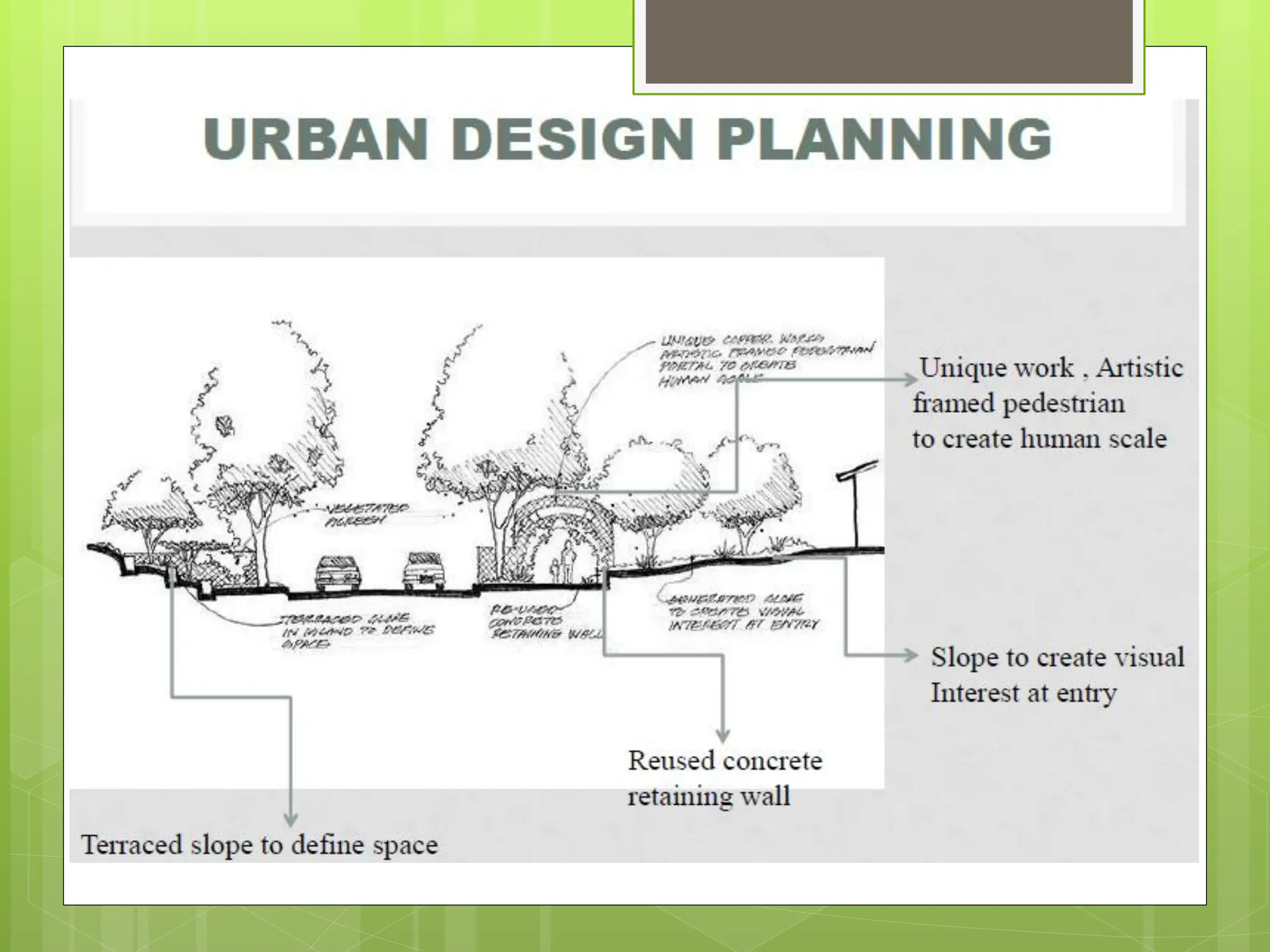
URBAN DESIGN
BACH -803
DR.SHRUTI H KAPUR
PROFESSOR
CT INSTITUTE OF ARCHITECTURE AND PLANNING
Session2024-2025
L1: INTRODUCTION AND SCOPE OF URBAN DESIGN
Urban design
•Today the term ‘ urban design ‘ is used to describe any
design that takes place in the setting of the city. It is an
integrated field addressing traditional and overlapping
concerns of city planning, landscape architecture, civil
engineering
( environmental engineering) and architecture. The
most prominent concern being the design of public,
urban realm at a city and precinct level.
•urban design broadly should be taken to mean the
relationship between different buildings; the relationship
between buildings and streets, squares, parks and
waterways and other spaces which make up the public
domain …. And the patterns of movement and activity
which are hereby established; in short the complex
relationship between elements of built and unbuilt
space.
•Urban design is also an intervention into the
morphology
( shape; structure) of a city which in turn influences and
gets influenced by
-the socio economic, political and cultural realm
-climate, geology, flora and fauna
To create a self sustaining system that enriches human
experience.
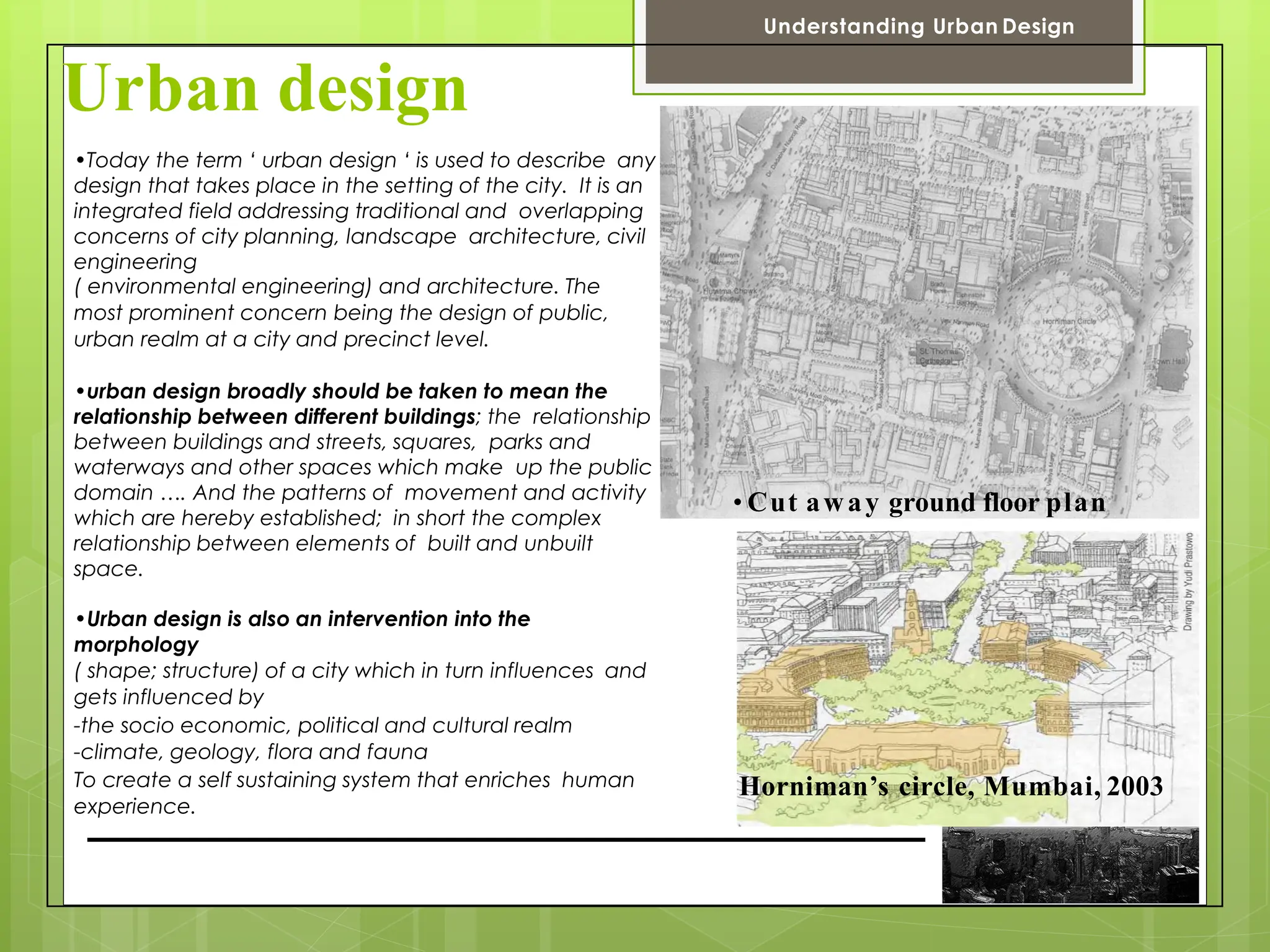
• Cut away ground floor plan
Horniman’s circle, Mumbai, 2003
Understanding Urban Design
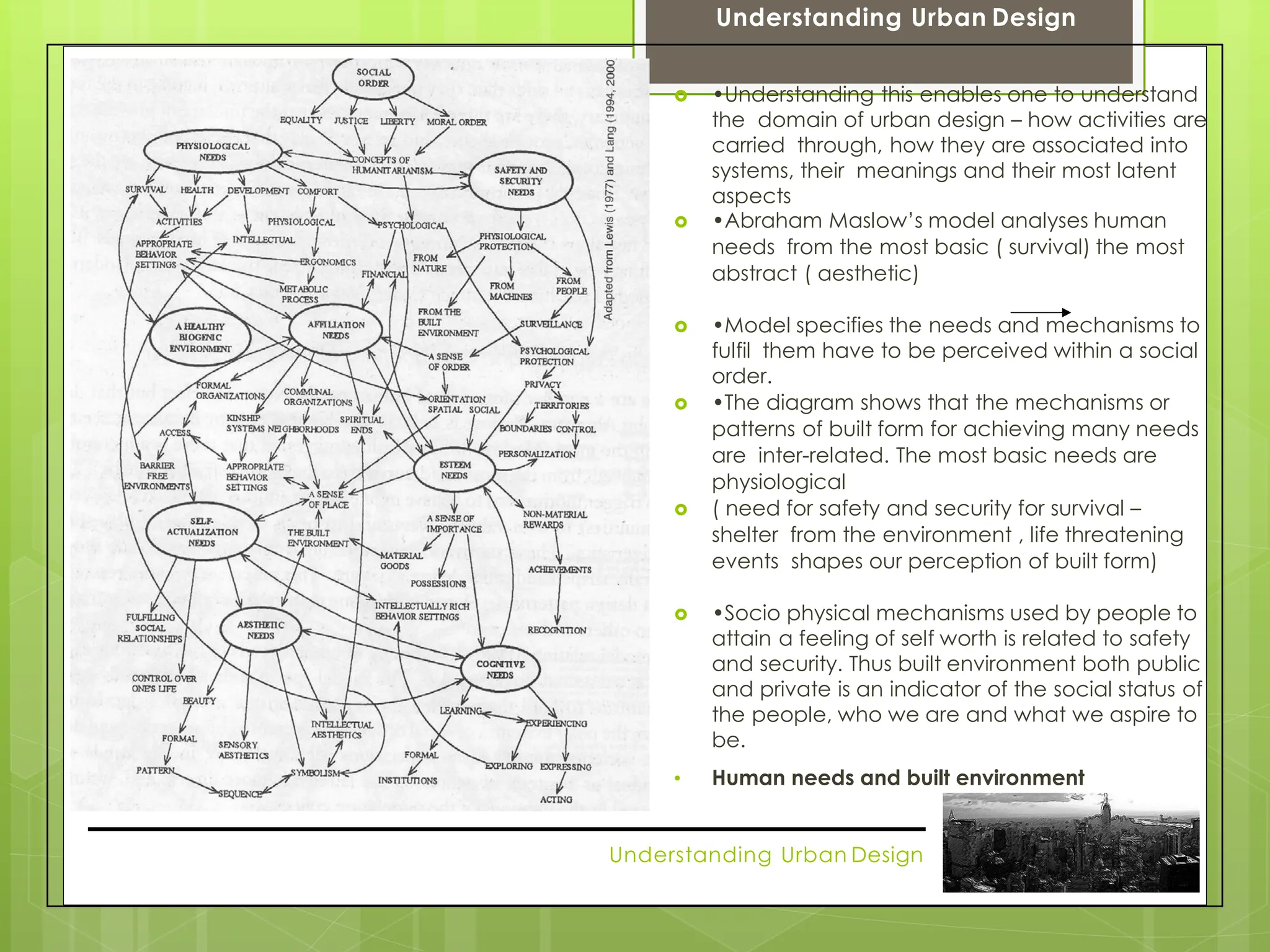
 •Understanding this enables one to understand
the domain of urban design – how activities are
carried through, how they are associated into
systems, their meanings and their most latent
aspects
 •Abraham Maslow’s model analyses human
needs from the most basic ( survival) the most
abstract ( aesthetic)
 •Model specifies the needs and mechanisms to
fulfil them have to be perceived within a social
order.
 •The diagram shows that the mechanisms or
patterns of built form for achieving many needs
are inter-related. The most basic needs are
physiological
 ( need for safety and security for survival –
shelter from the environment , life threatening
events shapes our perception of built form)
 •Socio physical mechanisms used by people to
attain a feeling of self worth is related to safety
and security. Thus built environment both public
and private is an indicator of the social status of
the people, who we are and what we aspire to
be.
• Human needs and built environment
Understanding Urban Design
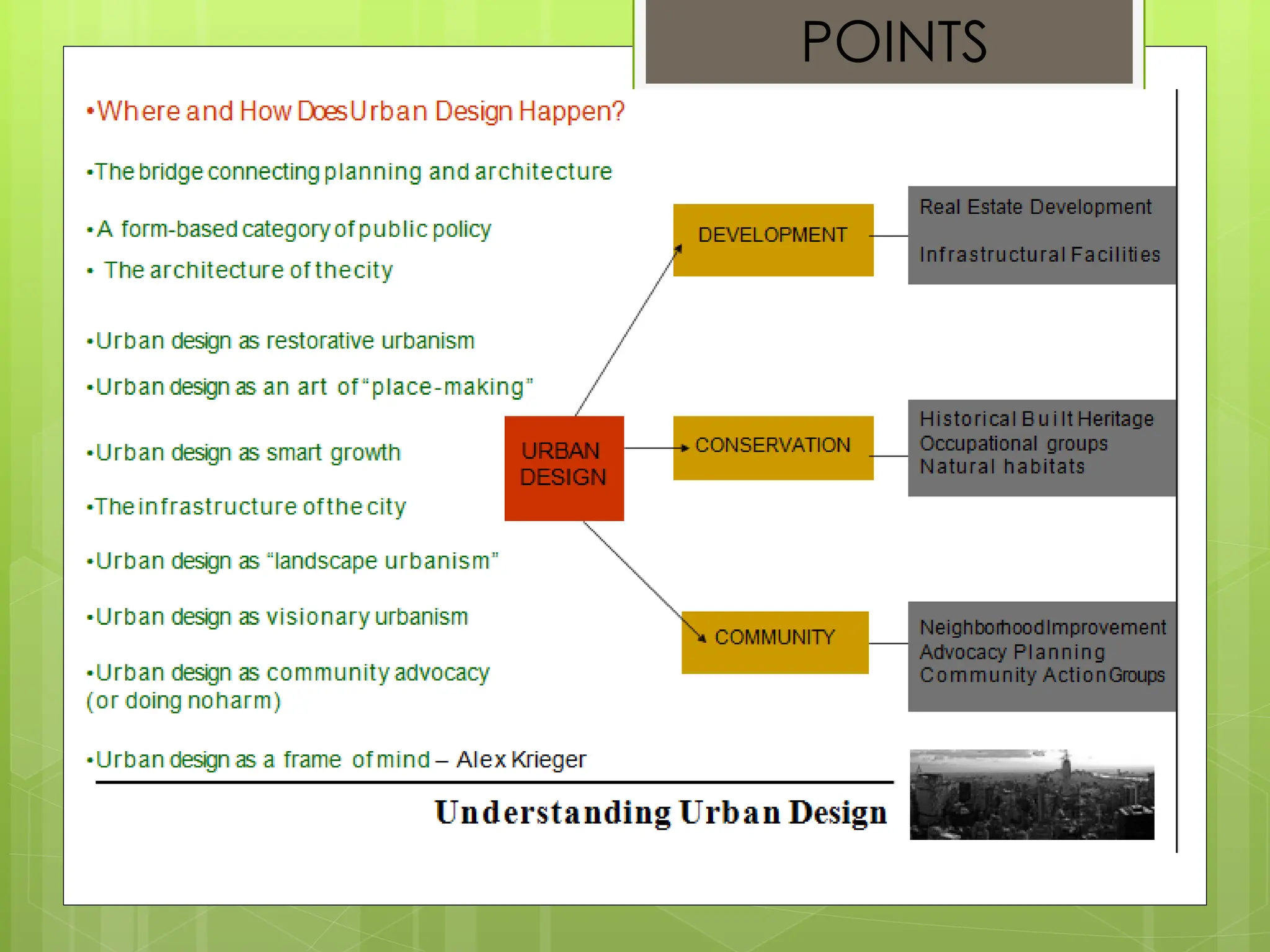
Urban design is the process of designing and shaping
cities,
towns and villages. It is about making connections
between people
and places, movement and urban form, nature and the
built.
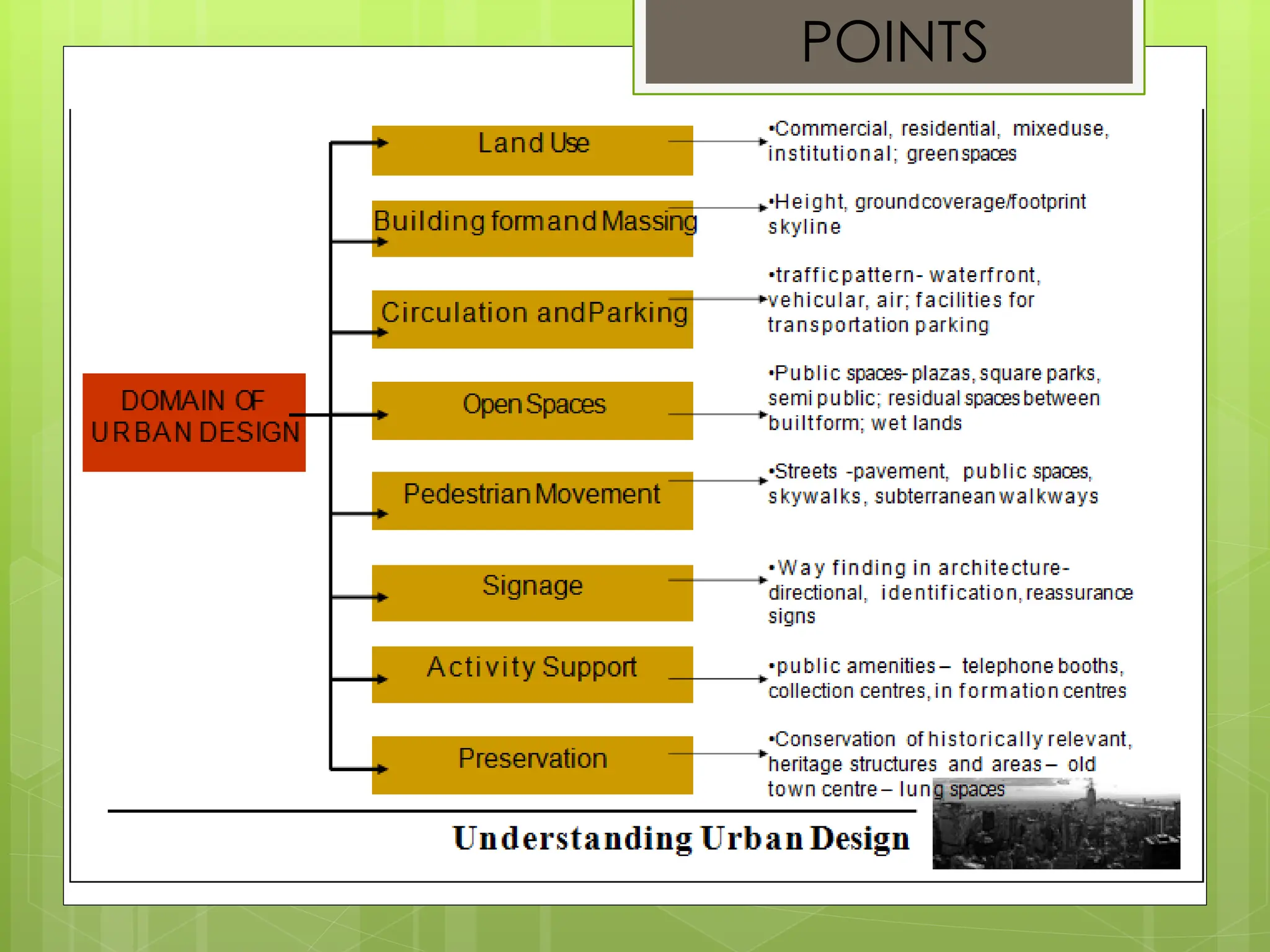
Urban design considers:
❑Pedestrian zones
❑Incorporation of nature within a city
❑Aesthetics
❑Urban structure
❑Urban typology, density and sustainability - spatial
types and morphologies related to intensity of use,
consumption of resources and production
❑Accessibility
❑Character
❑Civil society
POINTS
POINTS
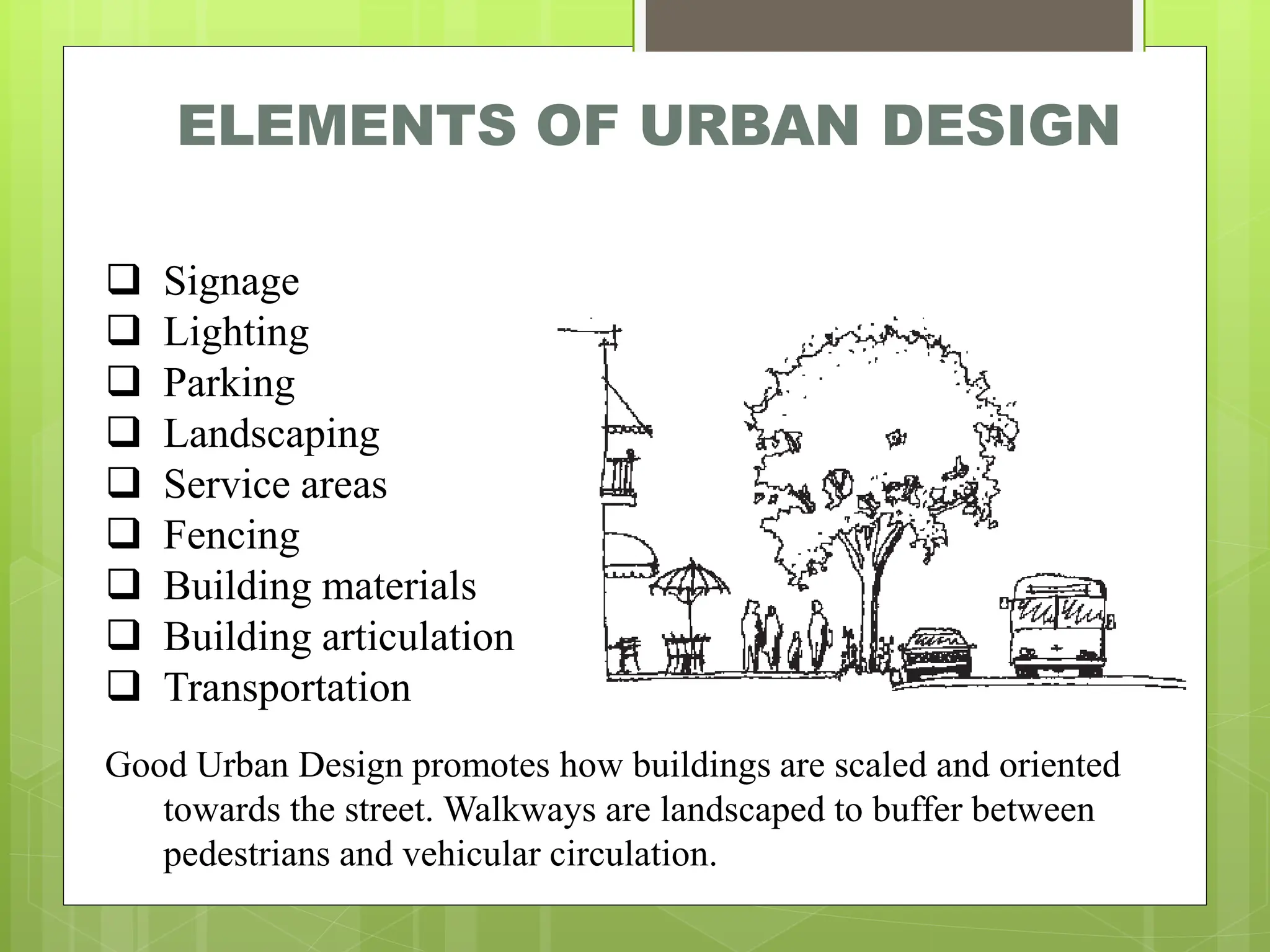
ELEMENTS OF URBAN DESIGN
❑ Signage
❑ Lighting
❑ Parking
❑ Landscaping
❑ Service areas
❑ Fencing
❑ Building materials
❑ Building articulation
❑ Transportation
Good Urban Design promotes how buildings are scaled and oriented
towards the street. Walkways are landscaped to buffer between
pedestrians and vehicular circulation.
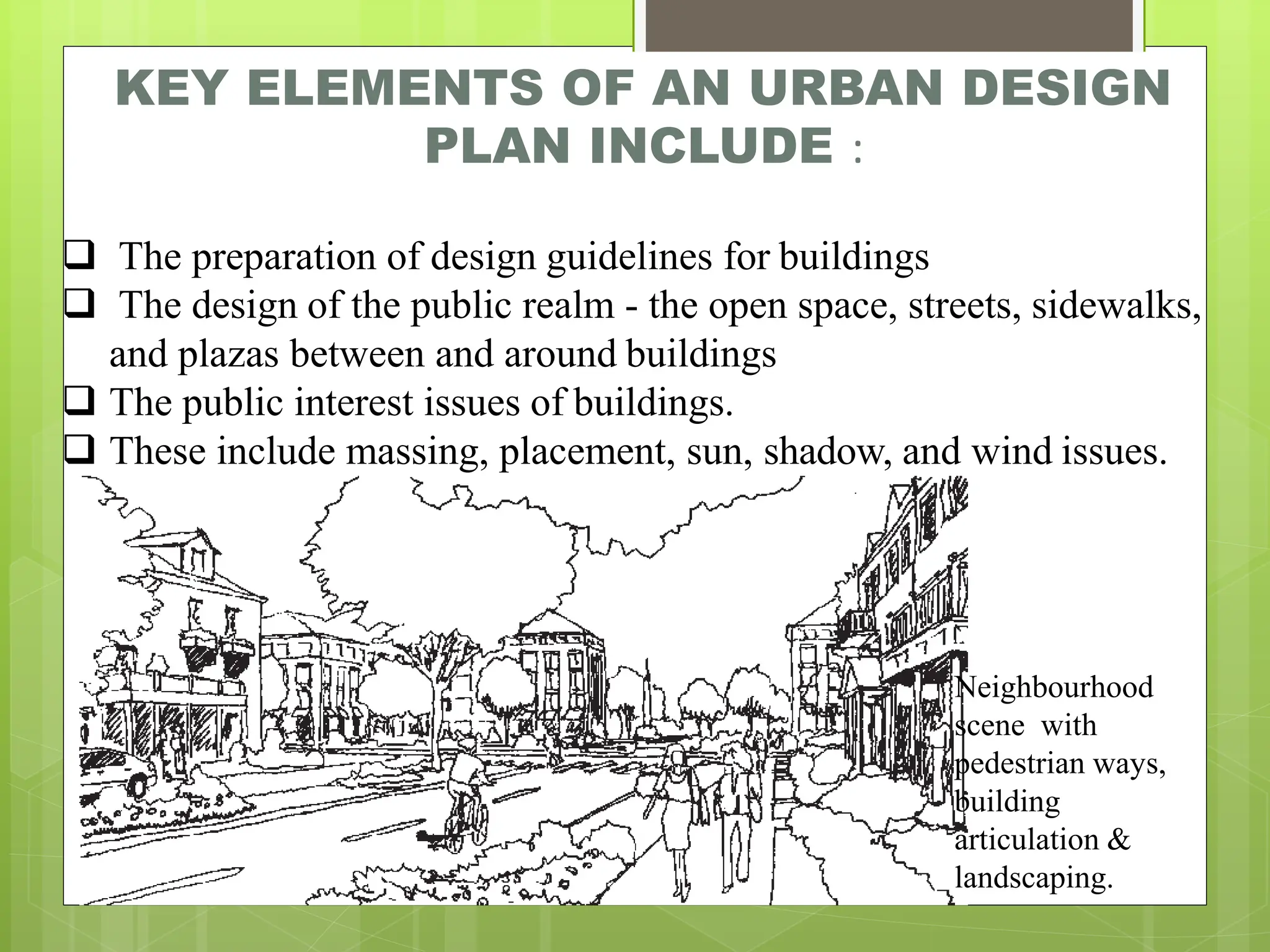
KEY ELEMENTS OF AN URBAN DESIGN
PLAN INCLUDE :
.
❑ The preparation of design guidelines for buildings
❑ The design of the public realm - the open space, streets, sidewalks,
and plazas between and around buildings
❑ The public interest issues of buildings.
❑ These include massing, placement, sun, shadow, and wind issues.
Neighbourhood
scene with
pedestrian ways,
building
articulation &
landscaping.
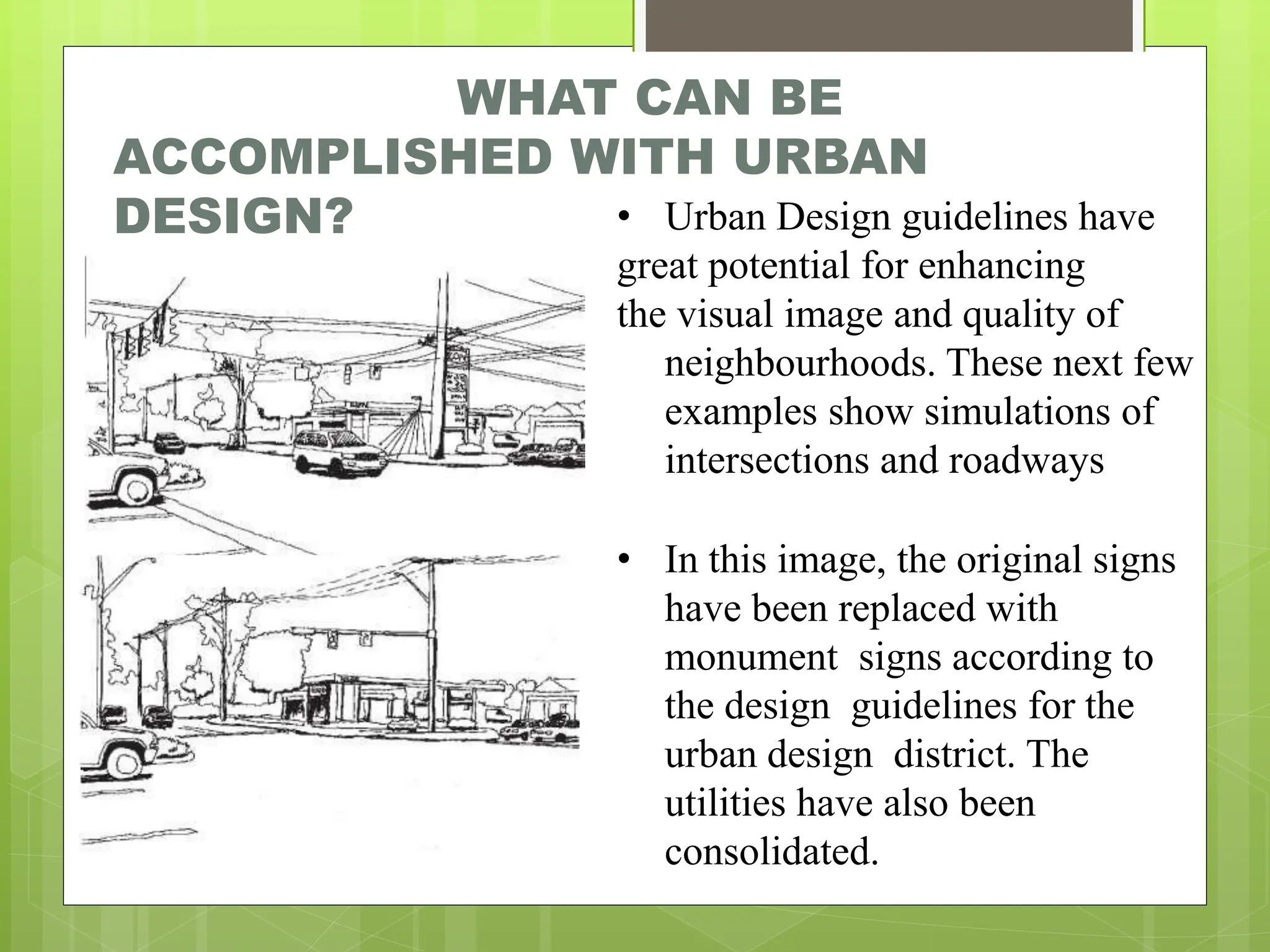
WHAT CAN BE
ACCOMPLISHED WITH URBAN
DESIGN? • Urban Design guidelines have
great potential for enhancing
the visual image and quality of
neighbourhoods. These next few
examples show simulations of
intersections and roadways
• In this image, the original signs
have been replaced with
monument signs according to
the design guidelines for the
urban design district. The
utilities have also been
consolidated.
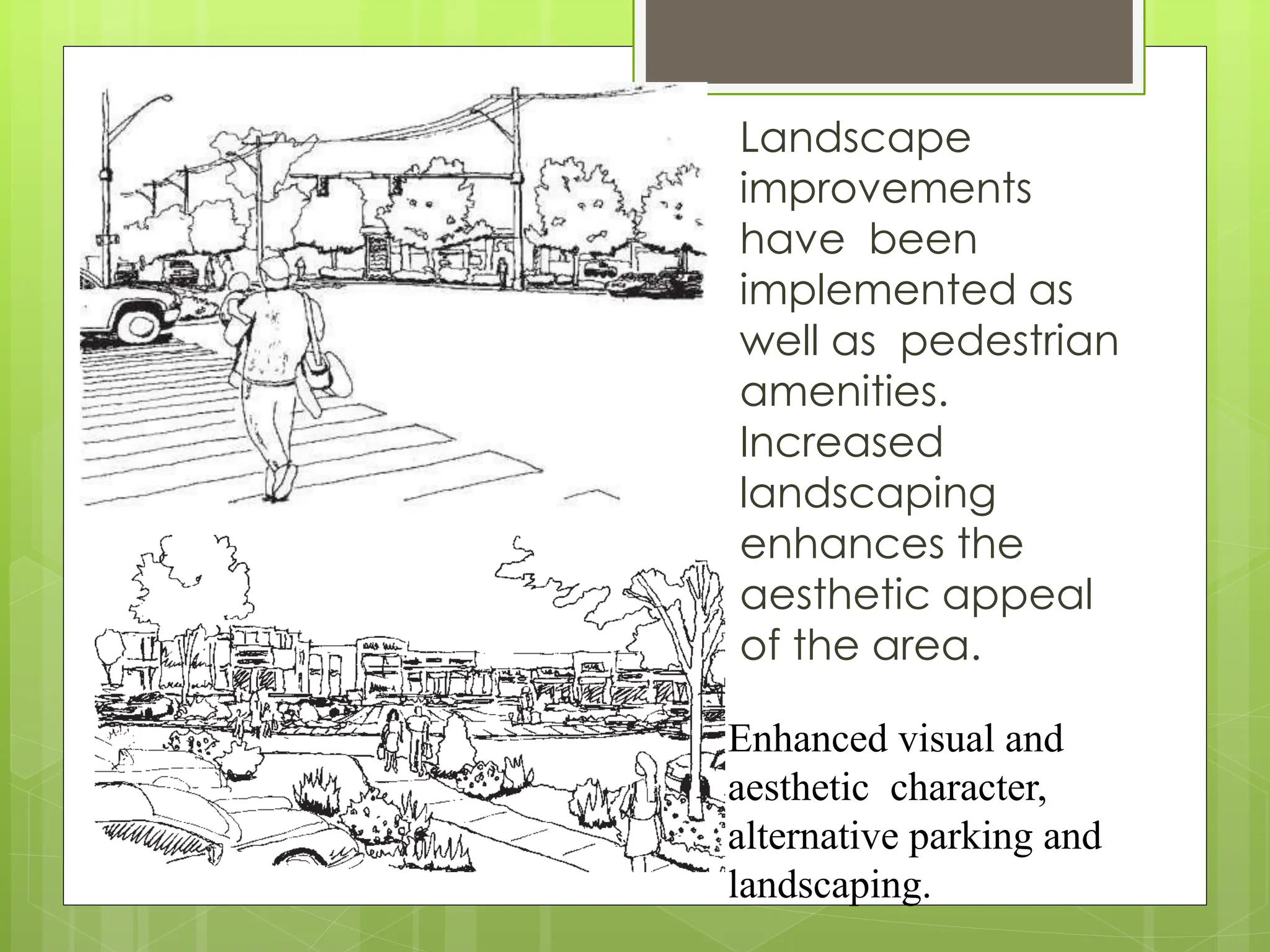
Landscape
improvements
have been
implemented as
well as pedestrian
amenities.
Increased
landscaping
enhances the
aesthetic appeal
of the area.
Enhanced visual and
aesthetic character,
alternative parking and
landscaping.
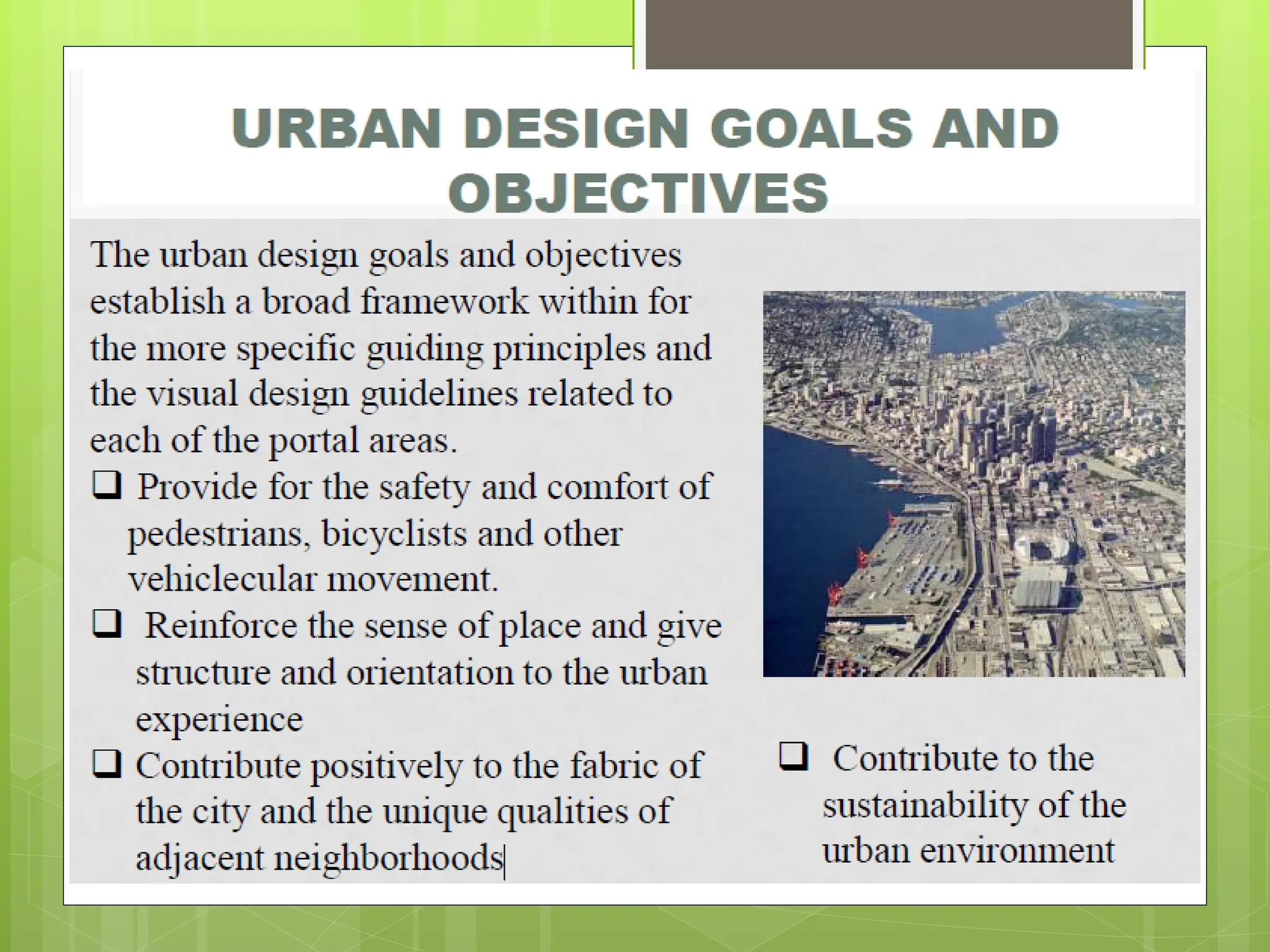
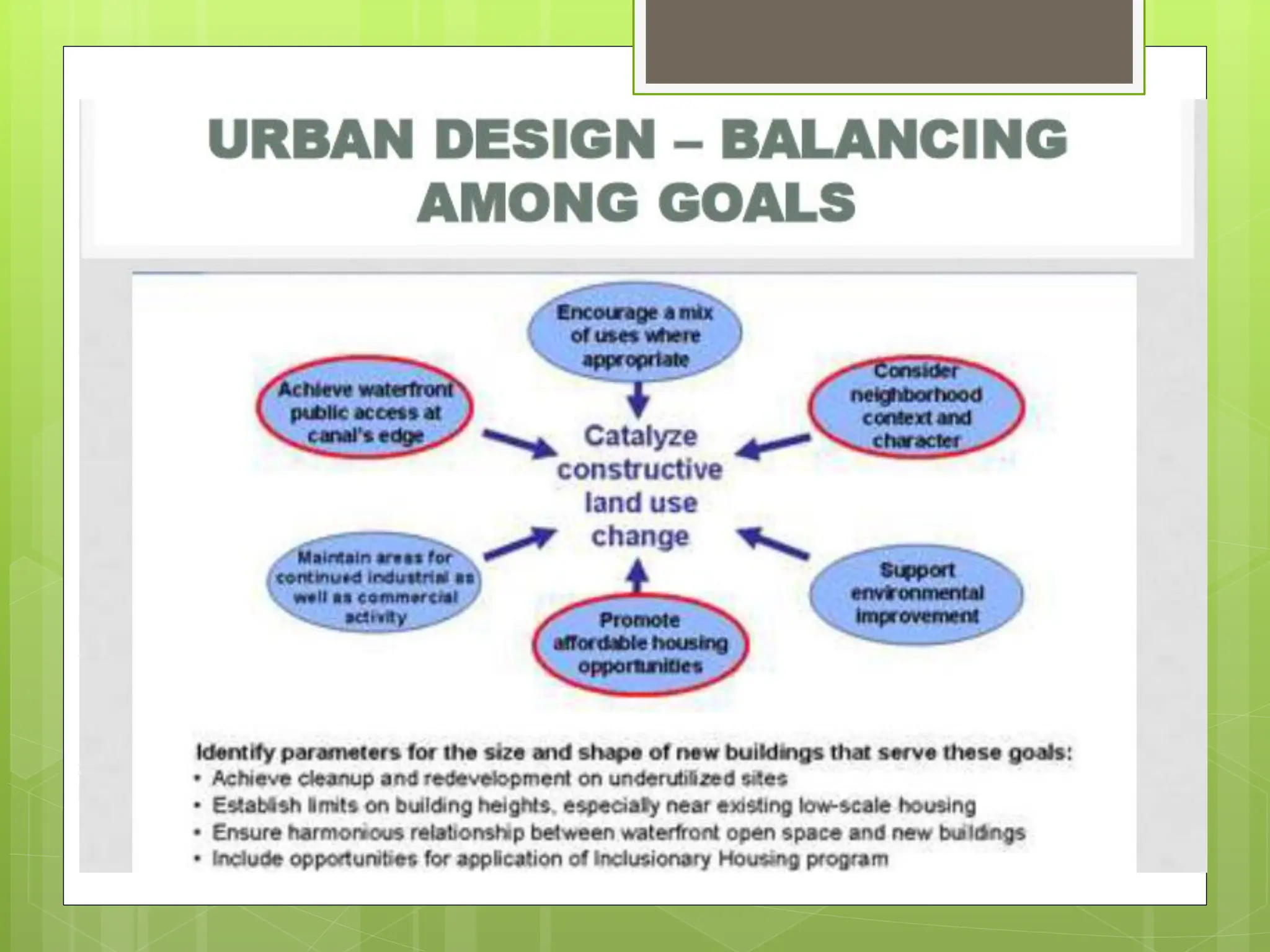
OBJECTIVES OF URBAN DESIGN
1. Context facilitates into one efficient, supportive community,
emphasises on the design, responds outwardly to the street pattern and
establishes a modern, dynamic environment oriented to pedestrians,
combines of practical social space and visual interest by creating an
exciting, cohesive urban streetscape.
2. Characterprovides space with its own identity having dramatic visual
appeal through the use of decorative panels, offering artistic users clean,
functional spaces and highlights specific areas
3. Creativity provides design that is both attractive and user- friendly,
colour and form are used to draw attention to entry points and attract
people toward the defined areas.
4. Custodianship improves efficiency in terms of land use,transportation
and energy, will generate 24 hour activity and ‘eyes on the street’,
improving safety and security in the area.
4.Choice brings flexibility into the design, allows the buildings to adapt styles
and techniques, maintains a functional and efficient styles.
5.Ease of movement maintain the connectivity within and along the
premises, pedestrian-oriented streetscape designed to control
traffic, allowing cycle and public transport use to flourish.
6.Legibity gives the clear image of the built up area and provides the
purpose of the area .
7.Continuity and enclosure promotes the continuity of street frontages and
the enclosure of space by development which clearly defines private and
public areas .
8.Quality of the public realm promotes public spaces and routes to
attract public interest
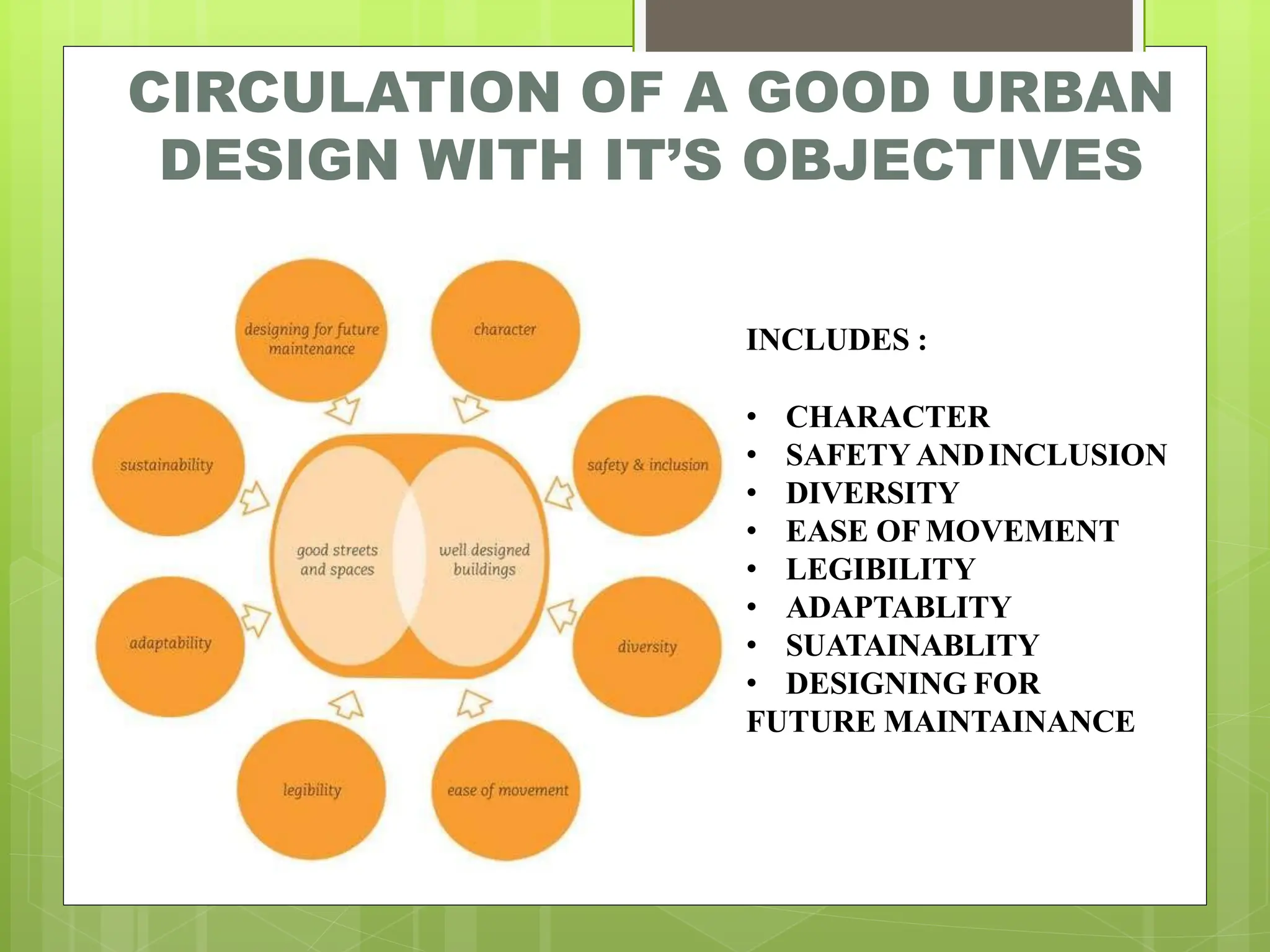
CIRCULATION OF A GOOD URBAN
DESIGN WITH IT’S OBJECTIVES
INCLUDES :
• CHARACTER
• SAFETY ANDINCLUSION
• DIVERSITY
• EASE OF MOVEMENT
• LEGIBILITY
• ADAPTABLITY
• SUATAINABLITY
• DESIGNING FOR
FUTURE MAINTAINANCE
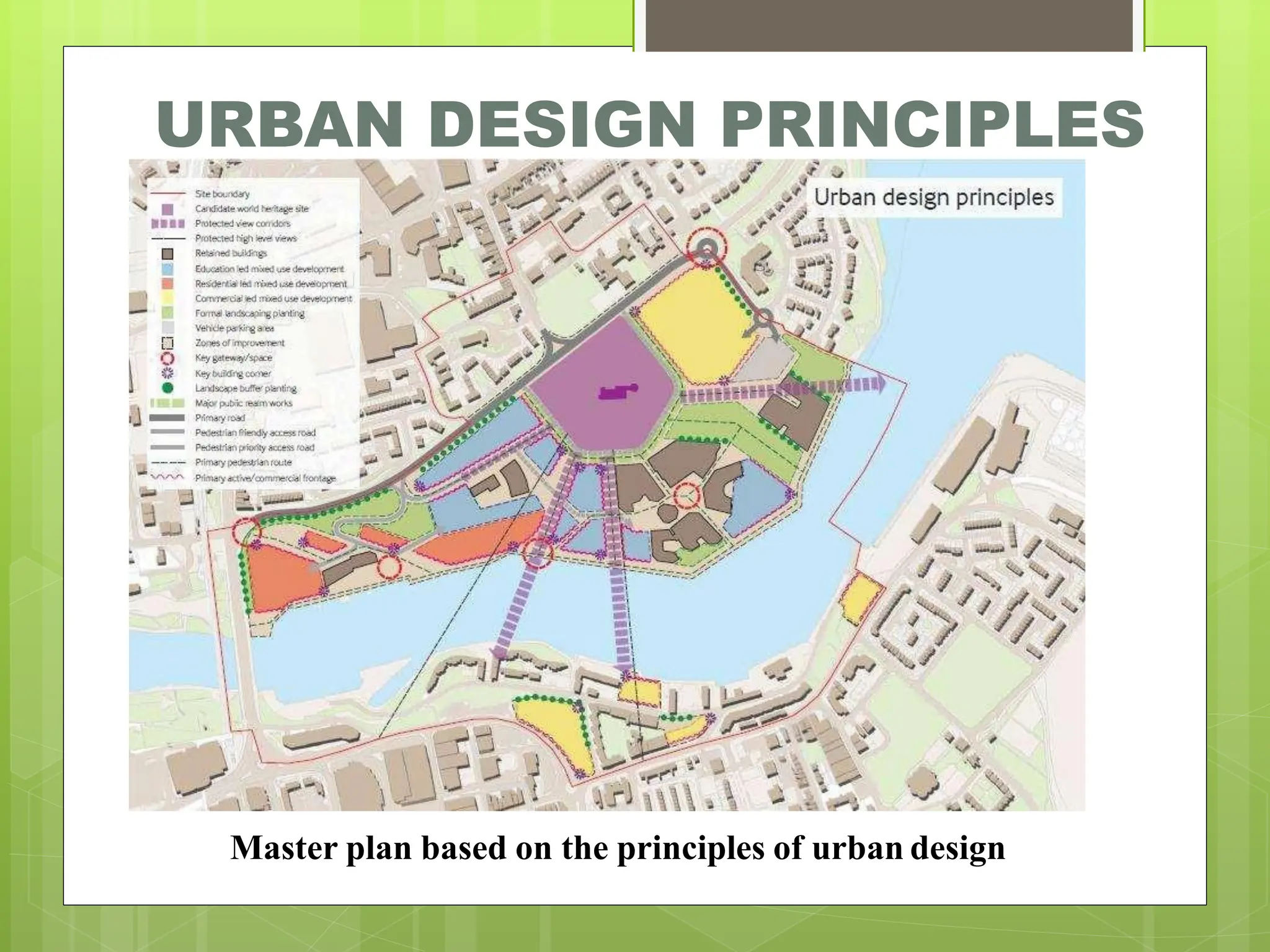
URBAN DESIGN PRINCIPLES
Master plan based on the principles of urban design
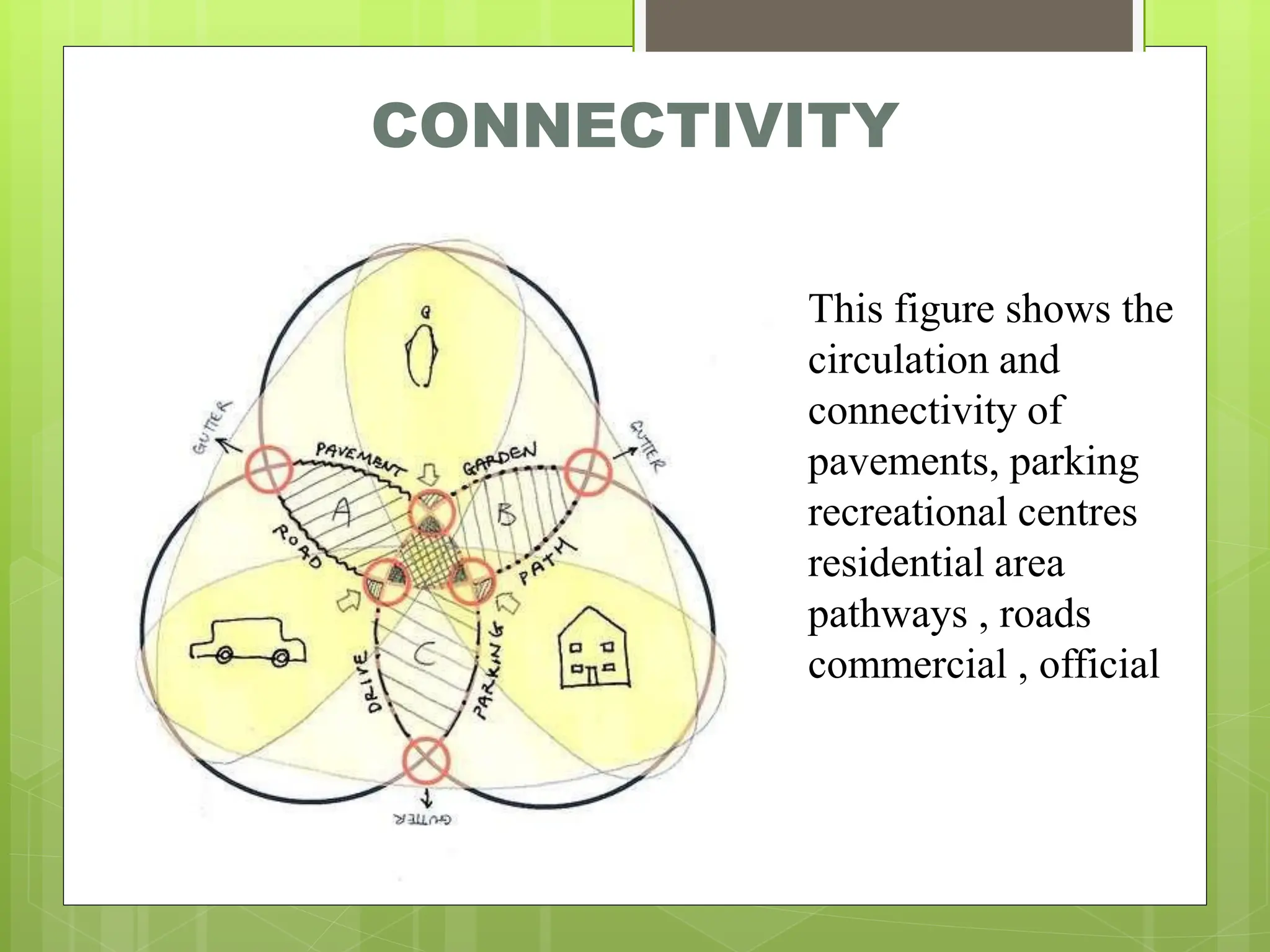
CONNECTIVITY
This figure shows the
circulation and
connectivity of
pavements, parking
recreational centres
residential area
pathways , roads
commercial , official
PRINCIPLES OF URBAN DESIGN
• THE METROPOLITAN REGION IS A FUNDAMENTAL
ECONOMIC UNIT.
• PLACE MAKING : IT DEFINES THE SPACE WITHOUT
HAVING ACTUALLYA DEFINATE BOUNDARIES
FOR EXAMPLE : HANUMAN TEMPLE , DELHI
• INDEFINATE EDGES : THE ACTIVITIES ITSELF MAKE A
BOUNDARY OF THE AREAAND DEMARKATES THE
SPACE . A CITY NEEDS TO HAVE A CENTER WHICH IS
ACTUALLY NOT THE CENTER BUT ITS WORKING AND
ECONOMY MAKES IT .
FOR EAMPLE : NEHRU PLACE , CP DELHI
• THE METROPOLIS SHOULD HAVE A FRAGILE AND
FRIENDLY RELATIONSHIP BETWEEN HINTERLEND
AND LANDSCAPE AREAS.
• DEVELOPMENT AND REDEVELOPMENT OF CITIES
AND TOWNS.
• THE DEVELOPMENT PATTERN SHOULD NOT BLUR
OR ERDICATE THE EDGES OF THE METROPOLIS.
• REVENUES AND RESOURCES SHOULD BE USED
COOPERATELY .
• OPEN SPACES : THERE MUST BE OPEN SPACES
BETWEEN THE DIFFERENT NEIGHBOURHOOD UNIT
WHICH ACTS AS BREATHER.
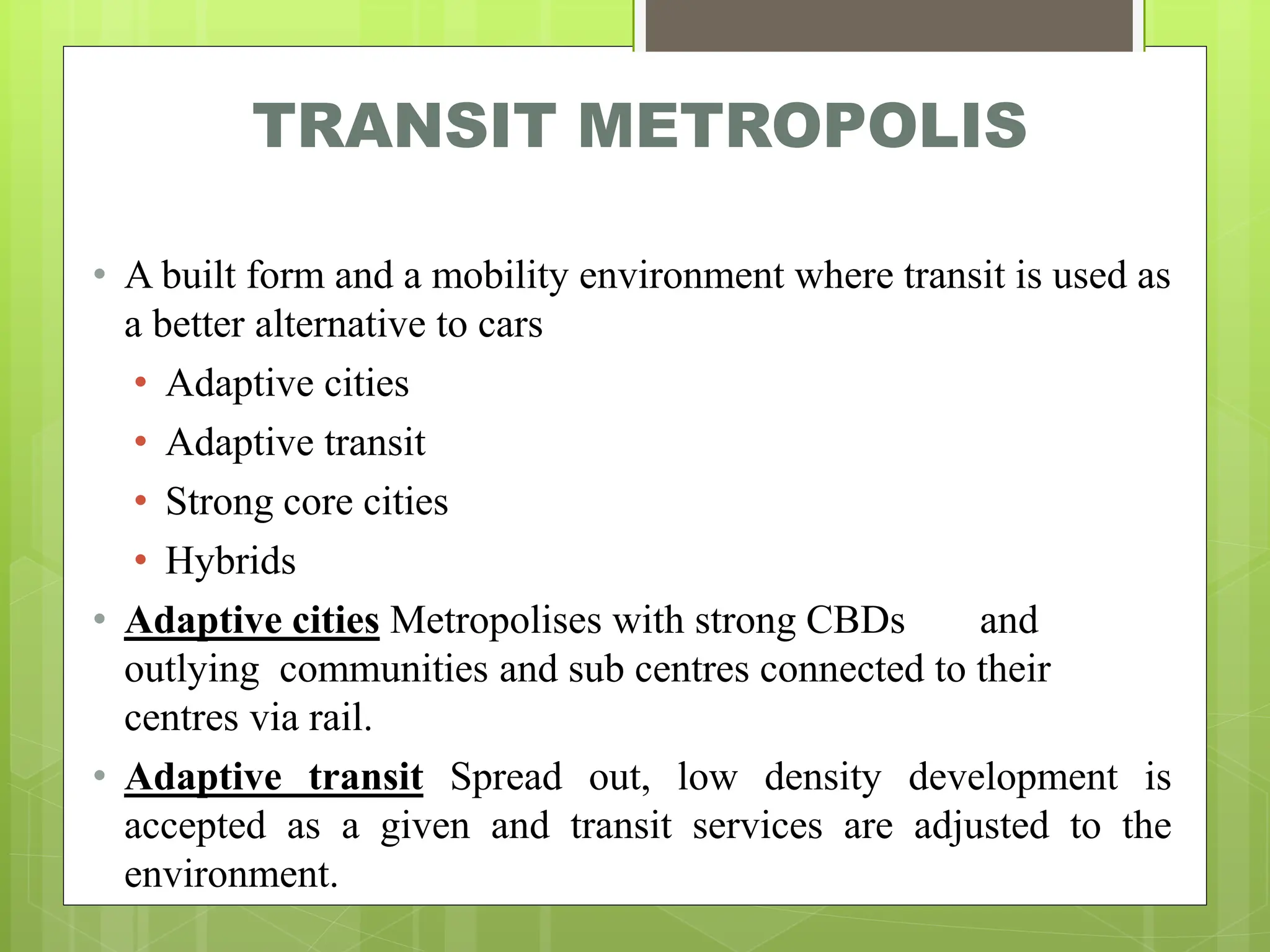
TRANSIT METROPOLIS
• A built form and a mobility environment where transit is used as
a better alternative to cars
• Adaptive cities
• Adaptive transit
• Strong core cities
• Hybrids
• Adaptive cities Metropolises with strong CBDs and
outlying communities and sub centres connected to their
centres via rail.
• Adaptive transit Spread out, low density development is
accepted as a given and transit services are adjusted to the
environment.
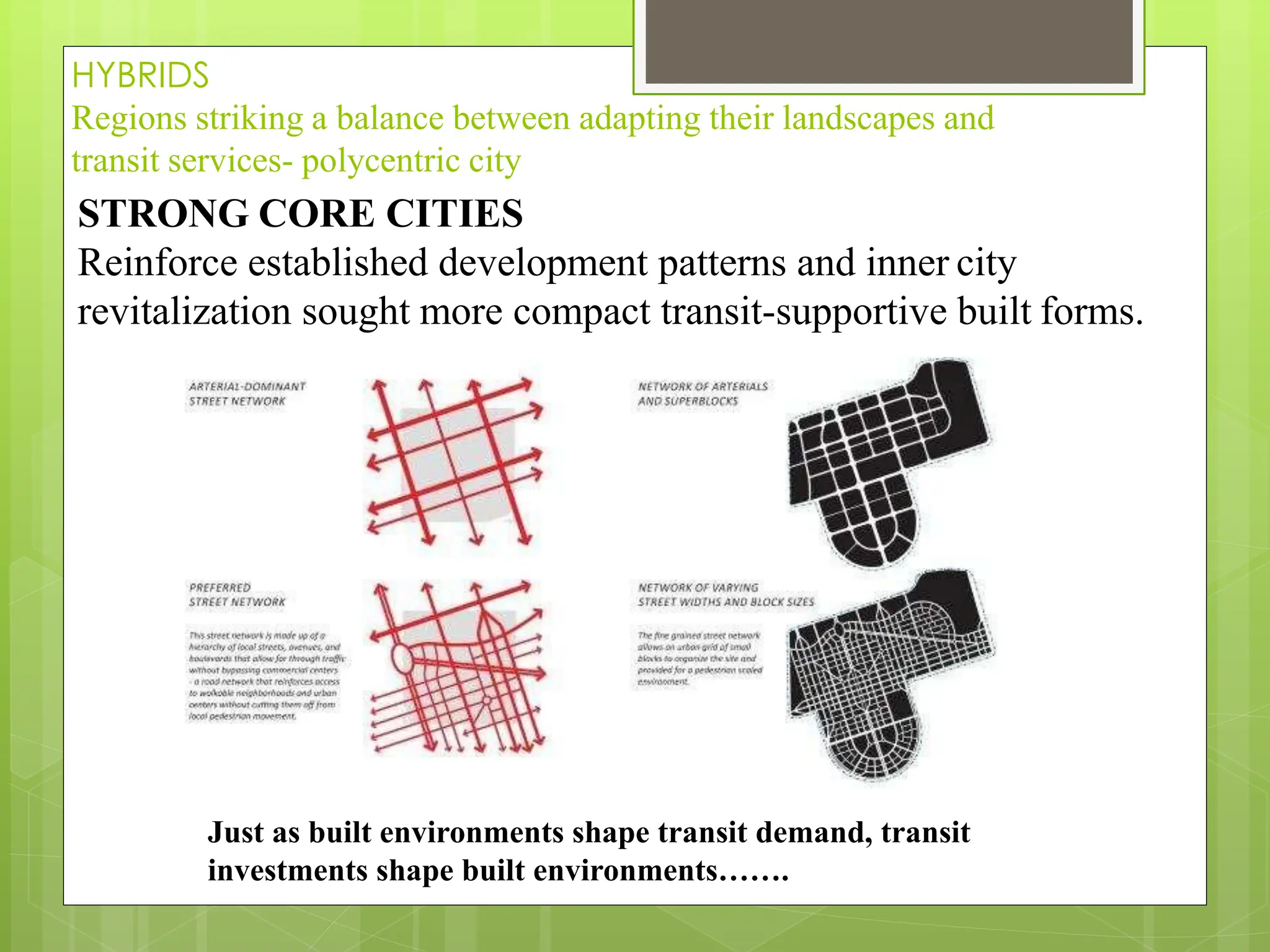
HYBRIDS
Regions striking a balance between adapting their landscapes and
transit services- polycentric city
STRONG CORE CITIES
Reinforce established development patterns and inner city
revitalization sought more compact transit-supportive built forms.
Just as built environments shape transit demand, transit
investments shape built environments…….
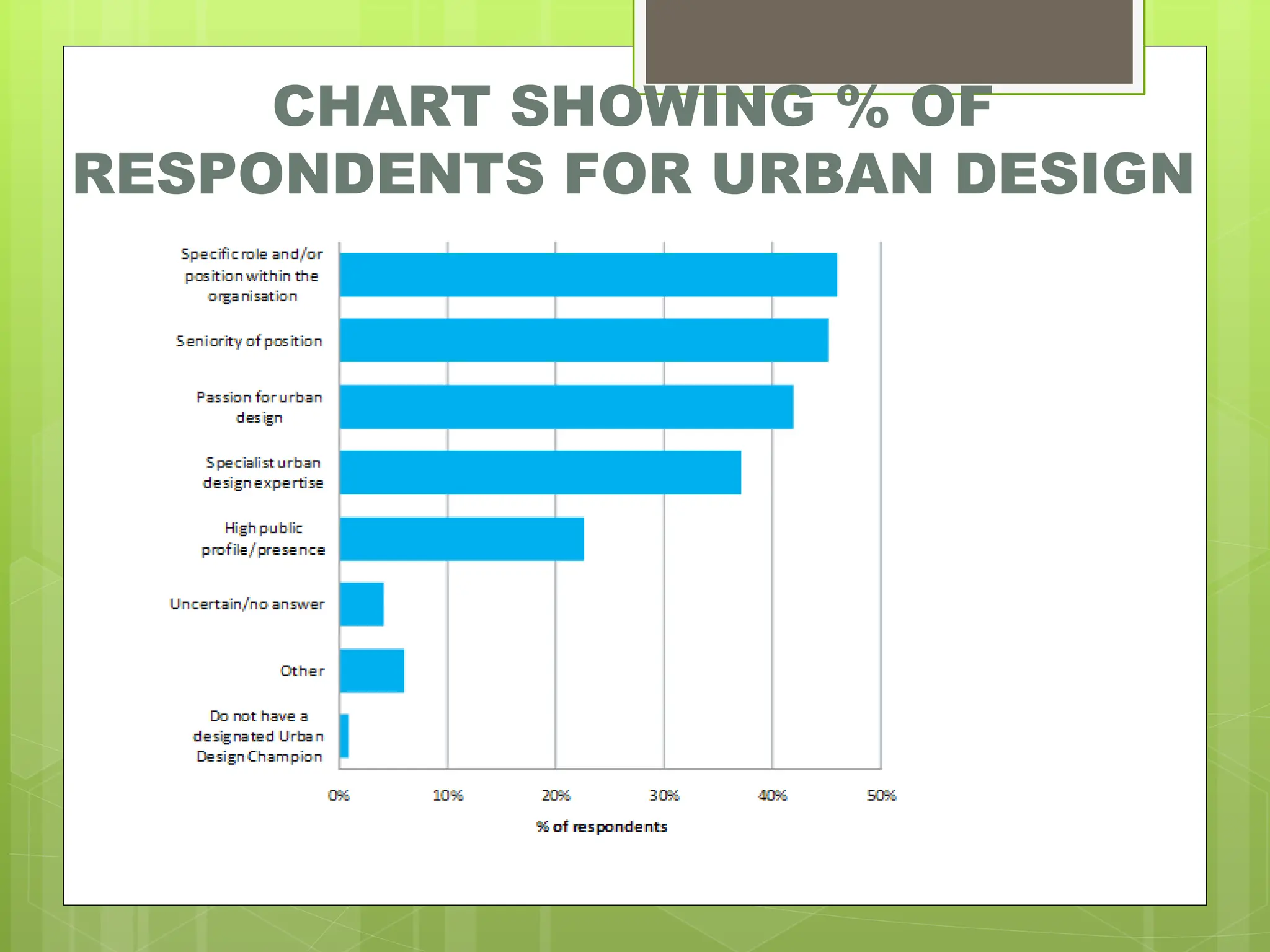
CHART SHOWING % OF
RESPONDENTS FOR URBAN DESIGN
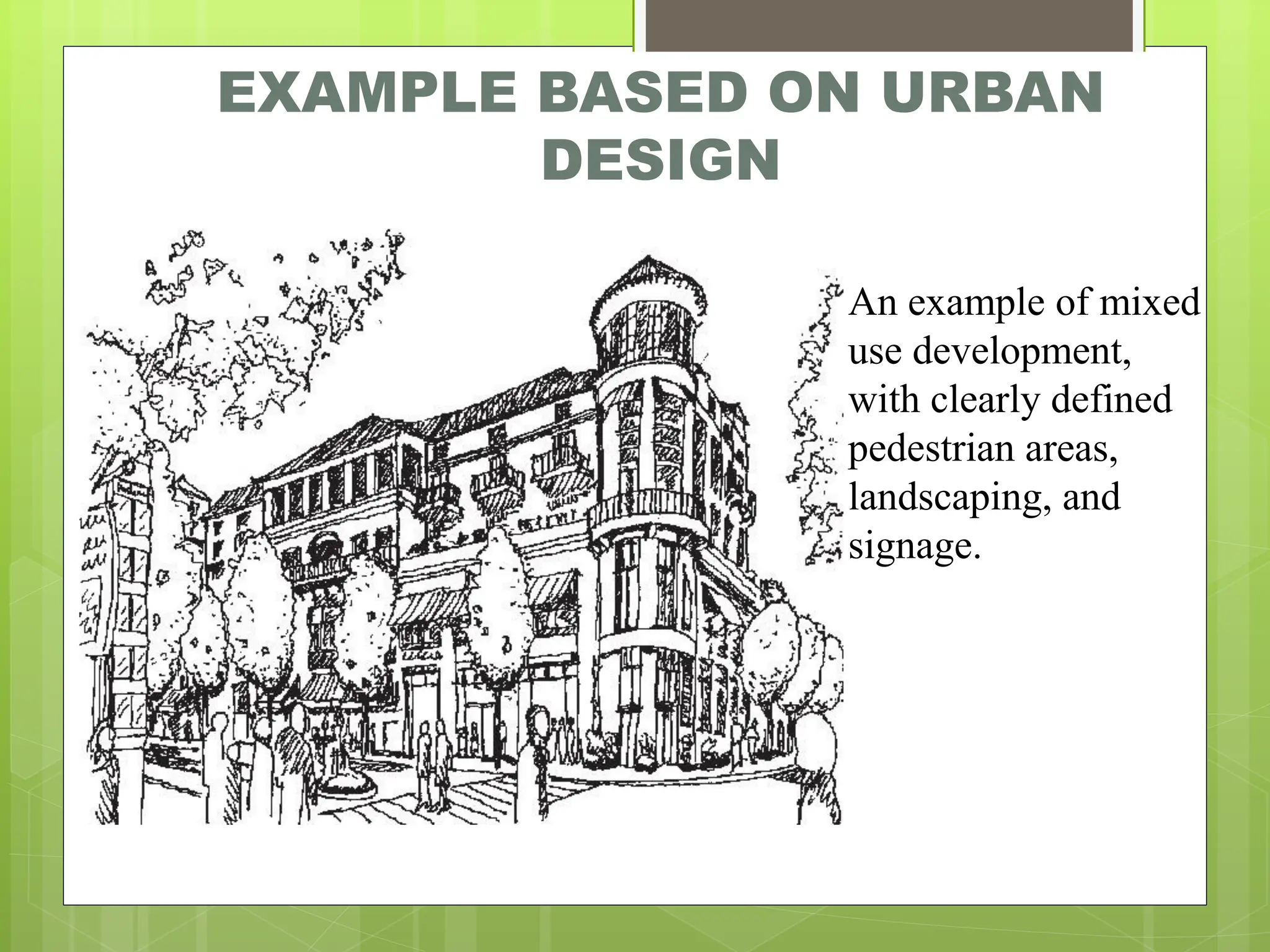
EXAMPLE BASED ON URBAN
DESIGN
An example of mixed
use development,
with clearly defined
pedestrian areas,
landscaping, and
signage.
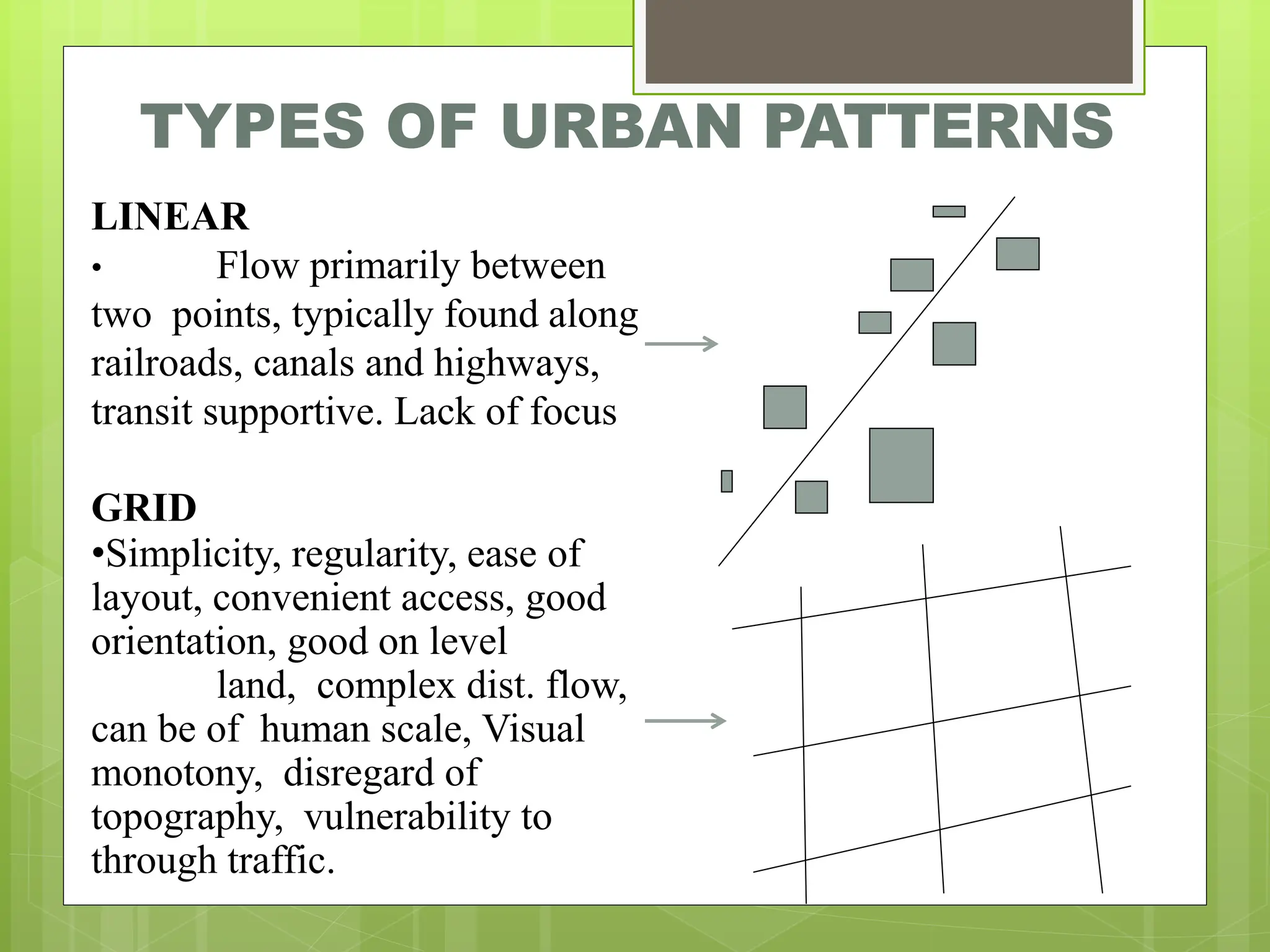
TYPES OF URBAN PATTERNS
LINEAR
• Flow primarily between
two points, typically found along
railroads, canals and highways,
transit supportive. Lack of focus
GRID
•Simplicity, regularity, ease of
layout, convenient access, good
orientation, good on level
land, complex dist. flow,
can be of human scale, Visual
monotony, disregard of
topography, vulnerability to
through traffic.
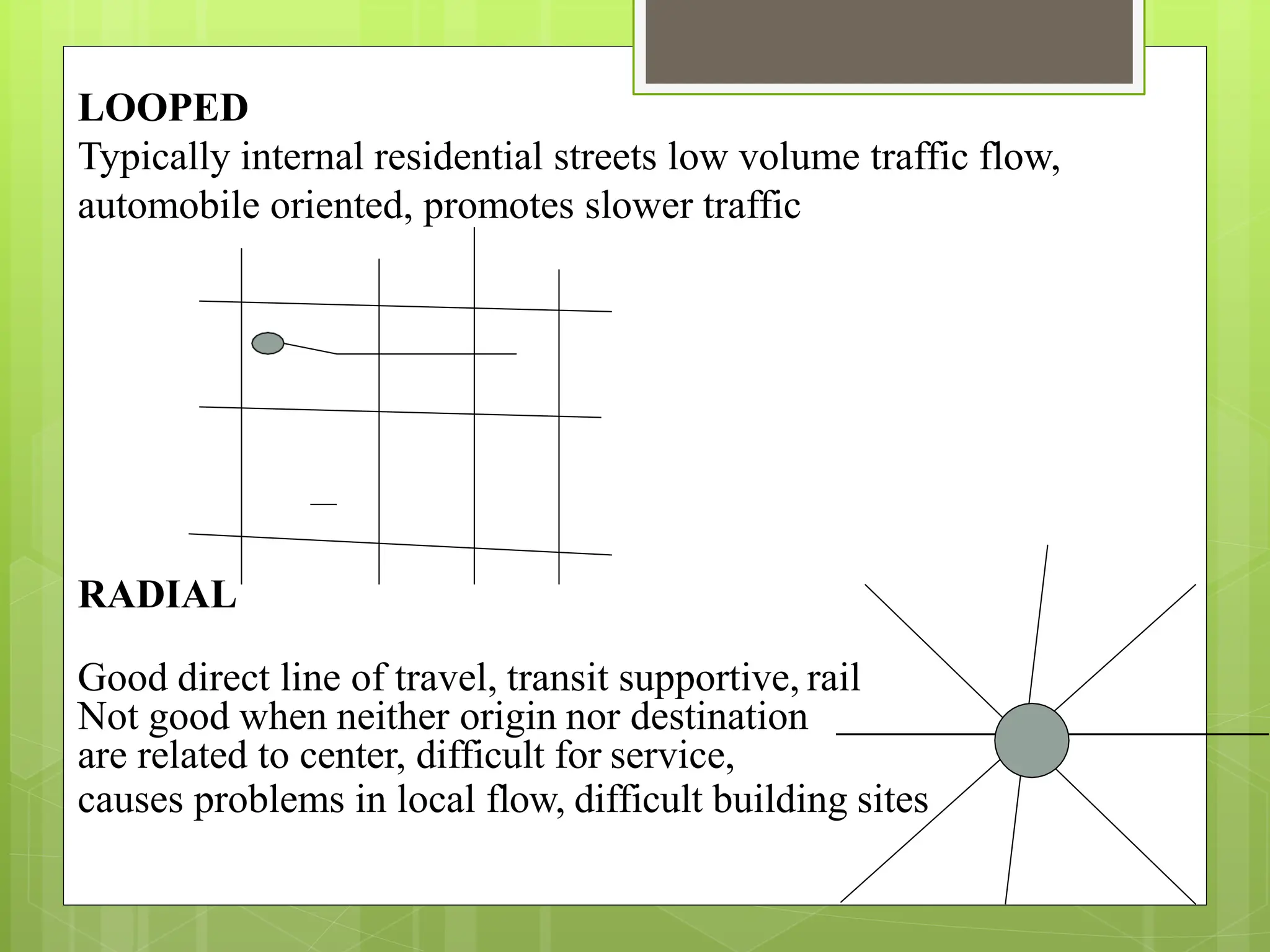
LOOPED
Typically internal residential streets low volume traffic flow,
automobile oriented, promotes slower traffic
RADIAL
Good direct line of travel, transit supportive, rail
Not good when neither origin nor destination
are related to center, difficult for service,
causes problems in local flow, difficult building sites
CONCLUSION
• TO ENCOURAGE PEDESTRIAN MOVEMENTS AND
DISCOURAGE THE AUTOMOBLIES USE AND HENCE
CONSERVE ENERGY
• TO PLAN RESOURCE EFFICIENT AND
SUSTAINABLE URBAN CITIES .
• TO PRESERVE AND RENEW THE HISTORIC
LANDMARKS.
• TO PROVIDE OPEN SPACES BETWEEN THE
NEIGHBORHOOD UNITS TO PROVIDE THE
REVILALIZATION ZONES.
• URBAN FABRIC- CONSTITUTIONAL BUILDINGS
AND THE PUBLIC GATHERING SPACES SHOULD
HAVE DISTINT FORMS AS THEY SERVE DISTINCT
ROLES.
POINTS
THANK YOU

L-1 BACH 803 Introduction of URBAN DESIGN.pdf

  • 1.
    URBAN DESIGN BACH -803 DR.SHRUTIH KAPUR PROFESSOR CT INSTITUTE OF ARCHITECTURE AND PLANNING Session2024-2025 L1: INTRODUCTION AND SCOPE OF URBAN DESIGN
  • 2.
    Urban design •Today theterm ‘ urban design ‘ is used to describe any design that takes place in the setting of the city. It is an integrated field addressing traditional and overlapping concerns of city planning, landscape architecture, civil engineering ( environmental engineering) and architecture. The most prominent concern being the design of public, urban realm at a city and precinct level. •urban design broadly should be taken to mean the relationship between different buildings; the relationship between buildings and streets, squares, parks and waterways and other spaces which make up the public domain …. And the patterns of movement and activity which are hereby established; in short the complex relationship between elements of built and unbuilt space. •Urban design is also an intervention into the morphology ( shape; structure) of a city which in turn influences and gets influenced by -the socio economic, political and cultural realm -climate, geology, flora and fauna To create a self sustaining system that enriches human experience. • Cut away ground floor plan Horniman’s circle, Mumbai, 2003 Understanding Urban Design
  • 3.
     •Understanding thisenables one to understand the domain of urban design – how activities are carried through, how they are associated into systems, their meanings and their most latent aspects  •Abraham Maslow’s model analyses human needs from the most basic ( survival) the most abstract ( aesthetic)  •Model specifies the needs and mechanisms to fulfil them have to be perceived within a social order.  •The diagram shows that the mechanisms or patterns of built form for achieving many needs are inter-related. The most basic needs are physiological  ( need for safety and security for survival – shelter from the environment , life threatening events shapes our perception of built form)  •Socio physical mechanisms used by people to attain a feeling of self worth is related to safety and security. Thus built environment both public and private is an indicator of the social status of the people, who we are and what we aspire to be. • Human needs and built environment Understanding Urban Design Understanding Urban Design
  • 4.
    Urban design isthe process of designing and shaping cities, towns and villages. It is about making connections between people and places, movement and urban form, nature and the built. Urban design considers: ❑Pedestrian zones ❑Incorporation of nature within a city ❑Aesthetics ❑Urban structure ❑Urban typology, density and sustainability - spatial types and morphologies related to intensity of use, consumption of resources and production ❑Accessibility ❑Character ❑Civil society
  • 5.
  • 6.
  • 10.
    ELEMENTS OF URBANDESIGN ❑ Signage ❑ Lighting ❑ Parking ❑ Landscaping ❑ Service areas ❑ Fencing ❑ Building materials ❑ Building articulation ❑ Transportation Good Urban Design promotes how buildings are scaled and oriented towards the street. Walkways are landscaped to buffer between pedestrians and vehicular circulation.
  • 11.
    KEY ELEMENTS OFAN URBAN DESIGN PLAN INCLUDE : . ❑ The preparation of design guidelines for buildings ❑ The design of the public realm - the open space, streets, sidewalks, and plazas between and around buildings ❑ The public interest issues of buildings. ❑ These include massing, placement, sun, shadow, and wind issues. Neighbourhood scene with pedestrian ways, building articulation & landscaping.
  • 12.
    WHAT CAN BE ACCOMPLISHEDWITH URBAN DESIGN? • Urban Design guidelines have great potential for enhancing the visual image and quality of neighbourhoods. These next few examples show simulations of intersections and roadways • In this image, the original signs have been replaced with monument signs according to the design guidelines for the urban design district. The utilities have also been consolidated.
  • 13.
    Landscape improvements have been implemented as wellas pedestrian amenities. Increased landscaping enhances the aesthetic appeal of the area. Enhanced visual and aesthetic character, alternative parking and landscaping.
  • 14.
    OBJECTIVES OF URBANDESIGN 1. Context facilitates into one efficient, supportive community, emphasises on the design, responds outwardly to the street pattern and establishes a modern, dynamic environment oriented to pedestrians, combines of practical social space and visual interest by creating an exciting, cohesive urban streetscape. 2. Characterprovides space with its own identity having dramatic visual appeal through the use of decorative panels, offering artistic users clean, functional spaces and highlights specific areas 3. Creativity provides design that is both attractive and user- friendly, colour and form are used to draw attention to entry points and attract people toward the defined areas. 4. Custodianship improves efficiency in terms of land use,transportation and energy, will generate 24 hour activity and ‘eyes on the street’, improving safety and security in the area.
  • 15.
    4.Choice brings flexibilityinto the design, allows the buildings to adapt styles and techniques, maintains a functional and efficient styles. 5.Ease of movement maintain the connectivity within and along the premises, pedestrian-oriented streetscape designed to control traffic, allowing cycle and public transport use to flourish. 6.Legibity gives the clear image of the built up area and provides the purpose of the area . 7.Continuity and enclosure promotes the continuity of street frontages and the enclosure of space by development which clearly defines private and public areas . 8.Quality of the public realm promotes public spaces and routes to attract public interest
  • 16.
    CIRCULATION OF AGOOD URBAN DESIGN WITH IT’S OBJECTIVES INCLUDES : • CHARACTER • SAFETY ANDINCLUSION • DIVERSITY • EASE OF MOVEMENT • LEGIBILITY • ADAPTABLITY • SUATAINABLITY • DESIGNING FOR FUTURE MAINTAINANCE
  • 17.
    URBAN DESIGN PRINCIPLES Masterplan based on the principles of urban design
  • 18.
    CONNECTIVITY This figure showsthe circulation and connectivity of pavements, parking recreational centres residential area pathways , roads commercial , official
  • 19.
    PRINCIPLES OF URBANDESIGN • THE METROPOLITAN REGION IS A FUNDAMENTAL ECONOMIC UNIT. • PLACE MAKING : IT DEFINES THE SPACE WITHOUT HAVING ACTUALLYA DEFINATE BOUNDARIES FOR EXAMPLE : HANUMAN TEMPLE , DELHI • INDEFINATE EDGES : THE ACTIVITIES ITSELF MAKE A BOUNDARY OF THE AREAAND DEMARKATES THE SPACE . A CITY NEEDS TO HAVE A CENTER WHICH IS ACTUALLY NOT THE CENTER BUT ITS WORKING AND ECONOMY MAKES IT . FOR EAMPLE : NEHRU PLACE , CP DELHI
  • 20.
    • THE METROPOLISSHOULD HAVE A FRAGILE AND FRIENDLY RELATIONSHIP BETWEEN HINTERLEND AND LANDSCAPE AREAS. • DEVELOPMENT AND REDEVELOPMENT OF CITIES AND TOWNS. • THE DEVELOPMENT PATTERN SHOULD NOT BLUR OR ERDICATE THE EDGES OF THE METROPOLIS. • REVENUES AND RESOURCES SHOULD BE USED COOPERATELY . • OPEN SPACES : THERE MUST BE OPEN SPACES BETWEEN THE DIFFERENT NEIGHBOURHOOD UNIT WHICH ACTS AS BREATHER.
  • 21.
    TRANSIT METROPOLIS • Abuilt form and a mobility environment where transit is used as a better alternative to cars • Adaptive cities • Adaptive transit • Strong core cities • Hybrids • Adaptive cities Metropolises with strong CBDs and outlying communities and sub centres connected to their centres via rail. • Adaptive transit Spread out, low density development is accepted as a given and transit services are adjusted to the environment.
  • 22.
    HYBRIDS Regions striking abalance between adapting their landscapes and transit services- polycentric city STRONG CORE CITIES Reinforce established development patterns and inner city revitalization sought more compact transit-supportive built forms. Just as built environments shape transit demand, transit investments shape built environments…….
  • 23.
    CHART SHOWING %OF RESPONDENTS FOR URBAN DESIGN
  • 24.
    EXAMPLE BASED ONURBAN DESIGN An example of mixed use development, with clearly defined pedestrian areas, landscaping, and signage.
  • 25.
    TYPES OF URBANPATTERNS LINEAR • Flow primarily between two points, typically found along railroads, canals and highways, transit supportive. Lack of focus GRID •Simplicity, regularity, ease of layout, convenient access, good orientation, good on level land, complex dist. flow, can be of human scale, Visual monotony, disregard of topography, vulnerability to through traffic.
  • 26.
    LOOPED Typically internal residentialstreets low volume traffic flow, automobile oriented, promotes slower traffic RADIAL Good direct line of travel, transit supportive, rail Not good when neither origin nor destination are related to center, difficult for service, causes problems in local flow, difficult building sites
  • 27.
    CONCLUSION • TO ENCOURAGEPEDESTRIAN MOVEMENTS AND DISCOURAGE THE AUTOMOBLIES USE AND HENCE CONSERVE ENERGY • TO PLAN RESOURCE EFFICIENT AND SUSTAINABLE URBAN CITIES . • TO PRESERVE AND RENEW THE HISTORIC LANDMARKS. • TO PROVIDE OPEN SPACES BETWEEN THE NEIGHBORHOOD UNITS TO PROVIDE THE REVILALIZATION ZONES. • URBAN FABRIC- CONSTITUTIONAL BUILDINGS AND THE PUBLIC GATHERING SPACES SHOULD HAVE DISTINT FORMS AS THEY SERVE DISTINCT ROLES.
  • 28.