
Health& Disease
• Various specific activities occur continuously
in our living body cells, tissues and organs.
• All the activities are interrelated. For them, the
energy and nutrient materials are necessary.
• Any substance or factor, when inhibits or stop
the activities of the cells or tissues, there occurs
disturbance or loss of certain specific activities
and as a result the health is endangered.
• Good health means a sound physical, mental and
social state.
• Public cleanliness and sanitation are of utmost
importance for individual health.
• Good financial status and good occupation or
profession are also necessary for personal health.
• Any type of infection, malnutrition or abnormal
activities in the cells, tissues and organs in the
human body or in other animals or plants result
in the development of uneasiness and such a
state of the body is known as DISEASE.
Causes of Disease
• When the disease occurs, one or more systems in the
body or its outer appearance gets spoiled or it starts
showing changes.
• Among the internal causes, the abnormal functioning
of the heart, lungs, kidneys, liver and various other
organs of the body, genetic mutations, hormonal
imbalance or abnormal functioning of the immune
system can be responsible.
• Among the external causes malnutrition, pathogenic
organisms, environmental pollutants, and
undesirable habits like chewing tobacco, taking
alcoholic drinks and other intoxicating drugs, etc.
Acute Disease
• Diseases which occur rapidly
and all of a sudden and their
effects on the body are short-
lived are called Acute Disease.
• Example:- Bronchitis,
Common Cold, etc.
• The effects of acute and
chronic diseases are different
on the health of individuals.
• The acute diseases do not have
great or serious effects on the
general health of the person.
Such diseases are cured in a
short period of time.
Chronic Disease
• The disease, whose symptoms
and effects persist for months,
years or all throughout the life
and whose effects on the
human health are acute and
remained for a long period of
time, are called Chronic
Diseases.
• Example:- Tuberculosis (TB),
Cancer, Diabetes, etc.
• The chronic diseases have
great or serious effects on the
health. Long term treatment or
sometimes lifelong treatment
maybe needed to get rid of
such diseases.
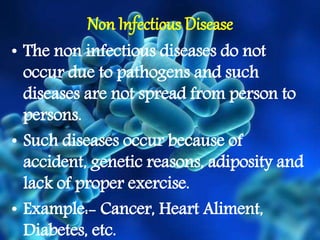
Non Infectious Disease
• The non infectious diseases do not
occur due to pathogens and such
diseases are not spread from person to
persons.
• Such diseases occur because of
accident, genetic reasons, adiposity and
lack of proper exercise.
• Example:- Cancer, Heart Aliment,
Diabetes, etc.
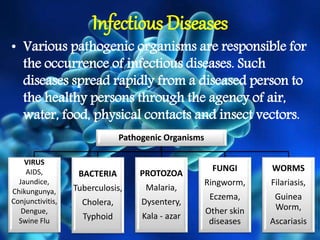
Infectious Diseases
• Various pathogenic organisms are responsible for
the occurrence of infectious diseases. Such
diseases spread rapidly from a diseased person to
the healthy persons through the agency of air,
water, food, physical contacts and insect vectors.
Pathogenic Organisms
VIRUS
AIDS,
Jaundice,
Chikungunya,
Conjunctivitis,
Dengue,
Swine Flu
BACTERIA
Tuberculosis,
Cholera,
Typhoid
PROTOZOA
Malaria,
Dysentery,
Kala - azar
FUNGI
Ringworm,
Eczema,
Other skin
diseases
WORMS
Filariasis,
Guinea
Worm,
Ascariasis
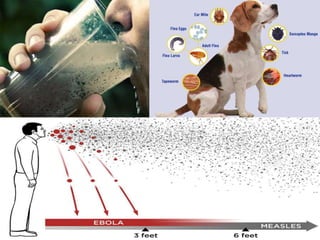
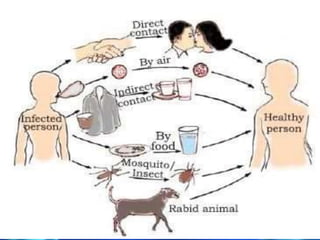
Spread of Infectious/Contagious Diseases
• The spread of disease or pathogens from the
diseased person to other persons occurs by
different means.
Spread through
AIR
Common
Cold,
Bronchitis,
Pneumonia,
Tuberculosis
WATER
Cholera,
Dysentery,
Typhoid,
Jaundice
FOOD
Cholera,
Dysentery,
Diarrhea,
Jaundice
OTHER
ANIMALS
Malaria,
Rabies
(Hydrophobia)
SEXUAL
CONTACT
AIDS,
Gonorrhea,
Syphilis
Pathogens Entry and Their Target Organs
Pathogens Entry Target Organs Disease
Bacteria Nose Lungs Tuberculosis,
Pneumonia
Bacteria Mouth Intestines Typhoid, Cholera
Protozoa Mosquito bites in
blood
Liver, RBC Malaria
Virus Nose Lungs Common cold,
Influenza
Virus Mouth Liver Jaundice
Virus Sexual Contact Immune System AIDS
Virus Eyes Eyes Conjunctivitis
Virus Mosquito bites in
blood
Blood, brain muscle,
joints, skin
Dengue
Diseases seen in
human beings
Typhoid
•Typhoid is a disease caused
by the bacteria – Salmonella
Typhi.
•It is caused by taking
contaminated water, food and
milk.
•The houseflies, sitting on such
food, milk and stool of cholera
patients are vectors that
spread this disease.
•Severe headache, fluctuations
in body temperature and
diarrhea are some of the chief
symptoms of the disease.
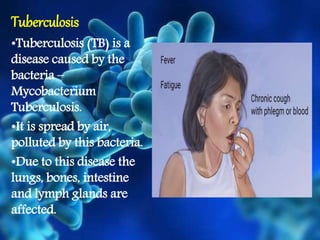
Tuberculosis
•Tuberculosis (TB) is a
disease caused by the
bacteria –
Mycobacterium
Tuberculosis.
•It is spread by air,
polluted by this bacteria.
•Due to this disease the
lungs, bones, intestine
and lymph glands are
affected.
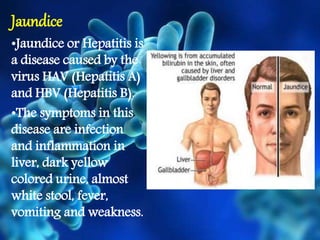
Jaundice
•Jaundice or Hepatitis is
a disease caused by the
virus HAV (Hepatitis A)
and HBV (Hepatitis B).
•The symptoms in this
disease are infection
and inflammation in
liver, dark yellow
colored urine, almost
white stool, fever,
vomiting and weakness.
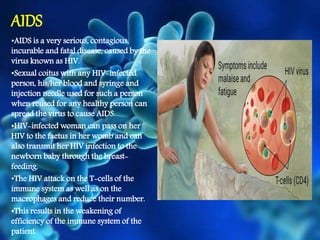
AIDS
•AIDS is a very serious, contagious,
incurable and fatal disease, caused by the
virus known as HIV.
•Sexual coitus with any HIV-infected
person, his/her blood and syringe and
injection needle used for such a person
when reused for any healthy person can
spread the virus to cause AIDS.
•HIV-infected woman can pass on her
HIV to the faetus in her womb and can
also transmit her HIV infection to the
newborn baby through the breast-
feeding.
•The HIV attack on the T-cells of the
immune system as well as on the
macrophages and reduce their number.
•This results in the weakening of
efficiency of the immune system of the
patient.
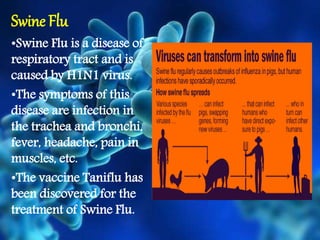
Swine Flu
•Swine Flu is a disease of
respiratory tract and is
caused by H1N1 virus.
•The symptoms of this
disease are infection in
the trachea and bronchi,
fever, headache, pain in
muscles, etc.
•The vaccine Taniflu has
been discovered for the
treatment of Swine Flu.
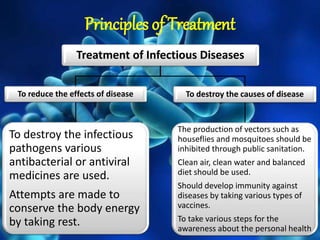
Principles of Treatment
Treatment of Infectious Diseases
To reduce the effects of disease
To destroy the infectious
pathogens various
antibacterial or antiviral
medicines are used.
Attempts are made to
conserve the body energy
by taking rest.
To destroy the causes of disease
The production of vectors such as
houseflies and mosquitoes should be
inhibited through public sanitation.
Clean air, clean water and balanced
diet should be used.
Should develop immunity against
diseases by taking various types of
vaccines.
To take various steps for the
awareness about the personal health
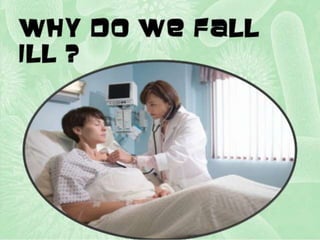
Why Do We Fall Ill?
Why Do We Fall Ill?

Why Do We Fall Ill?

  • 2.
    Health& Disease • Variousspecific activities occur continuously in our living body cells, tissues and organs. • All the activities are interrelated. For them, the energy and nutrient materials are necessary. • Any substance or factor, when inhibits or stop the activities of the cells or tissues, there occurs disturbance or loss of certain specific activities and as a result the health is endangered.
  • 3.
    • Good healthmeans a sound physical, mental and social state. • Public cleanliness and sanitation are of utmost importance for individual health. • Good financial status and good occupation or profession are also necessary for personal health. • Any type of infection, malnutrition or abnormal activities in the cells, tissues and organs in the human body or in other animals or plants result in the development of uneasiness and such a state of the body is known as DISEASE.
  • 4.
    Causes of Disease •When the disease occurs, one or more systems in the body or its outer appearance gets spoiled or it starts showing changes. • Among the internal causes, the abnormal functioning of the heart, lungs, kidneys, liver and various other organs of the body, genetic mutations, hormonal imbalance or abnormal functioning of the immune system can be responsible. • Among the external causes malnutrition, pathogenic organisms, environmental pollutants, and undesirable habits like chewing tobacco, taking alcoholic drinks and other intoxicating drugs, etc.
  • 5.
    Acute Disease • Diseaseswhich occur rapidly and all of a sudden and their effects on the body are short- lived are called Acute Disease. • Example:- Bronchitis, Common Cold, etc. • The effects of acute and chronic diseases are different on the health of individuals. • The acute diseases do not have great or serious effects on the general health of the person. Such diseases are cured in a short period of time. Chronic Disease • The disease, whose symptoms and effects persist for months, years or all throughout the life and whose effects on the human health are acute and remained for a long period of time, are called Chronic Diseases. • Example:- Tuberculosis (TB), Cancer, Diabetes, etc. • The chronic diseases have great or serious effects on the health. Long term treatment or sometimes lifelong treatment maybe needed to get rid of such diseases.
  • 6.
    Non Infectious Disease •The non infectious diseases do not occur due to pathogens and such diseases are not spread from person to persons. • Such diseases occur because of accident, genetic reasons, adiposity and lack of proper exercise. • Example:- Cancer, Heart Aliment, Diabetes, etc.
  • 7.
    Infectious Diseases • Variouspathogenic organisms are responsible for the occurrence of infectious diseases. Such diseases spread rapidly from a diseased person to the healthy persons through the agency of air, water, food, physical contacts and insect vectors. Pathogenic Organisms VIRUS AIDS, Jaundice, Chikungunya, Conjunctivitis, Dengue, Swine Flu BACTERIA Tuberculosis, Cholera, Typhoid PROTOZOA Malaria, Dysentery, Kala - azar FUNGI Ringworm, Eczema, Other skin diseases WORMS Filariasis, Guinea Worm, Ascariasis
  • 8.
    Spread of Infectious/ContagiousDiseases • The spread of disease or pathogens from the diseased person to other persons occurs by different means. Spread through AIR Common Cold, Bronchitis, Pneumonia, Tuberculosis WATER Cholera, Dysentery, Typhoid, Jaundice FOOD Cholera, Dysentery, Diarrhea, Jaundice OTHER ANIMALS Malaria, Rabies (Hydrophobia) SEXUAL CONTACT AIDS, Gonorrhea, Syphilis
  • 11.
    Pathogens Entry andTheir Target Organs Pathogens Entry Target Organs Disease Bacteria Nose Lungs Tuberculosis, Pneumonia Bacteria Mouth Intestines Typhoid, Cholera Protozoa Mosquito bites in blood Liver, RBC Malaria Virus Nose Lungs Common cold, Influenza Virus Mouth Liver Jaundice Virus Sexual Contact Immune System AIDS Virus Eyes Eyes Conjunctivitis Virus Mosquito bites in blood Blood, brain muscle, joints, skin Dengue
  • 12.
  • 13.
    Typhoid •Typhoid is adisease caused by the bacteria – Salmonella Typhi. •It is caused by taking contaminated water, food and milk. •The houseflies, sitting on such food, milk and stool of cholera patients are vectors that spread this disease. •Severe headache, fluctuations in body temperature and diarrhea are some of the chief symptoms of the disease.
  • 14.
    Tuberculosis •Tuberculosis (TB) isa disease caused by the bacteria – Mycobacterium Tuberculosis. •It is spread by air, polluted by this bacteria. •Due to this disease the lungs, bones, intestine and lymph glands are affected.
  • 15.
    Jaundice •Jaundice or Hepatitisis a disease caused by the virus HAV (Hepatitis A) and HBV (Hepatitis B). •The symptoms in this disease are infection and inflammation in liver, dark yellow colored urine, almost white stool, fever, vomiting and weakness.
  • 16.
    AIDS •AIDS is avery serious, contagious, incurable and fatal disease, caused by the virus known as HIV. •Sexual coitus with any HIV-infected person, his/her blood and syringe and injection needle used for such a person when reused for any healthy person can spread the virus to cause AIDS. •HIV-infected woman can pass on her HIV to the faetus in her womb and can also transmit her HIV infection to the newborn baby through the breast- feeding. •The HIV attack on the T-cells of the immune system as well as on the macrophages and reduce their number. •This results in the weakening of efficiency of the immune system of the patient.
  • 17.
    Swine Flu •Swine Fluis a disease of respiratory tract and is caused by H1N1 virus. •The symptoms of this disease are infection in the trachea and bronchi, fever, headache, pain in muscles, etc. •The vaccine Taniflu has been discovered for the treatment of Swine Flu.
  • 18.
    Principles of Treatment Treatmentof Infectious Diseases To reduce the effects of disease To destroy the infectious pathogens various antibacterial or antiviral medicines are used. Attempts are made to conserve the body energy by taking rest. To destroy the causes of disease The production of vectors such as houseflies and mosquitoes should be inhibited through public sanitation. Clean air, clean water and balanced diet should be used. Should develop immunity against diseases by taking various types of vaccines. To take various steps for the awareness about the personal health