WHY DO WE FALL ILL ?
CLASS – 9
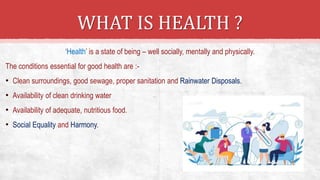
‘Health’ is a state of being – well socially, mentally and physically.
The conditions essential for good health are :-
• Clean surroundings, good sewage, proper sanitation and Rainwater Disposals.
• Availability of clean drinking water
• Availability of adequate, nutritious food.
• Social Equality and Harmony.
WHAT IS HEALTH ?
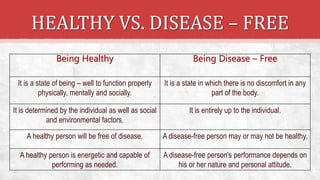
HEALTHY VS. DISEASE – FREE
Being Healthy Being Disease – Free
It is a state of being – well to function properly
physically, mentally and socially.
It is a state in which there is no discomfort in any
part of the body.
It is determined by the individual as well as social
and environmental factors.
It is entirely up to the individual.
A healthy person will be free of disease. A disease-free person may or may not be healthy.
A healthy person is energetic and capable of
performing as needed.
A disease-free person's performance depends on
his or her nature and personal attitude.
DISEASE AND ITS CAUSES
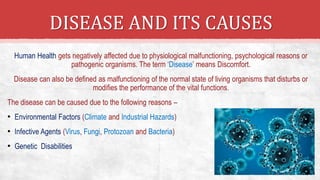
Human Health gets negatively affected due to physiological malfunctioning, psychological reasons or
pathogenic organisms. The term ‘Disease’ means Discomfort.
Disease can also be defined as malfunctioning of the normal state of living organisms that disturbs or
modifies the performance of the vital functions.
The disease can be caused due to the following reasons –
• Environmental Factors (Climate and Industrial Hazards)
• Infective Agents (Virus, Fungi, Protozoan and Bacteria)
• Genetic Disabilities
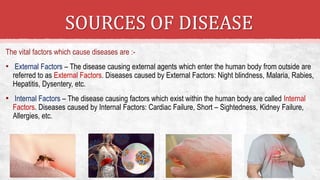
The vital factors which cause diseases are :-
• External Factors – The disease causing external agents which enter the human body from outside are
referred to as External Factors. Diseases caused by External Factors: Night blindness, Malaria, Rabies,
Hepatitis, Dysentery, etc.
• Internal Factors – The disease causing factors which exist within the human body are called Internal
Factors. Diseases caused by Internal Factors: Cardiac Failure, Short – Sightedness, Kidney Failure,
Allergies, etc.
SOURCES OF DISEASE
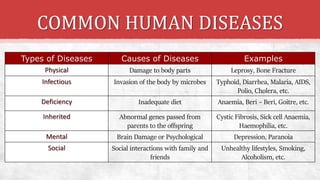
Types of Diseases Causes of Diseases Examples
Physical Damage to body parts Leprosy, Bone Fracture
Infectious Invasion of the body by microbes Typhoid, Diarrhea, Malaria, AIDS,
Polio, Cholera, etc.
Deficiency Inadequate diet Anaemia, Beri – Beri, Goitre, etc.
Inherited Abnormal genes passed from
parents to the offspring
Cystic Fibrosis, Sick cell Anaemia,
Haemophilia, etc.
Mental Brain Damage or Psychological Depression, Paranoia
Social Social interactions with family and
friends
Unhealthy lifestyles, Smoking,
Alcoholism, etc.
COMMON HUMAN DISEASES
DEFICIENCY DISEASES
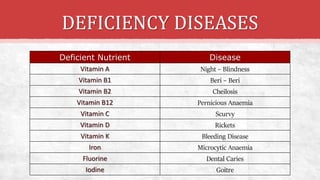
Deficient Nutrient Disease
Vitamin A Night – Blindness
Vitamin B1 Beri – Beri
Vitamin B2 Cheilosis
Vitamin B12 Pernicious Anaemia
Vitamin C Scurvy
Vitamin D Rickets
Vitamin K Bleeding Disease
Iron Microcytic Anaemia
Fluorine Dental Caries
Iodine Goitre
LEVELS OF IMMEDIATE CAUSES
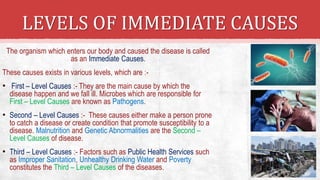
The organism which enters our body and caused the disease is called
as an Immediate Causes.
These causes exists in various levels, which are :-
• First – Level Causes :- They are the main cause by which the
disease happen and we fall ill. Microbes which are responsible for
First – Level Causes are known as Pathogens.
• Second – Level Causes :- These causes either make a person prone
to catch a disease or create condition that promote susceptibility to a
disease. Malnutrition and Genetic Abnormalities are the Second –
Level Causes of disease.
• Third – Level Causes :- Factors such as Public Health Services such
as Improper Sanitation, Unhealthy Drinking Water and Poverty
constitutes the Third – Level Causes of the diseases.
ACUTE DISEASES
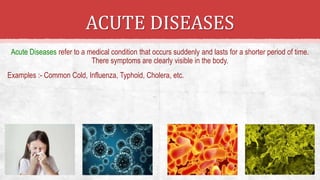
Acute Diseases refer to a medical condition that occurs suddenly and lasts for a shorter period of time.
There symptoms are clearly visible in the body.
Examples :- Common Cold, Influenza, Typhoid, Cholera, etc.
CHRONIC DISEASES
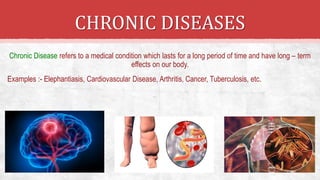
Chronic Disease refers to a medical condition which lasts for a long period of time and have long – term
effects on our body.
Examples :- Elephantiasis, Cardiovascular Disease, Arthritis, Cancer, Tuberculosis, etc.
INFECTIOUS DISEASES
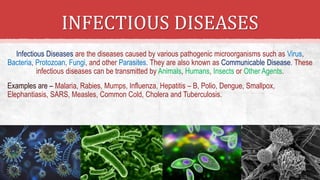
Infectious Diseases are the diseases caused by various pathogenic microorganisms such as Virus,
Bacteria, Protozoan, Fungi, and other Parasites. They are also known as Communicable Disease. These
infectious diseases can be transmitted by Animals, Humans, Insects or Other Agents.
Examples are – Malaria, Rabies, Mumps, Influenza, Hepatitis – B, Polio, Dengue, Smallpox,
Elephantiasis, SARS, Measles, Common Cold, Cholera and Tuberculosis.
INFECTIOUS AGENTS
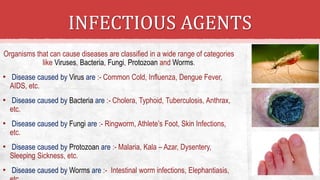
Organisms that can cause diseases are classified in a wide range of categories
like Viruses, Bacteria, Fungi, Protozoan and Worms.
• Disease caused by Virus are :- Common Cold, Influenza, Dengue Fever,
AIDS, etc.
• Disease caused by Bacteria are :- Cholera, Typhoid, Tuberculosis, Anthrax,
etc.
• Disease caused by Fungi are :- Ringworm, Athlete’s Foot, Skin Infections,
etc.
• Disease caused by Protozoan are :- Malaria, Kala – Azar, Dysentery,
Sleeping Sickness, etc.
• Disease caused by Worms are :- Intestinal worm infections, Elephantiasis,
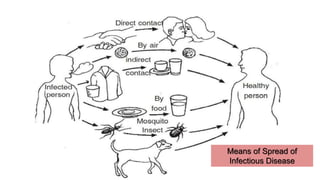
Means of Spread of
Infectious Disease
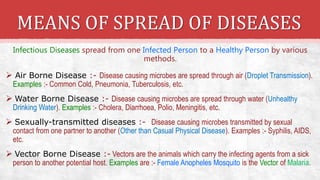
MEANS OF SPREAD OF DISEASES
Infectious Diseases spread from one Infected Person to a Healthy Person by various
methods.
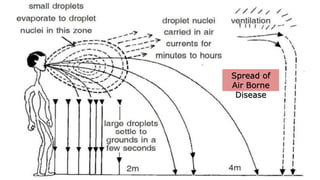
 Air Borne Disease :- Disease causing microbes are spread through air (Droplet Transmission).
Examples :- Common Cold, Pneumonia, Tuberculosis, etc.
 Water Borne Disease :- Disease causing microbes are spread through water (Unhealthy
Drinking Water). Examples :- Cholera, Diarrhoea, Polio, Meningitis, etc.
 Sexually-transmitted diseases :- Disease causing microbes transmitted by sexual
contact from one partner to another (Other than Casual Physical Disease). Examples :- Syphilis, AIDS,
etc.
 Vector Borne Disease :- Vectors are the animals which carry the infecting agents from a sick
person to another potential host. Examples are :- Female Anopheles Mosquito is the Vector of Malaria.
Spread of
Air Borne
Disease
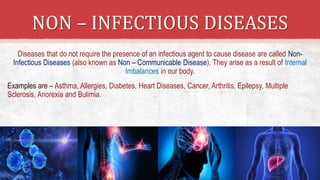
Diseases that do not require the presence of an infectious agent to cause disease are called Non-
Infectious Diseases (also known as Non – Communicable Disease). They arise as a result of Internal
Imbalances in our body.
Examples are – Asthma, Allergies, Diabetes, Heart Diseases, Cancer, Arthritis, Epilepsy, Multiple
Sclerosis, Anorexia and Bulimia.
NON – INFECTIOUS DISEASES
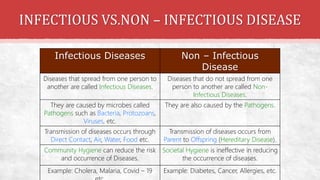
Infectious Diseases Non – Infectious
Disease
Diseases that spread from one person to
another are called Infectious Diseases.
Diseases that do not spread from one
person to another are called Non-
Infectious Diseases.
They are caused by microbes called
Pathogens such as Bacteria, Protozoans,
Viruses, etc.
They are also caused by the Pathogens.
Transmission of diseases occurs through
Direct Contact, Air, Water, Food etc.
Transmission of diseases occurs from
Parent to Offspring (Hereditary Disease).
Community Hygiene can reduce the risk
and occurrence of Diseases.
Societal Hygiene is ineffective in reducing
the occurrence of diseases.
Example: Cholera, Malaria, Covid – 19 Example: Diabetes, Cancer, Allergies, etc.
INFECTIOUS VS.NON – INFECTIOUS DISEASE
SYMPTOMS OF A DISEASE
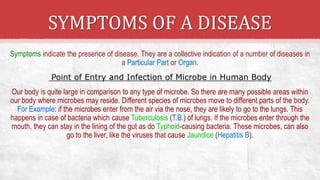
Symptoms indicate the presence of disease. They are a collective indication of a number of diseases in
a Particular Part or Organ.
Point of Entry and Infection of Microbe in Human Body
Our body is quite large in comparison to any type of microbe. So there are many possible areas within
our body where microbes may reside. Different species of microbes move to different parts of the body.
For Example: if the microbes enter from the air via the nose, they are likely to go to the lungs. This
happens in case of bacteria which cause Tuberculosis (T.B.) of lungs. If the microbes enter through the
mouth, they can stay in the lining of the gut as do Typhoid-causing bacteria. These microbes, can also
go to the liver, like the viruses that cause Jaundice (Hepatitis B).
PRINCIPLE OF TREATMENT
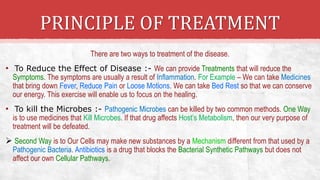
There are two ways to treatment of the disease.
• To Reduce the Effect of Disease :- We can provide Treatments that will reduce the
Symptoms. The symptoms are usually a result of Inflammation. For Example – We can take Medicines
that bring down Fever, Reduce Pain or Loose Motions. We can take Bed Rest so that we can conserve
our energy. This exercise will enable us to focus on the healing.
• To kill the Microbes :- Pathogenic Microbes can be killed by two common methods. One Way
is to use medicines that Kill Microbes. If that drug affects Host’s Metabolism, then our very purpose of
treatment will be defeated.
 Second Way is to Our Cells may make new substances by a Mechanism different from that used by a
Pathogenic Bacteria. Antibiotics is a drug that blocks the Bacterial Synthetic Pathways but does not
affect our own Cellular Pathways.
PREVENTION OF DISEASE
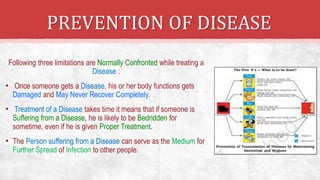
Following three limitations are Normally Confronted while treating a
Disease :
• Once someone gets a Disease, his or her body functions gets
Damaged and May Never Recover Completely.
• Treatment of a Disease takes time it means that if someone is
Suffering from a Disease, he is likely to be Bedridden for
sometime, even if he is given Proper Treatment.
• The Person suffering from a Disease can serve as the Medium for
Further Spread of Infection to other people.
VACCINATION
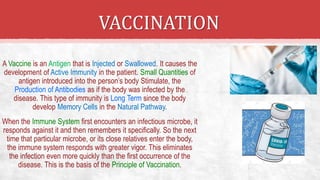
A Vaccine is an Antigen that is Injected or Swallowed. It causes the
development of Active Immunity in the patient. Small Quantities of
antigen introduced into the person’s body Stimulate, the
Production of Antibodies as if the body was infected by the
disease. This type of immunity is Long Term since the body
develop Memory Cells in the Natural Pathway.
When the Immune System first encounters an infectious microbe, it
responds against it and then remembers it specifically. So the next
time that particular microbe, or its close relatives enter the body,
the immune system responds with greater vigor. This eliminates
the infection even more quickly than the first occurrence of the
disease. This is the basis of the Principle of Vaccination.
PEPTIC ULCER
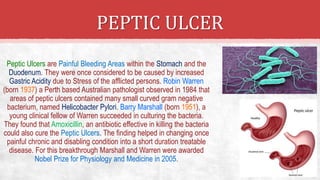
Peptic Ulcers are Painful Bleeding Areas within the Stomach and the
Duodenum. They were once considered to be caused by increased
Gastric Acidity due to Stress of the afflicted persons. Robin Warren
(born 1937) a Perth based Australian pathologist observed in 1984 that
areas of peptic ulcers contained many small curved gram negative
bacterium, named Helicobacter Pylori. Barry Marshall (born 1951), a
young clinical fellow of Warren succeeded in culturing the bacteria.
They found that Amoxicillin, an antibiotic effective in killing the bacteria
could also cure the Peptic Ulcers. The finding helped in changing once
painful chronic and disabling condition into a short duration treatable
disease. For this breakthrough Marshall and Warren were awarded
Nobel Prize for Physiology and Medicine in 2005.
WHY DO WE FALL ILL ? Class - 9

WHY DO WE FALL ILL ? Class - 9

  • 1.
    WHY DO WEFALL ILL ? CLASS – 9
  • 2.
    ‘Health’ is astate of being – well socially, mentally and physically. The conditions essential for good health are :- • Clean surroundings, good sewage, proper sanitation and Rainwater Disposals. • Availability of clean drinking water • Availability of adequate, nutritious food. • Social Equality and Harmony. WHAT IS HEALTH ?
  • 3.
    HEALTHY VS. DISEASE– FREE Being Healthy Being Disease – Free It is a state of being – well to function properly physically, mentally and socially. It is a state in which there is no discomfort in any part of the body. It is determined by the individual as well as social and environmental factors. It is entirely up to the individual. A healthy person will be free of disease. A disease-free person may or may not be healthy. A healthy person is energetic and capable of performing as needed. A disease-free person's performance depends on his or her nature and personal attitude.
  • 4.
    DISEASE AND ITSCAUSES Human Health gets negatively affected due to physiological malfunctioning, psychological reasons or pathogenic organisms. The term ‘Disease’ means Discomfort. Disease can also be defined as malfunctioning of the normal state of living organisms that disturbs or modifies the performance of the vital functions. The disease can be caused due to the following reasons – • Environmental Factors (Climate and Industrial Hazards) • Infective Agents (Virus, Fungi, Protozoan and Bacteria) • Genetic Disabilities
  • 5.
    The vital factorswhich cause diseases are :- • External Factors – The disease causing external agents which enter the human body from outside are referred to as External Factors. Diseases caused by External Factors: Night blindness, Malaria, Rabies, Hepatitis, Dysentery, etc. • Internal Factors – The disease causing factors which exist within the human body are called Internal Factors. Diseases caused by Internal Factors: Cardiac Failure, Short – Sightedness, Kidney Failure, Allergies, etc. SOURCES OF DISEASE
  • 6.
    Types of DiseasesCauses of Diseases Examples Physical Damage to body parts Leprosy, Bone Fracture Infectious Invasion of the body by microbes Typhoid, Diarrhea, Malaria, AIDS, Polio, Cholera, etc. Deficiency Inadequate diet Anaemia, Beri – Beri, Goitre, etc. Inherited Abnormal genes passed from parents to the offspring Cystic Fibrosis, Sick cell Anaemia, Haemophilia, etc. Mental Brain Damage or Psychological Depression, Paranoia Social Social interactions with family and friends Unhealthy lifestyles, Smoking, Alcoholism, etc. COMMON HUMAN DISEASES
  • 7.
    DEFICIENCY DISEASES Deficient NutrientDisease Vitamin A Night – Blindness Vitamin B1 Beri – Beri Vitamin B2 Cheilosis Vitamin B12 Pernicious Anaemia Vitamin C Scurvy Vitamin D Rickets Vitamin K Bleeding Disease Iron Microcytic Anaemia Fluorine Dental Caries Iodine Goitre
  • 8.
    LEVELS OF IMMEDIATECAUSES The organism which enters our body and caused the disease is called as an Immediate Causes. These causes exists in various levels, which are :- • First – Level Causes :- They are the main cause by which the disease happen and we fall ill. Microbes which are responsible for First – Level Causes are known as Pathogens. • Second – Level Causes :- These causes either make a person prone to catch a disease or create condition that promote susceptibility to a disease. Malnutrition and Genetic Abnormalities are the Second – Level Causes of disease. • Third – Level Causes :- Factors such as Public Health Services such as Improper Sanitation, Unhealthy Drinking Water and Poverty constitutes the Third – Level Causes of the diseases.
  • 9.
    ACUTE DISEASES Acute Diseasesrefer to a medical condition that occurs suddenly and lasts for a shorter period of time. There symptoms are clearly visible in the body. Examples :- Common Cold, Influenza, Typhoid, Cholera, etc.
  • 10.
    CHRONIC DISEASES Chronic Diseaserefers to a medical condition which lasts for a long period of time and have long – term effects on our body. Examples :- Elephantiasis, Cardiovascular Disease, Arthritis, Cancer, Tuberculosis, etc.
  • 11.
    INFECTIOUS DISEASES Infectious Diseasesare the diseases caused by various pathogenic microorganisms such as Virus, Bacteria, Protozoan, Fungi, and other Parasites. They are also known as Communicable Disease. These infectious diseases can be transmitted by Animals, Humans, Insects or Other Agents. Examples are – Malaria, Rabies, Mumps, Influenza, Hepatitis – B, Polio, Dengue, Smallpox, Elephantiasis, SARS, Measles, Common Cold, Cholera and Tuberculosis.
  • 12.
    INFECTIOUS AGENTS Organisms thatcan cause diseases are classified in a wide range of categories like Viruses, Bacteria, Fungi, Protozoan and Worms. • Disease caused by Virus are :- Common Cold, Influenza, Dengue Fever, AIDS, etc. • Disease caused by Bacteria are :- Cholera, Typhoid, Tuberculosis, Anthrax, etc. • Disease caused by Fungi are :- Ringworm, Athlete’s Foot, Skin Infections, etc. • Disease caused by Protozoan are :- Malaria, Kala – Azar, Dysentery, Sleeping Sickness, etc. • Disease caused by Worms are :- Intestinal worm infections, Elephantiasis,
  • 13.
    Means of Spreadof Infectious Disease
  • 14.
    MEANS OF SPREADOF DISEASES Infectious Diseases spread from one Infected Person to a Healthy Person by various methods.  Air Borne Disease :- Disease causing microbes are spread through air (Droplet Transmission). Examples :- Common Cold, Pneumonia, Tuberculosis, etc.  Water Borne Disease :- Disease causing microbes are spread through water (Unhealthy Drinking Water). Examples :- Cholera, Diarrhoea, Polio, Meningitis, etc.  Sexually-transmitted diseases :- Disease causing microbes transmitted by sexual contact from one partner to another (Other than Casual Physical Disease). Examples :- Syphilis, AIDS, etc.  Vector Borne Disease :- Vectors are the animals which carry the infecting agents from a sick person to another potential host. Examples are :- Female Anopheles Mosquito is the Vector of Malaria.
  • 15.
  • 16.
    Diseases that donot require the presence of an infectious agent to cause disease are called Non- Infectious Diseases (also known as Non – Communicable Disease). They arise as a result of Internal Imbalances in our body. Examples are – Asthma, Allergies, Diabetes, Heart Diseases, Cancer, Arthritis, Epilepsy, Multiple Sclerosis, Anorexia and Bulimia. NON – INFECTIOUS DISEASES
  • 17.
    Infectious Diseases Non– Infectious Disease Diseases that spread from one person to another are called Infectious Diseases. Diseases that do not spread from one person to another are called Non- Infectious Diseases. They are caused by microbes called Pathogens such as Bacteria, Protozoans, Viruses, etc. They are also caused by the Pathogens. Transmission of diseases occurs through Direct Contact, Air, Water, Food etc. Transmission of diseases occurs from Parent to Offspring (Hereditary Disease). Community Hygiene can reduce the risk and occurrence of Diseases. Societal Hygiene is ineffective in reducing the occurrence of diseases. Example: Cholera, Malaria, Covid – 19 Example: Diabetes, Cancer, Allergies, etc. INFECTIOUS VS.NON – INFECTIOUS DISEASE
  • 18.
    SYMPTOMS OF ADISEASE Symptoms indicate the presence of disease. They are a collective indication of a number of diseases in a Particular Part or Organ. Point of Entry and Infection of Microbe in Human Body Our body is quite large in comparison to any type of microbe. So there are many possible areas within our body where microbes may reside. Different species of microbes move to different parts of the body. For Example: if the microbes enter from the air via the nose, they are likely to go to the lungs. This happens in case of bacteria which cause Tuberculosis (T.B.) of lungs. If the microbes enter through the mouth, they can stay in the lining of the gut as do Typhoid-causing bacteria. These microbes, can also go to the liver, like the viruses that cause Jaundice (Hepatitis B).
  • 19.
    PRINCIPLE OF TREATMENT Thereare two ways to treatment of the disease. • To Reduce the Effect of Disease :- We can provide Treatments that will reduce the Symptoms. The symptoms are usually a result of Inflammation. For Example – We can take Medicines that bring down Fever, Reduce Pain or Loose Motions. We can take Bed Rest so that we can conserve our energy. This exercise will enable us to focus on the healing. • To kill the Microbes :- Pathogenic Microbes can be killed by two common methods. One Way is to use medicines that Kill Microbes. If that drug affects Host’s Metabolism, then our very purpose of treatment will be defeated.  Second Way is to Our Cells may make new substances by a Mechanism different from that used by a Pathogenic Bacteria. Antibiotics is a drug that blocks the Bacterial Synthetic Pathways but does not affect our own Cellular Pathways.
  • 20.
    PREVENTION OF DISEASE Followingthree limitations are Normally Confronted while treating a Disease : • Once someone gets a Disease, his or her body functions gets Damaged and May Never Recover Completely. • Treatment of a Disease takes time it means that if someone is Suffering from a Disease, he is likely to be Bedridden for sometime, even if he is given Proper Treatment. • The Person suffering from a Disease can serve as the Medium for Further Spread of Infection to other people.
  • 21.
    VACCINATION A Vaccine isan Antigen that is Injected or Swallowed. It causes the development of Active Immunity in the patient. Small Quantities of antigen introduced into the person’s body Stimulate, the Production of Antibodies as if the body was infected by the disease. This type of immunity is Long Term since the body develop Memory Cells in the Natural Pathway. When the Immune System first encounters an infectious microbe, it responds against it and then remembers it specifically. So the next time that particular microbe, or its close relatives enter the body, the immune system responds with greater vigor. This eliminates the infection even more quickly than the first occurrence of the disease. This is the basis of the Principle of Vaccination.
  • 22.
    PEPTIC ULCER Peptic Ulcersare Painful Bleeding Areas within the Stomach and the Duodenum. They were once considered to be caused by increased Gastric Acidity due to Stress of the afflicted persons. Robin Warren (born 1937) a Perth based Australian pathologist observed in 1984 that areas of peptic ulcers contained many small curved gram negative bacterium, named Helicobacter Pylori. Barry Marshall (born 1951), a young clinical fellow of Warren succeeded in culturing the bacteria. They found that Amoxicillin, an antibiotic effective in killing the bacteria could also cure the Peptic Ulcers. The finding helped in changing once painful chronic and disabling condition into a short duration treatable disease. For this breakthrough Marshall and Warren were awarded Nobel Prize for Physiology and Medicine in 2005.