General Science
(Biology)
CLASS VIII
Subject Teacher:
CHAPTER 05
COAL AND PETROLEUM
INTRODUCTION
We use various materials for our basic needs. Some of
them are found in nature and some have been made
by human efforts. Since all these are obtained from
nature, they are called natural resources.
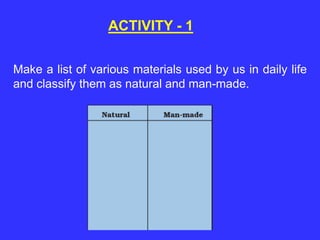
ACTIVITY - 1
Make a list of various materials used by us in daily life
and classify them as natural and man-made.
CLASSIFICATION OF RESOURCES
Can air, water and soil be exhausted by human
activities? You have already studied about water . Is
water a limitless resource?
CLASSIFICATION OF RESOURCES
In the light of the availability of various resources in
nature, natural resources can be broadly classified into
two kinds:
INEXHAUSTIBLE NATURAL RESOURCES:
These resources are present in unlimited quantity in
nature and are not likely to be exhausted by human
activities. Examples are: sunlight, air.
CLASSIFICATION OF RESOURCES
EXHAUSTIBLE NATURAL RESOURCES:
The amount of these resources in nature is limited.
They can be exhausted by human activities. Examples
of these resources are forests, wildlife, minerals, coal,
petroleum, natural gas etc.
ACTIVITY - 2
Take some containers. Fill them with
popcorn/peanuts/roasted gram/toffees. Divide students
into groups of seven each. Further divide each group
into three subgroups containing 1, 2 and 4 students.
Label them as first, second and third generation
respectively. These sub-groups represent the
consumers. As population is growing, second and third
generations have larger number of consumers. Put one
full container for each group on a table.
[It is a group activity]
ACTIVITY - 2
Ask consumers of the first generation from each group
to consume eatables from the container of their group.
Now, ask the second generation consumers from each
group to do the same. Ask students to observe
carefully the availability of eatables in each container. If
some thing is left in the containers, ask third generation
from each group to consume it. Now, finally observe
whether all the consumers of the third generation got
the eatables or not. Also observe if any thing is still left
in any of the containers.
OBSERVATION
Assume that the eatables in the container represent
the total availability of an exhaustible natural resource
like coal, petroleum or natural gas. Each group may
have different consumption pattern. Are the earlier
generations of any group too greedy? It may be that
the earlier generations in some groups were
concerned about the coming generations and left
something for them. In this chapter we will learn about
some exhaustible natural resources like coal,
petroleum and natural gas. These were formed from
the dead remains of living organisms (fossils). So,
these are all known as fossil fuels.
COAL
You may have seen coal, or heard about it. It is as
hard as stone and is black in colour.
Coal is one of the fuels used to cook food. Earlier, it was
used in railway engines to produce steam to run the
engine. It is also used in thermal power plants to
produce electricity. Coal is also used as a fuel in various
industries
STORY OF COAL
About 300 million years ago the earth had dense
forests in low lying wetland areas. Due to natural
processes, like flooding, these forests got buried under
the soil. As more soil deposited over them, they were
compressed. The temperature also rose as they sank
deeper and deeper. Under high pressure and high
temperature, dead plants got slowly converted to coal.
As coal contains mainly carbon, the slow process of
conversion of dead vegetation into coal is called
carbonisation. Since it was formed from the remains of
vegetation, coal is also called a fossil fuel.
STORY OF COAL
When heated in air, coal burns and produces mainly
carbon dioxide gas. Coal is processed in industry to
get some useful products such as coke, coal tar and
coal gas.
COMPONENTS OF COAL
A. COKE
It is a tough, porous and black substance. It is almost
pure form of carbon. Coke is used in the manufacture
of steel and in the extraction of many metals.
COMPONENTS OF COAL
When heated in air, coal burns and produces mainly
carbon dioxide gas. Coal is processed in industry to
get some useful products such as coke, coal tar and
coal gas. about 200 substances. Products obtained
from coal tar are used as starting materials for
manufacturing various substances used in everyday
life.
B. COAL TAR
COMPONENTS OF COAL
B. COAL TAR
In industry it is used for making like synthetic dyes,
drugs, explosives, perfumes, plastics, paints,
photographic materials, roofing materials, etc.
Interestingly, naphthalene balls used to repel moths
and other insects are also obtained from coal tar.
These days, bitumen, a
petroleum product, is used in
place of coal-tar for metalling
the roads.
COMPONENTS OF COAL
C. COAL GAS
Coal gas is obtained during the processing of coal to
get coke. It is used as a fuel in many industries
situated near the coal processing plants. These days,
bitumen, a petroleum product, is used in place of coal-
tar for metalling the roads. Coal gas was used for
street lighting for the first time in London in 1810 and in
New York around 1820. Now a days, it is used as a
source of heat rather than light.
PETROLEUM
You know that petrol is used as a fuel in light
automobiles such as motor cycles/ scooters and cars.
Heavy motor vehicles like trucks and tractors run on
diesel. Petrol and diesel are obtained from a natural
resource called petroleum. Do you know how
petroleum is formed? Petroleum was formed from
organisms living in the sea. As these organisms died,
their bodies settled at the bottom of the sea and got
covered with layers of sand and clay. Over millions of
years, absence of air, high temperature and high
pressure transformed the dead organisms into
petroleum and natural gas.
PETROLEUM
It shows the deposits of petroleum and natural gas.
You see that the layer containing petroleum oil and gas
is above that of water. Why is it so? Recall that oil and
gas are lighter than water and do not mix with it.
PETROLEUM
The world’s first oil well was drilled in Pennsylvania,
USA, in 1859. Eight years later, in 1867, oil was stuck
at Makum in Assam. In India, oil is found in Assam,
Gujarat, Mumbai High and in the river basins of
Godavari and Krishna.
REFINING OF PETROLEUM
Petroleum is a dark oily liquid. It has an unpleasant
odour. It is a mixture of various constituents such as
petroleum gas, petrol, diesel, lubricating oil, paraffin
wax, etc. The process of separating the various
constituents/ fractions of petroleum is known as
refining. It is carried out in a petroleum refinery.
REFINING OF PETROLEUM
Many useful substances are obtained from petroleum
and natural gas. These are termed as
‘Petrochemicals’. These are used in the manufacture
of detergents, fibres (polyester, nylon, acrylic etc.),
polythene and other man-made plastics. Hydrogen
gas obtained from natural gas, is used in the
production of fertilisers (urea). Due to its great
commercial importance, petroleum is also called
‘black gold’.
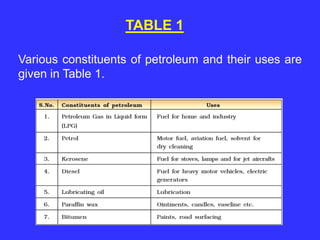
TABLE 1
Various constituents of petroleum and their uses are
given in Table 1.
NATURAL GAS
Natural gas is a very important fossil fuel because it
is easy to transport through pipes. Natural gas is
stored under high pressure as compressed natural
gas (CNG). CNG is used for power generation. It is
now being used as a fuel for transport vehicles
because it is less polluting. It is a cleaner fuel. The
great advantage of CNG is that it can be used
directly for burning in homes and factories where it
can be supplied through pipes. Such a network of
pipelines exists in Vadodara (Gujarat), some parts of
Delhi and other places.
NATURAL GAS
Natural gas is also used as a starting material for the
manufacture of a number of chemicals and fertilisers.
India has vast reserves of natural gas. In our country,
natural gas has been found in Tripura, Rajasthan,
Maharashtra and in the Krishna Godavari delta.
SOME NATURAL RESOURCES ARE
LIMITED
You have studied in the beginning of the chapter that
some natural resources are exhaustible like fossil
fuels, forests, minerals etc. You know that coal and
petroleum are fossil fuels. It required the dead
organisms millions of years to get converted into
these fuels. On the other hand, the known reserves
of these will last almost a few hundred years.
Moreover, burning of these fuels is a major cause of
air pollution. Their use is also linked to global
warming.
SOME NATURAL RESOURCES ARE
LIMITED
It is therefore necessary that we use these fuels only
when absolutely necessary. This will result in better
environment, smaller risk of global warming and their
availability for a longer period of time. In India, the
Petroleum Conservation Research Association
(PCRA) advises people how to save petrol/diesel
while driving.
SOME NATURAL RESOURCES ARE
LIMITED
Their tips are:
• Drive at a constant and moderate speed as far as
possible
• Switch off the engine at traffic lights or at a place
where you have to wait
• Ensure correct tyre pressure
• Ensure regular maintenance of the vehicle.
1. COAL
2. COAL GAS
3. COAL TAR
4. COKE
5. FOSSIL FUEL
6. NATURAL GAS
7. PETROLEUM
8. PETROLEUM REFINERY
KEYWORDS
Any Questions Please…
Prepared By
IT CLUB, Sainik School Amaravathinagar
Post: Amaravathinagar
Dist: Tiruppur, Tamilnadu
Club I/c
Praveen M Jigajinni
DCSc & Engg,PGDCA,ADCA,MCA,MSc(IT),MTech(IT), M.Phil (Comp Sci)
For Any Queries Please feel free to contact:
Email Id : praveenkumarjigajinni@gmail.com
Cell No: 9431453730
SER ROLL NO NAME CLASS HOUSE
1 5988 R Dharani Tharan XC Pandya
2 6378 M Arish XA Pallava
3 5982 R Sarvesh XC Chera
4 5957 RS Sharan Yogesh XC Pallava
5 5956 S Varun Selva XA Chera
6 5938 Aman Kumar XD Pandya
7 5901 AR Sachin Prasad XC Chola
8 5906 M Erin Churchill XC Chola
9 5887 KM Sourabh XC Pandya
10 5954 K Kishore Kumar XC Pandya
11 5896 M Eric Churchill XA Pallava
12 6074 Dheeraj Kumar IXA Chola
13 6054 Vishal Kumar IXA Pallava
14 6024 MA Sri Kavi Priyan IXA Chola
15 6018 Ankush Kumar IXA Chera
16 6071 Kabiram Kumar IXC Chera
17 5826 V Surya XIC Chola
18 5824 B Poovendhan XIA Chera
19 6107 SK Kannan IXA Chola
20 5839 M Arrush XIB Pallava
21 5752 B Madana Nateshwar XIB Pallava
22 5832 E Manoj XIB Chola
23 5815 C Rujesh Kumar XIA Chera
24 5879 V Logesh XIB Pandya
25 5797 Bhupendra Singh XIC Pallava
Club Members
THANK YOU

Chapter 05 coal & petroleum

  • 1.
  • 2.
  • 3.
    INTRODUCTION We use variousmaterials for our basic needs. Some of them are found in nature and some have been made by human efforts. Since all these are obtained from nature, they are called natural resources.
  • 4.
    ACTIVITY - 1 Makea list of various materials used by us in daily life and classify them as natural and man-made.
  • 5.
    CLASSIFICATION OF RESOURCES Canair, water and soil be exhausted by human activities? You have already studied about water . Is water a limitless resource?
  • 6.
    CLASSIFICATION OF RESOURCES Inthe light of the availability of various resources in nature, natural resources can be broadly classified into two kinds: INEXHAUSTIBLE NATURAL RESOURCES: These resources are present in unlimited quantity in nature and are not likely to be exhausted by human activities. Examples are: sunlight, air.
  • 7.
    CLASSIFICATION OF RESOURCES EXHAUSTIBLENATURAL RESOURCES: The amount of these resources in nature is limited. They can be exhausted by human activities. Examples of these resources are forests, wildlife, minerals, coal, petroleum, natural gas etc.
  • 8.
    ACTIVITY - 2 Takesome containers. Fill them with popcorn/peanuts/roasted gram/toffees. Divide students into groups of seven each. Further divide each group into three subgroups containing 1, 2 and 4 students. Label them as first, second and third generation respectively. These sub-groups represent the consumers. As population is growing, second and third generations have larger number of consumers. Put one full container for each group on a table. [It is a group activity]
  • 9.
    ACTIVITY - 2 Askconsumers of the first generation from each group to consume eatables from the container of their group. Now, ask the second generation consumers from each group to do the same. Ask students to observe carefully the availability of eatables in each container. If some thing is left in the containers, ask third generation from each group to consume it. Now, finally observe whether all the consumers of the third generation got the eatables or not. Also observe if any thing is still left in any of the containers.
  • 10.
    OBSERVATION Assume that theeatables in the container represent the total availability of an exhaustible natural resource like coal, petroleum or natural gas. Each group may have different consumption pattern. Are the earlier generations of any group too greedy? It may be that the earlier generations in some groups were concerned about the coming generations and left something for them. In this chapter we will learn about some exhaustible natural resources like coal, petroleum and natural gas. These were formed from the dead remains of living organisms (fossils). So, these are all known as fossil fuels.
  • 11.
    COAL You may haveseen coal, or heard about it. It is as hard as stone and is black in colour. Coal is one of the fuels used to cook food. Earlier, it was used in railway engines to produce steam to run the engine. It is also used in thermal power plants to produce electricity. Coal is also used as a fuel in various industries
  • 12.
    STORY OF COAL About300 million years ago the earth had dense forests in low lying wetland areas. Due to natural processes, like flooding, these forests got buried under the soil. As more soil deposited over them, they were compressed. The temperature also rose as they sank deeper and deeper. Under high pressure and high temperature, dead plants got slowly converted to coal. As coal contains mainly carbon, the slow process of conversion of dead vegetation into coal is called carbonisation. Since it was formed from the remains of vegetation, coal is also called a fossil fuel.
  • 13.
    STORY OF COAL Whenheated in air, coal burns and produces mainly carbon dioxide gas. Coal is processed in industry to get some useful products such as coke, coal tar and coal gas.
  • 14.
    COMPONENTS OF COAL A.COKE It is a tough, porous and black substance. It is almost pure form of carbon. Coke is used in the manufacture of steel and in the extraction of many metals.
  • 15.
    COMPONENTS OF COAL Whenheated in air, coal burns and produces mainly carbon dioxide gas. Coal is processed in industry to get some useful products such as coke, coal tar and coal gas. about 200 substances. Products obtained from coal tar are used as starting materials for manufacturing various substances used in everyday life. B. COAL TAR
  • 16.
    COMPONENTS OF COAL B.COAL TAR In industry it is used for making like synthetic dyes, drugs, explosives, perfumes, plastics, paints, photographic materials, roofing materials, etc. Interestingly, naphthalene balls used to repel moths and other insects are also obtained from coal tar. These days, bitumen, a petroleum product, is used in place of coal-tar for metalling the roads.
  • 17.
    COMPONENTS OF COAL C.COAL GAS Coal gas is obtained during the processing of coal to get coke. It is used as a fuel in many industries situated near the coal processing plants. These days, bitumen, a petroleum product, is used in place of coal- tar for metalling the roads. Coal gas was used for street lighting for the first time in London in 1810 and in New York around 1820. Now a days, it is used as a source of heat rather than light.
  • 18.
    PETROLEUM You know thatpetrol is used as a fuel in light automobiles such as motor cycles/ scooters and cars. Heavy motor vehicles like trucks and tractors run on diesel. Petrol and diesel are obtained from a natural resource called petroleum. Do you know how petroleum is formed? Petroleum was formed from organisms living in the sea. As these organisms died, their bodies settled at the bottom of the sea and got covered with layers of sand and clay. Over millions of years, absence of air, high temperature and high pressure transformed the dead organisms into petroleum and natural gas.
  • 19.
    PETROLEUM It shows thedeposits of petroleum and natural gas. You see that the layer containing petroleum oil and gas is above that of water. Why is it so? Recall that oil and gas are lighter than water and do not mix with it.
  • 20.
    PETROLEUM The world’s firstoil well was drilled in Pennsylvania, USA, in 1859. Eight years later, in 1867, oil was stuck at Makum in Assam. In India, oil is found in Assam, Gujarat, Mumbai High and in the river basins of Godavari and Krishna.
  • 21.
    REFINING OF PETROLEUM Petroleumis a dark oily liquid. It has an unpleasant odour. It is a mixture of various constituents such as petroleum gas, petrol, diesel, lubricating oil, paraffin wax, etc. The process of separating the various constituents/ fractions of petroleum is known as refining. It is carried out in a petroleum refinery.
  • 22.
    REFINING OF PETROLEUM Manyuseful substances are obtained from petroleum and natural gas. These are termed as ‘Petrochemicals’. These are used in the manufacture of detergents, fibres (polyester, nylon, acrylic etc.), polythene and other man-made plastics. Hydrogen gas obtained from natural gas, is used in the production of fertilisers (urea). Due to its great commercial importance, petroleum is also called ‘black gold’.
  • 23.
    TABLE 1 Various constituentsof petroleum and their uses are given in Table 1.
  • 24.
    NATURAL GAS Natural gasis a very important fossil fuel because it is easy to transport through pipes. Natural gas is stored under high pressure as compressed natural gas (CNG). CNG is used for power generation. It is now being used as a fuel for transport vehicles because it is less polluting. It is a cleaner fuel. The great advantage of CNG is that it can be used directly for burning in homes and factories where it can be supplied through pipes. Such a network of pipelines exists in Vadodara (Gujarat), some parts of Delhi and other places.
  • 25.
    NATURAL GAS Natural gasis also used as a starting material for the manufacture of a number of chemicals and fertilisers. India has vast reserves of natural gas. In our country, natural gas has been found in Tripura, Rajasthan, Maharashtra and in the Krishna Godavari delta.
  • 26.
    SOME NATURAL RESOURCESARE LIMITED You have studied in the beginning of the chapter that some natural resources are exhaustible like fossil fuels, forests, minerals etc. You know that coal and petroleum are fossil fuels. It required the dead organisms millions of years to get converted into these fuels. On the other hand, the known reserves of these will last almost a few hundred years. Moreover, burning of these fuels is a major cause of air pollution. Their use is also linked to global warming.
  • 27.
    SOME NATURAL RESOURCESARE LIMITED It is therefore necessary that we use these fuels only when absolutely necessary. This will result in better environment, smaller risk of global warming and their availability for a longer period of time. In India, the Petroleum Conservation Research Association (PCRA) advises people how to save petrol/diesel while driving.
  • 28.
    SOME NATURAL RESOURCESARE LIMITED Their tips are: • Drive at a constant and moderate speed as far as possible • Switch off the engine at traffic lights or at a place where you have to wait • Ensure correct tyre pressure • Ensure regular maintenance of the vehicle.
  • 29.
    1. COAL 2. COALGAS 3. COAL TAR 4. COKE 5. FOSSIL FUEL 6. NATURAL GAS 7. PETROLEUM 8. PETROLEUM REFINERY KEYWORDS
  • 30.
  • 31.
    Prepared By IT CLUB,Sainik School Amaravathinagar Post: Amaravathinagar Dist: Tiruppur, Tamilnadu Club I/c Praveen M Jigajinni DCSc & Engg,PGDCA,ADCA,MCA,MSc(IT),MTech(IT), M.Phil (Comp Sci) For Any Queries Please feel free to contact: Email Id : praveenkumarjigajinni@gmail.com Cell No: 9431453730
  • 32.
    SER ROLL NONAME CLASS HOUSE 1 5988 R Dharani Tharan XC Pandya 2 6378 M Arish XA Pallava 3 5982 R Sarvesh XC Chera 4 5957 RS Sharan Yogesh XC Pallava 5 5956 S Varun Selva XA Chera 6 5938 Aman Kumar XD Pandya 7 5901 AR Sachin Prasad XC Chola 8 5906 M Erin Churchill XC Chola 9 5887 KM Sourabh XC Pandya 10 5954 K Kishore Kumar XC Pandya 11 5896 M Eric Churchill XA Pallava 12 6074 Dheeraj Kumar IXA Chola 13 6054 Vishal Kumar IXA Pallava 14 6024 MA Sri Kavi Priyan IXA Chola 15 6018 Ankush Kumar IXA Chera 16 6071 Kabiram Kumar IXC Chera 17 5826 V Surya XIC Chola 18 5824 B Poovendhan XIA Chera 19 6107 SK Kannan IXA Chola 20 5839 M Arrush XIB Pallava 21 5752 B Madana Nateshwar XIB Pallava 22 5832 E Manoj XIB Chola 23 5815 C Rujesh Kumar XIA Chera 24 5879 V Logesh XIB Pandya 25 5797 Bhupendra Singh XIC Pallava Club Members
  • 33.