KING TUT AND HIS NAME
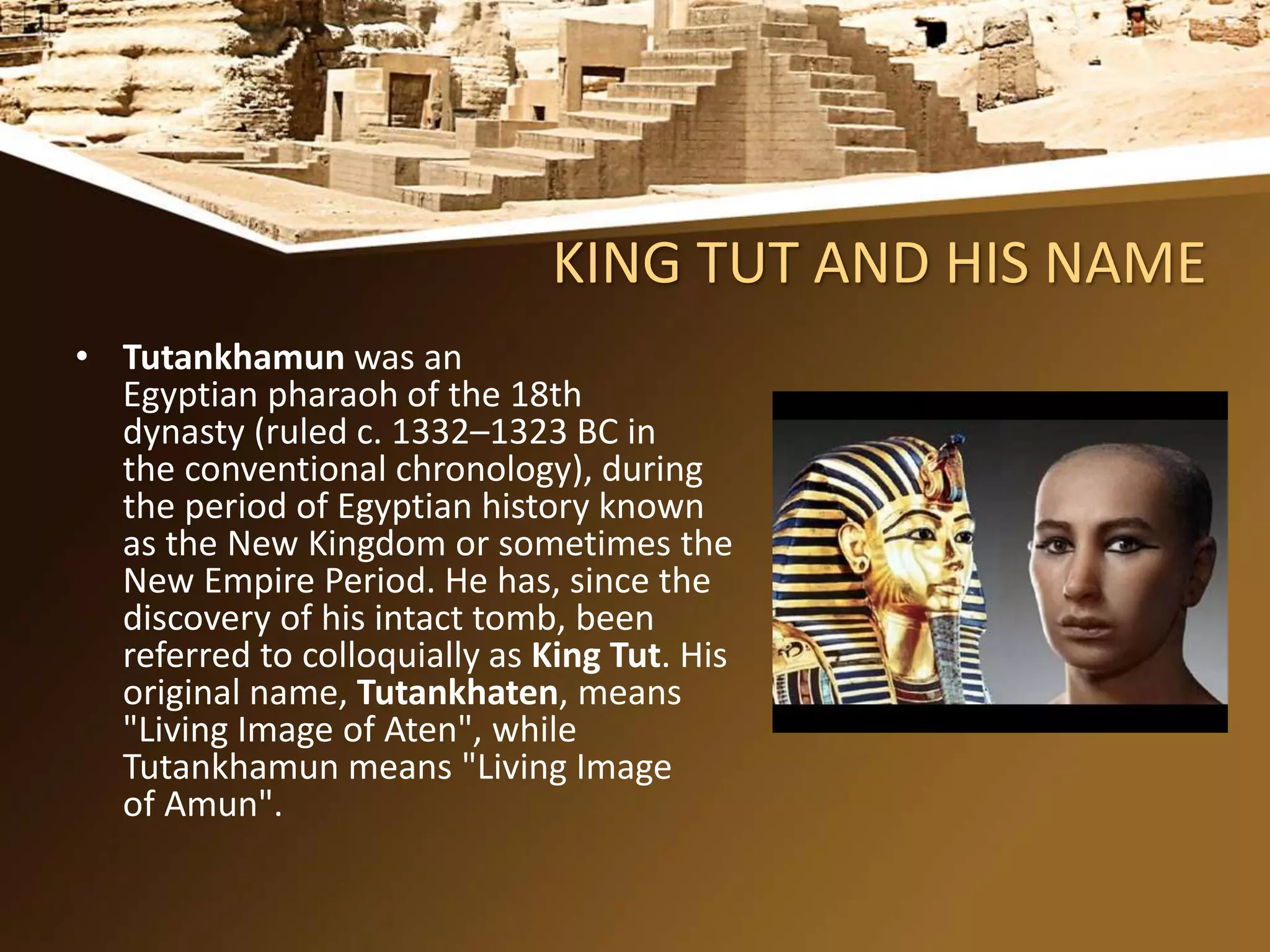
• Tutankhamun was an
Egyptian pharaoh of the 18th
dynasty (ruled c. 1332–1323 BC in
the conventional chronology), during
the period of Egyptian history known
as the New Kingdom or sometimes the
New Empire Period. He has, since the
discovery of his intact tomb, been
referred to colloquially as King Tut. His
original name, Tutankhaten, means
"Living Image of Aten", while
Tutankhamun means "Living Image
of Amun".
DISCOVERY OF KING TUT
• The 1922 discovery by Howard Carter of
Tutankhamun's nearly intact tomb, funded by Lord
Carnarvon, received worldwide press coverage. When
Carter first arrived in Egypt in 1891, most of the ancient
Egyptian tombs had been discovered, though the little-
known King Tutankhamen, who had died when he was
18, was still unaccounted for. After World War I, Carter
began an intensive search for “King Tut’s Tomb,” finally
finding steps to the burial room hidden in the debris near
the entrance of the nearby tomb of King Ramses VI in the
Valley of the Kings.
• On November 26, 1922, Carter and fellow
archaeologist Lord Carnarvon entered the interior
chambers of the tomb, finding them miraculously
intact. Thus began a monumental excavation process
in which Carter carefully explored the four-room
tomb over several years, uncovering an incredible
collection of several thousand objects. The most
splendid architectural find was a stone sarcophagus
containing three coffins nested within each other.
Inside the final coffin, which was made out of solid
gold, was the mummy of the boy-king Tutankhamen,
preserved for more than 3,000 years.
RESEARCHES ON HIS APPEARANCE
• Tutankhamun was slight of build, and was
roughly 180 cm (5 ft 11 in) tall. He had large
front incisors and an overbite characteristic of
the Thutmosid royal line to which he belonged.
Between September 2007 and October 2009,
various mummies were subjected to detailed
anthropological, radiological, and genetic
studies as part of the King Tutankhamun Family
Project. The research showed that
Tutankhamun also had "a slightly cleft
palate" and possibly a mild case of scoliosis, a
medical condition in which the spine deviates
to the side from the normal position.
REASONS FOR KING TUT’S DEATH
• It was believed that he was murdered or assassinated for some
of the reasons.A CT scan taken in 2005 showed that he had
suffered a compound left leg fracture shortly before his death,
and that the leg had become infected. DNA analysis conducted
in 2010 showed the presence of malaria in his system, leading
to the belief that malaria and Köhler disease II combined led to
his death. As at March 2018, there has been recent theory that
some of the tomb images of Tutankhamun leading an army to
war, depict truth, and that he died in battle in Syria.There is
strong suspicion that in the north wall of Tutankhamun's tomb
chamber is a doorway, blocked and hidden by decorated plaster,
leading to another chamber, which may contain a burial
of Nefertiti. There are plans to investigate by drilling a narrow
hole through the supposed blockage and sending a camera
through it.
HYDRAULIC LIFTS
• An elevator operated by fluid pressure, especially one used for
raising automobiles in service stations and garages. Different
types of hydraulic lift systems are available, including scissor
lifts, two-post lifts, four-post lifts, carousel lifts and mezzanine
lifts. All hydraulic lifts use hydraulic pressure as the motive
force. In many cases, hydraulic lifts are powered by air
compressors. These air compressors pressurize the hydraulic
oil, allowing it to lift the associated load. If the air compressor
has not had sufficient time to pressurize the hydraulic fluid,
the lift will not function. Other hydraulic lifts use an electric
motor driven pump or a fuel motor driven pump to pressurize
the fluid.
SCANS TOOK ON THE MUMMY OF
KING TUT.
Medical scientists used a “state-of-the-
art CAT-scanner” to perform initial
radiological analysis on Tut Scientists
may have discovered Tut’s cleft palate
and club foot using X-ray scans.
Scientists also used bore needles to
collect samples. Those samples – which
were particularly well-preserved thanks
to the ancient Egyptians’ masterful
mummification – contain the real
treasure for scientists: DNA.
THANK YOU

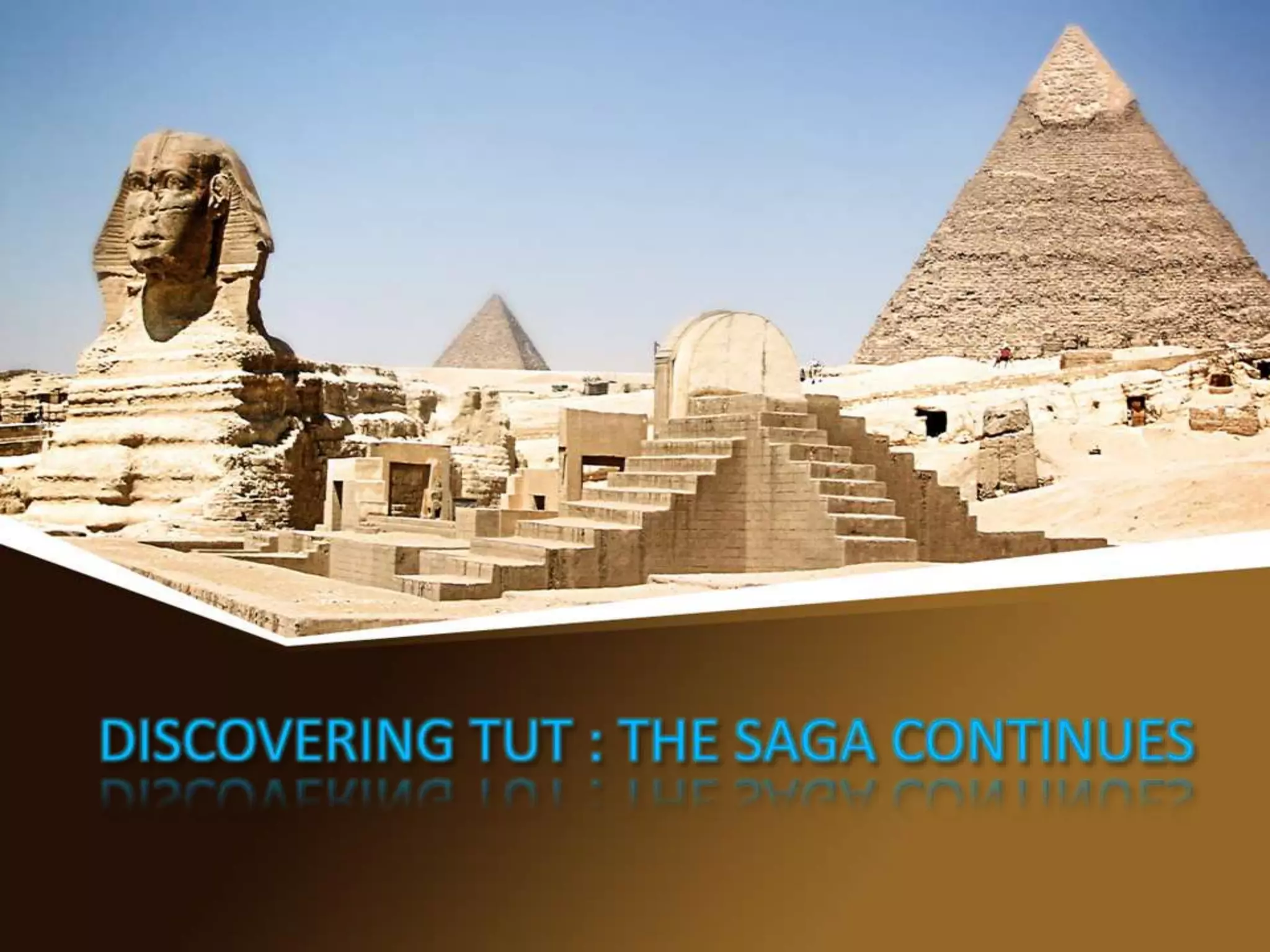
DISCOVERING KING TUT :THE SAGA CONTINUES

  • 2.
    KING TUT ANDHIS NAME • Tutankhamun was an Egyptian pharaoh of the 18th dynasty (ruled c. 1332–1323 BC in the conventional chronology), during the period of Egyptian history known as the New Kingdom or sometimes the New Empire Period. He has, since the discovery of his intact tomb, been referred to colloquially as King Tut. His original name, Tutankhaten, means "Living Image of Aten", while Tutankhamun means "Living Image of Amun".
  • 3.
    DISCOVERY OF KINGTUT • The 1922 discovery by Howard Carter of Tutankhamun's nearly intact tomb, funded by Lord Carnarvon, received worldwide press coverage. When Carter first arrived in Egypt in 1891, most of the ancient Egyptian tombs had been discovered, though the little- known King Tutankhamen, who had died when he was 18, was still unaccounted for. After World War I, Carter began an intensive search for “King Tut’s Tomb,” finally finding steps to the burial room hidden in the debris near the entrance of the nearby tomb of King Ramses VI in the Valley of the Kings.
  • 4.
    • On November26, 1922, Carter and fellow archaeologist Lord Carnarvon entered the interior chambers of the tomb, finding them miraculously intact. Thus began a monumental excavation process in which Carter carefully explored the four-room tomb over several years, uncovering an incredible collection of several thousand objects. The most splendid architectural find was a stone sarcophagus containing three coffins nested within each other. Inside the final coffin, which was made out of solid gold, was the mummy of the boy-king Tutankhamen, preserved for more than 3,000 years.
  • 7.
    RESEARCHES ON HISAPPEARANCE • Tutankhamun was slight of build, and was roughly 180 cm (5 ft 11 in) tall. He had large front incisors and an overbite characteristic of the Thutmosid royal line to which he belonged. Between September 2007 and October 2009, various mummies were subjected to detailed anthropological, radiological, and genetic studies as part of the King Tutankhamun Family Project. The research showed that Tutankhamun also had "a slightly cleft palate" and possibly a mild case of scoliosis, a medical condition in which the spine deviates to the side from the normal position.
  • 8.
    REASONS FOR KINGTUT’S DEATH • It was believed that he was murdered or assassinated for some of the reasons.A CT scan taken in 2005 showed that he had suffered a compound left leg fracture shortly before his death, and that the leg had become infected. DNA analysis conducted in 2010 showed the presence of malaria in his system, leading to the belief that malaria and Köhler disease II combined led to his death. As at March 2018, there has been recent theory that some of the tomb images of Tutankhamun leading an army to war, depict truth, and that he died in battle in Syria.There is strong suspicion that in the north wall of Tutankhamun's tomb chamber is a doorway, blocked and hidden by decorated plaster, leading to another chamber, which may contain a burial of Nefertiti. There are plans to investigate by drilling a narrow hole through the supposed blockage and sending a camera through it.
  • 9.
    HYDRAULIC LIFTS • Anelevator operated by fluid pressure, especially one used for raising automobiles in service stations and garages. Different types of hydraulic lift systems are available, including scissor lifts, two-post lifts, four-post lifts, carousel lifts and mezzanine lifts. All hydraulic lifts use hydraulic pressure as the motive force. In many cases, hydraulic lifts are powered by air compressors. These air compressors pressurize the hydraulic oil, allowing it to lift the associated load. If the air compressor has not had sufficient time to pressurize the hydraulic fluid, the lift will not function. Other hydraulic lifts use an electric motor driven pump or a fuel motor driven pump to pressurize the fluid.
  • 11.
    SCANS TOOK ONTHE MUMMY OF KING TUT. Medical scientists used a “state-of-the- art CAT-scanner” to perform initial radiological analysis on Tut Scientists may have discovered Tut’s cleft palate and club foot using X-ray scans. Scientists also used bore needles to collect samples. Those samples – which were particularly well-preserved thanks to the ancient Egyptians’ masterful mummification – contain the real treasure for scientists: DNA.
  • 12.