WHY
  DESIGN
  MATTERS
  P&G EXECUTIVE SUMMIT
      29 APRIL 2010


PRESTON SMALLEY          1
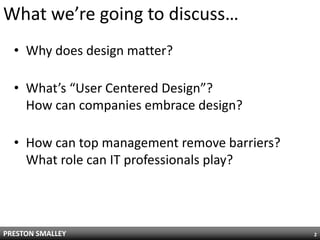
What we’re going to discuss…
  • Why does design matter?
  • What’s “User Centered Design”?
    How can companies embrace design?

  • How can top management remove barriers?
    What role can IT professionals play?


PRESTON SMALLEY                               2
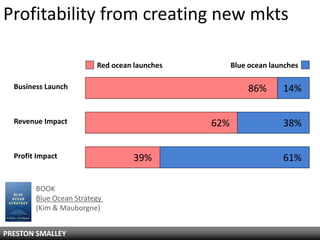
Profitability from creating new mkts

                         Red ocean launches         Blue ocean launches

  Business Launch                                       86%       14%


  Revenue Impact                              62%                 38%


  Profit Impact                    39%                            61%

        BOOK
        Blue Ocean Strategy
        (Kim & Mauborgne)


PRESTON SMALLEY
Customer Insight:
   Swiffer (P&G)   To clean up spilled coffee
                   grounds the customer didn’t use
                   the broom or vacuum.
                   Instead she used a paper towel.


                   Swiffer launched in 1999 and
                   created the “quick-clean” market.
                   As of 2005—had a market share
                   of 75% representing $750M.
PRESTON SMALLEY                                        4
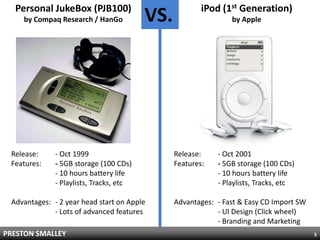
Personal JukeBox (PJB100)                            iPod (1st Generation)
    by Compaq Research / HanGo           VS.                   by Apple


 Release:     - Oct 1999                       Release:    - Oct 2001
 Features:    - 5GB storage (100 CDs)          Features:   - 5GB storage (100 CDs)
              - 10 hours battery life                      - 10 hours battery life
              - Playlists, Tracks, etc                     - Playlists, Tracks, etc

 Advantages: - 2 year head start on Apple      Advantages: - Fast & Easy CD Import SW
             - Lots of advanced features                   - UI Design (Click wheel)
                                                           - Branding and Marketing
PRESTON SMALLEY                                                                         5
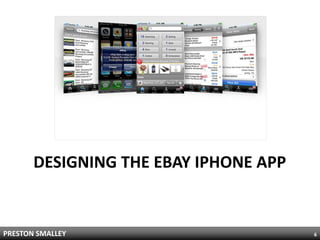
DESIGNING THE EBAY IPHONE APP


PRESTON SMALLEY                        6
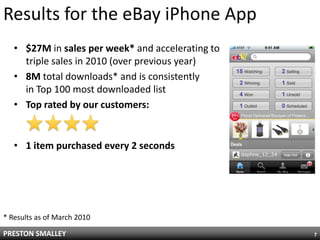
Results for the eBay iPhone App
   • $27M in sales per week* and accelerating to
     triple sales in 2010 (over previous year)
   • 8M total downloads* and is consistently
     in Top 100 most downloaded list
   • Top rated by our customers:


   • 1 item purchased every 2 seconds


* Results as of March 2010

PRESTON SMALLEY                                    7
So what is
   user centered design?

  How can I embrace it?

PRESTON SMALLEY            8
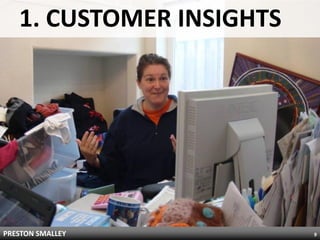
1. CUSTOMER INSIGHTS


PRESTON SMALLEY           9
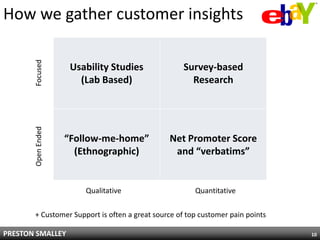
How we gather customer insights
       Focused


                     Usability Studies              Survey-based
                       (Lab Based)                    Research
       Open Ended


                    “Follow-me-home”           Net Promoter Score
                      (Ethnographic)            and “verbatims”


                        Qualitative                    Quantitative


       + Customer Support is often a great source of top customer pain points

PRESTON SMALLEY                                                                 10
2. DISCOVERY MIND

PRESTON SMALLEY        11
EX: Product Discovery
     • Product Discovery is a way to insert the “thinking”
       part into our process that enables us to come up with
       big ideas and right solutions to the right problems,
       before we rush into implementation.

     • How we made this happen…
        – Introduced formal Discovery phase within timeline
        – Cross functional ownership (Customer, BU, Technology)
        – Drove cultural changes - Delaying judgments, Saying NO


PRESTON SMALLEY
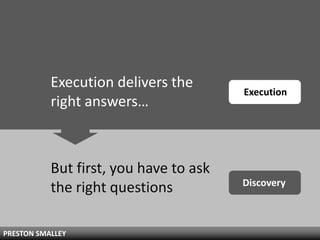
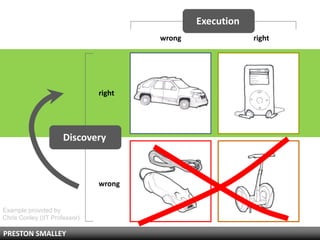
Execution delivers the
                                        Execution
           right answers…


           But first, you have to ask
                                        Discovery
           the right questions

PRESTON SMALLEY
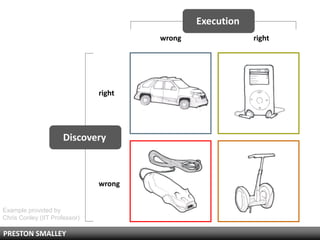
Execution
                                       wrong               right


                               right


                     Discovery


Example provided by
                               wrong
                                                           ?
Chris Conley (IIT Professor)

PRESTON SMALLEY
Execution
                                       wrong               right


                               right


                     Discovery


Example provided by
                               wrong
                                                           ?
Chris Conley (IIT Professor)

PRESTON SMALLEY
Key Discovery Questions
  •   What are the unmet needs of our customers?
  •   What’s the problem that we are trying to solve?
  •   Who are we solving it for?
  •   Do you and the stakeholders have a common
      understanding of the problem?

            BOOK
            Subject to Change
            Merholz and Schauer


PRESTON SMALLEY                                         16
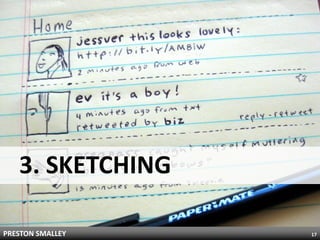
3. SKETCHING

PRESTON SMALLEY   17
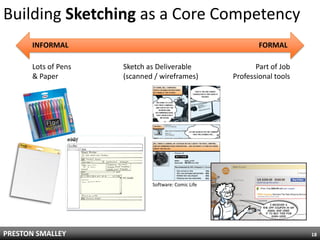
Building Sketching as a Core Competency
      INFORMAL                                              FORMAL

      Lots of Pens   Sketch as Deliverable                 Part of Job
      & Paper        (scanned / wireframes)         Professional tools


                             Software: Comic Life


PRESTON SMALLEY                                                          18
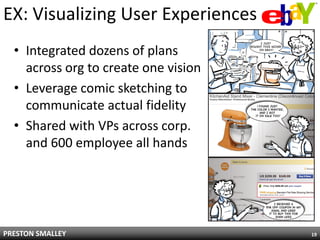
EX: Visualizing User Experiences
  • Integrated dozens of plans
    across org to create one vision
  • Leverage comic sketching to
    communicate actual fidelity
  • Shared with VPs across corp.
    and 600 employee all hands


PRESTON SMALLEY                       19
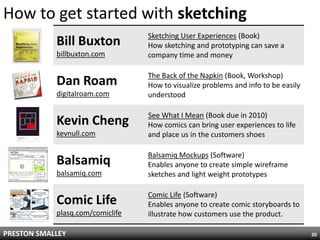
How to get started with sketching
                                  Sketching User Experiences (Book)
            Bill Buxton           How sketching and prototyping can save a
            billbuxton.com        company time and money

                                  The Back of the Napkin (Book, Workshop)
            Dan Roam              How to visualize problems and info to be easily
            digitalroam.com       understood

                                  See What I Mean (Book due in 2010)
            Kevin Cheng           How comics can bring user experiences to life
            kevnull.com           and place us in the customers shoes

                                  Balsamiq Mockups (Software)
            Balsamiq              Enables anyone to create simple wireframe
            balsamiq.com          sketches and light weight prototypes

                                  Comic Life (Software)
            Comic Life            Enables anyone to create comic storyboards to
            plasq.com/comiclife   illustrate how customers use the product.

PRESTON SMALLEY                                                                     20
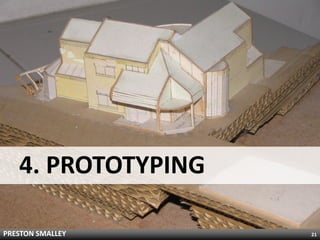
4. PROTOTYPING

PRESTON SMALLEY     21
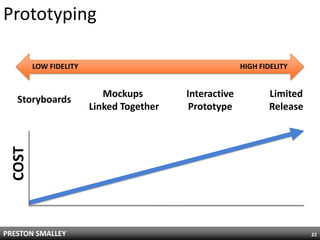
Prototyping

        LOW FIDELITY                                   HIGH FIDELITY


                          Mockups        Interactive          Limited
   Storyboards
                       Linked Together    Prototype           Release
 COST


PRESTON SMALLEY                                                         22
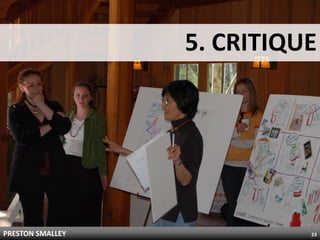
5. CRITIQUE


PRESTON SMALLEY             23
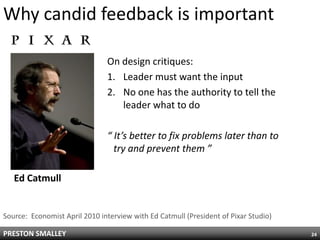
Why candid feedback is important

                               On design critiques:
                               1. Leader must want the input
                               2. No one has the authority to tell the
                                  leader what to do

                               “ It’s better to fix problems later than to
                                 try and prevent them ”

   Ed Catmull


Source: Economist April 2010 interview with Ed Catmull (President of Pixar Studio)

PRESTON SMALLEY                                                                      24
So what are the
        barriers to design?


PRESTON SMALLEY               25
What are the common barriers?
  •   Complexity
  •   Process
  •   Technology Platforms
  •   Culture of “Blessing”


PRESTON SMALLEY                 26
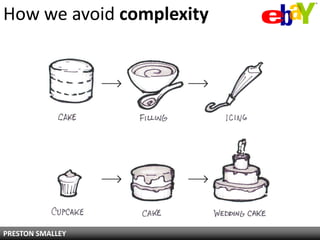
How we avoid complexity


PRESTON SMALLEY
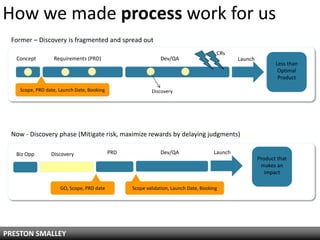
How we made process work for us
 Former – Discovery is fragmented and spread out
                                                                                       CRs
   Concept        Requirements (PRD)                          Dev/QA                           Launch
                                                                                                               Less than
                                                                                                                Optimal
                                                                                                                Product

    Scope, PRD date, Launch Date, Booking                 Discovery


 Now - Discovery phase (Mitigate risk, maximize rewards by delaying judgments)

   Biz Opp       Discovery                  PRD               Dev/QA                  Launch
                                                                                                        Product that
                                                                                                         makes an
                                                                                                           impact

                     GO, Scope, PRD date          Scope validation, Launch Date, Booking


PRESTON SMALLEY
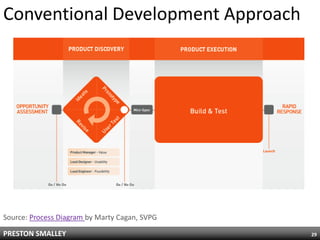
Conventional Development Approach


Source: Process Diagram by Marty Cagan, SVPG

PRESTON SMALLEY                                29
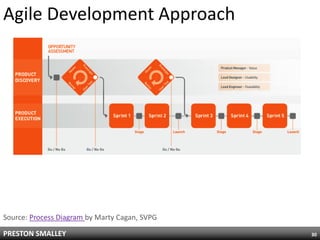
Agile Development Approach


Source: Process Diagram by Marty Cagan, SVPG

PRESTON SMALLEY                                30
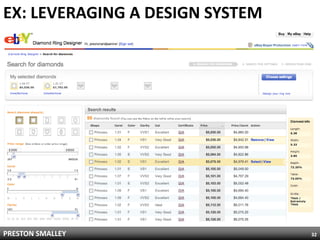
BUILDING DIAMONDS.EBAY.COM
         (TECH PLATFORM AS ENABLER)
PRESTON SMALLEY                       31
EX: LEVERAGING A DESIGN SYSTEM


PRESTON SMALLEY                  32
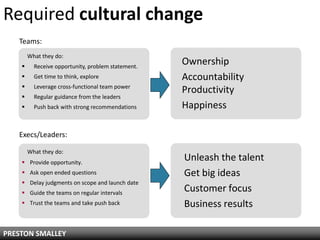
Required cultural change
   Teams:
        What they do:
         Receive opportunity, problem statement.
                                                    Ownership
         Get time to think, explore                Accountability
         Leverage cross-functional team power
                                                    Productivity
         Regular guidance from the leaders
         Push back with strong recommendations     Happiness

   Execs/Leaders:

        What they do:
     Provide opportunity.
                                                    Unleash the talent
     Ask open ended questions                      Get big ideas
     Delay judgments on scope and launch date
     Guide the teams on regular intervals
                                                    Customer focus
     Trust the teams and take push back            Business results

PRESTON SMALLEY
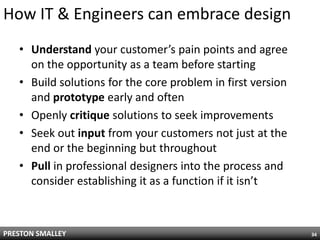
How IT & Engineers can embrace design
   • Understand your customer’s pain points and agree
     on the opportunity as a team before starting
   • Build solutions for the core problem in first version
     and prototype early and often
   • Openly critique solutions to seek improvements
   • Seek out input from your customers not just at the
     end or the beginning but throughout
   • Pull in professional designers into the process and
     consider establishing it as a function if it isn’t


PRESTON SMALLEY                                              34
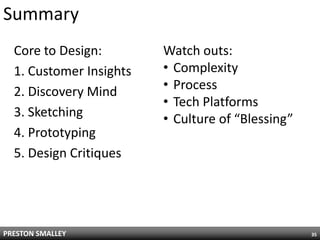
Summary
  Core to Design:        Watch outs:
  1. Customer Insights   • Complexity
  2. Discovery Mind      • Process
                         • Tech Platforms
  3. Sketching           • Culture of “Blessing”
  4. Prototyping
  5. Design Critiques


PRESTON SMALLEY                                    35
QUESTIONS


PRESTON SMALLEY   www.prestonsmalley.com   prestons@gmail.com   36
APPENDIX


PRESTON SMALLEY   37
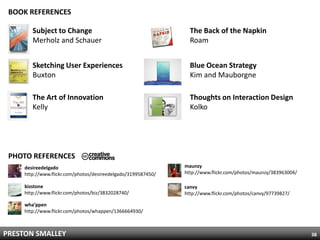
BOOK REFERENCES

        Subject to Change                                        The Back of the Napkin
        Merholz and Schauer                                      Roam


        Sketching User Experiences                               Blue Ocean Strategy
        Buxton                                                   Kim and Mauborgne

        The Art of Innovation                                    Thoughts on Interaction Design
        Kelly                                                    Kolko


 PHOTO REFERENCES
     desireedelgado                                            maunzy
     http://www.flickr.com/photos/desireedelgado/3199587450/   http://www.flickr.com/photos/maunzy/383963004/

     bizstone                                                  canvy
     http://www.flickr.com/photos/biz/3832028740/              http://www.flickr.com/photos/canvy/97739827/

     wha’ppen
     http://www.flickr.com/photos/whappen/1366664930/


PRESTON SMALLEY                                                                                                 38
Where to go for great designers
  • Carnegie Mellon
     Human Computer Interaction Institute
     Pittsburgh, PA
  • UC Berkeley
     School of Information
     Berkeley, CA
  • Stanford
     D School
     Palo Alto, CA
  • Savannah College of Art and Design
     Interaction Design
     Savannah, GA


PRESTON SMALLEY                             39
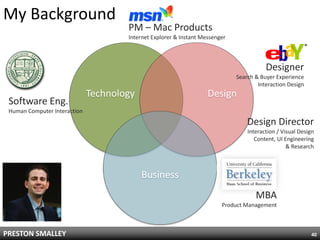
My Background
                                      PM – Mac Products
                                      Internet Explorer & Instant Messenger


                                                                                         Designer
                                                                              Search & Buyer Experience
                                                                                      Interaction Design
                              Technology                            Design
 Software Eng.
 Human Computer Interaction
                                                                                  Design Director
                                                                                  Interaction / Visual Design
                                                                                     Content, UI Engineering
                                                                                                  & Research


                                           Business
                                                                                     MBA
                                                                         Product Management


PRESTON SMALLEY                                                                                            40

Why Design Matters - P&G Keynote

  • 1.
    WHY DESIGN MATTERS P&G EXECUTIVE SUMMIT 29 APRIL 2010 PRESTON SMALLEY 1
  • 2.
    What we’re goingto discuss… • Why does design matter? • What’s “User Centered Design”? How can companies embrace design? • How can top management remove barriers? What role can IT professionals play? PRESTON SMALLEY 2
  • 3.
    Profitability from creatingnew mkts Red ocean launches Blue ocean launches Business Launch 86% 14% Revenue Impact 62% 38% Profit Impact 39% 61% BOOK Blue Ocean Strategy (Kim & Mauborgne) PRESTON SMALLEY
  • 4.
    Customer Insight: Swiffer (P&G) To clean up spilled coffee grounds the customer didn’t use the broom or vacuum. Instead she used a paper towel. Swiffer launched in 1999 and created the “quick-clean” market. As of 2005—had a market share of 75% representing $750M. PRESTON SMALLEY 4
  • 5.
    Personal JukeBox (PJB100) iPod (1st Generation) by Compaq Research / HanGo VS. by Apple Release: - Oct 1999 Release: - Oct 2001 Features: - 5GB storage (100 CDs) Features: - 5GB storage (100 CDs) - 10 hours battery life - 10 hours battery life - Playlists, Tracks, etc - Playlists, Tracks, etc Advantages: - 2 year head start on Apple Advantages: - Fast & Easy CD Import SW - Lots of advanced features - UI Design (Click wheel) - Branding and Marketing PRESTON SMALLEY 5
  • 6.
    DESIGNING THE EBAYIPHONE APP PRESTON SMALLEY 6
  • 7.
    Results for theeBay iPhone App • $27M in sales per week* and accelerating to triple sales in 2010 (over previous year) • 8M total downloads* and is consistently in Top 100 most downloaded list • Top rated by our customers: • 1 item purchased every 2 seconds * Results as of March 2010 PRESTON SMALLEY 7
  • 8.
    So what is user centered design? How can I embrace it? PRESTON SMALLEY 8
  • 9.
  • 10.
    How we gathercustomer insights Focused Usability Studies Survey-based (Lab Based) Research Open Ended “Follow-me-home” Net Promoter Score (Ethnographic) and “verbatims” Qualitative Quantitative + Customer Support is often a great source of top customer pain points PRESTON SMALLEY 10
  • 11.
  • 12.
    EX: Product Discovery • Product Discovery is a way to insert the “thinking” part into our process that enables us to come up with big ideas and right solutions to the right problems, before we rush into implementation. • How we made this happen… – Introduced formal Discovery phase within timeline – Cross functional ownership (Customer, BU, Technology) – Drove cultural changes - Delaying judgments, Saying NO PRESTON SMALLEY
  • 13.
    Execution delivers the Execution right answers… But first, you have to ask Discovery the right questions PRESTON SMALLEY
  • 14.
    Execution wrong right right Discovery Example provided by wrong ? Chris Conley (IIT Professor) PRESTON SMALLEY
  • 15.
    Execution wrong right right Discovery Example provided by wrong ? Chris Conley (IIT Professor) PRESTON SMALLEY
  • 16.
    Key Discovery Questions • What are the unmet needs of our customers? • What’s the problem that we are trying to solve? • Who are we solving it for? • Do you and the stakeholders have a common understanding of the problem? BOOK Subject to Change Merholz and Schauer PRESTON SMALLEY 16
  • 17.
  • 18.
    Building Sketching asa Core Competency INFORMAL FORMAL Lots of Pens Sketch as Deliverable Part of Job & Paper (scanned / wireframes) Professional tools Software: Comic Life PRESTON SMALLEY 18
  • 19.
    EX: Visualizing UserExperiences • Integrated dozens of plans across org to create one vision • Leverage comic sketching to communicate actual fidelity • Shared with VPs across corp. and 600 employee all hands PRESTON SMALLEY 19
  • 20.
    How to getstarted with sketching Sketching User Experiences (Book) Bill Buxton How sketching and prototyping can save a billbuxton.com company time and money The Back of the Napkin (Book, Workshop) Dan Roam How to visualize problems and info to be easily digitalroam.com understood See What I Mean (Book due in 2010) Kevin Cheng How comics can bring user experiences to life kevnull.com and place us in the customers shoes Balsamiq Mockups (Software) Balsamiq Enables anyone to create simple wireframe balsamiq.com sketches and light weight prototypes Comic Life (Software) Comic Life Enables anyone to create comic storyboards to plasq.com/comiclife illustrate how customers use the product. PRESTON SMALLEY 20
  • 21.
  • 22.
    Prototyping LOW FIDELITY HIGH FIDELITY Mockups Interactive Limited Storyboards Linked Together Prototype Release COST PRESTON SMALLEY 22
  • 23.
  • 24.
    Why candid feedbackis important On design critiques: 1. Leader must want the input 2. No one has the authority to tell the leader what to do “ It’s better to fix problems later than to try and prevent them ” Ed Catmull Source: Economist April 2010 interview with Ed Catmull (President of Pixar Studio) PRESTON SMALLEY 24
  • 25.
    So what arethe barriers to design? PRESTON SMALLEY 25
  • 26.
    What are thecommon barriers? • Complexity • Process • Technology Platforms • Culture of “Blessing” PRESTON SMALLEY 26
  • 27.
    How we avoidcomplexity PRESTON SMALLEY
  • 28.
    How we madeprocess work for us Former – Discovery is fragmented and spread out CRs Concept Requirements (PRD) Dev/QA Launch Less than Optimal Product Scope, PRD date, Launch Date, Booking Discovery Now - Discovery phase (Mitigate risk, maximize rewards by delaying judgments) Biz Opp Discovery PRD Dev/QA Launch Product that makes an impact GO, Scope, PRD date Scope validation, Launch Date, Booking PRESTON SMALLEY
  • 29.
    Conventional Development Approach Source:Process Diagram by Marty Cagan, SVPG PRESTON SMALLEY 29
  • 30.
    Agile Development Approach Source:Process Diagram by Marty Cagan, SVPG PRESTON SMALLEY 30
  • 31.
    BUILDING DIAMONDS.EBAY.COM (TECH PLATFORM AS ENABLER) PRESTON SMALLEY 31
  • 32.
    EX: LEVERAGING ADESIGN SYSTEM PRESTON SMALLEY 32
  • 33.
    Required cultural change Teams: What they do:  Receive opportunity, problem statement. Ownership  Get time to think, explore Accountability  Leverage cross-functional team power Productivity  Regular guidance from the leaders  Push back with strong recommendations Happiness Execs/Leaders: What they do:  Provide opportunity. Unleash the talent  Ask open ended questions Get big ideas  Delay judgments on scope and launch date  Guide the teams on regular intervals Customer focus  Trust the teams and take push back Business results PRESTON SMALLEY
  • 34.
    How IT &Engineers can embrace design • Understand your customer’s pain points and agree on the opportunity as a team before starting • Build solutions for the core problem in first version and prototype early and often • Openly critique solutions to seek improvements • Seek out input from your customers not just at the end or the beginning but throughout • Pull in professional designers into the process and consider establishing it as a function if it isn’t PRESTON SMALLEY 34
  • 35.
    Summary Coreto Design: Watch outs: 1. Customer Insights • Complexity 2. Discovery Mind • Process • Tech Platforms 3. Sketching • Culture of “Blessing” 4. Prototyping 5. Design Critiques PRESTON SMALLEY 35
  • 36.
    QUESTIONS PRESTON SMALLEY www.prestonsmalley.com prestons@gmail.com 36
  • 37.
  • 38.
    BOOK REFERENCES Subject to Change The Back of the Napkin Merholz and Schauer Roam Sketching User Experiences Blue Ocean Strategy Buxton Kim and Mauborgne The Art of Innovation Thoughts on Interaction Design Kelly Kolko PHOTO REFERENCES desireedelgado maunzy http://www.flickr.com/photos/desireedelgado/3199587450/ http://www.flickr.com/photos/maunzy/383963004/ bizstone canvy http://www.flickr.com/photos/biz/3832028740/ http://www.flickr.com/photos/canvy/97739827/ wha’ppen http://www.flickr.com/photos/whappen/1366664930/ PRESTON SMALLEY 38
  • 39.
    Where to gofor great designers • Carnegie Mellon Human Computer Interaction Institute Pittsburgh, PA • UC Berkeley School of Information Berkeley, CA • Stanford D School Palo Alto, CA • Savannah College of Art and Design Interaction Design Savannah, GA PRESTON SMALLEY 39
  • 40.
    My Background PM – Mac Products Internet Explorer & Instant Messenger Designer Search & Buyer Experience Interaction Design Technology Design Software Eng. Human Computer Interaction Design Director Interaction / Visual Design Content, UI Engineering & Research Business MBA Product Management PRESTON SMALLEY 40

Editor's Notes

  • #2 As part of the Design to Delight initiative at P&G (Marta, Mui, Rosa Maria and others are leading) I believe design should be used as a competitive advantage and that it can be applied to all kinds of products and services… including the ones you in this room work on. PRESENTED ON 4/29/2010 in Cincinnati, OH to Directors at P&G within their Global Business Services division which supports the Bus and 100K employees.
  • #3 I’ll cover 5 tenets of design that I believe are criticalI’ll discuss some common barriers that top management can either cause or actively remove. And lastly I’ll touch on how you as IT professionals can think about adopting some of these concepts.
  • #5 Story: Two P&G researchers followed a nice, grandmotherly lady as she ambled about, showing them around her house. When she flung the doors of her closet open, the researchers noticed that a broom covered with dust stood in the corner. In another closet, a vacuum cleaner sat, unused and forlorn. The researchers nodded conspiratorially at each other as they jotted notes.They all wandered into the kitchen. Jarring the researchers from their note-taking frenzy, the woman asked them, “Would you nice boys like some coffee?” The researchers agreed, blushing at being called “nice boys.” As the woman took a can of coffee grounds down from the pantry and opened it, the can slipped from her hands. She cried out as the can tumbled to the ground, strewing coffee grounds across the floor.Instantly, she grabbed a paper towel and attacked the mess, muttering to herself as she crouched on the floor. When she stood again, the researchers were staring at her, befuddled. “What?” she asked, the look of puzzlement on their faces engendering a puzzlement of her own. “You didn’t use the broom,” one researcher remarked. “Or the vacuum cleaner,” the other chimed in.With a sigh, the lady vented her frustration –the broom wouldn’t do a good-enough job and would leave coffee grounds on the floor, and the vacuum cleaner was heavy, cumbersome, needed to be plugged in, and was just overkill for the small mishap.The researchers nodded and wrote. Then, flipping their notebooks closed, they smiled and glanced at each other again with that same conspiratorial look, the gleam of excited insight shining from their eyes.SOURCE: BusinessWeek2005 - http://www.businessweek.com/innovate/content/sep2005/id20050923_571639.htm
  • #6 However, it isn’t always enough to create a blue ocean. Personal JukeBox failed despite 2 year head start. Discovery Mind critical to identifying the getting started “import” pain pointFind the “Ah Ha” moment (e.g. seeing all your music neatly organized and accessible)…It wasn’t until later that Apple added other key features like buying music, automatic genius playlists, video, apps and more.
  • #7 Fast Timeline and Constrained Device. Forced team to focus on the essence of the experience. Thought about what would customers want to do on the go. Limited feature set. Technology Platform enables this kind of design innovation
  • #9 5 key aspects to user centered design:Customer InsightsDiscovery MindSketchingPrototypingCritique
  • #10 At its core design is based on understanding who you are designing for. Their pain points and the opportunities to help them be more successful.
  • #11 Also don’t overlook other channels that may exist like Customer Support contacts and employee use of products
  • #12 Prior to executing on any significant project, I’ve found it crucial to focus the team on what problems exactly we’re trying to solve. This is especially important for an “executive mandated” project as if the team doesn’t really know why they’re doing XYZ it’s unlikely to be successful.
  • #13 Thru a change management process I worked with a visionary leader on in team, ShaileshShilwant, to insert “Product Discovery” at the front of our process.
  • #17 Here’s some of the questions we ask up front… partnered with BrendenSchauer (Adaptive Path) who also authored the book Subject to Change.
  • #18 Many of remember drawing as kids… I know I really enjoy seeing what my son, 3, draws with his crayons. So if a preschooler can do it, shouldn’t everyone in this room? And yet as we grow up we learn to tell ourselves that “I’m not good at sketching” but we’re more comparing ourselves to what a professional sketch artist might do. And yet I’ve found that if you democratize sketching and in fact encourage everyone… engineers, business analysts, and not just designers… you’re able iterate and co-create the solution much faster than you would otherwise.
  • #19 There’s a full spectrum of ways to integrate sketching into your company. Everything from simple pens (I like Flair) to comic storyboards to it being part of the job description for one person on my team.
  • #20 We even created a comic book in 2008 that was distributed throughout the organization. Not only was it fun… it captured the attention and focus of the organization in a way that bullets on a page never could.
  • #22 Architects learned this centuries ago… a small, rough model is infinitely easier and cheaper to change than the real thing—once the concrete foundation is poured. One of my favorite stories in technology circles is 15 years ago when Jeff Hawkins was designing the first Palm Pilot PDA—he cut a number of blocks of balsawood, carrying them around in his shirt pocket and actually pulling it out in meetings, until he got the size just right. Then he had the engineers build to that size and stripped out all but the most crutial features. The great irony here is that Palm ended up establishing the category where the Apple Newton had failed—and now we see the tables turned with the Apple iPhone displacing Palm’s own smart phone.
  • #23 Bill Buxton talks a lot about this concept that as the fidelity increases in fidelity, the cost (both the real cost and opportunity cost) increases.
  • #24 I hold a weekly design critique with my product designers where the goal is to improve the overall design. The designers come open and wanting the feedback and leave with no obligation of implementing the feedback. It’s up to them to decide, knowing the project best, how to proceed.
  • #25 Perhaps the greatest successful winning streak in the movie business (10 hits). They have found a repeatable process. “it’s very important for that dynamic to work, because it could be a brutal process, there needs to be the feeling they are all helping each other who wants that help. In order for that to work its important that no one in the room has the authority to tell the director they have to take their notes [make changes]. So no-one is taking a list of what you have to do to fix the film. All we can do is give the feedback and he goes off with the feedback… our job as leaders is to protect the dynamic in the room so that they’re honest with each other.”http://www.scottberkun.com/blog/2010/inside-pixars-leadership/
  • #29 Key Talking points:One size doesn’t fit all. Discovery does not mean 2 months. It can be done in 2 hours for small projects (Low risk)Discovery also means doing it with the team not just in your head by yourself.In turnaround times, we may have to do things quickly without spending a lot of upfront time. Our portfolio should be a good mix of “Do it now, fix the basic” and “long term, big bets”.
  • #30 It’s important to capture the opportunity up front and spend enough time revising the prototype before moving forward with execution.
  • #31 I’m a big fan of agile methodology… focuses on the core aspects early on.
  • #32 When we built motors.ebay.com it was a massive undertaking. It was clear that we would need to build not just a few more vertical experiences like that one but dozens if not hundreds more. But our existing technology platform was a barrier and needed to become an enabler. This project tried out the new tech platform, our new strategy of verticals, and our new more interactive design system.
  • #34 Key talking points: - Hit blessing cultureTeams as well as Leaders (Execs) need to change (not just process)Talk about regular rhythm that Stephanie mentioned.Ultimately, we will get the best work from (and retain) our best talent if we direct them to:Be bought into the whyOwn the what and howGet their input and commitment on the whenOther Points to cover throughout:Culture of inquiryAsk open ended questions to guide the team in early phasesHolistic view of the customer experienceDelay judgmentsGo slow to go fasterFail fast, fail early (Prototype, Test, Prototype, Test)Iterative, collaborative way of workingUnleash Cross-functional creativity (PM, UED, Tech)Maximize opportunities with big bets