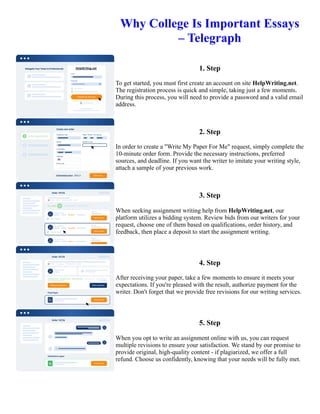
Download to read offline

![Black Boy Character Analysis
Everybody, at one moment or another during their childhood, has wished to gain the responsibilities of
an adult. However, most kids are held back by the childish part of themselves. They have to go
through a coming of age cycle, that once completed, has matured them and made them evolve from
their old self. In Richard Wright s autobiography Black Boy, we follow a young boy named Richard
through his own journey to become a man, as we see him struggle and overcome obstacles. The author
uses the motifs of hunger, discrimination, and religion to represent his quest and to emphasize on all
the challenges life throws at him. Richard s life is horribly scarred by the haunting ghost of hunger.
During his stay at West Helena, once Aunt Maggie has left with his new uncle, Richard and his family
are left with no money to buy food. A few weeks after his aunt s departure, hunger [haunts him] so ...
Show more content on Helpwriting.net ...
After the boy s visit to try and convince Richard to become religious, his family [begs him] so
continuously to come to God that it becomes impossible for him to ignore them without wounding
them. He desperately tries to think of some way to say no without making them hate him (Wright
116). Religion represents the conflict that flares in his family. He is different from them, and he wants
to make them to understand that without hurting them. When Ella is caught reading a book to Richard,
his grandmother gets furious and tells Richard that books are the Devil s work [...], [and that he is]
going to burn in hell (Wright, 39). For the first time in his life, Richard has tasted what was life to
him, and is determined to get away from his family s religious beliefs and get himself the life he
wants. He realizes that they can t understand what he is feeling. In this book, religion is used as a way
to represent the tension in his family, and is used to make Richard gain independence from his
... Get more on HelpWriting.net ...](https://image.slidesharecdn.com/whycollegeisimportantessaystelegraph-240122212604-48a26f3e/85/Why-College-Is-Important-Essays-Telegraph-3-320.jpg)






![Informative Speech On Neonatal Nurses
I. Raise your hand if you are a parent. To all the parents that raised their hands, think back to the time
you and your spouse were in the hospital room anxiously waiting for your unborn child to arrive. How
happy were you when the nurse placed your baby into your arms? That feeling of seeing your healthy
newborn baby for the first time is unexplainable, but how would you feel if your newborn was born
prematurely or had birth defects? II. The short staff of neonatal nurses has led to more than 23,000
American infants died in 2014, or about 6 for every 1,000 live births (Vital Record New). III. Twenty
one years ago, my parents received the devastating news that my lungs were not developing properly
and as a result my mom had an induced labor. I was born as a premature baby, weighing only 3 lbs.
and was placed in the care of neonatal nurses in the Neonatal Intensive Care Unit (NICU) for 18 days.
While my mom came to visit me, she would notice how well the nurses would care for me. Though
their jobs were tough, the nurses would often carry me while I was crying and would often talk me to
sleep, sometimes singing lullabies. IV. This situation has made me grateful to be alive since I was able
to be brought back to health due to these wonderful neonatal nurses who helped me recover, but not
many newborn babies are fortunate enough to survive just like me as newborn babies have died and
suffered due to the lack of supervision that neonatal nurses are incapable of providing. V. Today I will
inform you about the everyday obligations of neonatal nurses, the explanations of deficiency of staff
and the impacts a sufficient number of neonatal nurses can cause in a baby s life. Let s begin by
explaining what neonatal nurses are. Body I. Neonatal nurses are registered nurses who are
responsible to care for newborns who are critically ill or premature. (Slide 1: Neonatal nurses with
babies [Photos]). Knowing what a neonatal nurse does for our newborn children will help us
understand what exactly they do to them while they are not with us in the hospital room. A. The duties
of a neonatal nurse comprise of caring for newborns with a variety of problems such as premature
birth, surgical complications, heart malformations,
... Get more on HelpWriting.net ...](https://image.slidesharecdn.com/whycollegeisimportantessaystelegraph-240122212604-48a26f3e/85/Why-College-Is-Important-Essays-Telegraph-22-320.jpg)









Validity and reliability are two important concepts in assessment. Here is an explanation of each term: Validity refers to how well a test measures what it claims to measure. A test has high validity if it assesses the specific skills or knowledge it is intended to assess. For example, a math test should accurately measure a student's math skills and knowledge, not other unrelated abilities. Ensuring validity is important so that test scores can be meaningfully interpreted and used. Reliability refers to the consistency of test scores. A reliable test would produce similar results if the same person took it multiple times, or if two raters scored a student's work. Reliability is concerned with whether a test provides consistent measurement. A test with


