














Why choose Hack/HHVM
over PHP7
Intelligence, Ltd.
Yuji Otani
1
Presented on Feb 24, 2016
2
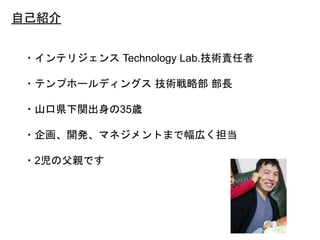
• Born in Shimonoseki, Yamaguchi Prefecture
• Software Engineer at Intelligence, Ltd
• I love cars and programming
• Be my friend on Facebook!
https://www.facebook.com/yuji.otani.16
About me:
3
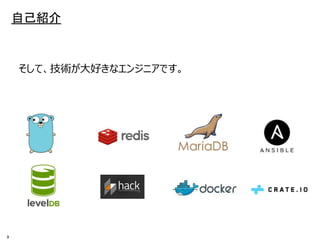
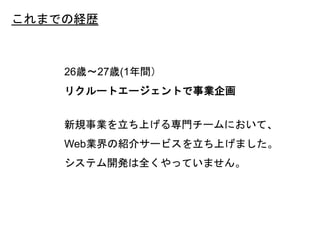
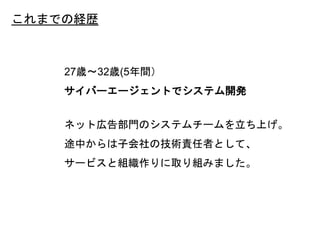
5years
→ →
My main experiences with
programming languages:
7years
1year
4
Question 1
Have you used
Hack/HHVM?
5
Question 2
PHP7 has been released.
Are you uncertain about
what to use next?
6
Goal of this presentation:
Convey the qualities of Hack/HHVM
and make you consider it
7
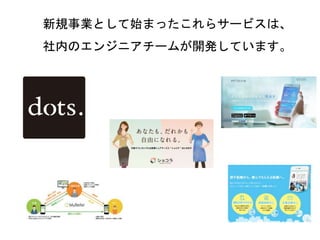
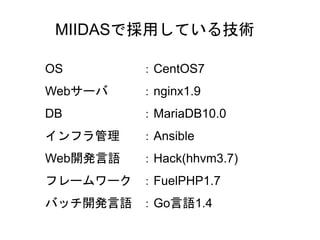
We have adopted Hack/HHVM in many
projects here at Intelligence since 2015.
The Framework of our choice is FuelPHP.
8
Example: MIIDAS (job hunting service)
https://miidas.jp
9
Example: MyRefer (employee referral service)
https://i-myrefer.jp/
10
• a programming language developed by Facebook
• compatible with PHP
• runs on HHVM (virtual machine)
• based on PHP5.6
What is Hack?
• bug-free and fast coding
• enjoyable coding experience
• fast runtime
• fit for large scale systems
The goals of Hack:
http://growthhackjapan.com/2014-03-23-facebook-hack-released-to-the-public/
12
• we wanted to challenge something new while
leveraging the experience with PHP
• we wanted to deliver a performant service
• we wanted to keep the ease of readability and
maintainability even when the system grew bigger
• PHP7 was not available yet
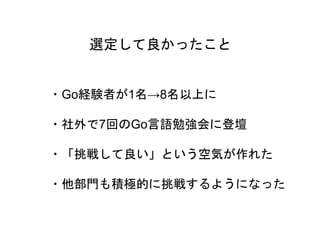
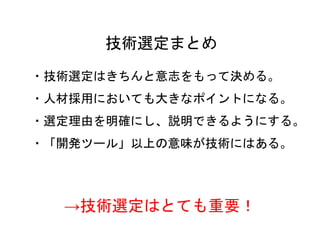
Why we chose Hack:
13
At the end of last year, the big
happening
14
Dec 3, 2015
PHP7 was released!
15
Huge performance improvements!!
http://talks.php.net/fluent15#/wpbench
16
• Null coalesce operator
• EngineException (catchable fatal errors)
• anonymous classes
• scalar type hinting
• return type declaration
New language specifications
17
• optimized for 64-bit CPUs
• efficient use of CPU cache
• in-memory arrays became sequences (in PHP5 they were all
associative arrays)
• the memory usage by arrays has improved dramatically.
* PHP5 (72bytes) → PHP7 (32bytes)
New data structure
18
PHP7 incorporated many features
from Hack/HHVM
• scalar type hinting
• return value declaration
• great performance
• lower consumption of memory for arrays
• AST (abstract syntax tree) compiling
19
Currently PHP faces a big turning point.
That's precisely the reason why I want you to
know the qualities of Hack/HHVM.
20
Point 1
Powerful type hinting
21
What is type hinting?
You can specify the type of arguments and return values of
functions.
Class Sample {
public static function sampleFunc(int $a): string{
return "OK";
}
}
//OK
Sample::sampleFunc (1);
//Fatal Error
Sample::sampleFunc ("a");
22
Type hinting in PHP
Types that could be used in type hinting were gradually added.
PHP5.0 :Class
PHP5.1 :array
PHP5.4 :Closure and function
PHP7 :Scalar Type (int, float, string, bool)
23
There are major differences in type
hinting between Hack and PHP7
24
PHP7 type hinting
There are 2 modes:
• Weakly typed = automatic type casting
• Strongly typed = strict type checking
<?php
Class Sample {
public static function sampleFunc(int $a): string{
return "OK";
}
}
// OK in both modes
Sample::sampleFunc(1);
// OK only in weakly typed mode
Sample::sampleFunc("1");
25
PHP7 type hinting
• The default mode is “weakly typed”
• To switch to “strongly typed” mode, it is necessary to
declare it in the beginning of the source files
• It’s only possible to declare “strongly typed” mode per file,
i.e. it’s not possible to declare “strongly typed” mode in
configuration files
<?php
// "Strongly typed" mode is enabled in this file only
declare(strict_types=1);
26
PHP7 type hinting
• It is not possible to declare nullable or mixed types.
• Passing Null to a function with type-hinted parameters will
trigger error.
<?php
Class Sample {
public static function sampleFunc(int $a): string{
return "OK";
}
}
//Fatal Error
Sample::sampleFunc(null);
27
Hack type hinting
• Only “strongly typed” mode
• Permits any type (including null) by using the “mixed”
keyword
<?hh
Class Sample {
public static function sampleFunc(mixed $a): string{
return "OK";
}
}
//OK
Sample::sampleFunc(null);
Sample::sampleFunc(1);
Sample::sampleFunc(”a");
28
Hack Type Hinting
• Accepts Null by adding a “?” before the type hint
<?hh
Class Sample {
public static function sampleFunc(?int $a): string{
return "OK";
}
}
//OK
Sample::sampleFunc(null);
Sample::sampleFunc(1);
29
Hack Type Hinting
The types of keys and values of arrays can be specified.
However, it is only for static analysis, not runtime.
<?hh
Class Sample {
public static function sampleFunc(array<int, string> $a): string{
return "OK";
}
}
//OK
Sample::sampleFunc(array(1 => "a", 2 => "b"));
Sample::sampleFunc(array(1 => 1, 2 => null));
30
Hack Type Hinting
It is possible to specify types in Enum.
<?hh
enum Size: int {
MEDIUM = 1;
LARGE = 2;
}
Class Sample {
public static function sampleFunc(Size $size): string{
return "OK";
}
}
//OK
Sample::sampleFunc(Size::LARGE);
Sample::sampleFunc(2);
Sample::sampleFunc(4); // This works too: it checks the type, not the value.
//Error
Sample::sampleFunc(”a");
31
Type Hinting
• “Strongly typed” only
• Nullable and mixed types
The specifications put emphasis on
type-sensitive, large scale systems.
• “Weakly typed” by default
• No nullable nor mixed types
The specifications put emphasis on
the speed of type-agnostic
development.
32
Point 2
Collections
33
PHP5 arrays:
• Arrays and associative arrays can be used in the same way
• Arrays accept values of any type
• Keys can be integer or string
• Values are retrieved in order of insertion, regardless of keys
<?php
// the code below prints “ab”
$arr = array(1 => ”a", 0 => ”b");
foreach($arr as $value ) {
print($value);
}
34
Hack Collections:
• Has original collections: Vector, Map, Set and Pair
• It is possible to specify the types of keys and values, though
they’re not checked during runtime
<?hh
$a = new Map<string, string>;
//OK
$a->set("key1", "value1");
//OK
$a->set("key2", 2);
//OK
$a->set(3, array());
35
Hack Collection
It’s not necessary to check if the key exists prior to fetching a
value, and it won’t trigger a “Notice” error when the key doesn’t
exist.
<?hh
$a = new Map<string, string>;
$a->set("key1", "value1");
// $val1 becomes “value1”
$val1 = $a->get("key1");
// $val2 becomes null, no “Notice” error fired
$val2 = $a->get("key2");
36
Map
Stores key-value pairs
B
A
D
EC
37
Vector
Pure stack-like ordered array
21 4 53
38
Set
Ordered collection of unique values
BA D EC
39
Pair
Immutable collection of exactly 2 values
40
Collection
• Four original collections
• It is possible to specify the types
of values (keys as well for Maps)
The specifications put emphasis on
type-sensitive, large scale systems.
• Only arrays that accept any type
• No concern over the types of
arrays and their values
The specifications put emphasis on
the speed of “anything-goes”
associative arrays.
41
Point 3
Original specifications
42
Original features:
• Lambdas
• Generics
• Enum
• Tuples
• Shapes
43
Enum (Enumeration of value)
<?hh
enum Size: int {
SMALL = 0;
MEDIUM = 1;
LARGE = 2;
X_LARGE = 3;
}
Enumerate values with a specific type
44
Tuples
<?hh
list($a, $b) = testFunc();
public function testFunc() : (string, int) {
return tuple(“OK”, 1);
}
Return multiple values ​​from a function
45
Original language specification
Hack/HHVM has added many original language specifications.
By using Hack in your service, you can achieve:
• quick development with fewer bugs
• developers actually enjoy coding
46
Point 4
Parallel execution
47
Parallel execution
It is possible to run statements in parallel by using
original functions such as “Async” and “Await.”
Parallel execution is possible out-of-the-box,
reaching even higher performance speeds.
48
Parallel execution
49
Point 5
Static analysis tool
50
Static analysis tool
The static analysis of the code is done by hh_client. It
checks for syntax errors and inconsistencies, allowing
developers to fix them before runtime.
Code with fewer bugs like this is only possible due to the
strict type restrictions in Hack.
51
You can check the program before execution.
• Check for compilation errors
• Type-check the arguments and return values
• Check for discouraged syntax
• Check for inappropriate type casting
Static analysis tool
* configure automatic static analysis with hhvm.hack.lang.auto_typecheck
in config files.
52
Point 6
Gradually adopting features from PHP7
53
Continued support for both PHP5 and 7
• HHVM3.11 implements the new features in PHP7
• The direction is to support both PHP5 and PHP7
• Also possible to break backward compatibility by setting
“hhvm.php7.all = 1” in the settings
• Features from PHP7 can be individually enabled
https://docs.hhvm.com/hhvm/configuration/INI-settings#php-7-settings
54
Point 7
Great adoption record
55
Great adoption record
The adoption continues to grow, especially among large
scale services. Wikipedia and Baidu have many commits into
the source code to Hack/HHVM.
https://github.com/facebook/hhvm/wiki/Users
56
Although Hack/HHVM is very nice,
there are also unfavorable qualities
57
Release cycle
Hack (HHVM)
• Released every 8 weeks
• Every 3rd version is turned into the LTS version, which is
supported for one year
PHP
• Released every 1 year
• Life cycle of 3 years (bug fixes 2 years, security 1 year)
LTS are supported for about 1 year
Hack/HHVM support
59
• HHVM crash: needed to monitor to restart
automatically
• pecl not supported: tried replacing some with
golang, but currently venturing into HNI
• Had to upgrade CentOS6 to CentOS7 due to
sudden end of support
• Most of IDEs don’t support it
Some issues we faced in production
60
Hard to find resources
Problem
61
PHP7 support in HHVM
62
PHP7 support in HHVM
http://hhvm.com/blog/10859/php-7-support
63
TLDR;
• The release of PHP7 is also fortunate to HHVM
• New features in PHP7 will be available from HHVM3.11
• HHVM will continue supporting both PHP5 and PHP7
• Possible to break backward compatibility by setting
“hhvm.php7.all = 1” in the settings
https://docs.hhvm.com/hhvm/configuration/INI-settings#php-7-settings
64
Issues related to PHP7 can be tracked on GitHub
https://github.com/facebook/hhvm/labels/php7%20incompatibility
65
Wrap-up
• PHP7 and Hack are similar, but with different
features
• Hack seems to more suited to large scale systems
• Hack didn’t split from PHP, it synchronizes and
evolves together
66
PHP specifications are community-driven, while Hack
is mainly developed by Facebook.
I think PHP values the “loose PHP-ness,” while Hack
values the “correct practical use.”
Final thoughts
67
It is great to have options in the future of
an excellent language like PHP!
68
PHP7 is out, but it is still worth to
choose Hack/HHVM!
69
thank you
70
This document was created with accuracy in mind, but
the author does not guarantee its veracity nor its
usefulness. In addition, this material was created solely
by the author, and it does not represent the views,
values, etc. of any organization.
Disclaimer

Why choose Hack/HHVM over PHP7

  • 1.
    Why choose Hack/HHVM overPHP7 Intelligence, Ltd. Yuji Otani 1 Presented on Feb 24, 2016
  • 2.
    2 • Born inShimonoseki, Yamaguchi Prefecture • Software Engineer at Intelligence, Ltd • I love cars and programming • Be my friend on Facebook! https://www.facebook.com/yuji.otani.16 About me:
  • 3.
    3 5years → → My mainexperiences with programming languages: 7years 1year
  • 4.
    4 Question 1 Have youused Hack/HHVM?
  • 5.
    5 Question 2 PHP7 hasbeen released. Are you uncertain about what to use next?
  • 6.
    6 Goal of thispresentation: Convey the qualities of Hack/HHVM and make you consider it
  • 7.
    7 We have adoptedHack/HHVM in many projects here at Intelligence since 2015. The Framework of our choice is FuelPHP.
  • 8.
    8 Example: MIIDAS (jobhunting service) https://miidas.jp
  • 9.
    9 Example: MyRefer (employeereferral service) https://i-myrefer.jp/
  • 10.
    10 • a programminglanguage developed by Facebook • compatible with PHP • runs on HHVM (virtual machine) • based on PHP5.6 What is Hack?
  • 11.
    • bug-free andfast coding • enjoyable coding experience • fast runtime • fit for large scale systems The goals of Hack: http://growthhackjapan.com/2014-03-23-facebook-hack-released-to-the-public/
  • 12.
    12 • we wantedto challenge something new while leveraging the experience with PHP • we wanted to deliver a performant service • we wanted to keep the ease of readability and maintainability even when the system grew bigger • PHP7 was not available yet Why we chose Hack:
  • 13.
    13 At the endof last year, the big happening
  • 14.
    14 Dec 3, 2015 PHP7was released!
  • 15.
  • 16.
    16 • Null coalesceoperator • EngineException (catchable fatal errors) • anonymous classes • scalar type hinting • return type declaration New language specifications
  • 17.
    17 • optimized for64-bit CPUs • efficient use of CPU cache • in-memory arrays became sequences (in PHP5 they were all associative arrays) • the memory usage by arrays has improved dramatically. * PHP5 (72bytes) → PHP7 (32bytes) New data structure
  • 18.
    18 PHP7 incorporated manyfeatures from Hack/HHVM • scalar type hinting • return value declaration • great performance • lower consumption of memory for arrays • AST (abstract syntax tree) compiling
  • 19.
    19 Currently PHP facesa big turning point. That's precisely the reason why I want you to know the qualities of Hack/HHVM.
  • 20.
  • 21.
    21 What is typehinting? You can specify the type of arguments and return values of functions. Class Sample { public static function sampleFunc(int $a): string{ return "OK"; } } //OK Sample::sampleFunc (1); //Fatal Error Sample::sampleFunc ("a");
  • 22.
    22 Type hinting inPHP Types that could be used in type hinting were gradually added. PHP5.0 :Class PHP5.1 :array PHP5.4 :Closure and function PHP7 :Scalar Type (int, float, string, bool)
  • 23.
    23 There are majordifferences in type hinting between Hack and PHP7
  • 24.
    24 PHP7 type hinting Thereare 2 modes: • Weakly typed = automatic type casting • Strongly typed = strict type checking <?php Class Sample { public static function sampleFunc(int $a): string{ return "OK"; } } // OK in both modes Sample::sampleFunc(1); // OK only in weakly typed mode Sample::sampleFunc("1");
  • 25.
    25 PHP7 type hinting •The default mode is “weakly typed” • To switch to “strongly typed” mode, it is necessary to declare it in the beginning of the source files • It’s only possible to declare “strongly typed” mode per file, i.e. it’s not possible to declare “strongly typed” mode in configuration files <?php // "Strongly typed" mode is enabled in this file only declare(strict_types=1);
  • 26.
    26 PHP7 type hinting •It is not possible to declare nullable or mixed types. • Passing Null to a function with type-hinted parameters will trigger error. <?php Class Sample { public static function sampleFunc(int $a): string{ return "OK"; } } //Fatal Error Sample::sampleFunc(null);
  • 27.
    27 Hack type hinting •Only “strongly typed” mode • Permits any type (including null) by using the “mixed” keyword <?hh Class Sample { public static function sampleFunc(mixed $a): string{ return "OK"; } } //OK Sample::sampleFunc(null); Sample::sampleFunc(1); Sample::sampleFunc(”a");
  • 28.
    28 Hack Type Hinting •Accepts Null by adding a “?” before the type hint <?hh Class Sample { public static function sampleFunc(?int $a): string{ return "OK"; } } //OK Sample::sampleFunc(null); Sample::sampleFunc(1);
  • 29.
    29 Hack Type Hinting Thetypes of keys and values of arrays can be specified. However, it is only for static analysis, not runtime. <?hh Class Sample { public static function sampleFunc(array<int, string> $a): string{ return "OK"; } } //OK Sample::sampleFunc(array(1 => "a", 2 => "b")); Sample::sampleFunc(array(1 => 1, 2 => null));
  • 30.
    30 Hack Type Hinting Itis possible to specify types in Enum. <?hh enum Size: int { MEDIUM = 1; LARGE = 2; } Class Sample { public static function sampleFunc(Size $size): string{ return "OK"; } } //OK Sample::sampleFunc(Size::LARGE); Sample::sampleFunc(2); Sample::sampleFunc(4); // This works too: it checks the type, not the value. //Error Sample::sampleFunc(”a");
  • 31.
    31 Type Hinting • “Stronglytyped” only • Nullable and mixed types The specifications put emphasis on type-sensitive, large scale systems. • “Weakly typed” by default • No nullable nor mixed types The specifications put emphasis on the speed of type-agnostic development.
  • 32.
  • 33.
    33 PHP5 arrays: • Arraysand associative arrays can be used in the same way • Arrays accept values of any type • Keys can be integer or string • Values are retrieved in order of insertion, regardless of keys <?php // the code below prints “ab” $arr = array(1 => ”a", 0 => ”b"); foreach($arr as $value ) { print($value); }
  • 34.
    34 Hack Collections: • Hasoriginal collections: Vector, Map, Set and Pair • It is possible to specify the types of keys and values, though they’re not checked during runtime <?hh $a = new Map<string, string>; //OK $a->set("key1", "value1"); //OK $a->set("key2", 2); //OK $a->set(3, array());
  • 35.
    35 Hack Collection It’s notnecessary to check if the key exists prior to fetching a value, and it won’t trigger a “Notice” error when the key doesn’t exist. <?hh $a = new Map<string, string>; $a->set("key1", "value1"); // $val1 becomes “value1” $val1 = $a->get("key1"); // $val2 becomes null, no “Notice” error fired $val2 = $a->get("key2");
  • 36.
  • 37.
  • 38.
    38 Set Ordered collection ofunique values BA D EC
  • 39.
  • 40.
    40 Collection • Four originalcollections • It is possible to specify the types of values (keys as well for Maps) The specifications put emphasis on type-sensitive, large scale systems. • Only arrays that accept any type • No concern over the types of arrays and their values The specifications put emphasis on the speed of “anything-goes” associative arrays.
  • 41.
  • 42.
    42 Original features: • Lambdas •Generics • Enum • Tuples • Shapes
  • 43.
    43 Enum (Enumeration ofvalue) <?hh enum Size: int { SMALL = 0; MEDIUM = 1; LARGE = 2; X_LARGE = 3; } Enumerate values with a specific type
  • 44.
    44 Tuples <?hh list($a, $b) =testFunc(); public function testFunc() : (string, int) { return tuple(“OK”, 1); } Return multiple values ​​from a function
  • 45.
    45 Original language specification Hack/HHVMhas added many original language specifications. By using Hack in your service, you can achieve: • quick development with fewer bugs • developers actually enjoy coding
  • 46.
  • 47.
    47 Parallel execution It ispossible to run statements in parallel by using original functions such as “Async” and “Await.” Parallel execution is possible out-of-the-box, reaching even higher performance speeds.
  • 48.
  • 49.
  • 50.
    50 Static analysis tool Thestatic analysis of the code is done by hh_client. It checks for syntax errors and inconsistencies, allowing developers to fix them before runtime. Code with fewer bugs like this is only possible due to the strict type restrictions in Hack.
  • 51.
    51 You can checkthe program before execution. • Check for compilation errors • Type-check the arguments and return values • Check for discouraged syntax • Check for inappropriate type casting Static analysis tool * configure automatic static analysis with hhvm.hack.lang.auto_typecheck in config files.
  • 52.
  • 53.
    53 Continued support forboth PHP5 and 7 • HHVM3.11 implements the new features in PHP7 • The direction is to support both PHP5 and PHP7 • Also possible to break backward compatibility by setting “hhvm.php7.all = 1” in the settings • Features from PHP7 can be individually enabled https://docs.hhvm.com/hhvm/configuration/INI-settings#php-7-settings
  • 54.
  • 55.
    55 Great adoption record Theadoption continues to grow, especially among large scale services. Wikipedia and Baidu have many commits into the source code to Hack/HHVM. https://github.com/facebook/hhvm/wiki/Users
  • 56.
    56 Although Hack/HHVM isvery nice, there are also unfavorable qualities
  • 57.
    57 Release cycle Hack (HHVM) •Released every 8 weeks • Every 3rd version is turned into the LTS version, which is supported for one year PHP • Released every 1 year • Life cycle of 3 years (bug fixes 2 years, security 1 year)
  • 58.
    LTS are supportedfor about 1 year Hack/HHVM support
  • 59.
    59 • HHVM crash:needed to monitor to restart automatically • pecl not supported: tried replacing some with golang, but currently venturing into HNI • Had to upgrade CentOS6 to CentOS7 due to sudden end of support • Most of IDEs don’t support it Some issues we faced in production
  • 60.
    60 Hard to findresources Problem
  • 61.
  • 62.
    62 PHP7 support inHHVM http://hhvm.com/blog/10859/php-7-support
  • 63.
    63 TLDR; • The releaseof PHP7 is also fortunate to HHVM • New features in PHP7 will be available from HHVM3.11 • HHVM will continue supporting both PHP5 and PHP7 • Possible to break backward compatibility by setting “hhvm.php7.all = 1” in the settings https://docs.hhvm.com/hhvm/configuration/INI-settings#php-7-settings
  • 64.
    64 Issues related toPHP7 can be tracked on GitHub https://github.com/facebook/hhvm/labels/php7%20incompatibility
  • 65.
    65 Wrap-up • PHP7 andHack are similar, but with different features • Hack seems to more suited to large scale systems • Hack didn’t split from PHP, it synchronizes and evolves together
  • 66.
    66 PHP specifications arecommunity-driven, while Hack is mainly developed by Facebook. I think PHP values the “loose PHP-ness,” while Hack values the “correct practical use.” Final thoughts
  • 67.
    67 It is greatto have options in the future of an excellent language like PHP!
  • 68.
    68 PHP7 is out,but it is still worth to choose Hack/HHVM!
  • 69.
  • 70.
    70 This document wascreated with accuracy in mind, but the author does not guarantee its veracity nor its usefulness. In addition, this material was created solely by the author, and it does not represent the views, values, etc. of any organization. Disclaimer