TAKING PHP
SERIOUSLY
Keith Adams
Facebook
Strange Loop 2013
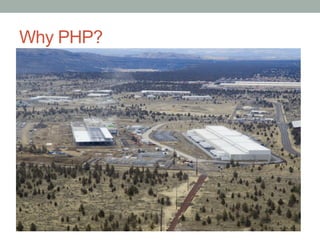
Why PHP?
What this talk is
•  Experience report
•  Apologia
•  Qualified advocacy
•  A surprise.
What this talk is not
•  “Network effects”/”Legacy”
•  “Right tool for the job”
•  tautological
•  some tools really are bad
•  PHP might be such a tool
•  “Worse is better”
•  pace Richard Gabriel
•  Better is better
•  Most people think of UNIX as “better” nowadays
Recent changes
•  Traits (ala Scala)
•  Closures
•  Generators (yield statement)
•  The HipHop VM (hhvm) is fast
•  https://github.com/facebook/hiphop-php/
•  https://www.hhvm.com
•  ...and we want it to run your code
•  http://www.hhvm.com/blog/?p=875
Conventional Wisdom on PHP
•  “PHP: A fractal of bad design”
•  http://me.veekun.com/blog/2012/04/09/php-a-fractal-of-bad-design/
•  “[ ] You have reinvented PHP better, but that’s still no
justification”
•  http://colinm.org/language_checklist.html
•  Etc.
And yet...
•  A lot of software that has changed the world has been
rendered in PHP
•  Mediawiki
•  Facebook
•  Wordpress
•  Drupal
•  This is at least interesting
•  Should they really have been written in Haskell?
•  Does PHP make projects more or less successful?
Facebook’s PHP Codebase
•  x * 105 files
•  y * 107 LoC
•  10 releases per week
•  Anecdotally, good engineers are astonishingly productive
in PHP
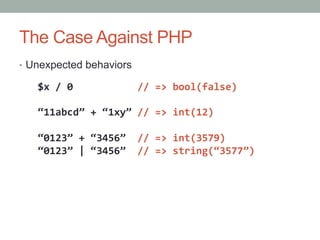
The Case Against PHP
•  Unexpected behaviors
$x	
  /	
  0	


  //	
  =>	
  bool(false)	


“11abcd”	
  +	
  “1xy”	
  //	
  =>	
  int(12)	
  
“0123”	
  +	
  “3456”	
  	
  //	
  =>	
  int(3579)	
  
“0123”	
  |	
  “3456”	
  	
  //	
  =>	
  string(“3577”)	
  
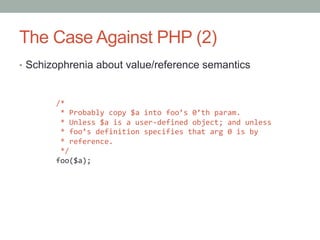
The Case Against PHP (2)
•  Schizophrenia about value/reference semantics
	
  	
  /*	


  *	
  Probably	
  copy	
  $a	
  into	
  foo’s	
  0’th	
  param.	


  *	
  Unless	
  $a	
  is	
  a	
  user-­‐defined	
  object;	
  and	
  unless	


  *	
  foo’s	
  definition	
  specifies	
  that	
  arg	
  0	
  is	
  by	


  *	
  reference.	


  */	


  foo($a);	
  
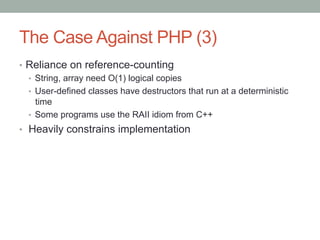
The Case Against PHP (3)
•  Reliance on reference-counting
•  String, array need O(1) logical copies
•  User-defined classes have destructors that run at a deterministic
time
•  Some programs use the RAII idiom from C++
•  Heavily constrains implementation
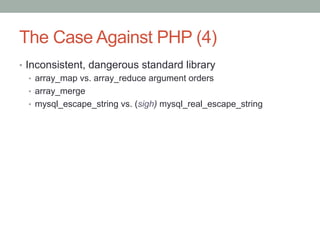
The Case Against PHP (4)
•  Inconsistent, dangerous standard library
•  array_map vs. array_reduce argument orders
•  array_merge
•  mysql_escape_string vs. (sigh) mysql_real_escape_string
The Case Against PHP: “Guilty”
•  It’s all true!
•  These are “unforced errors”
•  Most other languages do better
•  You would want to avoid them in a PHP Reboot
In Defense of PHP
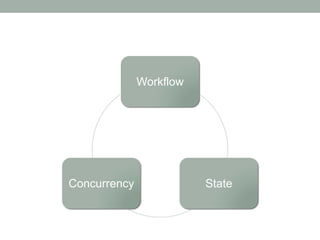
•  PHP gets three important things really right
•  Programmer workflow
•  State
•  Concurrency
Workflow
•  Save, reload-the-page
•  Short feedback cycle
•  Optimizes most precious resource of all: programmer
short-term memory
State
•  PHP requests always start with empty heap, namespace
•  Cross-request state must be saved explicitly
•  Filesystem, memcache, APC
•  Affirmative virtue
•  Typical FB requests spend 10ms initializing
•  Reduces the cost of bugs
•  Requests interact in limited ways
•  Natural boundary for failure isolation
Concurrency
•  PHP requests execute in a single thread
•  Concurrency happens via recursive web requests
•  shared-nothing
•  inputs/outputs copied
•  Limits PHP’s applicable domain
•  That’s actually good.
Workflow
StateConcurrency
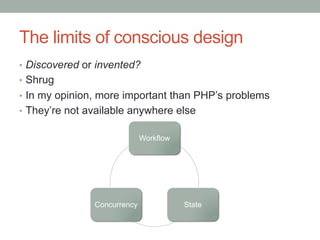
The limits of conscious design
•  Discovered or invented?
•  Shrug
•  In my opinion, more important than PHP’s problems
•  They’re not available anywhere else
Workflow
StateConcurrency
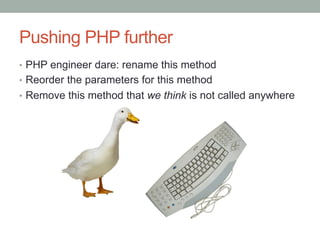
Pushing PHP further
•  PHP engineer dare: rename this method
•  Reorder the parameters for this method
•  Remove this method that we think is not called anywhere
Pushing PHP further (2)
•  Enforce invariants:
•  Only escaped strings are passed to build_query	
  
•  A certain array() maps strings to Widgets
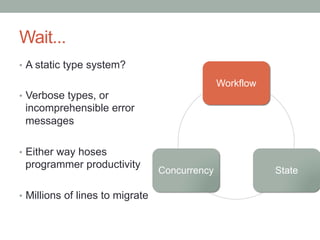
Wait...
•  A static type system?
•  Verbose types, or
incomprehensible error
messages
•  Either way hoses
programmer productivity
•  Millions of lines to migrate
Workflow
StateConcurrency
We think we’ve solved this problem
•  Introducing Hack
•  Gradual typing for PHP
•  Novel type inference system
•  Real-time type-checking
preserves PHP workflow
•  Credit: Julien Verlaguet
Hack
•  Opt into typing via <?hh (instead of <?php)
•  <?hh	
  //	
  strict	
  
•  Almost-totally sound analysis
•  Requires transitive closure of code has been hackified	
  
•  <?hh	
  
•  Tolerates missing annotations
•  Assumes undeclared classes/functions exist, behave as implied by
any types
•  Disallows most “silly” PHP-isms
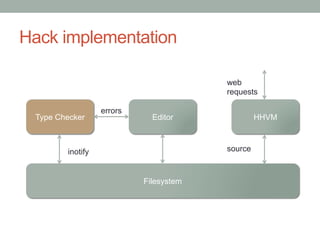
Hack implementation
EditorType Checker HHVM
Filesystem
inotify
errors
web
requests
source
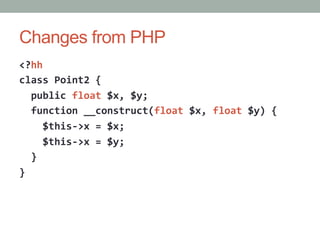
Changes from PHP
<?hh	
  
class	
  Point2	
  {	


  public	
  float	
  $x,	
  $y;	


  function	
  __construct(float	
  $x,	
  float	
  $y)	
  {	


  $this-­‐>x	
  =	
  $x;	


  $this-­‐>x	
  =	
  $y;	


  }	
  
}	
  
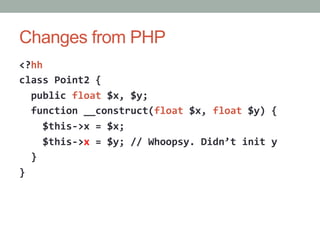
Changes from PHP
<?hh	
  
class	
  Point2	
  {	


  public	
  float	
  $x,	
  $y;	


  function	
  __construct(float	
  $x,	
  float	
  $y)	
  {	


  $this-­‐>x	
  =	
  $x;	


  $this-­‐>x	
  =	
  $y;	
  //	
  Whoopsy.	
  Didn’t	
  init	
  y	


  }	
  
}	
  
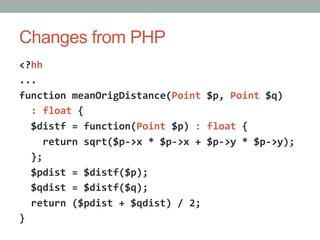
Changes from PHP
<?hh	
  
...	
  
function	
  meanOrigDistance(Point	
  $p,	
  Point	
  $q)	


  :	
  float	
  {	


  $distf	
  =	
  function(Point	
  $p)	
  :	
  float	
  {	


  return	
  sqrt($p-­‐>x	
  *	
  $p-­‐>x	
  +	
  $p-­‐>y	
  *	
  $p-­‐>y);	


  };	


  $pdist	
  =	
  $distf($p);	


  $qdist	
  =	
  $distf($q);	


  return	
  ($pdist	
  +	
  $qdist)	
  /	
  2;	
  
}	
  
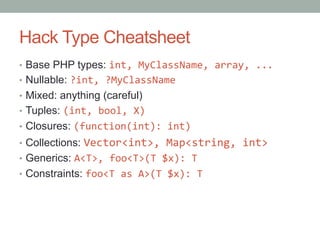
Hack Type Cheatsheet
•  Base PHP types: int,	
  MyClassName,	
  array,	
  ...	
  
•  Nullable: ?int,	
  ?MyClassName	
  
•  Mixed: anything (careful)
•  Tuples: (int,	
  bool,	
  X)	
  
•  Closures: (function(int):	
  int)	
  
•  Collections: Vector<int>,	
  Map<string,	
  int>	
  
•  Generics: A<T>,	
  foo<T>(T	
  $x):	
  T	
  
•  Constraints: foo<T	
  as	
  A>(T	
  $x):	
  T	
  
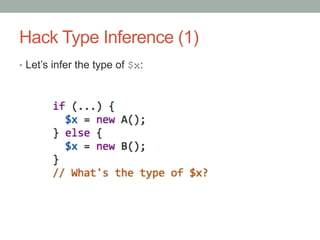
Hack Type Inference (1)
•  Let’s infer the type of $x:
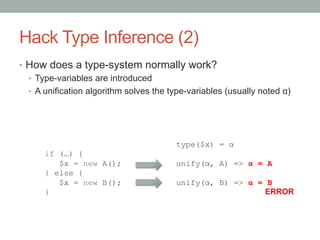
Hack Type Inference (2)
•  How does a type-system normally work?
•  Type-variables are introduced
•  A unification algorithm solves the type-variables (usually noted α)
if (…) {
$x = new A();
} else {
$x = new B();
}
type($x) = α
unify(α, A) => α = A
unify(α, B) => α = B
ERROR
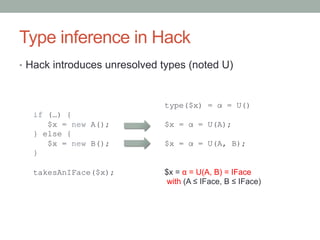
Type inference in Hack
•  Hack introduces unresolved types (noted U)
if (…) {
$x = new A();
} else {
$x = new B();
}
takesAnIFace($x);
type($x) = α = U()
$x = α = U(A);
$x = α = U(A, B);
$x = α = U(A, B) = IFace
with (A ≤ IFace, B ≤ IFace)
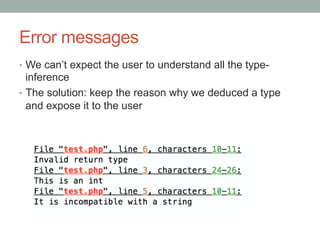
Error messages
•  We can’t expect the user to understand all the type-
inference
•  The solution: keep the reason why we deduced a type
and expose it to the user
Hack
•  “[ X ] You have reinvented PHP better, but that’s still no
justification
•  [ X ] The name of your language makes it impossible to
find on Google”
•  Many millions of lines converted
•  Most new code in Hack
•  Most PHP users at Facebook regularly check in Hack
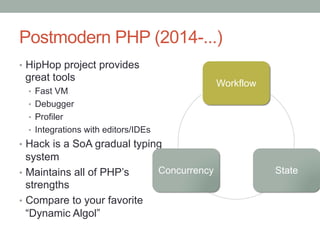
Postmodern PHP (2014-...)
•  HipHop project provides
great tools
•  Fast VM
•  Debugger
•  Profiler
•  Integrations with editors/IDEs
•  Hack is a SoA gradual typing
system
•  Maintains all of PHP’s
strengths
•  Compare to your favorite
“Dynamic Algol”
Workflow
StateConcurrency
When PHP?
•  Any time you might consider another “Dynamic Algol”
language
•  Python, Lua, JavaScript, Perl, Ruby, ...
•  Server-side
•  Request-oriented
•  ...but want to preserve some of the option value of
“BigLangs”
•  Type system
•  High-performance implementations
Backup
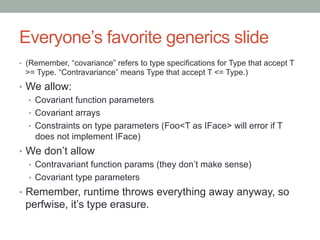
Everyone’s favorite generics slide
•  (Remember, “covariance” refers to type specifications for Type that accept T
>= Type. “Contravariance” means Type that accept T <= Type.)
•  We allow:
•  Covariant function parameters
•  Covariant arrays
•  Constraints on type parameters (Foo<T as IFace> will error if T
does not implement IFace)
•  We don’t allow
•  Contravariant function params (they don’t make sense)
•  Covariant type parameters
•  Remember, runtime throws everything away anyway, so
perfwise, it’s type erasure.

TAKING PHP SERIOUSLY - Keith Adams

  • 1.
  • 2.
  • 3.
    What this talkis •  Experience report •  Apologia •  Qualified advocacy •  A surprise.
  • 4.
    What this talkis not •  “Network effects”/”Legacy” •  “Right tool for the job” •  tautological •  some tools really are bad •  PHP might be such a tool •  “Worse is better” •  pace Richard Gabriel •  Better is better •  Most people think of UNIX as “better” nowadays
  • 5.
    Recent changes •  Traits(ala Scala) •  Closures •  Generators (yield statement) •  The HipHop VM (hhvm) is fast •  https://github.com/facebook/hiphop-php/ •  https://www.hhvm.com •  ...and we want it to run your code •  http://www.hhvm.com/blog/?p=875
  • 6.
    Conventional Wisdom onPHP •  “PHP: A fractal of bad design” •  http://me.veekun.com/blog/2012/04/09/php-a-fractal-of-bad-design/ •  “[ ] You have reinvented PHP better, but that’s still no justification” •  http://colinm.org/language_checklist.html •  Etc.
  • 7.
    And yet... •  Alot of software that has changed the world has been rendered in PHP •  Mediawiki •  Facebook •  Wordpress •  Drupal •  This is at least interesting •  Should they really have been written in Haskell? •  Does PHP make projects more or less successful?
  • 8.
    Facebook’s PHP Codebase • x * 105 files •  y * 107 LoC •  10 releases per week •  Anecdotally, good engineers are astonishingly productive in PHP
  • 9.
    The Case AgainstPHP •  Unexpected behaviors $x  /  0                      //  =>  bool(false)     “11abcd”  +  “1xy”  //  =>  int(12)   “0123”  +  “3456”    //  =>  int(3579)   “0123”  |  “3456”    //  =>  string(“3577”)  
  • 10.
    The Case AgainstPHP (2) •  Schizophrenia about value/reference semantics    /*          *  Probably  copy  $a  into  foo’s  0’th  param.        *  Unless  $a  is  a  user-­‐defined  object;  and  unless        *  foo’s  definition  specifies  that  arg  0  is  by          *  reference.        */      foo($a);  
  • 11.
    The Case AgainstPHP (3) •  Reliance on reference-counting •  String, array need O(1) logical copies •  User-defined classes have destructors that run at a deterministic time •  Some programs use the RAII idiom from C++ •  Heavily constrains implementation
  • 12.
    The Case AgainstPHP (4) •  Inconsistent, dangerous standard library •  array_map vs. array_reduce argument orders •  array_merge •  mysql_escape_string vs. (sigh) mysql_real_escape_string
  • 13.
    The Case AgainstPHP: “Guilty” •  It’s all true! •  These are “unforced errors” •  Most other languages do better •  You would want to avoid them in a PHP Reboot
  • 14.
    In Defense ofPHP •  PHP gets three important things really right •  Programmer workflow •  State •  Concurrency
  • 15.
    Workflow •  Save, reload-the-page • Short feedback cycle •  Optimizes most precious resource of all: programmer short-term memory
  • 16.
    State •  PHP requestsalways start with empty heap, namespace •  Cross-request state must be saved explicitly •  Filesystem, memcache, APC •  Affirmative virtue •  Typical FB requests spend 10ms initializing •  Reduces the cost of bugs •  Requests interact in limited ways •  Natural boundary for failure isolation
  • 17.
    Concurrency •  PHP requestsexecute in a single thread •  Concurrency happens via recursive web requests •  shared-nothing •  inputs/outputs copied •  Limits PHP’s applicable domain •  That’s actually good.
  • 18.
  • 19.
    The limits ofconscious design •  Discovered or invented? •  Shrug •  In my opinion, more important than PHP’s problems •  They’re not available anywhere else Workflow StateConcurrency
  • 20.
    Pushing PHP further • PHP engineer dare: rename this method •  Reorder the parameters for this method •  Remove this method that we think is not called anywhere
  • 21.
    Pushing PHP further(2) •  Enforce invariants: •  Only escaped strings are passed to build_query   •  A certain array() maps strings to Widgets
  • 22.
    Wait... •  A statictype system? •  Verbose types, or incomprehensible error messages •  Either way hoses programmer productivity •  Millions of lines to migrate Workflow StateConcurrency
  • 23.
    We think we’vesolved this problem •  Introducing Hack •  Gradual typing for PHP •  Novel type inference system •  Real-time type-checking preserves PHP workflow •  Credit: Julien Verlaguet
  • 24.
    Hack •  Opt intotyping via <?hh (instead of <?php) •  <?hh  //  strict   •  Almost-totally sound analysis •  Requires transitive closure of code has been hackified   •  <?hh   •  Tolerates missing annotations •  Assumes undeclared classes/functions exist, behave as implied by any types •  Disallows most “silly” PHP-isms
  • 25.
    Hack implementation EditorType CheckerHHVM Filesystem inotify errors web requests source
  • 26.
    Changes from PHP <?hh   class  Point2  {      public  float  $x,  $y;      function  __construct(float  $x,  float  $y)  {          $this-­‐>x  =  $x;          $this-­‐>x  =  $y;      }   }  
  • 27.
    Changes from PHP <?hh   class  Point2  {      public  float  $x,  $y;      function  __construct(float  $x,  float  $y)  {          $this-­‐>x  =  $x;          $this-­‐>x  =  $y;  //  Whoopsy.  Didn’t  init  y      }   }  
  • 28.
    Changes from PHP <?hh   ...   function  meanOrigDistance(Point  $p,  Point  $q)      :  float  {      $distf  =  function(Point  $p)  :  float  {          return  sqrt($p-­‐>x  *  $p-­‐>x  +  $p-­‐>y  *  $p-­‐>y);      };      $pdist  =  $distf($p);      $qdist  =  $distf($q);      return  ($pdist  +  $qdist)  /  2;   }  
  • 29.
    Hack Type Cheatsheet • Base PHP types: int,  MyClassName,  array,  ...   •  Nullable: ?int,  ?MyClassName   •  Mixed: anything (careful) •  Tuples: (int,  bool,  X)   •  Closures: (function(int):  int)   •  Collections: Vector<int>,  Map<string,  int>   •  Generics: A<T>,  foo<T>(T  $x):  T   •  Constraints: foo<T  as  A>(T  $x):  T  
  • 30.
    Hack Type Inference(1) •  Let’s infer the type of $x:
  • 31.
    Hack Type Inference(2) •  How does a type-system normally work? •  Type-variables are introduced •  A unification algorithm solves the type-variables (usually noted α) if (…) { $x = new A(); } else { $x = new B(); } type($x) = α unify(α, A) => α = A unify(α, B) => α = B ERROR
  • 32.
    Type inference inHack •  Hack introduces unresolved types (noted U) if (…) { $x = new A(); } else { $x = new B(); } takesAnIFace($x); type($x) = α = U() $x = α = U(A); $x = α = U(A, B); $x = α = U(A, B) = IFace with (A ≤ IFace, B ≤ IFace)
  • 33.
    Error messages •  Wecan’t expect the user to understand all the type- inference •  The solution: keep the reason why we deduced a type and expose it to the user
  • 34.
    Hack •  “[ X] You have reinvented PHP better, but that’s still no justification •  [ X ] The name of your language makes it impossible to find on Google” •  Many millions of lines converted •  Most new code in Hack •  Most PHP users at Facebook regularly check in Hack
  • 35.
    Postmodern PHP (2014-...) • HipHop project provides great tools •  Fast VM •  Debugger •  Profiler •  Integrations with editors/IDEs •  Hack is a SoA gradual typing system •  Maintains all of PHP’s strengths •  Compare to your favorite “Dynamic Algol” Workflow StateConcurrency
  • 36.
    When PHP? •  Anytime you might consider another “Dynamic Algol” language •  Python, Lua, JavaScript, Perl, Ruby, ... •  Server-side •  Request-oriented •  ...but want to preserve some of the option value of “BigLangs” •  Type system •  High-performance implementations
  • 38.
  • 39.
    Everyone’s favorite genericsslide •  (Remember, “covariance” refers to type specifications for Type that accept T >= Type. “Contravariance” means Type that accept T <= Type.) •  We allow: •  Covariant function parameters •  Covariant arrays •  Constraints on type parameters (Foo<T as IFace> will error if T does not implement IFace) •  We don’t allow •  Contravariant function params (they don’t make sense) •  Covariant type parameters •  Remember, runtime throws everything away anyway, so perfwise, it’s type erasure.