1 / 33
Doing It Wrong with Puppet
A small collection of anti-patterns, pitfalls
and bad practices
Felix Frank
PuppetCamp Berlin 2014
April 11, 2014
2 / 33
Bio
Felix Frank
2004 – 2009 sysadmin and FOSS dev at DESY
2009 CS diploma at Tech Uni
since 2009 Puppeteer at
– we are a company that
manages complex IT systems and services for business
customers
hosts a sizable server fleet
relies on Puppet and git consequently
3 / 33
Agenda
Use boolean facts
Expect C-like values for parameters
Make excessive use of “if defined()”
Use large numbers of execs
Rely on dynamic scoping
4 / 33
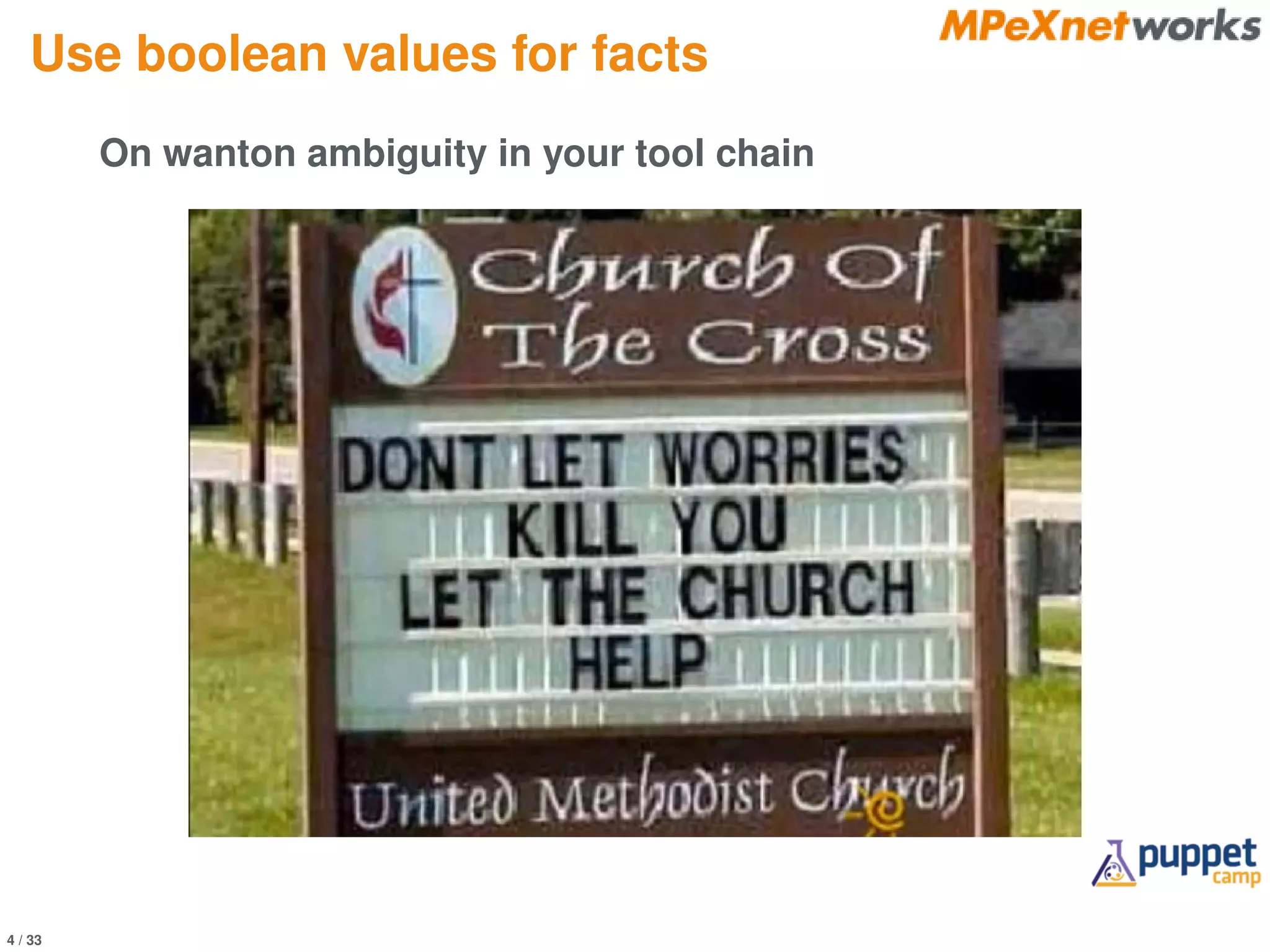
Use boolean values for facts
On wanton ambiguity in your tool chain
5 / 33
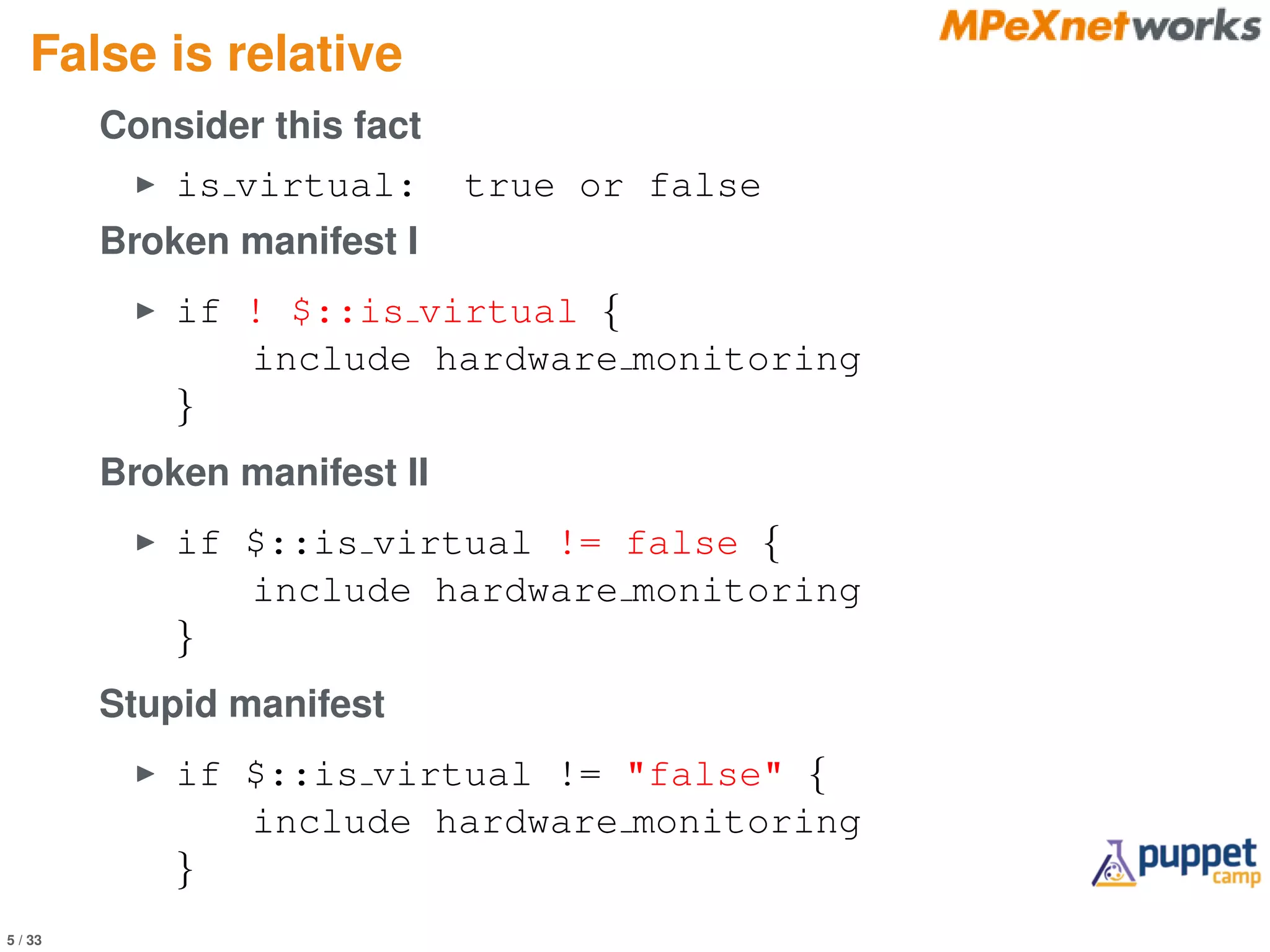
False is relative
Consider this fact
is virtual: true or false
Broken manifest I
if ! $::is virtual {
include hardware monitoring
}
Broken manifest II
if $::is virtual != false {
include hardware monitoring
}
Stupid manifest
if $::is virtual != "false" {
include hardware monitoring
}
6 / 33
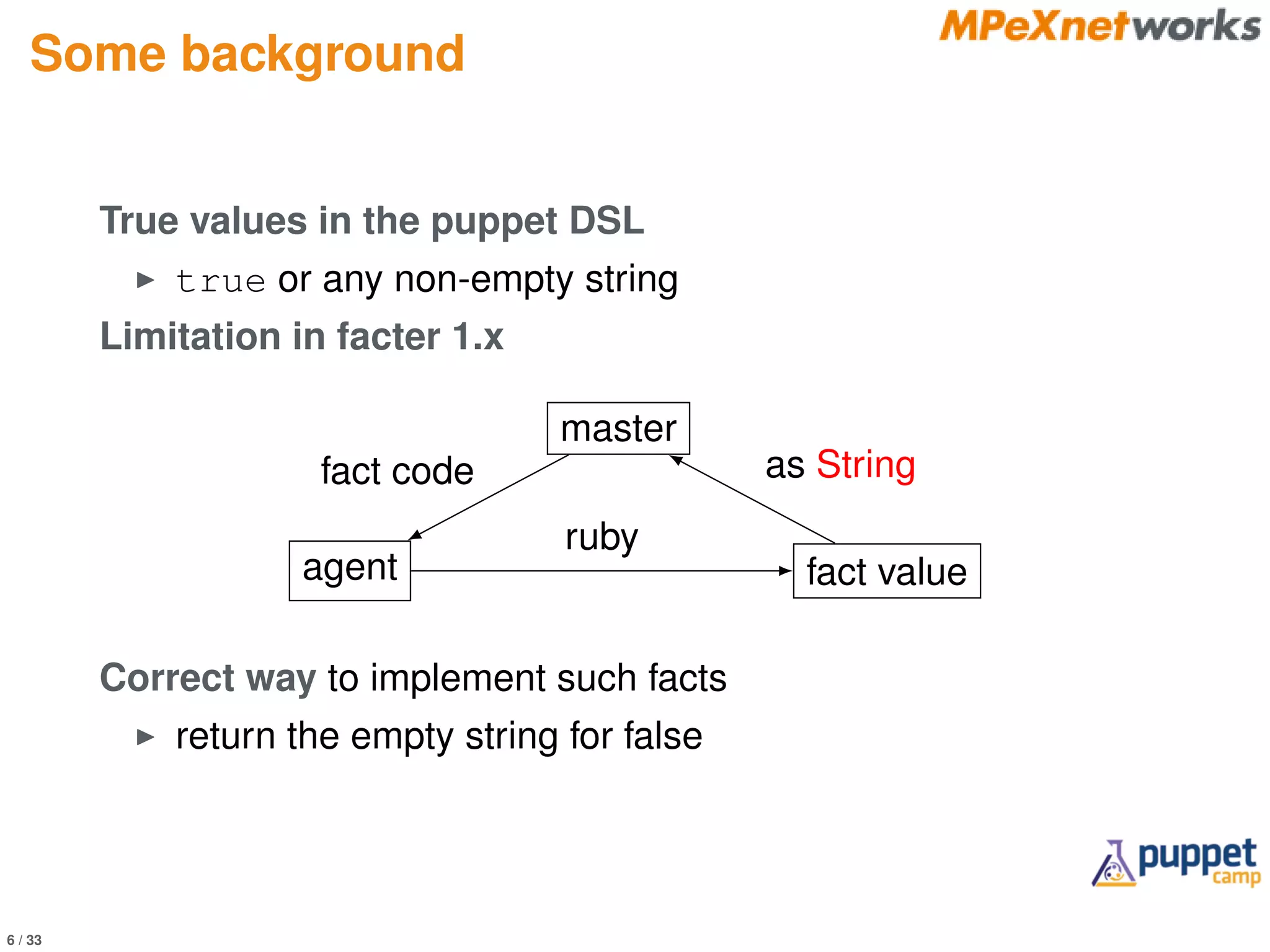
Some background
True values in the puppet DSL
true or any non-empty string
Limitation in facter 1.x
master
agent fact value
fact code
ruby
as String
Correct way to implement such facts
return the empty string for false
7 / 33
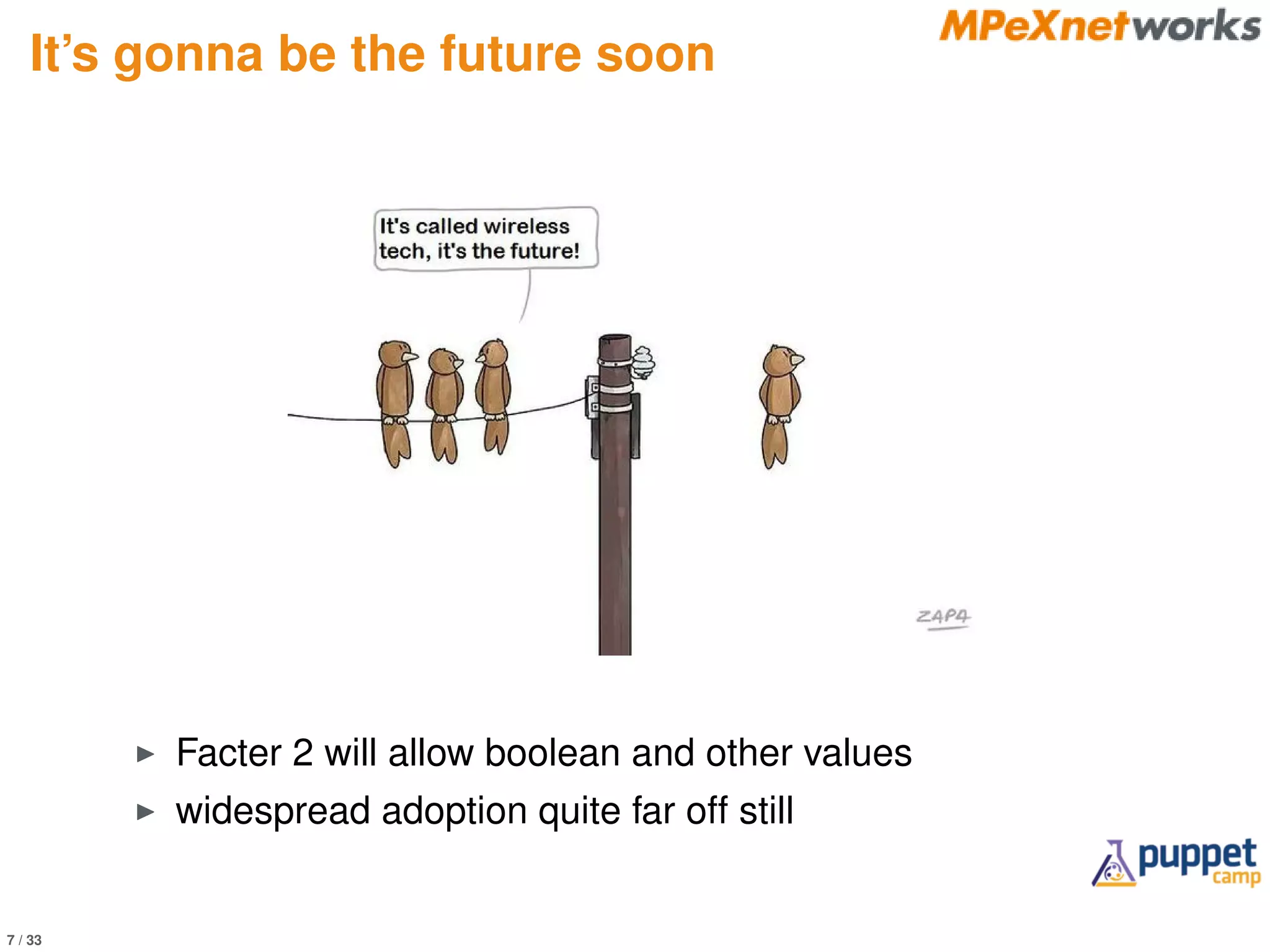
It’s gonna be the future soon
Facter 2 will allow boolean and other values
widespread adoption quite far off still
8 / 33
Up next
Use boolean facts
Expect C-like values for parameters
Make excessive use of “if defined()”
Use large numbers of execs
Rely on dynamic scoping
9 / 33
Expect C-like values for parameters
Or: treating Puppet like a scripting language pt. 1
10 / 33
The Perl trap
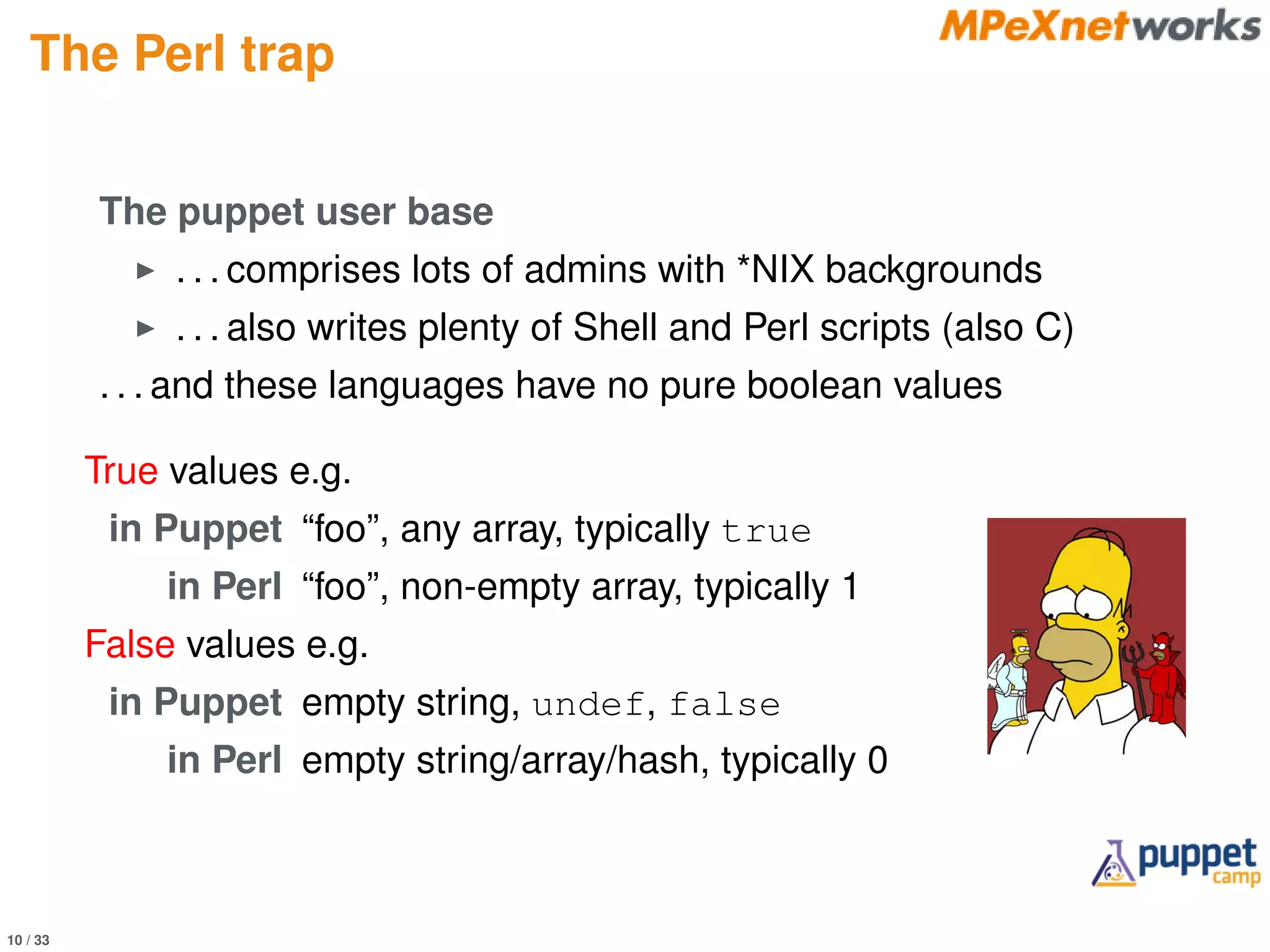
The puppet user base
. . . comprises lots of admins with *NIX backgrounds
. . . also writes plenty of Shell and Perl scripts (also C)
. . . and these languages have no pure boolean values
True values e.g.
in Puppet “foo”, any array, typically true
in Perl “foo”, non-empty array, typically 1
False values e.g.
in Puppet empty string, undef, false
in Perl empty string/array/hash, typically 0
11 / 33
Building confusing modules
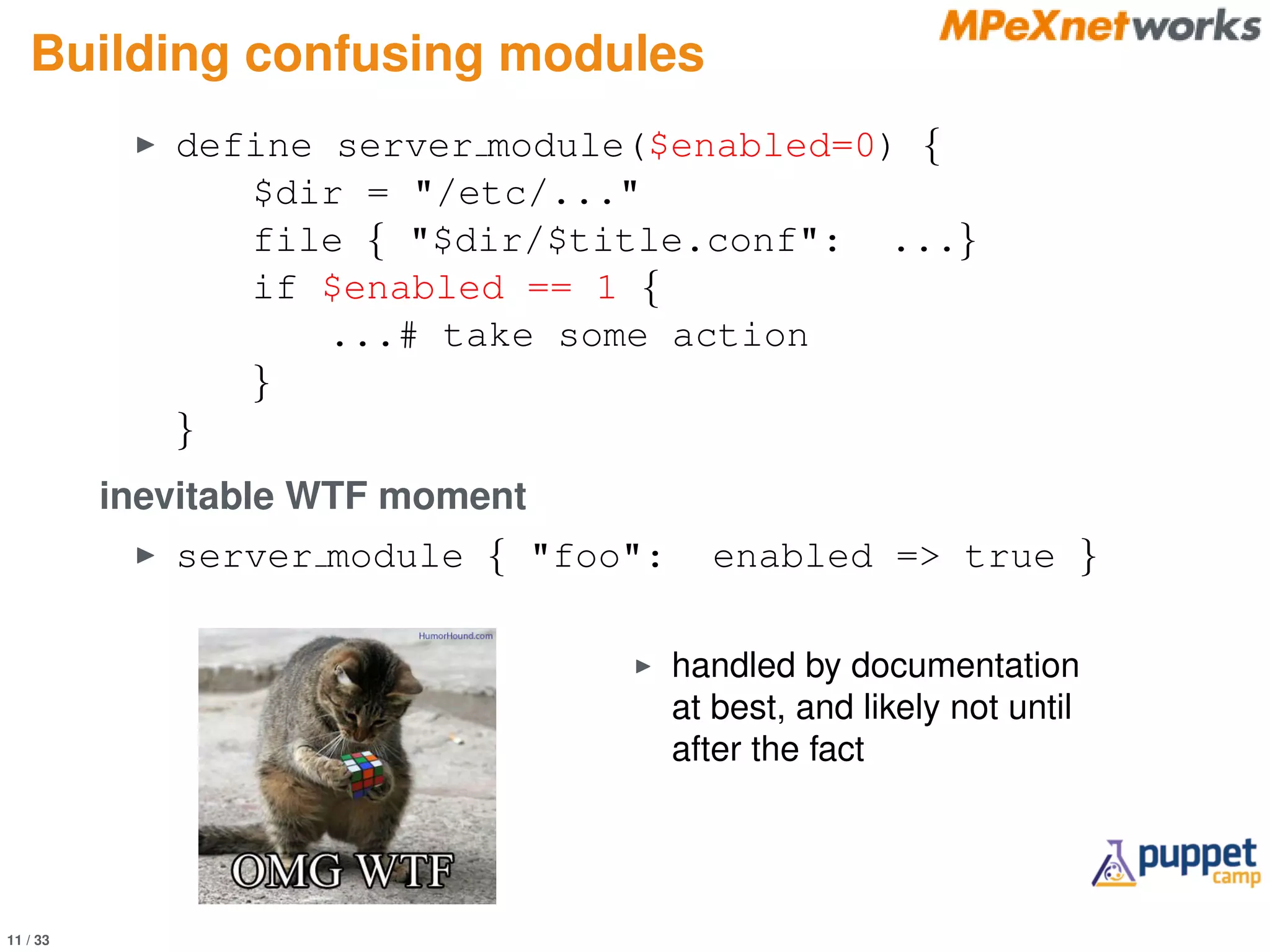
define server module($enabled=0) {
$dir = "/etc/..."
file { "$dir/$title.conf": ...}
if $enabled == 1 {
...# take some action
}
}
inevitable WTF moment
server module { "foo": enabled => true }
handled by documentation
at best, and likely not until
after the fact
12 / 33
Up next
Use boolean facts
Expect C-like values for parameters
Make excessive use of “if defined()”
Use large numbers of execs
Rely on dynamic scoping
13 / 33
Make excessive use of “if defined()”
A tale of borderline non-determinism
14 / 33
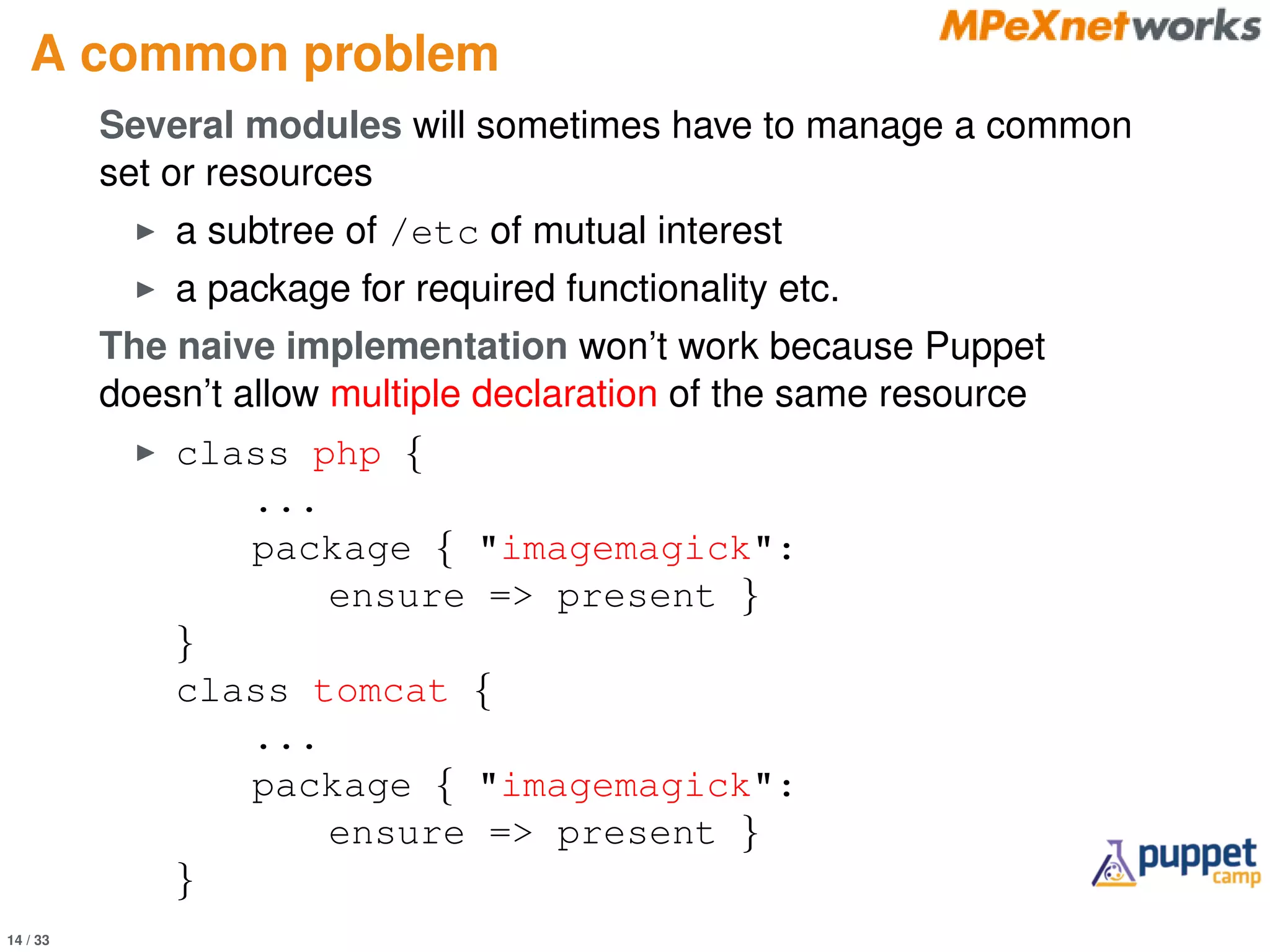
A common problem
Several modules will sometimes have to manage a common
set or resources
a subtree of /etc of mutual interest
a package for required functionality etc.
The naive implementation won’t work because Puppet
doesn’t allow multiple declaration of the same resource
class php {
...
package { "imagemagick":
ensure => present }
}
class tomcat {
...
package { "imagemagick":
ensure => present }
}
15 / 33
A common workaround
Protect declarations with a function call
class php {
...
if !defined(Package[imagemagick]) {
package { "imagemagick":
ensure => present }
}
}
class tomcat {
...
if !defined(Package[imagemagick]) {
package { "imagemagick":
ensure => present }
}
}
16 / 33
A possible issue with that
There is no protection against contradiction
class php {
...
if !defined(Package[imagemagick]) {
package { "imagemagick":
ensure => present }
}
}
class graphicsmagick {
...
if !defined(Package[imagemagick]) {
package { "imagemagick":
ensure => absent }
}
}
17 / 33
A more likely scenario
It’s easy to lose metaparameters
class php {
...
if !defined(Package[imagemagick]) {
package { "imagemagick":
ensure => present,
require => File[...] }
}
}
class tomcat {
...
if !defined(Package[imagemagick]) {
package { "imagemagick":
ensure => present,
notify => Exec[...] }
}
}
18 / 33
By the way. . .
The latter issue can be worked around
class php {
...
if !defined(Package[imagemagick]) {
package { "imagemagick":
ensure => present,
require => File[...] }
}
else {
Package<| title == "imagemagick" |> {
require +> File[...]
}
}
}
19 / 33
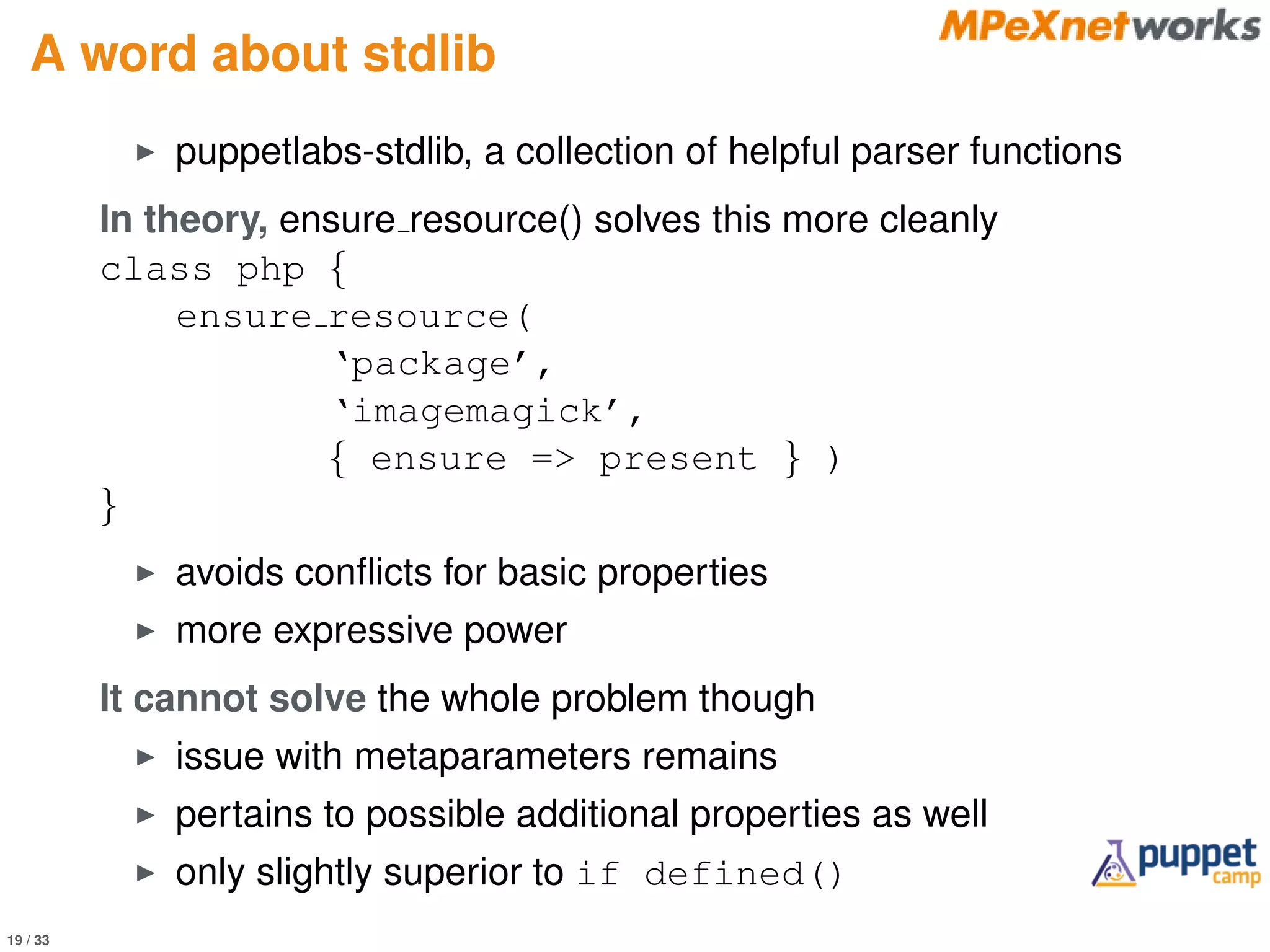
A word about stdlib
puppetlabs-stdlib, a collection of helpful parser functions
In theory, ensure resource() solves this more cleanly
class php {
ensure resource(
‘package’,
‘imagemagick’,
{ ensure => present } )
}
avoids conflicts for basic properties
more expressive power
It cannot solve the whole problem though
issue with metaparameters remains
pertains to possible additional properties as well
only slightly superior to if defined()
20 / 33
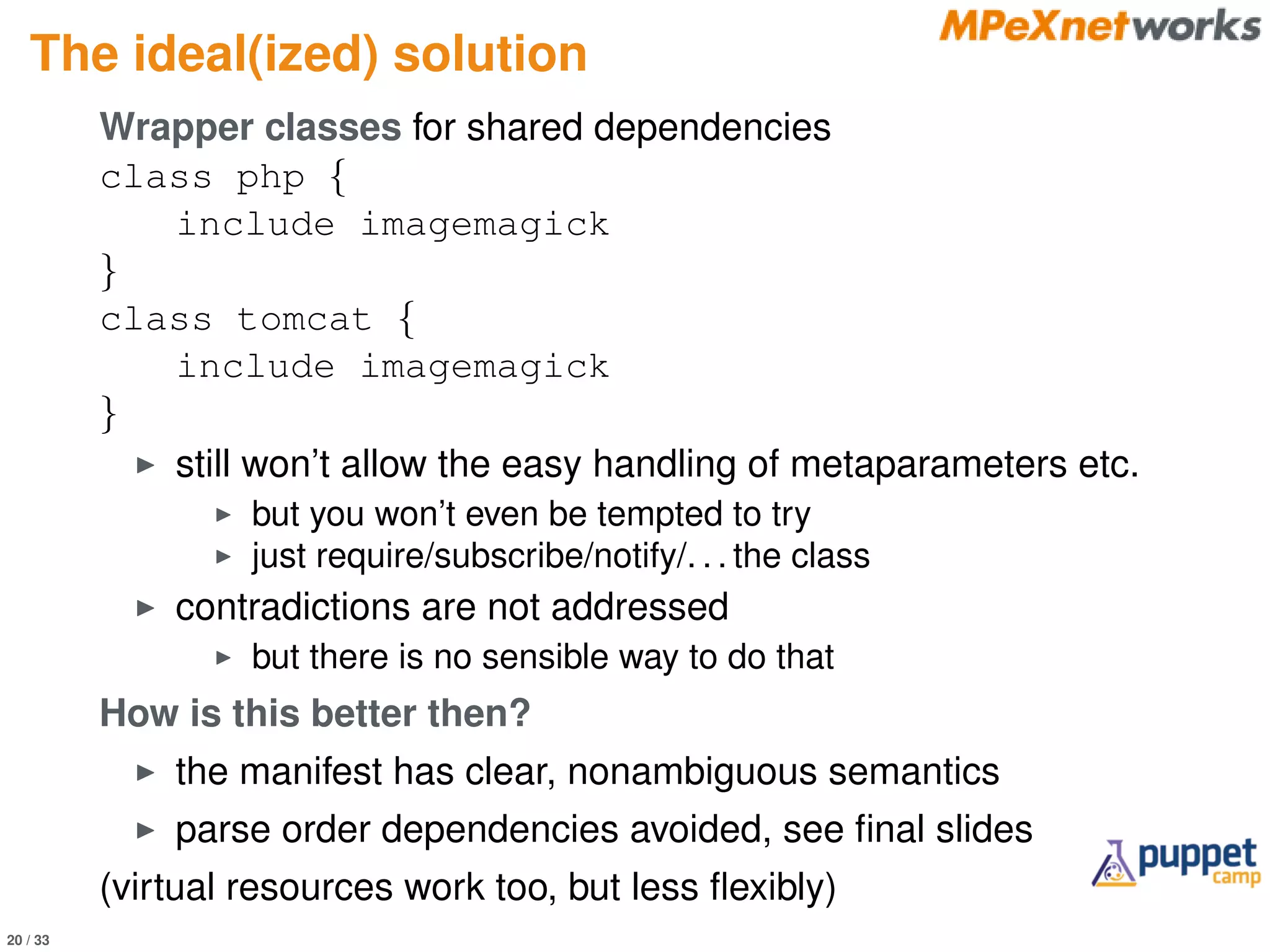
The ideal(ized) solution
Wrapper classes for shared dependencies
class php {
include imagemagick
}
class tomcat {
include imagemagick
}
still won’t allow the easy handling of metaparameters etc.
but you won’t even be tempted to try
just require/subscribe/notify/. . . the class
contradictions are not addressed
but there is no sensible way to do that
How is this better then?
the manifest has clear, nonambiguous semantics
parse order dependencies avoided, see final slides
(virtual resources work too, but less flexibly)
21 / 33
Up next
Use boolean facts
Expect C-like values for parameters
Make excessive use of “if defined()”
Use large numbers of execs
Rely on dynamic scoping
22 / 33
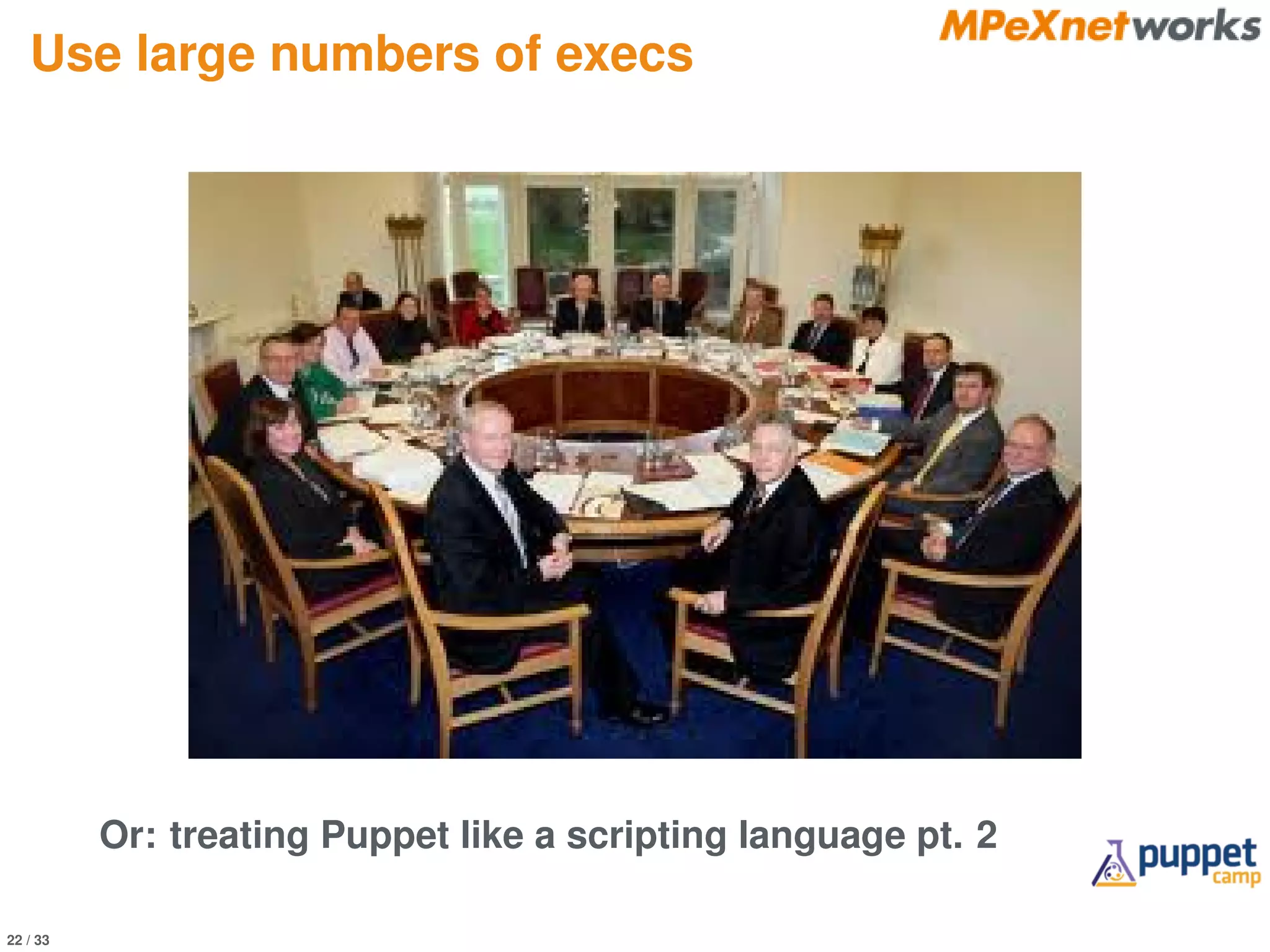
Use large numbers of execs
Or: treating Puppet like a scripting language pt. 2
23 / 33
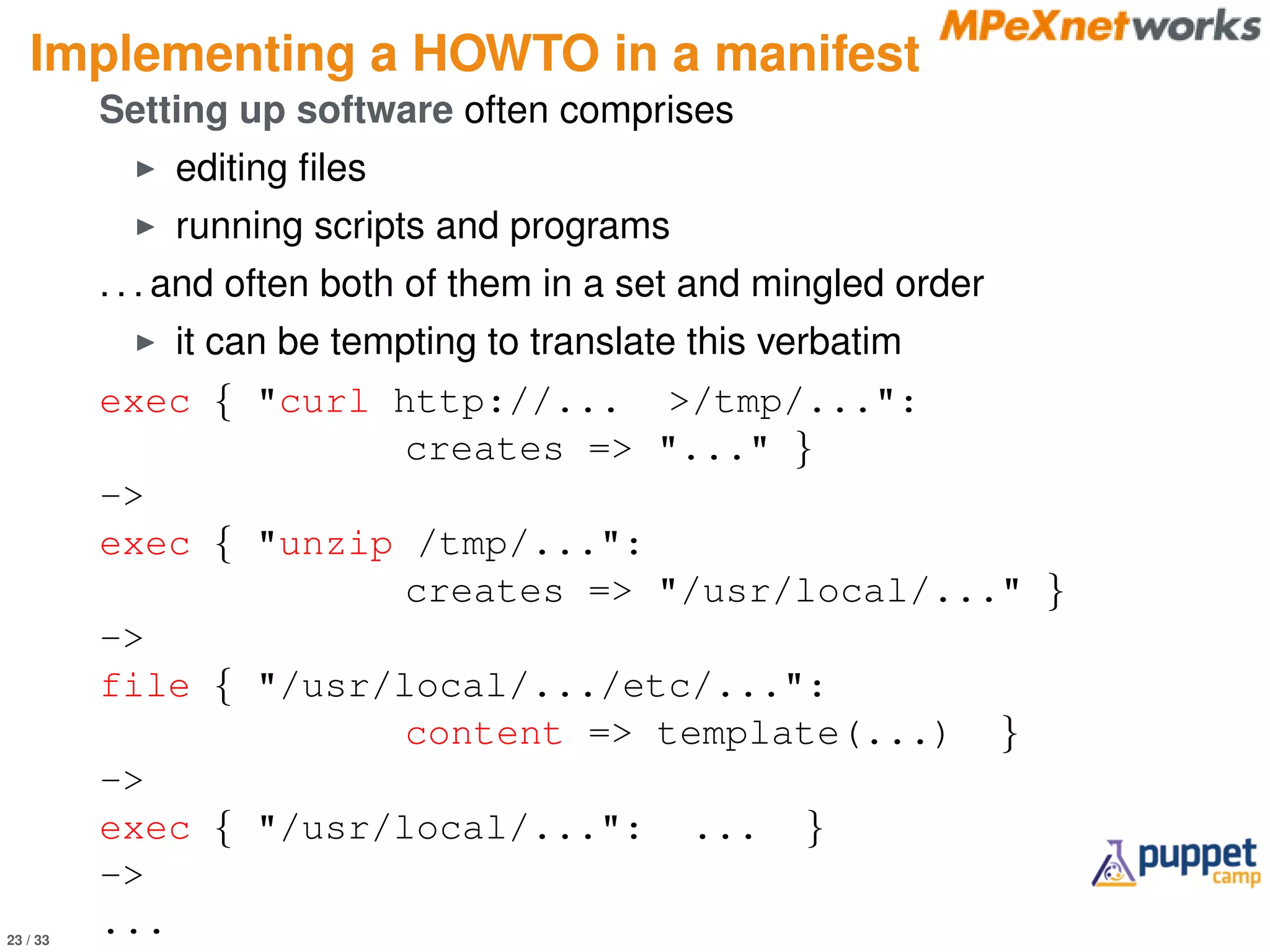
Implementing a HOWTO in a manifest
Setting up software often comprises
editing files
running scripts and programs
. . . and often both of them in a set and mingled order
it can be tempting to translate this verbatim
exec { "curl http://... >/tmp/...":
creates => "..." }
->
exec { "unzip /tmp/...":
creates => "/usr/local/..." }
->
file { "/usr/local/.../etc/...":
content => template(...) }
->
exec { "/usr/local/...": ... }
->
...
24 / 33
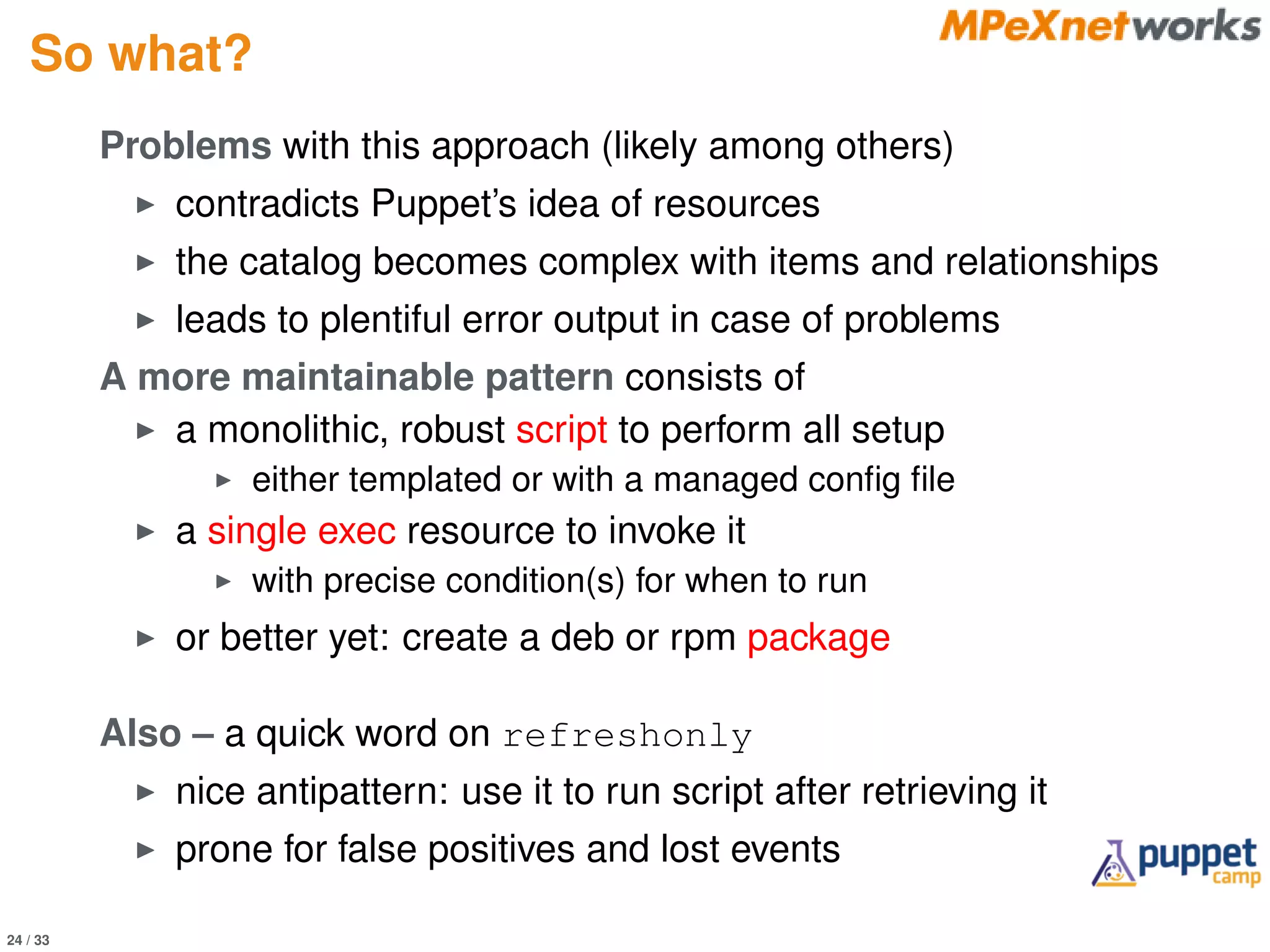
So what?
Problems with this approach (likely among others)
contradicts Puppet’s idea of resources
the catalog becomes complex with items and relationships
leads to plentiful error output in case of problems
A more maintainable pattern consists of
a monolithic, robust script to perform all setup
either templated or with a managed config file
a single exec resource to invoke it
with precise condition(s) for when to run
or better yet: create a deb or rpm package
Also – a quick word on refreshonly
nice antipattern: use it to run script after retrieving it
prone for false positives and lost events
25 / 33
So remember
A small mnemonic
26 / 33
Up next
Use boolean facts
Expect C-like values for parameters
Make excessive use of “if defined()”
Use large numbers of execs
Rely on dynamic scoping
27 / 33
Rely on dynamic scoping
Or: how to jumble up your own manifest’s opinions
. . . which is another bout with nondeterminism
28 / 33
Brief review
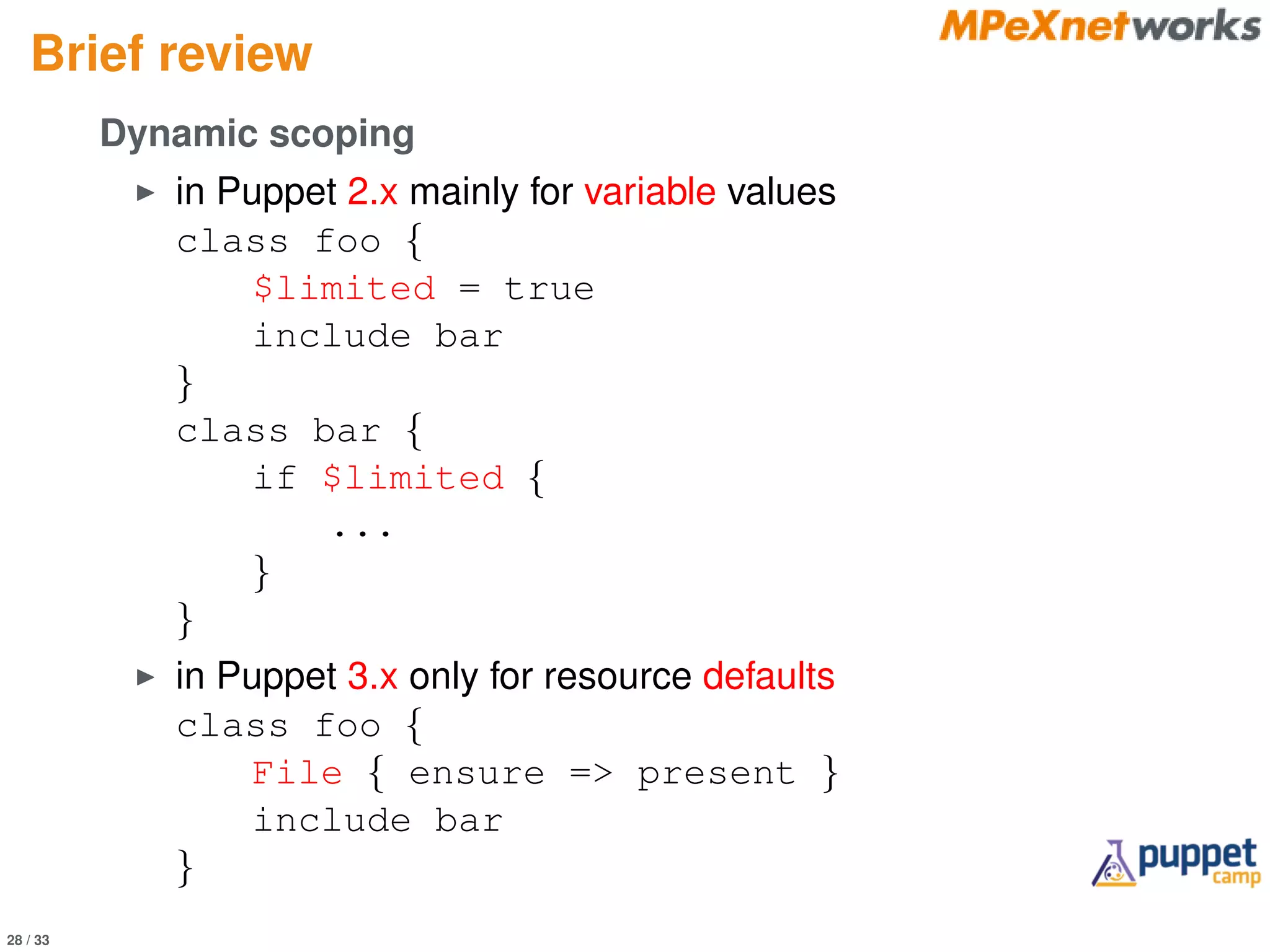
Dynamic scoping
in Puppet 2.x mainly for variable values
class foo {
$limited = true
include bar
}
class bar {
if $limited {
...
}
}
in Puppet 3.x only for resource defaults
class foo {
File { ensure => present }
include bar
}
29 / 33
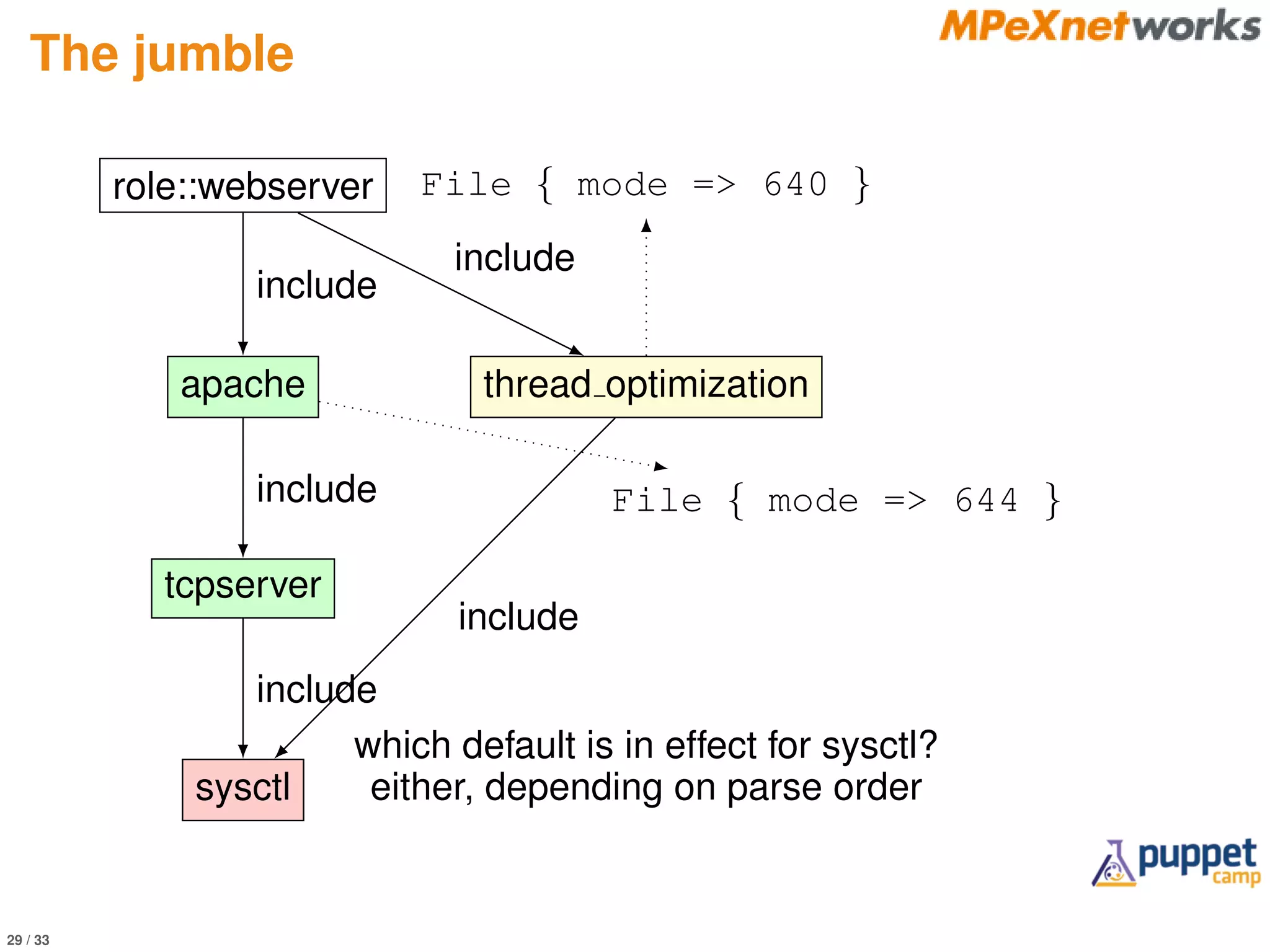
The jumble
role::webserver
apache
tcpserver
sysctl
apache
tcpserver
sysctlsysctl
include
include
include
File { mode => 644 }
thread optimization
include
include
File { mode => 640 }
thread optimization
which default is in effect for sysctl?
either, depending on parse order
30 / 33
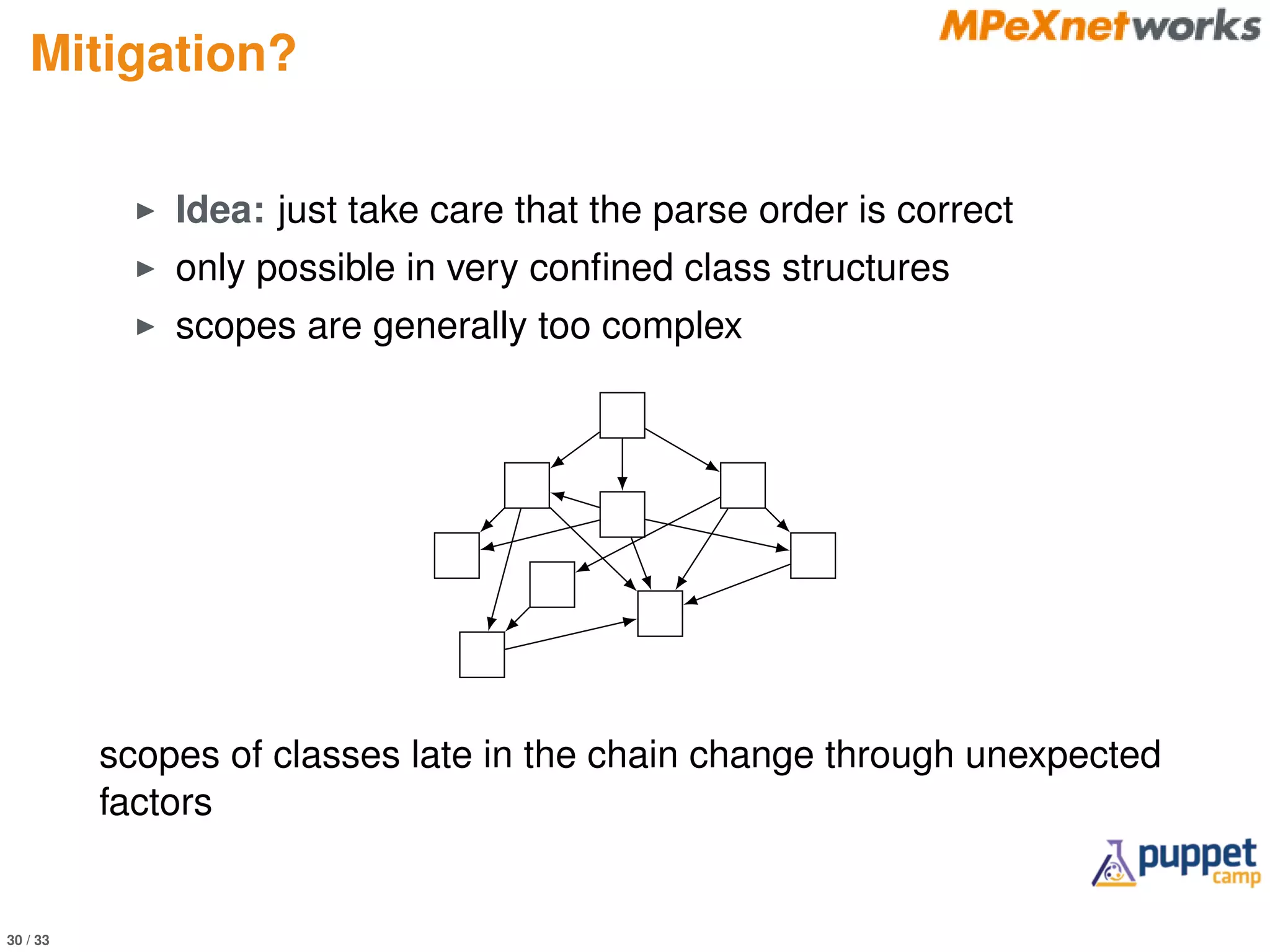
Mitigation?
Idea: just take care that the parse order is correct
only possible in very confined class structures
scopes are generally too complex
scopes of classes late in the chain change through unexpected
factors
31 / 33
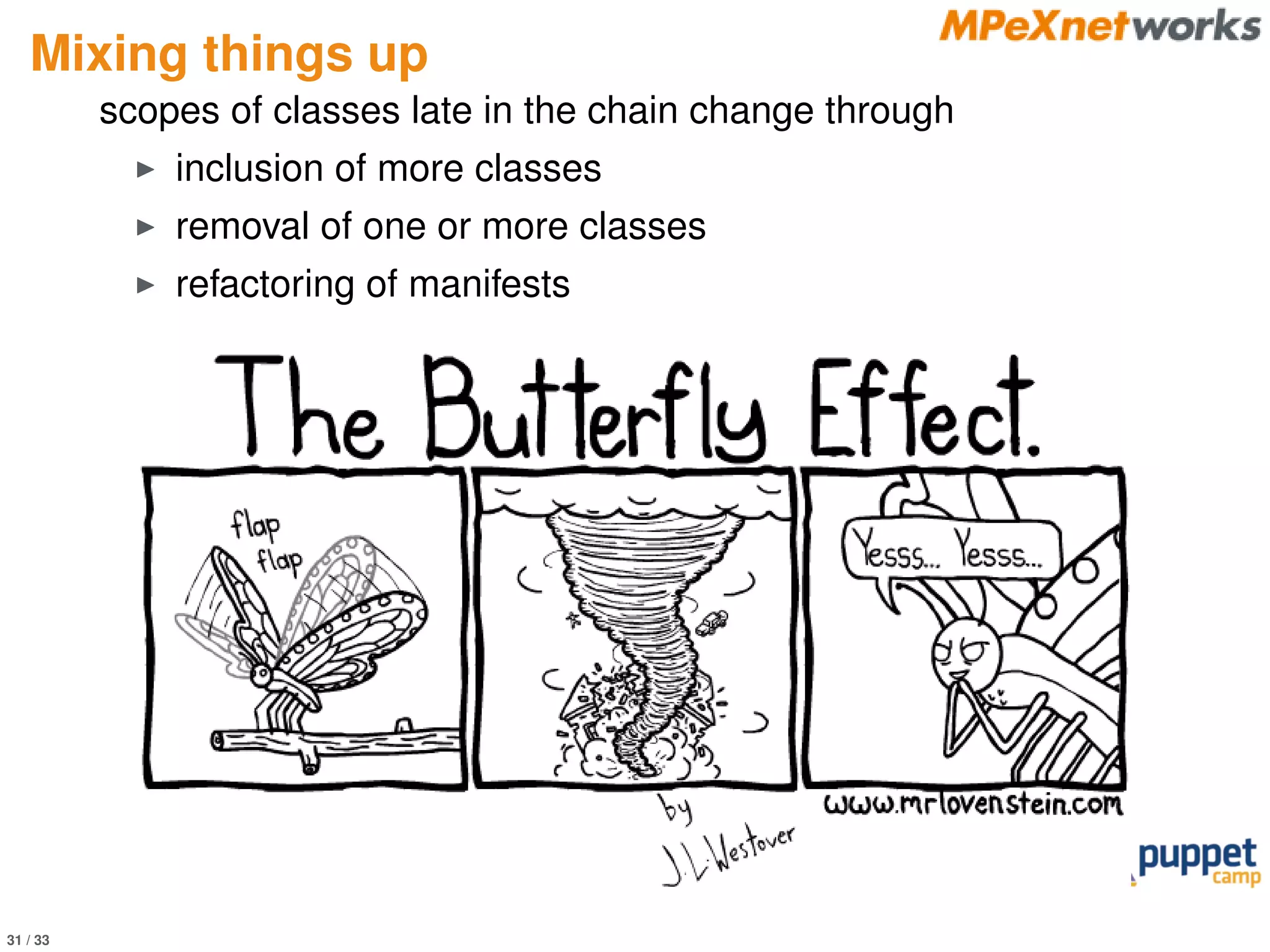
Mixing things up
scopes of classes late in the chain change through
inclusion of more classes
removal of one or more classes
refactoring of manifests
32 / 33
Conclusion
Avoid!
parameters and Hiera will get you there much safer
You may want to move away from dynamic scopes anyway
they will likely get deprecated and removed
33 / 33
Thanks for your attention
Image sources
https://www.pinterest.com/pin/418553359088246576/
http://www.kulfoto.com/funny-pictures/17395/its-called-
wireless-tech-and-its-the-future
http://www.cacbasketball.com/b2-5v5-unification-finals-
uhhh-ditka/
http://www.someecards.com/usercards/
viewcard/MjAxMy00MzdlNjAzZjE2MWRkMjk0
http://www.marketingpilgrim.com/2013/08/google-glass-
update-like-having-an-admin-assistant-on-your-
shoulder.html
http://www.aboutbradsugars.com/tag/executive-coaching/
http://themetapicture.com/schrodingers-cat/
http://www.mrlovenstein.com/comic/50
http://funny-pics.co/photo/funny-cat-cheering-up-dog/
34 / 33
We are hiring
Always looking for techs who
know their way around Puppet (or would like to)
further the development of our homegrown
infrastructure and tools
will implement more technologies in our
management ecosystem
Visit us
http://mpexnetworks.de/ueber-uns/jobs.html
jobs@mpexnetworks.de
35 / 33
Bonus content!
36 / 33
Preferring new style class declaration
the good thing about classes: they are singletons
a class can be declared an arbitrary number of times
Class parameterization
a class with parameters must be one of a kind
multiple declarations with different parameters just as
contradictory as with resources (or more so)
Additional fun
declaration using include implies all parameters use their
respective default value
does not mix with new style class { } declaration
mixing is allowed but only with all include statements
before the class { }
more parse order dependencies (yay!)

Doing It Wrong with Puppet -

  • 1.
    1 / 33 DoingIt Wrong with Puppet A small collection of anti-patterns, pitfalls and bad practices Felix Frank PuppetCamp Berlin 2014 April 11, 2014
  • 2.
    2 / 33 Bio FelixFrank 2004 – 2009 sysadmin and FOSS dev at DESY 2009 CS diploma at Tech Uni since 2009 Puppeteer at – we are a company that manages complex IT systems and services for business customers hosts a sizable server fleet relies on Puppet and git consequently
  • 3.
    3 / 33 Agenda Useboolean facts Expect C-like values for parameters Make excessive use of “if defined()” Use large numbers of execs Rely on dynamic scoping
  • 4.
    4 / 33 Useboolean values for facts On wanton ambiguity in your tool chain
  • 5.
    5 / 33 Falseis relative Consider this fact is virtual: true or false Broken manifest I if ! $::is virtual { include hardware monitoring } Broken manifest II if $::is virtual != false { include hardware monitoring } Stupid manifest if $::is virtual != "false" { include hardware monitoring }
  • 6.
    6 / 33 Somebackground True values in the puppet DSL true or any non-empty string Limitation in facter 1.x master agent fact value fact code ruby as String Correct way to implement such facts return the empty string for false
  • 7.
    7 / 33 It’sgonna be the future soon Facter 2 will allow boolean and other values widespread adoption quite far off still
  • 8.
    8 / 33 Upnext Use boolean facts Expect C-like values for parameters Make excessive use of “if defined()” Use large numbers of execs Rely on dynamic scoping
  • 9.
    9 / 33 ExpectC-like values for parameters Or: treating Puppet like a scripting language pt. 1
  • 10.
    10 / 33 ThePerl trap The puppet user base . . . comprises lots of admins with *NIX backgrounds . . . also writes plenty of Shell and Perl scripts (also C) . . . and these languages have no pure boolean values True values e.g. in Puppet “foo”, any array, typically true in Perl “foo”, non-empty array, typically 1 False values e.g. in Puppet empty string, undef, false in Perl empty string/array/hash, typically 0
  • 11.
    11 / 33 Buildingconfusing modules define server module($enabled=0) { $dir = "/etc/..." file { "$dir/$title.conf": ...} if $enabled == 1 { ...# take some action } } inevitable WTF moment server module { "foo": enabled => true } handled by documentation at best, and likely not until after the fact
  • 12.
    12 / 33 Upnext Use boolean facts Expect C-like values for parameters Make excessive use of “if defined()” Use large numbers of execs Rely on dynamic scoping
  • 13.
    13 / 33 Makeexcessive use of “if defined()” A tale of borderline non-determinism
  • 14.
    14 / 33 Acommon problem Several modules will sometimes have to manage a common set or resources a subtree of /etc of mutual interest a package for required functionality etc. The naive implementation won’t work because Puppet doesn’t allow multiple declaration of the same resource class php { ... package { "imagemagick": ensure => present } } class tomcat { ... package { "imagemagick": ensure => present } }
  • 15.
    15 / 33 Acommon workaround Protect declarations with a function call class php { ... if !defined(Package[imagemagick]) { package { "imagemagick": ensure => present } } } class tomcat { ... if !defined(Package[imagemagick]) { package { "imagemagick": ensure => present } } }
  • 16.
    16 / 33 Apossible issue with that There is no protection against contradiction class php { ... if !defined(Package[imagemagick]) { package { "imagemagick": ensure => present } } } class graphicsmagick { ... if !defined(Package[imagemagick]) { package { "imagemagick": ensure => absent } } }
  • 17.
    17 / 33 Amore likely scenario It’s easy to lose metaparameters class php { ... if !defined(Package[imagemagick]) { package { "imagemagick": ensure => present, require => File[...] } } } class tomcat { ... if !defined(Package[imagemagick]) { package { "imagemagick": ensure => present, notify => Exec[...] } } }
  • 18.
    18 / 33 Bythe way. . . The latter issue can be worked around class php { ... if !defined(Package[imagemagick]) { package { "imagemagick": ensure => present, require => File[...] } } else { Package<| title == "imagemagick" |> { require +> File[...] } } }
  • 19.
    19 / 33 Aword about stdlib puppetlabs-stdlib, a collection of helpful parser functions In theory, ensure resource() solves this more cleanly class php { ensure resource( ‘package’, ‘imagemagick’, { ensure => present } ) } avoids conflicts for basic properties more expressive power It cannot solve the whole problem though issue with metaparameters remains pertains to possible additional properties as well only slightly superior to if defined()
  • 20.
    20 / 33 Theideal(ized) solution Wrapper classes for shared dependencies class php { include imagemagick } class tomcat { include imagemagick } still won’t allow the easy handling of metaparameters etc. but you won’t even be tempted to try just require/subscribe/notify/. . . the class contradictions are not addressed but there is no sensible way to do that How is this better then? the manifest has clear, nonambiguous semantics parse order dependencies avoided, see final slides (virtual resources work too, but less flexibly)
  • 21.
    21 / 33 Upnext Use boolean facts Expect C-like values for parameters Make excessive use of “if defined()” Use large numbers of execs Rely on dynamic scoping
  • 22.
    22 / 33 Uselarge numbers of execs Or: treating Puppet like a scripting language pt. 2
  • 23.
    23 / 33 Implementinga HOWTO in a manifest Setting up software often comprises editing files running scripts and programs . . . and often both of them in a set and mingled order it can be tempting to translate this verbatim exec { "curl http://... >/tmp/...": creates => "..." } -> exec { "unzip /tmp/...": creates => "/usr/local/..." } -> file { "/usr/local/.../etc/...": content => template(...) } -> exec { "/usr/local/...": ... } -> ...
  • 24.
    24 / 33 Sowhat? Problems with this approach (likely among others) contradicts Puppet’s idea of resources the catalog becomes complex with items and relationships leads to plentiful error output in case of problems A more maintainable pattern consists of a monolithic, robust script to perform all setup either templated or with a managed config file a single exec resource to invoke it with precise condition(s) for when to run or better yet: create a deb or rpm package Also – a quick word on refreshonly nice antipattern: use it to run script after retrieving it prone for false positives and lost events
  • 25.
    25 / 33 Soremember A small mnemonic
  • 26.
    26 / 33 Upnext Use boolean facts Expect C-like values for parameters Make excessive use of “if defined()” Use large numbers of execs Rely on dynamic scoping
  • 27.
    27 / 33 Relyon dynamic scoping Or: how to jumble up your own manifest’s opinions . . . which is another bout with nondeterminism
  • 28.
    28 / 33 Briefreview Dynamic scoping in Puppet 2.x mainly for variable values class foo { $limited = true include bar } class bar { if $limited { ... } } in Puppet 3.x only for resource defaults class foo { File { ensure => present } include bar }
  • 29.
    29 / 33 Thejumble role::webserver apache tcpserver sysctl apache tcpserver sysctlsysctl include include include File { mode => 644 } thread optimization include include File { mode => 640 } thread optimization which default is in effect for sysctl? either, depending on parse order
  • 30.
    30 / 33 Mitigation? Idea:just take care that the parse order is correct only possible in very confined class structures scopes are generally too complex scopes of classes late in the chain change through unexpected factors
  • 31.
    31 / 33 Mixingthings up scopes of classes late in the chain change through inclusion of more classes removal of one or more classes refactoring of manifests
  • 32.
    32 / 33 Conclusion Avoid! parametersand Hiera will get you there much safer You may want to move away from dynamic scopes anyway they will likely get deprecated and removed
  • 33.
    33 / 33 Thanksfor your attention Image sources https://www.pinterest.com/pin/418553359088246576/ http://www.kulfoto.com/funny-pictures/17395/its-called- wireless-tech-and-its-the-future http://www.cacbasketball.com/b2-5v5-unification-finals- uhhh-ditka/ http://www.someecards.com/usercards/ viewcard/MjAxMy00MzdlNjAzZjE2MWRkMjk0 http://www.marketingpilgrim.com/2013/08/google-glass- update-like-having-an-admin-assistant-on-your- shoulder.html http://www.aboutbradsugars.com/tag/executive-coaching/ http://themetapicture.com/schrodingers-cat/ http://www.mrlovenstein.com/comic/50 http://funny-pics.co/photo/funny-cat-cheering-up-dog/
  • 34.
    34 / 33 Weare hiring Always looking for techs who know their way around Puppet (or would like to) further the development of our homegrown infrastructure and tools will implement more technologies in our management ecosystem Visit us http://mpexnetworks.de/ueber-uns/jobs.html jobs@mpexnetworks.de
  • 35.
    35 / 33 Bonuscontent!
  • 36.
    36 / 33 Preferringnew style class declaration the good thing about classes: they are singletons a class can be declared an arbitrary number of times Class parameterization a class with parameters must be one of a kind multiple declarations with different parameters just as contradictory as with resources (or more so) Additional fun declaration using include implies all parameters use their respective default value does not mix with new style class { } declaration mixing is allowed but only with all include statements before the class { } more parse order dependencies (yay!)