Why Blended Learning?
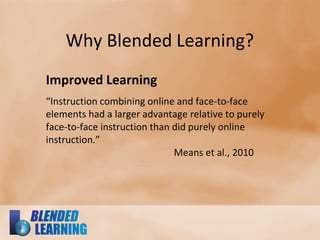
Improved Learning
“Instruction combining online and face-to-face
elements had a larger advantage relative to purely
face-to-face instruction than did purely online
instruction.”
Means et al., 2010
Why Blended Learning?
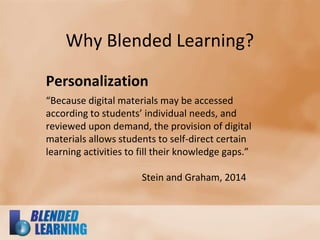
Personalization
“Because digital materials may be accessed
according to students’ individual needs, and
reviewed upon demand, the provision of digital
materials allows students to self-direct certain
learning activities to fill their knowledge gaps.”
Stein and Graham, 2014
Why Blended Learning?
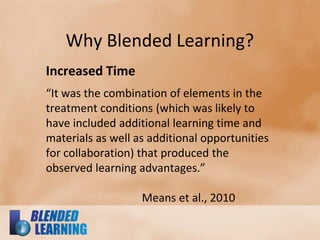
Increased Time
“It was the combination of elements in the
treatment conditions (which was likely to
have included additional learning time and
materials as well as additional opportunities
for collaboration) that produced the
observed learning advantages.”
Means et al., 2010
Why Blended Learning?
Credit Recovery, Nonconsumption, and Cost
Blended learning is also being used to
support credit recovery and address
nonconsumption (or the unavailability of
some courses, including AP courses), which
can save costs by outsourcing niche classes.
References
Christensen Institute. (2012). Christensen
Institute Blended Learning. Retrieved June 19,
2015, from http://www.christenseninstitute.org/key-
concepts/blended-learning-2/
Dziuban, C. D., Hartman, J. L., & Moskal, P. D.
(2004). Blended learning. Educause Center for Applied
Research, 2004(7). Retrieved June 19, 2015, from
http://www.educause.edu/ir/library/pdf/ERB0407.pdf
Graham, C.R. (2006). Blended learning systems:
Definition, current trends, and future
directions. In C.J. Bonk & C.R. Graham (Eds.),
The handbook of blended learning: Global
perspectives, local designs (pp. 3–21). San
Francisco: JosseyBass/Pfeiffer.
References
Picciano, Anthony G. (2014). Introduction to
Blended Learning: Research perspectives,
Volume 2. In A.G. Picciano, C.D. Dziuban, and
C.R. Graham (Eds.), Blended Learning: Research
perspectives, volume 2 (pp. 1-9). New York:
Routledge.
Stein, J. & Graham C. (2014). Essentials for
Blended Learning: A standards-based guide. New
York: Routledge.
Why Blended Learning

Why Blended Learning

  • 2.
    Why Blended Learning? ImprovedLearning “Instruction combining online and face-to-face elements had a larger advantage relative to purely face-to-face instruction than did purely online instruction.” Means et al., 2010
  • 3.
    Why Blended Learning? Personalization “Becausedigital materials may be accessed according to students’ individual needs, and reviewed upon demand, the provision of digital materials allows students to self-direct certain learning activities to fill their knowledge gaps.” Stein and Graham, 2014
  • 4.
    Why Blended Learning? IncreasedTime “It was the combination of elements in the treatment conditions (which was likely to have included additional learning time and materials as well as additional opportunities for collaboration) that produced the observed learning advantages.” Means et al., 2010
  • 5.
    Why Blended Learning? CreditRecovery, Nonconsumption, and Cost Blended learning is also being used to support credit recovery and address nonconsumption (or the unavailability of some courses, including AP courses), which can save costs by outsourcing niche classes.
  • 6.
    References Christensen Institute. (2012).Christensen Institute Blended Learning. Retrieved June 19, 2015, from http://www.christenseninstitute.org/key- concepts/blended-learning-2/ Dziuban, C. D., Hartman, J. L., & Moskal, P. D. (2004). Blended learning. Educause Center for Applied Research, 2004(7). Retrieved June 19, 2015, from http://www.educause.edu/ir/library/pdf/ERB0407.pdf Graham, C.R. (2006). Blended learning systems: Definition, current trends, and future directions. In C.J. Bonk & C.R. Graham (Eds.), The handbook of blended learning: Global perspectives, local designs (pp. 3–21). San Francisco: JosseyBass/Pfeiffer.
  • 7.
    References Picciano, Anthony G.(2014). Introduction to Blended Learning: Research perspectives, Volume 2. In A.G. Picciano, C.D. Dziuban, and C.R. Graham (Eds.), Blended Learning: Research perspectives, volume 2 (pp. 1-9). New York: Routledge. Stein, J. & Graham C. (2014). Essentials for Blended Learning: A standards-based guide. New York: Routledge.