Who Gets To Innovate?
An archestra notebook.
© 2013 Malcolm Ryder / archestra
Problem: Innovation is Inconvenient
Innovation is a practice, not a skill.
Innovation is important as a performance advantage; other than that,
it’s just interesting.
For most innovators, chances of follow-through are… not so good.
The Innovator’s Gauntlet
1.

The business goal of innovation is to translate market opportunity to market performance

2.

Adopting externally sourced innovations is not a new business idea: e.g., M&A

3.

Producing internally originated innovations is also not a new business idea: e.g., R&D

4.

Anyone can do research; development is almost always subject to a different degree of
management

5.

Development responds to business pressures in market performance

6.

Research responds to business pressures in market opportunity

7.

Research is intended to create opportunities that did not already exist

8.

In the research stage, an innovation usually has no value outside of being a “problem solution”
• The importance of a problem predetermines the expected base value of its solution
The Innovator’s Gauntlet
9.

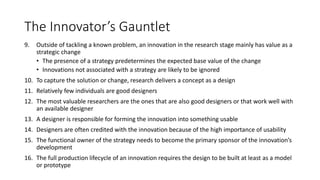
Outside of tackling a known problem, an innovation in the research stage mainly has value as a
strategic change
• The presence of a strategy predetermines the expected base value of the change
• Innovations not associated with a strategy are likely to be ignored

10. To capture the solution or change, research delivers a concept as a design
11. Relatively few individuals are good designers
12. The most valuable researchers are the ones that are also good designers or that work well with
an available designer
13. A designer is responsible for forming the innovation into something usable
14. Designers are often credited with the innovation because of the high importance of usability
15. The functional owner of the strategy needs to become the primary sponsor of the innovation’s
development
16. The full production lifecycle of an innovation requires the design to be built at least as a model
or prototype
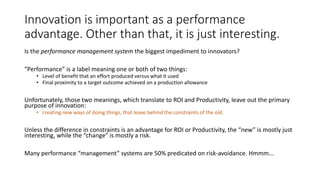
Innovation is important as a performance
advantage. Other than that, it is just interesting.
Is the performance management system the biggest impediment to innovators?

“Performance” is a label meaning one or both of two things:

• Level of benefit that an effort produced versus what it used
• Final proximity to a target outcome achieved on a production allowance

Unfortunately, those two meanings, which translate to ROI and Productivity, leave out the primary
purpose of innovation:
• creating new ways of doing things, that leave behind the constraints of the old.

Unless the difference in constraints is an advantage for ROI or Productivity, the “new” is mostly just
interesting, while the “change” is mostly a risk.
Many performance “management” systems are 50% predicated on risk-avoidance. Hmmm...
For most innovators, chances of follow-through are…
not so good.
1. The business goal of innovation is to translate market opportunity to market performance
2. Adopting externally sourced innovations is not a new business idea: M&A
3. Producing internally originated innovations is also not a new business idea: essentially, R&D
4. Anyone can do research; development is almost always subject to a different degree of management

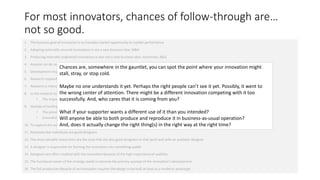
Chances are, somewhere in the gauntlet, you can spot the point where your innovation might
stall, stray, or stop cold.

5. Development responds to business pressures in market performance
6. Research responds to business pressures in market opportunity

7. Research is intended to createno one understands it yet. Perhaps
Maybe opportunities that did not already exist
8.

the right people can’t see it yet. Possibly, it went to
the wrong center of attention. of being might be a different innovation competing with it too
In the research stage, an innovation usually has no value outsideThere a “problem solution”
• The importance of a problem predetermines cares thatbase value of its solution you?
successfully. And, who the expected it is coming from

9. Outside of tackling a known problem, an innovation in the research stage mainly has value as a strategic change

than you intended?
• InnovationsWill anyone be able to both to be ignoredand reproduce it in business-as-usual operation?
not associated with a strategy are likely produce
10. To capture the solution or change, it actually change thearight thing(s) in the right way at the right time?
And, does research delivers a concept as design.
•

The presence of a strategy predetermines thewants a differentthe changeit
What if your supporter expected base value of use of

11. Relatively few individuals are good designers
12. The most valuable researchers are the ones that are also good designers or that work well with an available designer

13. A designer is responsible for forming the innovation into something usable
14. Designers are often credited with the innovation because of the high importance of usability
15. The functional owner of the strategy needs to become the primary sponsor of the innovation’s development
16. The full production lifecycle of an innovation requires the design to be built at least as a model or prototype
Solutions…
Breaking Through
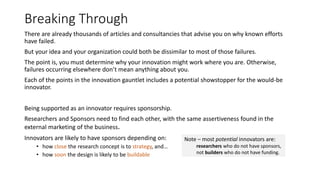
There are already thousands of articles and consultancies that advise you on why known efforts
have failed.
But your idea and your organization could both be dissimilar to most of those failures.
The point is, you must determine why your innovation might work where you are. Otherwise,
failures occurring elsewhere don’t mean anything about you.
Each of the points in the innovation gauntlet includes a potential showstopper for the would-be
innovator.
Being supported as an innovator requires sponsorship.
Researchers and Sponsors need to find each other, with the same assertiveness found in the
external marketing of the business.
Innovators are likely to have sponsors depending on:
• how close the research concept is to strategy, and…
• how soon the design is likely to be buildable

Note – most potential innovators are:
researchers who do not have sponsors,
not builders who do not have funding.
Profiling the Innovation
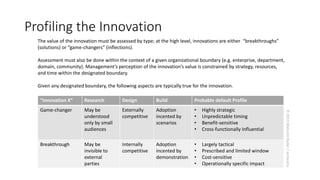
The value of the innovation must be assessed by type; at the high level, innovations are either “breakthroughs”
(solutions) or “game-changers” (inflections).
Assessment must also be done within the context of a given organizational boundary (e.g. enterprise, department,
domain, community). Management’s perception of the innovation’s value is constrained by strategy, resources,
and time within the designated boundary.
Given any designated boundary, the following aspects are typically true for the innovation.
Research

Design

Build

Probable default Profile

Game-changer

May be
understood
only by small
audiences

Externally
competitive

Adoption
incented by
scenarios

•
•
•
•

Highly strategic
Unpredictable timing
Benefit-sensitive
Cross-functionally Influential

Breakthrough

May be
invisible to
external
parties

Internally
competitive

Adoption
incented by
demonstration

•
•
•
•

Largely tactical
Prescribed and limited window
Cost-sensitive
Operationally specific impact

© 2013 Malcolm Ryder / archestra

“Innovation X”
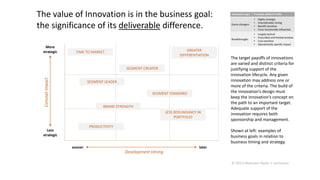
The value of Innovation is in the business goal:
the significance of its deliverable difference.
More
strategic

GREATER
DIFFERENTIATION

TIME TO MARKET

Concept impact

SEGMENT CREATOR
SEGMENT LEADER
SEGMENT STANDARD

BRAND STRENGTH
LESS REDUNDANCY IN
PORTFOLIO
PRODUCTIVITY

Less
strategic

The target payoffs of innovations
are varied and distinct criteria for
justifying support of the
innovation lifecycle. Any given
innovation may address one or
more of the criteria. The build of
the innovation’s design must
keep the innovation’s concept on
the path to an important target.
Adequate support of the
innovation requires both
sponsorship and management.
Shown at left: examples of
business goals in relation to
business timing and strategy.

sooner

later

Development timing
© 2013 Malcolm Ryder / archestra
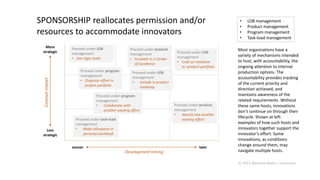
SPONSORSHIP reallocates permission and/or
resources to accommodate innovators

Concept impact

More
strategic

Less
strategic

Proceed under LOB
management
• Join tiger team

Proceed under program
management
• Organize effort in
project portfolio

Proceed under product
management
• Incubate in a Center
of Excellence

Proceed under LOB
management
• Craft an initiative
re: product portfolio

Proceed under LOB
management
•
Include in product
roadmap

Proceed under program
management
•
Collaborate with
another existing effort
Proceed under task-load
management
•
Make allowance in
personal workload
sooner

Proceed under product
management
•
Absorb into another
existing effort

later

Development timing

•
•
•
•

LOB management
Product management
Program management
Task-load management

Most organizations have a
variety of mechanisms intended
to host, with accountability, the
ongoing attention to internal
production options. The
accountability provides tracking
of the current priority and
direction achieved, and
maintains awareness of the
related requirements. Without
these same hosts, innovations
don’t continue on through their
lifecycle. Shown at left:
examples of how such hosts and
innovators together support the
innovator’s effort. Some
innovations, as conditions
change around them, may
navigate multiple hosts.
© 2013 Malcolm Ryder / archestra
The Who Cares Test
• An organization that has a policy of promoting innovation will “make good” on the promotion by
explicitly managing innovations across their lifecycles (research, design and build). This will be
reflected both under strategic planning and in portfolio evaluation of its products and solutions.
• The requirement for follow-through of that policy is a practice that solicits and orchestrates
assertive navigation of potential innovators amongst the organization’s options for sponsorship
and resourcing.
• Innovators eligible for attention and support need to be able to articulate how their concept
represents actionable opportunity that does not already exist in the established practice of the
organization.
Solved: Where the Practice Resides
Getting the innovation opportunity into practice should be a business development function. This specifically
means that the organization is systematically looking for the innovator.
The business development management team should be prospecting throughout the organization to solicit and
vet research.
Any researcher should be able to engage the business development process and the business development
management team, to have the opportunity to review the organization’s current value mapping and have an
interview regarding how to describe and assess their research.
The business development management team should maintain a portfolio of innovation research, which
should be continually available for review-on-demand by strategists and executives.
The critical decision to generate a design from the research concept should be recommended by business
development, who should then become an agent representing the recommended research to hosts, sponsors
and other operations managers.
Design and build decisions are not frequently under the control of the researcher. Credit for design and build
should be accountable under Project Management and Operations.
All highly-rated innovations should be recognized proxies of “contributions” that would factor into performance
evaluations and assignments of the researcher.

Who Gets To Innovate?

  • 1.
    Who Gets ToInnovate? An archestra notebook. © 2013 Malcolm Ryder / archestra
  • 2.
    Problem: Innovation isInconvenient Innovation is a practice, not a skill. Innovation is important as a performance advantage; other than that, it’s just interesting. For most innovators, chances of follow-through are… not so good.
  • 3.
    The Innovator’s Gauntlet 1. Thebusiness goal of innovation is to translate market opportunity to market performance 2. Adopting externally sourced innovations is not a new business idea: e.g., M&A 3. Producing internally originated innovations is also not a new business idea: e.g., R&D 4. Anyone can do research; development is almost always subject to a different degree of management 5. Development responds to business pressures in market performance 6. Research responds to business pressures in market opportunity 7. Research is intended to create opportunities that did not already exist 8. In the research stage, an innovation usually has no value outside of being a “problem solution” • The importance of a problem predetermines the expected base value of its solution
  • 4.
    The Innovator’s Gauntlet 9. Outsideof tackling a known problem, an innovation in the research stage mainly has value as a strategic change • The presence of a strategy predetermines the expected base value of the change • Innovations not associated with a strategy are likely to be ignored 10. To capture the solution or change, research delivers a concept as a design 11. Relatively few individuals are good designers 12. The most valuable researchers are the ones that are also good designers or that work well with an available designer 13. A designer is responsible for forming the innovation into something usable 14. Designers are often credited with the innovation because of the high importance of usability 15. The functional owner of the strategy needs to become the primary sponsor of the innovation’s development 16. The full production lifecycle of an innovation requires the design to be built at least as a model or prototype
  • 5.
    Innovation is importantas a performance advantage. Other than that, it is just interesting. Is the performance management system the biggest impediment to innovators? “Performance” is a label meaning one or both of two things: • Level of benefit that an effort produced versus what it used • Final proximity to a target outcome achieved on a production allowance Unfortunately, those two meanings, which translate to ROI and Productivity, leave out the primary purpose of innovation: • creating new ways of doing things, that leave behind the constraints of the old. Unless the difference in constraints is an advantage for ROI or Productivity, the “new” is mostly just interesting, while the “change” is mostly a risk. Many performance “management” systems are 50% predicated on risk-avoidance. Hmmm...
  • 6.
    For most innovators,chances of follow-through are… not so good. 1. The business goal of innovation is to translate market opportunity to market performance 2. Adopting externally sourced innovations is not a new business idea: M&A 3. Producing internally originated innovations is also not a new business idea: essentially, R&D 4. Anyone can do research; development is almost always subject to a different degree of management Chances are, somewhere in the gauntlet, you can spot the point where your innovation might stall, stray, or stop cold. 5. Development responds to business pressures in market performance 6. Research responds to business pressures in market opportunity 7. Research is intended to createno one understands it yet. Perhaps Maybe opportunities that did not already exist 8. the right people can’t see it yet. Possibly, it went to the wrong center of attention. of being might be a different innovation competing with it too In the research stage, an innovation usually has no value outsideThere a “problem solution” • The importance of a problem predetermines cares thatbase value of its solution you? successfully. And, who the expected it is coming from 9. Outside of tackling a known problem, an innovation in the research stage mainly has value as a strategic change than you intended? • InnovationsWill anyone be able to both to be ignoredand reproduce it in business-as-usual operation? not associated with a strategy are likely produce 10. To capture the solution or change, it actually change thearight thing(s) in the right way at the right time? And, does research delivers a concept as design. • The presence of a strategy predetermines thewants a differentthe changeit What if your supporter expected base value of use of 11. Relatively few individuals are good designers 12. The most valuable researchers are the ones that are also good designers or that work well with an available designer 13. A designer is responsible for forming the innovation into something usable 14. Designers are often credited with the innovation because of the high importance of usability 15. The functional owner of the strategy needs to become the primary sponsor of the innovation’s development 16. The full production lifecycle of an innovation requires the design to be built at least as a model or prototype
  • 7.
  • 8.
    Breaking Through There arealready thousands of articles and consultancies that advise you on why known efforts have failed. But your idea and your organization could both be dissimilar to most of those failures. The point is, you must determine why your innovation might work where you are. Otherwise, failures occurring elsewhere don’t mean anything about you. Each of the points in the innovation gauntlet includes a potential showstopper for the would-be innovator. Being supported as an innovator requires sponsorship. Researchers and Sponsors need to find each other, with the same assertiveness found in the external marketing of the business. Innovators are likely to have sponsors depending on: • how close the research concept is to strategy, and… • how soon the design is likely to be buildable Note – most potential innovators are: researchers who do not have sponsors, not builders who do not have funding.
  • 9.
    Profiling the Innovation Thevalue of the innovation must be assessed by type; at the high level, innovations are either “breakthroughs” (solutions) or “game-changers” (inflections). Assessment must also be done within the context of a given organizational boundary (e.g. enterprise, department, domain, community). Management’s perception of the innovation’s value is constrained by strategy, resources, and time within the designated boundary. Given any designated boundary, the following aspects are typically true for the innovation. Research Design Build Probable default Profile Game-changer May be understood only by small audiences Externally competitive Adoption incented by scenarios • • • • Highly strategic Unpredictable timing Benefit-sensitive Cross-functionally Influential Breakthrough May be invisible to external parties Internally competitive Adoption incented by demonstration • • • • Largely tactical Prescribed and limited window Cost-sensitive Operationally specific impact © 2013 Malcolm Ryder / archestra “Innovation X”
  • 10.
    The value ofInnovation is in the business goal: the significance of its deliverable difference. More strategic GREATER DIFFERENTIATION TIME TO MARKET Concept impact SEGMENT CREATOR SEGMENT LEADER SEGMENT STANDARD BRAND STRENGTH LESS REDUNDANCY IN PORTFOLIO PRODUCTIVITY Less strategic The target payoffs of innovations are varied and distinct criteria for justifying support of the innovation lifecycle. Any given innovation may address one or more of the criteria. The build of the innovation’s design must keep the innovation’s concept on the path to an important target. Adequate support of the innovation requires both sponsorship and management. Shown at left: examples of business goals in relation to business timing and strategy. sooner later Development timing © 2013 Malcolm Ryder / archestra
  • 11.
    SPONSORSHIP reallocates permissionand/or resources to accommodate innovators Concept impact More strategic Less strategic Proceed under LOB management • Join tiger team Proceed under program management • Organize effort in project portfolio Proceed under product management • Incubate in a Center of Excellence Proceed under LOB management • Craft an initiative re: product portfolio Proceed under LOB management • Include in product roadmap Proceed under program management • Collaborate with another existing effort Proceed under task-load management • Make allowance in personal workload sooner Proceed under product management • Absorb into another existing effort later Development timing • • • • LOB management Product management Program management Task-load management Most organizations have a variety of mechanisms intended to host, with accountability, the ongoing attention to internal production options. The accountability provides tracking of the current priority and direction achieved, and maintains awareness of the related requirements. Without these same hosts, innovations don’t continue on through their lifecycle. Shown at left: examples of how such hosts and innovators together support the innovator’s effort. Some innovations, as conditions change around them, may navigate multiple hosts. © 2013 Malcolm Ryder / archestra
  • 12.
    The Who CaresTest • An organization that has a policy of promoting innovation will “make good” on the promotion by explicitly managing innovations across their lifecycles (research, design and build). This will be reflected both under strategic planning and in portfolio evaluation of its products and solutions. • The requirement for follow-through of that policy is a practice that solicits and orchestrates assertive navigation of potential innovators amongst the organization’s options for sponsorship and resourcing. • Innovators eligible for attention and support need to be able to articulate how their concept represents actionable opportunity that does not already exist in the established practice of the organization.
  • 13.
    Solved: Where thePractice Resides Getting the innovation opportunity into practice should be a business development function. This specifically means that the organization is systematically looking for the innovator. The business development management team should be prospecting throughout the organization to solicit and vet research. Any researcher should be able to engage the business development process and the business development management team, to have the opportunity to review the organization’s current value mapping and have an interview regarding how to describe and assess their research. The business development management team should maintain a portfolio of innovation research, which should be continually available for review-on-demand by strategists and executives. The critical decision to generate a design from the research concept should be recommended by business development, who should then become an agent representing the recommended research to hosts, sponsors and other operations managers. Design and build decisions are not frequently under the control of the researcher. Credit for design and build should be accountable under Project Management and Operations. All highly-rated innovations should be recognized proxies of “contributions” that would factor into performance evaluations and assignments of the researcher.