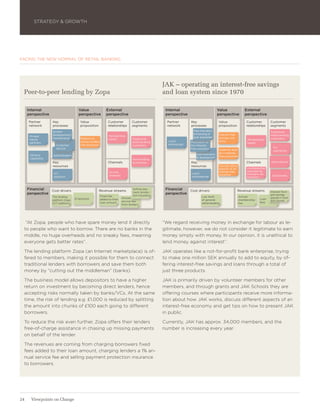
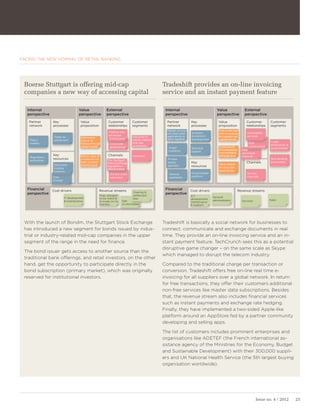
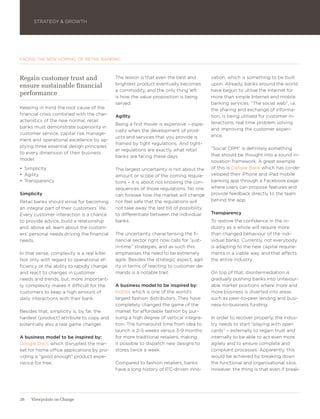
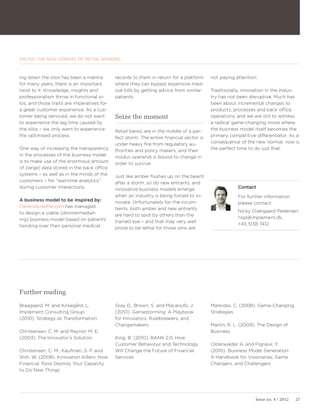
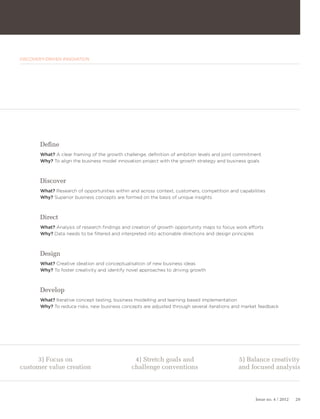


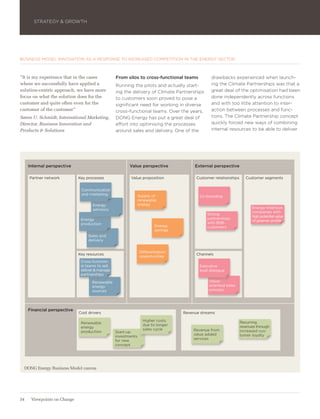
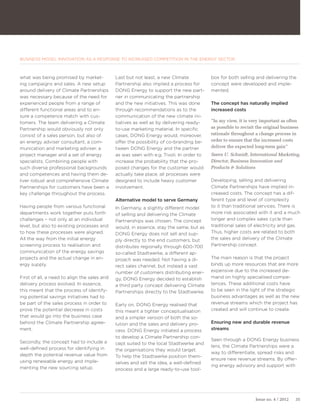
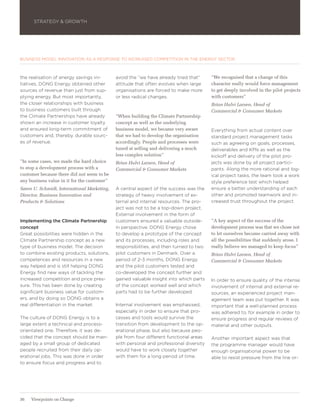


Viewpoints on Change
       STRATEGY & GROWTH                                                ISSN: 1904-6758 – NR. 4 / 2012


Business Model Innovation
New paths to creating growth
and delighting customers

CONTENTS

P. 3                         P. 20                   P. 28                     P. 30

Article                      Article                 Model                     Article
Create growth through        Facing the New Normal   Discovery-driven          Business model innovation as
innovative business models   of Retail Banking       innovation                a response to increased com-
                                                                               petition in the energy sector
STRATEGY & GROWTH


EDITORIAL


Why not?
                                                                  results. Rather promise little and surprise positively than
            BY NIELS AHRENGOT
                                                                  reaching for the stars and risking not quite reaching them –
            CEO, IMPLEMENT CONSULTING GROUP
                                                                  analogously to the above example.

                                                                  However, large innovations solely based on analyses of the
                                                                  past are rare. For even though the analysis is imperative in
                                                                  order to being able to understand and generalise and, thus,
We are involved in a project for a global growth company          scale, the tempo and complexity in our surrounding world
where we have recently carried out a project with focus on        have reached a level where we need to change the bal-
developing products faster and more efficiently. The project      ance between value creation and our need for predictabil-
was, in our opinion, a success. The client company, which is      ity. Those of us who think analytically must learn to speak
recognised as one of the world’s leading experts within their     an intuitive language, and those who think intuitively must
area of expertise, was, basically, satisfied. However, because    learn to communicate in an analytical mindset. Both sets of
they act the way they do when clients are at their best, they     competences are absolutely necessary. Even though innova-
ask anyway: Seeing that we are capable of reducing the lead       tion and intuitive thinking are closely linked, it is only when
time of a project from 600 to 300 days, why not reduce it to      rationality and analysis are involved in the process that the
100 days?                                                         large-scale commercial and business breakthroughs take
                                                                  place.
It is, of course, quite the partykiller in a situation where we
had expected to get a pat on the shoulder for our efforts.        Companies such as Apple, Google and Just Eat are good ex-
But he is right. Why do we consider good results as final         amples. Their development has been unpredictable, but their
when we are fully aware that in 12 months from now, we will       value creation has been immense, because they have been
be able to create the same percentage improvements one            able to combine intuitive and analytical thinking. Whether
more time and once again 12 months later? Why do we not           we, as Roger Martin, call it Design Thinking is of minor im-
change our mindset radically, raise the bar and reap the full     portance. We MUST be able to combine that which is ration-
benefits now? And once again – not in 12 months, but in six       al and analytical with that which is intuitive and irrational. In
months?                                                           this cross field, limitations turn into opportunities. This is also
                                                                  where the most successful companies operate and the best
Recently, we had the pleasure of discussing strategy with         employees thrive, develop and generate most value.
Roger Martin, Dean of the Rotman School of Management.
According to Martin, today, most strategic work suffers from      Thus, the question presented in the beginning of this article
a gap between analytical and intuitive thinking. This is pri-     is just a logical consequence of the reality we live in and a
marily caused by the fact that strategy has become an ana-        question that we – who are well on in years – must get used
lytical discipline where predictability is rewarded more than     to being asked: Why not?


2    Viewpoints on Change
ARTICLE


Create growth through
innovative business models
Understanding the why, what and how of business model innovation
by Morten Hejlesen


Short-term competitive advantage is       ness should lie the aspiration to delight       and influence key decisions through
created by exploiting existing business   customers. It might seem deceptively            rhetoric or regulations. Inside impedi-
models. However, in the long term,        simple, but, in reality, this core tenet is     ments come in many shapes. Actions
all markets mature, competition           challenged every day.                           of the past such as investments and
intensifies and turbulence increases.                                                     strategic choices create commitments
Consequently, new sources of growth       Outside pressure from investors trig-           that are hard to escape when customer
must be explored, and fresh answers       gers the desire to focus on short-term          needs are changing. Often, the un-
to enduring success must be found.        optimisation putting long-term cus-             derstanding of customer needs lacks
The answer used to be innovate or die.    tomer and, thus, shareholder value              depth or is based on false assumptions,
But research shows that pouring more
                                          creation at risk. Diverse stakeholder           thus limiting capabilities to conquer a
money into pure product innovation
                                          groups compete to capture attention             differentiated position in the market-
does not lead to improved performance.
We need to dig deeper.

To succeed in innovation and to             WHAT IS CUSTOMER VALUE?
seize new oppor-tunities, the scope
of innovation must be expanded to
                                            The idea of ”delighting customers” can be translated into the equally simple
encompass the full business model,
                                            idea of ”creating value” for customers. But what exactly is customer value,
and new processes must be mastered.
                                            and how can it be defined?
This article explores how an innovative
business model is linked to customer        Firstly, customer value cannot be equated with low price. More precisely,
value creation, defines growth              value creation is a trade-off between certain benefits and costs associated
opportunities and presents key success      with the value proposition over its entire life cycle. The total value of owner-
factors to exploit the potential of         ship must be calculated to assess the value creation potential.
business model innovation.
                                            Secondly, value lies in the eye of the beholder. Value is subjectively judged
                                            by the customer, which means that we must identify perceived benefits and
                                            costs. All insurance companies know this fact as they, in reality, sell products
Rethink customer                            which, hopefully, are not used. Value is not related to product attributes, but
value creation                              rather customer benefits.

                                            Thirdly, the value creation potential must be adjusted for the riskiness of the
Delighting customers is the heartbeat       value proposition. All innovators know this by heart. New products that are
of every business                           relatively unknown are always harder to sell than well-known products be-
While pundits claim that the only           cause of a higher perceived risk.
constant in the world of business is
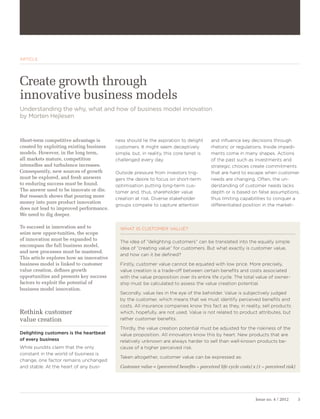
                                            Taken altogether, customer value can be expressed as:
change, one factor remains unchanged
and stable. At the heart of any busi-       Customer value = (perceived benefits – perceived life cycle costs) x (1 – perceived risk)


                                                                                                                Issue no. 4 / 2012      3
STRATEGY & GROWTH


CREATE GROWTH THROUGH INNOVATIVE BUSINESS MODELS


place. Management incentive structures      However, excess post-war production         in the 1970s and is still an effective ap-
are aligned with a strong focus on ”run-    capacity and a frugal culture created       proach to customer-centric sales. In
ning the business” rather than ”devel-      the perfect storm, motivating compa-        fact, many businesses are still on a jour-
oping the business”. Mental blinders        nies to find new ways of reaching the       ney from delivering products to creat-
tend to pop up resulting in a bias to run   heart of their customers. Increasingly,     ing solutions composed of both tangi-
business as usual, and new ideas are        generic products were differentiated        ble products and intangible services.
judged unattractive due to the risk of      and associated with emotional and so-       The trend has also been dubbed ser-
cannibalising the current business. And     cial benefits. The rise of branding and     vitisation of manufacturing, which also
the list continues.                         segmented marketing strongly indicat-       highlights the shift towards designing
                                            ed a shift towards a broader concept        all aspects of the customer experience
Altogether, the simple goal of delight-     of customer value creation. The shift is    as well as tailoring the experience to
ing customers is not that simple at all.    beautifully portrayed in the TV series      individual customer needs. Customer
Even though it has been proven time         Mad Men about the American flourish-        delight was no longer perceived as a
after time that customer-centric or-        ing advertising industry in the 1950-60s    result of simple products, but integrat-
ganisations are the most successful, it     and the boom of Madison Avenue ad           ed solutions with a carefully designed
is complex and challenging to walk the      agencies.                                   and value-adding layer of experiences
talk. Moreover, the ways in which or-                                                   that surrounded the core product.
ganisations deliver valuable customer       In parallel, the strong focus on tangible
experiences have dramatically changed       products was replaced with the idea         In the 1990s, Joe Pine and Jim Gilmore
in the past decades.                        of comprehensive value propositions         portrayed the rise of the experience
                                            and selling total solutions to customers.   economy in which they claim that work
Focus on customer benefits                  Solution selling emerged as a discipline    is a theatre and every business a stage.
– not product attributes
A quick glance at the history of delight-
ing customers shows that focus has ex-
                                              WHO IS YOUR CUSTOMER?
panded from fulfilling simple needs to
addressing the full range of advanced
                                              Simple questions usually turn out to be tough ones. Theodore Levitt asked:
customer needs, and the scope of in-
                                              ”What business are you in?”. We also need to ask: ”Who is your customer?”.
novation has been widened from ba-
                                              While the examples mentioned show the importance of the end user, value
sic products to integrated solutions. In
                                              creation should be managed for all touch points that your offerings have be-
other words, the key driver has been
                                              fore reaching the final customer.
growing attention to manipulating all
parameters of the business ecosystem          In the insulation industry, Rockwool has analysed and designed value proposi-
in order to deliver customer value.           tions for all customers involved with their core product. The chain of custom-
                                              ers includes building owners, architects, contractors, sub-contractors, install-
In the days of mass production,               ers and distributors. Moreover, a careful evaluation of different segments
customers were delighted by simple            within each customer group needs to form the basis for the design of differ-
products fulfilling basic needs and           ent value propositions for every group.
wants. Henry Ford famously dictated
                                              In the case of fast-moving consumer goods, all companies face similar chal-
in 1909 that customers could have the
                                              lenges. Value creation cannot only focus on the end consumer, but should
functional benefits of his Model T, while
                                              also consider the needs of the shoppers buying the goods, the retailers selling
he cared less about fancy colours: ”Any
                                              the goods, the wholesaler distributing the goods and even external partners
customer can have a car painted any
                                              responsible for production. Before pouring a simple glass of milk, customer
colour that he wants so long as it is
                                              needs must be served appropriately many different places in the total con-
black”. Cars were black and nothing
                                              sumption chain.
but black.


4    Viewpoints on Change
CREATE GROWTH THROUGH INNOVATIVE BUSINESS MODELS


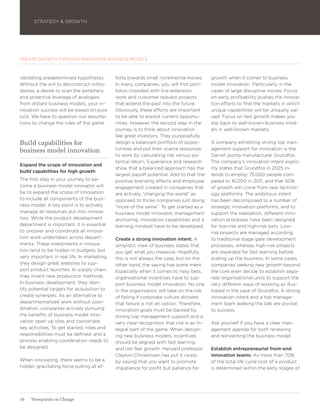
Accompanied by branding strategies              experienced-based differentiation.           Develop experience-based solutions
that engaged all five senses and even           Fuelled by financial meltdowns, rising       to gain competitive advantage
experiences designed around the idea            awareness of human impact on the en-         As a consequence of increasing com-
of catalysing personal transformations,         vironment and increased global inter-        petition in mature markets, new op-
the experience-centric thinking supple-         connectedness, most organisations are        portunities in emerging markets and
mented past logics of value creation.           now consciously evaluating how to fulfil     near-constant disruptions at the fringes
On the one hand, products developed             altruistic benefits for customers. In oth-   of most industries, focus on delighting
into solutions. On the other hand, fulfil-      er words, how to incorporate elements        customers plays a key role in gaining a
ment of functional needs was accom-             of selfless concern for the welfare of       foothold in a competitive marketplace.
panied by addressing more sophisticat-          others in their value propositions, e.g.     Although the notion of creating blue
ed customer needs.                              cradle-to-cradle principles and the am-      oceans is appealing, real-life experience
                                                bition to safeguard the planet for the       often shows that competitors quickly
Recent developments in the ways of              coming generation through company-           invade uncontested space and capture
delivering customer value might be              wide social responsibility, plays a still    market share.
considered as a counter-reaction to the         more vital role in order to delight cus-
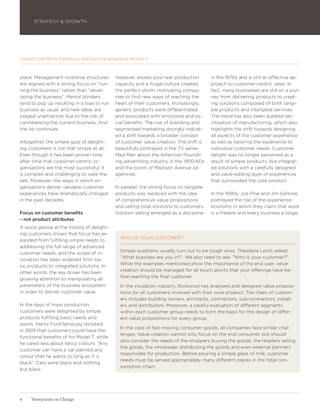
mainly narcissistic attempts to achieve         tomers (figure 1).                           To carry on delighting customers on a
                                                                                             continuous basis, advanced manners
                                                                                             of delivering value and creating com-
                                                                                             petitive advantage are needed. Add
                                                                                             to that the dramatic consequences of
                                                                                             recent technological developments
                                                                                             such as the internet that has created
                                        Functional
                                                                                             an unprecedented range of opportuni-
                                         benefits
                                                                                             ties to interact with and deliver value
                                        Efficiency
                                                                                             to customers. By leveraging the power
                                        Excellence
                                                                                             of emerging technologies, entirely new
                                                                                             markets have been made accessible,
                                                                                             and novel manners of interacting with
                                                                                             customers have been created.
                Emotional                                       Social
                 benefits                                      benefits                      Consider Danish telecom TDC that
                 Feelings                                       Status                       bundles telephony subscriptions with
                 Aesthetic                                      Esteem                       free access to millions of music tracks
                                                                                             through the TDC Play service or the
                                                                                             rise of internet-based portals for long-
                                                                                             distance microfinancing and interac-
                                                                                             tions with African entrepreneurs such
                                                                                             as MYC4 and Kiva. Since Kiva was
                                         Altruistic
                                                                                             founded in 2005, 636,949 lenders
                                         benefits
                                                                                             have invested USD 255 million in poor
                                          Ethics
                                                                                             entrepreneurs in remote areas of the
                                        Spirituality
                                                                                             world. The entrepreneurs have grown
                                                                                             their businesses and repaid 99% of the
                                                                                             loans. Both examples highlight the re-
                                                                                             cent explosion of colours on the palette
  Figure 1. Four dimensions of customer value creation                                       of delivering valuable customer experi-


                                                                                                                 Issue no. 4 / 2012   5
STRATEGY & GROWTH


CREATE GROWTH THROUGH INNOVATIVE BUSINESS MODELS


                                                                                           panded from delivering basic products
                                                                                           to crafting advanced business models.

                                                                                           Professor Michael Porter captured this
                                                                                           paradigmatic shift back in 1996 when
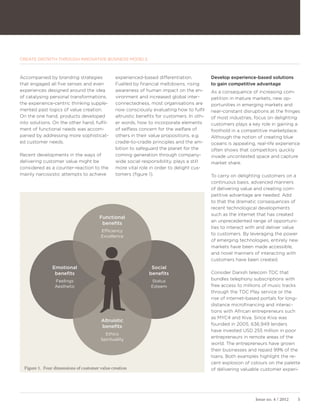
                       Integrated       Value-based        Experience-                     he noted that a strategic fit among
                       solutions         solutions        based solutions                  many activities is fundamental – not
                                                                                           only to competitive advantage, but also
      Internal                                                                             to the sustainability of that advantage.
      innovation                                                                           Porter argued that it is considerably
      focus
                                                                                           harder for a competing firm to match
                                           Basic             Complex                       an array of interlocked activities than
                       Basic
                                        products and       products and                    it is merely to imitate a particular sales
                       offerings
                                          services           services                      force approach, match a process tech-
                                                                                           nology or replicate a set of product
                                                                                           features. Therefore, positions built on
                                        Simple needs     Advanced needs                    systems of activities are far more sus-
                                                                                           tainable than those built on individual
                                         External customer focus                           activities.

                                                                                           Consequently, we have to revise the
    Figure 2. Customer and innovation focus matrix                                         old dictum of ”building a better mouse-
                                                                                           trap” to make the world beat a path to
                                                                                           our door. Although more than 4,400
                                                                                           patents have been issued by the United
ences. The message to old Ford is sim-           Above all, the uniting discovery across
                                                                                           States Patent and Trademark Office for
ple: Black is no longer the only option.         the spectrum of opportunities is the
                                                                                           new mousetraps, and it is the most fre-
                                                 recognition of the need to carefully
                                                                                           quently invented device in history, the
While the shift can be described as              consider and design all elements of the
                                                                                           driver of long-term success resides not
an overarching trend, it is evident that         business model to address the specific
                                                                                           only in the mousetrap itself, but in the
success can still be found in all quad-          needs of the particular customer seg-
                                                                                           complete business model.
rants (Figure 2). Customer needs dif-            ment. The explosion of colours on the
fer across segments and markets.                 design palette has created an unprec-
                                                                                           The business model view resonates
Industries compete on different factors.         edented range of opportunities to be
                                                                                           with research on how to profit from
In some cases, an attractive opportu-            explored in order to find the right fit
                                                                                           innovation. The mousetrap approach
nity can be exploited by developing              between the value proposition and the
                                                                                           clearly plays an important role. A tight
simple and convenient products that              customers.
                                                                                           regime of patents, copyrights and trade
attract non-users and, thus, expand-
                                                                                           secrets is one component of the equa-
ing the current market. In other cases,
                                                                                           tion, but to commercialise an innova-
advanced experience-based solutions
can be leveraged to capture the prof-
                                                 Develop new business models               tion or exploit a new business strategy,
                                                                                           complementary assets are needed such
itable high-end of an existing market.
                                                 Innovate your business models             as manufacturing capabilities, distribu-
However, it is clear that competitive
                                                 to reap superior returns                  tion channels, specialised services and
advantage as a rule of thumb is more
                                                 In essence, the scope of creating cus-    a sales force.
sustainable when solutions are hard to
imitate as well as based on deep and             tomer value propositions and, thus,
enduring customer relationships.                 competitive advantage has been ex-


6      Viewpoints on Change
CREATE GROWTH THROUGH INNOVATIVE BUSINESS MODELS


What is a business model?                   is enabled by the organisation’s ability    The external perspective describes
                                            to standardise and industrialise opera-     how the value proposition is delivered
In brief, a business model describes        tions across the activity system. The       to the targeted customer segments. To
how an organisation creates, delivers       aim is not to add complexity, but to en-    reach the customers, the value propo-
and captures value. More precisely, a       able scalability through simple, but ef-    sition is distributed and communicat-
business model articulates the content,     fective activity systems.                   ed through a set of channels, and to
structure and governance of the activ-                                                  establish long-term customer relation-
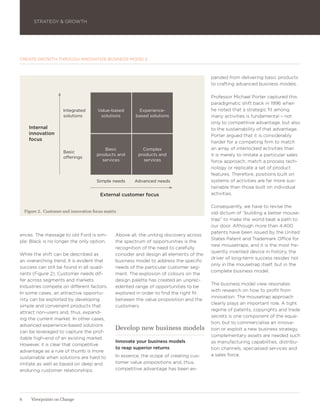
ity system that delivers a value propo-     The activity system can be illustrated      ships, ways of building the relationship
sition to the customer and enables          by using a simple model consisting of       have to be identified. E.g. car manu-
economic value creation for all activity    4 dimensions and 9 building blocks.         facturers have established a number
system exchange partners.                                                               of customer clubs – both online and
                                            The value perspective describes the         offline – to build close connections to
A simple example of customer needs          total market offering provided by the       their customers.
being fulfilled by radically different      company. It consists of a value proposi-
business models is car transportation.      tion composed by an integrated solu-        The internal perspective describes
Getting from A to B and the freedom         tion of products and services. Typically,   how the market offering is produced. A
to choose when to go can be served          the core offering is linked to comple-      number of tangible, intangible or finan-
by a car that is bought, leased, rented     mentary offerings to create a compre-       cial key resources must be leveraged to
or even shared with co-owners through       hensive customer experience. E.g. car       create the value proposition through a
car sharing services. The core product      manufacturers have recently begun to        range of key processes. Strong brands
is essentially the same, while the activ-   offer leasing contracts, which has prov-    are important intangible resources, and
ity system underlying the product cov-      en to be an important complementary         the design of processes both in back
ers a spectrum of business model de-        service to the core product that drives     and front office functions is vital to
sign options. In all cases, value capture   growth.                                     economies of scale. Often, an external
                                                                                        partner network is a key component
                                                                                        of the value proposition, e.g. the finan-
 Internal                         Value                External                         cial service providers involved in the
 perspective                      perspective          perspective                      car leasing contracts mentioned in the
                                                                                        example.
                Key                                       Customer
                processes                                 relationships                 The financial perspective describes
                                                                                        how profit is made by identifying rev-
                                                                                        enue streams and depicting the cost
                                                                                        structure. Revenue comes in many
    Partner                          Value                            Customer          shapes as the car example illustrates,
    network                          proposition                      segments
                                                                                        and both financial components should
                                                                                        be carefully designed to maximise prof-
                                                                                        its and customer value.
                Key
                                                          Channels
                resources                                                               The activity system is generic and
                                                                                        can be used to systematically visual-
                                                                                        ise and redesign any business model.
                                                                                        Furthermore, it creates a unified lan-
                   Cost                               Revenue                           guage around the elusive business
                   drivers                            streams                           model concept that can be used across
 Financial
                                                                                        organisational functions and units.
 perspective


                                                                                                            Issue no. 4 / 2012   7
STRATEGY & GROWTH


CREATE GROWTH THROUGH INNOVATIVE BUSINESS MODELS


                                                                                             Decide on what game to play before
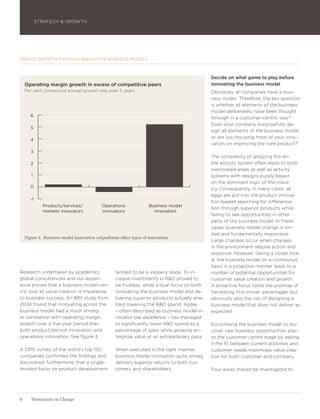
    Operating margin growth in excess of competitive peers                                   innovating the business model
    Per cent compound annual growth rate over 5 years                                        Obviously, all companies have a busi-
                                                                                             ness model. Therefore, the key question
                                                                                             is whether all elements of the business
                                                                                             model deliberately have been thought
       6
                                                                                             through in a customer-centric way?
                                                                                             Does your company purposefully de-
       5
                                                                                             sign all elements of the business model,
                                                                                             or are you focusing most of your inno-
       4
                                                                                             vation on improving the core product?
       3
                                                                                             The complexity of grasping the en-
       2                                                                                     tire activity system often leads to both
                                                                                             overlooked areas as well as activity
       1                                                                                     systems with designs purely based
                                                                                             on the dominant logic of the indus-
       0
                                                                                             try. Consequently, in many cases, all
                                                                                             eggs are put into the product innova-
      -1
                                                                                             tion basket searching for differentia-
             Products/services/            Operations              Business model
                                                                                             tion through superior products while
             markets innovators            innovators                innovators
                                                                                             failing to see opportunities in other
                                                                                             parts of the business model. In these
                                                                                             cases, business model change is lim-
                                                                                             ited and fundamentally responsive.
    Figure 3. Business model innovation outperforms other types of innovation
                                                                                             Large changes occur when changes
                                                                                             in the environment require action and
                                                                                             response. However, taking a closer look
                                                                                             at the business model on a continuous
                                                                                             basis in a proactive manner leads to a
Research undertaken by academics,                 tended to be a slippery slope. To in-      number of potential opportunities for
global consultancies and our experi-              crease investments in R&D proved to        customer value creation and growth.
ence proves that a business model-cen-            be fruitless, while a dual focus on both   A proactive focus holds the promise of
tric look at value creation is imperative         innovating the business model and de-      harvesting first-mover advantages, but
to business success. An IBM study from            livering superior products actually ena-   obviously also the risk of designing a
2006 found that innovating across the             bled lowering the R&D spend. Apple         business model that does not deliver as
business model had a much strong-                 – often described as business model in-    expected.
er correlation with operating margin              novator par excellence – has managed
growth over a five-year period than               to significantly lower R&D spend as a      Scrutinising the business model to dis-
both product/service innovation and               percentage of sales while growing en-      cover new business opportunities plac-
operations innovation. See figure 3.              terprise value at an extraordinary pace.   es the customer centre stage by asking
                                                                                             if the fit between current activities and
A 2010 survey of the world’s top 150              When executed in the right manner,         customer needs maximises value crea-
companies confirmed the findings and              business model innovation quite simply     tion for both customer and company.
discovered, furthermore, that a single-           delivers superior returns to both cus-
minded focus on product development               tomers and shareholders.                   Four areas should be investigated to


8      Viewpoints on Change
CREATE GROWTH THROUGH INNOVATIVE BUSINESS MODELS


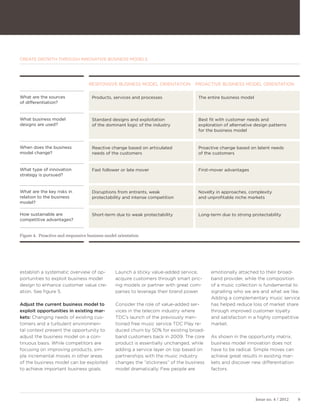
                                   RESPONSIVE BUSINESS MODEL ORIENTATION            PROACTIVE BUSINESS MODEL ORIENTATION


What are the sources                 Products, services and processes                 The entire business model
of differentiation?


What business model                  Standard designs and exploitation                Best fit with customer needs and
designs are used?                    of the dominant logic of the industry            exploration of alternative design patterns
                                                                                      for the business model


When does the business               Reactive change based on articulated             Proactive change based on latent needs
model change?                        needs of the customers                           of the customers


What type of innovation              Fast follower or late mover                      First-mover advantages
strategy is pursued?


What are the key risks in            Disruptions from entrants, weak                  Novelty in approaches, complexity
relation to the business             protectability and intense competition           and unprofitable niche markets
model?

How sustainable are                  Short-term due to weak protectability            Long-term due to strong protectability
competitive advantages?


Figure 4. Proactive and responsive business model orientation


establish a systematic overview of op-           Launch a sticky value-added service,       emotionally attached to their broad-
portunities to exploit business model            acquire customers through smart pric-      band provider, while the composition
design to enhance customer value cre-            ing models or partner with great com-      of a music collection is fundamental to
ation. See figure 5.                             panies to leverage their brand power.      signalling who we are and what we like.
                                                                                            Adding a complementary music service
Adjust the current business model to             Consider the role of value-added ser-      has helped reduce loss of market share
exploit opportunities in existing mar-           vices in the telecom industry where        through improved customer loyalty
kets: Changing needs of existing cus-            TDC’s launch of the previously men-        and satisfaction in a highly competitive
tomers and a turbulent environmen-               tioned free music service TDC Play re-     market.
tal context present the opportunity to           duced churn by 50% for existing broad-
adjust the business model on a con-              band customers back in 2009. The core      As shown in the opportunity matrix,
tinuous basis. While competitors are             product is essentially unchanged, while    business model innovation does not
focusing on improving products, sim-             adding a service layer on top based on     have to be radical. Simple moves can
ple incremental moves in other areas             partnerships with the music industry       achieve great results in existing mar-
of the business model can be exploited           changes the ”stickiness” of the business   kets and discover new differentiation
to achieve important business goals.             model dramatically. Few people are         factors.


                                                                                                                  Issue no. 4 / 2012   9
STRATEGY & GROWTH


CREATE GROWTH THROUGH INNOVATIVE BUSINESS MODELS


                                                                                          sions. Should all segments be served
                                                                                          by the same business model while
                                                                                          running the risk of opening a flank for
                                                                                          competitors? Or should a radically new
                                                                                          business model be designed to serve
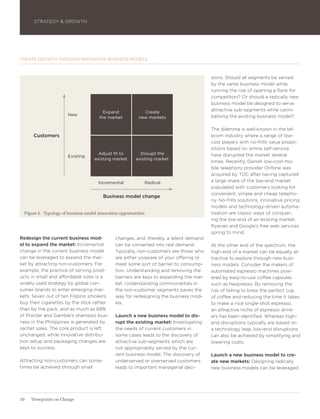
                                          Expand              Create
                                                                                          attractive sub-segments while canni-
                        New                                                               balising the existing business model?
                                        the market          new markets

                                                                                          The dilemma is well-known in the tel-
      Customers                                                                           ecom industry where a range of low-
                                                                                          cost players with no-frills value propo-
                                                                                          sitions based on online self-service
                                       Adjust fit to        Disrupt the                   have disrupted the market several
                        Existing
                                     existing market      existing market
                                                                                          times. Recently, Danish low-cost mo-
                                                                                          bile telephony provider Onfone was
                                                                                          acquired by TDC after having captured
                                       Incremental            Radical                     a large share of the low-end market
                                                                                          populated with customers looking for
                                                                                          convenient, simple and cheap telepho-
                                         Business model change
                                                                                          ny. No-frills solutions, innovative pricing
                                                                                          models and technology-driven automa-
  Figure 5. Typology of business model innovation opportunities                           tisation are classic ways of conquer-
                                                                                          ing the low-end of an existing market.
                                                                                          Ryanair and Google’s free web services
                                                                                          spring to mind.
Redesign the current business mod-              changes, and, thereby, a latent demand
el to expand the market: Incremental            can be converted into real demand.        At the other end of the spectrum, the
change in the current business model            Typically, non-customers are those who    high-end of a market can be equally at-
can be leveraged to expand the mar-             are either unaware of your offering or    tractive to explore through new busi-
ket by attracting non-customers. For            meet some sort of barrier to consump-     ness models. Consider the makers of
example, the practice of serving prod-          tion. Understanding and removing the      automated espresso machines pow-
ucts in small and affordable sizes is a         barriers are keys to expanding the mar-   ered by easy-to-use coffee capsules
widely used strategy by global con-             ket. Understanding commonalities in       such as Nespresso. By removing the
sumer brands to enter emerging mar-             the non-customer segments paves the       risk of failing to brew the perfect cup
kets. Seven out of ten Filipino smokers         way for redesigning the business mod-     of coffee and reducing the time it takes
buy their cigarettes by the stick rather        els.                                      to make a nice single-shot espresso,
than by the pack, and as much as 68%                                                      an attractive niche of espresso drink-
of Procter and Gamble’s shampoo busi-           Launch a new business model to dis-       ers has been identified. Whereas high-
ness in the Philippines is generated by         rupt the existing market: Investigating   end disruptions typically are based on
sachet sales. The core product is left          the needs of current customers in         a technology leap, low-end disruptions
unchanged, while innovative distribu-           some cases leads to the discovery of      can also be achieved by simplifying and
tion setup and packaging changes are            attractive sub-segments which are         lowering costs.
keys to success.                                not appropriately served by the cur-
                                                rent business model. The discovery of     Launch a new business model to cre-
Attracting non-customers can some-              underserved or overserved customers       ate new markets: Designing radically
times be achieved through small                 leads to important managerial deci-       new business models can be leveraged


10   Viewpoints on Change
CREATE GROWTH THROUGH INNOVATIVE BUSINESS MODELS


to create entirely new markets where            tom of the pyramid live on less than          ness unit level and when developing
large groups of customers have been             $2.50 per day and are by far the larg-        new market offerings. Obviously, new
locked out. In some markets, minor              est global socio-economic group.              business models are not launched out
business model tweaks such as sachet            Furthermore, fulfilling the vision leads      of the blue, but rather closely aligned
marketing are simply not enough. A              to value creation that, by far, goes be-      with overarching strategic growth am-
complete overhaul or even a new busi-           yond pure economic value creation.            bitions of the company. In other words,
ness model is needed to commercialise                                                         a diagnosis of the strengths and weak-
a value proposition for a new market.           New market creation demands innova-           nesses of current business models
New markets can be defined both geo-            tive business models. Moreover, these         needs to form the basis for any at-
graphically such as bringing products           emerging markets are often judged             tempt to pursue one or more of the
from developed markets to emerging              unattractive to well-established compa-       four opportunities.
markets and as needs-based such as              nies, because they start out small and
fulfilling emerging customer needs.             do not meet the expected growth rates         Combine diverse knowledge perspec-
                                                to attract ordinary innovation invest-        tives to create new business models
A business model currently under de-            ments. However, these markets often           Becoming a business model innovator
velopment illustrating the idea is the          become large and profitable, and pa-          can be compared to an artist shifting
current debate concerning designing             tience for growth pays off.                   style from painting with monochrome
a house for the poor that can be con-                                                         colours to using a palette with all the
structed for under $300 which keeps             The four generic growth opportuni-            vivid colours of the rainbow. Options
a family safe, allows them to sleep at          ties (see figure 6) can be explored and       explode, and the number of possible
night and gives them both a home and            exploited by any company to sustain           solutions for designing the next market
a sense of dignity. It is a grand chal-         growth and delight customers. The             offering increases. However, in order to
lenge that surely can only be solved by         common denominator is a proactive             be successful, the colours on the pal-
thinking innovatively about the entire          posture that recognises the need to           ette need to be picked carefully. Not all
business model. The potential is huge.          cover all components of the business          colours can be used for the next break-
2.5 billion people at the so-called bot-        model – both when strategising at busi-       through. In other words, the articulat-


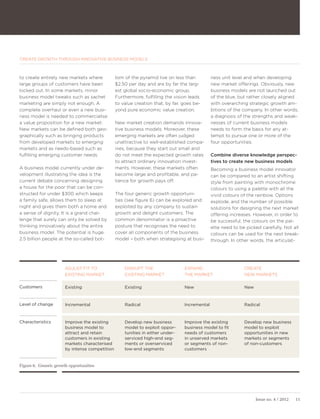
                       ADJUST FIT TO                DISRUPT THE                 EXPAND                       CREATE
                       EXISTING MARKET              EXISTING MARKET             THE MARKET                   NEW MARKETS

Customers              Existing                     Existing                    New                          New


Level of change        Incremental                  Radical                     Incremental                  Radical


Characteristics        Improve the existing         Develop new business        Improve the existing         Develop new business
                       business model to            model to exploit oppor-     business model to fit        model to exploit
                       attract and retain           tunities in either under-   needs of customers           opportunities in new
                       customers in existing        serviced high-end seg-      in unserved markets          markets or segments
                       markets characterised        ments or overserviced       or segments of non-          of non-customers
                       by intense competition       low-end segments            customers


Figure 6. Generic growth opportunities


                                                                                                                   Issue no. 4 / 2012   11
STRATEGY & GROWTH


CREATE GROWTH THROUGH INNOVATIVE BUSINESS MODELS


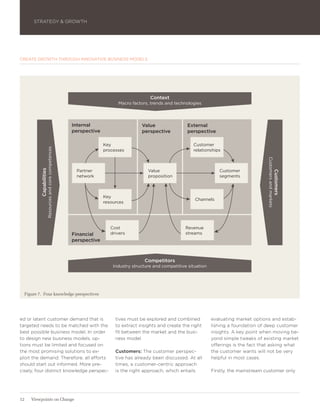
                                                                                         Context
                                                                          Macro factors, trends and technologies


                                                      Internal                       Value                External
                                                      perspective                    perspective          perspective

                                                                    Key                                      Customer
                     Resources and core competences


                                                                    processes                                relationships


                                                                                                                                                Customers and markets
          Capabilities


                                                       Partner                          Value                             Customer


                                                                                                                                                                    Customers
                                                       network                          proposition                       segments


                                                                    Key
                                                                                                              Channels
                                                                    resources


                                                                       Cost                               Revenue
                                                      Financial        drivers                            streams
                                                      perspective


                                                                                      Competitors
                                                                        Industry structure and competitive situation


  Figure 7. Four knowledge perspectives


ed or latent customer demand that is                                     tives must be explored and combined           evaluating market options and estab-
targeted needs to be matched with the                                    to extract insights and create the right      lishing a foundation of deep customer
best possible business model. In order                                   fit between the market and the busi-          insights. A key point when moving be-
to design new business models, op-                                       ness model.                                   yond simple tweaks of existing market
tions must be limited and focused on                                                                                   offerings is the fact that asking what
the most promising solutions to ex-                                      Customers: The customer perspec-              the customer wants will not be very
ploit the demand. Therefore, all efforts                                 tive has already been discussed. At all       helpful in most cases.
should start out informed. More pre-                                     times, a customer-centric approach
cisely, four distinct knowledge perspec-                                 is the right approach, which entails          Firstly, the mainstream customer only


12   Viewpoints on Change
CREATE GROWTH THROUGH INNOVATIVE BUSINESS MODELS


experiences what he or she already         lutions. On the one hand, a number of       Furthermore, an analysis of close com-
knows and lacks knowledge about dif-       constraints can be identified by analys-    petitors can be used to spot industry
ferent options. The customer’s frame of    ing macrofactors such as legal regu-        orthodoxies and mental models that
reference is severely limited, and usu-    lations, economic factors and soci-         could be challenged. Whirlpool ob-
ally customer ideas cannot be used to      etal trends. Often, constraints can be      served that all white goods were de-
leap-jump competition. They tend to        turned into great opportunities, which      signed and sold with women in mind,
be incremental and result in me-too        producers of outdoor ashtrays discov-       and they used that piece of competi-
products. Secondly, the knowledge that     ered when indoor smoking in public          tive insight to create a new product line
can be accessed easily by asking the       buildings was prohibited in Denmark         for men and their garages. While the
customer will most likely not be very      some years ago. A simple change in          idea might seem a bit sexist, business
unique. All competitors will have access   regulations caused an instant boom in       for Gladiator® GarageWorks is flourish-
to the same knowledge through ana-         demand. On the other hand, many po-         ing, and American men are eager to in-
lyst reports and industry market stud-     tential solutions can be discovered by      stall designer fridges in their garages.
ies. One exception is the so-called lead   studying the context. Both microtrends
users who typically represent a tiny       and macrotrends can provide answers         To identify and break out of industry
fraction of your customer base. They       to great experience design.                 orthodoxies, the analysis should not be
are characterised by their eagerness to                                                restricted to close competitors when
tweak, modify and rebuild your prod-       Due to the explosion of small digi-         bigger and bolder ideas are wanted.
ucts. Looking at their modifications can   tal sensors embedded in many con-           Just as lead users and emerging tech-
be helpful to identify emerging de-        sumer products, it is easy to measure       nologies can inspire the discovery of
mands, since they are usually ”ahead”      almost everything that we do. Nike          new business models, so can research
of the mass market.                        and Apple partnered and designed            into analogous industries. Looking
                                           the Nike+ tracking device for runners.      across industries helps identify emerg-
Instead of asking the customers what       Fitbit has developed a personal track-      ing business model design patterns
they want, the best approaches for dis-    ing device collecting real-time data on     that can be imported from one industry
covering unique insights are to listen     every step taken, stairs climbed and        to another. Danish playground produc-
and observe customers in their real-life   calories burned. Both examples illus-       er Indu basically copied Google’s busi-
context. To get under the skin of the      trate the booming interest in measuring     ness model by offering ad-supported
customer, ethnographic research meth-      and quantifying your everyday life. New     playgrounds to schools and communi-
ods must be used, and data should be       technologies shape trends and can also      ties for free. Looking across the indus-
interpreted systematically to find the     be mapped to identify design options.       try value chain can also be used as a
surprising insights which pave the way     A key area of interest should be emerg-     tool for identifying shifts in the industry
for innovation. While high-level quanti-   ing technologies and careful analysis       profit pool. Small changes in the loca-
tative analysis of customers can set the   of their possible implications for future   tion of high profits in the value chain
direction, deep qualitative studies are    business models. A simple but power-        can be used to anticipate important
the best option to find the latent needs   ful exercise is to map 20-30 important      changes and growth opportunities. The
to exploit. Sharpen knowledge through      technology-based trends and concep-         message is clear: When innovation am-
exploring the full upstream chain of       tualise a set of new solutions on the       bition levels are high, an ordinary com-
customers and understanding needs in       basis of each of those trends.              petitive analysis will not be sufficient.
all phases of the customer journey from
initial consideration to disposal of a     Competition: The competition                Capabilities: The capability perspective
market offering. Put simply, get out of    perspective should without a doubt          is used to explore both internal and ex-
the building and meet the customers.       be explored. Competitive analysis can       ternal capabilities and resources. Firstly,
                                           be used to single out those customer        a mapping of internal capabilities and
Context: The context perspective of-       wants and needs which are not cur-          resources can provide insight about
fers both constraints and possible so-     rently satisfied in the marketplace.        underused resources or underexploited


                                                                                                            Issue no. 4 / 2012   13
STRATEGY & GROWTH


CREATE GROWTH THROUGH INNOVATIVE BUSINESS MODELS


business capabilities. For instance, the      Know your options before innovat-          of a product line. But bold moves do
service business of many manufactur-          ing. A broad and diverse foundation of     require a decent amount of knowledge
ing companies has been profession-            knowledge simply makes it easier to        and inspiration upfront.
alised in recent years. At Danish wind        be both innovative and goal-oriented.
turbine manufacturer Vestas, the ser-         However, the deep dive into emerging       The bottom line is that analysis must
vice business is growing, while the to-       technologies, latent customer needs        always serve a purpose and enable
tal turnover growth is under pressure.        and inspiring business models should       you to challenge world views. That
Services accounted for EUR 214 million        always be timeboxed and balanced           also means that research efforts guid-
in 2006 growing to EUR 700 million in         with the innovation challenge at hand.     ing business model innovation must be
2011 out of a total turnover of EUR 6.4       There is no need to boil the ocean to      designed to build surprising hypoth-
billion.                                      design a simple service business on top    eses as opposed to just testing and

Secondly, resources and capabilities
of the business ecosystem should be
mapped to identify partnering, collabo-        WHAT ARE THE CHARACTERISTICS OF A GREAT BUSINESS MODEL?
ration and integration opportunities. A
highly profitable business model in the        Not all business models are created equal, and some key factors must be con-
publishing industry is to license for-         sidered when evaluating different design options. A delighted customer is the
gotten comic book characters to toy,           ultimate goal of your business model, but to survive in the long run as a busi-
movie and computer game produc-                ness, the challenge is not just creating customer value, but capturing value as
ers. In that way, resources are exploited      well.
in a new context through smart part-
nering agreements. Consider Marvel             To capture value, your design must provide a high degree of protectability
Entertainment’s lucrative licensing of         through either legal or natural barriers. Legal barriers could be patents, trade
Spiderman and X-men to Hollywood               secrets, copyrights or non-disclosure agreements. Natural barriers could
studios. If partnering opportunities are       be difficulty in reverse engineering your offering, switching costs or tacit-
lackluster, a business ecosystem can be        ness of relevant technology. To capture value, you must also have some de-
designed when the right incentives are         gree of control over so-called complementary assets. Such assets are for in-
present. External app developers play          stance manufacturing capabilities, an effective distribution setup, a portfolio
a vital role in Apple’s iPhone and iPad        of strong brands, innovative services and leverage of shared technologies. In
success. More importantly, the use of          other words, the strength of your protection mechanisms and supporting as-
external developers and their resourc-         sets will determine your ability to capture value.
es reduces the risk of failure for Apple
and increases the speed of innovation          At the end of the day, great business models are based on solid financial mod-
at the same time. Bad apps die, while          els. To support your efforts in discovering the right financial model, consider
Apple survives, and barriers of entry in       some of the questions below:
the app market are so low that a 12-           •	 Do high switching costs create effective lock-in of customers?
year old app programmer can achieve            •	 Can you easily scale your business model?
significant success. Apps are all about        •	 Does your business model produce recurring revenues?
survival of the fittest, and in the heat of    •	 Can you design the financial model so that you earn before you spend?
the battle Apple’s business model just         •	 Is it possible to exploit a partner network to reduce your costs and risk?
gets stronger and stronger.                    •	 Does your business model exploit protection mechanisms?
                                               •	 Can you take advantage of existing assets and capabilities?
Altogether, new business opportuni-            •	 Can you redesign the cost structure to change the rules of the industry?
ties are discovered at the intersection        •	 How can you rethink the in- and outflow of cash throughout both
of the four knowledge perspectives.               development and launch of the business model?


14   Viewpoints on Change
CREATE GROWTH THROUGH INNOVATIVE BUSINESS MODELS


                                                   Issue no. 4 / 2012   15
STRATEGY & GROWTH


CREATE GROWTH THROUGH INNOVATIVE BUSINESS MODELS


validating predetermined hypotheses.         forts towards small incremental moves.       growth when it comes to business
Without the will to deconstruct ortho-       In many companies, you will find port-       model innovation. Particularly in the
doxies, a desire to scan the periphery       folios crowded with line extension           cases of large disruptive moves. Focus
and proactive leverage of analogies          work and customer request projects           on early profitability pushes the innova-
from distant business models, your in-       that extend the past into the future.        tion efforts to find the markets in which
novation success will be based on pure       Obviously, these efforts are important       unique capabilities will be uniquely val-
luck. We have to question our assump-        to be able to exploit current opportu-       ued. Focus on fast growth makes you
tions to change the rules of the game.       nities. However, the second step in the      slip back to well-known business mod-
                                             journey is to think about innovation         els in well-known markets.
                                             like great investors. They purposefully
Build capabilities for                       design a balanced portfolio of oppor-        A company exhibiting strong top man-
business model innovation                    tunities and put their scarce resources      agement support for innovation is the
                                             to work by calculating risk versus po-       Danish pump manufacturer Grundfos.
                                             tential return. Experience and research      The company’s innovation intent explic-
Expand the scope of innovation and
                                             show that a balanced approach has the        itly states that Grundfos in 2025 in-
build capabilities for high growth
                                             largest payoff potential. Add to that the    tends to employ 75,000 people com-
The first step in your journey to be-        positive branding effects and employee       pared to 16,000 in 2011, and that 50%
come a business model innovator will         engagement created in companies that         of growth will come from new technol-
be to expand the scope of innovation         are actively ”changing the world” as         ogy platforms. The ambitious intent
to include all components of the busi-       opposed to those companies just doing        has been decomposed to a number of
ness model. A key point is to actively       ”more of the same”. To get started as a      strategic innovation platforms, and to
manage all resources put into innova-        business model innovator, management         support the realisation, different inno-
tion. While the product development          anchoring, innovation capabilities and a     vation processes have been designed
department is important, it is essential     learning mindset have to be developed.       for low-risk and high-risk bets. Low-
to uncover and coordinate all innova-                                                     risk projects are managed according
tion work undertaken across depart-          Create a strong innovation intent: A         to traditional stage gate development
ments. These investments in innova-          simplistic view of business states that      processes, whereas high-risk projects
tion tend to be hidden in budgets, but       you get what you measure. Hopefully,         are rewarded for fast learning before
very important in real life. In marketing,   this is not always the case, but on the      scaling up the business. In some cases,
they design great websites to sup-           other hand, the saying has some merit.       companies seeking new growth beyond
port product launches. In supply chain,      Especially when it comes to risky bets,      the core even decide to establish sepa-
they invent new production methods.          organisational incentives have to sup-       rate organisational units to support the
In business development, they iden-          port business model innovation. No one       very different ways of working as illus-
tify potential targets for acquisition to    in the organisation will take on the risk    trated in the case of Grundfos. A strong
create synergies. As an alternative to       of failing if corporate culture dictates     innovation intent and a top manage-
departmentalised work without coor-          that failure is not an option. Therefore,    ment team walking the talk are pivotal
dination, companies actively pursuing        innovation goals must be backed by           to success.
the benefits of business model inno-         strong top management support and a
vation open up silos and coordinate          very clear recognition that risk is an in-   Ask yourself if you have a clear man-
key activities. To get started, roles and    tegral part of the game. When design-        agement agenda for both renewing
responsibilities must be defined, and a      ing new business models, incentives          and reinventing the business model.
process enabling coordination needs to       should be aligned with fast learning
be designed.                                 and not fast growth. Harvard professor       Establish entrepreneurial front-end
                                             Clayton Christensen has put it nicely        innovation teams: As more than 70%
When innovating, there seems to be a         by saying that you want to promote           of the total life cycle cost of a product
hidden gravitating force pulling all ef-     impatience for profit but patience for       is determined within the early stages of


16   Viewpoints on Change
CREATE GROWTH THROUGH INNOVATIVE BUSINESS MODELS


the innovation project, innovators can         problems to solve and actively explor-                    a prerequisite when forming innova-
substantially influence the outcome by         ing the four knowledge perspectives                       tion teams. Common tools are also a
focusing on the front end of innovation.       described above. If teams are eager to                    key ingredient in and enabler of knowl-
Success and failure are determined at          focus on creating myriads of ideas to                     edge sharing and shared purpose. For
a very early stage, so spend a little to       begin with, they run the risk of creating                 instance, everyone in the team needs to
learn a lot.                                   ”solutions looking for problems”. This                    get tools which bring them ”out of the
                                               approach is counterintuitive and will                     building” to meet the customer and us-
Firstly, the front-end innovation pro-         lead to frustrations when they discover                   ers in order to observe, interview and
cess must be extremely well-defined in         that there is no or little match between                  co-create with them. Simple tools will
order to ensure the right focus. Often,        market needs and product ideas.                           give your team a head start. If possible,
the front end is notoriously fuzzy,                                                                      teams should be co-located and even
which is a classic stepping stone to fail-     Secondly, it is important to recognise                    work on the same weekdays in order
ure. Instead, focus on installing a solid      the need for establishing a shared vo-                    to maximise effectiveness. Framed by
discovery-driven process where cross-          cabulary and toolbox when bringing                        clear ambition levels and well-defined
functional and multidisciplinary teams         people together with diverse compe-                       deadlines, such teams will power your
led by heavyweight project managers            tences. Innovation flourishes through                     innovation engine and be the key to
are working on well-defined innovation         cross-pollination, but without a com-                     identifying new paths to growth. To
challenges derived from the innova-            mon ”language” communication sti-                         support customer focus and business
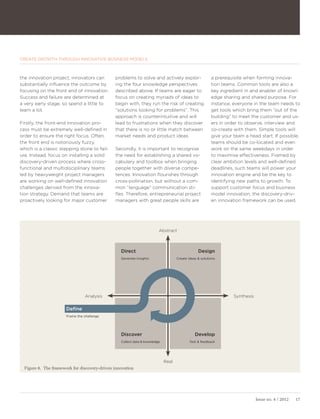
tion strategy. Demand that teams are           fles. Therefore, entrepreneurial project                  model innovation, the discovery-driv-
proactively looking for major customer         managers with great people skills are                     en innovation framework can be used.


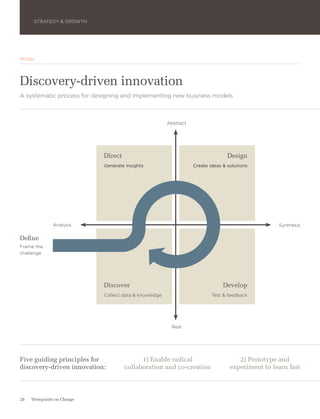
                                                                         Abstract


                                                  Direct                                         Design
                                                  Generate insights                 Create ideas & solutions


                                 Analysis                                                                          Synthesis

                       Define
                       Frame the challenge


                                                  Discover                                     Develop
                                                  Collect data & knowledge                  Test & feedback


                                                                             Real
  Figure 8. The framework for discovery-driven innovation


                                                                                                                               Issue no. 4 / 2012   17
STRATEGY & GROWTH


CREATE GROWTH THROUGH INNOVATIVE BUSINESS MODELS


Each step of the framework is support-
ed by an advanced toolbox and innova-
tion best practices.

Ask yourself if you have strong innova-
                                                                                    Assumption N
tion teams dedicated to exploring and
exploiting new opportunities follow-
ing a well-defined and well-anchored                                                Assumption N-1
process.                                                                            Adjustment
                                                                                                         Adjustment
                                                                                    Assumption ...
Master learning-based implementa-                               Exit 2     Exit 1
tion: Having defined a strong innova-                                               Assumption 3           Adjustment
tion intent and formed entrepreneurial
teams enable creation of new business
                                                                 Adjustment         Assumption 2
opportunities. However, the tricky part
of the equation is often a successful
launch – in particular, if you are ventur-
ing beyond the existing business mod-                                                Assumption 1
el. Simply put, you must use a different                            Adjustment
approach based on fast learning cycles
where you plan to learn.

All new business concepts are funda-
mentally an interlinked set of assump-
tions which must be proved to hold
true. But the assumptions are associ-
ated with different levels of risk, and        Figure 9. A systematic approach to testing and implementing new opportunities
instead of doing a full launch to test
everything at once, you should learn
systematically about your assumptions.
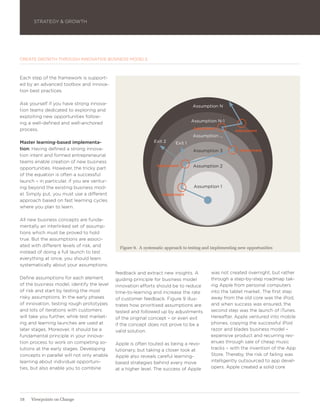
                                             feedback and extract new insights. A           was not created overnight, but rather
Define assumptions for each element          guiding principle for business model           through a step-by-step roadmap tak-
of the business model, identify the level    innovation efforts should be to reduce         ing Apple from personal computers
of risk and start by testing the most        time-to-learning and increase the rate         into the tablet market. The first step
risky assumptions. In the early phases       of customer feedback. Figure 9 illus-          away from the old core was the iPod,
of innovation, testing rough prototypes      trates how prioritised assumptions are         and when success was ensured, the
and lots of iterations with customers        tested and followed up by adjustments          second step was the launch of iTunes.
will take you further, while test market-    of the original concept – or even exit         Hereafter, Apple ventured into mobile
ing and learning launches are used at        if the concept does not prove to be a          phones, copying the successful iPod
later stages. Moreover, it should be a       valid solution.                                razor and blades business model –
fundamental principle in your innova-                                                       expensive product and recurring rev-
tion process to work on competing so-        Apple is often touted as being a revo-         enues through sale of cheap music
lutions at the early stages. Developing      lutionary, but taking a closer look at         tracks – with the invention of the App
concepts in parallel will not only enable    Apple also reveals careful learning-           Store. Thereby, the risk of failing was
learning about individual opportuni-         based strategies behind every move             intelligently outsourced to app devel-
ties, but also enable you to combine         at a higher level. The success of Apple        opers. Apple created a solid core


18   Viewpoints on Change
CREATE GROWTH THROUGH INNOVATIVE BUSINESS MODELS


product and a strong dual-sided busi-       ing orientation and proactively manage     tive advantage. However, to stay true
ness platform – a meeting place for         high-risk opportunities with the goal of   to the principles, we should not get
Apple’s customers and app develop-          learning as fast and cheaply as possi-     caught up in too much theorising, but
ers – while much risk was placed on the     ble.                                       just do it and learn along the way. Close
shoulders of app developers trying out                                                 the laptop, get out of the building and
different options. Apple was safe, while    Altogether, the three principles should    learn from your customers to discover
a lot of apps failed.                       inform and guide all business model        your future business models.
                                            innovation efforts, and, obviously, the
Apple’s ”open innovation” approach          importance of the principles is cor-
with strong reliance on a thriving eco-     related with the level of risk. On the
system also points to the fact that part-   other hand, all innovation activities
nering opportunities should be careful-     and growth initiatives can benefit from
ly considered when implementing new         gaining a fresh perspective from busi-
business models. Often, a great partner     ness model thinking and from rethink-
can both fortify competitive advan-         ing your business model through the
tage and create a shortcut by leverag-      lens of discovery-driven innovation.                   Contact
ing their assets. Furthermore, different                                                           For further information
partnering options are also a possible      In a world characterised by exponen-                   please contact:
way of escaping the invisible mental        tially increasing turbulence, expanding                Morten Hejlesen,
blinders of the core business.              your innovation horizon to encompass                   moh@implement.dk,
                                            the entire business model is timely and                +45 4138 0012
Ask yourself if you have a strong learn-    needed for gaining long-term competi-


Further inspiration about business model innovation

Brown, Tim (2009). Change by Design,        Jaruzelski, Barry, Dehoff, Kevin and       Martin, Roger (2009). The Design of
HarperCollins Publishers                    Bordia, Rakesh (2005). ”Money Isn’t        Business, Harvard Business School Press
                                            Everything”, strategy+business
Christensen, Clayton M. and Raynor,                                                    Osterwalder, Alexander and Pigneur,
Michael E. (2003). The Innovator’s          Johnson, Mark W. (2010). Seizing the       Yves (2010). Business Model
Solution, Harvard Business School Press     White Space, Harvard Business Press        Generation, John Wiley & Sons


Hejlesen, Morten (2010). ”Danske            Lay, Bill (2009). ”Getting Bullish on      Sehested, Claus and Sonnenberg,
pumper på afrikansk eventyr” i              Business Model Innovation”, PRTM           Henrik (2009). Lean Innovation,
Innovationsantologi, Systime                                                           Børsens Forlag
                                            Markides, Constantinos C. (2008).
IBM (2006). Expanding the Innovation        Game-Changing Strategies, Jossey-          Zook, Chris and Allen, James (2001).
Horizon                                     Bass                                       Profit from the Core, Harvard Business
                                                                                       School Press


                                                                                                           Issue no. 4 / 2012   19
STRATEGY & GROWTH


ARTICLE BASED ON INTERVIEWS AND DISCUSSIONS WITH EXECUTIVES FROM LEADING RETAIL BANKS IN DENMARK


Facing the New Normal of Retail Banking
Regain customer trust and financial performance through innovative business models based
on simplicity, agility and transparency in every aspect of customer interactions
by Nicky Overgaard Pedersen


The new normal:                             It is about making potentially radical
                                            changes to the manner in which banks       THE IDEA IN BRIEF
A disrupted industry
                                            operate and engage with their custom-
                                            ers. It is about designing new innova-     The world economic turmoil has
The term “financial innovation” has a                                                  disrupted the entire financial ser-
                                            tive business models with the ability to
certain ring to it that instantly brings                                               vices sector, creating a new normal
                                            delight the customers by leveraging the
the root cause of the current world                                                    characterised by increased regula-
                                            banks’ core capability of putting money
economic turmoil to mind.                                                              tory demands and a severe loss
                                            to work in a productive manner – with-
                                            out increasing the risk.                   of trust from the average retail
When presented with this particular                                                    banking customer. More than ever,
term, the average retail banking cus-                                                  the industry will have to innovate
                                            Characteristics of the new normal
tomer is left with a reluctant and cau-                                                in order to prosper and rebuild the
tious mind, thinking of lost pensions,      To fully understand the challenges that
                                                                                       damaged image.
enormous bailout plans and plain and        retail banks are facing and why this has
                                            disrupted the entire financial services    However, the traditional sources
simple unfairness caused by “too smart
                                            sector, consider this:                     of innovation cannot be tapped
investment bankers”.
                                                                                       this time as they themselves have
                                            •	 The Occupy movement started
                                                                                       played a major part in getting to
It just does not smell right, and the im-      in Spain in May 2011 as a protest
                                                                                       where we are now: risky and com-
perative customer experience metrics           against the political system, unem-
                                                                                       plex products.
are suffering just as the general pub-         ployment rates and corruption. Less
lic perception of the entire sector has        than six months later, in Septem-       To make up for the past and fit into
taken quite a beating.                         ber 2011, Occupy Wall Street was        the new normal, retail banks must
                                               formed, and since then the move-        expand the scope of their strategic
Financial innovation as the remedy             ment has evolved into a worldwide       innovation efforts. They have to
                                               protest against power vested in the     look beyond products and services
On the other hand, financial innova-
                                               top 1% income earners and general       and look at their entire business
tion is exactly what retail banks need in
                                               economic inequality. And it is all to
order to comply with “the new normal”                                                  model to regain trust and financial
                                               be blamed on the banks.
they are facing. But how can one apply                                                 performance.
                                            •	 The disintermediation trend is chal-
financial innovation without losing even                                               In order to succeed, three essential
                                               lenging the traditional role of banks
more of the precious customers’ confi-         as intermediaries. Today, it is not     design principles must be applied
dence?                                         unusual to see private enterprises      to every dimension of future busi-
                                               with higher credit ratings than the     ness models:
The answer to this is not about add-           average bank. Boerse Stuttgart is
ing even more complexity to the finan-                                                 •	 Simplicity
                                               taking advantage of this by offering
cial products and services – quite the                                                 •	 Agility
                                               bonds issued by mid-cap companies,
contrary.                                                                              •	 Transparency
                                               effectively opening up for cheaper


20   Viewpoints on Change
FACING THE NEW NORMAL OF RETAIL BANKING


   and alternative “business-to-business                                                 ers faster. And to some extent, this has
   funding”.                                  MANAGING THE CAPITAL COST                  proven to be a viable path.
•	 Some banks are now considered to           OF RISK IS CRUCIAL
   be systemically important financial                                                   However, the primary focus for strate-
   institutions. They have been catego-       Right now, it is all about survival by
                                                                                         gic business development has been on
   rised as being “too big to fail” by        trimming the balance sheet. ROE
                                                                                         the product side. Developing the right
   policy makers. Currently, the total        and credit ratings are imperative to
                                                                                         set of products and services capable of
   capital ratio must not be lower than       our ability to deliver superior cus-
                                                                                         both serving existing customers as well
   8%. Once Basel III has been fully          tomer experience.
                                                                                         as attracting new ones seemed to be
   implemented in 2014, that number
                                              Going forward, we will see that            the one and only truth.
   will reach 13-14% depending on the
                                              only those with a solid financial
   size and systemic importance of the
                                              performance will have the freedom          Over time, this product-oriented fo-
   bank. This alone will potentially lead
                                              to innovate: It is very expensive to       cus has not only spawned increasingly
   to a decrease in ROE between 4-5%
                                              play the role of first mover.              complex and risky products, but ironi-
   – if nothing is done.
                                                                                         cally enough also made it even harder
                                              Developing new products is a risky
                                                                                         to implement cost-effective straight-
In other words, banks are forced to act       business, and mitigating financial
                                                                                         through processing solutions in the
just to maintain their ROE. Regulatory        risk is the largest obstacle for inno-
                                                                                         back office operations.
demands are tightening, and the cost          vation – but also the largest driver.
of being a regular bank customer is
                                              The banks that find ways to man-           Truly, this depicts an unfavourable
increasing – all in all, something that
                                              age this catch-22 will have a clear        situation where the striving for higher
does not go easy with low market con-
                                              advantage.                                 profits from the product side is jeop-
fidence, changed customer behaviours
                                                                                         ardising the agility and transparency of
and expectations.                             Ken Adrian
                                                                                         customer interactions.
                                              Head of Segment Household
Fight for freedom to innovate                 Nordea Danmark
                                                                                         Reduce risk through product
As a consequence of ROE being under                                                      innovation
pressure in the years to come, all sails
                                                                                         Rest assured, product development will
are set to deleverage the books be-
                                            banking and cash management – areas          continue to be a central topic as the
cause without proper earnings, credit
                                            in which the customers bring their own       risk and complexity are bound to be
ratings will be lowered, funding of capi-
                                            money to the table, so to speak. Still,      reduced, thus requiring radical changes
tal will go up and products will become
                                            this is not enough. There is a strong        to products and product structures.
more expensive to the end customers,
                                            need for even more innovative thinking.
which essentially affects the customer
                                                                                         An example of this type of innovation
experience in a negative way.
                                                                                         is the changes to the price and product

The fact is that a lot of retail banks      The traditional sources of                   structure of home mortgage financing
                                            innovation cannot be tapped                  recently introduced by Nykredit and
are in urgent need for deposits, and
                                                                                         Totalkredit:
Amazon-like promotions have begun           this time
popping up, urging customers to “start                                                   1. Under the new price structure, prices
saving now and get an instant givea-        For decades, innovation in the finan-           differ according to risk.
way or bonus!”.                             cial sector has been more or less trivial.   2. For a combined mortgage, the loan-
                                            There has been a heavy focus on opti-           to-value ratio of SDOs has been
Not all countries and regulations allow     misation of internal processes to re-           lowered from 80% to 60% for retail
for such instruments to be applied, so      duce operating costs per customer as            customers.
instead focus is shifting towards private   well as to be able to serve the custom-


                                                                                                             Issue no. 4 / 2012   21
STRATEGY & GROWTH


FACING THE NEW NORMAL OF RETAIL BANKING


                                           quote by the late Harvard professor          Innovating the business
     TOO RISKY, TOO COMPLEX                Theodore Levitt:                             models
     Traditionally, one of the primary     “People don’t want to buy a quarter-inch
     sources of innovation has been cal-                                                Clearly, financial products have not
                                           drill. They want a quarter-inch hole!”
     culators and engineers in product                                                  lost their strategic importance, but,
     development, spinning off increas-                                                 going forward, it is clear that retail
                                           This falls well into line with the current
     ingly complex and risky products.                                                  banks need to give a lot more credit to
                                           perception among leading retail bank-
                                                                                        the services – and the entire business
     For obvious reasons, this can no      ers in Denmark. The products are be-
                                                                                        model – surrounding the products.
     longer be the case. The new nor-      coming hygiene factors, i.e. nobody
     mal forces the entire industry to     looks at them as stand-alone differen-
                                                                                        If they fail to do so, providing complete
     rethink our offerings and business    tiators in the battle for market shares
                                                                                        and compliant advisory at the lowest
     models based on transparency and      and customer attention. Instead, the
                                                                                        possible risk based on the individual
     simplicity.                           bank advisers’ ability to transform knowl-
                                                                                        customer needs becomes almost im-
                                           edge and insights into viable solutions
     Ove Feddersen                                                                      possible.
                                           by communicating 1:1 with the custom-
     Head of Product Strategy
                                           er has become a crucial trait to be dis-
     Nykredit                                                                           In other words, banks need to rethink
                                           played in every customer interaction.
                                                                                        their business models and find new
                                                                                        ways of creating, delivering and captur-
                                                                                        ing value.
Look beyond the products to increase
the customer experience                      FITTING INTO THE NEW NORMAL
                                                                                        Already now, retail banks are facing
                                             REQUIRES CHANGE
As a direct outcome of the current eco-                                                 competition from new entrants and in-
nomic turmoil and the derived changes                                                   novative business models. While many
                                             We are witnessing a global para-
to the products, terms and conditions,                                                  of the new entrants are still operating
                                             digm shift in which banks need
a great deal of existing retail custom-                                                 on the fringes of the industry with low
                                             to find new ways of operating in
ers are not only finding themselves in                                                  growth rates and market shares, they
                                             order to regain customer trust and
a hard position, but, even more impor-                                                  should be taken very seriously.
                                             financial performance.
tantly, they are having a difficult time
assessing the consequences of this           The regulatory framework used              Many of the players exhibit disrup-
new situation.                               to “only” dictate the direction            tive potential and possess the power
                                             in which we could innovate our             to radically alter the rules of the game
This implies that retail customers in        business. One could say that the           by targeting small niche segments in
particular are becoming heavily de-          framework was “larger than us”, i.e.       the existing market. Basically, the new
pendent on superior advisory services,       still giving us room to operate.           players are exploiting attractive sub-
and if anything positive has come out                                                   segments which are not appropriately
                                             With the regulatory demands we
of the financial crisis, it is the wake-                                                served by current business models. In
                                             are facing from Basel III etc., the
up call to every retail bank constantly                                                 some cases, entirely new markets are
                                             framework will become “smaller
reminding them to consider the needs                                                    created for customers who have been
                                             than us”, so unless we change radi-
of the customers in every touch point,                                                  totally locked out of existing markets in
                                             cally, we simply will not fit into the
channel and type of interaction, while                                                  the past.
                                             new normal.
bearing in mind that there is a crucial
discrepancy between what custom-             Ken Adrian                                 Look out! New kids on the block!
ers think and say they need and what         Head of Segment Household                  An article by Rita McGrath states that
they actually need and really want. This     Nordea Danmark                             one of five large business trends in
difference is best illustrated with the


22     Viewpoints on Change
FACING THE NEW NORMAL OF RETAIL BANKING


2012 is that oblique competition will     high streets. Besides that, Apple has a     In 2010, users could buy theatre tick-
become ubiquitous, emphasising that       rather large amount of capital available.   ets for Harry Potter, and, over time,
enterprises traditionally were compet-                                                Facebook Credits may actually end up
ing within industries, whereas competi-   The question that banks should ask is:      being the preferred currency for buying
tion can now come out of the blue and     When will Apple open a bank near us?        any media content over the Internet.
take over entire markets.                 Perhaps not a traditional retail bank as    The obvious question remains: Where
                                          we know it, but “just” some sort of add-    will the retail banks be in that set-up?
Take the average German consumer.         on service that provides credit on the
He or she controls a total of six de-     fly to purchase products in the store.      Examples of new business models
posit accounts, but only two of those
                                                                                      Rather than risking instant “paralysis
are placed in a bank. The other four      Another example of a potential chal-
                                                                                      by analysis” and complicating things
are placed with iTunes, DIY stores,       lenger to retail banks is Facebook with
                                                                                      by trying to figure out how to inno-
PlayStationNetwork, third party logis-    staggering 800 million registered users.
                                                                                      vate your business model, simply start
tics providers etc.                       In 2009, something called “Facebook
                                                                                      by looking at what is already going on
                                          Credits” was introduced rather silently.
                                                                                      within – as well as outside – the finan-
Now consider this: Apple has more         Anyone could buy 50 credits for the
                                                                                      cial sector and let that be an inspira-
than 200 stores worldwide – stores        price of $5 “to buy things (i.e. game-re-
                                                                                      tional guideline for challenging your
that are well-recognised by high-end      lated content) on Facebook in an easy
                                                                                      conventional wisdom. See examples
consumers. More or less all placed on     and safe manner”.
                                                                                      on the next page.


                                                                                                          Issue no. 4 / 2012   23
STRATEGY & GROWTH


FACING THE NEW NORMAL OF RETAIL BANKING


                                                                                                    JAK – operating an interest-free savings
 Peer-to-peer lending by Zopa                                                                       and loan system since 1970

     Internal                          Value                  External                               Internal                            Value                 External
     perspective                       perspective            perspective                            perspective                         perspective           perspective
     Partner        Key                 Value                   Customer          Customer            Partner       Key                  Value                  Customer          Customer
     network        processes           proposition             relationships     segments            network       processes            proposition            relationships     segments
                    System                                                                                           Mass education                                               Traditional
                    development/                                                                                     & financing of      Interest-free                            retail banking
      Private                                                   Membership-                                          local economies
                    maintenance         Platform to             based             Traditional                                            savings and                              customers
      equity                                                                                                                                                     Membership-
                                        connect lenders                           retail banking      Local         Promotion of         loans
      partners                                                                                                                                                   based
                      Customer          with borrowers                            customers           enterprises   the interest-
                      service                                                                                                                                                       Co-
                                                                                                                    free economy         Grants for stud-                           operatives
                                                                                                                        Administration   ies in interest-
      Venture       Administration                                                                                                       free economies
      capitalists                                                                                                       & development
                                                                                   Non-lending
                    Key                                         Channels           businesses                       Key                                         Channels          Associations
                    resources                                                                                       resources            Courses about
                                                                                                                                         aspects of an           Local branches
                                                                On-line                                                                  interest-free           operated by
                     ICT                                                                                            Local                                        members for
                                                                channels                                                                 economy                                   Companies
                     platform                                                                                       volunteering                                 members


     Financial   Cost drivers                         Revenue streams
                                                                                   Selling pay-      Financial   Cost drivers                            Revenue streams
                                                                                   ment protec-                                                                                   Interest from
     perspective                                                                   tion insurance
                                                                                                     perspective                                                                  pre-savings
                    The lending                           Fixed fee                                                        Low level                        Annual
                                     Employees                             Annual                                                                                                 placed in Swe-
                    platform Zopa                         added to their                                                   of general                       membership    Loan
                                                                           service fee                                                                                            dish bonds
                    (ICT platform)                        loan amount                                                      administration                   fee           fees
                                                                           from lenders


  “At Zopa, people who have spare money lend it directly                                            “We regard receiving money in exchange for labour as le-
 to people who want to borrow. There are no banks in the                                            gitimate, however, we do not consider it legitimate to earn
 middle, no huge overheads and no sneaky fees, meaning                                              money simply with money. In our opinion, it is unethical to
 everyone gets better rates”.                                                                       lend money against interest”.

 The lending platform Zopa (an Internet marketplace) is of-                                         JAK operates like a not-for-profit bank enterprise, trying
 fered to members, making it possible for them to connect                                           to make one million SEK annually to add to equity, by of-
 traditional lenders with borrowers and save them both                                              fering interest-free savings and loans through a total of
 money by “cutting out the middleman” (banks).                                                      just three products.

 The business model allows depositors to have a higher                                              JAK is primarily driven by volunteer members for other
 return on investment by becoming direct lenders, hence                                             members, and through grants and JAK Schools they are
 accepting risks normally taken by banks/VCs. At the same                                           offering courses where participants receive more informa-
 time, the risk of lending e.g. £1,000 is reduced by splitting                                      tion about how JAK works, discuss different aspects of an
 the amount into chunks of £100 each going to different                                             interest-free economy and get tips on how to present JAK
 borrowers.                                                                                         in public.

 To reduce the risk even further, Zopa offers their lenders                                         Currently, JAK has approx. 34,000 members, and the
 free-of-charge assistance in chasing up missing payments                                           number is increasing every year.
 on behalf of the lender.

 The revenues are coming from charging borrowers fixed
 fees added to their loan amount, charging lenders a 1% an-
 nual service fee and selling payment protection insurance
 to borrowers.


24     Viewpoints on Change
FACING THE NEW NORMAL OF RETAIL BANKING


 Boerse Stuttgart is offering mid-cap                                                               Tradeshift provides an on-line invoicing
 companies a new way of accessing capital                                                           service and an instant payment feature

  Internal                           Value                  External                                 Internal                              Value                    External
  perspective                        perspective            perspective                              perspective                           perspective              perspective
   Partner       Key                  Value                   Customer           Customer             Partner            Key                Value                    Customer         Customer
   network       processes            proposition             relationships      segments             network            processes          proposition              relationships    segments
                                                                                                      Partner commu-                        Free on-line real
                                                              Trading and                                                Systems                                     Automated
                                                                                                      nity that builds                      time e-invoicing
                                                              exchange                                applications to    & platform         for suppliers over       services
                 Trade-to-            Alternative                                Industrial or
                                                              ”community”        industry-related     sell on AppStore   development        a global network
   Policy        settlement           source of
                                                                                 mid-cap                                                                                              Large
   makers                             finance through          Corporate                                                                                              B2B
                                                                                 companies                                                                                            enterprises &
                                      capital market           governance                              Angel                                Social network            communities
                                                                                                                         Technical                                                    governments
                                                                                                       Investors                            for businesses to     App
                                                                                                                         support
                                                                                                                                            communicate &         developer
                 Key                  Better rates &          Channels           Investors                                                  exchange docs.        network
   Regulatory
   authorities
                 resources            conditions for         The Stuttgart                            Private                                                                         Non-lending
                                      both investor          Stock Exchange                           equity             Key                                         Channels         businesses
                 Electronic           & bond issuer                                                                                         Value-added
                                                             regulated un-                            partners           resources
                 trading                                                                                                                    services and
                                                             official market
                 systems                                                                                                                    applications
                                                               On-line order                           Venture           Cloud-based                                 On-line
                 Data                                          execution                               capitalists       platform                                    channels
                 storage


  Financial   Cost drivers                             Revenue streams                               Financial   Cost drivers                                   Revenue streams
                                                                                 Clearing &
  perspective                                          Fees charged              settlement
                                                                                                     perspective
                                                                                                                         ICT            General
                           IT development              to be listed &            fees                                    development,
                           & maintenance                                 Sale                                                           administration            Services           Apps
                                                       to trade on its                                                   maintenance
                                                       markets           of information                                  & support


 With the launch of Bondm, the Stuttgart Stock Exchange                                             Tradeshift is basically a social network for businesses to
 has introduced a new segment for bonds issued by indus-                                            connect, communicate and exchange documents in real
 trial or industry-related mid-cap companies in the upper                                           time. They provide an on-line invoicing service and an in-
 segment of the range in the need for finance.                                                      stant payment feature. TechCrunch sees this as a potential
                                                                                                    disruptive game changer – on the same scale as Skype
 The bond issuer gets access to another source than the
                                                                                                    which managed to disrupt the telecom industry.
 traditional bank offerings, and retail investors, on the other
 hand, get the opportunity to participate directly in the                                           Compared to the traditional charge per transaction or
 bond subscription (primary market), which was originally                                           conversion, Tradeshift offers free on-line real time e-
 reserved for institutional investors.                                                              invoicing for all suppliers over a global network. In return
                                                                                                    for free transactions, they offer their customers additional
                                                                                                    non-free services like master data subscriptions. Besides
                                                                                                    that, the revenue stream also includes financial services
                                                                                                    such as instant payments and exchange rate hedging.
                                                                                                    Finally, they have implemented a two-sided Apple-like
                                                                                                    platform around an AppStore fed by a partner community
                                                                                                    developing and selling apps.

                                                                                                    The list of customers includes prominent enterprises and
                                                                                                    organisations like ADETEF (the French international as-
                                                                                                    sistance agency of the Ministries for the Economy, Budget
                                                                                                    and Sustainable Development) with their 300,000 suppli-
                                                                                                    ers and UK National Health Service (the 5th largest buying
                                                                                                    organisation worldwide).


                                                                                                                                                                              Issue no. 4 / 2012      25
STRATEGY & GROWTH


FACING THE NEW NORMAL OF RETAIL BANKING


Regain customer trust and                     The lesson is that even the best and         vation, which is something to be built
ensure sustainable financial                  brightest product eventually becomes         upon. Already, banks around the world
                                              a commodity, and the only thing left         have begun to utilise the Internet for
performance                                   is how the value proposition is being        more than simple Internet and mobile
                                              served.                                      banking services: “The social web”, i.e.
Keeping in mind the root cause of the                                                      the sharing and exchange of informa-
financial crisis combined with the char-      Agility                                      tion, is being utilised for customer in-
acteristics of the new normal, retail                                                      teractions, real time problem solving
                                              Being a first mover is expensive – espe-
banks must demonstrate superiority in                                                      and improving the customer experi-
                                              cially when the development of prod-
customer service, capital risk manage-                                                     ence.
                                              ucts and services that you provide is
ment and operational excellence by ap-
                                              framed by tight regulations. And tight-
plying three essential design principles                                                   “Social CRM” is definitely something
                                              er regulations are exactly what retail
to every dimension of their business                                                       that should be thought into a sound in-
                                              banks are facing these days.
model:                                                                                     novation framework. A great example
•	 Simplicity                                 The largest uncertainty is not about the     of this is Danske Bank which has co-de-
•	 Agility                                    amount or scope of the coming regula-        veloped their iPhone and iPad mobile
•	 Transparency                               tions – it is about not knowing the con-     banking app through a Facebook page
                                              sequences of those regulations. No one       where users can propose features and
Simplicity                                    can foresee how the market will change       provide feedback directly to the team
Retail banks should strive for becoming       nor feel safe that the regulations will      behind the app.
an integral part of their customers’ life.    not take away the last bit of possibility
Every customer interaction is a chance        to differentiate between the individual      Transparency
to provide advice, build a relationship       banks.                                       To restore the confidence in the in-
and, above all, learn about the custom-                                                    dustry as a whole will require more
ers’ personal needs driving the financial     The uncertainty characterising the fi-       than changed behaviour of the indi-
needs.                                        nancial sector right now calls for “just-    vidual banks. Currently, not everybody
                                              in-time” strategies, and as such this        is adapting to the new capital require-
In that sense, complexity is a real killer.   emphasises the need to be extremely          ments in a viable way, and that affects
Not only with regard to operational ef-       agile. Besides the strategic aspect, agil-   the entire industry.
ficiency or the ability to rapidly change     ity in terms of reacting to customer de-
and react to changes in customer              mands is a notable trait.                    On top of that, disintermediation is
needs and trends, but, more important-                                                     gradually pushing banks into unfavour-
ly, complexity makes it difficult for the     A business model to be inspired by:          able market positions where more and
customers to keep a high amount of            Inditex which is one of the world’s          more business is diverted into areas
daily interactions with their bank.           largest fashion distributors. They have      such as peer-to-peer lending and busi-
                                              completely changed the game of the           ness-to-business funding.
Besides that, simplicity is, by far, the      market for affordable fashion by pur-
hardest (product) attribute to copy and       suing a high degree of vertical integra-     In order to recover properly, the indus-
potentially also a real game changer.         tion. The turnaround time from idea to       try needs to start “playing with open
                                              launch is 2-5 weeks versus 3-9 months        cards” – externally to regain trust and
A business model to be inspired by:           for more traditional retailers, making       internally to be able to act even more
Google Docs which disrupted the mar-          it possible to dispatch new designs to       agilely and to ensure complete and
ket for home office applications by pro-      stores twice a week.                         compliant processes. Apparently, this
viding a “good enough” product expe-                                                       would be achieved by breaking down
rience for free.                              Compared to fashion retailers, banks         the functional and organisational silos.
                                              have a long history of ITC-driven inno-      However, the thing is that even if break-


26   Viewpoints on Change
FACING THE NEW NORMAL OF RETAIL BANKING


ing down the silos has been a mantra        records to them in return for a platform     not paying attention.
for many years, there is an important       where they can bypass expensive med-
twist to it: Knowledge, insights and        ical bills by getting advice from similar    Traditionally, innovation in the indus-
professionalism thrive in functional si-    patients.                                    try has not been disruptive. Much has
los, and those traits are imperatives for                                                been about incremental changes to
a great customer experience. As a cus-                                                   products, processes and back office
tomer being serviced, we do not want        Seize the moment                             operations, and we are still to witness
to experience the lag time caused by                                                     a radical game-changing move where
the silos – we only want to experience      Retail banks are in the middle of a per-     the business model itself becomes the
the optimised process.                      fect storm. The entire financial sector is   primary competitive differentiator. As a
                                            under heavy fire from regulatory au-         consequence of the new normal, now is
One way of increasing the transparency      thorities and policy makers, and their       the perfect time to do just that.
in the processes of the business model      modus operandi is bound to change in
is to make use of the enormous amount       order to survive.
of (large) data stored in the back office
systems – as well as in the minds of the    Just like amber flushes up on the beach
customers – for “real-time analytics”       after a storm, so do new entrants, and
during customer interactions.               innovative business models emerge                        Contact
                                            when an industry is being forced to in-                  For further information
A business model to be inspired by:         novate. Unfortunately for the incum-                     please contact:
PatientsLikeMe.com has managed              bents, both amber and new entrants
to design a viable (disintermediat-                                                                  Nicky Overgaard Pedersen,
                                            are hard to spot by others than the
ing) business model based on patients                                                                nop@implement.dk,
                                            trained eye – and that may very well
handing over their personal medical                                                                  +45 5138 7412
                                            prove to be lethal for those who are


Further reading

Braagaard, M. and Kirkegård, L.             Gray D., Brown, S. and Macanufo, J.          Markides, C. (2008). Game-Changing
Implement Consulting Group                  (2010). Gamestorming: A Playbook             Strategies
(2010). Strategy as Transformation          for Innovators, Rulebreakers, and
                                            Changemakers                                 Martin, R. L. (2009). The Design of
Christensen, C. M. and Raynor, M. E.                                                     Business
(2003). The Innovator’s Solution            King, B. (2010). BANK 2.0: How
                                            Customer Behaviour and Technology            Osterwalder A. and Pigneur, Y.
Christensen, C. M., Kaufman, S. P. and      Will Change the Future of Financial          (2010). Business Model Generation:
Shih, W. (2008). Innovation Killers: How    Services                                     A Handbook for Visionaries, Game
Financial Tools Destroy Your Capacity                                                    Changers, and Challengers
to Do New Things


                                                                                                             Issue no. 4 / 2012   27
STRATEGY & GROWTH


MODEL


Discovery-driven innovation
A systematic process for designing and implementing new business models


                                                       Abstract


                            Direct                                               Design
                            Generate insights                     Create ideas & solutions


               Analysis                                                                           Synthesis

Define
Frame the
challenge


                            Discover                                           Develop
                            Collect data & knowledge                      Test & feedback


                                                         Real


Five guiding principles for                1) Enable radical                         2) Prototype and
discovery-driven innovation:         collaboration and co-creation                experiment to learn fast


28   Viewpoints on Change
DISCOVERY-DRIVEN INNOVATION


       Define
       What? A clear framing of the growth challenge, definition of ambition levels and joint commitment
       Why? To align the business model innovation project with the growth strategy and business goals


       Discover
       What? Research of opportunities within and across context, customers, competition and capabilities
       Why? Superior business concepts are formed on the basis of unique insights


       Direct
       What? Analysis of research findings and creation of growth opportunity maps to focus work efforts
       Why? Data needs to be filtered and interpreted into actionable directions and design principles


       Design
       What? Creative ideation and conceptualisation of new business ideas
       Why? To foster creativity and identify novel approaches to driving growth


       Develop
       What? Iterative concept testing, business modelling and learning based implementation
       Why? To reduce risks, new business concepts are adjusted through several iterations and market feedback


     3) Focus on                                4) Stretch goals and                          5) Balance creativity
customer value creation                        challenge conventions                          and focused analysis


                                                                                                     Issue no. 4 / 2012   29
STRATEGY & GROWTH


ARTICLE BASED ON INTERVIEWS AND DEVELOPMENT PROJECTS WITH DONG ENERGY


Business model innovation as a response
to increased competition in the energy sector
By Thomas Børve and Johan Lawaetz


Increased competition in the energy       the game since it quickly led to intense       Despite the increased need to differ-
sector has stimulated many energy         competition, but also expanded the             entiate in the market, energy providers
suppliers to rethink the way they         arena in which Danish energy provid-           still have limited opportunities to do
do business. Because of the growing       ers should now compete. The market             so. For decades, the energy sector has
wish among Danish organisations to        opened to international competitors,           looked for new ways to offer value on
do business in a more sustainable         and as the industry has matured en-            top of an increasingly commoditised
way, DONG Energy decided that one         ergy providers have experienced an in-         product, but there has never been a
of the means to differentiate in the      creased pressure on prices.                    real breakthrough in new ways to bun-
market would be through what would                                                       dle products and innovate the business
be known as the Climate Partnership
                                          In the meantime, societal trends and           model – until now.
concept.
                                          new customer needs have emerged
                                          and gone straight to the top of the
Through pilot projects, the concept
soon proved to be more than just a
                                          global energy agenda. Private consum-          Climate Partnerships
                                          ers as well as business customers are
new product in the portfolio as it was
                                          now concerned with CSR, CO2 emis-              In May 2007, Novo Nordisk and DONG
able to spur significant business value
for customers. But to do so required a    sions and the overall environmental im-        Energy together launched the first
new internal setup of the underlying      pact in addition to getting a low price        Climate Partnership in Denmark. Since
competences and processes related         per MWh. As electricity is traded with         then, DONG Energy has entered into
to sales and delivery within DONG         full transparency on Nord Pool (the ex-        more than 100 Climate Partnerships
Energy.                                   change of electricity), the product itself     and developed a unique partnership
                                          was already very commoditised, but             model with a variety of Danish organi-
                                          price competition was further fuelled          sations. Companies, municipalities and
Changing market conditions                by the liberalisation. Moreover, shifting      other organisations are constantly
                                          energy provider nowadays is much less
in the Danish energy sector                                                              faced with climate questions, and they
                                          complex and gives companies an even            all share the common goal of decreas-
                                          larger economic incentive to do so. This       ing environmental impact of their activ-
In the past decade, the Danish en-        has further increased the need for dif-
ergy sector has experienced dramat-                                                      ities besides running financially healthy
                                          ferentiation between energy providers          operations. Through the new Climate
ic changes. New EU directives in the      and has resulted in an increased fo-
1990s indicated that a new era was                                                       Partnership concept, DONG Energy set
                                          cus on expanding product offerings. A          out to help companies do just that.
soon to come with a new regulatory        number of energy providers have gone
framework. During 2000-2004, the          from supplying just a single energy
Danish energy sector was liberalised –                                                   DONG Energy has a long-term vision
                                          source to supplying a broad range of           of providing clean and reliable energy.
the fastest liberalisation of an energy   fuels and services which now includes
market in Europe.                                                                        Climate Partnerships are an important
                                          e.g. financial services, price surveillance,   element in the climate strategy that
                                          energy services, CO2 quotas and ener-          has been developed to support this
This dramatically changed the rules of    gy savings consultancy.


30   Viewpoints on Change
BUSINESS MODEL INNOVATION AS A RESPONSE TO INCREASED COMPETITION IN THE ENERGY SECTOR


long-term vision. The strategy commits   offering a more comprehensive and         energy. The purpose is to support and
DONG Energy to support a significant     customer-oriented value proposition       strengthen innovation within climate
reduction in CO2 emissions stemming      providing significant business value      technology, increase the demand for
from energy production, and at the       to business customers. The main idea      renewable energy and strengthen cli-
same time it serves as a strong driver   of the concept was for both parties       mate initiatives in private and public
for differentiation.                     to execute energy savings and sup-        organisations.
                                         port renewable energy sources. DONG
Providing additional value by combin-    Energy’s energy advisers locate and       For the partner, the motivation behind
ing existing products and services       help execute these energy savings.        entering a Climate Partnership would
Based on DONG Energy’s many years                                                  obviously be to obtain a reduction in
of experience within energy savings      When energy savings are realised, the     operational costs by identifying and re-
consultancy, the Climate Partnership     entire or part of the reduction is used   alising energy savings and increase rev-
concept first and foremost aimed at      to finance the purchase of renewable      enue through enhanced differentiation.


 Foto: DONG Energy A/S


                                                                                                       Issue no. 4 / 2012   31
STRATEGY & GROWTH


BUSINESS MODEL INNOVATION AS A RESPONSE TO INCREASED COMPETITION IN THE ENERGY SECTOR


 Foto: DONG Energy A/S


32   Viewpoints on Change
BUSINESS MODEL INNOVATION AS A RESPONSE TO INCREASED COMPETITION IN THE ENERGY SECTOR


For selected large customers with little     case experience showed that it often         A more complex sales process
or no resources available to drive de-       proved more valuable for the partner         required new competences and
velopment projects themselves, DONG          to carry out initiatives related to other    customer involvement
Energy has, moreover, offered to take        typical elements of the CSR agenda           DONG Energy realised that position-
on the project and help its customers        such as ethical trade or improving the       ing the idea of a Climate Partnership
through the process from establish-          work environment.                            concept to organisations would impose
ing a business case, selling the project                                                  great changes on the sales process.
internally, analysing and discovering        The second criterion was that the com-       They understood that they would have
potential all the way to building the        pany should have a large potential val-      to target an entire set of new and more
implementation plan. In short, DONG          ue of differentiating through a renew-       business-oriented stakeholders than
Energy’s Climate Partnership concept         able profile. This, for instance, included   what they were used to from selling
bundles the best of its offerings to in-     companies exposed to large and strate-       electricity and gas.
clude sourcing, energy savings, finan-       gically important customers with tough
cial solutions and project management        demands for a renewable supply chain         Through initial learning as well as three
into a customised value proposition          (including subcontractors).                  intensive pilot projects spread out on
that responds accurately to customers’                                                    Denmark and Germany, DONG Energy
new climate challenges, helping them         Together these two criteria highlight-       found that the customers’ decision
reduce costs and meet a new type of          ed the customers for whom a Climate          to enter the partnership was being
market demand.                               Partnership would be especially inter-       pushed to the executive level. This was
                                             esting and to whom the market ap-            due to the large investment of com-
                                             proach should be directed.                   pany resources and the high potential
Well-defined customer segment
                                                                                          business value the concept was offer-
                                             One of the key ambitions when                ing. Because of this, the decision pro-
”To us, it was fundamental to be very
                                             DONG Energy launched the Climate             cess grew longer and more complex.
clear on who was going to use the new
                                             Partnership concept was to obtain a          The broader and higher involvement of
approach, and that it would only be for
                                             strategic differentiation in the busi-       the customer organisation in the sales
certain opportunities”
                                             ness market, but also to some degree         process meant that DONG Energy’s in-
Søren U. Schmidt, International Marketing,   in the consumer market, compared to          ternal sales processes as well as man-
Director, Business Innovation and            traditional energy providers. By help-       agement and sales competences had
Products & Solutions                         ing businesses, municipalities and other     to be much more focused on selling
                                             organisations reduce their energy con-       based on business value in order to
                                             sumption and establish a sustainable         meet these needs. Based on this in-
From the beginning, it was clear that        profile, DONG Energy aimed at tapping        sight, a value-oriented sales process,
Climate Partnerships would not be for        into the growing sustainable consumer        including tools for i) creating interest,
every market or every company. In or-        trend through intensive marketing of         ii) mapping stakeholder value, iii) es-
der to identify the ideal customers to       the partnerships’ positive effects on        tablishing an initial value analysis with
target, DONG Energy put together a           both the climate and the business value      the customer, iv) designing the final
simple customer prioritisation model.        obtained by the partner.                     proposal and v) preparing for final ne-
                                                                                          gotiations at executive level, was devel-
First of all, they realised that in or-      In a business to business context, the       oped by a small project group involving
der for the concept to be interesting        task of differentiation is not merely a      the people who would actually have to
from a business perspective, the target      marketing exercise. It also involves dra-    lead and perform the sales themselves.
company should spend a reasonable            matic changes in organisation, process-      In order to ensure reinforcement, a
amount of their total costs on energy.       es and competences.                          management structure, including goals
In other words, the company should be
                                                                                          and meeting agendas, was developed
relatively energy intensive. If not, the
                                                                                          and implemented.


                                                                                                              Issue no. 4 / 2012   33
STRATEGY & GROWTH


BUSINESS MODEL INNOVATION AS A RESPONSE TO INCREASED COMPETITION IN THE ENERGY SECTOR


”It is my experience that in the cases            From silos to cross-functional teams         drawbacks experienced when launch-
where we successfully have applied a              Running the pilots and actually start-       ing the Climate Partnerships was that a
solution-centric approach, we have more           ing the delivery of Climate Partnerships     great deal of the optimisation had been
focus on what the solution does for the           to customers soon proved to pose a           done independently across functions
customer and quite often even for the             significant need for working in diverse      and with too little attention to inter-
customer of the customer”                         cross-functional teams. Over the years,      action between processes and func-
Søren U. Schmidt, International Marketing,        DONG Energy has put a great deal of          tions. The Climate Partnership concept
Director, Business Innovation and                 effort into optimising the processes         quickly forced new ways of combining
Products & Solutions                              around sales and delivery. One of the        internal resources to be able to deliver


     Internal perspective                                Value perspective             External perspective

     Partner network         Key processes               Value proposition              Customer relationships      Customer segments


                              Communication
                              and marketing                     Supply of                Co-branding
                                                                renewable
                                    Energy                      energy
                                    advisory                                                                           Energy-intensive
                                                                                                                       companies with
                                                                                             Strong
                                                                                                                       high potential value
                              Energy                                                         partnerships
                                                                                                                       of greener profile
                              production                                                     with B2B-
                                                                        Energy               customers
                                                                        savings
                                  Sales and
                                  delivery


                                                                Differentiation
                             Key resources                                              Channels
                                                                opportunities
                              Cross-function-
                              al teams to sell,                                          Executive
                              deliver & manage                                           level dialogue
                              partnerships

                                    Renewable                                                 Value-
                                    energy                                                    oriented sales
                                    sources                                                   process


     Financial perspective
                             Cost drivers                                         Revenue streams

                                                                  Higher costs                                   Recurring
                              Renewable
                                                                  due to longer                                  revenues through
                              energy
                                                                  sales cycle         Revenue from               increased cus-
                              production          Start-up
                                                                                      value added                tomer loyalty
                                                  investments
                                                                                      services
                                                  for new
                                                  concept


  DONG Energy Business Model canvas


34    Viewpoints on Change
BUSINESS MODEL INNOVATION AS A RESPONSE TO INCREASED COMPETITION IN THE ENERGY SECTOR


what was being promised by market-            Last but not least, a new Climate           box for both selling and delivering the
ing campaigns and sales. A new setup          Partnership also implied a process for      concept were developed and imple-
around delivery of Climate Partnerships       DONG Energy to support the new part-        mented.
was necessary because of the need for         ner in communicating the partnership
experienced people from a range of            and the new initiatives. This was done      The concept has naturally implied
different functional areas and to en-         through recommendations as to the           increased costs
sure a competence match with cus-             communication of the new climate ini-
tomers. The team delivering a Climate         tiatives as well as by delivering ready-    ”In my view, it is very important as often
Partnership would obviously not only          to-use marketing material. In specific      as possible to revisit the original business
consist of a sales person, but also of        cases, DONG Energy would, moreover,         rationale throughout a change process in
an energy adviser consultant, a com-          offer the possibility of co-branding be-    order to ensure that the increased costs
munication and marketing adviser, a           tween DONG Energy and the partner           deliver the expected long-term gain”
project manager and a set of energy           as was seen with e.g. Tivoli. In order to   Søren U. Schmidt, International Marketing,
specialists. Combining people with            increase the probability that the pro-      Director, Business Innovation and
such diverse professional backgrounds         posed changes for the customer would        Products & Solutions
and competences and having them de-           actually take place, all processes were
liver robust and comprehensive Climate        designed to include heavy customer          Developing, selling and delivering
Partnerships for customers have been a        involvement.                                Climate Partnerships have implied in-
key challenge throughout the process.                                                     creased costs. The concept has a dif-
                                              Alternative model to serve Germany          ferent type and level of complexity
Having people from various functional         In Germany, a slightly different model      to it than traditional services. There is
departments work together puts forth          of selling and delivering the Climate       more risk associated with it and a much
challenges – not only at an individual        Partnerships was chosen. The concept        longer and complex sales cycle than
level, but also to existing processes and     would, in essence, stay the same, but as    traditional sales of electricity and gas.
to how these processes were aligned.          DONG Energy does not sell and sup-          Thus, higher costs are related to both
All the way from the initial energy           ply directly to the end customers, but      the sales and delivery of the Climate
screening process to realisation and          distributes regionally through 600-700      Partnership concept.
communication of the energy savings           so-called Stadtwerke, a different ap-
projects and the actual change in en-         proach was needed. Not having a di-         The main reason is that the project
ergy supply.                                  rect sales channel, but instead a vast      binds up more resources that are more
                                              number of customers distributing ener-      expensive due to the increased de-
First of all, a need to align the sales and   gy, DONG Energy decided to establish        mand on highly specialised compe-
delivery process evolved. In essence,         a third party concept delivering Climate    tences. These additional costs have
this meant that the process of identify-      Partnerships directly to the Stadtwerke.    to be seen in the light of the strategic
ing potential savings initiatives had to                                                  business advantages as well as the new
be part of the sales process in order to      Early on, DONG Energy realised that         revenue streams which the project has
prove the potential decrease in costs         this meant a tighter conceptualisation      created and will continue to create.
that would go into the business case          and a simpler version of both the so-
behind the Climate Partnership agree-         lution and the sales and delivery pro-      Ensuring new and durable revenue
ment.                                         cess. DONG Energy initiated a process       streams
                                              to develop a Climate Partnership con-
Secondly, the concept had to include a                                                    Seen through a DONG Energy business
                                              cept suited to the local Stadtwerke and
well-defined process for identifying in                                                   lens, the Climate Partnerships were a
                                              the organisations they would target.
depth the potential revenue value from                                                    way to differentiate, spread risks and
                                              To help the Stadtwerke position them-
using renewable energy and imple-                                                         ensure new revenue streams. By offer-
                                              selves and sell the idea, a well-defined
menting the new sourcing setup.                                                           ing energy advisory and support with
                                              process and a large ready-to-use tool-


                                                                                                                Issue no. 4 / 2012   35
STRATEGY & GROWTH


BUSINESS MODEL INNOVATION AS A RESPONSE TO INCREASED COMPETITION IN THE ENERGY SECTOR


the realisation of energy savings ini-       avoid the ”we have already tried that”     ”We recognised that a change of this
tiatives, DONG Energy obtained other         attitude that often evolves when large     character really would force management
sources of revenue than just from sup-       organisations are forced to make more      to get deeply involved in the pilot projects
plying energy. But most importantly,         or less radical changes.                   with customers”
the closer relationships with business                                                  Brian Hulvi Larsen, Head of
to business customers built through                                                     Commercial & Consumer Markets
the Climate Partnerships have already        ”When building the Climate Partnership
shown an increase in customer loyalty        concept as well as the underlying
and ensured long-term commitment of          business model, we became very aware       Everything from actual content over
customers and, thereby, durable sourc-       that we had to develop the organisation    standard project management tasks
es of revenue.                               accordingly. People and processes were     such as agreeing on goals, processes,
                                             tuned at selling and delivering a much     deliverables and KPIs as well as the
                                             less complex solution”                     kickoff and delivery of the pilot pro-
”In some cases, we made the hard choice      Brian Hulvi Larsen, Head of                jects was done by all project partici-
to stop a development process with a         Commercial & Consumer Markets              pants. Along the more rational and log-
customer because there did not seem to be                                               ical project tasks, the team took a work
any business value in it for the customer”                                              style preference test which helped
Søren U. Schmidt, International Marketing,   A central aspect of the success was the    ensure a better understanding of each
Director, Business Innovation and            strategy of heavy involvement of ex-       other and promoted teamwork and in-
Products & Solutions                         ternal and internal resources. The pro-    creased trust throughout the project.
                                             ject was not to be a top-down project.
                                             External involvement in the form of
Implementing the Climate Partnership         customers ensured a valuable outside-      ”A key aspect of the success of the
concept                                      in perspective. DONG Energy chose          development process was that we chose not
Great possibilities were hidden in the       to develop a prototype of the concept      to let ourselves become carried away with
Climate Partnership concept as a new         and its processes, including roles and     all the possibilities that suddenly arose. I
type of business model. The decision         responsibilities, and then turned to two   really believe we managed to keep focus”
to combine existing products, solutions,     pilot customers in Denmark. Over a         Brian Hulvi Larsen, Head of
competences and resources in a new           period of 2-3 months, DONG Energy          Commercial & Consumer Markets
way helped and is still helping DONG         and the pilot customers tested and
Energy find new ways of tackling the         co-developed the concept further and
increased competition and price pres-        gained valuable insight into which parts   In order to ensure quality of the intense
sure. This has been done by creating         of the concept worked well and which       involvement of internal and external re-
significant business value for custom-       parts had to be further developed.         sources, an experienced project man-
ers, and by doing so DONG obtains a                                                     agement team was put together. It was
real differentiation in the market.          Internal involvement was emphasised,       important that a well-planned process
                                             especially in order to ensure that pro-    was adhered to, for example in order to
The culture of DONG Energy is to a           cesses and tools would survive the         ensure progress and regular reviews of
large extent a technical and process-        transition from development to the op-     material and other outputs.
orientated one. Therefore, it was de-        erational phase, but also because peo-
cided that the concept should be man-        ple from four different functional areas   Another important aspect was that
aged by a small group of dedicated           with personal and professional diversity   the programme manager would have
people recruited from their daily op-        would have to work closely together        enough organisational power to be
erational jobs. This was done in order       with them for a long period of time.       able to resist pressure from the line or-
to ensure focus and progress and to


36   Viewpoints on Change
BUSINESS MODEL INNOVATION AS A RESPONSE TO INCREASED COMPETITION IN THE ENERGY SECTOR


ganisation when they all of a sudden      ships, new and long-lasting revenue
and untimely would be in desperate        sources while altogether helping to             Contact
need to get the resources back in order   make businesses both more energy ef-
                                                                                          For further information
to handle their daily operational tasks   ficient and able to differentiate them-
                                                                                          please contact:
taking time away from the project.        selves in the market.
                                                                                          Thomas Børve,
All in all, DONG Energy’s Climate                                                         tbj@implement.dk,
Partnership concept has been an exem-     ”One of my biggest fears was that we            +45 2338 0020
plary case of how businesses can inno-    would succeed in creating a fantastic
vate their business model as a response   new concept but fail in getting the
to significant changes in the business    organisation to adopt it, sell it and deliver
environment. By rethinking the value      it successfully to customers. I am not
proposition and working cross-func-       afraid anymore”
tionally, the Climate Partnerships have   Brian Hulvi Larsen, Head of
resulted in tighter customer relation-    Commercial & Consumer Markets


                                                                                                 Issue no. 4 / 2012   37
STRATEGY & GROWTH


IMPLEMENT CONSULTING GROUP PUBLICATION


Taking your innovation further
Lean innovation book


                                    Lean Innovation                             nisations, and present a series of prin-
     IN BRIEF                                                                   ciples that can be used to bring more
                                    ”The authors really show their expertise    leadership into innovation initiatives.
                                    and passion, and just as good, they         They also discuss methods for creating
                                    share page after page of great tools and    a clearer focus on results and learning
                                    techniques for managing the often-hidden    in innovative organisations’ core proces-
                                    guts of the innovation process.”            ses.
                                    Langdon Morris,
                                                                                Ecco, LINAK, Rambøll Oil & Gas,
                                    Innovation Labs
                                                                                Exhausto and Coloplast are among
                                                                                the companies that have contributed
                                    Lean has created very good results
                                                                                examples of how this can be achieved.
                                    within production and administration
                                    in organisations all over the world.
     Title:                                                                     ”Every company should take global
                                    But what happens when Lean meets
     Lean Innovation                                                            competition concerning knowledge
                                    Innovation? Does it destroy the creati-
                                                                                initiatives seriously”
                                    vity required for innovation, or can Lean
     Authors:                       improve the results in a business?
     Claus Sehested                                                             ”Most companies have a vast potential
     and Henrik Sonnenberg,                                                     hidden in their knowledge workers and in
                                    In Lean Innovation, Claus Sehested and
     Implement Consulting Group                                                 their overall innovation system”
                                    Henrik Sonnenberg reveal how the in-
                                    terplay between creativity and efficien-
     Publisher:                                                                 ”There are leading lights in the form of
                                    cy can ensure that top management
     Børsens Forlag/                                                            companies that have created a culture that
                                    visions are realised through innovation
     UK edition: Springer-Verlag                                                brings unique solutions to the market”
                                    initiatives. Lean can boost innovation
                                    initiatives to a higher level and trans-
     Web and LinkedIn Group:        form the company’s innovation proces-
     www.leaninnovation.eu          ses into its most important strategic
                                    competence.                                 For further information please contact
                                                                                Claus Sehested (cs@implement.eu,
                                    In their book, the authors of Lean          +45 2338 0034) or Henrik Sonnenberg
                                    Innovation deal with key challenges         (hso@implement.eu, +45 2338 0031)
                                    faced by managers in knowledge orga-


38     Viewpoints on Change
Visit our website
www.implement.dk
Implement Consulting Group is a Scandinavian consulting company with more than 250 employees
in Denmark, Sweden and Norway.

We help private and public sector companies implement strategic change with impact.


Denmark              Sweden                 Norway
Slotsmarken 16       Tegnérgatan 35         Solheimsgaten 9
DK-2970 Hørsholm     SE-111 61 Stockholm    NO-5058 Bergen
Tel. +45 4586 7900   Tel. +46 8 723 13 12   Tel. +47 5590 1000

www.implement.dk

Viewpoint on Business Model Innovation

  • 1.
    Viewpoints on Change STRATEGY & GROWTH ISSN: 1904-6758 – NR. 4 / 2012 Business Model Innovation New paths to creating growth and delighting customers CONTENTS P. 3 P. 20 P. 28 P. 30 Article Article Model Article Create growth through Facing the New Normal Discovery-driven Business model innovation as innovative business models of Retail Banking innovation a response to increased com- petition in the energy sector
  • 2.
    STRATEGY & GROWTH EDITORIAL Whynot? results. Rather promise little and surprise positively than BY NIELS AHRENGOT reaching for the stars and risking not quite reaching them – CEO, IMPLEMENT CONSULTING GROUP analogously to the above example. However, large innovations solely based on analyses of the past are rare. For even though the analysis is imperative in order to being able to understand and generalise and, thus, We are involved in a project for a global growth company scale, the tempo and complexity in our surrounding world where we have recently carried out a project with focus on have reached a level where we need to change the bal- developing products faster and more efficiently. The project ance between value creation and our need for predictabil- was, in our opinion, a success. The client company, which is ity. Those of us who think analytically must learn to speak recognised as one of the world’s leading experts within their an intuitive language, and those who think intuitively must area of expertise, was, basically, satisfied. However, because learn to communicate in an analytical mindset. Both sets of they act the way they do when clients are at their best, they competences are absolutely necessary. Even though innova- ask anyway: Seeing that we are capable of reducing the lead tion and intuitive thinking are closely linked, it is only when time of a project from 600 to 300 days, why not reduce it to rationality and analysis are involved in the process that the 100 days? large-scale commercial and business breakthroughs take place. It is, of course, quite the partykiller in a situation where we had expected to get a pat on the shoulder for our efforts. Companies such as Apple, Google and Just Eat are good ex- But he is right. Why do we consider good results as final amples. Their development has been unpredictable, but their when we are fully aware that in 12 months from now, we will value creation has been immense, because they have been be able to create the same percentage improvements one able to combine intuitive and analytical thinking. Whether more time and once again 12 months later? Why do we not we, as Roger Martin, call it Design Thinking is of minor im- change our mindset radically, raise the bar and reap the full portance. We MUST be able to combine that which is ration- benefits now? And once again – not in 12 months, but in six al and analytical with that which is intuitive and irrational. In months? this cross field, limitations turn into opportunities. This is also where the most successful companies operate and the best Recently, we had the pleasure of discussing strategy with employees thrive, develop and generate most value. Roger Martin, Dean of the Rotman School of Management. According to Martin, today, most strategic work suffers from Thus, the question presented in the beginning of this article a gap between analytical and intuitive thinking. This is pri- is just a logical consequence of the reality we live in and a marily caused by the fact that strategy has become an ana- question that we – who are well on in years – must get used lytical discipline where predictability is rewarded more than to being asked: Why not? 2 Viewpoints on Change
  • 3.
    ARTICLE Create growth through innovativebusiness models Understanding the why, what and how of business model innovation by Morten Hejlesen Short-term competitive advantage is ness should lie the aspiration to delight and influence key decisions through created by exploiting existing business customers. It might seem deceptively rhetoric or regulations. Inside impedi- models. However, in the long term, simple, but, in reality, this core tenet is ments come in many shapes. Actions all markets mature, competition challenged every day. of the past such as investments and intensifies and turbulence increases. strategic choices create commitments Consequently, new sources of growth Outside pressure from investors trig- that are hard to escape when customer must be explored, and fresh answers gers the desire to focus on short-term needs are changing. Often, the un- to enduring success must be found. optimisation putting long-term cus- derstanding of customer needs lacks The answer used to be innovate or die. tomer and, thus, shareholder value depth or is based on false assumptions, But research shows that pouring more creation at risk. Diverse stakeholder thus limiting capabilities to conquer a money into pure product innovation groups compete to capture attention differentiated position in the market- does not lead to improved performance. We need to dig deeper. To succeed in innovation and to WHAT IS CUSTOMER VALUE? seize new oppor-tunities, the scope of innovation must be expanded to The idea of ”delighting customers” can be translated into the equally simple encompass the full business model, idea of ”creating value” for customers. But what exactly is customer value, and new processes must be mastered. and how can it be defined? This article explores how an innovative business model is linked to customer Firstly, customer value cannot be equated with low price. More precisely, value creation, defines growth value creation is a trade-off between certain benefits and costs associated opportunities and presents key success with the value proposition over its entire life cycle. The total value of owner- factors to exploit the potential of ship must be calculated to assess the value creation potential. business model innovation. Secondly, value lies in the eye of the beholder. Value is subjectively judged by the customer, which means that we must identify perceived benefits and costs. All insurance companies know this fact as they, in reality, sell products Rethink customer which, hopefully, are not used. Value is not related to product attributes, but value creation rather customer benefits. Thirdly, the value creation potential must be adjusted for the riskiness of the Delighting customers is the heartbeat value proposition. All innovators know this by heart. New products that are of every business relatively unknown are always harder to sell than well-known products be- While pundits claim that the only cause of a higher perceived risk. constant in the world of business is Taken altogether, customer value can be expressed as: change, one factor remains unchanged and stable. At the heart of any busi- Customer value = (perceived benefits – perceived life cycle costs) x (1 – perceived risk) Issue no. 4 / 2012 3
  • 4.
    STRATEGY & GROWTH CREATEGROWTH THROUGH INNOVATIVE BUSINESS MODELS place. Management incentive structures However, excess post-war production in the 1970s and is still an effective ap- are aligned with a strong focus on ”run- capacity and a frugal culture created proach to customer-centric sales. In ning the business” rather than ”devel- the perfect storm, motivating compa- fact, many businesses are still on a jour- oping the business”. Mental blinders nies to find new ways of reaching the ney from delivering products to creat- tend to pop up resulting in a bias to run heart of their customers. Increasingly, ing solutions composed of both tangi- business as usual, and new ideas are generic products were differentiated ble products and intangible services. judged unattractive due to the risk of and associated with emotional and so- The trend has also been dubbed ser- cannibalising the current business. And cial benefits. The rise of branding and vitisation of manufacturing, which also the list continues. segmented marketing strongly indicat- highlights the shift towards designing ed a shift towards a broader concept all aspects of the customer experience Altogether, the simple goal of delight- of customer value creation. The shift is as well as tailoring the experience to ing customers is not that simple at all. beautifully portrayed in the TV series individual customer needs. Customer Even though it has been proven time Mad Men about the American flourish- delight was no longer perceived as a after time that customer-centric or- ing advertising industry in the 1950-60s result of simple products, but integrat- ganisations are the most successful, it and the boom of Madison Avenue ad ed solutions with a carefully designed is complex and challenging to walk the agencies. and value-adding layer of experiences talk. Moreover, the ways in which or- that surrounded the core product. ganisations deliver valuable customer In parallel, the strong focus on tangible experiences have dramatically changed products was replaced with the idea In the 1990s, Joe Pine and Jim Gilmore in the past decades. of comprehensive value propositions portrayed the rise of the experience and selling total solutions to customers. economy in which they claim that work Focus on customer benefits Solution selling emerged as a discipline is a theatre and every business a stage. – not product attributes A quick glance at the history of delight- ing customers shows that focus has ex- WHO IS YOUR CUSTOMER? panded from fulfilling simple needs to addressing the full range of advanced Simple questions usually turn out to be tough ones. Theodore Levitt asked: customer needs, and the scope of in- ”What business are you in?”. We also need to ask: ”Who is your customer?”. novation has been widened from ba- While the examples mentioned show the importance of the end user, value sic products to integrated solutions. In creation should be managed for all touch points that your offerings have be- other words, the key driver has been fore reaching the final customer. growing attention to manipulating all parameters of the business ecosystem In the insulation industry, Rockwool has analysed and designed value proposi- in order to deliver customer value. tions for all customers involved with their core product. The chain of custom- ers includes building owners, architects, contractors, sub-contractors, install- In the days of mass production, ers and distributors. Moreover, a careful evaluation of different segments customers were delighted by simple within each customer group needs to form the basis for the design of differ- products fulfilling basic needs and ent value propositions for every group. wants. Henry Ford famously dictated In the case of fast-moving consumer goods, all companies face similar chal- in 1909 that customers could have the lenges. Value creation cannot only focus on the end consumer, but should functional benefits of his Model T, while also consider the needs of the shoppers buying the goods, the retailers selling he cared less about fancy colours: ”Any the goods, the wholesaler distributing the goods and even external partners customer can have a car painted any responsible for production. Before pouring a simple glass of milk, customer colour that he wants so long as it is needs must be served appropriately many different places in the total con- black”. Cars were black and nothing sumption chain. but black. 4 Viewpoints on Change
  • 5.
    CREATE GROWTH THROUGHINNOVATIVE BUSINESS MODELS Accompanied by branding strategies experienced-based differentiation. Develop experience-based solutions that engaged all five senses and even Fuelled by financial meltdowns, rising to gain competitive advantage experiences designed around the idea awareness of human impact on the en- As a consequence of increasing com- of catalysing personal transformations, vironment and increased global inter- petition in mature markets, new op- the experience-centric thinking supple- connectedness, most organisations are portunities in emerging markets and mented past logics of value creation. now consciously evaluating how to fulfil near-constant disruptions at the fringes On the one hand, products developed altruistic benefits for customers. In oth- of most industries, focus on delighting into solutions. On the other hand, fulfil- er words, how to incorporate elements customers plays a key role in gaining a ment of functional needs was accom- of selfless concern for the welfare of foothold in a competitive marketplace. panied by addressing more sophisticat- others in their value propositions, e.g. Although the notion of creating blue ed customer needs. cradle-to-cradle principles and the am- oceans is appealing, real-life experience bition to safeguard the planet for the often shows that competitors quickly Recent developments in the ways of coming generation through company- invade uncontested space and capture delivering customer value might be wide social responsibility, plays a still market share. considered as a counter-reaction to the more vital role in order to delight cus- mainly narcissistic attempts to achieve tomers (figure 1). To carry on delighting customers on a continuous basis, advanced manners of delivering value and creating com- petitive advantage are needed. Add to that the dramatic consequences of recent technological developments such as the internet that has created Functional an unprecedented range of opportuni- benefits ties to interact with and deliver value Efficiency to customers. By leveraging the power Excellence of emerging technologies, entirely new markets have been made accessible, and novel manners of interacting with customers have been created. Emotional Social benefits benefits Consider Danish telecom TDC that Feelings Status bundles telephony subscriptions with Aesthetic Esteem free access to millions of music tracks through the TDC Play service or the rise of internet-based portals for long- distance microfinancing and interac- tions with African entrepreneurs such as MYC4 and Kiva. Since Kiva was Altruistic founded in 2005, 636,949 lenders benefits have invested USD 255 million in poor Ethics entrepreneurs in remote areas of the Spirituality world. The entrepreneurs have grown their businesses and repaid 99% of the loans. Both examples highlight the re- cent explosion of colours on the palette Figure 1. Four dimensions of customer value creation of delivering valuable customer experi- Issue no. 4 / 2012 5
  • 6.
    STRATEGY & GROWTH CREATEGROWTH THROUGH INNOVATIVE BUSINESS MODELS panded from delivering basic products to crafting advanced business models. Professor Michael Porter captured this paradigmatic shift back in 1996 when Integrated Value-based Experience- he noted that a strategic fit among solutions solutions based solutions many activities is fundamental – not only to competitive advantage, but also Internal to the sustainability of that advantage. innovation Porter argued that it is considerably focus harder for a competing firm to match Basic Complex an array of interlocked activities than Basic products and products and it is merely to imitate a particular sales offerings services services force approach, match a process tech- nology or replicate a set of product features. Therefore, positions built on Simple needs Advanced needs systems of activities are far more sus- tainable than those built on individual External customer focus activities. Consequently, we have to revise the Figure 2. Customer and innovation focus matrix old dictum of ”building a better mouse- trap” to make the world beat a path to our door. Although more than 4,400 patents have been issued by the United ences. The message to old Ford is sim- Above all, the uniting discovery across States Patent and Trademark Office for ple: Black is no longer the only option. the spectrum of opportunities is the new mousetraps, and it is the most fre- recognition of the need to carefully quently invented device in history, the While the shift can be described as consider and design all elements of the driver of long-term success resides not an overarching trend, it is evident that business model to address the specific only in the mousetrap itself, but in the success can still be found in all quad- needs of the particular customer seg- complete business model. rants (Figure 2). Customer needs dif- ment. The explosion of colours on the fer across segments and markets. design palette has created an unprec- The business model view resonates Industries compete on different factors. edented range of opportunities to be with research on how to profit from In some cases, an attractive opportu- explored in order to find the right fit innovation. The mousetrap approach nity can be exploited by developing between the value proposition and the clearly plays an important role. A tight simple and convenient products that customers. regime of patents, copyrights and trade attract non-users and, thus, expand- secrets is one component of the equa- ing the current market. In other cases, tion, but to commercialise an innova- advanced experience-based solutions can be leveraged to capture the prof- Develop new business models tion or exploit a new business strategy, complementary assets are needed such itable high-end of an existing market. Innovate your business models as manufacturing capabilities, distribu- However, it is clear that competitive to reap superior returns tion channels, specialised services and advantage as a rule of thumb is more In essence, the scope of creating cus- a sales force. sustainable when solutions are hard to imitate as well as based on deep and tomer value propositions and, thus, enduring customer relationships. competitive advantage has been ex- 6 Viewpoints on Change
  • 7.
    CREATE GROWTH THROUGHINNOVATIVE BUSINESS MODELS What is a business model? is enabled by the organisation’s ability The external perspective describes to standardise and industrialise opera- how the value proposition is delivered In brief, a business model describes tions across the activity system. The to the targeted customer segments. To how an organisation creates, delivers aim is not to add complexity, but to en- reach the customers, the value propo- and captures value. More precisely, a able scalability through simple, but ef- sition is distributed and communicat- business model articulates the content, fective activity systems. ed through a set of channels, and to structure and governance of the activ- establish long-term customer relation- ity system that delivers a value propo- The activity system can be illustrated ships, ways of building the relationship sition to the customer and enables by using a simple model consisting of have to be identified. E.g. car manu- economic value creation for all activity 4 dimensions and 9 building blocks. facturers have established a number system exchange partners. of customer clubs – both online and The value perspective describes the offline – to build close connections to A simple example of customer needs total market offering provided by the their customers. being fulfilled by radically different company. It consists of a value proposi- business models is car transportation. tion composed by an integrated solu- The internal perspective describes Getting from A to B and the freedom tion of products and services. Typically, how the market offering is produced. A to choose when to go can be served the core offering is linked to comple- number of tangible, intangible or finan- by a car that is bought, leased, rented mentary offerings to create a compre- cial key resources must be leveraged to or even shared with co-owners through hensive customer experience. E.g. car create the value proposition through a car sharing services. The core product manufacturers have recently begun to range of key processes. Strong brands is essentially the same, while the activ- offer leasing contracts, which has prov- are important intangible resources, and ity system underlying the product cov- en to be an important complementary the design of processes both in back ers a spectrum of business model de- service to the core product that drives and front office functions is vital to sign options. In all cases, value capture growth. economies of scale. Often, an external partner network is a key component of the value proposition, e.g. the finan- Internal Value External cial service providers involved in the perspective perspective perspective car leasing contracts mentioned in the example. Key Customer processes relationships The financial perspective describes how profit is made by identifying rev- enue streams and depicting the cost structure. Revenue comes in many Partner Value Customer shapes as the car example illustrates, network proposition segments and both financial components should be carefully designed to maximise prof- its and customer value. Key Channels resources The activity system is generic and can be used to systematically visual- ise and redesign any business model. Furthermore, it creates a unified lan- Cost Revenue guage around the elusive business drivers streams model concept that can be used across Financial organisational functions and units. perspective Issue no. 4 / 2012 7
  • 8.
    STRATEGY & GROWTH CREATEGROWTH THROUGH INNOVATIVE BUSINESS MODELS Decide on what game to play before Operating margin growth in excess of competitive peers innovating the business model Per cent compound annual growth rate over 5 years Obviously, all companies have a busi- ness model. Therefore, the key question is whether all elements of the business model deliberately have been thought 6 through in a customer-centric way? Does your company purposefully de- 5 sign all elements of the business model, or are you focusing most of your inno- 4 vation on improving the core product? 3 The complexity of grasping the en- 2 tire activity system often leads to both overlooked areas as well as activity 1 systems with designs purely based on the dominant logic of the indus- 0 try. Consequently, in many cases, all eggs are put into the product innova- -1 tion basket searching for differentia- Products/services/ Operations Business model tion through superior products while markets innovators innovators innovators failing to see opportunities in other parts of the business model. In these cases, business model change is lim- ited and fundamentally responsive. Figure 3. Business model innovation outperforms other types of innovation Large changes occur when changes in the environment require action and response. However, taking a closer look at the business model on a continuous basis in a proactive manner leads to a Research undertaken by academics, tended to be a slippery slope. To in- number of potential opportunities for global consultancies and our experi- crease investments in R&D proved to customer value creation and growth. ence proves that a business model-cen- be fruitless, while a dual focus on both A proactive focus holds the promise of tric look at value creation is imperative innovating the business model and de- harvesting first-mover advantages, but to business success. An IBM study from livering superior products actually ena- obviously also the risk of designing a 2006 found that innovating across the bled lowering the R&D spend. Apple business model that does not deliver as business model had a much strong- – often described as business model in- expected. er correlation with operating margin novator par excellence – has managed growth over a five-year period than to significantly lower R&D spend as a Scrutinising the business model to dis- both product/service innovation and percentage of sales while growing en- cover new business opportunities plac- operations innovation. See figure 3. terprise value at an extraordinary pace. es the customer centre stage by asking if the fit between current activities and A 2010 survey of the world’s top 150 When executed in the right manner, customer needs maximises value crea- companies confirmed the findings and business model innovation quite simply tion for both customer and company. discovered, furthermore, that a single- delivers superior returns to both cus- minded focus on product development tomers and shareholders. Four areas should be investigated to 8 Viewpoints on Change
  • 9.
    CREATE GROWTH THROUGHINNOVATIVE BUSINESS MODELS RESPONSIVE BUSINESS MODEL ORIENTATION PROACTIVE BUSINESS MODEL ORIENTATION What are the sources Products, services and processes The entire business model of differentiation? What business model Standard designs and exploitation Best fit with customer needs and designs are used? of the dominant logic of the industry exploration of alternative design patterns for the business model When does the business Reactive change based on articulated Proactive change based on latent needs model change? needs of the customers of the customers What type of innovation Fast follower or late mover First-mover advantages strategy is pursued? What are the key risks in Disruptions from entrants, weak Novelty in approaches, complexity relation to the business protectability and intense competition and unprofitable niche markets model? How sustainable are Short-term due to weak protectability Long-term due to strong protectability competitive advantages? Figure 4. Proactive and responsive business model orientation establish a systematic overview of op- Launch a sticky value-added service, emotionally attached to their broad- portunities to exploit business model acquire customers through smart pric- band provider, while the composition design to enhance customer value cre- ing models or partner with great com- of a music collection is fundamental to ation. See figure 5. panies to leverage their brand power. signalling who we are and what we like. Adding a complementary music service Adjust the current business model to Consider the role of value-added ser- has helped reduce loss of market share exploit opportunities in existing mar- vices in the telecom industry where through improved customer loyalty kets: Changing needs of existing cus- TDC’s launch of the previously men- and satisfaction in a highly competitive tomers and a turbulent environmen- tioned free music service TDC Play re- market. tal context present the opportunity to duced churn by 50% for existing broad- adjust the business model on a con- band customers back in 2009. The core As shown in the opportunity matrix, tinuous basis. While competitors are product is essentially unchanged, while business model innovation does not focusing on improving products, sim- adding a service layer on top based on have to be radical. Simple moves can ple incremental moves in other areas partnerships with the music industry achieve great results in existing mar- of the business model can be exploited changes the ”stickiness” of the business kets and discover new differentiation to achieve important business goals. model dramatically. Few people are factors. Issue no. 4 / 2012 9
  • 10.
    STRATEGY & GROWTH CREATEGROWTH THROUGH INNOVATIVE BUSINESS MODELS sions. Should all segments be served by the same business model while running the risk of opening a flank for competitors? Or should a radically new business model be designed to serve Expand Create attractive sub-segments while canni- New balising the existing business model? the market new markets The dilemma is well-known in the tel- Customers ecom industry where a range of low- cost players with no-frills value propo- sitions based on online self-service Adjust fit to Disrupt the have disrupted the market several Existing existing market existing market times. Recently, Danish low-cost mo- bile telephony provider Onfone was acquired by TDC after having captured Incremental Radical a large share of the low-end market populated with customers looking for convenient, simple and cheap telepho- Business model change ny. No-frills solutions, innovative pricing models and technology-driven automa- Figure 5. Typology of business model innovation opportunities tisation are classic ways of conquer- ing the low-end of an existing market. Ryanair and Google’s free web services spring to mind. Redesign the current business mod- changes, and, thereby, a latent demand el to expand the market: Incremental can be converted into real demand. At the other end of the spectrum, the change in the current business model Typically, non-customers are those who high-end of a market can be equally at- can be leveraged to expand the mar- are either unaware of your offering or tractive to explore through new busi- ket by attracting non-customers. For meet some sort of barrier to consump- ness models. Consider the makers of example, the practice of serving prod- tion. Understanding and removing the automated espresso machines pow- ucts in small and affordable sizes is a barriers are keys to expanding the mar- ered by easy-to-use coffee capsules widely used strategy by global con- ket. Understanding commonalities in such as Nespresso. By removing the sumer brands to enter emerging mar- the non-customer segments paves the risk of failing to brew the perfect cup kets. Seven out of ten Filipino smokers way for redesigning the business mod- of coffee and reducing the time it takes buy their cigarettes by the stick rather els. to make a nice single-shot espresso, than by the pack, and as much as 68% an attractive niche of espresso drink- of Procter and Gamble’s shampoo busi- Launch a new business model to dis- ers has been identified. Whereas high- ness in the Philippines is generated by rupt the existing market: Investigating end disruptions typically are based on sachet sales. The core product is left the needs of current customers in a technology leap, low-end disruptions unchanged, while innovative distribu- some cases leads to the discovery of can also be achieved by simplifying and tion setup and packaging changes are attractive sub-segments which are lowering costs. keys to success. not appropriately served by the cur- rent business model. The discovery of Launch a new business model to cre- Attracting non-customers can some- underserved or overserved customers ate new markets: Designing radically times be achieved through small leads to important managerial deci- new business models can be leveraged 10 Viewpoints on Change
  • 11.
    CREATE GROWTH THROUGHINNOVATIVE BUSINESS MODELS to create entirely new markets where tom of the pyramid live on less than ness unit level and when developing large groups of customers have been $2.50 per day and are by far the larg- new market offerings. Obviously, new locked out. In some markets, minor est global socio-economic group. business models are not launched out business model tweaks such as sachet Furthermore, fulfilling the vision leads of the blue, but rather closely aligned marketing are simply not enough. A to value creation that, by far, goes be- with overarching strategic growth am- complete overhaul or even a new busi- yond pure economic value creation. bitions of the company. In other words, ness model is needed to commercialise a diagnosis of the strengths and weak- a value proposition for a new market. New market creation demands innova- nesses of current business models New markets can be defined both geo- tive business models. Moreover, these needs to form the basis for any at- graphically such as bringing products emerging markets are often judged tempt to pursue one or more of the from developed markets to emerging unattractive to well-established compa- four opportunities. markets and as needs-based such as nies, because they start out small and fulfilling emerging customer needs. do not meet the expected growth rates Combine diverse knowledge perspec- to attract ordinary innovation invest- tives to create new business models A business model currently under de- ments. However, these markets often Becoming a business model innovator velopment illustrating the idea is the become large and profitable, and pa- can be compared to an artist shifting current debate concerning designing tience for growth pays off. style from painting with monochrome a house for the poor that can be con- colours to using a palette with all the structed for under $300 which keeps The four generic growth opportuni- vivid colours of the rainbow. Options a family safe, allows them to sleep at ties (see figure 6) can be explored and explode, and the number of possible night and gives them both a home and exploited by any company to sustain solutions for designing the next market a sense of dignity. It is a grand chal- growth and delight customers. The offering increases. However, in order to lenge that surely can only be solved by common denominator is a proactive be successful, the colours on the pal- thinking innovatively about the entire posture that recognises the need to ette need to be picked carefully. Not all business model. The potential is huge. cover all components of the business colours can be used for the next break- 2.5 billion people at the so-called bot- model – both when strategising at busi- through. In other words, the articulat- ADJUST FIT TO DISRUPT THE EXPAND CREATE EXISTING MARKET EXISTING MARKET THE MARKET NEW MARKETS Customers Existing Existing New New Level of change Incremental Radical Incremental Radical Characteristics Improve the existing Develop new business Improve the existing Develop new business business model to model to exploit oppor- business model to fit model to exploit attract and retain tunities in either under- needs of customers opportunities in new customers in existing serviced high-end seg- in unserved markets markets or segments markets characterised ments or overserviced or segments of non- of non-customers by intense competition low-end segments customers Figure 6. Generic growth opportunities Issue no. 4 / 2012 11
  • 12.
    STRATEGY & GROWTH CREATEGROWTH THROUGH INNOVATIVE BUSINESS MODELS Context Macro factors, trends and technologies Internal Value External perspective perspective perspective Key Customer Resources and core competences processes relationships Customers and markets Capabilities Partner Value Customer Customers network proposition segments Key Channels resources Cost Revenue Financial drivers streams perspective Competitors Industry structure and competitive situation Figure 7. Four knowledge perspectives ed or latent customer demand that is tives must be explored and combined evaluating market options and estab- targeted needs to be matched with the to extract insights and create the right lishing a foundation of deep customer best possible business model. In order fit between the market and the busi- insights. A key point when moving be- to design new business models, op- ness model. yond simple tweaks of existing market tions must be limited and focused on offerings is the fact that asking what the most promising solutions to ex- Customers: The customer perspec- the customer wants will not be very ploit the demand. Therefore, all efforts tive has already been discussed. At all helpful in most cases. should start out informed. More pre- times, a customer-centric approach cisely, four distinct knowledge perspec- is the right approach, which entails Firstly, the mainstream customer only 12 Viewpoints on Change
  • 13.
    CREATE GROWTH THROUGHINNOVATIVE BUSINESS MODELS experiences what he or she already lutions. On the one hand, a number of Furthermore, an analysis of close com- knows and lacks knowledge about dif- constraints can be identified by analys- petitors can be used to spot industry ferent options. The customer’s frame of ing macrofactors such as legal regu- orthodoxies and mental models that reference is severely limited, and usu- lations, economic factors and soci- could be challenged. Whirlpool ob- ally customer ideas cannot be used to etal trends. Often, constraints can be served that all white goods were de- leap-jump competition. They tend to turned into great opportunities, which signed and sold with women in mind, be incremental and result in me-too producers of outdoor ashtrays discov- and they used that piece of competi- products. Secondly, the knowledge that ered when indoor smoking in public tive insight to create a new product line can be accessed easily by asking the buildings was prohibited in Denmark for men and their garages. While the customer will most likely not be very some years ago. A simple change in idea might seem a bit sexist, business unique. All competitors will have access regulations caused an instant boom in for Gladiator® GarageWorks is flourish- to the same knowledge through ana- demand. On the other hand, many po- ing, and American men are eager to in- lyst reports and industry market stud- tential solutions can be discovered by stall designer fridges in their garages. ies. One exception is the so-called lead studying the context. Both microtrends users who typically represent a tiny and macrotrends can provide answers To identify and break out of industry fraction of your customer base. They to great experience design. orthodoxies, the analysis should not be are characterised by their eagerness to restricted to close competitors when tweak, modify and rebuild your prod- Due to the explosion of small digi- bigger and bolder ideas are wanted. ucts. Looking at their modifications can tal sensors embedded in many con- Just as lead users and emerging tech- be helpful to identify emerging de- sumer products, it is easy to measure nologies can inspire the discovery of mands, since they are usually ”ahead” almost everything that we do. Nike new business models, so can research of the mass market. and Apple partnered and designed into analogous industries. Looking the Nike+ tracking device for runners. across industries helps identify emerg- Instead of asking the customers what Fitbit has developed a personal track- ing business model design patterns they want, the best approaches for dis- ing device collecting real-time data on that can be imported from one industry covering unique insights are to listen every step taken, stairs climbed and to another. Danish playground produc- and observe customers in their real-life calories burned. Both examples illus- er Indu basically copied Google’s busi- context. To get under the skin of the trate the booming interest in measuring ness model by offering ad-supported customer, ethnographic research meth- and quantifying your everyday life. New playgrounds to schools and communi- ods must be used, and data should be technologies shape trends and can also ties for free. Looking across the indus- interpreted systematically to find the be mapped to identify design options. try value chain can also be used as a surprising insights which pave the way A key area of interest should be emerg- tool for identifying shifts in the industry for innovation. While high-level quanti- ing technologies and careful analysis profit pool. Small changes in the loca- tative analysis of customers can set the of their possible implications for future tion of high profits in the value chain direction, deep qualitative studies are business models. A simple but power- can be used to anticipate important the best option to find the latent needs ful exercise is to map 20-30 important changes and growth opportunities. The to exploit. Sharpen knowledge through technology-based trends and concep- message is clear: When innovation am- exploring the full upstream chain of tualise a set of new solutions on the bition levels are high, an ordinary com- customers and understanding needs in basis of each of those trends. petitive analysis will not be sufficient. all phases of the customer journey from initial consideration to disposal of a Competition: The competition Capabilities: The capability perspective market offering. Put simply, get out of perspective should without a doubt is used to explore both internal and ex- the building and meet the customers. be explored. Competitive analysis can ternal capabilities and resources. Firstly, be used to single out those customer a mapping of internal capabilities and Context: The context perspective of- wants and needs which are not cur- resources can provide insight about fers both constraints and possible so- rently satisfied in the marketplace. underused resources or underexploited Issue no. 4 / 2012 13
  • 14.
    STRATEGY & GROWTH CREATEGROWTH THROUGH INNOVATIVE BUSINESS MODELS business capabilities. For instance, the Know your options before innovat- of a product line. But bold moves do service business of many manufactur- ing. A broad and diverse foundation of require a decent amount of knowledge ing companies has been profession- knowledge simply makes it easier to and inspiration upfront. alised in recent years. At Danish wind be both innovative and goal-oriented. turbine manufacturer Vestas, the ser- However, the deep dive into emerging The bottom line is that analysis must vice business is growing, while the to- technologies, latent customer needs always serve a purpose and enable tal turnover growth is under pressure. and inspiring business models should you to challenge world views. That Services accounted for EUR 214 million always be timeboxed and balanced also means that research efforts guid- in 2006 growing to EUR 700 million in with the innovation challenge at hand. ing business model innovation must be 2011 out of a total turnover of EUR 6.4 There is no need to boil the ocean to designed to build surprising hypoth- billion. design a simple service business on top eses as opposed to just testing and Secondly, resources and capabilities of the business ecosystem should be mapped to identify partnering, collabo- WHAT ARE THE CHARACTERISTICS OF A GREAT BUSINESS MODEL? ration and integration opportunities. A highly profitable business model in the Not all business models are created equal, and some key factors must be con- publishing industry is to license for- sidered when evaluating different design options. A delighted customer is the gotten comic book characters to toy, ultimate goal of your business model, but to survive in the long run as a busi- movie and computer game produc- ness, the challenge is not just creating customer value, but capturing value as ers. In that way, resources are exploited well. in a new context through smart part- nering agreements. Consider Marvel To capture value, your design must provide a high degree of protectability Entertainment’s lucrative licensing of through either legal or natural barriers. Legal barriers could be patents, trade Spiderman and X-men to Hollywood secrets, copyrights or non-disclosure agreements. Natural barriers could studios. If partnering opportunities are be difficulty in reverse engineering your offering, switching costs or tacit- lackluster, a business ecosystem can be ness of relevant technology. To capture value, you must also have some de- designed when the right incentives are gree of control over so-called complementary assets. Such assets are for in- present. External app developers play stance manufacturing capabilities, an effective distribution setup, a portfolio a vital role in Apple’s iPhone and iPad of strong brands, innovative services and leverage of shared technologies. In success. More importantly, the use of other words, the strength of your protection mechanisms and supporting as- external developers and their resourc- sets will determine your ability to capture value. es reduces the risk of failure for Apple and increases the speed of innovation At the end of the day, great business models are based on solid financial mod- at the same time. Bad apps die, while els. To support your efforts in discovering the right financial model, consider Apple survives, and barriers of entry in some of the questions below: the app market are so low that a 12- • Do high switching costs create effective lock-in of customers? year old app programmer can achieve • Can you easily scale your business model? significant success. Apps are all about • Does your business model produce recurring revenues? survival of the fittest, and in the heat of • Can you design the financial model so that you earn before you spend? the battle Apple’s business model just • Is it possible to exploit a partner network to reduce your costs and risk? gets stronger and stronger. • Does your business model exploit protection mechanisms? • Can you take advantage of existing assets and capabilities? Altogether, new business opportuni- • Can you redesign the cost structure to change the rules of the industry? ties are discovered at the intersection • How can you rethink the in- and outflow of cash throughout both of the four knowledge perspectives. development and launch of the business model? 14 Viewpoints on Change
  • 15.
    CREATE GROWTH THROUGHINNOVATIVE BUSINESS MODELS Issue no. 4 / 2012 15
  • 16.
    STRATEGY & GROWTH CREATEGROWTH THROUGH INNOVATIVE BUSINESS MODELS validating predetermined hypotheses. forts towards small incremental moves. growth when it comes to business Without the will to deconstruct ortho- In many companies, you will find port- model innovation. Particularly in the doxies, a desire to scan the periphery folios crowded with line extension cases of large disruptive moves. Focus and proactive leverage of analogies work and customer request projects on early profitability pushes the innova- from distant business models, your in- that extend the past into the future. tion efforts to find the markets in which novation success will be based on pure Obviously, these efforts are important unique capabilities will be uniquely val- luck. We have to question our assump- to be able to exploit current opportu- ued. Focus on fast growth makes you tions to change the rules of the game. nities. However, the second step in the slip back to well-known business mod- journey is to think about innovation els in well-known markets. like great investors. They purposefully Build capabilities for design a balanced portfolio of oppor- A company exhibiting strong top man- business model innovation tunities and put their scarce resources agement support for innovation is the to work by calculating risk versus po- Danish pump manufacturer Grundfos. tential return. Experience and research The company’s innovation intent explic- Expand the scope of innovation and show that a balanced approach has the itly states that Grundfos in 2025 in- build capabilities for high growth largest payoff potential. Add to that the tends to employ 75,000 people com- The first step in your journey to be- positive branding effects and employee pared to 16,000 in 2011, and that 50% come a business model innovator will engagement created in companies that of growth will come from new technol- be to expand the scope of innovation are actively ”changing the world” as ogy platforms. The ambitious intent to include all components of the busi- opposed to those companies just doing has been decomposed to a number of ness model. A key point is to actively ”more of the same”. To get started as a strategic innovation platforms, and to manage all resources put into innova- business model innovator, management support the realisation, different inno- tion. While the product development anchoring, innovation capabilities and a vation processes have been designed department is important, it is essential learning mindset have to be developed. for low-risk and high-risk bets. Low- to uncover and coordinate all innova- risk projects are managed according tion work undertaken across depart- Create a strong innovation intent: A to traditional stage gate development ments. These investments in innova- simplistic view of business states that processes, whereas high-risk projects tion tend to be hidden in budgets, but you get what you measure. Hopefully, are rewarded for fast learning before very important in real life. In marketing, this is not always the case, but on the scaling up the business. In some cases, they design great websites to sup- other hand, the saying has some merit. companies seeking new growth beyond port product launches. In supply chain, Especially when it comes to risky bets, the core even decide to establish sepa- they invent new production methods. organisational incentives have to sup- rate organisational units to support the In business development, they iden- port business model innovation. No one very different ways of working as illus- tify potential targets for acquisition to in the organisation will take on the risk trated in the case of Grundfos. A strong create synergies. As an alternative to of failing if corporate culture dictates innovation intent and a top manage- departmentalised work without coor- that failure is not an option. Therefore, ment team walking the talk are pivotal dination, companies actively pursuing innovation goals must be backed by to success. the benefits of business model inno- strong top management support and a vation open up silos and coordinate very clear recognition that risk is an in- Ask yourself if you have a clear man- key activities. To get started, roles and tegral part of the game. When design- agement agenda for both renewing responsibilities must be defined, and a ing new business models, incentives and reinventing the business model. process enabling coordination needs to should be aligned with fast learning be designed. and not fast growth. Harvard professor Establish entrepreneurial front-end Clayton Christensen has put it nicely innovation teams: As more than 70% When innovating, there seems to be a by saying that you want to promote of the total life cycle cost of a product hidden gravitating force pulling all ef- impatience for profit but patience for is determined within the early stages of 16 Viewpoints on Change
  • 17.
    CREATE GROWTH THROUGHINNOVATIVE BUSINESS MODELS the innovation project, innovators can problems to solve and actively explor- a prerequisite when forming innova- substantially influence the outcome by ing the four knowledge perspectives tion teams. Common tools are also a focusing on the front end of innovation. described above. If teams are eager to key ingredient in and enabler of knowl- Success and failure are determined at focus on creating myriads of ideas to edge sharing and shared purpose. For a very early stage, so spend a little to begin with, they run the risk of creating instance, everyone in the team needs to learn a lot. ”solutions looking for problems”. This get tools which bring them ”out of the approach is counterintuitive and will building” to meet the customer and us- Firstly, the front-end innovation pro- lead to frustrations when they discover ers in order to observe, interview and cess must be extremely well-defined in that there is no or little match between co-create with them. Simple tools will order to ensure the right focus. Often, market needs and product ideas. give your team a head start. If possible, the front end is notoriously fuzzy, teams should be co-located and even which is a classic stepping stone to fail- Secondly, it is important to recognise work on the same weekdays in order ure. Instead, focus on installing a solid the need for establishing a shared vo- to maximise effectiveness. Framed by discovery-driven process where cross- cabulary and toolbox when bringing clear ambition levels and well-defined functional and multidisciplinary teams people together with diverse compe- deadlines, such teams will power your led by heavyweight project managers tences. Innovation flourishes through innovation engine and be the key to are working on well-defined innovation cross-pollination, but without a com- identifying new paths to growth. To challenges derived from the innova- mon ”language” communication sti- support customer focus and business tion strategy. Demand that teams are fles. Therefore, entrepreneurial project model innovation, the discovery-driv- proactively looking for major customer managers with great people skills are en innovation framework can be used. Abstract Direct Design Generate insights Create ideas & solutions Analysis Synthesis Define Frame the challenge Discover Develop Collect data & knowledge Test & feedback Real Figure 8. The framework for discovery-driven innovation Issue no. 4 / 2012 17
  • 18.
    STRATEGY & GROWTH CREATEGROWTH THROUGH INNOVATIVE BUSINESS MODELS Each step of the framework is support- ed by an advanced toolbox and innova- tion best practices. Ask yourself if you have strong innova- Assumption N tion teams dedicated to exploring and exploiting new opportunities follow- ing a well-defined and well-anchored Assumption N-1 process. Adjustment Adjustment Assumption ... Master learning-based implementa- Exit 2 Exit 1 tion: Having defined a strong innova- Assumption 3 Adjustment tion intent and formed entrepreneurial teams enable creation of new business Adjustment Assumption 2 opportunities. However, the tricky part of the equation is often a successful launch – in particular, if you are ventur- ing beyond the existing business mod- Assumption 1 el. Simply put, you must use a different Adjustment approach based on fast learning cycles where you plan to learn. All new business concepts are funda- mentally an interlinked set of assump- tions which must be proved to hold true. But the assumptions are associ- ated with different levels of risk, and Figure 9. A systematic approach to testing and implementing new opportunities instead of doing a full launch to test everything at once, you should learn systematically about your assumptions. feedback and extract new insights. A was not created overnight, but rather Define assumptions for each element guiding principle for business model through a step-by-step roadmap tak- of the business model, identify the level innovation efforts should be to reduce ing Apple from personal computers of risk and start by testing the most time-to-learning and increase the rate into the tablet market. The first step risky assumptions. In the early phases of customer feedback. Figure 9 illus- away from the old core was the iPod, of innovation, testing rough prototypes trates how prioritised assumptions are and when success was ensured, the and lots of iterations with customers tested and followed up by adjustments second step was the launch of iTunes. will take you further, while test market- of the original concept – or even exit Hereafter, Apple ventured into mobile ing and learning launches are used at if the concept does not prove to be a phones, copying the successful iPod later stages. Moreover, it should be a valid solution. razor and blades business model – fundamental principle in your innova- expensive product and recurring rev- tion process to work on competing so- Apple is often touted as being a revo- enues through sale of cheap music lutions at the early stages. Developing lutionary, but taking a closer look at tracks – with the invention of the App concepts in parallel will not only enable Apple also reveals careful learning- Store. Thereby, the risk of failing was learning about individual opportuni- based strategies behind every move intelligently outsourced to app devel- ties, but also enable you to combine at a higher level. The success of Apple opers. Apple created a solid core 18 Viewpoints on Change
  • 19.
    CREATE GROWTH THROUGHINNOVATIVE BUSINESS MODELS product and a strong dual-sided busi- ing orientation and proactively manage tive advantage. However, to stay true ness platform – a meeting place for high-risk opportunities with the goal of to the principles, we should not get Apple’s customers and app develop- learning as fast and cheaply as possi- caught up in too much theorising, but ers – while much risk was placed on the ble. just do it and learn along the way. Close shoulders of app developers trying out the laptop, get out of the building and different options. Apple was safe, while Altogether, the three principles should learn from your customers to discover a lot of apps failed. inform and guide all business model your future business models. innovation efforts, and, obviously, the Apple’s ”open innovation” approach importance of the principles is cor- with strong reliance on a thriving eco- related with the level of risk. On the system also points to the fact that part- other hand, all innovation activities nering opportunities should be careful- and growth initiatives can benefit from ly considered when implementing new gaining a fresh perspective from busi- business models. Often, a great partner ness model thinking and from rethink- can both fortify competitive advan- ing your business model through the tage and create a shortcut by leverag- lens of discovery-driven innovation. Contact ing their assets. Furthermore, different For further information partnering options are also a possible In a world characterised by exponen- please contact: way of escaping the invisible mental tially increasing turbulence, expanding Morten Hejlesen, blinders of the core business. your innovation horizon to encompass moh@implement.dk, the entire business model is timely and +45 4138 0012 Ask yourself if you have a strong learn- needed for gaining long-term competi- Further inspiration about business model innovation Brown, Tim (2009). Change by Design, Jaruzelski, Barry, Dehoff, Kevin and Martin, Roger (2009). The Design of HarperCollins Publishers Bordia, Rakesh (2005). ”Money Isn’t Business, Harvard Business School Press Everything”, strategy+business Christensen, Clayton M. and Raynor, Osterwalder, Alexander and Pigneur, Michael E. (2003). The Innovator’s Johnson, Mark W. (2010). Seizing the Yves (2010). Business Model Solution, Harvard Business School Press White Space, Harvard Business Press Generation, John Wiley & Sons Hejlesen, Morten (2010). ”Danske Lay, Bill (2009). ”Getting Bullish on Sehested, Claus and Sonnenberg, pumper på afrikansk eventyr” i Business Model Innovation”, PRTM Henrik (2009). Lean Innovation, Innovationsantologi, Systime Børsens Forlag Markides, Constantinos C. (2008). IBM (2006). Expanding the Innovation Game-Changing Strategies, Jossey- Zook, Chris and Allen, James (2001). Horizon Bass Profit from the Core, Harvard Business School Press Issue no. 4 / 2012 19
  • 20.
    STRATEGY & GROWTH ARTICLEBASED ON INTERVIEWS AND DISCUSSIONS WITH EXECUTIVES FROM LEADING RETAIL BANKS IN DENMARK Facing the New Normal of Retail Banking Regain customer trust and financial performance through innovative business models based on simplicity, agility and transparency in every aspect of customer interactions by Nicky Overgaard Pedersen The new normal: It is about making potentially radical changes to the manner in which banks THE IDEA IN BRIEF A disrupted industry operate and engage with their custom- ers. It is about designing new innova- The world economic turmoil has The term “financial innovation” has a disrupted the entire financial ser- tive business models with the ability to certain ring to it that instantly brings vices sector, creating a new normal delight the customers by leveraging the the root cause of the current world characterised by increased regula- banks’ core capability of putting money economic turmoil to mind. tory demands and a severe loss to work in a productive manner – with- out increasing the risk. of trust from the average retail When presented with this particular banking customer. More than ever, term, the average retail banking cus- the industry will have to innovate Characteristics of the new normal tomer is left with a reluctant and cau- in order to prosper and rebuild the tious mind, thinking of lost pensions, To fully understand the challenges that damaged image. enormous bailout plans and plain and retail banks are facing and why this has disrupted the entire financial services However, the traditional sources simple unfairness caused by “too smart sector, consider this: of innovation cannot be tapped investment bankers”. this time as they themselves have • The Occupy movement started played a major part in getting to It just does not smell right, and the im- in Spain in May 2011 as a protest where we are now: risky and com- perative customer experience metrics against the political system, unem- plex products. are suffering just as the general pub- ployment rates and corruption. Less lic perception of the entire sector has than six months later, in Septem- To make up for the past and fit into taken quite a beating. ber 2011, Occupy Wall Street was the new normal, retail banks must formed, and since then the move- expand the scope of their strategic Financial innovation as the remedy ment has evolved into a worldwide innovation efforts. They have to protest against power vested in the look beyond products and services On the other hand, financial innova- top 1% income earners and general and look at their entire business tion is exactly what retail banks need in economic inequality. And it is all to order to comply with “the new normal” model to regain trust and financial be blamed on the banks. they are facing. But how can one apply performance. • The disintermediation trend is chal- financial innovation without losing even In order to succeed, three essential lenging the traditional role of banks more of the precious customers’ confi- as intermediaries. Today, it is not design principles must be applied dence? unusual to see private enterprises to every dimension of future busi- with higher credit ratings than the ness models: The answer to this is not about add- average bank. Boerse Stuttgart is ing even more complexity to the finan- • Simplicity taking advantage of this by offering cial products and services – quite the • Agility bonds issued by mid-cap companies, contrary. • Transparency effectively opening up for cheaper 20 Viewpoints on Change
  • 21.
    FACING THE NEWNORMAL OF RETAIL BANKING and alternative “business-to-business ers faster. And to some extent, this has funding”. MANAGING THE CAPITAL COST proven to be a viable path. • Some banks are now considered to OF RISK IS CRUCIAL be systemically important financial However, the primary focus for strate- institutions. They have been catego- Right now, it is all about survival by gic business development has been on rised as being “too big to fail” by trimming the balance sheet. ROE the product side. Developing the right policy makers. Currently, the total and credit ratings are imperative to set of products and services capable of capital ratio must not be lower than our ability to deliver superior cus- both serving existing customers as well 8%. Once Basel III has been fully tomer experience. as attracting new ones seemed to be implemented in 2014, that number Going forward, we will see that the one and only truth. will reach 13-14% depending on the only those with a solid financial size and systemic importance of the performance will have the freedom Over time, this product-oriented fo- bank. This alone will potentially lead to innovate: It is very expensive to cus has not only spawned increasingly to a decrease in ROE between 4-5% play the role of first mover. complex and risky products, but ironi- – if nothing is done. cally enough also made it even harder Developing new products is a risky to implement cost-effective straight- In other words, banks are forced to act business, and mitigating financial through processing solutions in the just to maintain their ROE. Regulatory risk is the largest obstacle for inno- back office operations. demands are tightening, and the cost vation – but also the largest driver. of being a regular bank customer is The banks that find ways to man- Truly, this depicts an unfavourable increasing – all in all, something that age this catch-22 will have a clear situation where the striving for higher does not go easy with low market con- advantage. profits from the product side is jeop- fidence, changed customer behaviours ardising the agility and transparency of and expectations. Ken Adrian customer interactions. Head of Segment Household Fight for freedom to innovate Nordea Danmark Reduce risk through product As a consequence of ROE being under innovation pressure in the years to come, all sails Rest assured, product development will are set to deleverage the books be- banking and cash management – areas continue to be a central topic as the cause without proper earnings, credit in which the customers bring their own risk and complexity are bound to be ratings will be lowered, funding of capi- money to the table, so to speak. Still, reduced, thus requiring radical changes tal will go up and products will become this is not enough. There is a strong to products and product structures. more expensive to the end customers, need for even more innovative thinking. which essentially affects the customer An example of this type of innovation experience in a negative way. is the changes to the price and product The fact is that a lot of retail banks The traditional sources of structure of home mortgage financing innovation cannot be tapped recently introduced by Nykredit and are in urgent need for deposits, and Totalkredit: Amazon-like promotions have begun this time popping up, urging customers to “start 1. Under the new price structure, prices saving now and get an instant givea- For decades, innovation in the finan- differ according to risk. way or bonus!”. cial sector has been more or less trivial. 2. For a combined mortgage, the loan- There has been a heavy focus on opti- to-value ratio of SDOs has been Not all countries and regulations allow misation of internal processes to re- lowered from 80% to 60% for retail for such instruments to be applied, so duce operating costs per customer as customers. instead focus is shifting towards private well as to be able to serve the custom- Issue no. 4 / 2012 21
  • 22.
    STRATEGY & GROWTH FACINGTHE NEW NORMAL OF RETAIL BANKING quote by the late Harvard professor Innovating the business TOO RISKY, TOO COMPLEX Theodore Levitt: models Traditionally, one of the primary “People don’t want to buy a quarter-inch sources of innovation has been cal- Clearly, financial products have not drill. They want a quarter-inch hole!” culators and engineers in product lost their strategic importance, but, development, spinning off increas- going forward, it is clear that retail This falls well into line with the current ingly complex and risky products. banks need to give a lot more credit to perception among leading retail bank- the services – and the entire business For obvious reasons, this can no ers in Denmark. The products are be- model – surrounding the products. longer be the case. The new nor- coming hygiene factors, i.e. nobody mal forces the entire industry to looks at them as stand-alone differen- If they fail to do so, providing complete rethink our offerings and business tiators in the battle for market shares and compliant advisory at the lowest models based on transparency and and customer attention. Instead, the possible risk based on the individual simplicity. bank advisers’ ability to transform knowl- customer needs becomes almost im- edge and insights into viable solutions Ove Feddersen possible. by communicating 1:1 with the custom- Head of Product Strategy er has become a crucial trait to be dis- Nykredit In other words, banks need to rethink played in every customer interaction. their business models and find new ways of creating, delivering and captur- ing value. Look beyond the products to increase the customer experience FITTING INTO THE NEW NORMAL Already now, retail banks are facing REQUIRES CHANGE As a direct outcome of the current eco- competition from new entrants and in- nomic turmoil and the derived changes novative business models. While many We are witnessing a global para- to the products, terms and conditions, of the new entrants are still operating digm shift in which banks need a great deal of existing retail custom- on the fringes of the industry with low to find new ways of operating in ers are not only finding themselves in growth rates and market shares, they order to regain customer trust and a hard position, but, even more impor- should be taken very seriously. financial performance. tantly, they are having a difficult time assessing the consequences of this The regulatory framework used Many of the players exhibit disrup- new situation. to “only” dictate the direction tive potential and possess the power in which we could innovate our to radically alter the rules of the game This implies that retail customers in business. One could say that the by targeting small niche segments in particular are becoming heavily de- framework was “larger than us”, i.e. the existing market. Basically, the new pendent on superior advisory services, still giving us room to operate. players are exploiting attractive sub- and if anything positive has come out segments which are not appropriately With the regulatory demands we of the financial crisis, it is the wake- served by current business models. In are facing from Basel III etc., the up call to every retail bank constantly some cases, entirely new markets are framework will become “smaller reminding them to consider the needs created for customers who have been than us”, so unless we change radi- of the customers in every touch point, totally locked out of existing markets in cally, we simply will not fit into the channel and type of interaction, while the past. new normal. bearing in mind that there is a crucial discrepancy between what custom- Ken Adrian Look out! New kids on the block! ers think and say they need and what Head of Segment Household An article by Rita McGrath states that they actually need and really want. This Nordea Danmark one of five large business trends in difference is best illustrated with the 22 Viewpoints on Change
  • 23.
    FACING THE NEWNORMAL OF RETAIL BANKING 2012 is that oblique competition will high streets. Besides that, Apple has a In 2010, users could buy theatre tick- become ubiquitous, emphasising that rather large amount of capital available. ets for Harry Potter, and, over time, enterprises traditionally were compet- Facebook Credits may actually end up ing within industries, whereas competi- The question that banks should ask is: being the preferred currency for buying tion can now come out of the blue and When will Apple open a bank near us? any media content over the Internet. take over entire markets. Perhaps not a traditional retail bank as The obvious question remains: Where we know it, but “just” some sort of add- will the retail banks be in that set-up? Take the average German consumer. on service that provides credit on the He or she controls a total of six de- fly to purchase products in the store. Examples of new business models posit accounts, but only two of those Rather than risking instant “paralysis are placed in a bank. The other four Another example of a potential chal- by analysis” and complicating things are placed with iTunes, DIY stores, lenger to retail banks is Facebook with by trying to figure out how to inno- PlayStationNetwork, third party logis- staggering 800 million registered users. vate your business model, simply start tics providers etc. In 2009, something called “Facebook by looking at what is already going on Credits” was introduced rather silently. within – as well as outside – the finan- Now consider this: Apple has more Anyone could buy 50 credits for the cial sector and let that be an inspira- than 200 stores worldwide – stores price of $5 “to buy things (i.e. game-re- tional guideline for challenging your that are well-recognised by high-end lated content) on Facebook in an easy conventional wisdom. See examples consumers. More or less all placed on and safe manner”. on the next page. Issue no. 4 / 2012 23
  • 24.
    STRATEGY & GROWTH FACINGTHE NEW NORMAL OF RETAIL BANKING JAK – operating an interest-free savings Peer-to-peer lending by Zopa and loan system since 1970 Internal Value External Internal Value External perspective perspective perspective perspective perspective perspective Partner Key Value Customer Customer Partner Key Value Customer Customer network processes proposition relationships segments network processes proposition relationships segments System Mass education Traditional development/ & financing of Interest-free retail banking Private Membership- local economies maintenance Platform to based Traditional savings and customers equity Membership- connect lenders retail banking Local Promotion of loans partners based Customer with borrowers customers enterprises the interest- service Co- free economy Grants for stud- operatives Administration ies in interest- Venture Administration free economies capitalists & development Non-lending Key Channels businesses Key Channels Associations resources resources Courses about aspects of an Local branches On-line interest-free operated by ICT Local members for channels economy Companies platform volunteering members Financial Cost drivers Revenue streams Selling pay- Financial Cost drivers Revenue streams ment protec- Interest from perspective tion insurance perspective pre-savings The lending Fixed fee Low level Annual Employees Annual placed in Swe- platform Zopa added to their of general membership Loan service fee dish bonds (ICT platform) loan amount administration fee fees from lenders “At Zopa, people who have spare money lend it directly “We regard receiving money in exchange for labour as le- to people who want to borrow. There are no banks in the gitimate, however, we do not consider it legitimate to earn middle, no huge overheads and no sneaky fees, meaning money simply with money. In our opinion, it is unethical to everyone gets better rates”. lend money against interest”. The lending platform Zopa (an Internet marketplace) is of- JAK operates like a not-for-profit bank enterprise, trying fered to members, making it possible for them to connect to make one million SEK annually to add to equity, by of- traditional lenders with borrowers and save them both fering interest-free savings and loans through a total of money by “cutting out the middleman” (banks). just three products. The business model allows depositors to have a higher JAK is primarily driven by volunteer members for other return on investment by becoming direct lenders, hence members, and through grants and JAK Schools they are accepting risks normally taken by banks/VCs. At the same offering courses where participants receive more informa- time, the risk of lending e.g. £1,000 is reduced by splitting tion about how JAK works, discuss different aspects of an the amount into chunks of £100 each going to different interest-free economy and get tips on how to present JAK borrowers. in public. To reduce the risk even further, Zopa offers their lenders Currently, JAK has approx. 34,000 members, and the free-of-charge assistance in chasing up missing payments number is increasing every year. on behalf of the lender. The revenues are coming from charging borrowers fixed fees added to their loan amount, charging lenders a 1% an- nual service fee and selling payment protection insurance to borrowers. 24 Viewpoints on Change
  • 25.
    FACING THE NEWNORMAL OF RETAIL BANKING Boerse Stuttgart is offering mid-cap Tradeshift provides an on-line invoicing companies a new way of accessing capital service and an instant payment feature Internal Value External Internal Value External perspective perspective perspective perspective perspective perspective Partner Key Value Customer Customer Partner Key Value Customer Customer network processes proposition relationships segments network processes proposition relationships segments Partner commu- Free on-line real Trading and Systems Automated nity that builds time e-invoicing exchange applications to & platform for suppliers over services Trade-to- Alternative Industrial or ”community” industry-related sell on AppStore development a global network Policy settlement source of mid-cap Large makers finance through Corporate B2B companies enterprises & capital market governance Angel Social network communities Technical governments Investors for businesses to App support communicate & developer Key Better rates & Channels Investors exchange docs. network Regulatory authorities resources conditions for The Stuttgart Private Non-lending both investor Stock Exchange equity Key Channels businesses Electronic & bond issuer Value-added regulated un- partners resources trading services and official market systems applications On-line order Venture Cloud-based On-line Data execution capitalists platform channels storage Financial Cost drivers Revenue streams Financial Cost drivers Revenue streams Clearing & perspective Fees charged settlement perspective ICT General IT development to be listed & fees development, & maintenance Sale administration Services Apps to trade on its maintenance markets of information & support With the launch of Bondm, the Stuttgart Stock Exchange Tradeshift is basically a social network for businesses to has introduced a new segment for bonds issued by indus- connect, communicate and exchange documents in real trial or industry-related mid-cap companies in the upper time. They provide an on-line invoicing service and an in- segment of the range in the need for finance. stant payment feature. TechCrunch sees this as a potential disruptive game changer – on the same scale as Skype The bond issuer gets access to another source than the which managed to disrupt the telecom industry. traditional bank offerings, and retail investors, on the other hand, get the opportunity to participate directly in the Compared to the traditional charge per transaction or bond subscription (primary market), which was originally conversion, Tradeshift offers free on-line real time e- reserved for institutional investors. invoicing for all suppliers over a global network. In return for free transactions, they offer their customers additional non-free services like master data subscriptions. Besides that, the revenue stream also includes financial services such as instant payments and exchange rate hedging. Finally, they have implemented a two-sided Apple-like platform around an AppStore fed by a partner community developing and selling apps. The list of customers includes prominent enterprises and organisations like ADETEF (the French international as- sistance agency of the Ministries for the Economy, Budget and Sustainable Development) with their 300,000 suppli- ers and UK National Health Service (the 5th largest buying organisation worldwide). Issue no. 4 / 2012 25
  • 26.
    STRATEGY & GROWTH FACINGTHE NEW NORMAL OF RETAIL BANKING Regain customer trust and The lesson is that even the best and vation, which is something to be built ensure sustainable financial brightest product eventually becomes upon. Already, banks around the world a commodity, and the only thing left have begun to utilise the Internet for performance is how the value proposition is being more than simple Internet and mobile served. banking services: “The social web”, i.e. Keeping in mind the root cause of the the sharing and exchange of informa- financial crisis combined with the char- Agility tion, is being utilised for customer in- acteristics of the new normal, retail teractions, real time problem solving Being a first mover is expensive – espe- banks must demonstrate superiority in and improving the customer experi- cially when the development of prod- customer service, capital risk manage- ence. ucts and services that you provide is ment and operational excellence by ap- framed by tight regulations. And tight- plying three essential design principles “Social CRM” is definitely something er regulations are exactly what retail to every dimension of their business that should be thought into a sound in- banks are facing these days. model: novation framework. A great example • Simplicity The largest uncertainty is not about the of this is Danske Bank which has co-de- • Agility amount or scope of the coming regula- veloped their iPhone and iPad mobile • Transparency tions – it is about not knowing the con- banking app through a Facebook page sequences of those regulations. No one where users can propose features and Simplicity can foresee how the market will change provide feedback directly to the team Retail banks should strive for becoming nor feel safe that the regulations will behind the app. an integral part of their customers’ life. not take away the last bit of possibility Every customer interaction is a chance to differentiate between the individual Transparency to provide advice, build a relationship banks. To restore the confidence in the in- and, above all, learn about the custom- dustry as a whole will require more ers’ personal needs driving the financial The uncertainty characterising the fi- than changed behaviour of the indi- needs. nancial sector right now calls for “just- vidual banks. Currently, not everybody in-time” strategies, and as such this is adapting to the new capital require- In that sense, complexity is a real killer. emphasises the need to be extremely ments in a viable way, and that affects Not only with regard to operational ef- agile. Besides the strategic aspect, agil- the entire industry. ficiency or the ability to rapidly change ity in terms of reacting to customer de- and react to changes in customer mands is a notable trait. On top of that, disintermediation is needs and trends, but, more important- gradually pushing banks into unfavour- ly, complexity makes it difficult for the A business model to be inspired by: able market positions where more and customers to keep a high amount of Inditex which is one of the world’s more business is diverted into areas daily interactions with their bank. largest fashion distributors. They have such as peer-to-peer lending and busi- completely changed the game of the ness-to-business funding. Besides that, simplicity is, by far, the market for affordable fashion by pur- hardest (product) attribute to copy and suing a high degree of vertical integra- In order to recover properly, the indus- potentially also a real game changer. tion. The turnaround time from idea to try needs to start “playing with open launch is 2-5 weeks versus 3-9 months cards” – externally to regain trust and A business model to be inspired by: for more traditional retailers, making internally to be able to act even more Google Docs which disrupted the mar- it possible to dispatch new designs to agilely and to ensure complete and ket for home office applications by pro- stores twice a week. compliant processes. Apparently, this viding a “good enough” product expe- would be achieved by breaking down rience for free. Compared to fashion retailers, banks the functional and organisational silos. have a long history of ITC-driven inno- However, the thing is that even if break- 26 Viewpoints on Change
  • 27.
    FACING THE NEWNORMAL OF RETAIL BANKING ing down the silos has been a mantra records to them in return for a platform not paying attention. for many years, there is an important where they can bypass expensive med- twist to it: Knowledge, insights and ical bills by getting advice from similar Traditionally, innovation in the indus- professionalism thrive in functional si- patients. try has not been disruptive. Much has los, and those traits are imperatives for been about incremental changes to a great customer experience. As a cus- products, processes and back office tomer being serviced, we do not want Seize the moment operations, and we are still to witness to experience the lag time caused by a radical game-changing move where the silos – we only want to experience Retail banks are in the middle of a per- the business model itself becomes the the optimised process. fect storm. The entire financial sector is primary competitive differentiator. As a under heavy fire from regulatory au- consequence of the new normal, now is One way of increasing the transparency thorities and policy makers, and their the perfect time to do just that. in the processes of the business model modus operandi is bound to change in is to make use of the enormous amount order to survive. of (large) data stored in the back office systems – as well as in the minds of the Just like amber flushes up on the beach customers – for “real-time analytics” after a storm, so do new entrants, and during customer interactions. innovative business models emerge Contact when an industry is being forced to in- For further information A business model to be inspired by: novate. Unfortunately for the incum- please contact: PatientsLikeMe.com has managed bents, both amber and new entrants to design a viable (disintermediat- Nicky Overgaard Pedersen, are hard to spot by others than the ing) business model based on patients nop@implement.dk, trained eye – and that may very well handing over their personal medical +45 5138 7412 prove to be lethal for those who are Further reading Braagaard, M. and Kirkegård, L. Gray D., Brown, S. and Macanufo, J. Markides, C. (2008). Game-Changing Implement Consulting Group (2010). Gamestorming: A Playbook Strategies (2010). Strategy as Transformation for Innovators, Rulebreakers, and Changemakers Martin, R. L. (2009). The Design of Christensen, C. M. and Raynor, M. E. Business (2003). The Innovator’s Solution King, B. (2010). BANK 2.0: How Customer Behaviour and Technology Osterwalder A. and Pigneur, Y. Christensen, C. M., Kaufman, S. P. and Will Change the Future of Financial (2010). Business Model Generation: Shih, W. (2008). Innovation Killers: How Services A Handbook for Visionaries, Game Financial Tools Destroy Your Capacity Changers, and Challengers to Do New Things Issue no. 4 / 2012 27
  • 28.
    STRATEGY & GROWTH MODEL Discovery-driveninnovation A systematic process for designing and implementing new business models Abstract Direct Design Generate insights Create ideas & solutions Analysis Synthesis Define Frame the challenge Discover Develop Collect data & knowledge Test & feedback Real Five guiding principles for 1) Enable radical 2) Prototype and discovery-driven innovation: collaboration and co-creation experiment to learn fast 28 Viewpoints on Change
  • 29.
    DISCOVERY-DRIVEN INNOVATION Define What? A clear framing of the growth challenge, definition of ambition levels and joint commitment Why? To align the business model innovation project with the growth strategy and business goals Discover What? Research of opportunities within and across context, customers, competition and capabilities Why? Superior business concepts are formed on the basis of unique insights Direct What? Analysis of research findings and creation of growth opportunity maps to focus work efforts Why? Data needs to be filtered and interpreted into actionable directions and design principles Design What? Creative ideation and conceptualisation of new business ideas Why? To foster creativity and identify novel approaches to driving growth Develop What? Iterative concept testing, business modelling and learning based implementation Why? To reduce risks, new business concepts are adjusted through several iterations and market feedback 3) Focus on 4) Stretch goals and 5) Balance creativity customer value creation challenge conventions and focused analysis Issue no. 4 / 2012 29
  • 30.
    STRATEGY & GROWTH ARTICLEBASED ON INTERVIEWS AND DEVELOPMENT PROJECTS WITH DONG ENERGY Business model innovation as a response to increased competition in the energy sector By Thomas Børve and Johan Lawaetz Increased competition in the energy the game since it quickly led to intense Despite the increased need to differ- sector has stimulated many energy competition, but also expanded the entiate in the market, energy providers suppliers to rethink the way they arena in which Danish energy provid- still have limited opportunities to do do business. Because of the growing ers should now compete. The market so. For decades, the energy sector has wish among Danish organisations to opened to international competitors, looked for new ways to offer value on do business in a more sustainable and as the industry has matured en- top of an increasingly commoditised way, DONG Energy decided that one ergy providers have experienced an in- product, but there has never been a of the means to differentiate in the creased pressure on prices. real breakthrough in new ways to bun- market would be through what would dle products and innovate the business be known as the Climate Partnership In the meantime, societal trends and model – until now. concept. new customer needs have emerged and gone straight to the top of the Through pilot projects, the concept soon proved to be more than just a global energy agenda. Private consum- Climate Partnerships ers as well as business customers are new product in the portfolio as it was now concerned with CSR, CO2 emis- In May 2007, Novo Nordisk and DONG able to spur significant business value for customers. But to do so required a sions and the overall environmental im- Energy together launched the first new internal setup of the underlying pact in addition to getting a low price Climate Partnership in Denmark. Since competences and processes related per MWh. As electricity is traded with then, DONG Energy has entered into to sales and delivery within DONG full transparency on Nord Pool (the ex- more than 100 Climate Partnerships Energy. change of electricity), the product itself and developed a unique partnership was already very commoditised, but model with a variety of Danish organi- price competition was further fuelled sations. Companies, municipalities and Changing market conditions by the liberalisation. Moreover, shifting other organisations are constantly energy provider nowadays is much less in the Danish energy sector faced with climate questions, and they complex and gives companies an even all share the common goal of decreas- larger economic incentive to do so. This ing environmental impact of their activ- In the past decade, the Danish en- has further increased the need for dif- ergy sector has experienced dramat- ities besides running financially healthy ferentiation between energy providers operations. Through the new Climate ic changes. New EU directives in the and has resulted in an increased fo- 1990s indicated that a new era was Partnership concept, DONG Energy set cus on expanding product offerings. A out to help companies do just that. soon to come with a new regulatory number of energy providers have gone framework. During 2000-2004, the from supplying just a single energy Danish energy sector was liberalised – DONG Energy has a long-term vision source to supplying a broad range of of providing clean and reliable energy. the fastest liberalisation of an energy fuels and services which now includes market in Europe. Climate Partnerships are an important e.g. financial services, price surveillance, element in the climate strategy that energy services, CO2 quotas and ener- has been developed to support this This dramatically changed the rules of gy savings consultancy. 30 Viewpoints on Change
  • 31.
    BUSINESS MODEL INNOVATIONAS A RESPONSE TO INCREASED COMPETITION IN THE ENERGY SECTOR long-term vision. The strategy commits offering a more comprehensive and energy. The purpose is to support and DONG Energy to support a significant customer-oriented value proposition strengthen innovation within climate reduction in CO2 emissions stemming providing significant business value technology, increase the demand for from energy production, and at the to business customers. The main idea renewable energy and strengthen cli- same time it serves as a strong driver of the concept was for both parties mate initiatives in private and public for differentiation. to execute energy savings and sup- organisations. port renewable energy sources. DONG Providing additional value by combin- Energy’s energy advisers locate and For the partner, the motivation behind ing existing products and services help execute these energy savings. entering a Climate Partnership would Based on DONG Energy’s many years obviously be to obtain a reduction in of experience within energy savings When energy savings are realised, the operational costs by identifying and re- consultancy, the Climate Partnership entire or part of the reduction is used alising energy savings and increase rev- concept first and foremost aimed at to finance the purchase of renewable enue through enhanced differentiation. Foto: DONG Energy A/S Issue no. 4 / 2012 31
  • 32.
    STRATEGY & GROWTH BUSINESSMODEL INNOVATION AS A RESPONSE TO INCREASED COMPETITION IN THE ENERGY SECTOR Foto: DONG Energy A/S 32 Viewpoints on Change
  • 33.
    BUSINESS MODEL INNOVATIONAS A RESPONSE TO INCREASED COMPETITION IN THE ENERGY SECTOR For selected large customers with little case experience showed that it often A more complex sales process or no resources available to drive de- proved more valuable for the partner required new competences and velopment projects themselves, DONG to carry out initiatives related to other customer involvement Energy has, moreover, offered to take typical elements of the CSR agenda DONG Energy realised that position- on the project and help its customers such as ethical trade or improving the ing the idea of a Climate Partnership through the process from establish- work environment. concept to organisations would impose ing a business case, selling the project great changes on the sales process. internally, analysing and discovering The second criterion was that the com- They understood that they would have potential all the way to building the pany should have a large potential val- to target an entire set of new and more implementation plan. In short, DONG ue of differentiating through a renew- business-oriented stakeholders than Energy’s Climate Partnership concept able profile. This, for instance, included what they were used to from selling bundles the best of its offerings to in- companies exposed to large and strate- electricity and gas. clude sourcing, energy savings, finan- gically important customers with tough cial solutions and project management demands for a renewable supply chain Through initial learning as well as three into a customised value proposition (including subcontractors). intensive pilot projects spread out on that responds accurately to customers’ Denmark and Germany, DONG Energy new climate challenges, helping them Together these two criteria highlight- found that the customers’ decision reduce costs and meet a new type of ed the customers for whom a Climate to enter the partnership was being market demand. Partnership would be especially inter- pushed to the executive level. This was esting and to whom the market ap- due to the large investment of com- proach should be directed. pany resources and the high potential Well-defined customer segment business value the concept was offer- One of the key ambitions when ing. Because of this, the decision pro- ”To us, it was fundamental to be very DONG Energy launched the Climate cess grew longer and more complex. clear on who was going to use the new Partnership concept was to obtain a The broader and higher involvement of approach, and that it would only be for strategic differentiation in the busi- the customer organisation in the sales certain opportunities” ness market, but also to some degree process meant that DONG Energy’s in- Søren U. Schmidt, International Marketing, in the consumer market, compared to ternal sales processes as well as man- Director, Business Innovation and traditional energy providers. By help- agement and sales competences had Products & Solutions ing businesses, municipalities and other to be much more focused on selling organisations reduce their energy con- based on business value in order to sumption and establish a sustainable meet these needs. Based on this in- From the beginning, it was clear that profile, DONG Energy aimed at tapping sight, a value-oriented sales process, Climate Partnerships would not be for into the growing sustainable consumer including tools for i) creating interest, every market or every company. In or- trend through intensive marketing of ii) mapping stakeholder value, iii) es- der to identify the ideal customers to the partnerships’ positive effects on tablishing an initial value analysis with target, DONG Energy put together a both the climate and the business value the customer, iv) designing the final simple customer prioritisation model. obtained by the partner. proposal and v) preparing for final ne- gotiations at executive level, was devel- First of all, they realised that in or- In a business to business context, the oped by a small project group involving der for the concept to be interesting task of differentiation is not merely a the people who would actually have to from a business perspective, the target marketing exercise. It also involves dra- lead and perform the sales themselves. company should spend a reasonable matic changes in organisation, process- In order to ensure reinforcement, a amount of their total costs on energy. es and competences. management structure, including goals In other words, the company should be and meeting agendas, was developed relatively energy intensive. If not, the and implemented. Issue no. 4 / 2012 33
  • 34.
    STRATEGY & GROWTH BUSINESSMODEL INNOVATION AS A RESPONSE TO INCREASED COMPETITION IN THE ENERGY SECTOR ”It is my experience that in the cases From silos to cross-functional teams drawbacks experienced when launch- where we successfully have applied a Running the pilots and actually start- ing the Climate Partnerships was that a solution-centric approach, we have more ing the delivery of Climate Partnerships great deal of the optimisation had been focus on what the solution does for the to customers soon proved to pose a done independently across functions customer and quite often even for the significant need for working in diverse and with too little attention to inter- customer of the customer” cross-functional teams. Over the years, action between processes and func- Søren U. Schmidt, International Marketing, DONG Energy has put a great deal of tions. The Climate Partnership concept Director, Business Innovation and effort into optimising the processes quickly forced new ways of combining Products & Solutions around sales and delivery. One of the internal resources to be able to deliver Internal perspective Value perspective External perspective Partner network Key processes Value proposition Customer relationships Customer segments Communication and marketing Supply of Co-branding renewable Energy energy advisory Energy-intensive companies with Strong high potential value Energy partnerships of greener profile production with B2B- Energy customers savings Sales and delivery Differentiation Key resources Channels opportunities Cross-function- al teams to sell, Executive deliver & manage level dialogue partnerships Renewable Value- energy oriented sales sources process Financial perspective Cost drivers Revenue streams Higher costs Recurring Renewable due to longer revenues through energy sales cycle Revenue from increased cus- production Start-up value added tomer loyalty investments services for new concept DONG Energy Business Model canvas 34 Viewpoints on Change
  • 35.
    BUSINESS MODEL INNOVATIONAS A RESPONSE TO INCREASED COMPETITION IN THE ENERGY SECTOR what was being promised by market- Last but not least, a new Climate box for both selling and delivering the ing campaigns and sales. A new setup Partnership also implied a process for concept were developed and imple- around delivery of Climate Partnerships DONG Energy to support the new part- mented. was necessary because of the need for ner in communicating the partnership experienced people from a range of and the new initiatives. This was done The concept has naturally implied different functional areas and to en- through recommendations as to the increased costs sure a competence match with cus- communication of the new climate ini- tomers. The team delivering a Climate tiatives as well as by delivering ready- ”In my view, it is very important as often Partnership would obviously not only to-use marketing material. In specific as possible to revisit the original business consist of a sales person, but also of cases, DONG Energy would, moreover, rationale throughout a change process in an energy adviser consultant, a com- offer the possibility of co-branding be- order to ensure that the increased costs munication and marketing adviser, a tween DONG Energy and the partner deliver the expected long-term gain” project manager and a set of energy as was seen with e.g. Tivoli. In order to Søren U. Schmidt, International Marketing, specialists. Combining people with increase the probability that the pro- Director, Business Innovation and such diverse professional backgrounds posed changes for the customer would Products & Solutions and competences and having them de- actually take place, all processes were liver robust and comprehensive Climate designed to include heavy customer Developing, selling and delivering Partnerships for customers have been a involvement. Climate Partnerships have implied in- key challenge throughout the process. creased costs. The concept has a dif- Alternative model to serve Germany ferent type and level of complexity Having people from various functional In Germany, a slightly different model to it than traditional services. There is departments work together puts forth of selling and delivering the Climate more risk associated with it and a much challenges – not only at an individual Partnerships was chosen. The concept longer and complex sales cycle than level, but also to existing processes and would, in essence, stay the same, but as traditional sales of electricity and gas. to how these processes were aligned. DONG Energy does not sell and sup- Thus, higher costs are related to both All the way from the initial energy ply directly to the end customers, but the sales and delivery of the Climate screening process to realisation and distributes regionally through 600-700 Partnership concept. communication of the energy savings so-called Stadtwerke, a different ap- projects and the actual change in en- proach was needed. Not having a di- The main reason is that the project ergy supply. rect sales channel, but instead a vast binds up more resources that are more number of customers distributing ener- expensive due to the increased de- First of all, a need to align the sales and gy, DONG Energy decided to establish mand on highly specialised compe- delivery process evolved. In essence, a third party concept delivering Climate tences. These additional costs have this meant that the process of identify- Partnerships directly to the Stadtwerke. to be seen in the light of the strategic ing potential savings initiatives had to business advantages as well as the new be part of the sales process in order to Early on, DONG Energy realised that revenue streams which the project has prove the potential decrease in costs this meant a tighter conceptualisation created and will continue to create. that would go into the business case and a simpler version of both the so- behind the Climate Partnership agree- lution and the sales and delivery pro- Ensuring new and durable revenue ment. cess. DONG Energy initiated a process streams to develop a Climate Partnership con- Secondly, the concept had to include a Seen through a DONG Energy business cept suited to the local Stadtwerke and well-defined process for identifying in lens, the Climate Partnerships were a the organisations they would target. depth the potential revenue value from way to differentiate, spread risks and To help the Stadtwerke position them- using renewable energy and imple- ensure new revenue streams. By offer- selves and sell the idea, a well-defined menting the new sourcing setup. ing energy advisory and support with process and a large ready-to-use tool- Issue no. 4 / 2012 35
  • 36.
    STRATEGY & GROWTH BUSINESSMODEL INNOVATION AS A RESPONSE TO INCREASED COMPETITION IN THE ENERGY SECTOR the realisation of energy savings ini- avoid the ”we have already tried that” ”We recognised that a change of this tiatives, DONG Energy obtained other attitude that often evolves when large character really would force management sources of revenue than just from sup- organisations are forced to make more to get deeply involved in the pilot projects plying energy. But most importantly, or less radical changes. with customers” the closer relationships with business Brian Hulvi Larsen, Head of to business customers built through Commercial & Consumer Markets the Climate Partnerships have already ”When building the Climate Partnership shown an increase in customer loyalty concept as well as the underlying and ensured long-term commitment of business model, we became very aware Everything from actual content over customers and, thereby, durable sourc- that we had to develop the organisation standard project management tasks es of revenue. accordingly. People and processes were such as agreeing on goals, processes, tuned at selling and delivering a much deliverables and KPIs as well as the less complex solution” kickoff and delivery of the pilot pro- ”In some cases, we made the hard choice Brian Hulvi Larsen, Head of jects was done by all project partici- to stop a development process with a Commercial & Consumer Markets pants. Along the more rational and log- customer because there did not seem to be ical project tasks, the team took a work any business value in it for the customer” style preference test which helped Søren U. Schmidt, International Marketing, A central aspect of the success was the ensure a better understanding of each Director, Business Innovation and strategy of heavy involvement of ex- other and promoted teamwork and in- Products & Solutions ternal and internal resources. The pro- creased trust throughout the project. ject was not to be a top-down project. External involvement in the form of Implementing the Climate Partnership customers ensured a valuable outside- ”A key aspect of the success of the concept in perspective. DONG Energy chose development process was that we chose not Great possibilities were hidden in the to develop a prototype of the concept to let ourselves become carried away with Climate Partnership concept as a new and its processes, including roles and all the possibilities that suddenly arose. I type of business model. The decision responsibilities, and then turned to two really believe we managed to keep focus” to combine existing products, solutions, pilot customers in Denmark. Over a Brian Hulvi Larsen, Head of competences and resources in a new period of 2-3 months, DONG Energy Commercial & Consumer Markets way helped and is still helping DONG and the pilot customers tested and Energy find new ways of tackling the co-developed the concept further and increased competition and price pres- gained valuable insight into which parts In order to ensure quality of the intense sure. This has been done by creating of the concept worked well and which involvement of internal and external re- significant business value for custom- parts had to be further developed. sources, an experienced project man- ers, and by doing so DONG obtains a agement team was put together. It was real differentiation in the market. Internal involvement was emphasised, important that a well-planned process especially in order to ensure that pro- was adhered to, for example in order to The culture of DONG Energy is to a cesses and tools would survive the ensure progress and regular reviews of large extent a technical and process- transition from development to the op- material and other outputs. orientated one. Therefore, it was de- erational phase, but also because peo- cided that the concept should be man- ple from four different functional areas Another important aspect was that aged by a small group of dedicated with personal and professional diversity the programme manager would have people recruited from their daily op- would have to work closely together enough organisational power to be erational jobs. This was done in order with them for a long period of time. able to resist pressure from the line or- to ensure focus and progress and to 36 Viewpoints on Change
  • 37.
    BUSINESS MODEL INNOVATIONAS A RESPONSE TO INCREASED COMPETITION IN THE ENERGY SECTOR ganisation when they all of a sudden ships, new and long-lasting revenue and untimely would be in desperate sources while altogether helping to Contact need to get the resources back in order make businesses both more energy ef- For further information to handle their daily operational tasks ficient and able to differentiate them- please contact: taking time away from the project. selves in the market. Thomas Børve, All in all, DONG Energy’s Climate tbj@implement.dk, Partnership concept has been an exem- ”One of my biggest fears was that we +45 2338 0020 plary case of how businesses can inno- would succeed in creating a fantastic vate their business model as a response new concept but fail in getting the to significant changes in the business organisation to adopt it, sell it and deliver environment. By rethinking the value it successfully to customers. I am not proposition and working cross-func- afraid anymore” tionally, the Climate Partnerships have Brian Hulvi Larsen, Head of resulted in tighter customer relation- Commercial & Consumer Markets Issue no. 4 / 2012 37
  • 38.
    STRATEGY & GROWTH IMPLEMENTCONSULTING GROUP PUBLICATION Taking your innovation further Lean innovation book Lean Innovation nisations, and present a series of prin- IN BRIEF ciples that can be used to bring more ”The authors really show their expertise leadership into innovation initiatives. and passion, and just as good, they They also discuss methods for creating share page after page of great tools and a clearer focus on results and learning techniques for managing the often-hidden in innovative organisations’ core proces- guts of the innovation process.” ses. Langdon Morris, Ecco, LINAK, Rambøll Oil & Gas, Innovation Labs Exhausto and Coloplast are among the companies that have contributed Lean has created very good results examples of how this can be achieved. within production and administration in organisations all over the world. Title: ”Every company should take global But what happens when Lean meets Lean Innovation competition concerning knowledge Innovation? Does it destroy the creati- initiatives seriously” vity required for innovation, or can Lean Authors: improve the results in a business? Claus Sehested ”Most companies have a vast potential and Henrik Sonnenberg, hidden in their knowledge workers and in In Lean Innovation, Claus Sehested and Implement Consulting Group their overall innovation system” Henrik Sonnenberg reveal how the in- terplay between creativity and efficien- Publisher: ”There are leading lights in the form of cy can ensure that top management Børsens Forlag/ companies that have created a culture that visions are realised through innovation UK edition: Springer-Verlag brings unique solutions to the market” initiatives. Lean can boost innovation initiatives to a higher level and trans- Web and LinkedIn Group: form the company’s innovation proces- www.leaninnovation.eu ses into its most important strategic competence. For further information please contact Claus Sehested (cs@implement.eu, In their book, the authors of Lean +45 2338 0034) or Henrik Sonnenberg Innovation deal with key challenges (hso@implement.eu, +45 2338 0031) faced by managers in knowledge orga- 38 Viewpoints on Change
  • 39.
  • 40.
    Implement Consulting Groupis a Scandinavian consulting company with more than 250 employees in Denmark, Sweden and Norway. We help private and public sector companies implement strategic change with impact. Denmark Sweden Norway Slotsmarken 16 Tegnérgatan 35 Solheimsgaten 9 DK-2970 Hørsholm SE-111 61 Stockholm NO-5058 Bergen Tel. +45 4586 7900 Tel. +46 8 723 13 12 Tel. +47 5590 1000 www.implement.dk