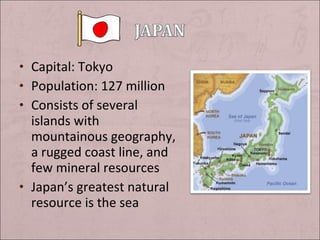
• Capital: Tokyo
• Population: 127 million
• Consists of several

islands with
mountainous geography,
a rugged coast line, and
few mineral resources
• Japan’s greatest natural
resource is the sea
• Most Japanese-Americans reside in California or

Hawaii.
• Lots of west coast cities in the U.S. have a section
called “Little Tokyo” or “Japantown”
• The Japanese-Americans are well educated!
o 90% of Japanese-Americans graduated high school,
72% have attended college, and most hold
professional jobs.

• In 2007 the median family income was 30%

above the national median.
• Only 5% live in poverty.
•
•
•
•

Family before self
Preserve harmony with society
Respect and care for elders
Formal and polite during conversations
o Conversations are typically indirect with frequent pauses (up to several minutes)
o Communication style is complex, slight gestures may have some meaning.

•
•
•

Emotional displays are avoided
Non-confrontational. Reluctant to say “no”
Direct eye contact is disrespectful
o Glancing around or downcast eyes are expected

•

Personal space
o The Japanese are a non-touching culture
o They normally stand or sit farther apart than most Americans
o Most Japanese-Americans are comfortable with a light handshake

•

Traditional greeting= bow from the waist with palms against thighs
o The lower and longer the bow, the more respect is shown.

•

Slouching and putting feet up are signs of disinterest
• Believe that the that the health care provider is a

knowledgeable authority figure who will meet their
needs without assistance
• They expect to be directed in their health care, but
will feel insulted if they are ordered to do something
without explanation.
• Criticism of health habits can lead to embarrassment
and loss of effective communication.
•

Shintoism=the indigenous religion of Japan.
o Belief is that humans are inherently good. Evil
is caused by pollution or filthiness (physical or
spiritual), and goodness is associated with
purity.

•

When Buddhism was introduced in the 6th
century, the concept of harmony was adapted
into the Japanese culture
o Harmony= a person’s relationship with nature,
family and society.
o Imbalance within one’s harmony due to poor
diet, lack of exercise, insufficient sleep, or
conflict with family or society disrupts proper
energy flow through the body and causes
illnesses.

•

Early Japanese immigrants either joined a
Buddhist temple or a Christian church after
arriving in America
o The church provided an opportunity for jobs
and an opportunity to learn English.

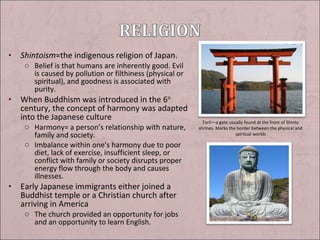
Torii—a gate usually found at the front of Shinto
shrines. Marks the border between the physical and
spiritual worlds
• Biggest holiday celebration= New

Year’s (Oshogatsu)

• New year’s day is celebrated on
January 1st
• 7 day celebration
• Food is prepared in advance. No
cooking is done during this
celebration
• New Year’s food consists of 10-20
dishes, each dish symbolizes a
special value (happiness, prosperity,
wealth, etc.)
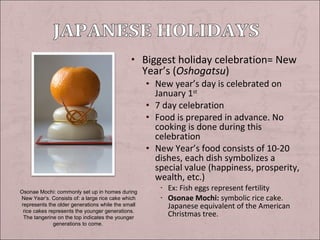
Osonae Mochi: commonly set up in homes during
New Year’s. Consists of: a large rice cake which
represents the older generations while the small
rice cakes represents the younger generations.
The tangerine on the top indicates the younger
generations to come.

•
•

Ex: Fish eggs represent fertility
Osonae Mochi: symbolic rice cake.
Japanese equivalent of the American
Christmas tree.
• Obon Festival: held in the 2nd or 3rd week of July to

appreciate the living, honor the dead, and comfort
the bereaved.
• Birthdays: certain birthdays are considered
hazardous or auspicious

o Special festivities are taken to avoid misfortune when a
man turns 42 or a woman turns 33.
o 61 years of age marks the beginning of a second
childhood. At this age, a person wears a red cap for this
honor.
o At 77, a long red overcoat is worn
o The 88th birthday is the most propitious birthday. A person
may wear both the red cap and coat.
• China had a strong influence on Japan’s food

culture

o However, Japanese food preparation and presentation
is unique!

• Their reverence for harmony within the body and

community and with nature has resulted in a
cuisine offering numerous preparation methods
for a limited number of foods.
• Each item is to be seen, tasted, and relished. They
place an emphasis on the appearance of the meal
so that the visual appeal reflects the balance
among the foods and the environment.
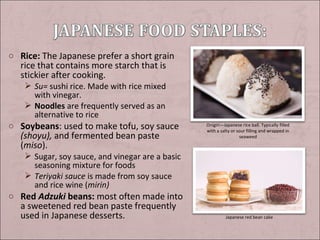
o Rice: The Japanese prefer a short grain

rice that contains more starch that is
stickier after cooking.
 Su= sushi rice. Made with rice mixed
with vinegar.
 Noodles are frequently served as an
alternative to rice

o Soybeans: used to make tofu, soy sauce

(shoyu), and fermented bean paste
(miso).

Onigiri—Japanese rice ball. Typically filled
with a salty or sour filling and wrapped in
seaweed

 Sugar, soy sauce, and vinegar are a basic
seasoning mixture for foods
 Teriyaki sauce is made from soy sauce
and rice wine (mirin)
o Red Adzuki beans: most often made into

a sweetened red bean paste frequently
used in Japanese desserts.

Japanese red bean cake
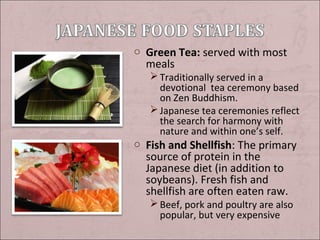
o Green Tea: served with most

meals

 Traditionally served in a
devotional tea ceremony based
on Zen Buddhism.
 Japanese tea ceremonies reflect
the search for harmony with
nature and within one’s self.

o Fish and Shellfish: The primary

source of protein in the
Japanese diet (in addition to
soybeans). Fresh fish and
shellfish are often eaten raw.

 Beef, pork and poultry are also
popular, but very expensive
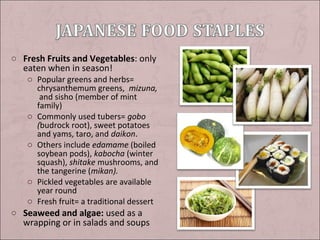
o Fresh Fruits and Vegetables: only

eaten when in season!

o Popular greens and herbs=
chrysanthemum greens, mizuna,
and sisho (member of mint
family)
o Commonly used tubers= gobo
(budrock root), sweet potatoes
and yams, taro, and daikon.
o Others include edamame (boiled
soybean pods), kabocha (winter
squash), shitake mushrooms, and
the tangerine (mikan).
o Pickled vegetables are available
year round
o Fresh fruit= a traditional dessert
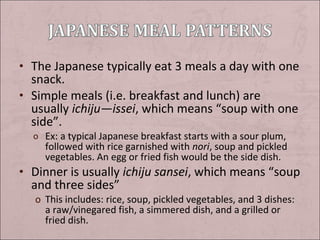
o Seaweed and algae: used as a

wrapping or in salads and soups
• The Japanese typically eat 3 meals a day with one

snack.
• Simple meals (i.e. breakfast and lunch) are
usually ichiju—issei, which means “soup with one
side”.
o Ex: a typical Japanese breakfast starts with a sour plum,

followed with rice garnished with nori, soup and pickled
vegetables. An egg or fried fish would be the side dish.

• Dinner is usually ichiju sansei, which means “soup

and three sides”

o This includes: rice, soup, pickled vegetables, and 3 dishes:
a raw/vinegared fish, a simmered dish, and a grilled or
fried dish.
• Meals typically aren't served in courses. Food

is usually presented at one time in individual
portions. Sometimes the soup may be served
at the end of the meal.
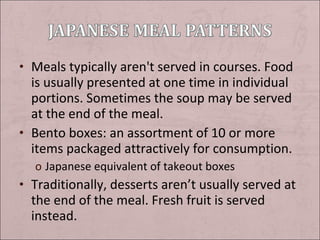
• Bento boxes: an assortment of 10 or more
items packaged attractively for consumption.
o Japanese equivalent of takeout boxes

• Traditionally, desserts aren’t usually served at

the end of the meal. Fresh fruit is served
instead.
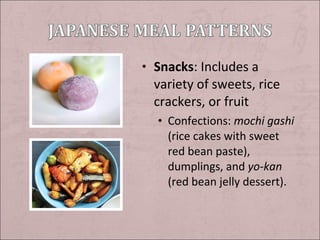
• Snacks: Includes a

variety of sweets, rice
crackers, or fruit
• Confections: mochi gashi
(rice cakes with sweet
red bean paste),
dumplings, and yo-kan
(red bean jelly dessert).
• Tables and Sitting:
o Traditional: Tatami mats and low tables. Shoes are
always taken off.




In a casual setting, only men sit cross legged and women
may sit with their legs out to one side
In a formal setting, both men and women kneel on the
floor, and sit on their heels.

o Today, it is common to find western style tables and
chairs in homes and restauraunts.

• It is customary to say “itadakimasu” (“I

gratefully receive”) before a meal, and
“gochisosama deshita” (“thank you for the
meal”) after finishing the meal
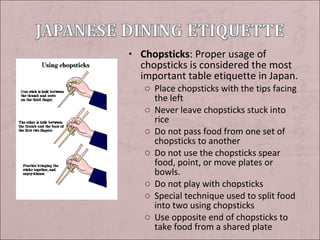
• Chopsticks: Proper usage of

chopsticks is considered the most
important table etiquette in Japan.
o Place chopsticks with the tips facing
the left
o Never leave chopsticks stuck into
rice
o Do not pass food from one set of
chopsticks to another
o Do not use the chopsticks spear
food, point, or move plates or
bowls.
o Do not play with chopsticks
o Special technique used to split food
into two using chopsticks
o Use opposite end of chopsticks to
take food from a shared plate
• Bowls: Rice or soup should be eaten out of the

bowl by picking up the bowl with the left hand
and chopsticks in the right (or vice versa for
people who are left handed)

o Bowls can be lifted to the mouth, but shouldn’t touch
the mouth unless drinking soup
o It is customary to slurp noodle soup, this shows the
chef you are enjoying your food. It is considered
polite.

• Soy sauce: not usually poured over foods at the

table (esp. rice and soup). It is considered rude to
waste soy sauce.
• Eat what is given: it is customary to eat everything on

your dishes, to the last grain of rice.

o It is considered impolite to ask for special requests or
substitutions
o After eating, move all the dishes back to the same position
at the beginning of the meal.

• Drinking: rather than pouring your own drink, it is

expected that everyone serves each other.

o When someone pours your drink, hold your glass with
both hands and thank them
o Do not start drinking until everyone is served and the toast
is finished.
• Based on the concept of yin and yang, there are

many beliefs on the harmful or beneficial effects of
certain food combinations
o Eel + pickled plums, watermelon + crab, cherries + milk are
all believed to cause llnesses
o Pickled plums and hot tea are believed to prevent
constipation
o Pickled plums and rice porridge are believed to be easily
digested and well tolerated during recovery from illness.
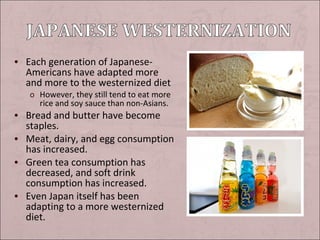
• Each generation of Japanese-

Americans have adapted more
and more to the westernized diet
o However, they still tend to eat more
rice and soy sauce than non-Asians.

• Bread and butter have become

staples.
• Meat, dairy, and egg consumption
has increased.
• Green tea consumption has
decreased, and soft drink
consumption has increased.
• Even Japan itself has been
adapting to a more westernized
diet.
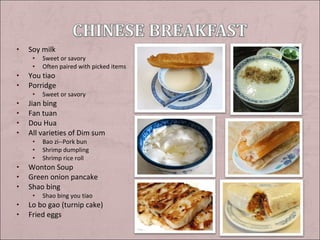
•

Soy milk
•
•

•
•

You tiao
Porridge
•

•
•
•
•

Bao zi--Pork bun
Shrimp dumpling
Shrimp rice roll

Wonton Soup
Green onion pancake
Shao bing
•

•
•

Sweet or savory

Jian bing
Fan tuan
Dou Hua
All varieties of Dim sum
•
•
•

•
•
•

Sweet or savory
Often paired with picked items

Shao bing you tiao

Lo bo gao (turnip cake)
Fried eggs
• The Chinese have been increasingly been

eating a more westernized diet
o Hot cereal
o Coffee
o Juice
o Toast
o Sandwiches

Final japanese food presentation

  • 2.
    • Capital: Tokyo •Population: 127 million • Consists of several islands with mountainous geography, a rugged coast line, and few mineral resources • Japan’s greatest natural resource is the sea
  • 3.
    • Most Japanese-Americansreside in California or Hawaii. • Lots of west coast cities in the U.S. have a section called “Little Tokyo” or “Japantown” • The Japanese-Americans are well educated! o 90% of Japanese-Americans graduated high school, 72% have attended college, and most hold professional jobs. • In 2007 the median family income was 30% above the national median. • Only 5% live in poverty.
  • 4.
    • • • • Family before self Preserveharmony with society Respect and care for elders Formal and polite during conversations o Conversations are typically indirect with frequent pauses (up to several minutes) o Communication style is complex, slight gestures may have some meaning. • • • Emotional displays are avoided Non-confrontational. Reluctant to say “no” Direct eye contact is disrespectful o Glancing around or downcast eyes are expected • Personal space o The Japanese are a non-touching culture o They normally stand or sit farther apart than most Americans o Most Japanese-Americans are comfortable with a light handshake • Traditional greeting= bow from the waist with palms against thighs o The lower and longer the bow, the more respect is shown. • Slouching and putting feet up are signs of disinterest
  • 5.
    • Believe thatthe that the health care provider is a knowledgeable authority figure who will meet their needs without assistance • They expect to be directed in their health care, but will feel insulted if they are ordered to do something without explanation. • Criticism of health habits can lead to embarrassment and loss of effective communication.
  • 6.
    • Shintoism=the indigenous religionof Japan. o Belief is that humans are inherently good. Evil is caused by pollution or filthiness (physical or spiritual), and goodness is associated with purity. • When Buddhism was introduced in the 6th century, the concept of harmony was adapted into the Japanese culture o Harmony= a person’s relationship with nature, family and society. o Imbalance within one’s harmony due to poor diet, lack of exercise, insufficient sleep, or conflict with family or society disrupts proper energy flow through the body and causes illnesses. • Early Japanese immigrants either joined a Buddhist temple or a Christian church after arriving in America o The church provided an opportunity for jobs and an opportunity to learn English. Torii—a gate usually found at the front of Shinto shrines. Marks the border between the physical and spiritual worlds
  • 7.
    • Biggest holidaycelebration= New Year’s (Oshogatsu) • New year’s day is celebrated on January 1st • 7 day celebration • Food is prepared in advance. No cooking is done during this celebration • New Year’s food consists of 10-20 dishes, each dish symbolizes a special value (happiness, prosperity, wealth, etc.) Osonae Mochi: commonly set up in homes during New Year’s. Consists of: a large rice cake which represents the older generations while the small rice cakes represents the younger generations. The tangerine on the top indicates the younger generations to come. • • Ex: Fish eggs represent fertility Osonae Mochi: symbolic rice cake. Japanese equivalent of the American Christmas tree.
  • 8.
    • Obon Festival:held in the 2nd or 3rd week of July to appreciate the living, honor the dead, and comfort the bereaved. • Birthdays: certain birthdays are considered hazardous or auspicious o Special festivities are taken to avoid misfortune when a man turns 42 or a woman turns 33. o 61 years of age marks the beginning of a second childhood. At this age, a person wears a red cap for this honor. o At 77, a long red overcoat is worn o The 88th birthday is the most propitious birthday. A person may wear both the red cap and coat.
  • 9.
    • China hada strong influence on Japan’s food culture o However, Japanese food preparation and presentation is unique! • Their reverence for harmony within the body and community and with nature has resulted in a cuisine offering numerous preparation methods for a limited number of foods. • Each item is to be seen, tasted, and relished. They place an emphasis on the appearance of the meal so that the visual appeal reflects the balance among the foods and the environment.
  • 11.
    o Rice: TheJapanese prefer a short grain rice that contains more starch that is stickier after cooking.  Su= sushi rice. Made with rice mixed with vinegar.  Noodles are frequently served as an alternative to rice o Soybeans: used to make tofu, soy sauce (shoyu), and fermented bean paste (miso). Onigiri—Japanese rice ball. Typically filled with a salty or sour filling and wrapped in seaweed  Sugar, soy sauce, and vinegar are a basic seasoning mixture for foods  Teriyaki sauce is made from soy sauce and rice wine (mirin) o Red Adzuki beans: most often made into a sweetened red bean paste frequently used in Japanese desserts. Japanese red bean cake
  • 12.
    o Green Tea:served with most meals  Traditionally served in a devotional tea ceremony based on Zen Buddhism.  Japanese tea ceremonies reflect the search for harmony with nature and within one’s self. o Fish and Shellfish: The primary source of protein in the Japanese diet (in addition to soybeans). Fresh fish and shellfish are often eaten raw.  Beef, pork and poultry are also popular, but very expensive
  • 13.
    o Fresh Fruitsand Vegetables: only eaten when in season! o Popular greens and herbs= chrysanthemum greens, mizuna, and sisho (member of mint family) o Commonly used tubers= gobo (budrock root), sweet potatoes and yams, taro, and daikon. o Others include edamame (boiled soybean pods), kabocha (winter squash), shitake mushrooms, and the tangerine (mikan). o Pickled vegetables are available year round o Fresh fruit= a traditional dessert o Seaweed and algae: used as a wrapping or in salads and soups
  • 14.
    • The Japanesetypically eat 3 meals a day with one snack. • Simple meals (i.e. breakfast and lunch) are usually ichiju—issei, which means “soup with one side”. o Ex: a typical Japanese breakfast starts with a sour plum, followed with rice garnished with nori, soup and pickled vegetables. An egg or fried fish would be the side dish. • Dinner is usually ichiju sansei, which means “soup and three sides” o This includes: rice, soup, pickled vegetables, and 3 dishes: a raw/vinegared fish, a simmered dish, and a grilled or fried dish.
  • 15.
    • Meals typicallyaren't served in courses. Food is usually presented at one time in individual portions. Sometimes the soup may be served at the end of the meal. • Bento boxes: an assortment of 10 or more items packaged attractively for consumption. o Japanese equivalent of takeout boxes • Traditionally, desserts aren’t usually served at the end of the meal. Fresh fruit is served instead.
  • 16.
    • Snacks: Includesa variety of sweets, rice crackers, or fruit • Confections: mochi gashi (rice cakes with sweet red bean paste), dumplings, and yo-kan (red bean jelly dessert).
  • 17.
    • Tables andSitting: o Traditional: Tatami mats and low tables. Shoes are always taken off.   In a casual setting, only men sit cross legged and women may sit with their legs out to one side In a formal setting, both men and women kneel on the floor, and sit on their heels. o Today, it is common to find western style tables and chairs in homes and restauraunts. • It is customary to say “itadakimasu” (“I gratefully receive”) before a meal, and “gochisosama deshita” (“thank you for the meal”) after finishing the meal
  • 18.
    • Chopsticks: Properusage of chopsticks is considered the most important table etiquette in Japan. o Place chopsticks with the tips facing the left o Never leave chopsticks stuck into rice o Do not pass food from one set of chopsticks to another o Do not use the chopsticks spear food, point, or move plates or bowls. o Do not play with chopsticks o Special technique used to split food into two using chopsticks o Use opposite end of chopsticks to take food from a shared plate
  • 19.
    • Bowls: Riceor soup should be eaten out of the bowl by picking up the bowl with the left hand and chopsticks in the right (or vice versa for people who are left handed) o Bowls can be lifted to the mouth, but shouldn’t touch the mouth unless drinking soup o It is customary to slurp noodle soup, this shows the chef you are enjoying your food. It is considered polite. • Soy sauce: not usually poured over foods at the table (esp. rice and soup). It is considered rude to waste soy sauce.
  • 20.
    • Eat whatis given: it is customary to eat everything on your dishes, to the last grain of rice. o It is considered impolite to ask for special requests or substitutions o After eating, move all the dishes back to the same position at the beginning of the meal. • Drinking: rather than pouring your own drink, it is expected that everyone serves each other. o When someone pours your drink, hold your glass with both hands and thank them o Do not start drinking until everyone is served and the toast is finished.
  • 21.
    • Based onthe concept of yin and yang, there are many beliefs on the harmful or beneficial effects of certain food combinations o Eel + pickled plums, watermelon + crab, cherries + milk are all believed to cause llnesses o Pickled plums and hot tea are believed to prevent constipation o Pickled plums and rice porridge are believed to be easily digested and well tolerated during recovery from illness.
  • 22.
    • Each generationof Japanese- Americans have adapted more and more to the westernized diet o However, they still tend to eat more rice and soy sauce than non-Asians. • Bread and butter have become staples. • Meat, dairy, and egg consumption has increased. • Green tea consumption has decreased, and soft drink consumption has increased. • Even Japan itself has been adapting to a more westernized diet.
  • 23.
    • Soy milk • • • • You tiao Porridge • • • • • Baozi--Pork bun Shrimp dumpling Shrimp rice roll Wonton Soup Green onion pancake Shao bing • • • Sweet or savory Jian bing Fan tuan Dou Hua All varieties of Dim sum • • • • • • Sweet or savory Often paired with picked items Shao bing you tiao Lo bo gao (turnip cake) Fried eggs
  • 24.
    • The Chinesehave been increasingly been eating a more westernized diet o Hot cereal o Coffee o Juice o Toast o Sandwiches

Editor's Notes

  • #12 Mizuna=peppery greens