DuPage Regional Office of Education October 18, 2011
Administrator Academy about online learning taught online. Regional initiative to assist school districts with online learning.
Determine action for online learning in the region. Share Resources Special Interest Group Other
Review background data about online learning. Formulate action plan, if appropriate. Have discussion. Answer questions.
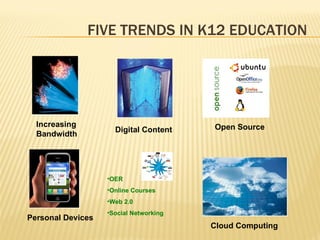
FIVE TRENDS IN K12 EDUCATION Cloud Computing Personal Devices Open Source Increasing Bandwidth Digital Content OER Online Courses Web 2.0 Social Networking
iNACOL – International Association for K-12 Online Learning OER – Open Educational Resources  (Free or inexpensive course content.)

Vail School District (AZ) reduced textbook costs from $53 per student to $9 per student with free digital resources.
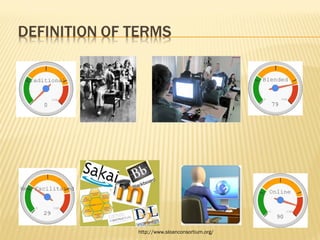
http://www.sloanconsortium.org/
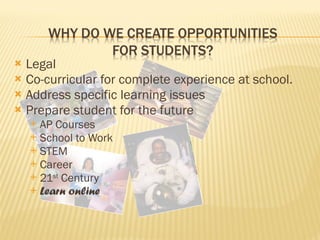
Legal Co-curricular for complete experience at school. Address specific learning issues Prepare student for the future AP Courses School to Work STEM Career 21 st  Century Learn online
In 2009, 5.6 million students enrolled online, 21% Increase over previous year, yet overall enrollment increased by 2%  In Higher Education http://www.sloanconsortium.org/
Nearly 30% of all students in higher education taking courses in fall 2009. In Higher Education http://www.sloanconsortium.org
2009, 2 million (est.) online class enrollments in K-12. Nearly 30% of all students in higher education took courses in fall 2009. http://www.inacol.org
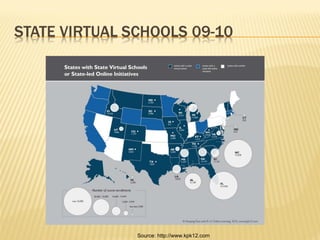
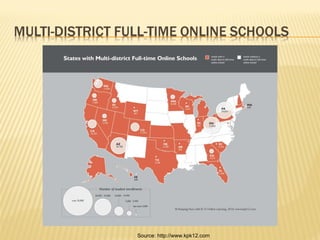
Source: http://www.kpk12.com
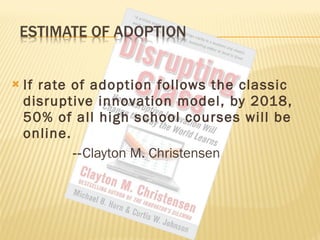
If rate of adoption follows the classic disruptive innovation model, by 2018, 50% of all high school courses will be online.  -- Clayton M. Christensen
Students who need or want  supplemental online courses  have access to them without barriers of cost, scheduling, transferability of credit, etc. Students who need or want a  full-time online  program have access to one or more without restrictions based on prior school setting, district permissions,  caps, etc.
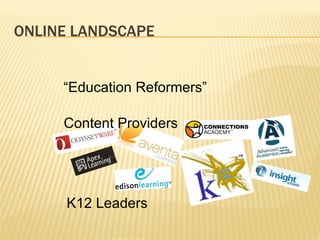
ONLINE LANDSCAPE K12 Leaders Content Providers “ Education Reformers”
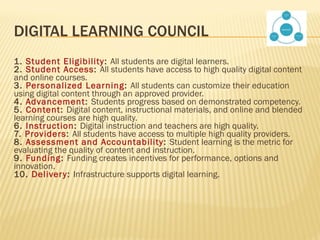
DIGITAL LEARNING COUNCIL 1.  Student Eligibility :  All students are digital learners.   2.  Student Access :  All students have access to high quality digital content and online courses. 3.  Personalized Learning :  All students can customize their education using digital content through an approved provider. 4.  Advancement :  Students progress based on demonstrated competency. 5.  Content :  Digital content, instructional materials, and online and blended learning courses are high quality. 6.  Instruction :  Digital instruction and teachers are high quality.   7.  Providers :  All students have access to multiple high quality providers. 8.  Assessment and Accountability :  Student learning is the metric for evaluating the quality of content and instruction. 9.  Funding :  Funding creates incentives for performance, options and innovation. 10.  Delivery :  Infrastructure supports digital learning.
How does the opportunity fit with your thinking?
Public Act 96-0684 (HB 2448, 8/25/09) and modified PA 97-0339 (HB 3223, 8/12/11):  Authorizes school districts to create and offer “remote educational programs” tailored to individual student needs and claim GSA for those programs.  105 ILCS 10-29 Prior law:  GSA could only be claimed for virtual programs offered in a classroom or other traditional school setting. Broad district discretion, provided the program and plan meet legislative criteria.
Adopted School Board Policy: Criteria for participation Limits on numbers of students or grade levels Approval process for participation Process to develop student plans System for calculating clock hours of attendance Process for renewal Student Remote Educational Plan: Specific achievement goals Assessments Progress reports Teacher/student interaction Designation of supervising adult Other family responsibilities Consistency with IEP Participating in district programs Responsible district administrator Term Specific location or locations for delivery
Students remain enrolled in a school district attendance center, and are tested and included for all State/federal accountability determinations Certified/Highly Qualified Teachers responsible for critical instructional activities GSA claimable for any days up to limit of student’s GSA. ISBE rules require documentation of active participation to claim GSA. District policy and data must be submitted to ISBE.
Does your school district’s policy support online learning? If a system of shared resources is developed, what policy is needed to accept course completion?
Borrow (steal) it Buy it Build it yourself
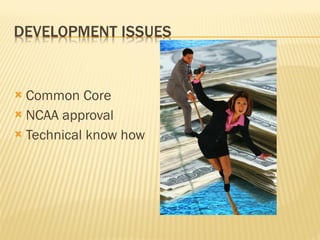
Common Core NCAA approval Technical know how
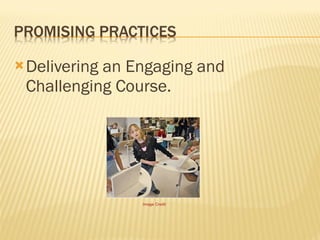
Delivering an Engaging and Challenging Course. Image Credit
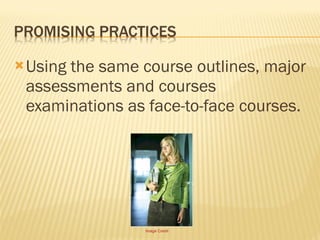
Using the same course outlines, major assessments and courses examinations as face-to-face courses. Image Credit
Proctoring major assessments and final exams. Image Credit
Using live virtual sessions with software like  Blackboard Collaborate  or  Abobe Connect . Image Credit
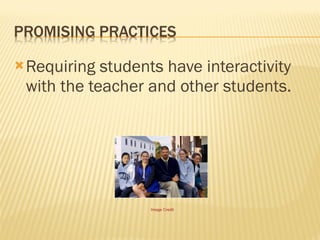
Requiring students have interactivity with the teacher and other students. Image Credit
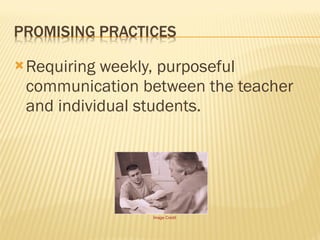
Requiring weekly, purposeful communication between the teacher and individual students. Image   Credit
Adding oral exams at milestone points in the course to check for understanding. Image Credit
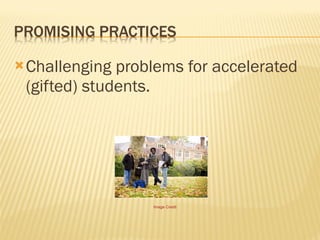
Challenging problems for accelerated (gifted) students. Image Credit
Regular formative assessments, followed by periodic formal evaluations by outside reviewers.
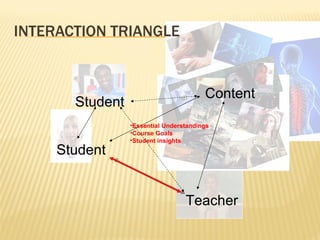
INTERACTION TRIANGLE Student Teacher Student Content Essential Understandings Course Goals Student insights
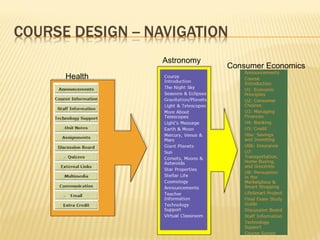
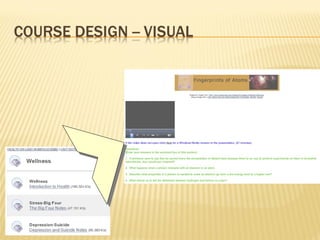
Health Astronomy Consumer Economics
 
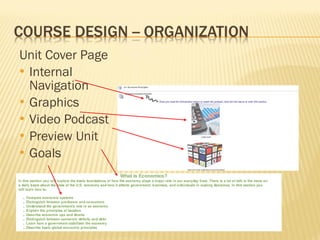
Unit Cover Page Internal Navigation Graphics Video Podcast Preview Unit Goals
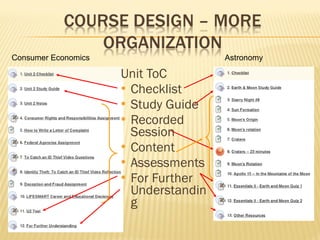
Unit ToC  Checklist Study Guide Recorded Session Content Assessments For Further Understanding Consumer Economics Astronomy
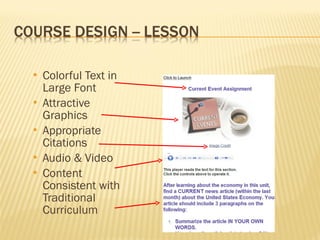
Colorful Text in Large Font Attractive Graphics  Appropriate Citations Audio & Video Content Consistent with Traditional Curriculum
How do these practices and views affect your view of online courses?
Achievement and Self-Esteem Beliefs  –  Students require a high degree of self-motivation, and [they] must perceive that their success depends on their own contributions, rather than those of the course or teacher. Responsibility/Risk Taking  –  Students have to take the initiative [to] complete tasks, even when all the information may not be given and the correct way to proceed may not be clear. Technology Skills and Access  –  Students in on-line courses not only must be skilled at using on-line resources but also should have better-than-average access to them. Organization and Self-Regulation  –  Even more than other academic activities, on-line environments seem to require students to have excellent organization and study skills. Roblyer, M.D. and Marshall, J. (2002).  Prediction success of virtual high school students:  Preliminary results from an educational success prediction instrument.
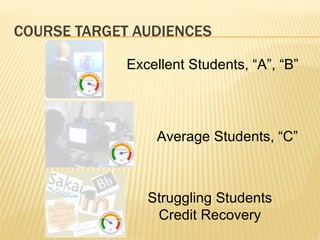
COURSE TARGET AUDIENCES Excellent Students, “A”, “B” Average Students, “C” Struggling Students Credit Recovery
 
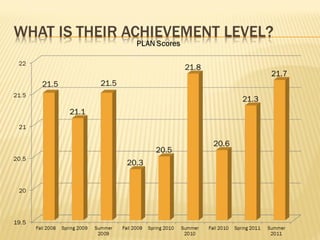
50 Students 6 weeks Median 97 National Percentile Rank in Math Content selected that was aligned with district’s course. Office Hours in  Wimba Classroom


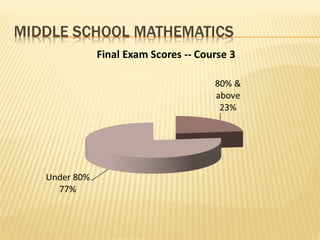
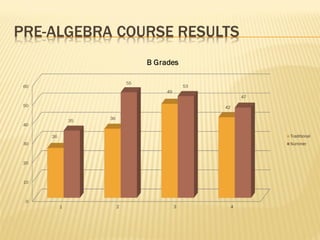
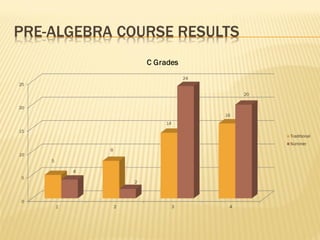
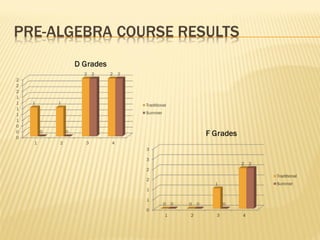
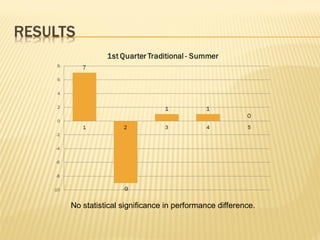
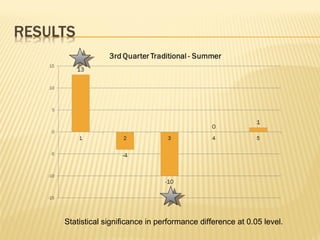
No statistical significance in performance difference.
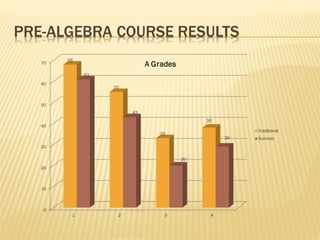
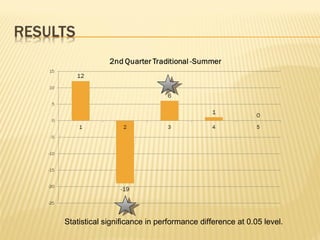
Statistical significance in performance difference at 0.05 level.
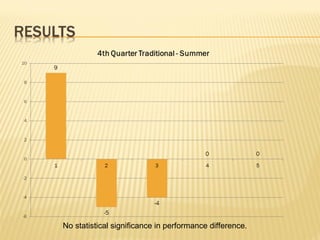
No statistical significance in performance difference.
Astronomy Consumer Economics English IV: 20 th  Century Literature English IV: AP Health U.S. History


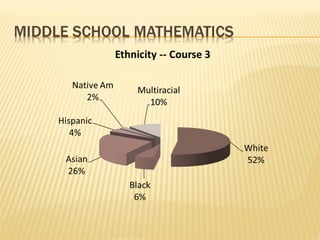
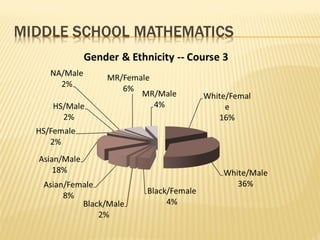
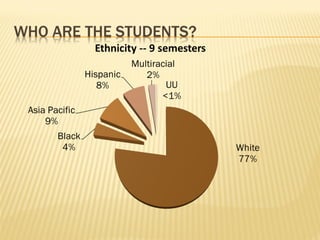
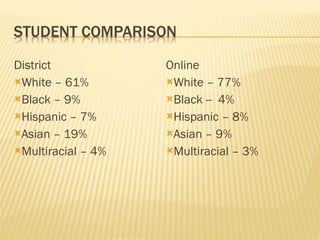
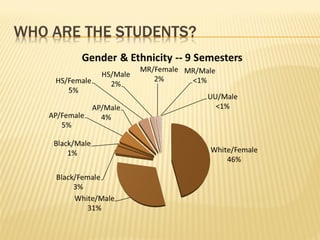
District White – 61% Black – 9% Hispanic – 7% Asian – 19% Multiracial – 4% Online White – 77% Black --  4% Hispanic – 8% Asian – 9% Multiracial – 3%
 
www.glickconsulting.com


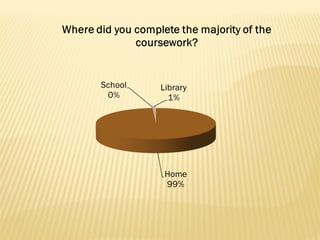
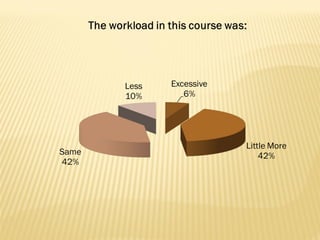
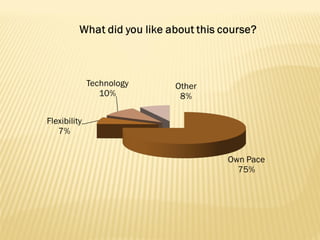
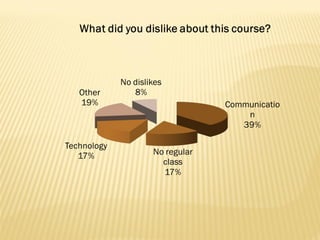
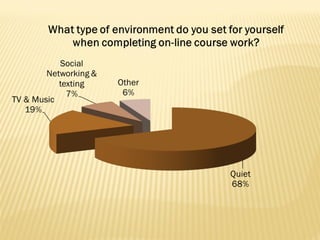
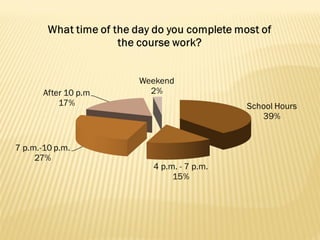
Only take this course if you are self-motivated enough to do it. It’s not bad at all if you manage your time wisely and set goals for yourself to finish it on time. I wrote down all of the due dates in my assignment notebook so I could see when they were coming up to remind myself or else I knew that I would probably forget.
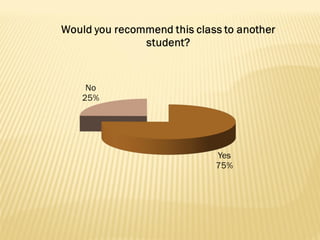
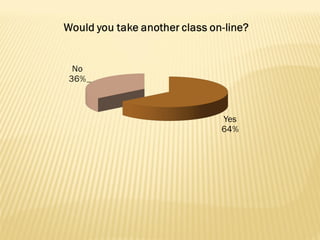
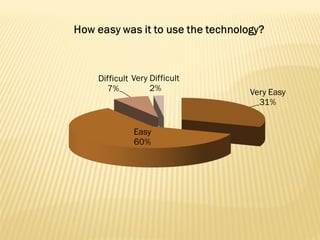
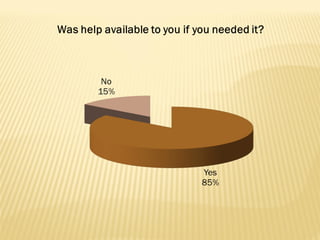
What do the results presented here tell you about how students can be successful online?
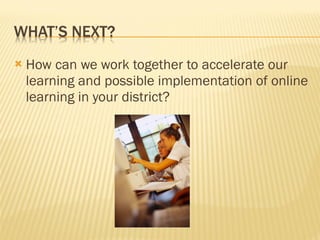
How can we work together to accelerate our learning and possible implementation of online learning in your district?
ELL Students High School graduation gateway courses Senior year courses (Blended models)
Where do you want to go from here?

DuPage Online Meeting

  • 1.
    DuPage Regional Officeof Education October 18, 2011
  • 2.
    Administrator Academy aboutonline learning taught online. Regional initiative to assist school districts with online learning.
  • 3.
    Determine action foronline learning in the region. Share Resources Special Interest Group Other
  • 4.
    Review background dataabout online learning. Formulate action plan, if appropriate. Have discussion. Answer questions.
  • 5.
    FIVE TRENDS INK12 EDUCATION Cloud Computing Personal Devices Open Source Increasing Bandwidth Digital Content OER Online Courses Web 2.0 Social Networking
  • 6.
    iNACOL – InternationalAssociation for K-12 Online Learning OER – Open Educational Resources (Free or inexpensive course content.)
  • 7.
    Vail School District(AZ) reduced textbook costs from $53 per student to $9 per student with free digital resources.
  • 8.
  • 9.
    Legal Co-curricular forcomplete experience at school. Address specific learning issues Prepare student for the future AP Courses School to Work STEM Career 21 st Century Learn online
  • 10.
    In 2009, 5.6million students enrolled online, 21% Increase over previous year, yet overall enrollment increased by 2% In Higher Education http://www.sloanconsortium.org/
  • 11.
    Nearly 30% ofall students in higher education taking courses in fall 2009. In Higher Education http://www.sloanconsortium.org
  • 12.
    2009, 2 million(est.) online class enrollments in K-12. Nearly 30% of all students in higher education took courses in fall 2009. http://www.inacol.org
  • 13.
  • 14.
  • 15.
    If rate ofadoption follows the classic disruptive innovation model, by 2018, 50% of all high school courses will be online. -- Clayton M. Christensen
  • 16.
    Students who needor want supplemental online courses have access to them without barriers of cost, scheduling, transferability of credit, etc. Students who need or want a full-time online program have access to one or more without restrictions based on prior school setting, district permissions, caps, etc.
  • 17.
    ONLINE LANDSCAPE K12Leaders Content Providers “ Education Reformers”
  • 18.
    DIGITAL LEARNING COUNCIL1. Student Eligibility : All students are digital learners. 2. Student Access : All students have access to high quality digital content and online courses. 3. Personalized Learning : All students can customize their education using digital content through an approved provider. 4. Advancement : Students progress based on demonstrated competency. 5. Content : Digital content, instructional materials, and online and blended learning courses are high quality. 6. Instruction : Digital instruction and teachers are high quality. 7. Providers : All students have access to multiple high quality providers. 8. Assessment and Accountability : Student learning is the metric for evaluating the quality of content and instruction. 9. Funding : Funding creates incentives for performance, options and innovation. 10. Delivery : Infrastructure supports digital learning.
  • 19.
    How does theopportunity fit with your thinking?
  • 20.
    Public Act 96-0684(HB 2448, 8/25/09) and modified PA 97-0339 (HB 3223, 8/12/11): Authorizes school districts to create and offer “remote educational programs” tailored to individual student needs and claim GSA for those programs. 105 ILCS 10-29 Prior law: GSA could only be claimed for virtual programs offered in a classroom or other traditional school setting. Broad district discretion, provided the program and plan meet legislative criteria.
  • 21.
    Adopted School BoardPolicy: Criteria for participation Limits on numbers of students or grade levels Approval process for participation Process to develop student plans System for calculating clock hours of attendance Process for renewal Student Remote Educational Plan: Specific achievement goals Assessments Progress reports Teacher/student interaction Designation of supervising adult Other family responsibilities Consistency with IEP Participating in district programs Responsible district administrator Term Specific location or locations for delivery
  • 22.
    Students remain enrolledin a school district attendance center, and are tested and included for all State/federal accountability determinations Certified/Highly Qualified Teachers responsible for critical instructional activities GSA claimable for any days up to limit of student’s GSA. ISBE rules require documentation of active participation to claim GSA. District policy and data must be submitted to ISBE.
  • 23.
    Does your schooldistrict’s policy support online learning? If a system of shared resources is developed, what policy is needed to accept course completion?
  • 24.
    Borrow (steal) itBuy it Build it yourself
  • 25.
    Common Core NCAAapproval Technical know how
  • 26.
    Delivering an Engagingand Challenging Course. Image Credit
  • 27.
    Using the samecourse outlines, major assessments and courses examinations as face-to-face courses. Image Credit
  • 28.
    Proctoring major assessmentsand final exams. Image Credit
  • 29.
    Using live virtualsessions with software like Blackboard Collaborate or Abobe Connect . Image Credit
  • 30.
    Requiring students haveinteractivity with the teacher and other students. Image Credit
  • 31.
    Requiring weekly, purposefulcommunication between the teacher and individual students. Image Credit
  • 32.
    Adding oral examsat milestone points in the course to check for understanding. Image Credit
  • 33.
    Challenging problems foraccelerated (gifted) students. Image Credit
  • 34.
    Regular formative assessments,followed by periodic formal evaluations by outside reviewers.
  • 35.
    INTERACTION TRIANGLE StudentTeacher Student Content Essential Understandings Course Goals Student insights
  • 36.
  • 37.
  • 38.
    Unit Cover PageInternal Navigation Graphics Video Podcast Preview Unit Goals
  • 39.
    Unit ToC Checklist Study Guide Recorded Session Content Assessments For Further Understanding Consumer Economics Astronomy
  • 40.
    Colorful Text inLarge Font Attractive Graphics Appropriate Citations Audio & Video Content Consistent with Traditional Curriculum
  • 41.
    How do thesepractices and views affect your view of online courses?
  • 42.
    Achievement and Self-EsteemBeliefs – Students require a high degree of self-motivation, and [they] must perceive that their success depends on their own contributions, rather than those of the course or teacher. Responsibility/Risk Taking – Students have to take the initiative [to] complete tasks, even when all the information may not be given and the correct way to proceed may not be clear. Technology Skills and Access – Students in on-line courses not only must be skilled at using on-line resources but also should have better-than-average access to them. Organization and Self-Regulation – Even more than other academic activities, on-line environments seem to require students to have excellent organization and study skills. Roblyer, M.D. and Marshall, J. (2002). Prediction success of virtual high school students: Preliminary results from an educational success prediction instrument.
  • 43.
    COURSE TARGET AUDIENCESExcellent Students, “A”, “B” Average Students, “C” Struggling Students Credit Recovery
  • 44.
  • 45.
    50 Students 6weeks Median 97 National Percentile Rank in Math Content selected that was aligned with district’s course. Office Hours in Wimba Classroom
  • 46.
  • 47.
  • 48.
  • 49.
  • 50.
  • 51.
  • 52.
  • 53.
  • 54.
    No statistical significancein performance difference.
  • 55.
    Statistical significance inperformance difference at 0.05 level.
  • 56.
    Statistical significance inperformance difference at 0.05 level.
  • 57.
    No statistical significancein performance difference.
  • 58.
    Astronomy Consumer EconomicsEnglish IV: 20 th Century Literature English IV: AP Health U.S. History
  • 59.
  • 60.
  • 61.
  • 62.
    District White –61% Black – 9% Hispanic – 7% Asian – 19% Multiracial – 4% Online White – 77% Black -- 4% Hispanic – 8% Asian – 9% Multiracial – 3%
  • 63.
  • 64.
  • 65.
  • 66.
  • 67.
  • 68.
  • 69.
  • 70.
  • 71.
  • 72.
  • 73.
  • 74.
  • 75.
  • 76.
  • 77.
  • 78.
    Only take thiscourse if you are self-motivated enough to do it. It’s not bad at all if you manage your time wisely and set goals for yourself to finish it on time. I wrote down all of the due dates in my assignment notebook so I could see when they were coming up to remind myself or else I knew that I would probably forget.
  • 79.
    What do theresults presented here tell you about how students can be successful online?
  • 80.
    How can wework together to accelerate our learning and possible implementation of online learning in your district?
  • 81.
    ELL Students HighSchool graduation gateway courses Senior year courses (Blended models)
  • 82.
    Where do youwant to go from here?