Preparing Teachers and Students in a Global Digital Era Lisa Dawley, Ph.D. Professor & Chair Dept. of Educational Technology [email_address]
Reforming Teacher Education “ By almost any standard, many if not most of the nation’s 1,450 schools, colleges, and departments of education are doing a mediocre job of preparing teachers for the realities of the 21st century classroom.” “ America’s university-based teacher preparation programs need revolutionary change--not evolutionary tinkering. Arne Duncan, US Secretary of Education
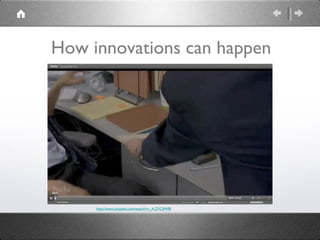
How innovations can happen http://www.youtube.com/watch?v=_A-ZVCjfWf8
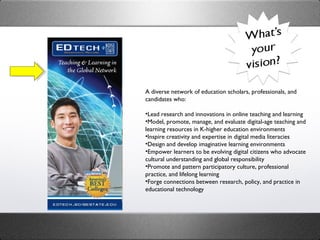
A diverse network of education scholars, professionals, and candidates who:   Lead research and innovations in online teaching and learning  Model, promote, manage, and evaluate digital-age teaching and learning resources in K-higher education environments  Inspire creativity and expertise in digital media literacies  Design and develop imaginative learning environments   Empower learners to be evolving digital citizens who advocate cultural understanding and global responsibility  Promote and pattern participatory culture, professional practice, and lifelong learning  Forge connections between research, policy, and practice in educational technology
The Unavoidable Evolution in  Teacher Education Societal trends in digital media usage Growth & standards in online education Emerging research-based frameworks Calls to reform teacher education Exploring processes of global network teaching & learning
Trends: societal http://www.youtube.com/watch?v=_A-ZVCjfWf8
Trends:  World Future Society Top 10 Breakthroughs Transforming Life  over the next 20-30 years Best forecast data ever assembled Alternative energy Desalination of water Precision farming Biometrics Quantum computers Entertainment on demand Global access Virtual education or distance learning Nanotechnology Smart Robots
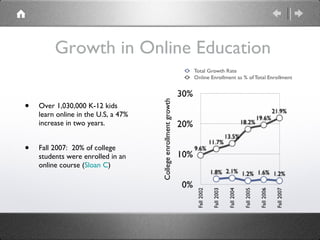
Growth in Online Education Over 1,030,000 K-12 kids learn online in the U.S, a 47% increase in two years. Fall 2007:  20% of college students were enrolled in an online course ( Sloan C )
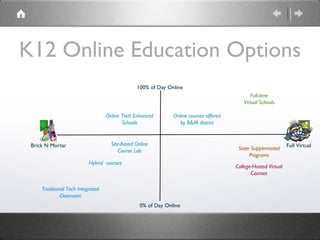
K12 Online Education Options Full-time Virtual Schools State Supplemental Programs College-Hosted Virtual Courses Brick N Mortar Full Virtual 0% of Day Online 100% of Day Online Traditional Tech Integrated Classroom Site-Based Online Course Lab Hybrid  courses Online courses offered by B&M district Online Tech Enhanced Schools
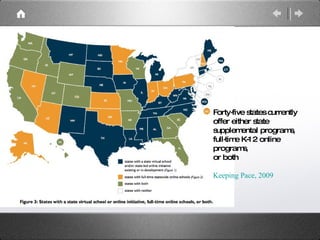
Forty-five states currently offer either state supplemental programs,  full-time K-12 online programs, or both Keeping Pace, 2009
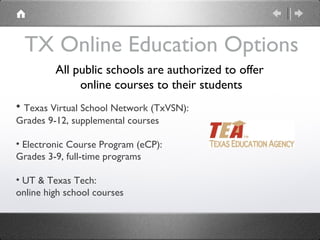
TX Online Education Options Texas Virtual School Network (TxVSN):  Grades 9-12, supplemental courses Electronic Course Program (eCP): Grades 3-9, full-time programs UT & Texas Tech: online high school courses  All public schools are authorized to offer  online courses to their students
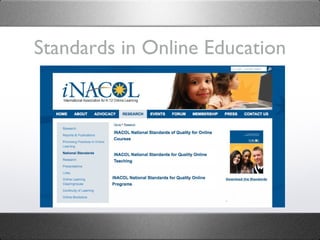
Standards in Online Education
Technologies: What does digital media learning look like today and tomorrow?
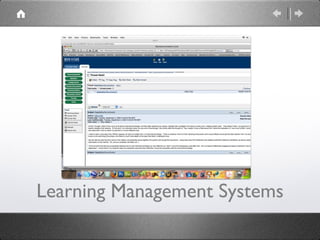
Learning Management Systems
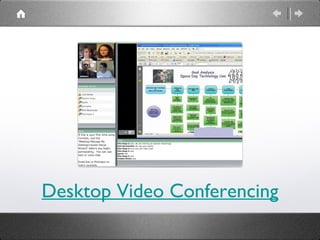
Desktop Video Conferencing
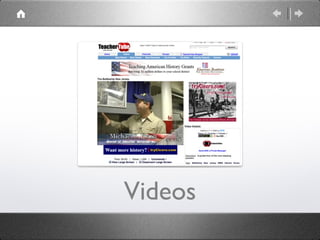
Videos
Voki  or SitePals It’s about user-controlled digital media communication!
Blogs
Wikis
Glogs!
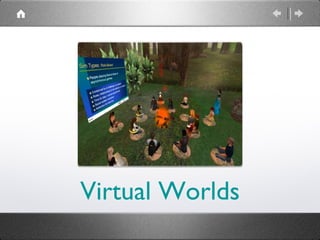
Virtual Worlds
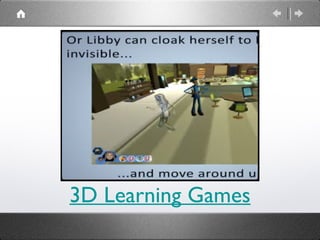
3D Learning Games
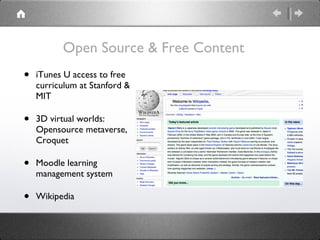
Open Source & Free Content iTunes U access to free curriculum at Stanford & MIT 3D virtual worlds:  Opensource metaverse, Croquet Moodle learning management system Wikipedia
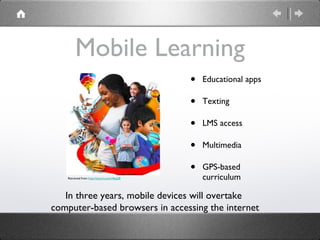
Mobile Learning Educational apps Texting LMS access Multimedia GPS-based curriculum Retrieved from  http://tinyurl.com/n9pq28 In three years, mobile devices will overtake  computer-based browsers in accessing the internet
Social Networking
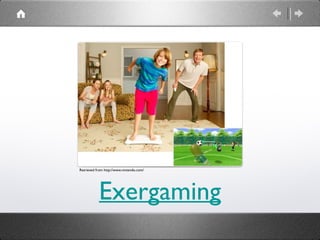
Exergaming Retrieved from http://www.nintendo.com/
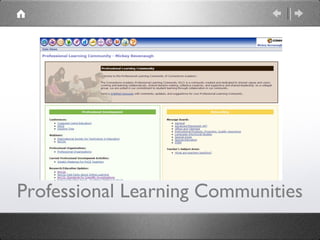
Professional Learning Communities
Leveraging Participatory Culture
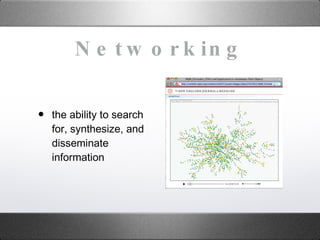
Networking the ability to search for, synthesize, and disseminate information
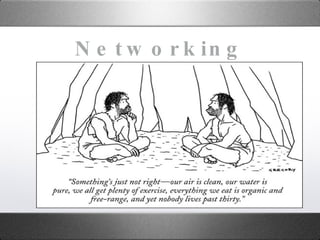
Networking
 
 
Over 1,000
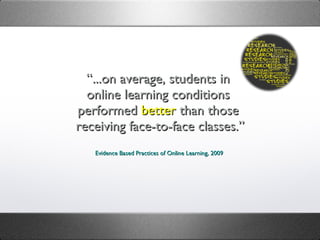
“ ...on average, students in  online learning conditions  performed  better  than those  receiving face-to-face classes. ” Evidence Based Practices of Online Learning, 2009
Impossible!
I knew it!
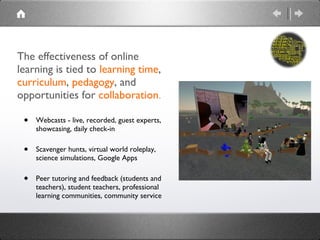
The effectiveness of online learning is tied to  learning time ,   curriculum ,   pedagogy , and opportunities for  collaboration . Webcasts - live, recorded, guest experts, showcasing, daily check-in Scavenger hunts, virtual world roleplay,  science simulations, Google Apps Peer tutoring and feedback (students and teachers), student teachers, professional  learning communities, community service
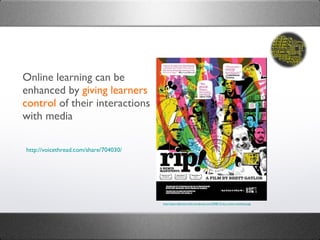
Online learning can be enhanced by  giving learners control  of their interactions with media http://openreflections.files.wordpress.com/2008/12/rip-a-remix-manifesto.jpg http://voicethread.com/share/704030/
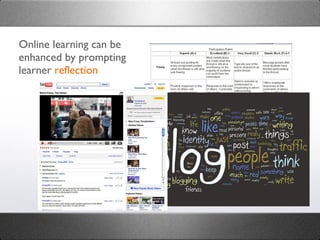
Online learning can be enhanced by prompting learner  reflection
What doesn’t  impact learning? Incorporating online quizzes  Media combinations don’t necessarily matter, but control over them does Scripts to support interaction can influence social engagement, but don’t improve learning
Going Virtual! K12 Online Teacher Professional Development Research Series Who is  teaching  online, what is their training, what are their needs? Who is  designing  online curriculum, what is their training, what are their needs?
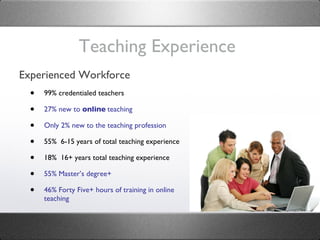
Teaching Experience Experienced Workforce 99% credentialed teachers 27% new to  online   teaching  Only 2% new to the teaching profession 55%  6-15 years of total teaching experience 18%  16+ years total teaching experience  55% Master’s degree+ 46% Forty Five+ hours of training in online teaching
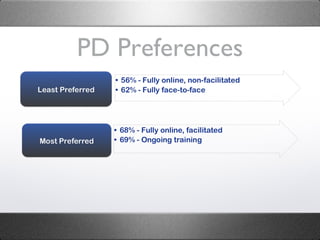
PD Preferences
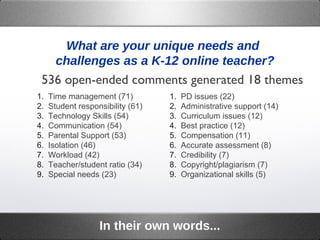
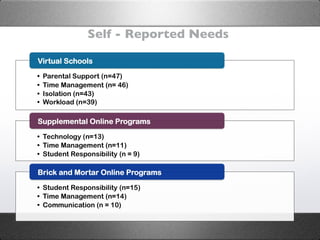
536 open-ended comments generated 18 themes  What are your unique needs and challenges as a K-12 online teacher?  In their own words... Time management (71) Student responsibility (61) Technology Skills (54) Communication (54) Parental Support (53) Isolation (46) Workload (42) Teacher/student ratio (34) Special needs (23) PD issues (22)  Administrative support (14)  Curriculum issues (12) Best practice (12) Compensation (11)  Accurate assessment (8) Credibility (7) Copyright/plagiarism (7) Organizational skills (5)
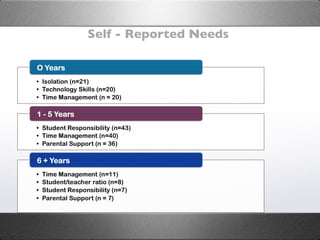
Self - Reported Needs
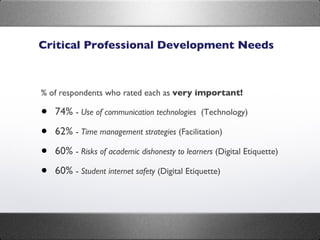
Critical Professional Development Needs % of respondents who rated each as  very important! 74%  -  Use of communication technologies   (Technology) 62%  -  Time management strategies  (Facilitation) 60%  -  Risks of academic dishonesty to learners  (Digital Etiquette) 60%  -  Student internet safety  (Digital Etiquette)
Idaho K-12 Online Teaching Endorsement
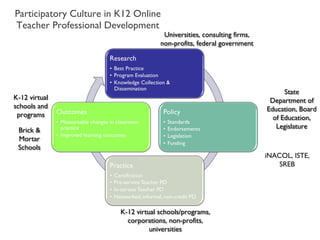
Participatory Culture in K12 Online Teacher Professional Development iNACOL, ISTE, SREB State Department of Education, Board of Education, Legislature K-12 virtual schools and programs K-12 virtual schools/programs, corporations, non-profits, universities Brick & Mortar Schools Universities, consulting firms, non-profits, federal government
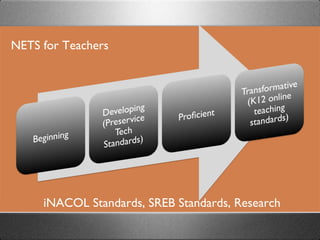
NETS for Teachers iNACOL Standards, SREB Standards, Research
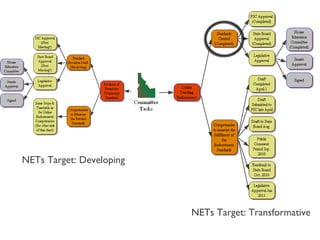
NETs Target: Developing NETs Target: Transformative
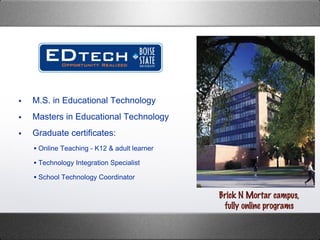
M.S. in Educational Technology  Masters in Educational Technology Graduate certificates: Online Teaching - K12 & adult learner  Technology Integration Specialist School Technology Coordinator Brick N Mortar campus, fully online programs
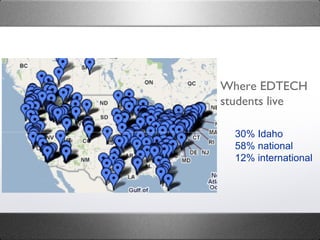
Where EDTECH students live 30% Idaho  58% national  12% international
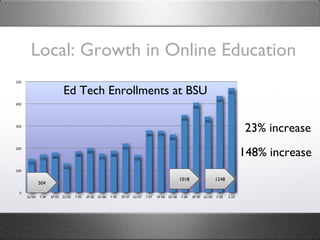
Local: Growth in Online Education 1018 1248 23% increase 504 Ed Tech Enrollments at BSU 148% increase
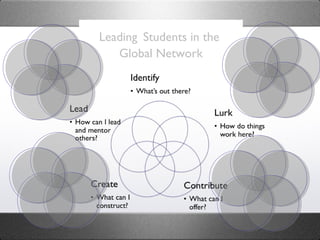
Leading   Students in the  Global Network
Innovative courses YouTube for Educators Teaching in Virtual Worlds Mobile Learning Social Network Learning Online Course Design Online Teaching in K12 Environments Interactive Courseware Design and more!
Exploring Networks LinkedIn:  professional portfolios, 100 members Facebook, Twitter, Moodle: social networking, 800 members Salesforce: email newsletters, 2,000 members EdTech Island Community: 1,600 members
Innovative projects The Cool Teacher Podcast EdTech Showcase Applied Research in Virtual Environments for Learning SIG Project-Based Learning: The Online Resource for PBL
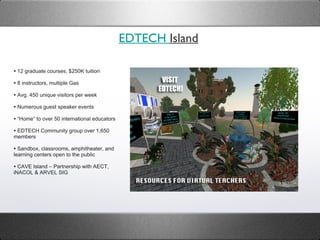
EDTECH  Island 12 graduate courses, $250K tuition 8 instructors, multiple Gas Avg. 450 unique visitors per week Numerous guest speaker events “ Home” to over 50 international educators EDTECH Community group over 1,650 members Sandbox, classrooms, amphitheater, and learning centers open to the public CAVE Island – Partnership with AECT, iNACOL & ARVEL SIG
Innovative partnerships iNACOL AECT ISTE ARVEL SIG, AERA Idaho Digital Learning Academy Connections Academy Univ. of North Texas
Join the evolution!
Resources Certificate in Online Teaching, BSU http://edtech.boisestate.edu Going Virtual! Research Series http://edtech.boisestate.edu/goingvirtual/goingvirtual.htm iNACOL (International Association for K12 Online Learning) http://inacol.org Lisa Dawley, Ph.D. Dept. of EDTECH Boise State University [email_address] edu lisadawley.wordpress.com
TEA Presentation

  • 1.
    Preparing Teachers andStudents in a Global Digital Era Lisa Dawley, Ph.D. Professor & Chair Dept. of Educational Technology [email_address]
  • 2.
    Reforming Teacher Education“ By almost any standard, many if not most of the nation’s 1,450 schools, colleges, and departments of education are doing a mediocre job of preparing teachers for the realities of the 21st century classroom.” “ America’s university-based teacher preparation programs need revolutionary change--not evolutionary tinkering. Arne Duncan, US Secretary of Education
  • 3.
    How innovations canhappen http://www.youtube.com/watch?v=_A-ZVCjfWf8
  • 4.
    A diverse networkof education scholars, professionals, and candidates who: Lead research and innovations in online teaching and learning Model, promote, manage, and evaluate digital-age teaching and learning resources in K-higher education environments Inspire creativity and expertise in digital media literacies Design and develop imaginative learning environments  Empower learners to be evolving digital citizens who advocate cultural understanding and global responsibility Promote and pattern participatory culture, professional practice, and lifelong learning Forge connections between research, policy, and practice in educational technology
  • 5.
    The Unavoidable Evolutionin Teacher Education Societal trends in digital media usage Growth & standards in online education Emerging research-based frameworks Calls to reform teacher education Exploring processes of global network teaching & learning
  • 6.
  • 7.
    Trends: WorldFuture Society Top 10 Breakthroughs Transforming Life over the next 20-30 years Best forecast data ever assembled Alternative energy Desalination of water Precision farming Biometrics Quantum computers Entertainment on demand Global access Virtual education or distance learning Nanotechnology Smart Robots
  • 8.
    Growth in OnlineEducation Over 1,030,000 K-12 kids learn online in the U.S, a 47% increase in two years. Fall 2007: 20% of college students were enrolled in an online course ( Sloan C )
  • 9.
    K12 Online EducationOptions Full-time Virtual Schools State Supplemental Programs College-Hosted Virtual Courses Brick N Mortar Full Virtual 0% of Day Online 100% of Day Online Traditional Tech Integrated Classroom Site-Based Online Course Lab Hybrid courses Online courses offered by B&M district Online Tech Enhanced Schools
  • 10.
    Forty-five states currentlyoffer either state supplemental programs, full-time K-12 online programs, or both Keeping Pace, 2009
  • 11.
    TX Online EducationOptions Texas Virtual School Network (TxVSN): Grades 9-12, supplemental courses Electronic Course Program (eCP): Grades 3-9, full-time programs UT & Texas Tech: online high school courses All public schools are authorized to offer online courses to their students
  • 12.
  • 13.
    Technologies: What doesdigital media learning look like today and tomorrow?
  • 14.
  • 15.
  • 16.
  • 17.
    Voki orSitePals It’s about user-controlled digital media communication!
  • 18.
  • 19.
  • 20.
  • 21.
  • 22.
  • 23.
    Open Source &Free Content iTunes U access to free curriculum at Stanford & MIT 3D virtual worlds: Opensource metaverse, Croquet Moodle learning management system Wikipedia
  • 24.
    Mobile Learning Educationalapps Texting LMS access Multimedia GPS-based curriculum Retrieved from http://tinyurl.com/n9pq28 In three years, mobile devices will overtake computer-based browsers in accessing the internet
  • 25.
  • 26.
    Exergaming Retrieved fromhttp://www.nintendo.com/
  • 27.
  • 28.
  • 29.
    Networking the abilityto search for, synthesize, and disseminate information
  • 30.
  • 31.
  • 32.
  • 33.
  • 34.
    “ ...on average,students in online learning conditions performed better than those receiving face-to-face classes. ” Evidence Based Practices of Online Learning, 2009
  • 35.
  • 36.
  • 37.
    The effectiveness ofonline learning is tied to learning time , curriculum , pedagogy , and opportunities for collaboration . Webcasts - live, recorded, guest experts, showcasing, daily check-in Scavenger hunts, virtual world roleplay, science simulations, Google Apps Peer tutoring and feedback (students and teachers), student teachers, professional learning communities, community service
  • 38.
    Online learning canbe enhanced by giving learners control of their interactions with media http://openreflections.files.wordpress.com/2008/12/rip-a-remix-manifesto.jpg http://voicethread.com/share/704030/
  • 39.
    Online learning canbe enhanced by prompting learner reflection
  • 40.
    What doesn’t impact learning? Incorporating online quizzes Media combinations don’t necessarily matter, but control over them does Scripts to support interaction can influence social engagement, but don’t improve learning
  • 41.
    Going Virtual! K12Online Teacher Professional Development Research Series Who is teaching online, what is their training, what are their needs? Who is designing online curriculum, what is their training, what are their needs?
  • 42.
    Teaching Experience ExperiencedWorkforce 99% credentialed teachers 27% new to online teaching Only 2% new to the teaching profession 55% 6-15 years of total teaching experience 18% 16+ years total teaching experience 55% Master’s degree+ 46% Forty Five+ hours of training in online teaching
  • 43.
  • 44.
    536 open-ended commentsgenerated 18 themes What are your unique needs and challenges as a K-12 online teacher? In their own words... Time management (71) Student responsibility (61) Technology Skills (54) Communication (54) Parental Support (53) Isolation (46) Workload (42) Teacher/student ratio (34) Special needs (23) PD issues (22) Administrative support (14) Curriculum issues (12) Best practice (12) Compensation (11) Accurate assessment (8) Credibility (7) Copyright/plagiarism (7) Organizational skills (5)
  • 45.
  • 46.
  • 47.
    Critical Professional DevelopmentNeeds % of respondents who rated each as very important! 74% - Use of communication technologies (Technology) 62% - Time management strategies (Facilitation) 60% - Risks of academic dishonesty to learners (Digital Etiquette) 60% - Student internet safety (Digital Etiquette)
  • 48.
    Idaho K-12 OnlineTeaching Endorsement
  • 49.
    Participatory Culture inK12 Online Teacher Professional Development iNACOL, ISTE, SREB State Department of Education, Board of Education, Legislature K-12 virtual schools and programs K-12 virtual schools/programs, corporations, non-profits, universities Brick & Mortar Schools Universities, consulting firms, non-profits, federal government
  • 50.
    NETS for TeachersiNACOL Standards, SREB Standards, Research
  • 51.
    NETs Target: DevelopingNETs Target: Transformative
  • 52.
    M.S. in EducationalTechnology Masters in Educational Technology Graduate certificates: Online Teaching - K12 & adult learner Technology Integration Specialist School Technology Coordinator Brick N Mortar campus, fully online programs
  • 53.
    Where EDTECH studentslive 30% Idaho 58% national 12% international
  • 54.
    Local: Growth inOnline Education 1018 1248 23% increase 504 Ed Tech Enrollments at BSU 148% increase
  • 55.
    Leading Students in the Global Network
  • 56.
    Innovative courses YouTubefor Educators Teaching in Virtual Worlds Mobile Learning Social Network Learning Online Course Design Online Teaching in K12 Environments Interactive Courseware Design and more!
  • 57.
    Exploring Networks LinkedIn: professional portfolios, 100 members Facebook, Twitter, Moodle: social networking, 800 members Salesforce: email newsletters, 2,000 members EdTech Island Community: 1,600 members
  • 58.
    Innovative projects TheCool Teacher Podcast EdTech Showcase Applied Research in Virtual Environments for Learning SIG Project-Based Learning: The Online Resource for PBL
  • 59.
    EDTECH Island12 graduate courses, $250K tuition 8 instructors, multiple Gas Avg. 450 unique visitors per week Numerous guest speaker events “ Home” to over 50 international educators EDTECH Community group over 1,650 members Sandbox, classrooms, amphitheater, and learning centers open to the public CAVE Island – Partnership with AECT, iNACOL & ARVEL SIG
  • 60.
    Innovative partnerships iNACOLAECT ISTE ARVEL SIG, AERA Idaho Digital Learning Academy Connections Academy Univ. of North Texas
  • 61.
  • 62.
    Resources Certificate inOnline Teaching, BSU http://edtech.boisestate.edu Going Virtual! Research Series http://edtech.boisestate.edu/goingvirtual/goingvirtual.htm iNACOL (International Association for K12 Online Learning) http://inacol.org Lisa Dawley, Ph.D. Dept. of EDTECH Boise State University [email_address] edu lisadawley.wordpress.com

Editor's Notes

  • #2 Teacher education is at a critical turning point. I believe a unique opportunity exists for teacher educators and policymakers to reconceptualize what it means to be a teacher and learner in an era of digital learning, and to set pathways for current and future generations.
  • #3 When these statements were made by Arne Duncan last October in his speech at Teacher’s College, I recalled some of my southern relatives who would say, “Them is fightin’ words.” I believe every challenge presents us an opportunity. Little did I know that one very large opportunity would arrive by watching Saturday Night Live.
  • #4 Several months ago, I had an epiphany that helped shaped the current direction of our online educational technology program at Boise State. Here’s the SNL video that inspired me.
  • #5 And here’s a copy of a brochure we were working on at the time that commercial was aired. We immediately decided to go in another direction—we carefully articulated our thinking and changed our mission statement. It was extremely empowering. I think we’re in a phase in online education where we need to move from “just don’t tell anyone” to “let’s tells everyone!”
  • #23 Conspiracy code
  • #29 So now that we have confirmation that online learning works, and in what ways, let’s look at how we can use participatory cultures in today’s social networks to leverage learning potential.
  • #30 Christakis & Fowler, Framingham Heart Survey, Networks are VIRAL, CONTAGION found 3 degrees of separation Obesity, drinking, and happiness (as measured in Facebook) move out three relationships, change occurs over time
  • #31 We’ve networked since the dawn of mankind
  • #32 We passed notes to social network….
  • #33 Today we network in many, many ways
  • #34 Now that we’ve had a little fun with myths and stereotypes, let’s talk about about the transformative power of online education. In a recent landmark meta-analysis conducted by the U.S. Department of Education, over 1,000 empirical studies were reviewed to determine the effectiveness of online learning.
  • #35 Their conclusion was clear. “...on average, students in online learning conditions performed better than those receiving face-to-face classes. ” What was most interesting about this finding is that the result is not due to the technology itself, but rather to the affordances offered by the technology.
  • #36 So while this conclusion may not sit well with those who have negative preconceived notions of online learning
  • #37 Our job is to move forward with knowledge based in research, best practice, and just plain fun. Where does fun fit in the picture?
  • #38 persistence
  • #39 move, use, remix, edit, build, change, click, interact, change, create, share, rate, record...!
  • #40 We all know about the use of rubrics to guide students’ participation in discussion forums as a type of reflective learning activity. And we may also have integrated blogs to support meta-processing of the learning experience. Have you also considered YouTube comments, or other forms of community posting an opportunity for reflection on their work or the work of others?
  • #50 How do we pull it all together: participatory culture, social networks, research, emerging trends, meeting federal and state mandates?
  • #53 Our department offers the technology integration course to preservice teachers in all credential programs at BSU. CLICK Our degree programs are all at the graduate level. MS in EdTech for those going into research. CLICK MET as a terminal degree for practioners working in schools or with ID. CLICK Three grad certificate programs
  • #56 Encourage students to create, then lead in participatory cultures The effect is CONTAGIOUS, VIRAL They can literally change the world