Outline of the Presentation:
• Define Wheat and Protein
• Four Basic Proteins
• Production of Wheat Starch
• Functional Properties of Wheat Protein
• Gliadin
• Glutenin
• Deamidated Gluten
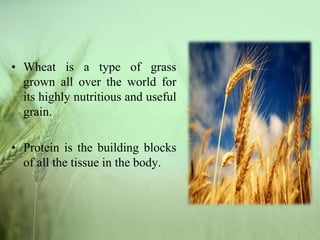
• Wheat is a type of grass
grown all over the world for
its highly nutritious and useful
grain.
• Protein is the building blocks
of all the tissue in the body.
has some properties specific to the baking
quality due to its special amino acid composition and
structure.
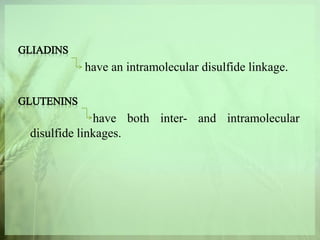
have an intramolecular disulfide linkage.
have both inter- and intramolecular
disulfide linkages.
• Determine viscoelastic properties of dough by
forming a continuous network.
• These proteins are characterized by unusually high
content of glutamine residues.
• A valuable source of plant protein.
• Gelation, emulsification, solubility, taste, foaming,
color, flavor formation after baking, water holding,
and fat absorption capacities.
• Closely related to its conformational state, which in
turn its influenced by processing conditions.
• Are mostly used in their native form, and a small
proportion is used in the form of protein concentrate
and vital and nonvital wheat gluten isolates.
• The storage protein of wheat are unique because they
are also functional proteins.
• They do not have enzyme activity, but they are only
cereal proteins to form a strong and cohesive dough
that will retain gas and produced light baked products.
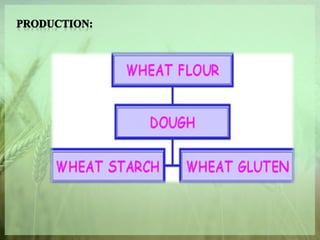
• They can be easily isolated by removing starch and
albumin/globulins by gently working dough under a
small stream of water. After washing, a rubbery ball is
left, which is called gluten.
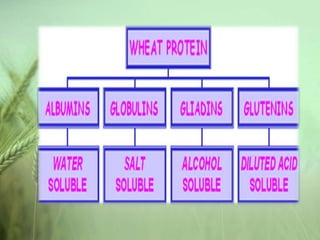
• Albumins are soluble in water or dilute salt solutions and
are coagulated by heat.
• Globulins are insoluble in pure water, but soluble in dilute
salt concentrations and insoluble at high salt
concentrations.
• Prolamins are soluble in aqueous alcohol.
• The glutelins are soluble in dilute acid or bases,
detergents, or dissociating (urea) or reducing (beta-
mercaptoethanol) agents.
• Are known for their role, along with glutenin, in the formation
of gluten.
• It is slightly soluble in ethanol and contains only intra-
molecule disulfide links.
• These proteins are essential to giving bread the ability to rise
properly and fix it's shape in baking. They are also some of the
best examples of food-derived pathogenesis. People with
gluten-sensitive enteropathy (the severe form of which is
coeliac disease) are sensitive to α, β, and γ gliadins.
TYPES OF GLIADIN
• α-/β-gliadins – soluble in low-percentage alcohols.
• γ-gliadins – ancestral form of cysteine-rich gliadin
with only intra-chain disulfide bridges
• ω-gliadins – soluble in higher percentages, 30–50%
acidic acetonitrile.
5 domains of α gliadins :
• Domain I – consist of nonrepetitive N-terminal
sequences and of repetitive sequences rich in
glutamine, proline, and aromatic amino acids.
• Domain II – contains a polyglutamine sequence
with a maximum of 18 residues of glutamine.
• Domain III & V – are homologous to the
corresponding domains of gamma-types gliadins
and low MW subunits of glutenin.
• Domain IV – is unique to alpha-type gliadins and
is rich in glutamine but poor in proline.
• The gamma-type gliadins are single monomeric
proteins with only intrachain disulfide bonds and are
considered to be the ancestral type of S-rich
prolamin.
GLUTENIN
• A protein best known for its role, along with gliadin, in the
creation of gluten with its disulfide inter- and intra-molecule
links.
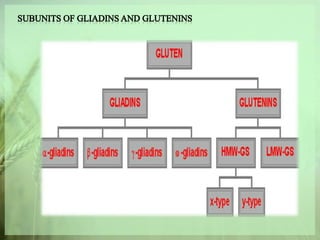
• Glutenin consists of 20% HMW (High-Molecular-Weight)
subunits, which are relatively low in sulfur. The other 80% are
LMW (Low-Molecular-Weight) subunits and are high in sulfur. It
is soluble in diluted acids and bases.
• Glutenin is responsible for the firmness of dough in baking bread
because it increases the stability through a 3-dimensional network
that forms when sulfur cross-linkages develop between protein
molecules during the kneading process.
Deamidated Gluten
• Gluten modification via deamidation can be achieved in two
ways, namely chemical deamidation (acid solubilization) under
acidic conditions and high temperature or enzymatic treatment.
• Deamidation of gluten proteins resulted in an increased charge
density on the protein, causing changes in protein conformation
due to electrostatic repulsion.
• Deamidation is a hydrolytic reaction, similar to the peptide-bond
cleavage reaction, which is catalyzed by proteases. It is catalyzed
by acids and bases (nucleophiles), and requires a water molecule .
THE END!
Thank you 

WHEAT_PROTEIN.ppt

  • 2.
    Outline of thePresentation: • Define Wheat and Protein • Four Basic Proteins • Production of Wheat Starch • Functional Properties of Wheat Protein • Gliadin • Glutenin • Deamidated Gluten
  • 3.
    • Wheat isa type of grass grown all over the world for its highly nutritious and useful grain. • Protein is the building blocks of all the tissue in the body.
  • 6.
    has some propertiesspecific to the baking quality due to its special amino acid composition and structure.
  • 7.
    have an intramoleculardisulfide linkage. have both inter- and intramolecular disulfide linkages.
  • 9.
    • Determine viscoelasticproperties of dough by forming a continuous network. • These proteins are characterized by unusually high content of glutamine residues. • A valuable source of plant protein. • Gelation, emulsification, solubility, taste, foaming, color, flavor formation after baking, water holding, and fat absorption capacities.
  • 10.
    • Closely relatedto its conformational state, which in turn its influenced by processing conditions. • Are mostly used in their native form, and a small proportion is used in the form of protein concentrate and vital and nonvital wheat gluten isolates.
  • 11.
    • The storageprotein of wheat are unique because they are also functional proteins. • They do not have enzyme activity, but they are only cereal proteins to form a strong and cohesive dough that will retain gas and produced light baked products. • They can be easily isolated by removing starch and albumin/globulins by gently working dough under a small stream of water. After washing, a rubbery ball is left, which is called gluten.
  • 12.
    • Albumins aresoluble in water or dilute salt solutions and are coagulated by heat. • Globulins are insoluble in pure water, but soluble in dilute salt concentrations and insoluble at high salt concentrations. • Prolamins are soluble in aqueous alcohol. • The glutelins are soluble in dilute acid or bases, detergents, or dissociating (urea) or reducing (beta- mercaptoethanol) agents.
  • 13.
    • Are knownfor their role, along with glutenin, in the formation of gluten. • It is slightly soluble in ethanol and contains only intra- molecule disulfide links. • These proteins are essential to giving bread the ability to rise properly and fix it's shape in baking. They are also some of the best examples of food-derived pathogenesis. People with gluten-sensitive enteropathy (the severe form of which is coeliac disease) are sensitive to α, β, and γ gliadins.
  • 14.
    TYPES OF GLIADIN •α-/β-gliadins – soluble in low-percentage alcohols. • γ-gliadins – ancestral form of cysteine-rich gliadin with only intra-chain disulfide bridges • ω-gliadins – soluble in higher percentages, 30–50% acidic acetonitrile.
  • 15.
    5 domains ofα gliadins : • Domain I – consist of nonrepetitive N-terminal sequences and of repetitive sequences rich in glutamine, proline, and aromatic amino acids. • Domain II – contains a polyglutamine sequence with a maximum of 18 residues of glutamine. • Domain III & V – are homologous to the corresponding domains of gamma-types gliadins and low MW subunits of glutenin. • Domain IV – is unique to alpha-type gliadins and is rich in glutamine but poor in proline.
  • 16.
    • The gamma-typegliadins are single monomeric proteins with only intrachain disulfide bonds and are considered to be the ancestral type of S-rich prolamin.
  • 17.
    GLUTENIN • A proteinbest known for its role, along with gliadin, in the creation of gluten with its disulfide inter- and intra-molecule links. • Glutenin consists of 20% HMW (High-Molecular-Weight) subunits, which are relatively low in sulfur. The other 80% are LMW (Low-Molecular-Weight) subunits and are high in sulfur. It is soluble in diluted acids and bases. • Glutenin is responsible for the firmness of dough in baking bread because it increases the stability through a 3-dimensional network that forms when sulfur cross-linkages develop between protein molecules during the kneading process.
  • 18.
    Deamidated Gluten • Glutenmodification via deamidation can be achieved in two ways, namely chemical deamidation (acid solubilization) under acidic conditions and high temperature or enzymatic treatment. • Deamidation of gluten proteins resulted in an increased charge density on the protein, causing changes in protein conformation due to electrostatic repulsion. • Deamidation is a hydrolytic reaction, similar to the peptide-bond cleavage reaction, which is catalyzed by proteases. It is catalyzed by acids and bases (nucleophiles), and requires a water molecule .
  • 19.