http://nanocarbon.famaf.unc.edu.ar/


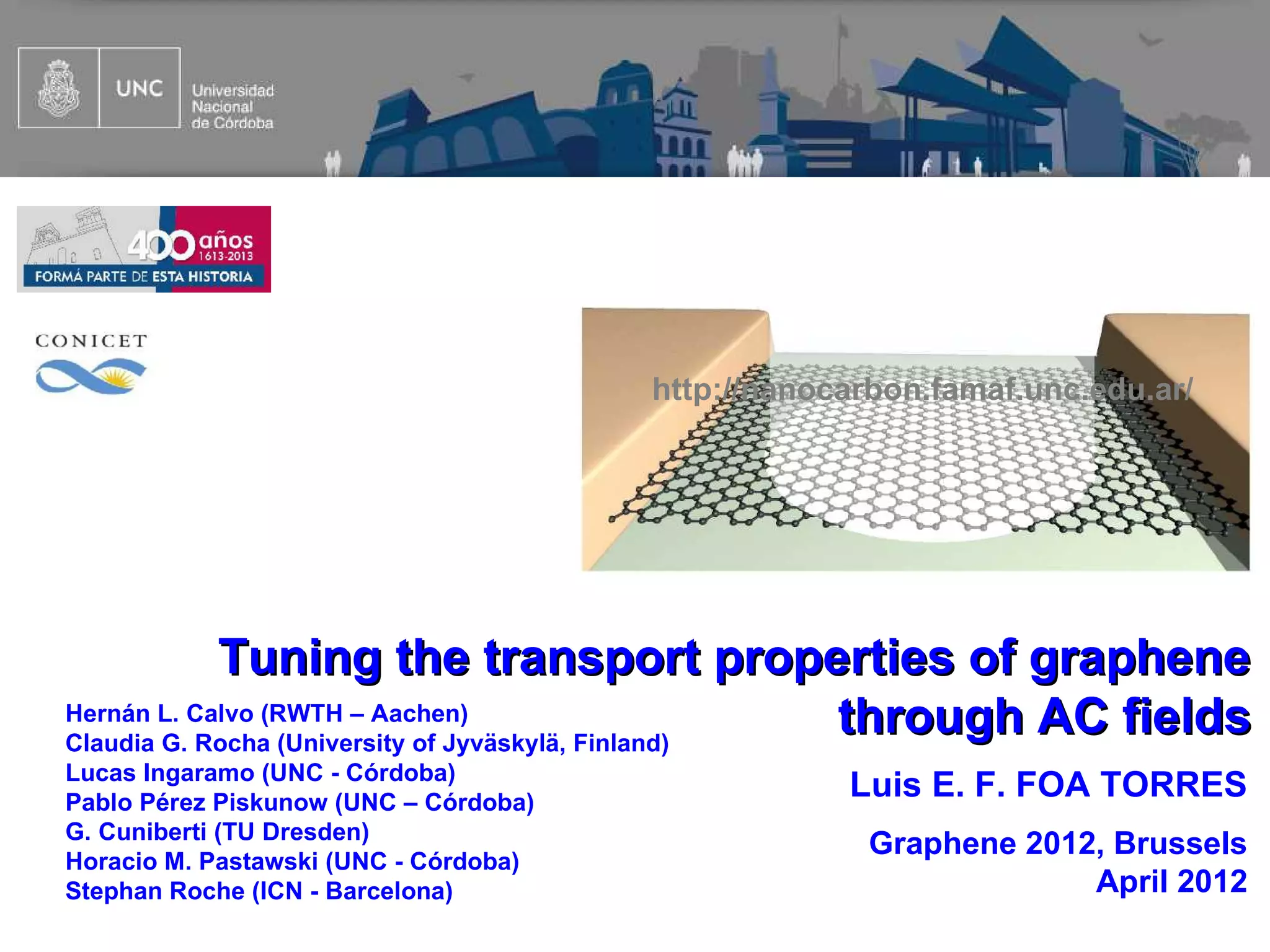
            Tuning the transport properties of graphene
Hernán L. Calvo (RWTH – Aachen)
Claudia G. Rocha (University of Jyväskylä, Finland)
                                                    through AC fields
Lucas Ingaramo (UNC - Córdoba)
Pablo Pérez Piskunow (UNC – Córdoba)
                                                   Luis E. F. FOA TORRES
G. Cuniberti (TU Dresden)
Horacio M. Pastawski (UNC - Córdoba)
                                                     Graphene 2012, Brussels
Stephan Roche (ICN - Barcelona)                                   April 2012
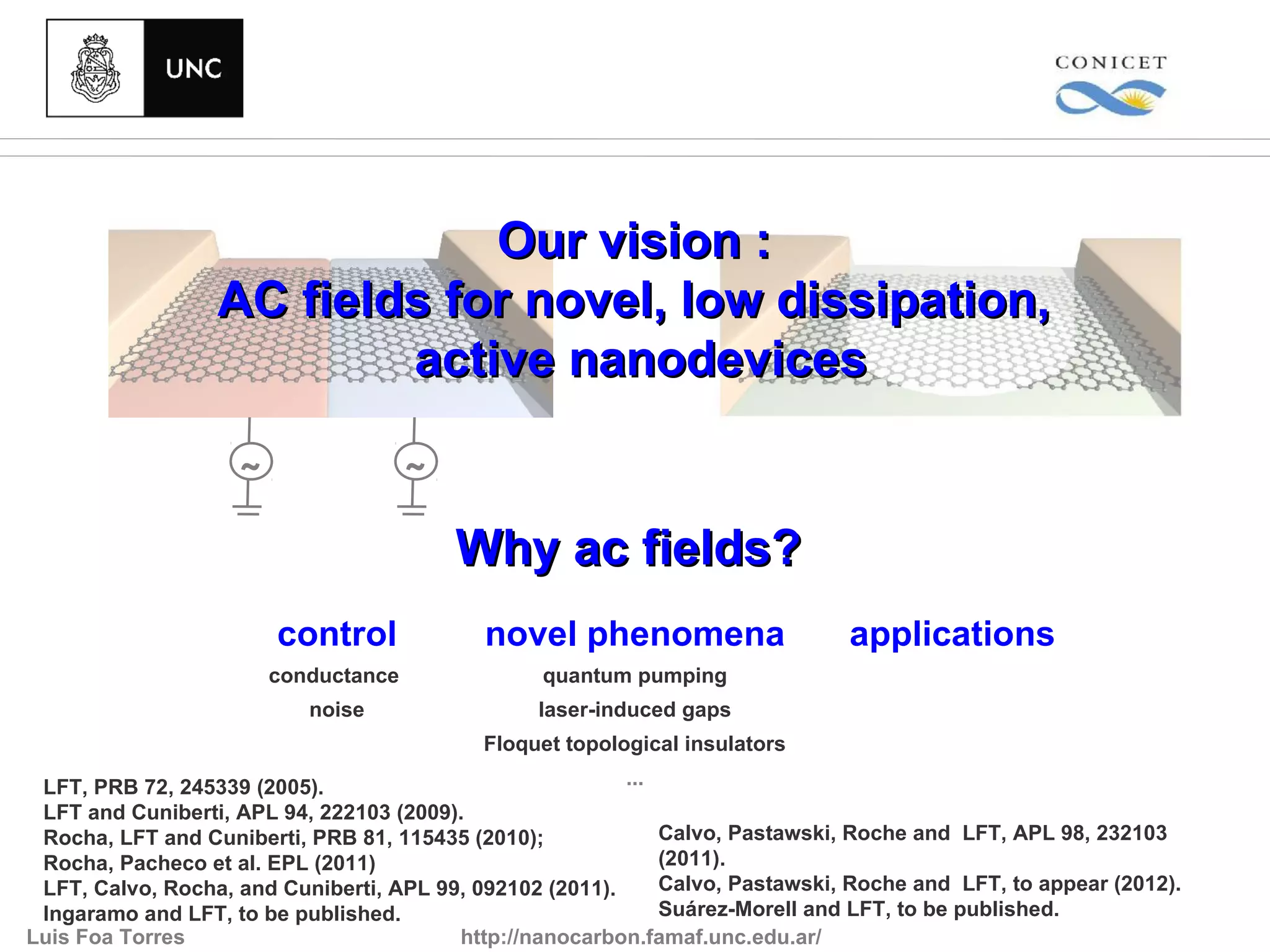
Our vision :
                  AC fields for novel, low dissipation,
                          active nanodevices

                    ~                 ~

                                          Why ac fields?
                        control             novel phenomena                    applications
                        conductance               quantum pumping
                           noise                 laser-induced gaps
                                            Floquet topological insulators

 LFT, PRB 72, 245339 (2005).                              ...
 LFT and Cuniberti, APL 94, 222103 (2009).
 Rocha, LFT and Cuniberti, PRB 81, 115435 (2010);             Calvo, Pastawski, Roche and LFT, APL 98, 232103
 Rocha, Pacheco et al. EPL (2011)                             (2011).
 LFT, Calvo, Rocha, and Cuniberti, APL 99, 092102 (2011).     Calvo, Pastawski, Roche and LFT, to appear (2012).
 Ingaramo and LFT, to be published.                           Suárez-Morell and LFT, to be published.
Luis Foa Torres                          http://nanocarbon.famaf.unc.edu.ar/
S. V. Syzranov, M. V. Fistul, and K. B. Efetov, PRB 78, 045407 (2008).                microwaves
T. Oka and H. Aoki, PRB 79, 081406(R) (2009) “Photovoltaic Hall effect in graphene”        visible light


         Could a laser induce a measurable gap
                      in graphene?
  How and for which frequencies / intensities / polarization?


    Idea: Exploit the low dimensionality and the peculiar electronic
                         structure of graphene.
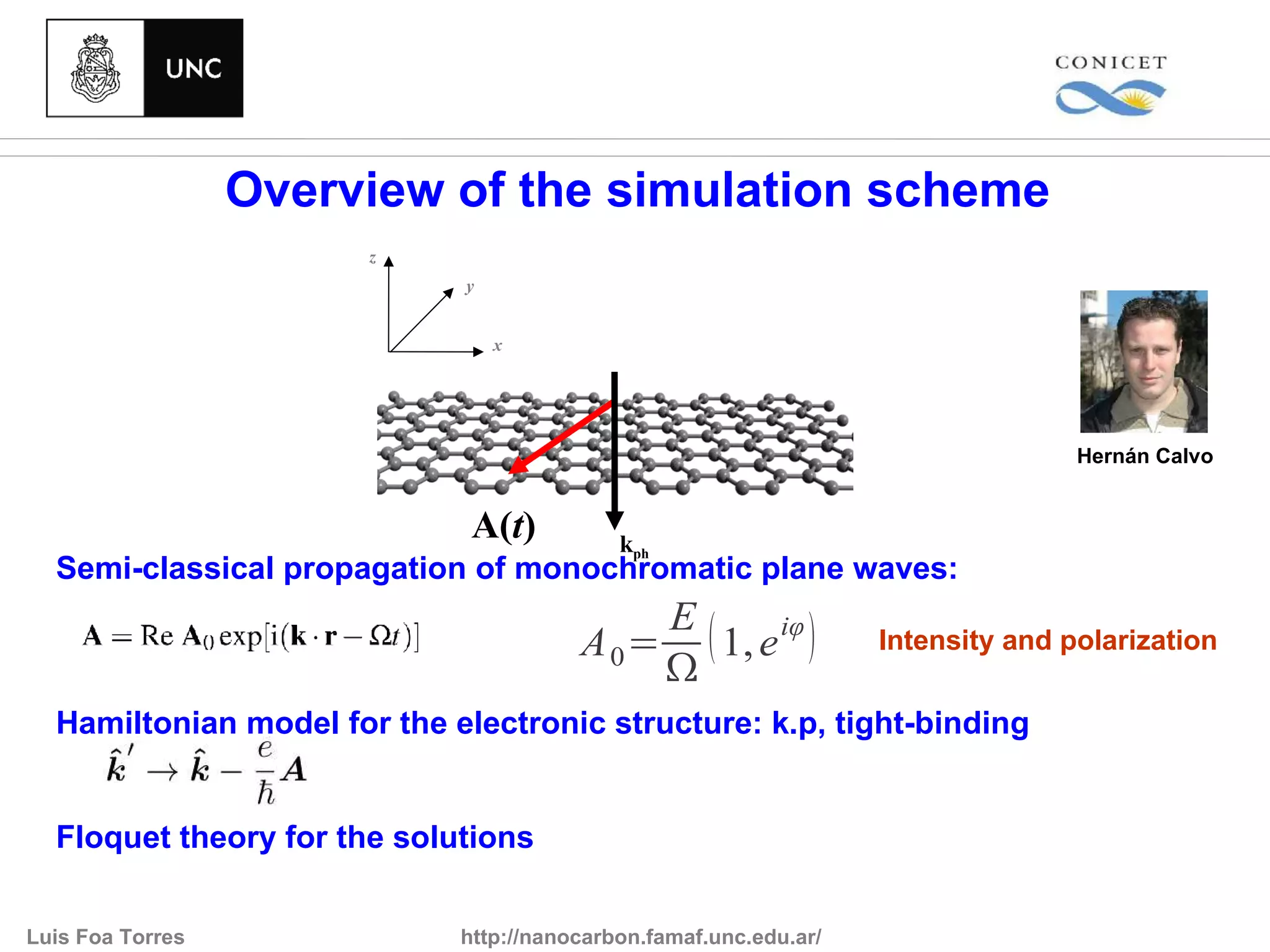
Overview of the simulation scheme
                       z
                             y


                                 x


                                                                                  Hernán Calvo


                              A(t)          kph
  Semi-classical propagation of monochromatic plane waves:
                                                  E
                                        A 0=        ( 1, e iφ )    Intensity and polarization
                                                  Ω
  Hamiltonian model for the electronic structure: k.p, tight-binding


  Floquet theory for the solutions


Luis Foa Torres              http://nanocarbon.famaf.unc.edu.ar/
Contents not available for the online version.
           For more info please check
                                         http://nanocarbon.famaf.unc.edu.ar/


Luis Foa Torres                http://nanocarbon.famaf.unc.edu.ar/
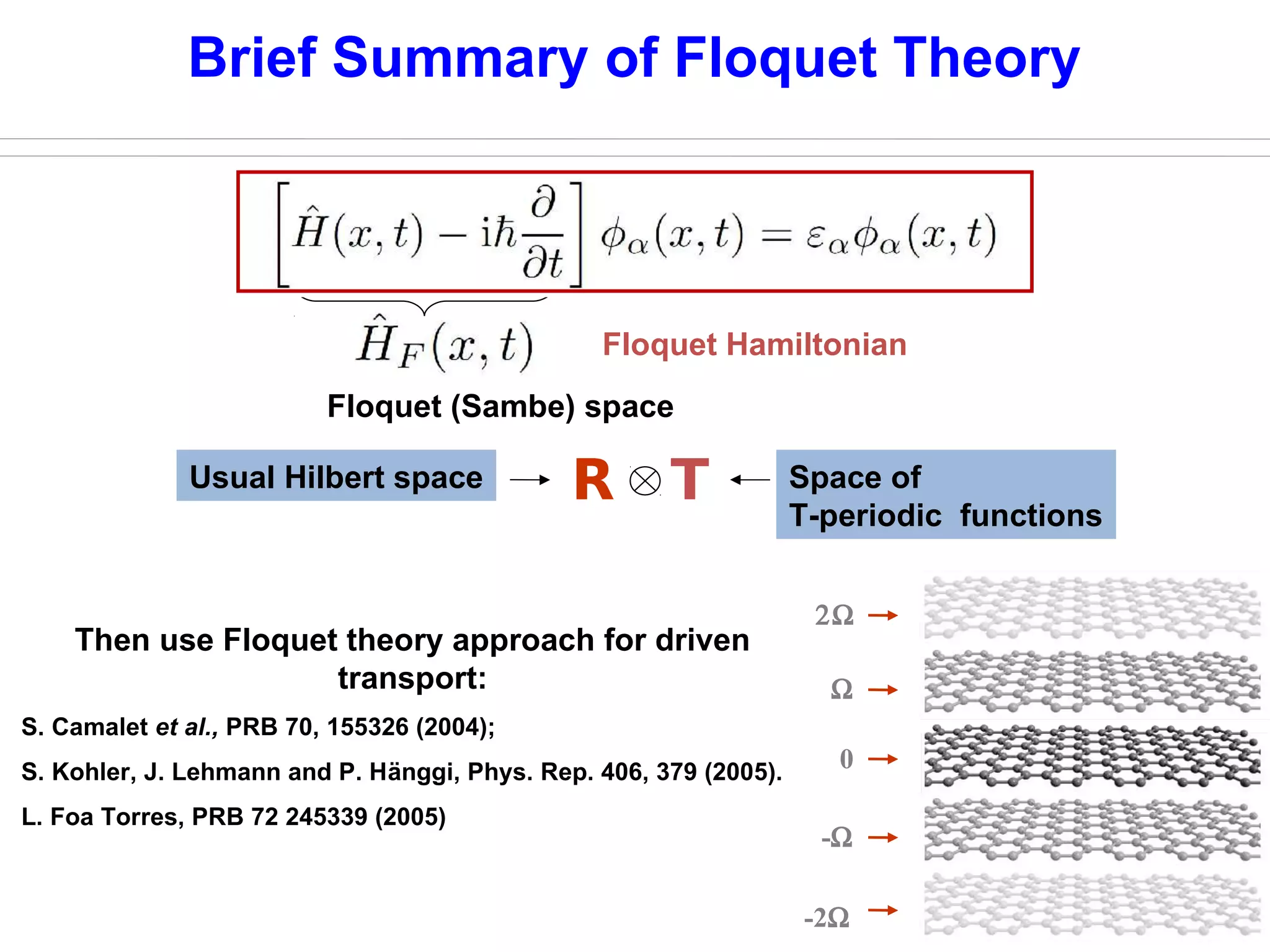
Brief Summary of Floquet Theory


                                                Floquet Hamiltonian
                          Floquet (Sambe) space

              Usual Hilbert space             R T                  Space of
                                                                   T-periodic functions


                                                                    2Ω
    Then use Floquet theory approach for driven
                    transport:                                       Ω
S. Camalet et al., PRB 70, 155326 (2004);
S. Kohler, J. Lehmann and P. Hänggi, Phys. Rep. 406, 379 (2005).      0

L. Foa Torres, PRB 72 245339 (2005)
                                                                     -Ω

                                                                   -2Ω
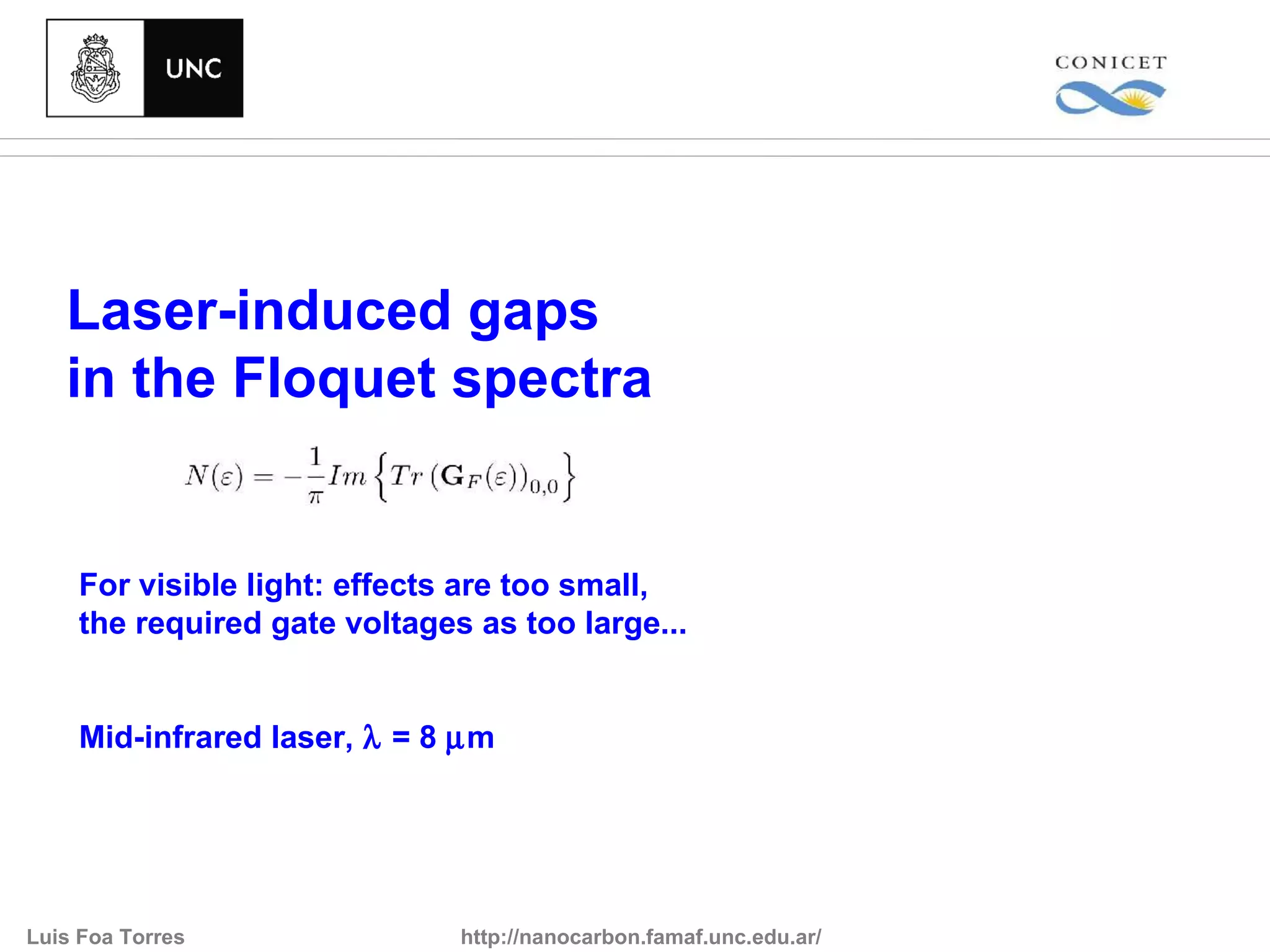
Laser-induced gaps
   in the Floquet spectra


    For visible light: effects are too small,
    the required gate voltages as too large...


    Mid-infrared laser, λ = 8 µm


Luis Foa Torres               http://nanocarbon.famaf.unc.edu.ar/
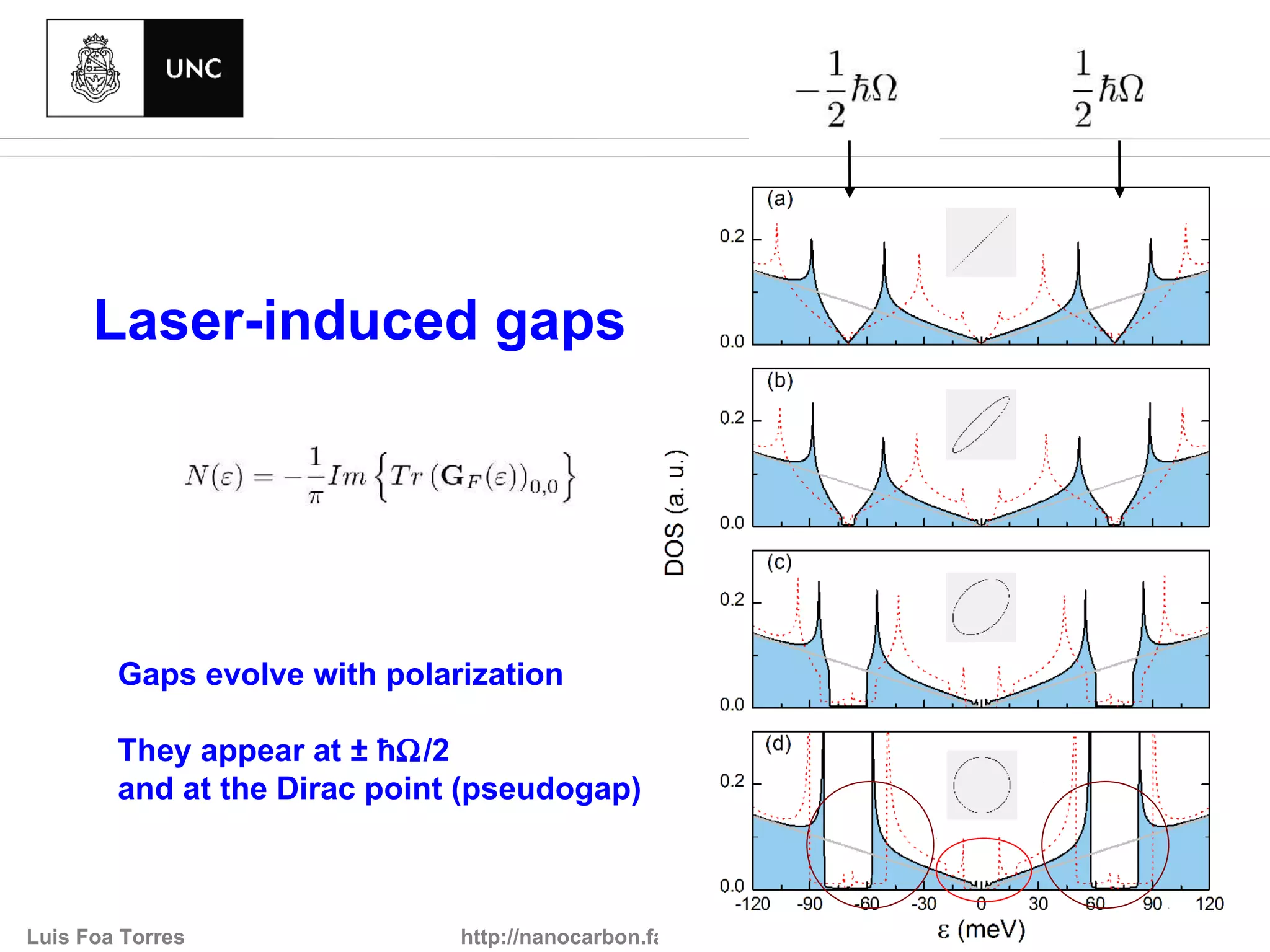
Laser-induced gaps


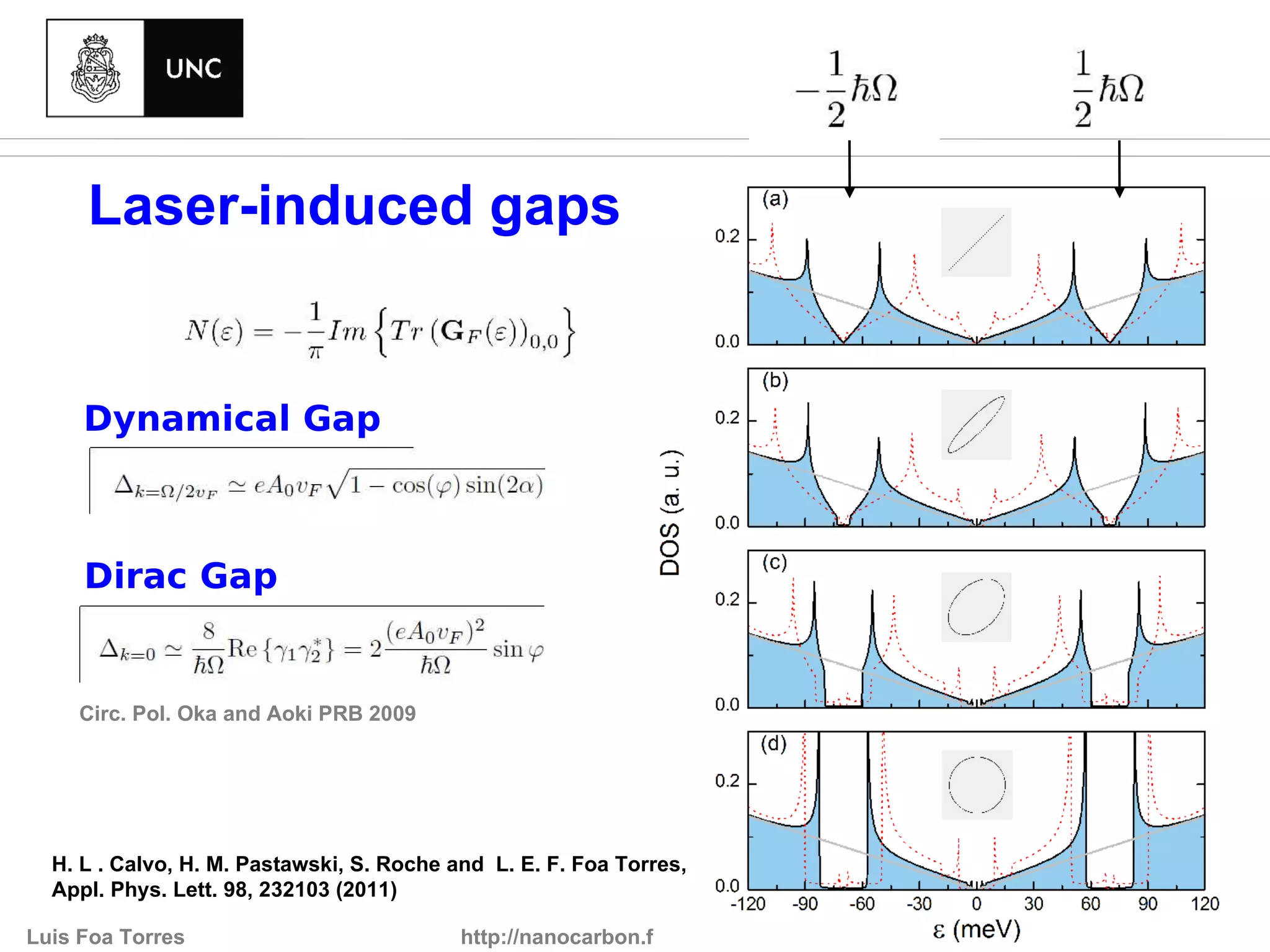
        Gaps evolve with polarization

        They appear at ± ħΩ/2
        and at the Dirac point (pseudogap)


Luis Foa Torres               http://nanocarbon.famaf.unc.edu.ar/
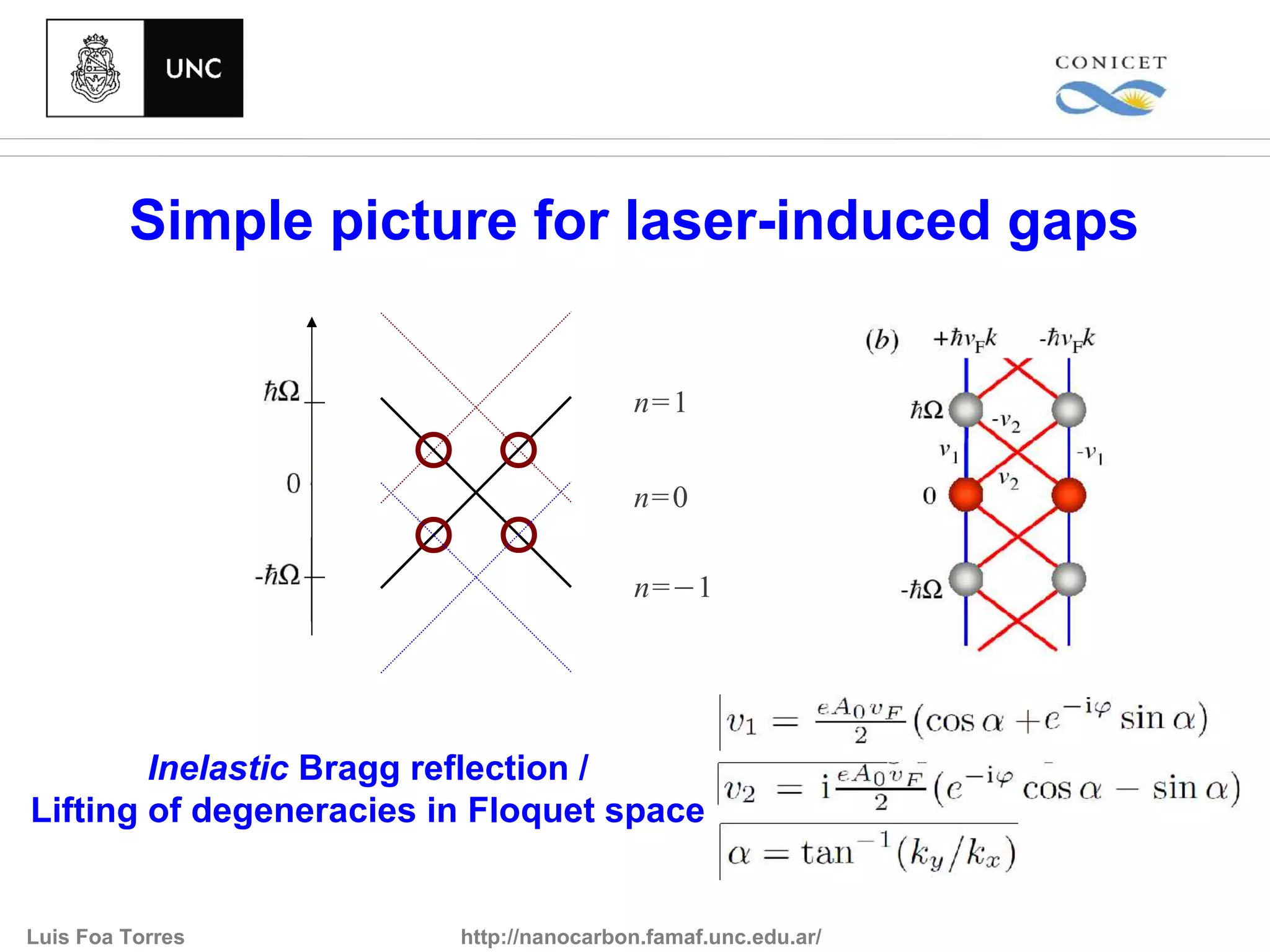
Simple picture for laser-induced gaps


                                         n=1


                                         n=0

                                         n=−1


        Inelastic Bragg reflection /
Lifting of degeneracies in Floquet space


Luis Foa Torres          http://nanocarbon.famaf.unc.edu.ar/
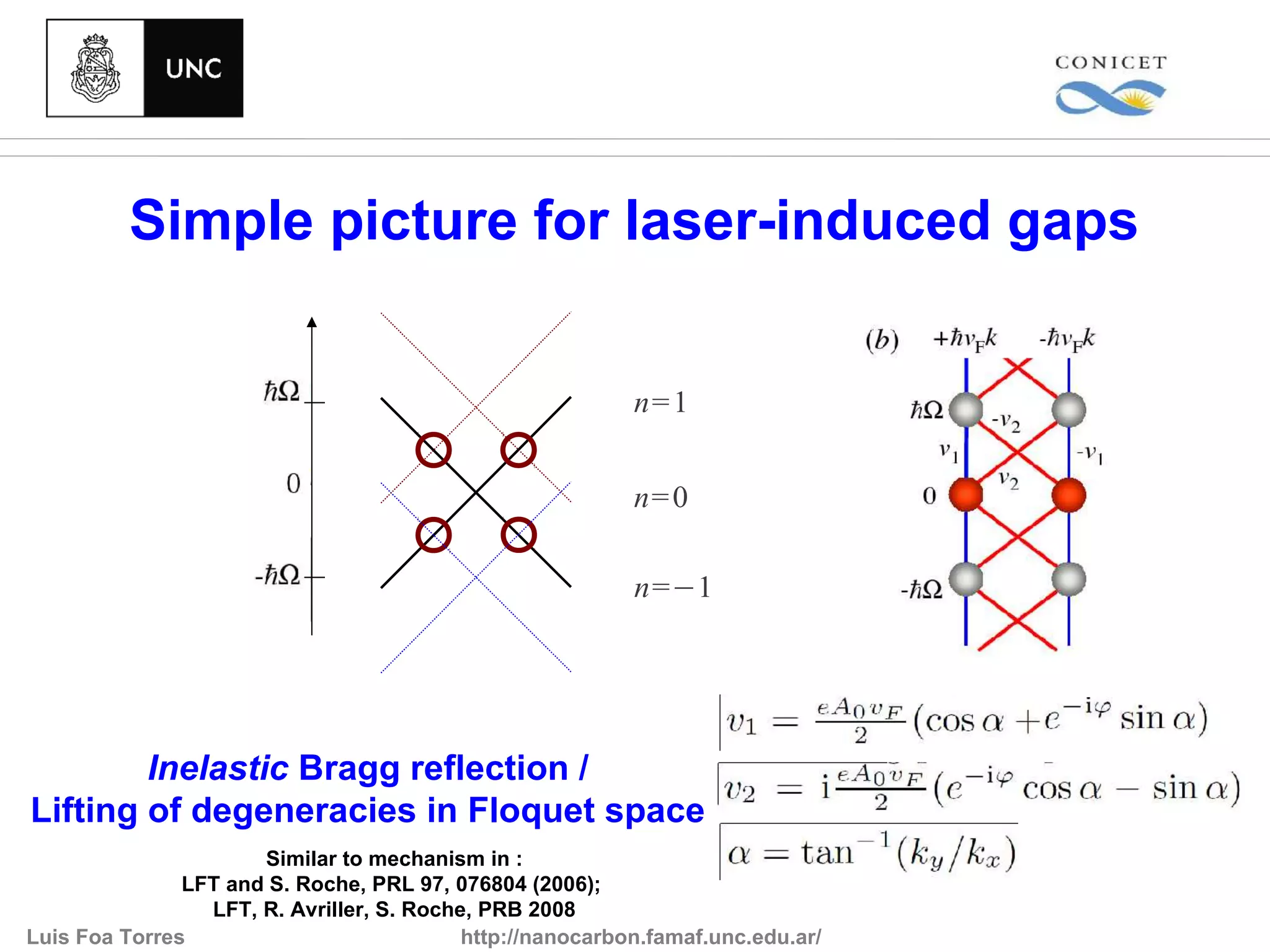
Simple picture for laser-induced gaps


                                                           n=1


                                                           n=0

                                                           n=−1


        Inelastic Bragg reflection /
Lifting of degeneracies in Floquet space
                      Similar to mechanism in :
               LFT and S. Roche, PRL 97, 076804 (2006);
                 LFT, R. Avriller, S. Roche, PRB 2008
Luis Foa Torres                            http://nanocarbon.famaf.unc.edu.ar/
Laser-induced gaps


     Dynamical Gap


     Dirac Gap


    Circ. Pol. Oka and Aoki PRB 2009


  H. L . Calvo, H. M. Pastawski, S. Roche and L. E. F. Foa Torres,
  Appl. Phys. Lett. 98, 232103 (2011)

Luis Foa Torres                            http://nanocarbon.famaf.unc.edu.ar/
What about the influence on transport?

Observable effects of these gaps in the
         Floquet spectra ?


                                     04/20/12
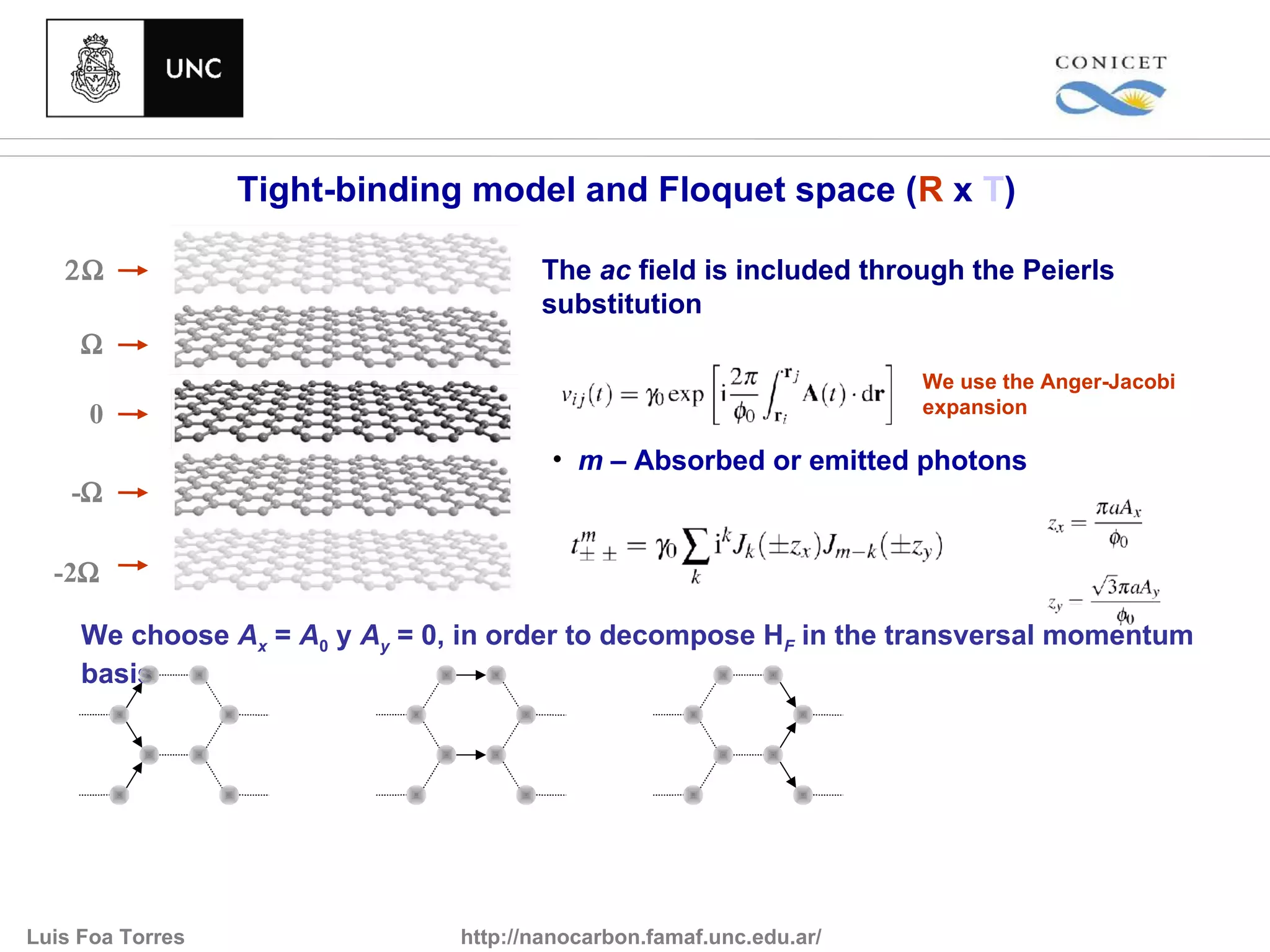
Tight-binding model and Floquet space (R x T)

   2Ω                                  The ac field is included through the Peierls
                                       substitution
     Ω
                                                                      We use the Anger-Jacobi
     0                                                                expansion

                                        • m – Absorbed or emitted photons
    -Ω

  -2Ω

     We choose Ax = A0 y Ay = 0, in order to decompose HF in the transversal momentum
     basis


Luis Foa Torres                 http://nanocarbon.famaf.unc.edu.ar/
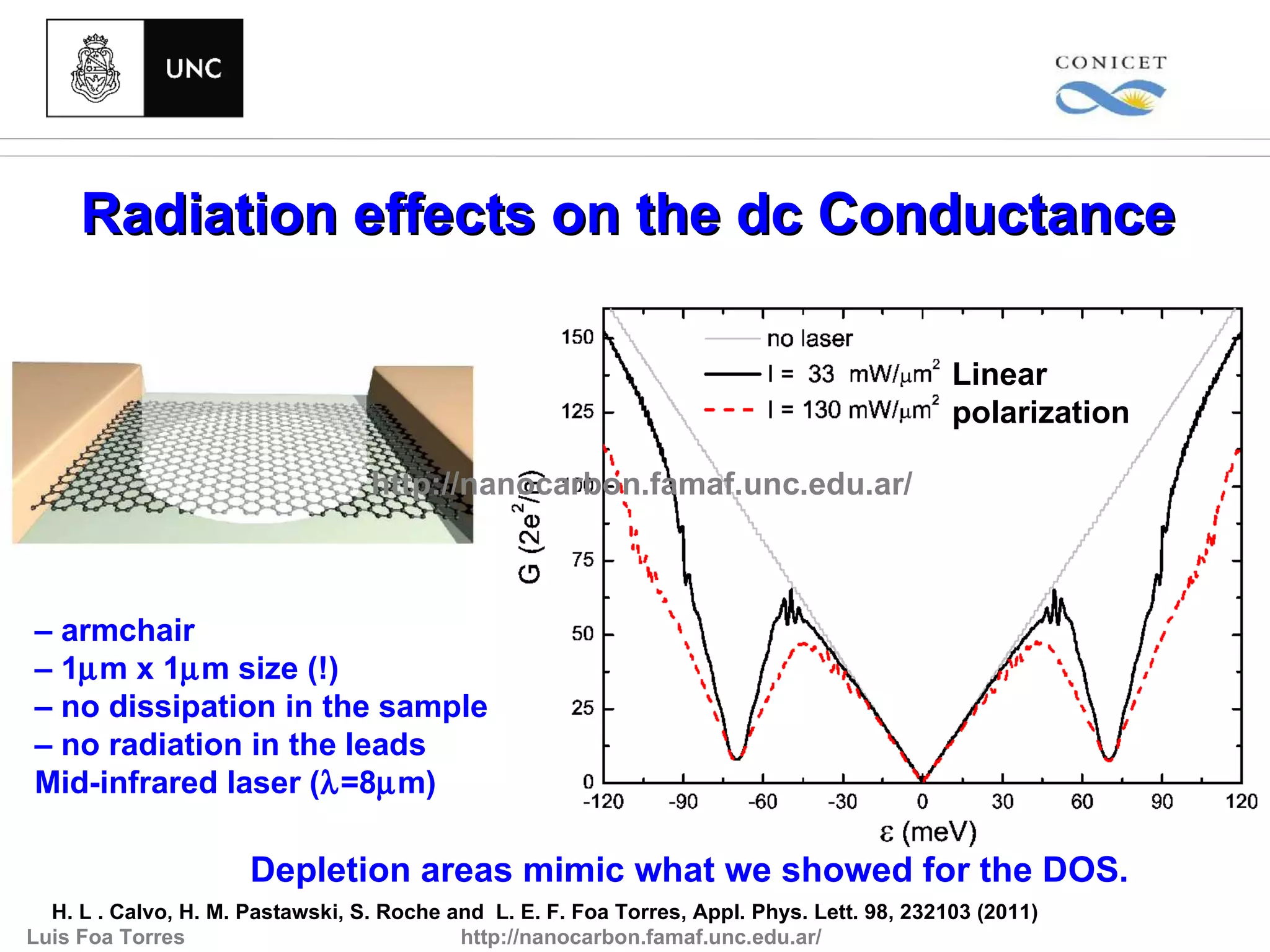
Radiation effects on the dc Conductance

                                                                                             Linear
                                                                                             polarization

                                  http://nanocarbon.famaf.unc.edu.ar/


– armchair
– 1µm x 1µm size (!)
– no dissipation in the sample
– no radiation in the leads
Mid-infrared laser (λ=8µm)

                      Depletion areas mimic what we showed for the DOS.
  H. L . Calvo, H. M. Pastawski, S. Roche and L. E. F. Foa Torres, Appl. Phys. Lett. 98, 232103 (2011)
Luis Foa Torres                            http://nanocarbon.famaf.unc.edu.ar/
What about nanoribbons?

           Contents not available for the online version.
           For more info please check
                                         http://nanocarbon.famaf.unc.edu.ar/


Luis Foa Torres                http://nanocarbon.famaf.unc.edu.ar/
Power and Temperature dependence


           Contents not available for the online version.
           For more info please check
                                         http://nanocarbon.famaf.unc.edu.ar/


Luis Foa Torres                http://nanocarbon.famaf.unc.edu.ar/
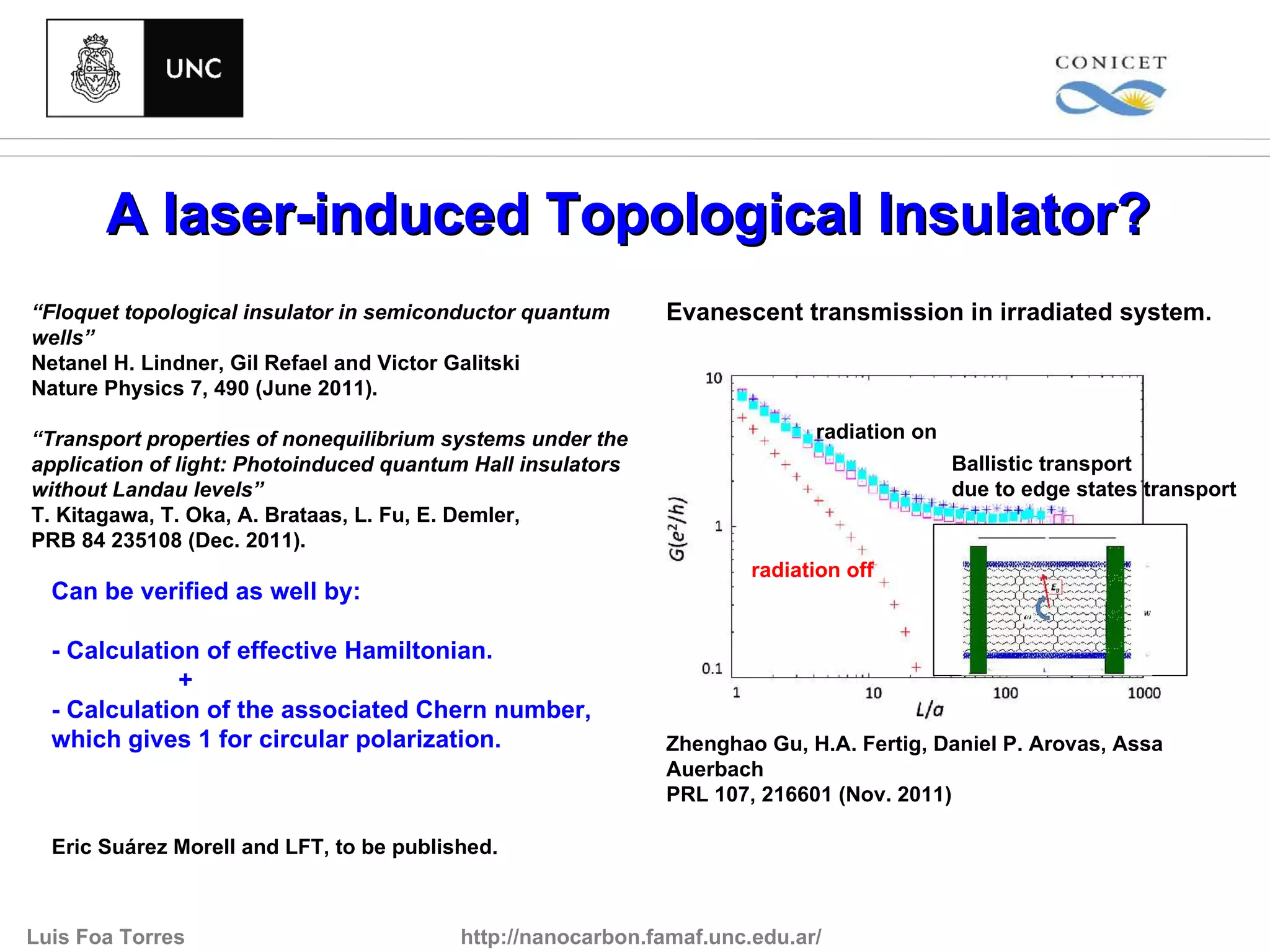
A laser-induced Topological Insulator?
“Floquet topological insulator in semiconductor quantum      Evanescent transmission in irradiated system.
wells”
Netanel H. Lindner, Gil Refael and Victor Galitski
Nature Physics 7, 490 (June 2011).

“Transport properties of nonequilibrium systems under the                   radiation on
application of light: Photoinduced quantum Hall insulators                                 Ballistic transport
without Landau levels”                                                                     due to edge states transport
T. Kitagawa, T. Oka, A. Brataas, L. Fu, E. Demler,
PRB 84 235108 (Dec. 2011).
                                                                      radiation off
  Can be verified as well by:

  - Calculation of effective Hamiltonian.
              +
  - Calculation of the associated Chern number,
  which gives 1 for circular polarization.                   Zhenghao Gu, H.A. Fertig, Daniel P. Arovas, Assa
                                                             Auerbach
                                                             PRL 107, 216601 (Nov. 2011)

  Eric Suárez Morell and LFT, to be published.


Luis Foa Torres                           http://nanocarbon.famaf.unc.edu.ar/
Contents not available for the online version.
           For more info please check
                                         http://nanocarbon.famaf.unc.edu.ar/


Luis Foa Torres                http://nanocarbon.famaf.unc.edu.ar/
Conclusions
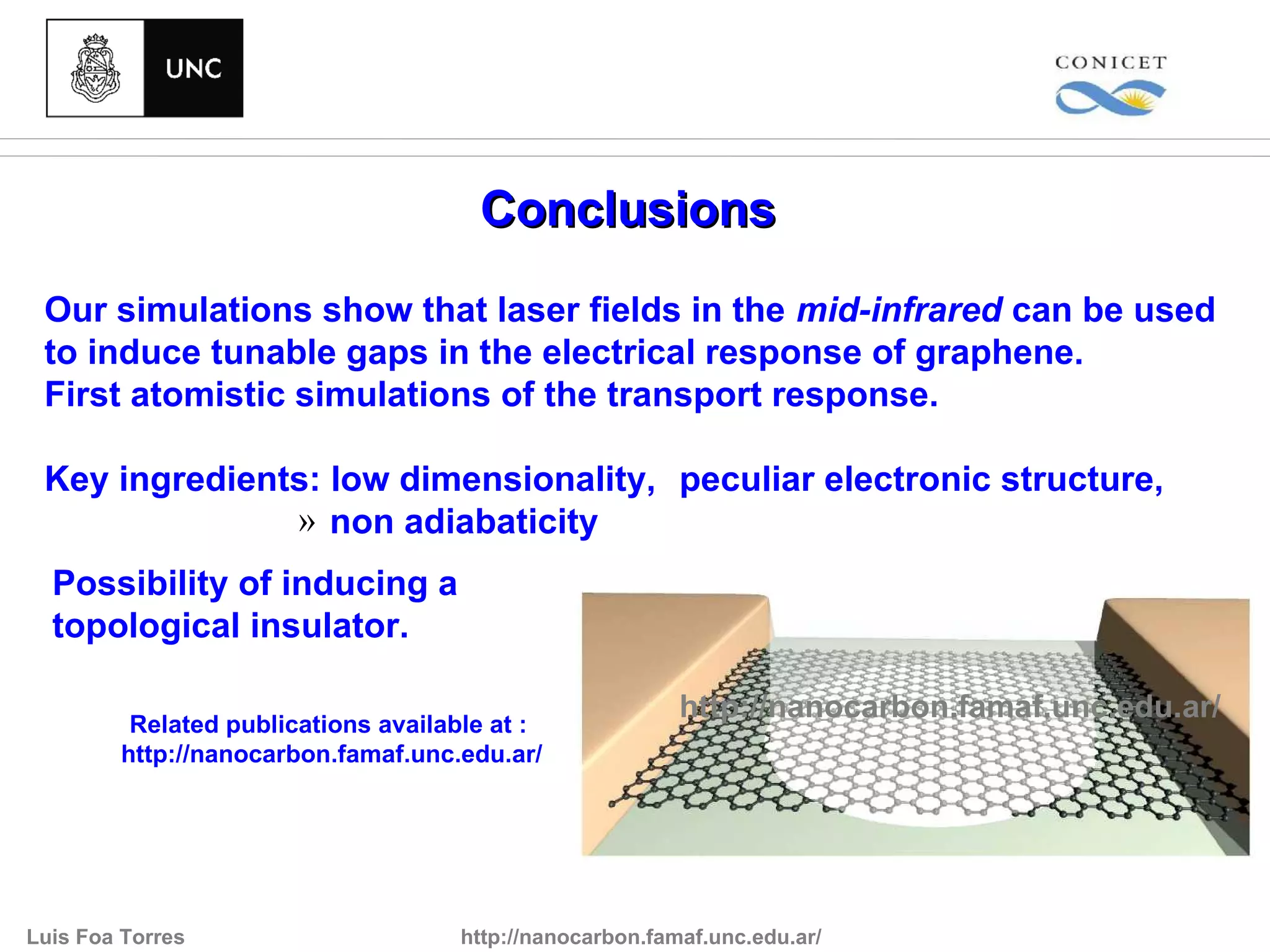
 Our simulations show that laser fields in the mid-infrared can be used
 to induce tunable gaps in the electrical response of graphene.
 First atomistic simulations of the transport response.

 Key ingredients: low dimensionality, peculiar electronic structure,
               » non adiabaticity
  Possibility of inducing a
  topological insulator.

         Related publications available at :
                                                          http://nanocarbon.famaf.unc.edu.ar/
        http://nanocarbon.famaf.unc.edu.ar/


Luis Foa Torres                      http://nanocarbon.famaf.unc.edu.ar/
Thank you!
                                                                           Gracias!

                                                                      |


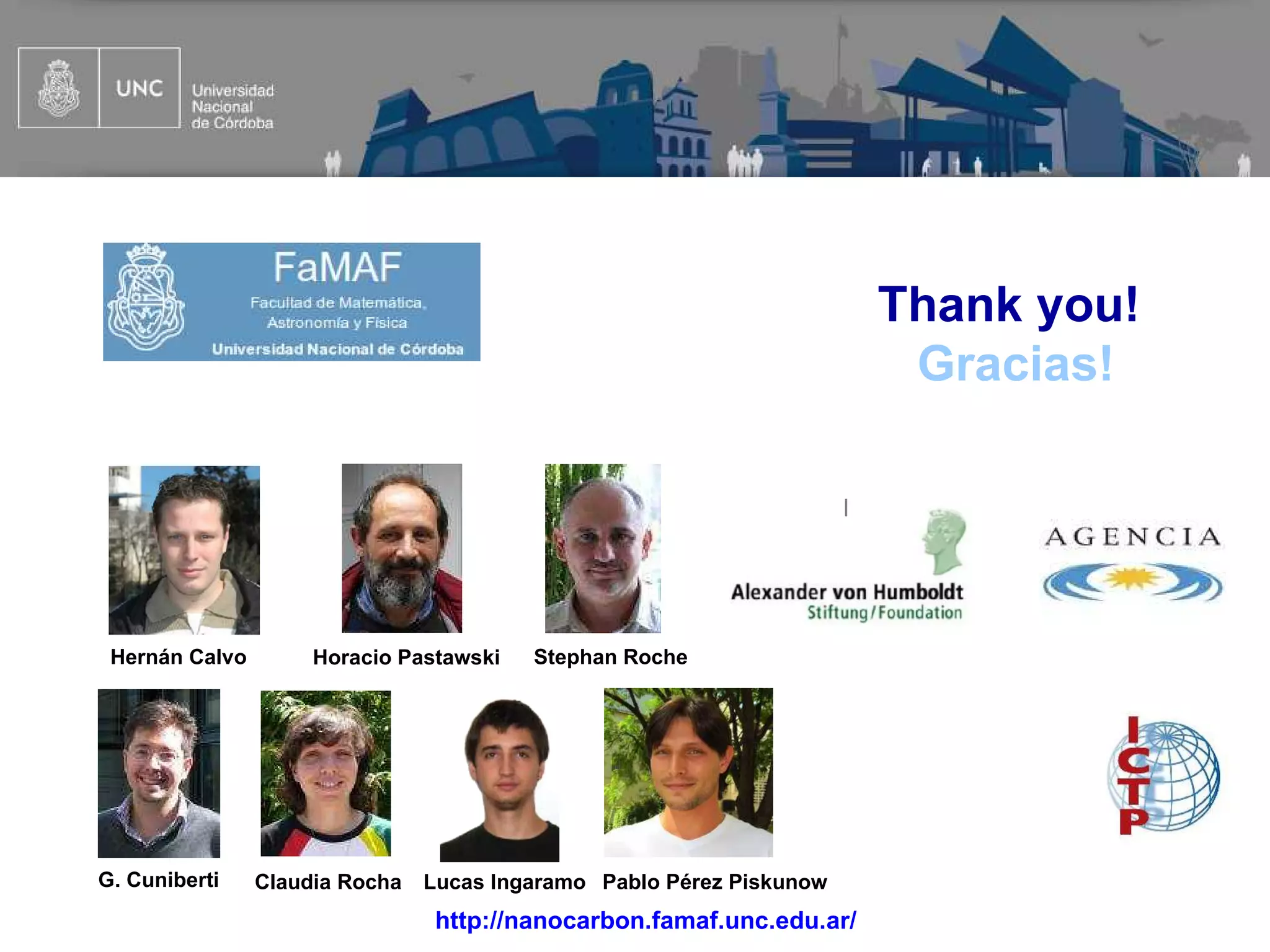
 Hernán Calvo        Horacio Pastawski   Stephan Roche


G. Cuniberti    Claudia Rocha   Lucas Ingaramo Pablo Pérez Piskunow
                                 http://nanocarbon.famaf.unc.edu.ar/

Tuning the transport properties of graphene through ac fields

  • 1.
    http://nanocarbon.famaf.unc.edu.ar/ Tuning the transport properties of graphene Hernán L. Calvo (RWTH – Aachen) Claudia G. Rocha (University of Jyväskylä, Finland) through AC fields Lucas Ingaramo (UNC - Córdoba) Pablo Pérez Piskunow (UNC – Córdoba) Luis E. F. FOA TORRES G. Cuniberti (TU Dresden) Horacio M. Pastawski (UNC - Córdoba) Graphene 2012, Brussels Stephan Roche (ICN - Barcelona) April 2012
  • 2.
    Our vision : AC fields for novel, low dissipation, active nanodevices ~ ~ Why ac fields? control novel phenomena applications conductance quantum pumping noise laser-induced gaps Floquet topological insulators LFT, PRB 72, 245339 (2005). ... LFT and Cuniberti, APL 94, 222103 (2009). Rocha, LFT and Cuniberti, PRB 81, 115435 (2010); Calvo, Pastawski, Roche and LFT, APL 98, 232103 Rocha, Pacheco et al. EPL (2011) (2011). LFT, Calvo, Rocha, and Cuniberti, APL 99, 092102 (2011). Calvo, Pastawski, Roche and LFT, to appear (2012). Ingaramo and LFT, to be published. Suárez-Morell and LFT, to be published. Luis Foa Torres http://nanocarbon.famaf.unc.edu.ar/
  • 3.
    S. V. Syzranov,M. V. Fistul, and K. B. Efetov, PRB 78, 045407 (2008). microwaves T. Oka and H. Aoki, PRB 79, 081406(R) (2009) “Photovoltaic Hall effect in graphene” visible light Could a laser induce a measurable gap in graphene? How and for which frequencies / intensities / polarization? Idea: Exploit the low dimensionality and the peculiar electronic structure of graphene.
  • 4.
    Overview of thesimulation scheme z y x Hernán Calvo A(t) kph Semi-classical propagation of monochromatic plane waves: E A 0= ( 1, e iφ ) Intensity and polarization Ω Hamiltonian model for the electronic structure: k.p, tight-binding Floquet theory for the solutions Luis Foa Torres http://nanocarbon.famaf.unc.edu.ar/
  • 5.
    Contents not availablefor the online version. For more info please check http://nanocarbon.famaf.unc.edu.ar/ Luis Foa Torres http://nanocarbon.famaf.unc.edu.ar/
  • 6.
    Brief Summary ofFloquet Theory Floquet Hamiltonian Floquet (Sambe) space Usual Hilbert space R T Space of T-periodic functions 2Ω Then use Floquet theory approach for driven transport: Ω S. Camalet et al., PRB 70, 155326 (2004); S. Kohler, J. Lehmann and P. Hänggi, Phys. Rep. 406, 379 (2005). 0 L. Foa Torres, PRB 72 245339 (2005) -Ω -2Ω
  • 7.
    Laser-induced gaps in the Floquet spectra For visible light: effects are too small, the required gate voltages as too large... Mid-infrared laser, λ = 8 µm Luis Foa Torres http://nanocarbon.famaf.unc.edu.ar/
  • 8.
    Laser-induced gaps Gaps evolve with polarization They appear at ± ħΩ/2 and at the Dirac point (pseudogap) Luis Foa Torres http://nanocarbon.famaf.unc.edu.ar/
  • 9.
    Simple picture forlaser-induced gaps n=1 n=0 n=−1 Inelastic Bragg reflection / Lifting of degeneracies in Floquet space Luis Foa Torres http://nanocarbon.famaf.unc.edu.ar/
  • 10.
    Simple picture forlaser-induced gaps n=1 n=0 n=−1 Inelastic Bragg reflection / Lifting of degeneracies in Floquet space Similar to mechanism in : LFT and S. Roche, PRL 97, 076804 (2006); LFT, R. Avriller, S. Roche, PRB 2008 Luis Foa Torres http://nanocarbon.famaf.unc.edu.ar/
  • 11.
    Laser-induced gaps Dynamical Gap Dirac Gap Circ. Pol. Oka and Aoki PRB 2009 H. L . Calvo, H. M. Pastawski, S. Roche and L. E. F. Foa Torres, Appl. Phys. Lett. 98, 232103 (2011) Luis Foa Torres http://nanocarbon.famaf.unc.edu.ar/
  • 12.
    What about theinfluence on transport? Observable effects of these gaps in the Floquet spectra ? 04/20/12
  • 13.
    Tight-binding model andFloquet space (R x T) 2Ω The ac field is included through the Peierls substitution Ω We use the Anger-Jacobi 0 expansion • m – Absorbed or emitted photons -Ω -2Ω We choose Ax = A0 y Ay = 0, in order to decompose HF in the transversal momentum basis Luis Foa Torres http://nanocarbon.famaf.unc.edu.ar/
  • 14.
    Radiation effects onthe dc Conductance Linear polarization http://nanocarbon.famaf.unc.edu.ar/ – armchair – 1µm x 1µm size (!) – no dissipation in the sample – no radiation in the leads Mid-infrared laser (λ=8µm) Depletion areas mimic what we showed for the DOS. H. L . Calvo, H. M. Pastawski, S. Roche and L. E. F. Foa Torres, Appl. Phys. Lett. 98, 232103 (2011) Luis Foa Torres http://nanocarbon.famaf.unc.edu.ar/
  • 15.
    What about nanoribbons? Contents not available for the online version. For more info please check http://nanocarbon.famaf.unc.edu.ar/ Luis Foa Torres http://nanocarbon.famaf.unc.edu.ar/
  • 16.
    Power and Temperaturedependence Contents not available for the online version. For more info please check http://nanocarbon.famaf.unc.edu.ar/ Luis Foa Torres http://nanocarbon.famaf.unc.edu.ar/
  • 17.
    A laser-induced TopologicalInsulator? “Floquet topological insulator in semiconductor quantum Evanescent transmission in irradiated system. wells” Netanel H. Lindner, Gil Refael and Victor Galitski Nature Physics 7, 490 (June 2011). “Transport properties of nonequilibrium systems under the radiation on application of light: Photoinduced quantum Hall insulators Ballistic transport without Landau levels” due to edge states transport T. Kitagawa, T. Oka, A. Brataas, L. Fu, E. Demler, PRB 84 235108 (Dec. 2011). radiation off Can be verified as well by: - Calculation of effective Hamiltonian. + - Calculation of the associated Chern number, which gives 1 for circular polarization. Zhenghao Gu, H.A. Fertig, Daniel P. Arovas, Assa Auerbach PRL 107, 216601 (Nov. 2011) Eric Suárez Morell and LFT, to be published. Luis Foa Torres http://nanocarbon.famaf.unc.edu.ar/
  • 18.
    Contents not availablefor the online version. For more info please check http://nanocarbon.famaf.unc.edu.ar/ Luis Foa Torres http://nanocarbon.famaf.unc.edu.ar/
  • 19.
    Conclusions Our simulationsshow that laser fields in the mid-infrared can be used to induce tunable gaps in the electrical response of graphene. First atomistic simulations of the transport response. Key ingredients: low dimensionality, peculiar electronic structure, » non adiabaticity Possibility of inducing a topological insulator. Related publications available at : http://nanocarbon.famaf.unc.edu.ar/ http://nanocarbon.famaf.unc.edu.ar/ Luis Foa Torres http://nanocarbon.famaf.unc.edu.ar/
  • 20.
    Thank you! Gracias! | Hernán Calvo Horacio Pastawski Stephan Roche G. Cuniberti Claudia Rocha Lucas Ingaramo Pablo Pérez Piskunow http://nanocarbon.famaf.unc.edu.ar/