WHAT WE
DIDN’T KNOW
ABOUT
ASTRONOMY
We are living in a new golden age of planetary discovery.
Man’s quest for flight
https://goo.gl/images/jwGqju
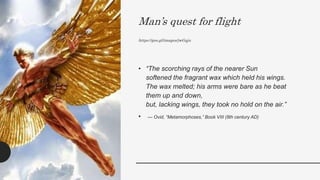
• “The scorching rays of the nearer Sun
softened the fragrant wax which held his wings.
The wax melted; his arms were bare as he beat
them up and down,
but, lacking wings, they took no hold on the air.”
• — Ovid, “Metamorphoses,” Book VIII (8th century AD)
TO NAVIGATE THE
SEAS OF THE SUN:
NASA'S SOLAR PROBE
PLUS MISSION TO THE
NEAREST STAR
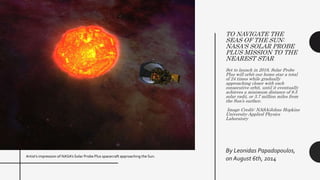
Set to launch in 2018, Solar Probe
Plus will orbit our home star a total
of 24 times while gradually
approaching closer with each
consecutive orbit, until it eventually
achieves a minimum distance of 8.5
solar radii, or 3.7 million miles from
the Sun’s surface.
Image Credit: NASA/Johns Hopkins
University Applied Physics
Laboratory
By Leonidas Papadopoulos,
on August 6th, 2014Artist’s impression of NASA’s Solar Probe Plus spacecraft approaching the Sun.
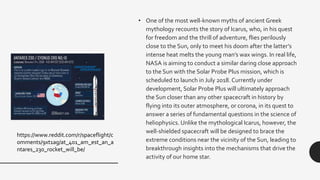
• One of the most well-known myths of ancient Greek
mythology recounts the story of Icarus, who, in his quest
for freedom and the thrill of adventure, flies perilously
close to the Sun, only to meet his doom after the latter’s
intense heat melts the young man’s wax wings. In real life,
NASA is aiming to conduct a similar daring close approach
to the Sun with the Solar Probe Plus mission, which is
scheduled to launch in July 2018. Currently under
development, Solar Probe Plus will ultimately approach
the Sun closer than any other spacecraft in history by
flying into its outer atmosphere, or corona, in its quest to
answer a series of fundamental questions in the science of
heliophysics. Unlike the mythological Icarus, however, the
well-shielded spacecraft will be designed to brace the
extreme conditions near the vicinity of the Sun, leading to
breakthrough insights into the mechanisms that drive the
activity of our home star.
https://www.reddit.com/r/spaceflight/c
omments/9xt1ag/at_401_am_est_an_a
ntares_230_rocket_will_be/
NASA Live: Earth
Views from the
Space Station
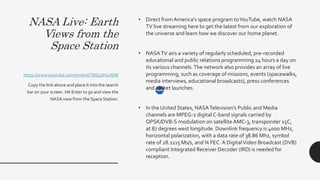
• Direct from America's space program toYouTube, watch NASA
TV live streaming here to get the latest from our exploration of
the universe and learn how we discover our home planet.
• NASATV airs a variety of regularly scheduled, pre-recorded
educational and public relations programming 24 hours a day on
its various channels.The network also provides an array of live
programming, such as coverage of missions, events (spacewalks,
media interviews, educational broadcasts), press conferences
and rocket launches.
• In the United States, NASATelevision's Public and Media
channels are MPEG-2 digital C-band signals carried by
QPSK/DVB-S modulation on satellite AMC-3, transponder 15C,
at 87 degrees west longitude. Downlink frequency is 4000 MHz,
horizontal polarization, with a data rate of 38.86 Mhz, symbol
rate of 28.1115 Ms/s, and ¾ FEC. A DigitalVideo Broadcast (DVB)
compliant Integrated Receiver Decoder (IRD) is needed for
reception.
https://www.youtube.com/embed/TBG3dHuzlbM
Copy the link above and place it into the search
bar on your screen. Hit Enter to go and view the
NASA view from the Space Station.
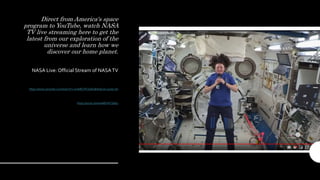
Direct from America's space
program to YouTube, watch NASA
TV live streaming here to get the
latest from our exploration of the
universe and learn how we
discover our home planet.
NASA Live: Official Stream of NASATV
https://www.youtube.com/watch?v=wwMDvPCGeE0&feature=youtu.be
https://youtu.be/wwMDvPCGeE0
The AmericaSpace Live Launch and Event
Tracker
The AmericaSpace Live Launch and Event
Tracker has up to the minute information of
the progress of upcoming rocket launches,
and space related events with live updates
and video where available, covering all the
major spaceports across the United States.
To see this in real time, go to the website.
Copy the address below and paste it into
your search bar.
https://www.americaspace.com/live-launch-
tracker/
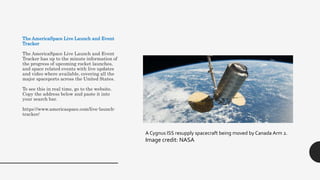
A Cygnus ISS resupply spacecraft being moved by Canada Arm 2.
Image credit: NASA
THE BEST IS
YET TO COME.
Thanks for viewing

What we didn't know about astronomy

  • 1.
    WHAT WE DIDN’T KNOW ABOUT ASTRONOMY Weare living in a new golden age of planetary discovery.
  • 2.
    Man’s quest forflight https://goo.gl/images/jwGqju • “The scorching rays of the nearer Sun softened the fragrant wax which held his wings. The wax melted; his arms were bare as he beat them up and down, but, lacking wings, they took no hold on the air.” • — Ovid, “Metamorphoses,” Book VIII (8th century AD)
  • 3.
    TO NAVIGATE THE SEASOF THE SUN: NASA'S SOLAR PROBE PLUS MISSION TO THE NEAREST STAR Set to launch in 2018, Solar Probe Plus will orbit our home star a total of 24 times while gradually approaching closer with each consecutive orbit, until it eventually achieves a minimum distance of 8.5 solar radii, or 3.7 million miles from the Sun’s surface. Image Credit: NASA/Johns Hopkins University Applied Physics Laboratory By Leonidas Papadopoulos, on August 6th, 2014Artist’s impression of NASA’s Solar Probe Plus spacecraft approaching the Sun.
  • 4.
    • One ofthe most well-known myths of ancient Greek mythology recounts the story of Icarus, who, in his quest for freedom and the thrill of adventure, flies perilously close to the Sun, only to meet his doom after the latter’s intense heat melts the young man’s wax wings. In real life, NASA is aiming to conduct a similar daring close approach to the Sun with the Solar Probe Plus mission, which is scheduled to launch in July 2018. Currently under development, Solar Probe Plus will ultimately approach the Sun closer than any other spacecraft in history by flying into its outer atmosphere, or corona, in its quest to answer a series of fundamental questions in the science of heliophysics. Unlike the mythological Icarus, however, the well-shielded spacecraft will be designed to brace the extreme conditions near the vicinity of the Sun, leading to breakthrough insights into the mechanisms that drive the activity of our home star. https://www.reddit.com/r/spaceflight/c omments/9xt1ag/at_401_am_est_an_a ntares_230_rocket_will_be/
  • 5.
    NASA Live: Earth Viewsfrom the Space Station • Direct from America's space program toYouTube, watch NASA TV live streaming here to get the latest from our exploration of the universe and learn how we discover our home planet. • NASATV airs a variety of regularly scheduled, pre-recorded educational and public relations programming 24 hours a day on its various channels.The network also provides an array of live programming, such as coverage of missions, events (spacewalks, media interviews, educational broadcasts), press conferences and rocket launches. • In the United States, NASATelevision's Public and Media channels are MPEG-2 digital C-band signals carried by QPSK/DVB-S modulation on satellite AMC-3, transponder 15C, at 87 degrees west longitude. Downlink frequency is 4000 MHz, horizontal polarization, with a data rate of 38.86 Mhz, symbol rate of 28.1115 Ms/s, and ¾ FEC. A DigitalVideo Broadcast (DVB) compliant Integrated Receiver Decoder (IRD) is needed for reception. https://www.youtube.com/embed/TBG3dHuzlbM Copy the link above and place it into the search bar on your screen. Hit Enter to go and view the NASA view from the Space Station.
  • 6.
    Direct from America'sspace program to YouTube, watch NASA TV live streaming here to get the latest from our exploration of the universe and learn how we discover our home planet. NASA Live: Official Stream of NASATV https://www.youtube.com/watch?v=wwMDvPCGeE0&feature=youtu.be https://youtu.be/wwMDvPCGeE0
  • 7.
    The AmericaSpace LiveLaunch and Event Tracker The AmericaSpace Live Launch and Event Tracker has up to the minute information of the progress of upcoming rocket launches, and space related events with live updates and video where available, covering all the major spaceports across the United States. To see this in real time, go to the website. Copy the address below and paste it into your search bar. https://www.americaspace.com/live-launch- tracker/ A Cygnus ISS resupply spacecraft being moved by Canada Arm 2. Image credit: NASA
  • 8.
    THE BEST IS YETTO COME. Thanks for viewing