VEMANA INSTITUTE OF TECHNOLOGY
DEPARTMENT OF ELECTRONICS AND COMMUNICATION ENGINEERING
GPS BASED SPACE DEBRIS
REMOVAL SYSTEM
BY:SUNIL D S
USN NO:1VI11EC078
GUIDED BY: Mrs. KUSUMA G S
1) Introduction
2)Types of orbits
3) Sources of debris
4) Tracking and Measurement of debris
5) Clearance of space debris
6) Conclusion
7) References
CONTENTS
Dept Of ECE,VIT 2
.
INTRODUCTION
Space debris , also known as orbital debris , space junk and
space waste , is the collection of defunct objects in orbit around
Earth.
This includes everything from spent rocket stages , old satellites,
fragments from disintegration , erosion and collision.
They can include anything from entire used rocket stages and
defunctioning satellites to explosion fragments, paint flakes, dust,
slag from solid rocket motors, coolant released by RORSAT also
known in the west as Radar Ocean Reconnaissance Satellite,
nuclear powered satellites, deliberate insertion of small needles,
and other small particles from equipment.
Dept Of ECE,VIT 3
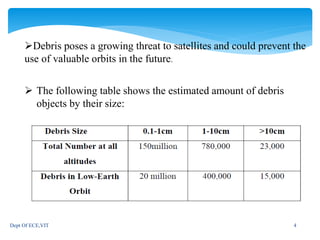
Debris poses a growing threat to satellites and could prevent the
use of valuable orbits in the future.
 The following table shows the estimated amount of debris
objects by their size:
Dept Of ECE,VIT 4
Dept Of ECE,VIT 5
Tracked orbital debris population catalogued by U.S. Air Force as of 2010.
1. Low Earth Orbit
2. Medium Earth Orbit
3. Geostationary Orbit
4. High Earth Orbit
TYPES OF ORBITS
Dept Of ECE,VIT 6
 LEO is still very close to the Earth, especially when compared
to other forms of satellite orbit including geostationary orbit.
Low Earth Orbit
 Low Earth Orbit extending from 200 km to 1200 km it means
that it is relatively low in altitude.
 Orbit times are much less than for many other forms of orbit.
The lower altitude means higher velocities are required to
balance the earth's gravitational field.
 Less energy is expended placing the satellites in LEO than
higher orbits.
 Communications satellites , Earth monitoring satellites use LEO
as they are able to see the surface of the Earth more clearly as
they are not so far away. They are also able to traverse the
surface of the Earth.
Dept Of ECE,VIT 7
 The International Space Station is in an LEO that varies
between 320 km (199 miles) and 400 km (249 miles) above the
Earth's surface.
Currently , NASA tracks more than 15,000 objects larger than
10 cm in LEO.
Dept Of ECE,VIT 8
Situated from 2000 km to 36,000
km above Earth’s surface.
The most common use for satellites
in this region is for navigation , Gps
communication and space
environment science.
Has an orbital period of 12 hours .
Medium Earth Orbit
Dept Of ECE,VIT 9
Geostationary Earth Orbit
 These are at a height of 35790 km,
it takes 24 hours for the satellite to
orbit.
 Geostationary satellites have
modernized and transformed
worldwide communications,
television broadcasting, and
meteorological and weather
forecasting. They also have a
number of significant defense and
intelligence applications.
Dept Of ECE,VIT 10
Highly Elliptical Orbit
 These satellites do not follow a circular orbit, but its orbit is elliptical.
 Its orbital period is of 8 to 24 hours.
 The perigee about 500 km and apogee of 50000 km.
Dept Of ECE,VIT 11
Fig. HEO
Tracking of debris
Radar and optical detectors such as LIDAR are the main tools used
for tracking space debris.
 Radio waves have been recently used. These waves are transmitted
into space and they bounce off of space junk back to the origin that
will detect and track the object.
 Ground based radar facilities and space telescopes are also used to
track the debris.
 Returned hardware of space debris is a valuable source of
information of the environment.
Some of the modules used were :
LDEF (Long duration exposure facility ) satellite
EURECA ( European Retrievable carrier )
STS-61 Endeavour
STS-109 Columbia
Dept Of ECE,VIT 12
“CLEARANCE OF SPACE DEBRIS”
Dept Of ECE,VIT 13
Different Types
Electro dynamic tethers
 Laser brooms
 Solar sails
 Space nets and collectors
Dept Of ECE,VIT
14
Electro-dynamic tethers
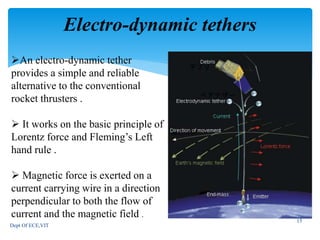
An electro-dynamic tether
provides a simple and reliable
alternative to the conventional
rocket thrusters .
 It works on the basic principle of
Lorentz force and Fleming’s Left
hand rule .
 Magnetic force is exerted on a
current carrying wire in a direction
perpendicular to both the flow of
current and the magnetic field .
Dept Of ECE,VIT
15
Laser brooms
 The laser broom uses a powerful ground based laser to ablate the
front surface off of debris and thereby produce a rocket like thrust
that slows the object.
With continued application the debris will eventually decrease their
altitude enough to become subject to atmospheric drag.
 Additionally , the momentum of photons in the laser beam could
be used to impart thrust on the debris directly.
 Mainly the laser based techniques are two types:
1. Ground based laser technique
2. Space based laser technique
Dept Of ECE,VIT
16
Ground based laser
Space based laser
Dept Of ECE,VIT 17
Solar sails
 The Solar sails uses the pressure
from sunlight to navigate an
object, just like a naval sail uses
wind.
 This way debris can be
navigated out of orbit and burn
into the atmosphere.
 The only problem with the solar
sail is that its very hard to
navigate the junk into the ocean
and hence might be pretty
dangerous.
Dept Of ECE,VIT 18
Space nets
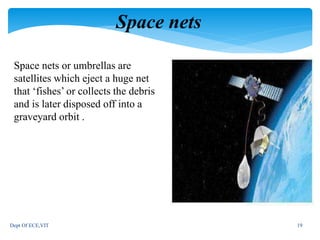
Space nets or umbrellas are
satellites which eject a huge net
that ‘fishes’ or collects the debris
and is later disposed off into a
graveyard orbit .
Dept Of ECE,VIT 19
Collector satellites
 The most commonly used
collector satellite is the Sling
Sat.
 It has two extended arms which
collect the debris as it is in
motion.
Dept Of ECE,VIT
20
CONCLUSION
Satellite communication would develop faster as there will be no
hindrance to it. Every point in the earth, even the poles could be
linked via satellites. Communication will be faster, better and
cheaper. Exploring the outer space would be easier and inter
planetary communication will flourish.
 Even though this problem might look unimportant and is being
neglected by people, it is of great concern for the developments in
space and technology. A part of the International Space Station
should be allocated for space debris removal and control called as
Debris removal station. This monitors the motion, size, and mass
of the debris and removes them using an appropriate method
suitable for that particular debris.
Dept Of ECE,VIT
21
REFERENCES
[1] International Journal of Research (IJR) Vol-1, Issue-10 November 2014
ISSN 2348-6848 Space Debris Elimination Techniques.
[2] Robert Osiander and Paul Ostdiek, Handbook of Space Engineering,
Archaeology.
[3] Marco M. Castronuovo, Active space debris removal-A preliminary
mission
analysis and design, Acta Astronautica 69 (2011) 848-859.
[4] Carmen Pardini, Toshiya Hanada and Paula H Krisko, Benefits and risks
of using electrodynamic tethers to de-orbit spacecrafts, Acta Astronautica
64 (2009) 571-588.
[5] Robert P Hoyt and Robert L Forward, The Terminator Tether:
Autonomous deorbit of LEO spacecraft for space debris mitigation, AIAA-
00—0329.
[6] Holger Burkhardt, Martin Sippel, et, Evaluation of propulsion systems
for satellite end-of-life deorbiting, Germany, AIAA-2002—4208.
Dept Of ECE,VIT 22
Dept Of ECE,VIT 23

GPS base Space Debris Removal System

  • 1.
    VEMANA INSTITUTE OFTECHNOLOGY DEPARTMENT OF ELECTRONICS AND COMMUNICATION ENGINEERING GPS BASED SPACE DEBRIS REMOVAL SYSTEM BY:SUNIL D S USN NO:1VI11EC078 GUIDED BY: Mrs. KUSUMA G S
  • 2.
    1) Introduction 2)Types oforbits 3) Sources of debris 4) Tracking and Measurement of debris 5) Clearance of space debris 6) Conclusion 7) References CONTENTS Dept Of ECE,VIT 2
  • 3.
    . INTRODUCTION Space debris ,also known as orbital debris , space junk and space waste , is the collection of defunct objects in orbit around Earth. This includes everything from spent rocket stages , old satellites, fragments from disintegration , erosion and collision. They can include anything from entire used rocket stages and defunctioning satellites to explosion fragments, paint flakes, dust, slag from solid rocket motors, coolant released by RORSAT also known in the west as Radar Ocean Reconnaissance Satellite, nuclear powered satellites, deliberate insertion of small needles, and other small particles from equipment. Dept Of ECE,VIT 3
  • 4.
    Debris poses agrowing threat to satellites and could prevent the use of valuable orbits in the future.  The following table shows the estimated amount of debris objects by their size: Dept Of ECE,VIT 4
  • 5.
    Dept Of ECE,VIT5 Tracked orbital debris population catalogued by U.S. Air Force as of 2010.
  • 6.
    1. Low EarthOrbit 2. Medium Earth Orbit 3. Geostationary Orbit 4. High Earth Orbit TYPES OF ORBITS Dept Of ECE,VIT 6
  • 7.
     LEO isstill very close to the Earth, especially when compared to other forms of satellite orbit including geostationary orbit. Low Earth Orbit  Low Earth Orbit extending from 200 km to 1200 km it means that it is relatively low in altitude.  Orbit times are much less than for many other forms of orbit. The lower altitude means higher velocities are required to balance the earth's gravitational field.  Less energy is expended placing the satellites in LEO than higher orbits.  Communications satellites , Earth monitoring satellites use LEO as they are able to see the surface of the Earth more clearly as they are not so far away. They are also able to traverse the surface of the Earth. Dept Of ECE,VIT 7
  • 8.
     The InternationalSpace Station is in an LEO that varies between 320 km (199 miles) and 400 km (249 miles) above the Earth's surface. Currently , NASA tracks more than 15,000 objects larger than 10 cm in LEO. Dept Of ECE,VIT 8
  • 9.
    Situated from 2000km to 36,000 km above Earth’s surface. The most common use for satellites in this region is for navigation , Gps communication and space environment science. Has an orbital period of 12 hours . Medium Earth Orbit Dept Of ECE,VIT 9
  • 10.
    Geostationary Earth Orbit These are at a height of 35790 km, it takes 24 hours for the satellite to orbit.  Geostationary satellites have modernized and transformed worldwide communications, television broadcasting, and meteorological and weather forecasting. They also have a number of significant defense and intelligence applications. Dept Of ECE,VIT 10
  • 11.
    Highly Elliptical Orbit These satellites do not follow a circular orbit, but its orbit is elliptical.  Its orbital period is of 8 to 24 hours.  The perigee about 500 km and apogee of 50000 km. Dept Of ECE,VIT 11 Fig. HEO
  • 12.
    Tracking of debris Radarand optical detectors such as LIDAR are the main tools used for tracking space debris.  Radio waves have been recently used. These waves are transmitted into space and they bounce off of space junk back to the origin that will detect and track the object.  Ground based radar facilities and space telescopes are also used to track the debris.  Returned hardware of space debris is a valuable source of information of the environment. Some of the modules used were : LDEF (Long duration exposure facility ) satellite EURECA ( European Retrievable carrier ) STS-61 Endeavour STS-109 Columbia Dept Of ECE,VIT 12
  • 13.
    “CLEARANCE OF SPACEDEBRIS” Dept Of ECE,VIT 13
  • 14.
    Different Types Electro dynamictethers  Laser brooms  Solar sails  Space nets and collectors Dept Of ECE,VIT 14
  • 15.
    Electro-dynamic tethers An electro-dynamictether provides a simple and reliable alternative to the conventional rocket thrusters .  It works on the basic principle of Lorentz force and Fleming’s Left hand rule .  Magnetic force is exerted on a current carrying wire in a direction perpendicular to both the flow of current and the magnetic field . Dept Of ECE,VIT 15
  • 16.
    Laser brooms  Thelaser broom uses a powerful ground based laser to ablate the front surface off of debris and thereby produce a rocket like thrust that slows the object. With continued application the debris will eventually decrease their altitude enough to become subject to atmospheric drag.  Additionally , the momentum of photons in the laser beam could be used to impart thrust on the debris directly.  Mainly the laser based techniques are two types: 1. Ground based laser technique 2. Space based laser technique Dept Of ECE,VIT 16
  • 17.
    Ground based laser Spacebased laser Dept Of ECE,VIT 17
  • 18.
    Solar sails  TheSolar sails uses the pressure from sunlight to navigate an object, just like a naval sail uses wind.  This way debris can be navigated out of orbit and burn into the atmosphere.  The only problem with the solar sail is that its very hard to navigate the junk into the ocean and hence might be pretty dangerous. Dept Of ECE,VIT 18
  • 19.
    Space nets Space netsor umbrellas are satellites which eject a huge net that ‘fishes’ or collects the debris and is later disposed off into a graveyard orbit . Dept Of ECE,VIT 19
  • 20.
    Collector satellites  Themost commonly used collector satellite is the Sling Sat.  It has two extended arms which collect the debris as it is in motion. Dept Of ECE,VIT 20
  • 21.
    CONCLUSION Satellite communication woulddevelop faster as there will be no hindrance to it. Every point in the earth, even the poles could be linked via satellites. Communication will be faster, better and cheaper. Exploring the outer space would be easier and inter planetary communication will flourish.  Even though this problem might look unimportant and is being neglected by people, it is of great concern for the developments in space and technology. A part of the International Space Station should be allocated for space debris removal and control called as Debris removal station. This monitors the motion, size, and mass of the debris and removes them using an appropriate method suitable for that particular debris. Dept Of ECE,VIT 21
  • 22.
    REFERENCES [1] International Journalof Research (IJR) Vol-1, Issue-10 November 2014 ISSN 2348-6848 Space Debris Elimination Techniques. [2] Robert Osiander and Paul Ostdiek, Handbook of Space Engineering, Archaeology. [3] Marco M. Castronuovo, Active space debris removal-A preliminary mission analysis and design, Acta Astronautica 69 (2011) 848-859. [4] Carmen Pardini, Toshiya Hanada and Paula H Krisko, Benefits and risks of using electrodynamic tethers to de-orbit spacecrafts, Acta Astronautica 64 (2009) 571-588. [5] Robert P Hoyt and Robert L Forward, The Terminator Tether: Autonomous deorbit of LEO spacecraft for space debris mitigation, AIAA- 00—0329. [6] Holger Burkhardt, Martin Sippel, et, Evaluation of propulsion systems for satellite end-of-life deorbiting, Germany, AIAA-2002—4208. Dept Of ECE,VIT 22
  • 23.