

@dave_thesmith
Geek, Scientist, Academic, Inspirational Teacher, Life Long Learner
Record Collector, Cyclist, Dad (not necessarily in that order)
Engaging Lectures
Dr David Smith NTF, SFHEA
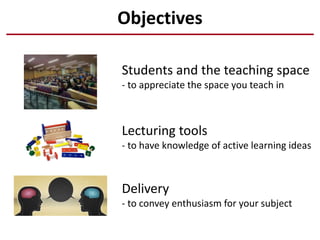
Objectives
Students and the teaching space
- to appreciate the space you teach in
Lecturing tools
- to have knowledge of active learning ideas
Delivery
- to convey enthusiasm for your subject
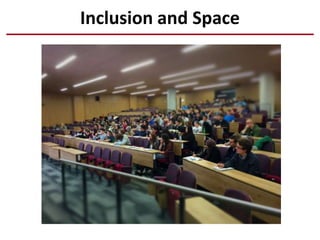
Inclusion and Space
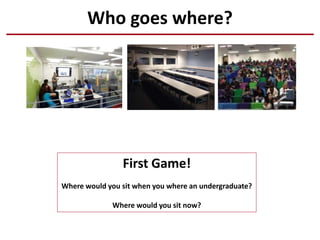
Who goes where?
First Game!
Where would you sit when you where an undergraduate?
Where would you sit now?
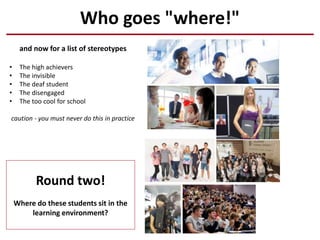
and now for a list of stereotypes
• The high achievers
• The invisible
• The deaf student
• The disengaged
• The too cool for school
caution - you must never do this in practice
Round two!
Where do these students sit in the
learning environment?
Who goes "where!"
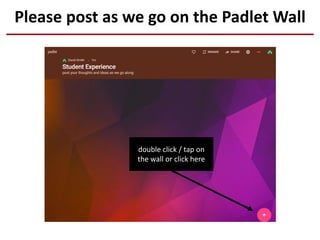
Please post as we go on the Padlet Wall
double click / tap on
the wall or click here
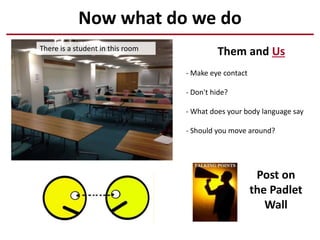
Now what do we do
Them and Us
- Who controls the pace of
teaching?
- Who is at eye level?
- Who is trying to hide?
- Is body language important?
Post on
the Padlet
Wall
Them and Us
- Make eye contact
- Don't hide?
- What does your body language say
- Should you move around?
There is a student in this room
Post on
the Padlet
Wall
Now what do we do
The Lecture Tool Kit
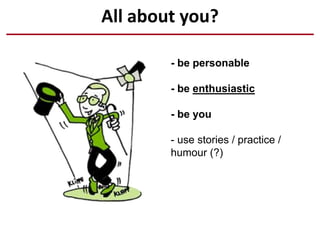
All about you?
- be personable
- be enthusiastic
- be you
- use stories / practice /
humour (?)
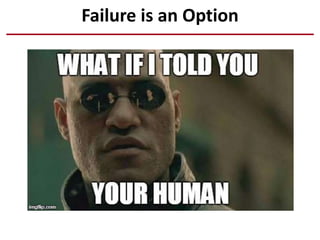
Failure is an Option
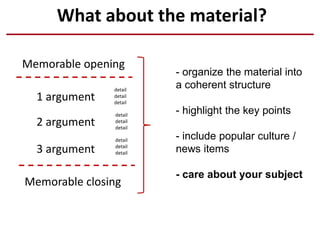
What about the material?
- organize the material into
a coherent structure
- highlight the key points
- include popular culture /
news items
- care about your subject
Memorable opening
1 argument
2 argument
3 argument
Memorable closing
detail
detail
detail
detail
detail
detail
detail
detail
detail
Bad slides don't help
Don't read this slide. There is nothing on this slide of importance.
At this very moment I am trying to make rather interesting point about something
or other.
Are you still reading this.
Have you looked out the window today there is a world of things out there.
Did you know that if you are reading this you are not listening to what I am
discussing.
I might as well have printed this out for you and used a lovely image, you still have
all the information but that way you care.
Look I told you to stop reading this it really is utter drivel.
Hum hum hum lunch time soon. I have some cheese and pickle sandwich's.
I wonder when I can next get coffee.
I hope you will take something away from todays session
Really stop reading this you can read faster than I can speak
Put your arm in the air if your reading this drivel.
Hopefully that made the point.
Tell you what I will shut up and give you a chance to read this.
Or not.
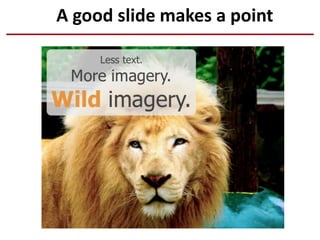
A good slide makes a point
this slide is intentionally blank
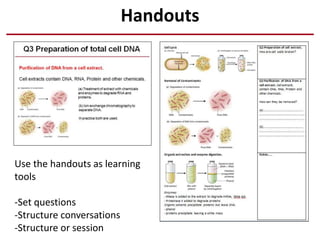
Handouts
Use the handouts as learning
tools
-Set questions
-Structure conversations
-Structure or session
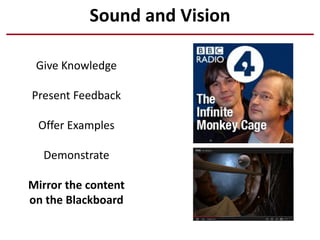
Sound and Vision
Give Knowledge
Present Feedback
Offer Examples
Demonstrate
Mirror the content
on the Blackboard
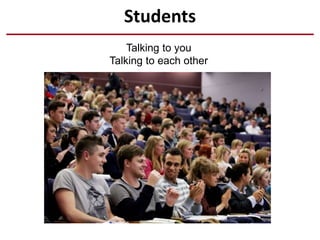
Students
Talking to you
Talking to each other
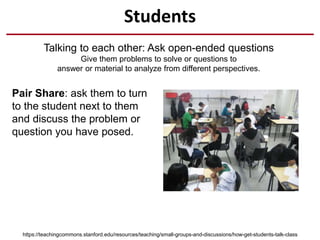
Students
Talking to each other: Ask open-ended questions
Give them problems to solve or questions to
answer or material to analyze from different perspectives.
https://teachingcommons.stanford.edu/resources/teaching/small-groups-and-discussions/how-get-students-talk-class
Pair Share: ask them to turn
to the student next to them
and discuss the problem or
question you have posed.
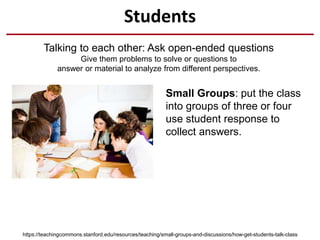
Students
Talking to each other: Ask open-ended questions
Give them problems to solve or questions to
answer or material to analyze from different perspectives.
https://teachingcommons.stanford.edu/resources/teaching/small-groups-and-discussions/how-get-students-talk-class
Small Groups: put the class
into groups of three or four
use student response to
collect answers.
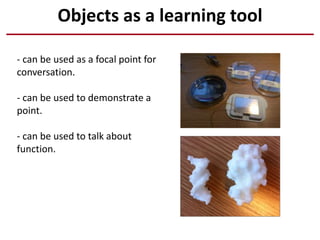
Objects as a learning tool
- can be used as a focal point for
conversation.
- can be used to demonstrate a
point.
- can be used to talk about
function.
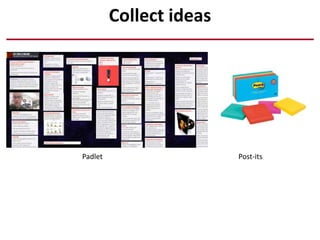
Collect ideas
Padlet Post-its
Have Employers Set Questions
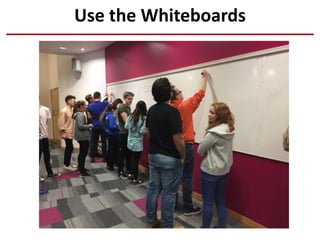
Use the Whiteboards
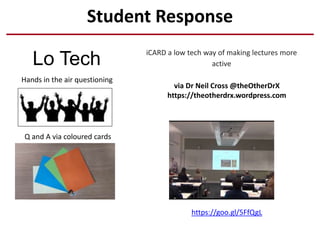
Student Response
Lo Tech
https://goo.gl/5FfQgL
iCARD a low tech way of making lectures more
active
via Dr Neil Cross @theOtherDrX
https://theotherdrx.wordpress.com
Q and A via coloured cards
Hands in the air questioning
Student Response
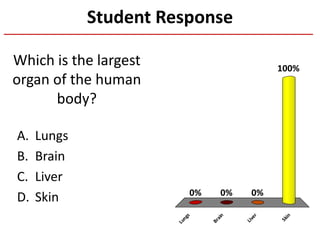
Student Response
A. Lungs
B. Brain
C. Liver
D. Skin
Lungs
Brain
Liver
Skin
0%
100%
0%0%
Which is the largest
organ of the human
body?
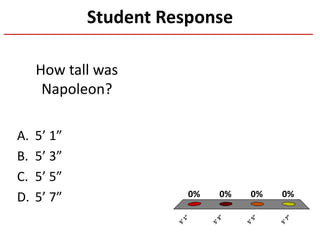
Student Response
A. 5’ 1”
B. 5’ 3”
C. 5’ 5”
D. 5’ 7”
5’1”
5’3”
5’5”
5’7”
0% 0%0%0%
How tall was
Napoleon?
Inform them
Delivery
to convey enthusiasm for your subject
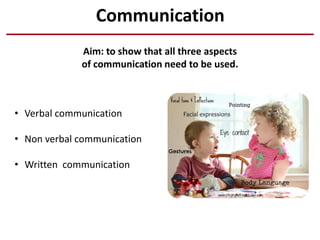
Communication
Aim: to show that all three aspects
of communication need to be used.
• Verbal communication
• Non verbal communication
• Written communication
nano teach!
1 min on any topic you like!
Something you know, something you care about.
You are white board use.
You can pick one for me!
- how to fly a stunt kite
- how to fit a bottom bracket
- why minecraft is fantastic
- what is an enzyme
- the record shops of Leeds
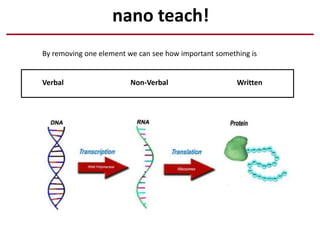
nano teach!
By removing one element we can see how important something is
Verbal Non-Verbal Written
nano teach!
Now its your turn
but lets remove one aspect of communication
GO!
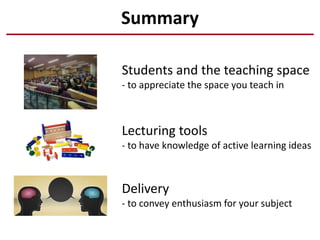
Summary
Students and the teaching space
- to appreciate the space you teach in
Lecturing tools
- to have knowledge of active learning ideas
Delivery
- to convey enthusiasm for your subject

Engaging students in the classroom

  • 1.
    @dave_thesmith Geek, Scientist, Academic,Inspirational Teacher, Life Long Learner Record Collector, Cyclist, Dad (not necessarily in that order) Engaging Lectures Dr David Smith NTF, SFHEA
  • 2.
    Objectives Students and theteaching space - to appreciate the space you teach in Lecturing tools - to have knowledge of active learning ideas Delivery - to convey enthusiasm for your subject
  • 3.
  • 4.
    Who goes where? FirstGame! Where would you sit when you where an undergraduate? Where would you sit now?
  • 5.
    and now fora list of stereotypes • The high achievers • The invisible • The deaf student • The disengaged • The too cool for school caution - you must never do this in practice Round two! Where do these students sit in the learning environment? Who goes "where!"
  • 6.
    Please post aswe go on the Padlet Wall double click / tap on the wall or click here
  • 7.
    Now what dowe do Them and Us - Who controls the pace of teaching? - Who is at eye level? - Who is trying to hide? - Is body language important? Post on the Padlet Wall
  • 8.
    Them and Us -Make eye contact - Don't hide? - What does your body language say - Should you move around? There is a student in this room Post on the Padlet Wall Now what do we do
  • 9.
  • 10.
    All about you? -be personable - be enthusiastic - be you - use stories / practice / humour (?)
  • 11.
  • 12.
    What about thematerial? - organize the material into a coherent structure - highlight the key points - include popular culture / news items - care about your subject Memorable opening 1 argument 2 argument 3 argument Memorable closing detail detail detail detail detail detail detail detail detail
  • 13.
    Bad slides don'thelp Don't read this slide. There is nothing on this slide of importance. At this very moment I am trying to make rather interesting point about something or other. Are you still reading this. Have you looked out the window today there is a world of things out there. Did you know that if you are reading this you are not listening to what I am discussing. I might as well have printed this out for you and used a lovely image, you still have all the information but that way you care. Look I told you to stop reading this it really is utter drivel. Hum hum hum lunch time soon. I have some cheese and pickle sandwich's. I wonder when I can next get coffee. I hope you will take something away from todays session Really stop reading this you can read faster than I can speak Put your arm in the air if your reading this drivel. Hopefully that made the point. Tell you what I will shut up and give you a chance to read this. Or not.
  • 14.
    A good slidemakes a point
  • 15.
    this slide isintentionally blank
  • 16.
    Handouts Use the handoutsas learning tools -Set questions -Structure conversations -Structure or session
  • 17.
    Sound and Vision GiveKnowledge Present Feedback Offer Examples Demonstrate Mirror the content on the Blackboard
  • 18.
  • 19.
    Students Talking to eachother: Ask open-ended questions Give them problems to solve or questions to answer or material to analyze from different perspectives. https://teachingcommons.stanford.edu/resources/teaching/small-groups-and-discussions/how-get-students-talk-class Pair Share: ask them to turn to the student next to them and discuss the problem or question you have posed.
  • 20.
    Students Talking to eachother: Ask open-ended questions Give them problems to solve or questions to answer or material to analyze from different perspectives. https://teachingcommons.stanford.edu/resources/teaching/small-groups-and-discussions/how-get-students-talk-class Small Groups: put the class into groups of three or four use student response to collect answers.
  • 21.
    Objects as alearning tool - can be used as a focal point for conversation. - can be used to demonstrate a point. - can be used to talk about function.
  • 22.
  • 23.
  • 24.
  • 25.
    Student Response Lo Tech https://goo.gl/5FfQgL iCARDa low tech way of making lectures more active via Dr Neil Cross @theOtherDrX https://theotherdrx.wordpress.com Q and A via coloured cards Hands in the air questioning
  • 26.
  • 27.
    Student Response A. Lungs B.Brain C. Liver D. Skin Lungs Brain Liver Skin 0% 100% 0%0% Which is the largest organ of the human body?
  • 28.
    Student Response A. 5’1” B. 5’ 3” C. 5’ 5” D. 5’ 7” 5’1” 5’3” 5’5” 5’7” 0% 0%0%0% How tall was Napoleon?
  • 29.
    Inform them Delivery to conveyenthusiasm for your subject
  • 30.
    Communication Aim: to showthat all three aspects of communication need to be used. • Verbal communication • Non verbal communication • Written communication
  • 31.
    nano teach! 1 minon any topic you like! Something you know, something you care about. You are white board use. You can pick one for me! - how to fly a stunt kite - how to fit a bottom bracket - why minecraft is fantastic - what is an enzyme - the record shops of Leeds
  • 32.
    nano teach! By removingone element we can see how important something is Verbal Non-Verbal Written
  • 33.
    nano teach! Now itsyour turn but lets remove one aspect of communication GO!
  • 34.
    Summary Students and theteaching space - to appreciate the space you teach in Lecturing tools - to have knowledge of active learning ideas Delivery - to convey enthusiasm for your subject