July 10, 2013
What Leaders Need to Know about
Establishing Trust and Defusing Conflict:
Best Practices in Project Management
Welcome and Session Kick-Off
• Presentation by Tercon Consultants:
Jeannette Terry
Steve Davis
• Participant Introductions
What Leaders Need to Know about Establishing Trust and Defusing
Conflict: Best Practices in Project Management Agenda – July 10, 2013
9:00 Welcome and Introductions
 Agenda Review & Ground Rules
 Group Activity – “Five Tricks”
10:30 Morning Tea Break
10:45 Impact of high and low trust on team performance
 Key behaviors that build and erode trust in the workplace
 How to restore trust that has been broken
 Application Tool: Building a Team Trust Map
12:15 Lunch Break
1:15 Group Activity: “The Conflict Quiz”
 The High Cost of Unresolved Conflict on teams
 How unmet personality needs trigger conflict
2:30 Afternoon Tea
2:45 The Power of the “Pause”
 Group Activity: Learning and Applying a Six Step Conflict Resolution Model
4:00- Review Keys Learnings and Evaluate the Day
4:15 Adjourn
Ground Rules
©2013 Tercon Consulting
1. Participate actively
2. Listen and learn from each other
3. Ask questions to get your needs met
4. Return from breaks on time
5. Please have mobile phones turned off or on vibrate/silent
Have Fun!
WHAT DID YOU LEARN FROM PLAYING
“FIVE TRICKS”???
1. When working with others, we usually assume that
everyone knows and follows the same “rules”
2. When we see a violation of one of these “rules”, we first
assume ignorance.
3. If the violation continues, we begin to suspect devious
intent, or at least a significant character flaw
4. Only as a last resort do we begin to wonder if the violator
actually knew and understood the “rule”
©2013 Tercon Consulting
Establishing & Maintaining Trust in the Workplace
Unit 1 Learning Objectives:
1. Tell-tale symptoms of low trust on project teams
2. Key behaviors that build trust and behaviors that erode it
3. How to restore trust when it has been eroded
4. Identifying your personal Trust Index
©2013 Tercon Consulting
Trust Is The Glue That Holds Teams Together
Delays in Decision-Making
Under-Communication
Conflict Avoidance
People Argue from Extreme
Positions
People Jump to Conclusions
When trust levels are low, the following symptoms often occur.
 “Data wars”; reduced risk-taking; lowered commitment to
implementation.
 Withholding information, going around others, failing to get
clarification about assignments and/or agreements during
meetings.
 The “real” issues don’t get surfaced, and people inform each
other of things at the last minute when it’s too late to make
changes.
 They use lots of “absolutes” with each other — “You always...”;
“You never...”
 They don’t test their assumptions for correctness or validity
Teams and Trust
 When trust is high, people are willing to make themselves vulnerable to
another person because they believe it’s safe to do so.
 When trust is low, people spend time protecting themselves from a situation
perceived as threatening - often causing others to mistrust them!
 When trust is low, individual agendas take precedence over team goals and
communication becomes distorted or ambiguous.
 When trust is low, the team will form cliques, and people talk about each
other instead of to each other regarding the real issues.
©2013 Tercon Consulting
 More open discussion of ideas and feelings
 Greater clarification of goals and problems
 Commitment to search for alternative courses of action (“third ways”)
 More satisfaction with problem-solving efforts
 Greater commitment to implementing decisions
 Stronger feeling of team cohesiveness and mutual support
 Improved product quality and customer satisfaction
©2013 Tercon Consulting
Characteristics of Team Cultures where Trust is High:
Discussion Questions:
• From your perspective, which behaviors are
most likely to build trust?
• Which behaviors are most likely to erode or
destroy trust?
©2013 Tercon Consulting
Best Practices for Defusing & Resolving
Conflict in the Workplace
Unit 2 Learning Objectives:
1. Clarify the misunderstandings and myths associated with
conflict
2. Identify the “hidden costs of conflict” on project teams
3. Understand the threatened or unmet needs that
commonly trigger conflict in our lives
4. Be able to use a Five-Step Model for constructive conflict
management/resolution
©2013 Tercon Consulting
What words
do you associate with
CONFLICT?
©2013 Tercon Consulting
Conflict Questionnaire
Choose TRUE (T) or FALSE (F).
1. Being a “team player” implies doing what is needed to prevent conflict with
others.
2. Conflicts by their nature are destructive.
3. A good way to deal with conflicts is to avoid them.
4. It is possible to be in a conflict without knowing it.
5. Whenever a conflict is resolved, there is always a winner and a loser.
6. Most people handle conflicts in a productive way.
7. Arguing is the same as conflict.
8. Whenever possible, a conflict is best resolved by a neutral third party.
9. All conflicts arise out of misunderstandings.
10. All conflicts can be resolved if the parties involved try hard enough.
11. Conflicts are symptoms of poor relationships.
12. Conflicts are inevitable in an environment of change and innovation.
13. It is best to be open and direct about conflict.
©2013 Tercon Consulting
Cost of Unresolved Project Conflicts
First Order Impacts Second Order Impacts Third Order Impacts
 Delayed / missed deadlines
 Communication lapses
 Recycling / rework
 Leadership distraction, e.g.
handling complaints, fires
 Rumors and innuendos
 Lack of quality concerns
 Safety inattentions
 Employee turnover
 Loss of institutional memory
 Increased management
scrutiny
 Split alliances – factions and
cliques
 Reduced collaboration and
lowered trust
 Lower morale and employee
commitment
 Loss of confidence for
project management
and/or upper management
 Loss of senior
management support
 Loss of market share
 A toxic culture – overall
cynicism and distrust
 Difficulty in recruitment
and retention of project
personnel
 Dissatisfied customers
and / or stakeholders
Conflict is an Inevitable Part of Working with Others
Conflict can be a destructive or constructive force, depending on the outcome:
DESTRUCTIVE
• No new decision or behavior results from the conflict, and the problem
remains unresolved
• Energy is continually diverted from more important issues and activities
• The morale of the team or individuals is destroyed
• The team becomes permanently divided and
polarized
©2013 Tercon Consulting
Conflict is an Inevitable Part of Working with Others
CONSTRUCTIVE
• Growth occurs
• It opens up discussion and issues are clarified
• Alternative solutions are identified.
• The problem gets solved
• Pent-up emotions and stress are safely released
• Cohesiveness among team members
is increased
• Individuals and the team grow and apply what they’ve learned to future conflicts
©2013 Tercon Consulting
DEFINING CONFLICT
NEED BEHAVIOR

Need Met
Need Not Met
A conflict occurs when a fundamental
need is threatened or unmet.
©2013 Tercon Consulting
Fundamental Personality Needs
• RESPECT NEEDS. The need for respectful treatment from others.
• POWER NEEDS. The need to influence and/or have control over others.
• INCLUSION NEEDS. The need to be accepted into groups.
• APPROVAL NEEDS. The need to be liked by others and accepted for who we are.
• JUSTICE NEEDS. The need to be treated fairly and equitably.
• INTEGRITY NEEDS. The need to live in alignment with your values.
• SELF-ESTEEM NEEDS. The need to maintain self-respect and a positive self-image.
©2013 Tercon Consulting
THE “POWER OF THE PAUSE”
©2013 Tercon Consulting
WHAT TO DO IN THE “PAUSE”
• Suspend activity
• Take centering breaths
• Listen
• Notice feelings
• Identify causes
• Take charge of emotions
• Accept temporary discomfort
• Accept responsibility
©2013 Tercon Consulting
MAPPING THE PROCESS
©2013 Tercon Consulting
INITIATION
A
(Bailout)
(Bailout) B
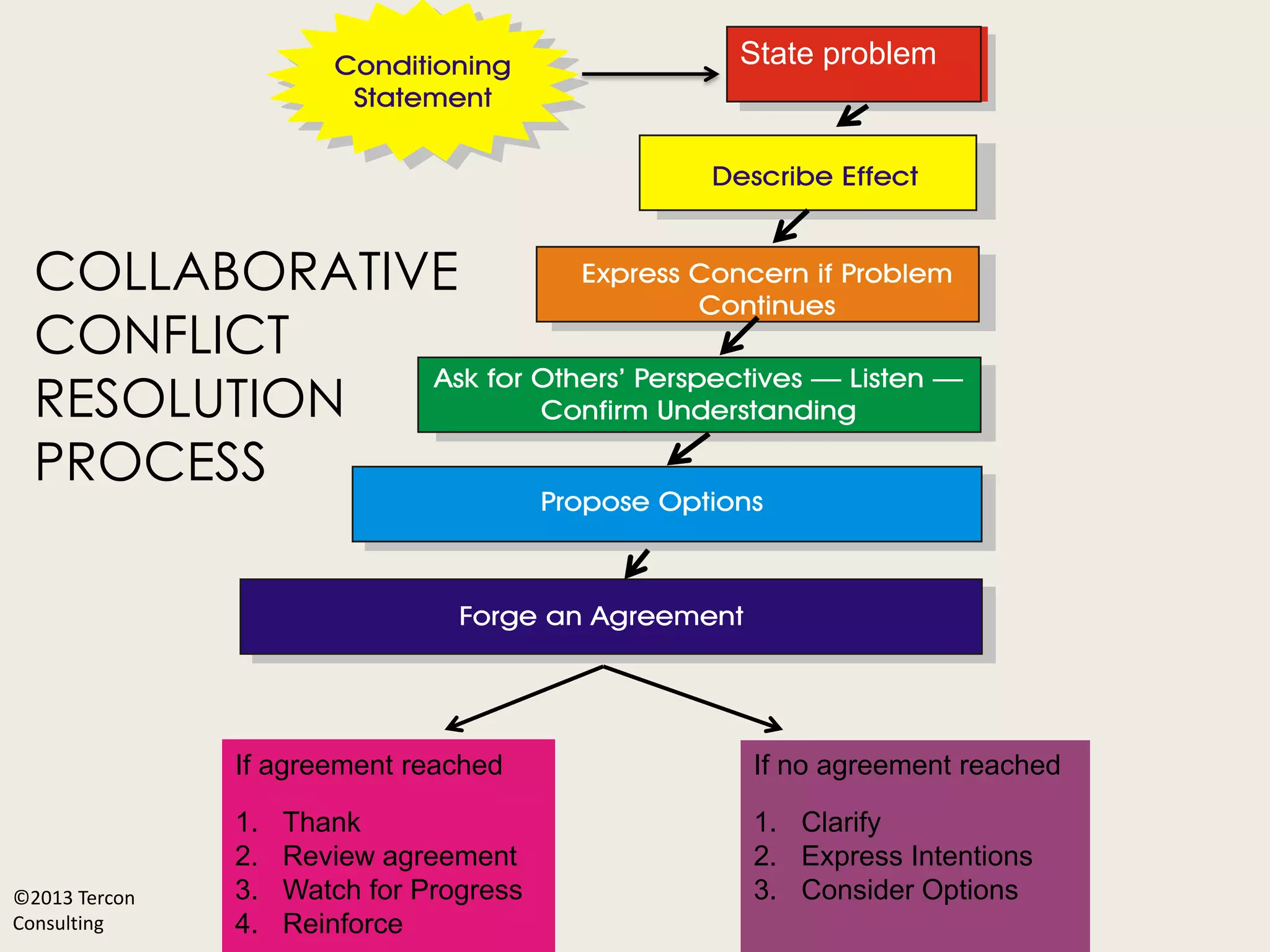
COLLABORATIVE
CONFLICT
RESOLUTION
PROCESS
State problem
If no agreement reached
1. Clarify
2. Express Intentions
3. Consider Options
If agreement reached
1. Thank
2. Review agreement
3. Watch for Progress
4. Reinforce
©2013 Tercon
Consulting
True Teams vs. Working Groups
TRUE TEAMS WORKING GROUPS
Open, honest dialogue Polite discussions
Look forward to getting
together
Meet because they have to
Encourage open-ended
discussion and active problem-
solving in meetings
Run efficient meetings
Discuss, decide and do real
work together
Share information, discuss and
delegate
Take mutual, collective
accountability for results
Take individual accountability
©2013 Tercon Consulting

What leaders need to know about establishing trust and defusing conflict

  • 1.
    July 10, 2013 WhatLeaders Need to Know about Establishing Trust and Defusing Conflict: Best Practices in Project Management
  • 2.
    Welcome and SessionKick-Off • Presentation by Tercon Consultants: Jeannette Terry Steve Davis • Participant Introductions
  • 3.
    What Leaders Needto Know about Establishing Trust and Defusing Conflict: Best Practices in Project Management Agenda – July 10, 2013 9:00 Welcome and Introductions  Agenda Review & Ground Rules  Group Activity – “Five Tricks” 10:30 Morning Tea Break 10:45 Impact of high and low trust on team performance  Key behaviors that build and erode trust in the workplace  How to restore trust that has been broken  Application Tool: Building a Team Trust Map 12:15 Lunch Break 1:15 Group Activity: “The Conflict Quiz”  The High Cost of Unresolved Conflict on teams  How unmet personality needs trigger conflict 2:30 Afternoon Tea 2:45 The Power of the “Pause”  Group Activity: Learning and Applying a Six Step Conflict Resolution Model 4:00- Review Keys Learnings and Evaluate the Day 4:15 Adjourn
  • 4.
    Ground Rules ©2013 TerconConsulting 1. Participate actively 2. Listen and learn from each other 3. Ask questions to get your needs met 4. Return from breaks on time 5. Please have mobile phones turned off or on vibrate/silent Have Fun!
  • 5.
    WHAT DID YOULEARN FROM PLAYING “FIVE TRICKS”??? 1. When working with others, we usually assume that everyone knows and follows the same “rules” 2. When we see a violation of one of these “rules”, we first assume ignorance. 3. If the violation continues, we begin to suspect devious intent, or at least a significant character flaw 4. Only as a last resort do we begin to wonder if the violator actually knew and understood the “rule” ©2013 Tercon Consulting
  • 6.
    Establishing & MaintainingTrust in the Workplace Unit 1 Learning Objectives: 1. Tell-tale symptoms of low trust on project teams 2. Key behaviors that build trust and behaviors that erode it 3. How to restore trust when it has been eroded 4. Identifying your personal Trust Index ©2013 Tercon Consulting
  • 7.
    ©2013 Tercon Consulting TrustIs The Glue That Holds Teams Together Delays in Decision-Making Under-Communication Conflict Avoidance People Argue from Extreme Positions People Jump to Conclusions When trust levels are low, the following symptoms often occur.  “Data wars”; reduced risk-taking; lowered commitment to implementation.  Withholding information, going around others, failing to get clarification about assignments and/or agreements during meetings.  The “real” issues don’t get surfaced, and people inform each other of things at the last minute when it’s too late to make changes.  They use lots of “absolutes” with each other — “You always...”; “You never...”  They don’t test their assumptions for correctness or validity
  • 8.
    Teams and Trust When trust is high, people are willing to make themselves vulnerable to another person because they believe it’s safe to do so.  When trust is low, people spend time protecting themselves from a situation perceived as threatening - often causing others to mistrust them!  When trust is low, individual agendas take precedence over team goals and communication becomes distorted or ambiguous.  When trust is low, the team will form cliques, and people talk about each other instead of to each other regarding the real issues. ©2013 Tercon Consulting
  • 9.
     More opendiscussion of ideas and feelings  Greater clarification of goals and problems  Commitment to search for alternative courses of action (“third ways”)  More satisfaction with problem-solving efforts  Greater commitment to implementing decisions  Stronger feeling of team cohesiveness and mutual support  Improved product quality and customer satisfaction ©2013 Tercon Consulting Characteristics of Team Cultures where Trust is High:
  • 10.
    Discussion Questions: • Fromyour perspective, which behaviors are most likely to build trust? • Which behaviors are most likely to erode or destroy trust? ©2013 Tercon Consulting
  • 11.
  • 12.
    Best Practices forDefusing & Resolving Conflict in the Workplace Unit 2 Learning Objectives: 1. Clarify the misunderstandings and myths associated with conflict 2. Identify the “hidden costs of conflict” on project teams 3. Understand the threatened or unmet needs that commonly trigger conflict in our lives 4. Be able to use a Five-Step Model for constructive conflict management/resolution ©2013 Tercon Consulting
  • 13.
    What words do youassociate with CONFLICT? ©2013 Tercon Consulting
  • 14.
    Conflict Questionnaire Choose TRUE(T) or FALSE (F). 1. Being a “team player” implies doing what is needed to prevent conflict with others. 2. Conflicts by their nature are destructive. 3. A good way to deal with conflicts is to avoid them. 4. It is possible to be in a conflict without knowing it. 5. Whenever a conflict is resolved, there is always a winner and a loser. 6. Most people handle conflicts in a productive way. 7. Arguing is the same as conflict. 8. Whenever possible, a conflict is best resolved by a neutral third party. 9. All conflicts arise out of misunderstandings. 10. All conflicts can be resolved if the parties involved try hard enough. 11. Conflicts are symptoms of poor relationships. 12. Conflicts are inevitable in an environment of change and innovation. 13. It is best to be open and direct about conflict. ©2013 Tercon Consulting
  • 15.
    ©2013 Tercon Consulting Costof Unresolved Project Conflicts First Order Impacts Second Order Impacts Third Order Impacts  Delayed / missed deadlines  Communication lapses  Recycling / rework  Leadership distraction, e.g. handling complaints, fires  Rumors and innuendos  Lack of quality concerns  Safety inattentions  Employee turnover  Loss of institutional memory  Increased management scrutiny  Split alliances – factions and cliques  Reduced collaboration and lowered trust  Lower morale and employee commitment  Loss of confidence for project management and/or upper management  Loss of senior management support  Loss of market share  A toxic culture – overall cynicism and distrust  Difficulty in recruitment and retention of project personnel  Dissatisfied customers and / or stakeholders
  • 16.
    Conflict is anInevitable Part of Working with Others Conflict can be a destructive or constructive force, depending on the outcome: DESTRUCTIVE • No new decision or behavior results from the conflict, and the problem remains unresolved • Energy is continually diverted from more important issues and activities • The morale of the team or individuals is destroyed • The team becomes permanently divided and polarized ©2013 Tercon Consulting
  • 17.
    Conflict is anInevitable Part of Working with Others CONSTRUCTIVE • Growth occurs • It opens up discussion and issues are clarified • Alternative solutions are identified. • The problem gets solved • Pent-up emotions and stress are safely released • Cohesiveness among team members is increased • Individuals and the team grow and apply what they’ve learned to future conflicts ©2013 Tercon Consulting
  • 18.
    DEFINING CONFLICT NEED BEHAVIOR  NeedMet Need Not Met A conflict occurs when a fundamental need is threatened or unmet. ©2013 Tercon Consulting
  • 19.
    Fundamental Personality Needs •RESPECT NEEDS. The need for respectful treatment from others. • POWER NEEDS. The need to influence and/or have control over others. • INCLUSION NEEDS. The need to be accepted into groups. • APPROVAL NEEDS. The need to be liked by others and accepted for who we are. • JUSTICE NEEDS. The need to be treated fairly and equitably. • INTEGRITY NEEDS. The need to live in alignment with your values. • SELF-ESTEEM NEEDS. The need to maintain self-respect and a positive self-image. ©2013 Tercon Consulting
  • 20.
    THE “POWER OFTHE PAUSE” ©2013 Tercon Consulting
  • 21.
    WHAT TO DOIN THE “PAUSE” • Suspend activity • Take centering breaths • Listen • Notice feelings • Identify causes • Take charge of emotions • Accept temporary discomfort • Accept responsibility ©2013 Tercon Consulting
  • 22.
    MAPPING THE PROCESS ©2013Tercon Consulting INITIATION A (Bailout) (Bailout) B
  • 23.
    COLLABORATIVE CONFLICT RESOLUTION PROCESS State problem If noagreement reached 1. Clarify 2. Express Intentions 3. Consider Options If agreement reached 1. Thank 2. Review agreement 3. Watch for Progress 4. Reinforce ©2013 Tercon Consulting
  • 24.
    True Teams vs.Working Groups TRUE TEAMS WORKING GROUPS Open, honest dialogue Polite discussions Look forward to getting together Meet because they have to Encourage open-ended discussion and active problem- solving in meetings Run efficient meetings Discuss, decide and do real work together Share information, discuss and delegate Take mutual, collective accountability for results Take individual accountability ©2013 Tercon Consulting