What Drives Resistance to Change?
A Leader’s Perspective

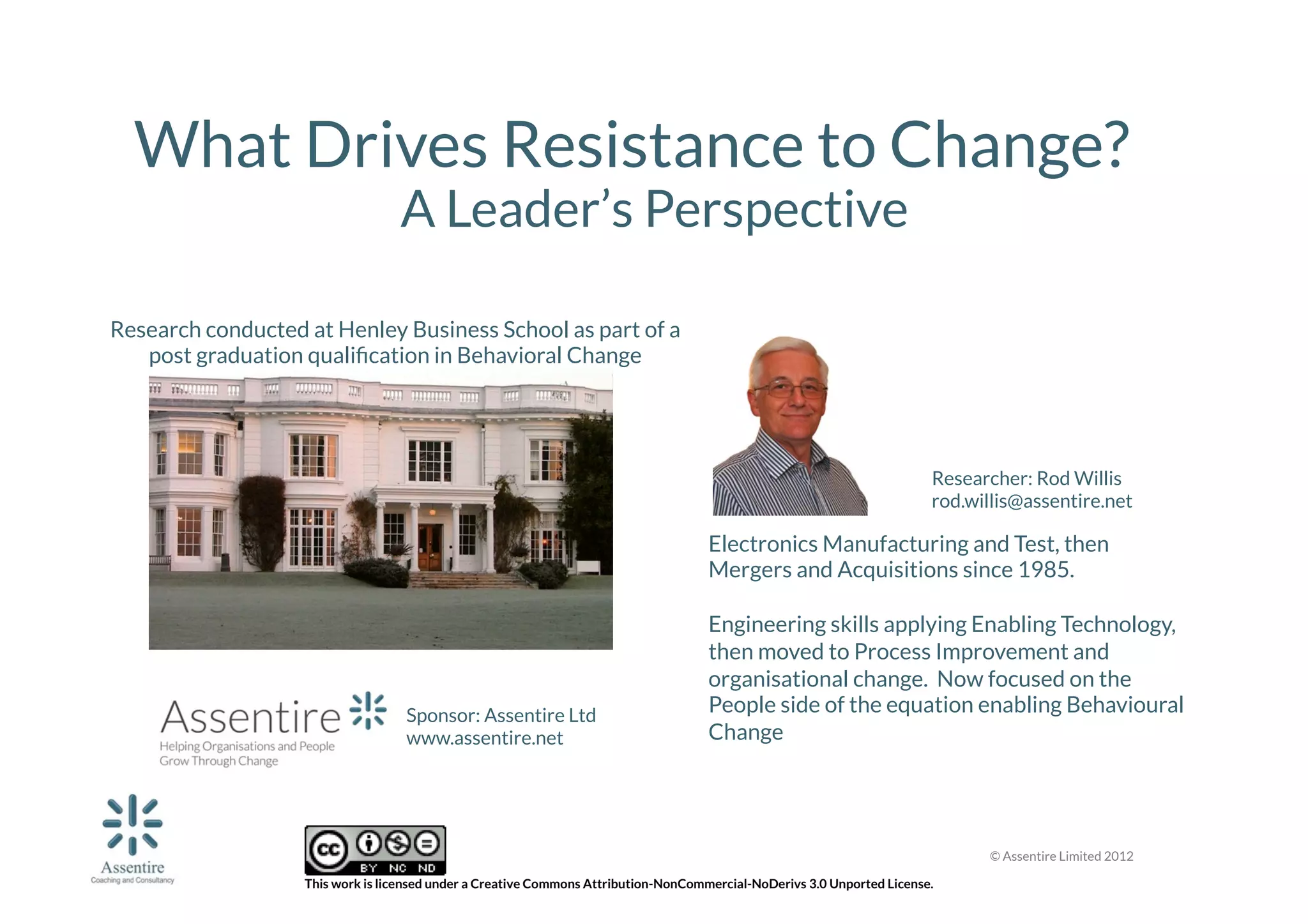
Research conducted at Henley Business School as part of a 
post graduation qualification in Behavioral Change 

Researcher: Rod Willis
rod.willis@assentire.net

Electronics Manufacturing and Test, then
Mergers and Acquisitions since 1985. 


Sponsor: Assentire Ltd
www.assentire.net 

Engineering skills applying Enabling Technology,
then moved to Process Improvement and
organisational change. Now focused on the
People side of the equation enabling Behavioural
Change 

© Assentire Limited 2012
Reflecting why are we here today?
Here are some thoughts

•  Find ways of being better at what we do
•  Be free to bring new ideas to the table
•  Be able to frame new ideas contextually

© Assentire Limited 2012
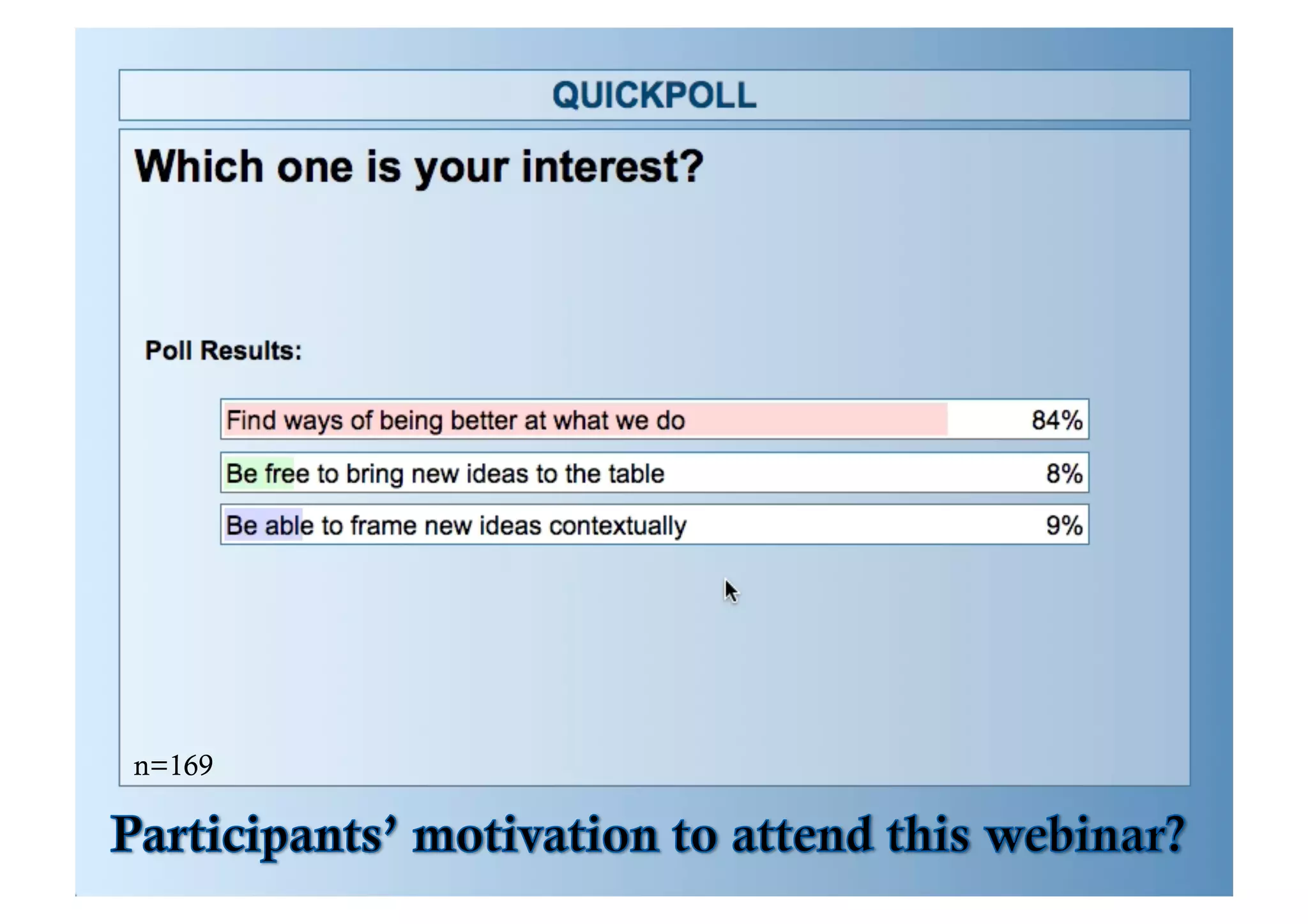
POLL	
  Ques)ons	
  #1	
  
•  Which	
  one	
  is	
  your	
  interest?	
  
–  Find	
  ways	
  of	
  being	
  be=er	
  at	
  what	
  we	
  do	
  
–  Be	
  free	
  to	
  bring	
  new	
  ideas	
  to	
  the	
  table	
  
–  Be	
  able	
  to	
  frame	
  new	
  ideas	
  contextually	


n=169
Select	
  only	
  one	
  
Is this research Important?
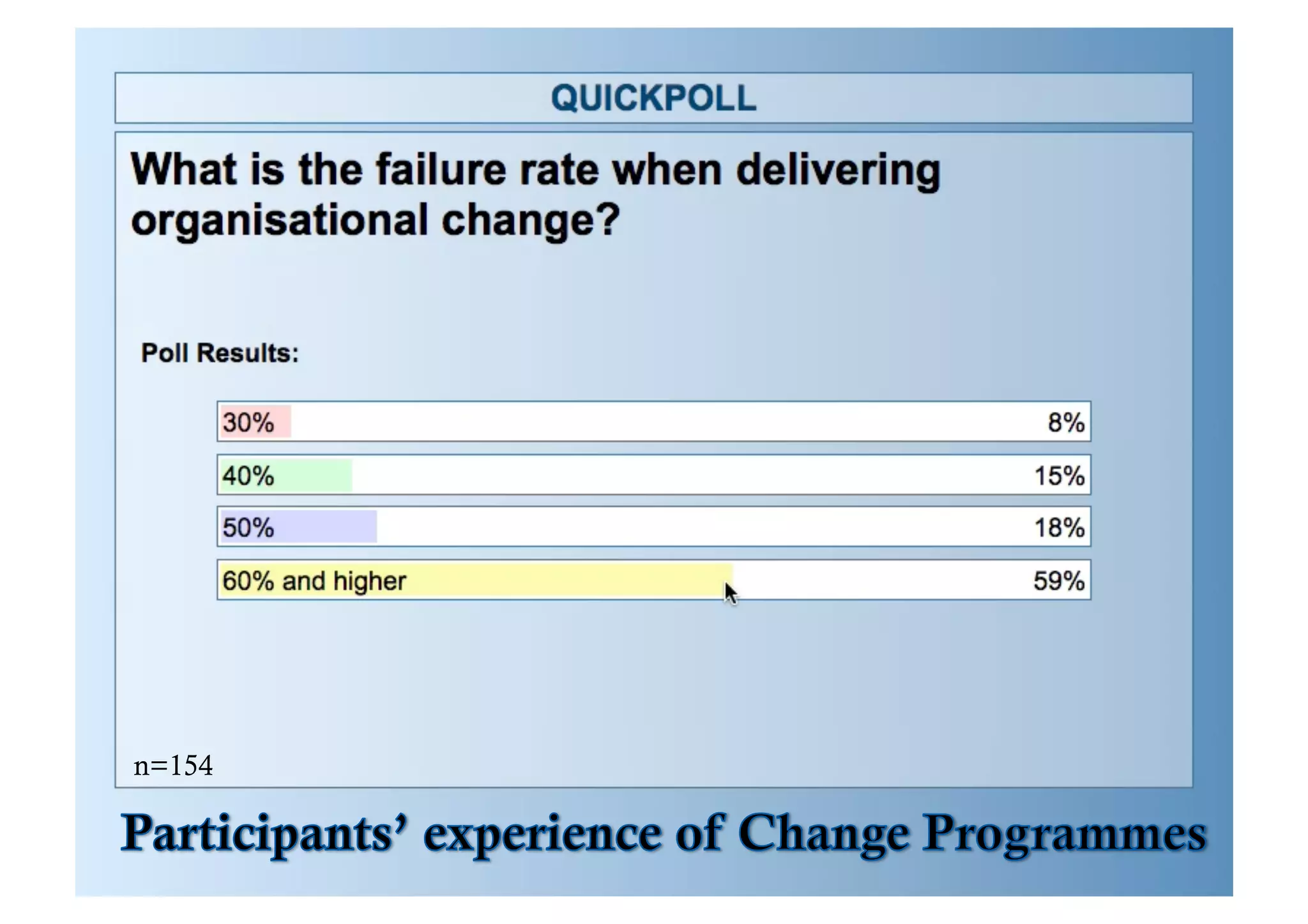
•  70% of all change initiatives fail (HBR).

http://hbr.org/product/hbr-s-10-must-reads-on-change-management-with-feat/an/12599-PBKENG

•  Resistance to Change is often cited as the number
one reason why a change program has not
delivered to the level that was anticipated.
•  Organisations need to respond to turbulent
market conditions. 
•  Needing to achieve more with fewer resources is
a common theme we hear daily in the media, be
this public, private or non-profit sectors. 
© Assentire Limited 2012
Is this research Important?
•  70% of all change initiatives fail (HBR).

http://hbr.org/product/hbr-s-10-must-reads-on-change-management-with-feat/an/12599-PBKENG

•  Resistance to Change is often cited as the number
one reason why a change program has not
delivered to the level that was anticipated.
•  Organisations need to respond to turbulent
market conditions. 
•  Needing to achieve more with fewer resources is
a common theme we hear daily in the media, be
n=154
this public, private or non-profit sectors. 
© Assentire Limited 2012
The Prime Research context
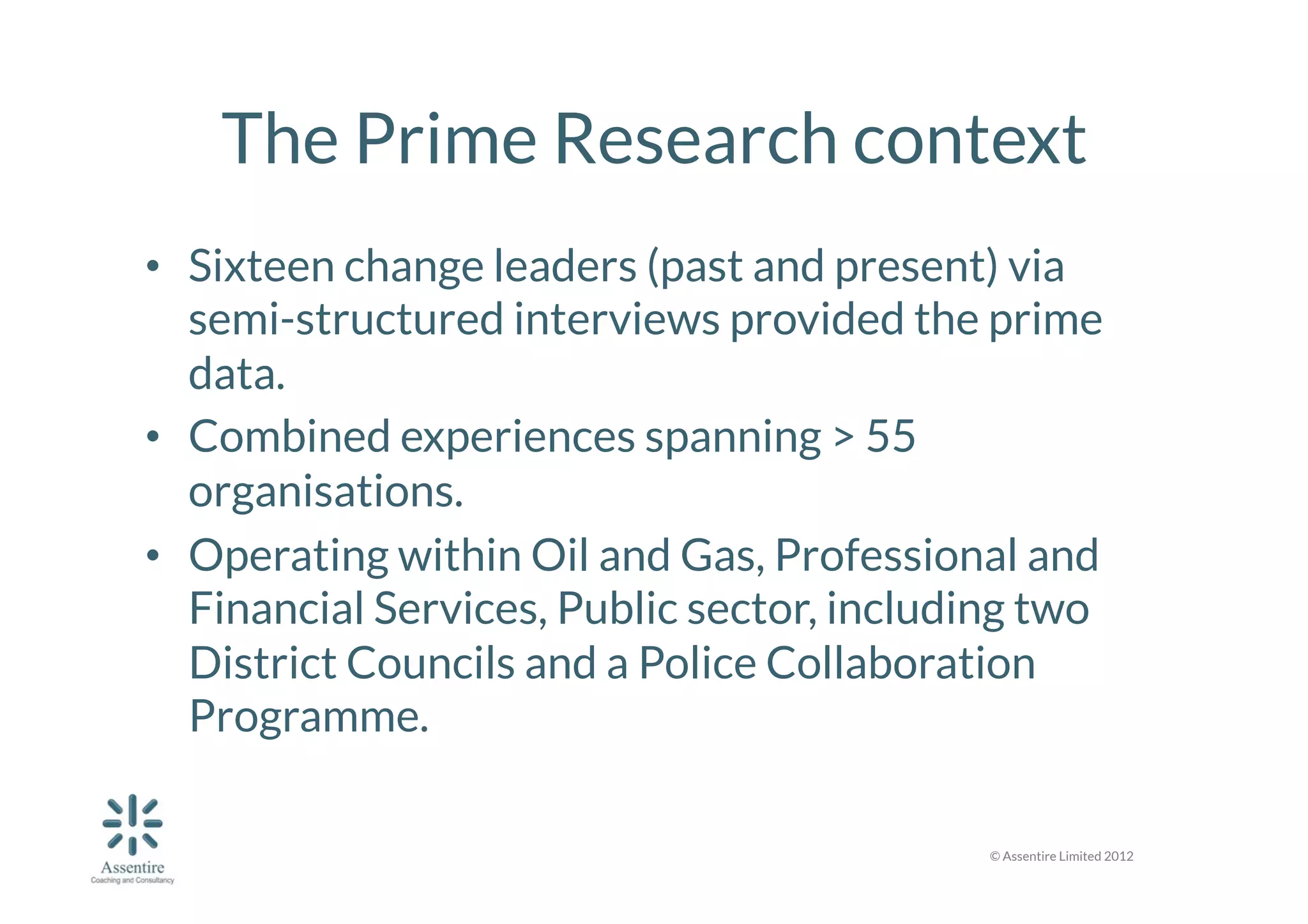
•  Sixteen change leaders (past and present) via
semi-structured interviews provided the prime
data.
•  Combined experiences spanning > 55
organisations. 
•  Operating within Oil and Gas, Professional and
Financial Services, Public sector, including two
District Councils and a Police Collaboration
Programme. 
© Assentire Limited 2012
The Problem of Change
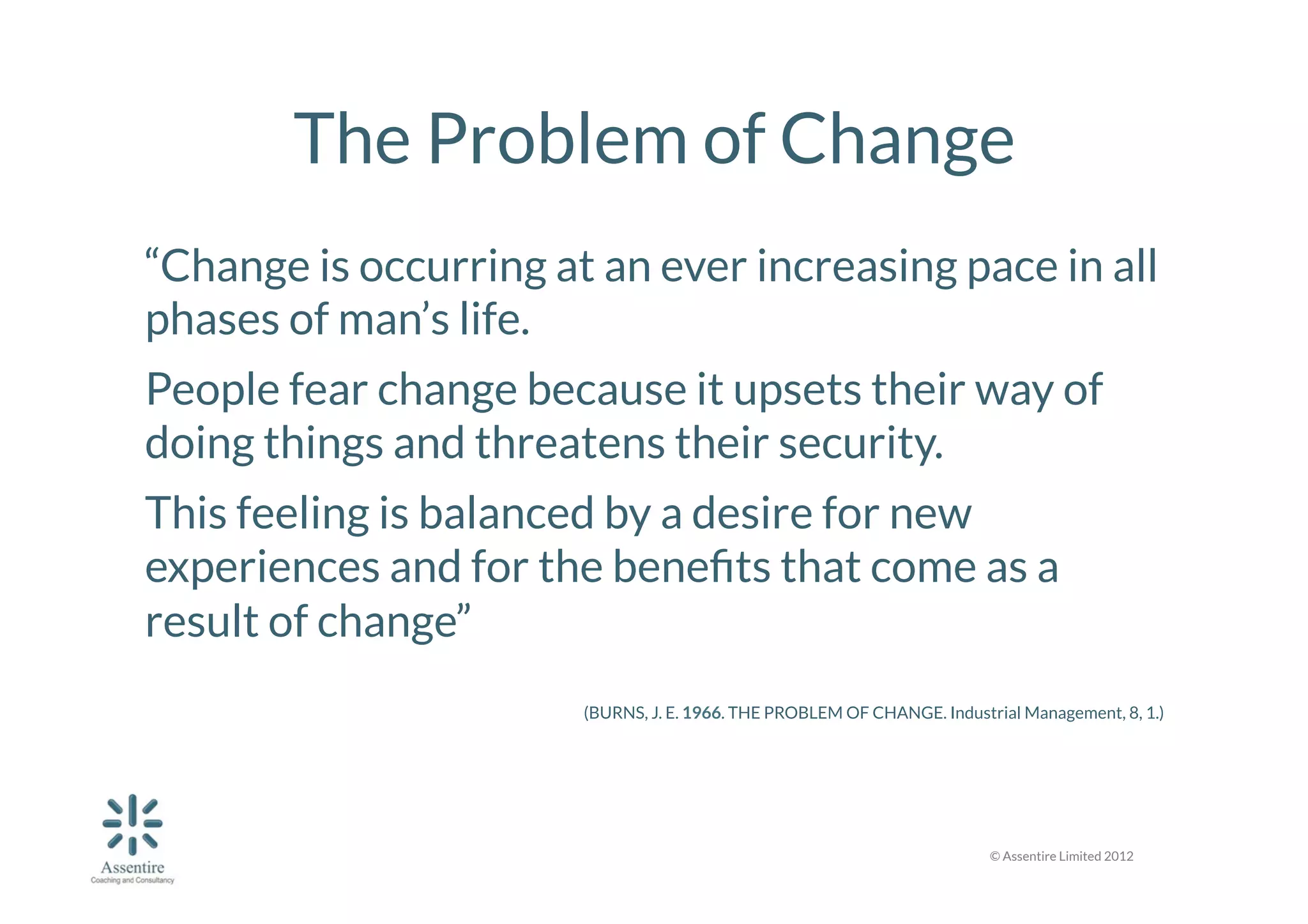
“Change is occurring at an ever increasing pace in all
phases of man’s life. 
People fear change because it upsets their way of
doing things and threatens their security. 
This feeling is balanced by a desire for new
experiences and for the benefits that come as a
result of change” 


(BURNS, J. E. 1966. THE PROBLEM OF CHANGE. Industrial Management, 8, 1.)


© Assentire Limited 2012
Some of the questions asked
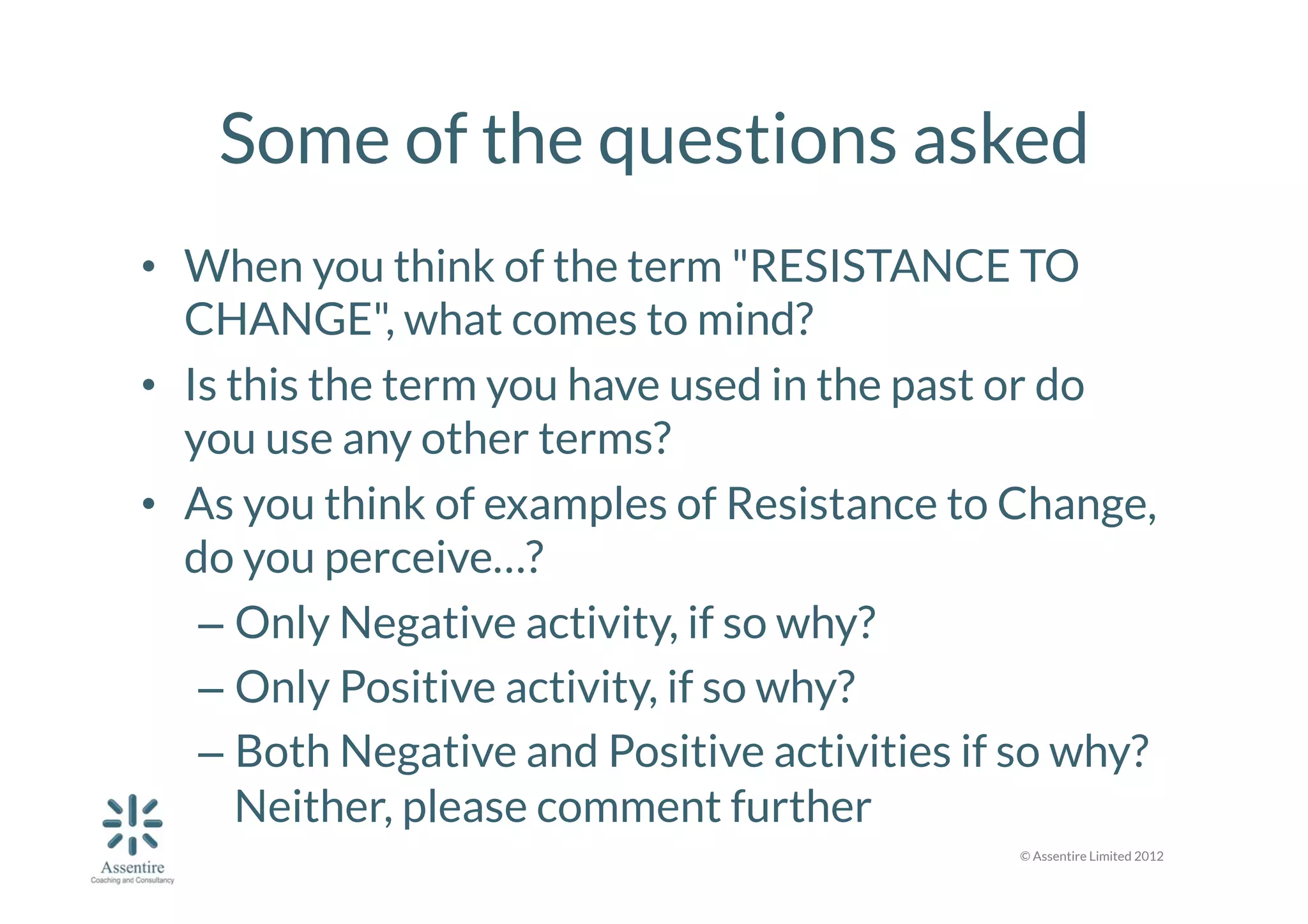
•  When you think of the term "RESISTANCE TO
CHANGE", what comes to mind?
•  Is this the term you have used in the past or do
you use any other terms?
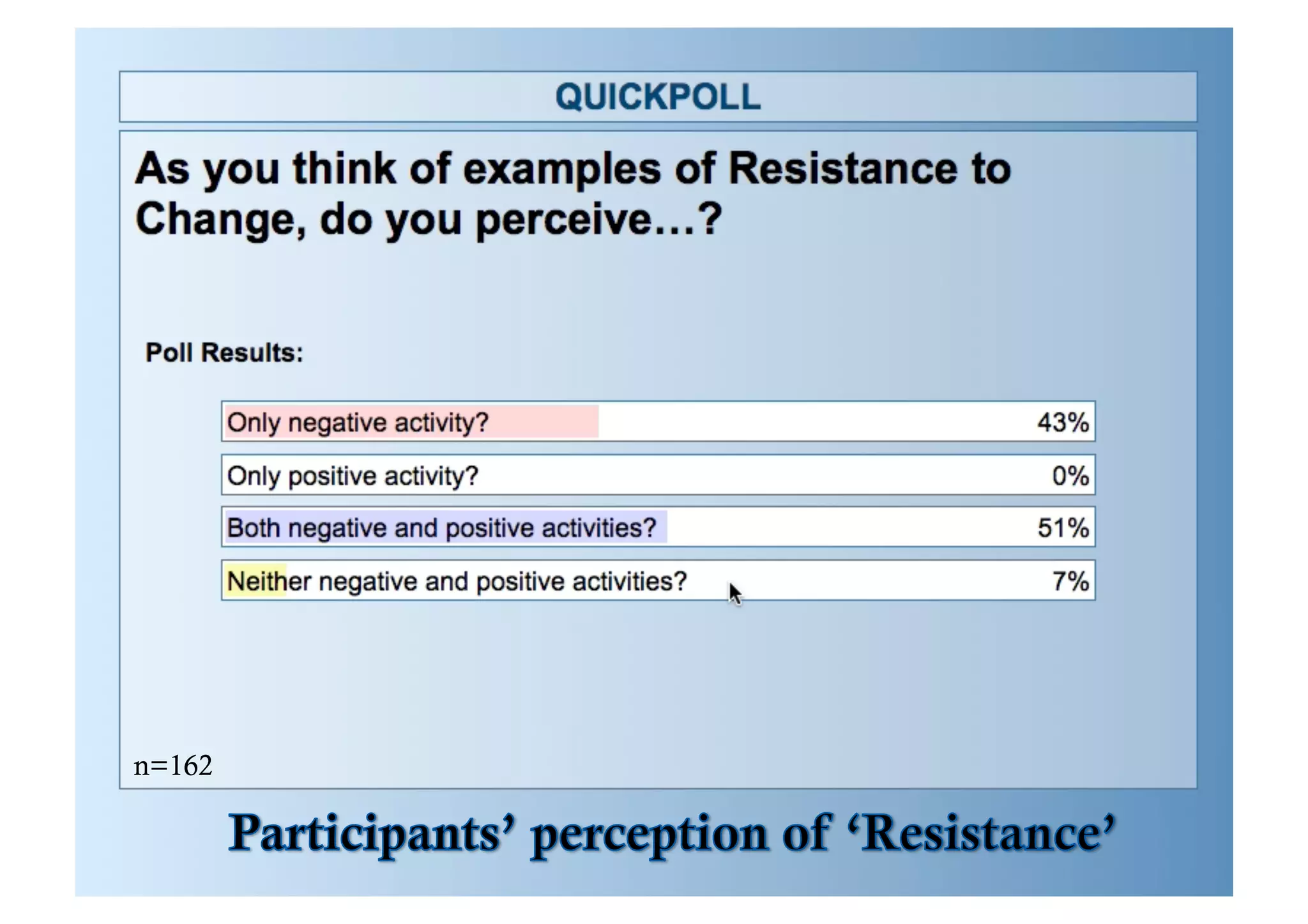
•  As you think of examples of Resistance to Change,
do you perceive…?
–  Only Negative activity, if so why? 
–  Only Positive activity, if so why? 
–  Both Negative and Positive activities if so why?
Neither, please comment further
© Assentire Limited 2012
POLL	
  Ques)ons	
  #2	
  
•  As	
  you	
  think	
  of	
  examples	
  of	
  Resistance	
  to	
  
Change,	
  do	
  you	
  perceive…?	
  
–  Only	
  Nega)ve	
  ac)vity?	
  	
  
–  Only	
  Posi)ve	
  ac)vity?	
  	
  
–  Both	
  Nega)ve	
  and	
  Posi)ve	
  ac)vi)es?	
  	
  
–  Neither	
  Nega)ve	
  nor	
  Posi)ve	
  ac)vi)es?	
  	
  
n=162

Select	
  only	
  one	
  
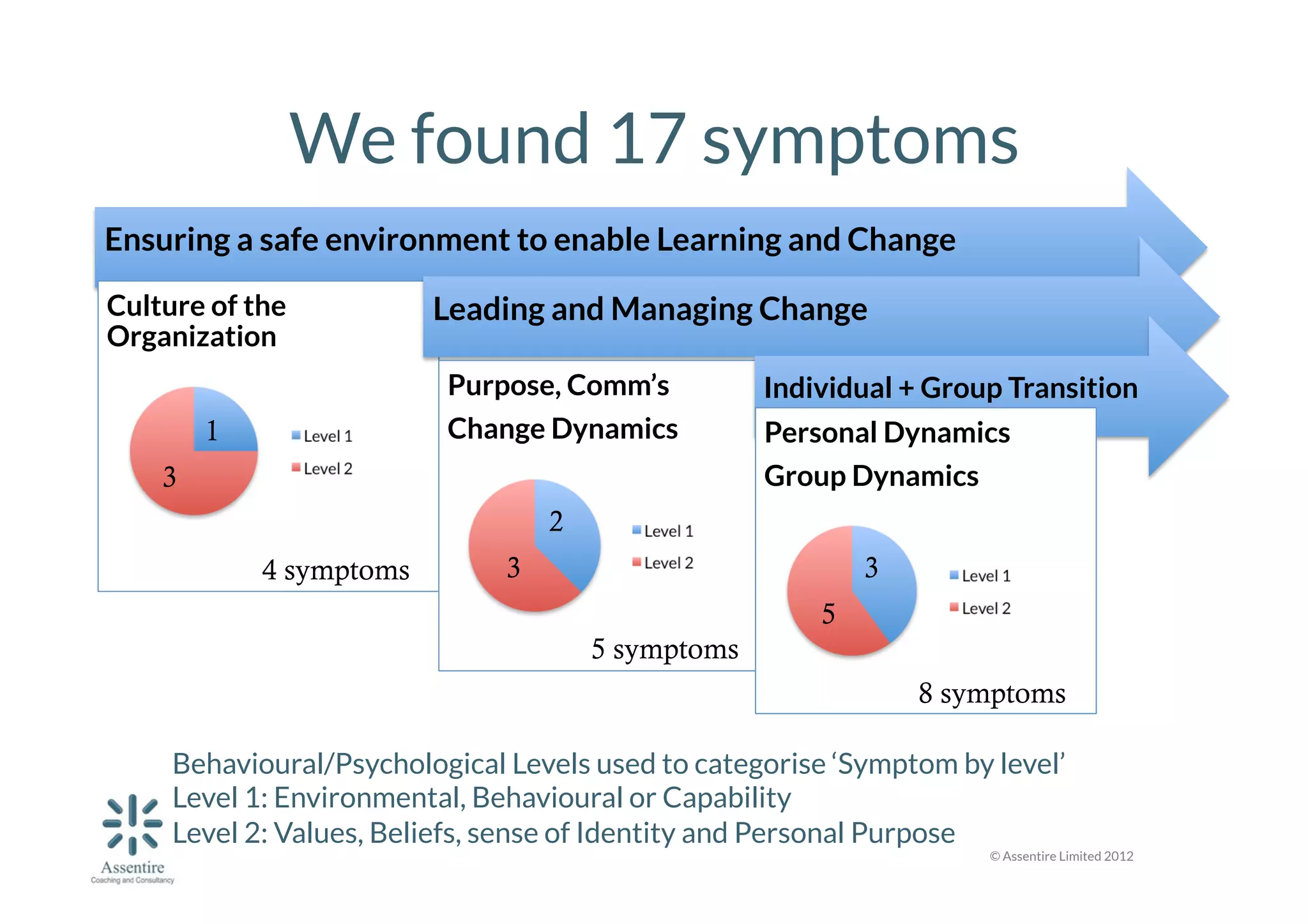
We found 17 symptoms
Ensuring a safe environment to enable Learning and Change
Culture of the
Organization

Leading and Managing Change

Symptoms by level

Purpose, Comm’s

Individual + Group Transition

1 off Level 1
1

Change Dynamics
Symptom by level

Personal Dynamics

3 off3
Level 2


4 symptoms

2 off Level 1
2
3 off3Level 2

Group Dynamics
Symptoms by level
3 off Level 1
3
5
5 off Level 2

5 symptoms
8 symptoms
Behavioural/Psychological Levels used to categorise ‘Symptom by level’
Level 1: Environmental, Behavioural or Capability
Level 2: Values, Beliefs, sense of Identity and Personal Purpose

© Assentire Limited 2012
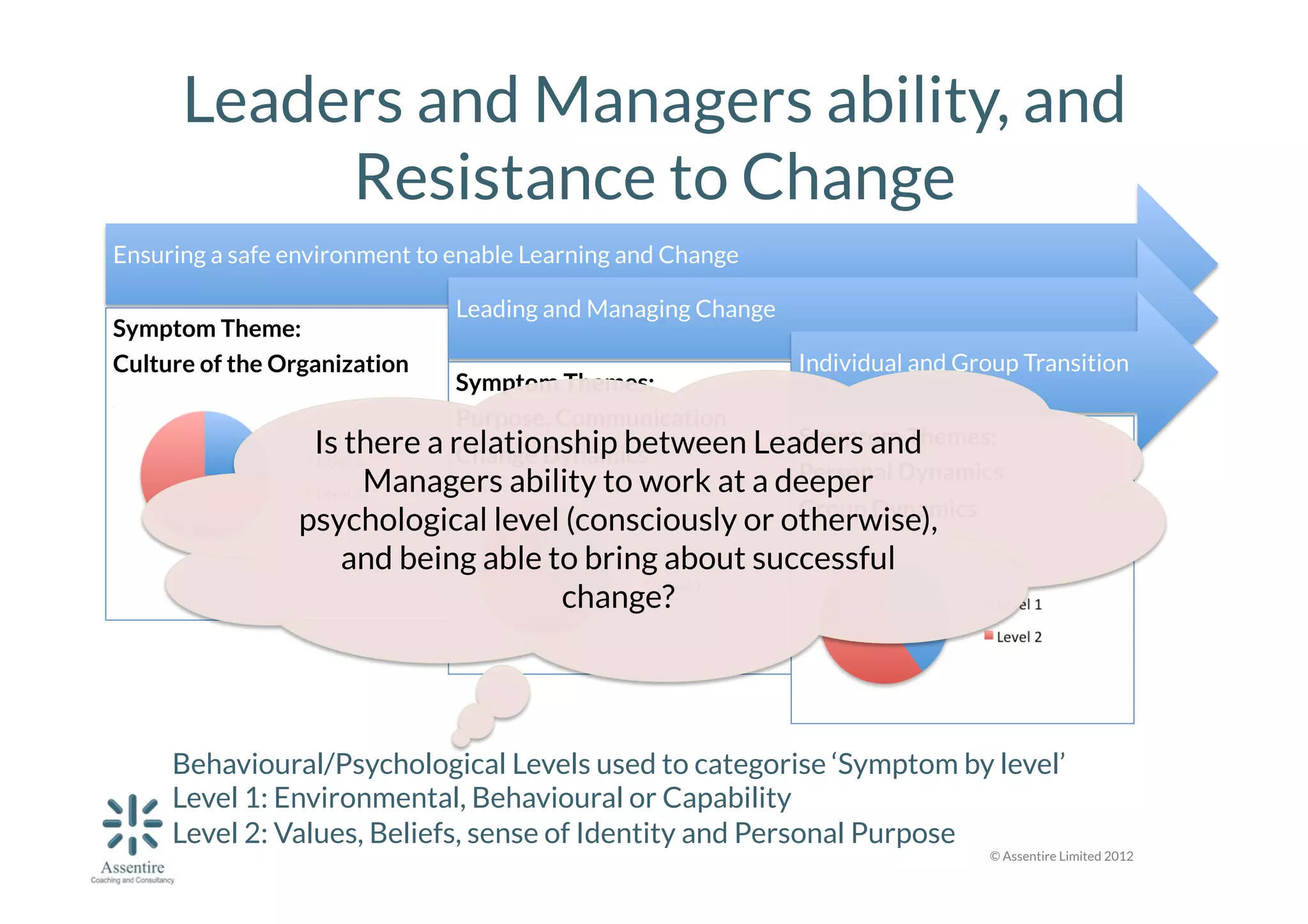
Leaders and Managers ability, and
Resistance to Change 
Ensuring a safe environment to enable Learning and Change
Symptom Theme:
Culture of the Organization

Leading and Managing Change
Symptom Themes:
Purpose, Communication

Individual and Group Transition

Symptoms by level
1 off Level 1
Symptom Themes:
Is there a relationship between Leaders and
Change Dynamics
Personal
3 off Level 2
Managers abilitylevel
work at a deeper Dynamics
Symptom by to

Group Dynamics
psychological level (consciously or otherwise),
2 off Level 1
Symptoms by level
and beingoff Level 2
 bring about successful
3 able to
3 off Level 1
change? 
5 off Level 2

Behavioural/Psychological Levels used to categorise ‘Symptom by level’
Level 1: Environmental, Behavioural or Capability
Level 2: Values, Beliefs, sense of Identity and Personal Purpose

© Assentire Limited 2012
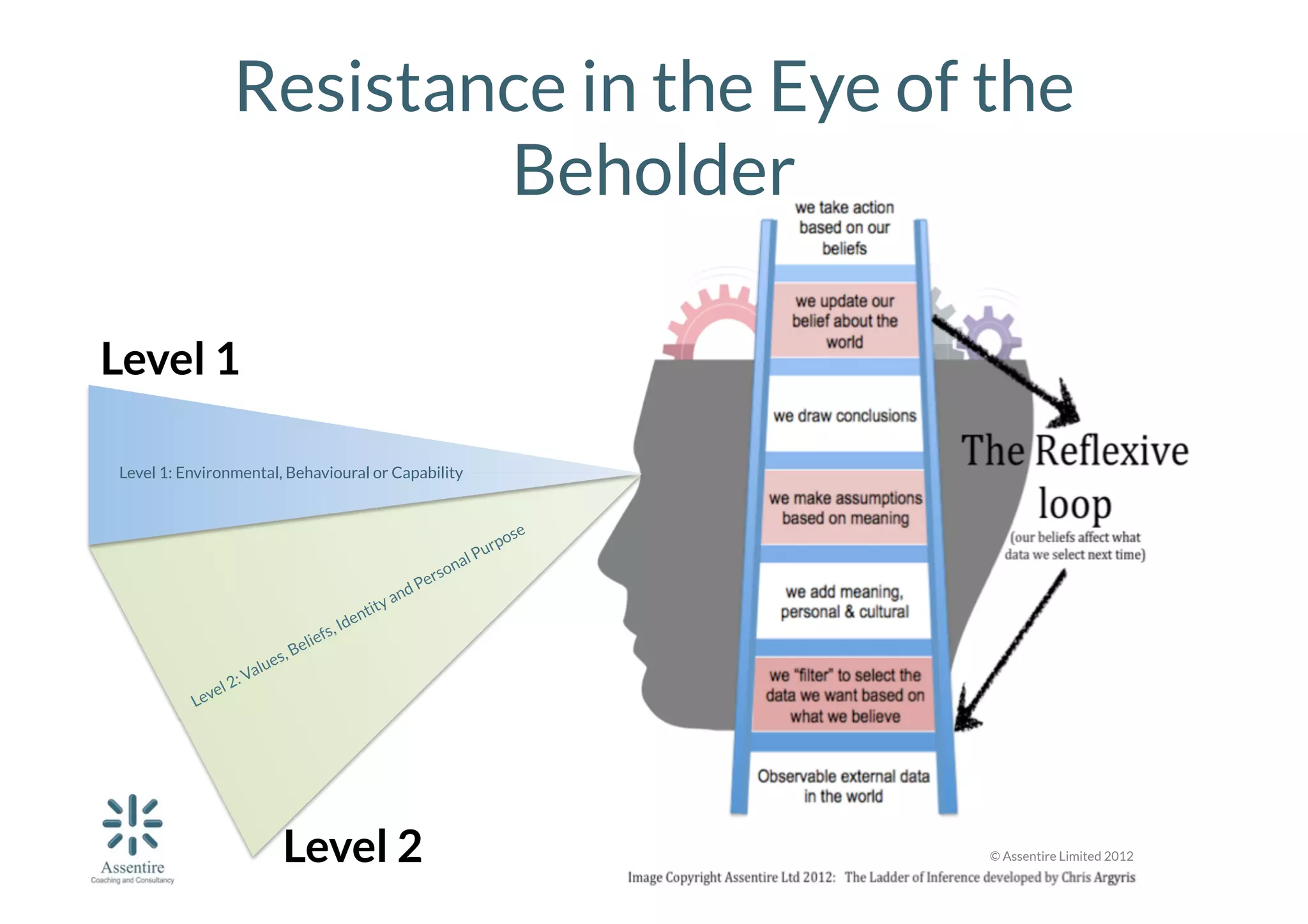
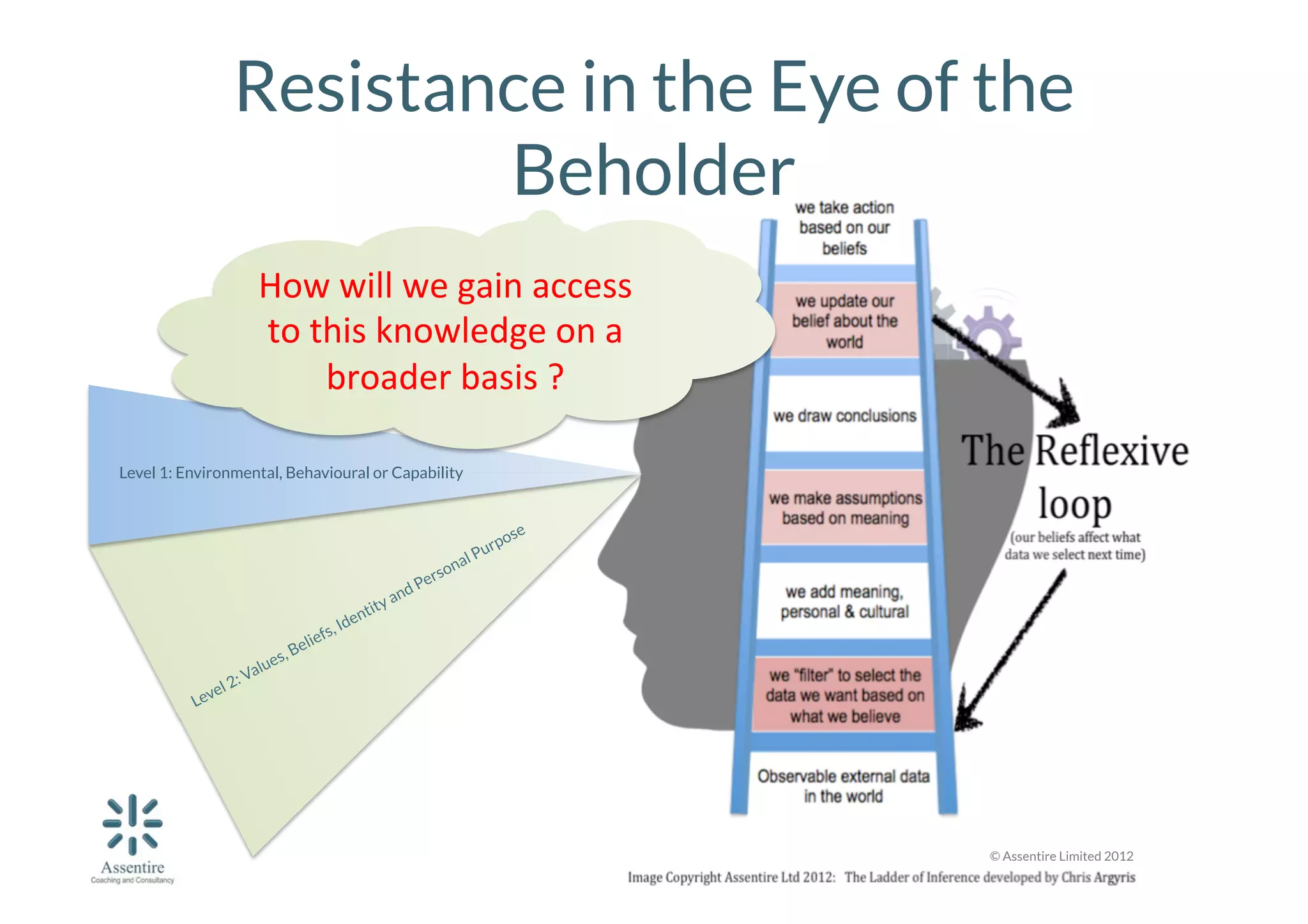
Resistance in the Eye of the
Beholder
Level 1
Level 1: Environmental, Behavioural or Capability

Level 2

© Assentire Limited 2012
Resistance in the Eye of the
Beholder
How	
  will	
  we	
  gain	
  access	
  
to	
  this	
  knowledge	
  on	
  a	
  
broader	
  basis	
  ?	
  
Level 1: Environmental, Behavioural or Capability

© Assentire Limited 2012
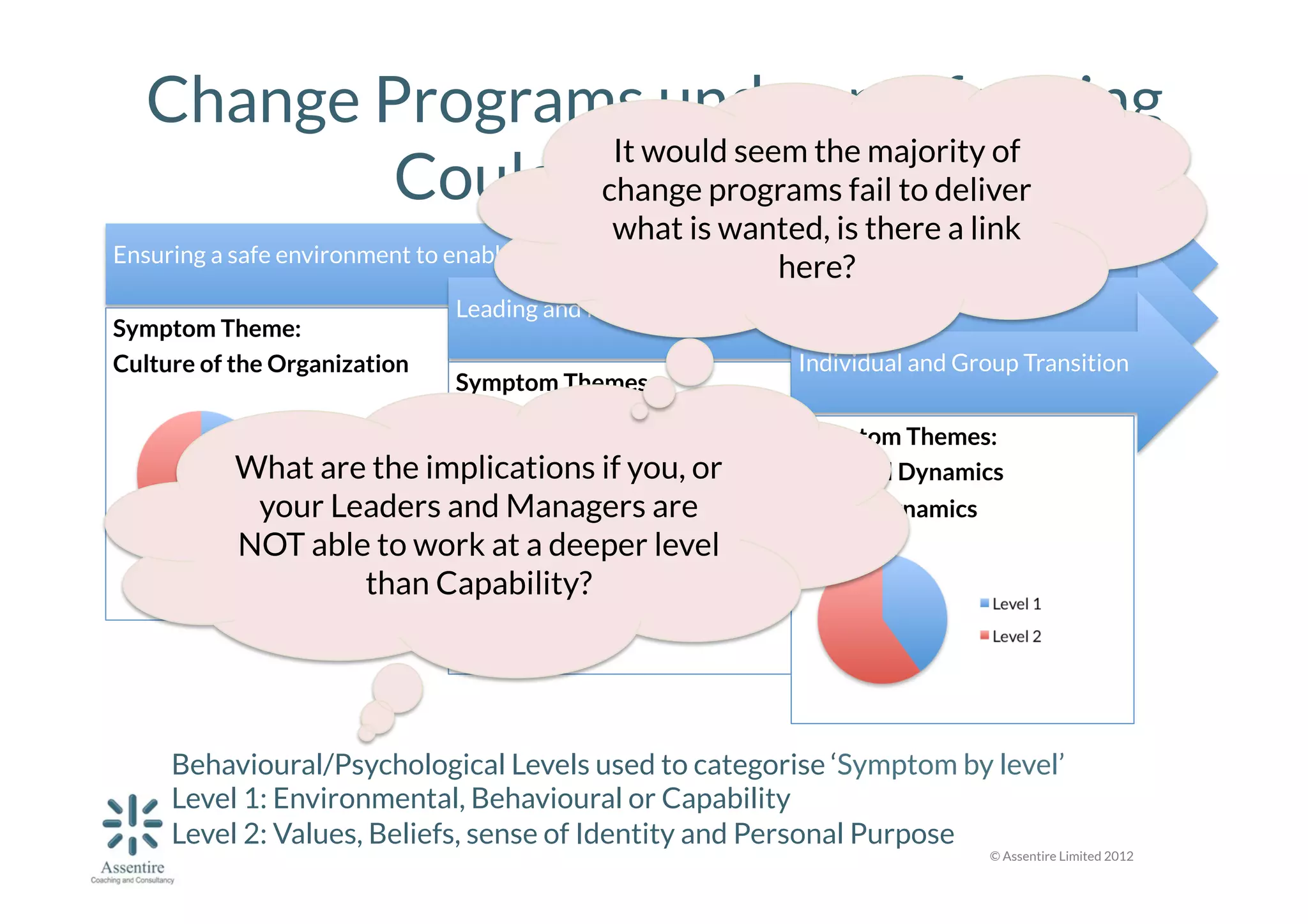
Change Programs under-performing
It would seem the majority of
Could this be why?
 deliver
change programs fail to

what is wanted, is there a link
Ensuring a safe environment to enable Learning and Change
here?
Symptom Theme:
Culture of the Organization
Symptoms by level
1 off Level 1

Leading and Managing Change
Symptom Themes:
Purpose, Communication


Change Dynamics
3 off Level 2
What are the implications if you, or
Symptom by level

your Leaders and Managers are
2 off Level 1
NOT able to work at a deeper level
3 off Level 2
than Capability? 

Individual and Group Transition
Symptom Themes:
Personal Dynamics
Group Dynamics
Symptoms by level
3 off Level 1
5 off Level 2

Behavioural/Psychological Levels used to categorise ‘Symptom by level’
Level 1: Environmental, Behavioural or Capability
Level 2: Values, Beliefs, sense of Identity and Personal Purpose

© Assentire Limited 2012
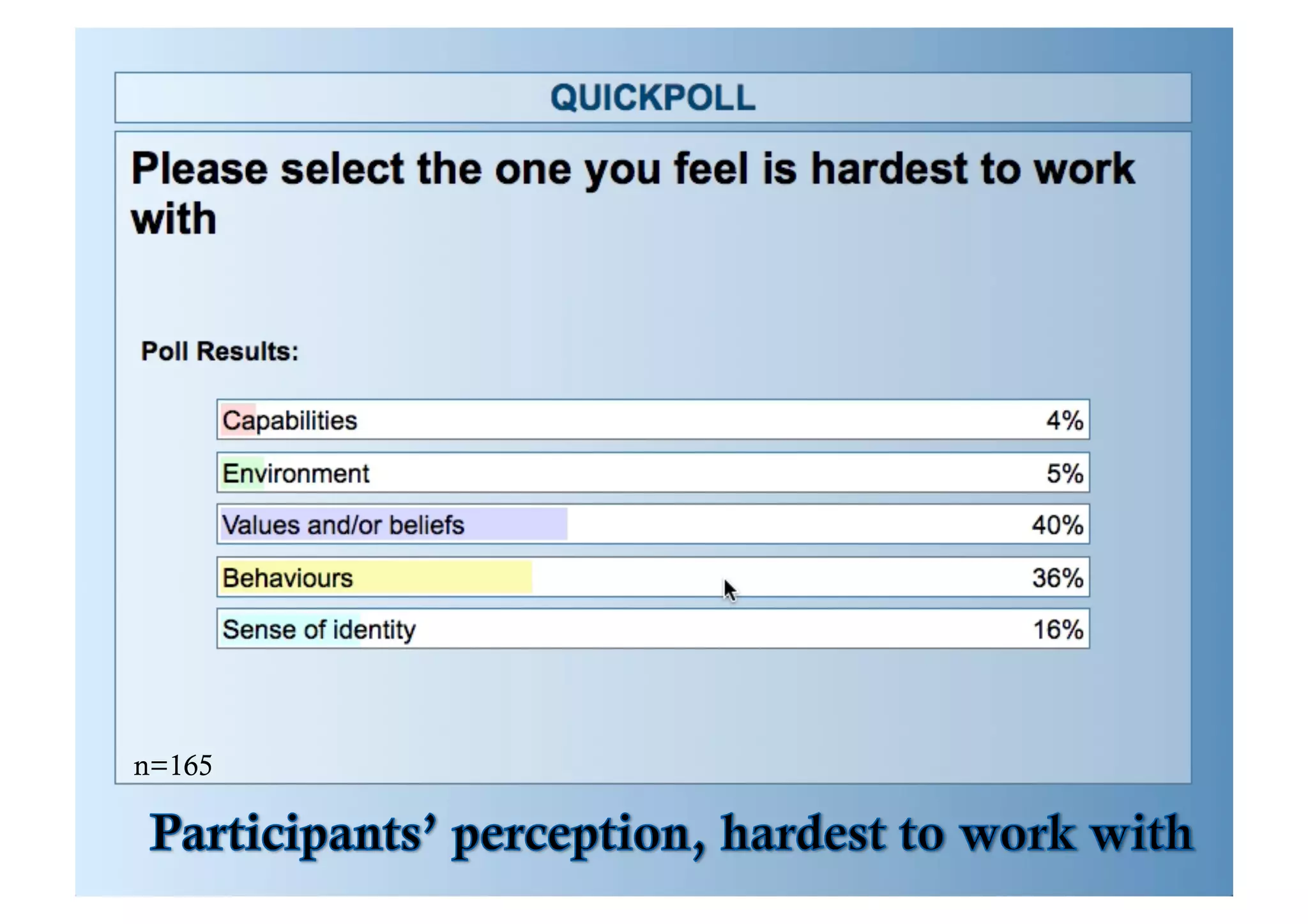
POLL	
  Ques)ons	
  #3	
  
•  Please	
  select	
  the	
  one	
  you	
  feel	
  is	
  hardest	
  to	
  
work	
  with.	
  	
  
–  Capabili)es	
  
–  Environment	
  
–  Values	
  and/or	
  Beliefs	
  
–  Behaviours	
  
–  Sense	
  of	
  Iden)ty	


Select	
  only	
  one	
  
n=165
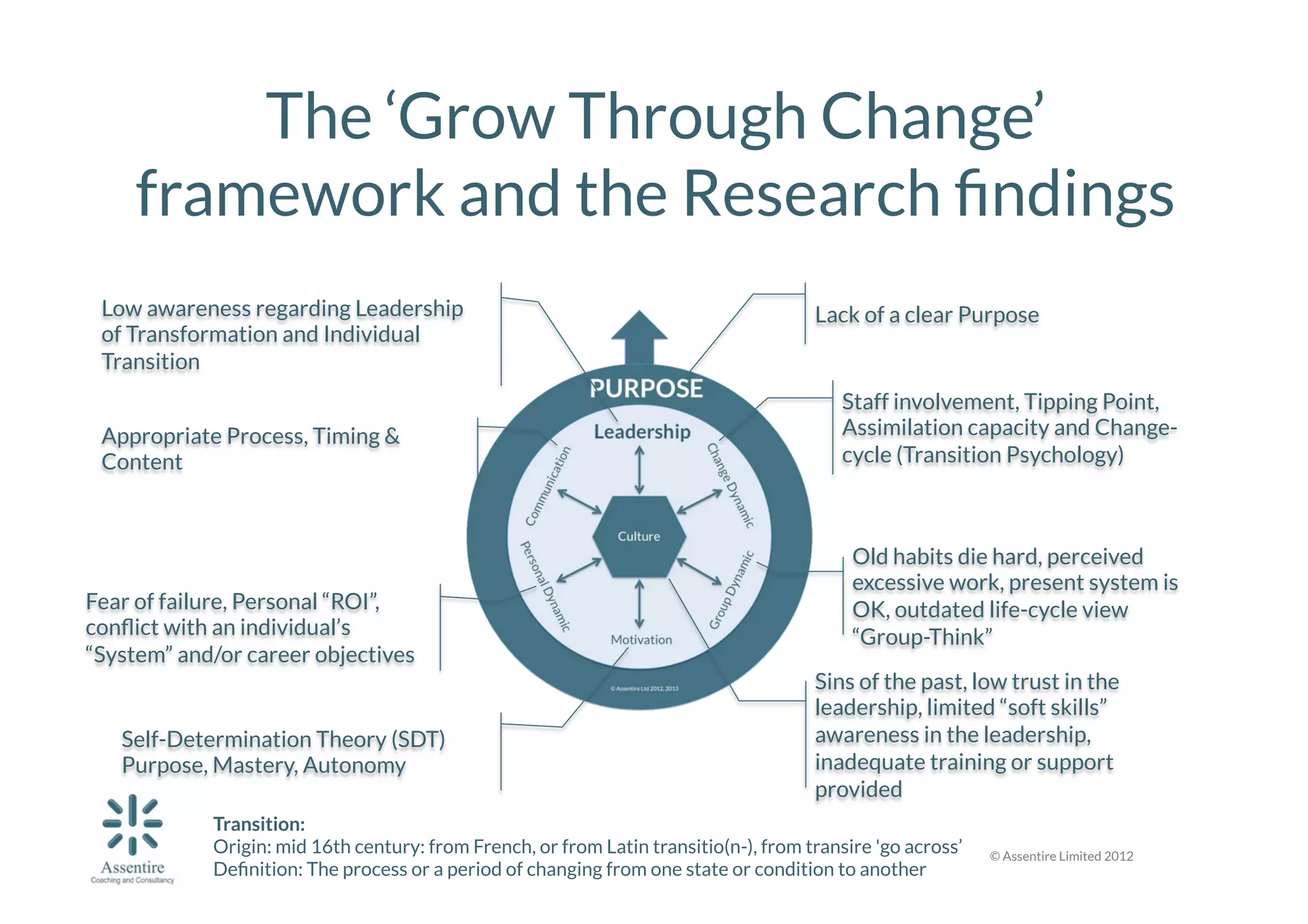
The ‘Grow Through Change’
framework and the Research findings
Low awareness regarding Leadership 
of Transformation and Individual
Transition
Appropriate Process, Timing &
Content

Fear of failure, Personal “ROI”,
conflict with an individual’s
“System” and/or career objectives

Self-Determination Theory (SDT)
Purpose, Mastery, Autonomy 

Lack of a clear Purpose

Staff involvement, Tipping Point,
Assimilation capacity and Changecycle (Transition Psychology)

Old habits die hard, perceived
excessive work, present system is
OK, outdated life-cycle view 
“Group-Think” 
Sins of the past, low trust in the
leadership, limited “soft skills”
awareness in the leadership,
inadequate training or support
provided

Transition: 
Origin: mid 16th century: from French, or from Latin transitio(n-), from transire 'go across’
Definition: The process or a period of changing from one state or condition to another

© Assentire Limited 2012
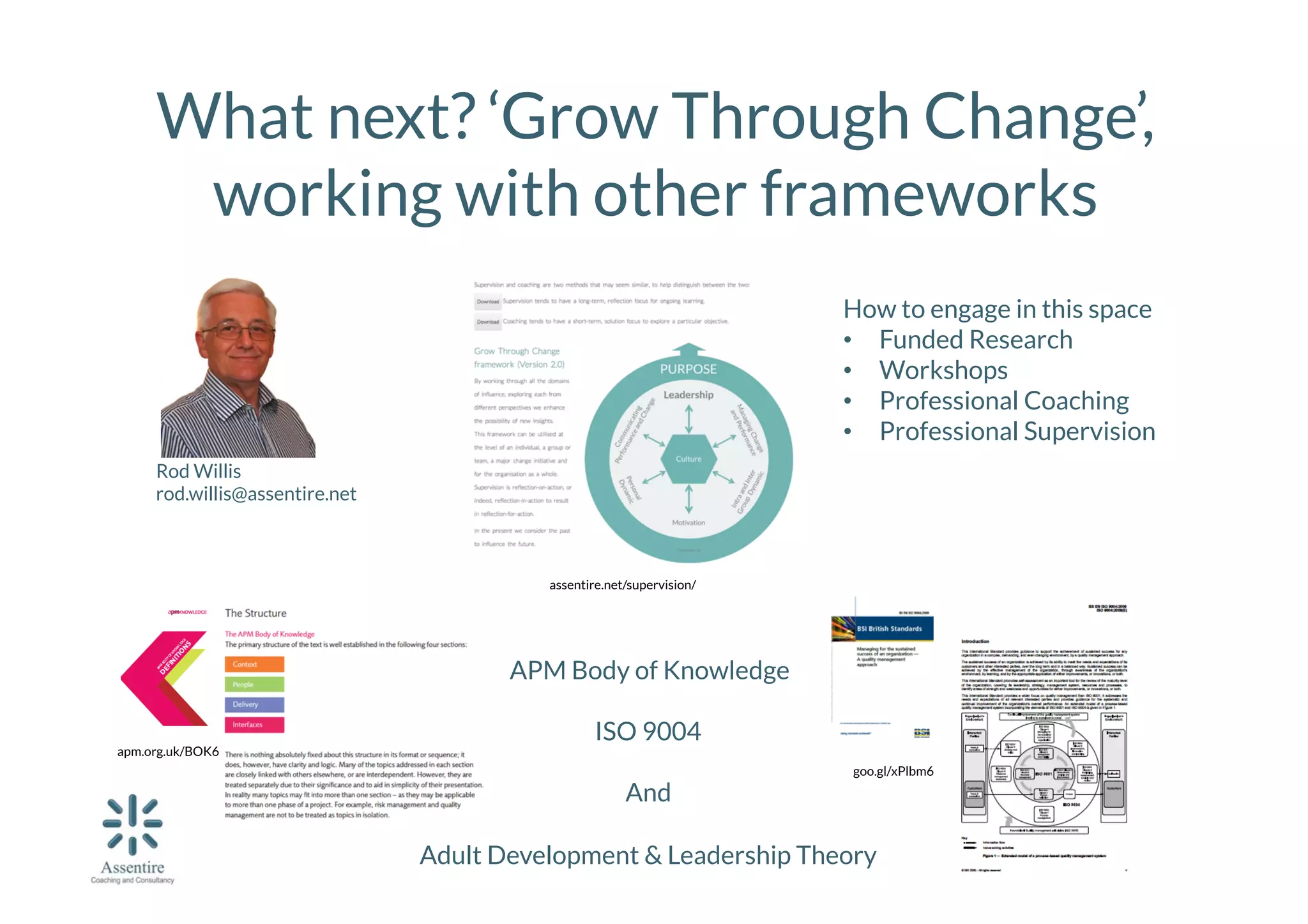
What next? ‘Grow Through Change’,
working with other frameworks
How to engage in this space
•  Funded Research
•  Workshops
•  Professional Coaching
•  Professional Supervision
Rod Willis
rod.willis@assentire.net

assentire.net/supervision/

apm.org.uk/BOK6

APM Body of Knowledge

ISO 9004

goo.gl/xPlbm6
And

Adult Development & Leadership Theory
Thoughts for the day


Resistance to Change, has our view actually changed in 50 year?

‘Real-life leaders: closing the knowing-doing gap’ 
(CIPD Research report September 2013)

‘New research finds 'reality gap’ in the capability of UK plc's 8
million managers, undermining attempts to boost economic
growth’ (CIPD 3rd of May 2012)


© Assentire Limited 2012
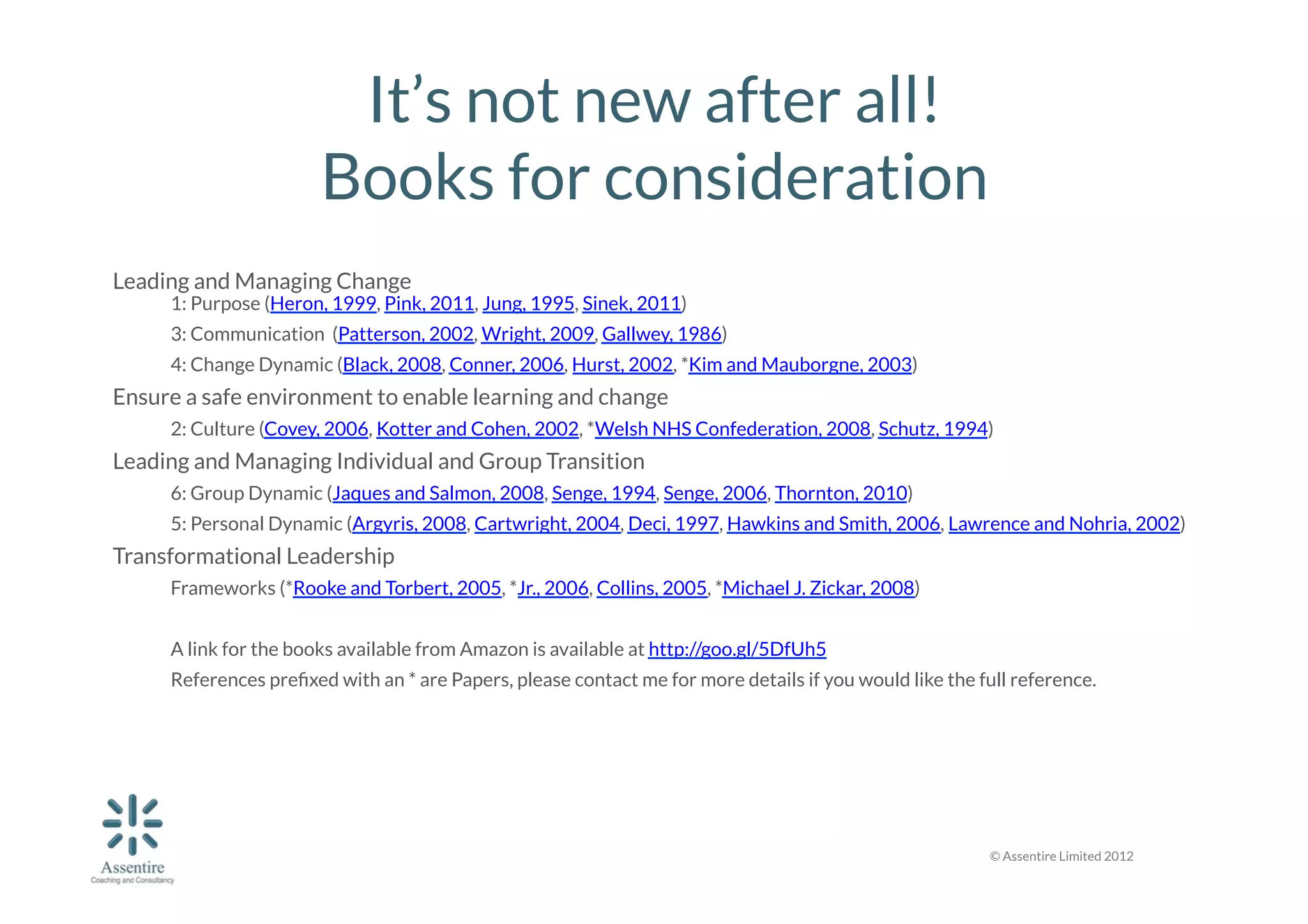
It’s not new after all!
Books for consideration
Leading and Managing Change 


1: Purpose (Heron, 1999, Pink, 2011, Jung, 1995, Sinek, 2011)

3: Communication (Patterson, 2002, Wright, 2009, Gallwey, 1986)

4: Change Dynamic (Black, 2008, Conner, 2006, Hurst, 2002, *Kim and Mauborgne, 2003)

Ensure a safe environment to enable learning and change 

2: Culture (Covey, 2006, Kotter and Cohen, 2002, *Welsh NHS Confederation, 2008, Schutz, 1994)

Leading and Managing Individual and Group Transition 

6: Group Dynamic (Jaques and Salmon, 2008, Senge, 1994, Senge, 2006, Thornton, 2010)

5: Personal Dynamic (Argyris, 2008, Cartwright, 2004, Deci, 1997, Hawkins and Smith, 2006, Lawrence and Nohria, 2002)

Transformational Leadership

Frameworks (*Rooke and Torbert, 2005, *Jr., 2006, Collins, 2005, *Michael J. Zickar, 2008)


A link for the books available from Amazon is available at http://goo.gl/5DfUh5


References prefixed with an * are Papers, please contact me for more details if you would like the full reference.

© Assentire Limited 2012
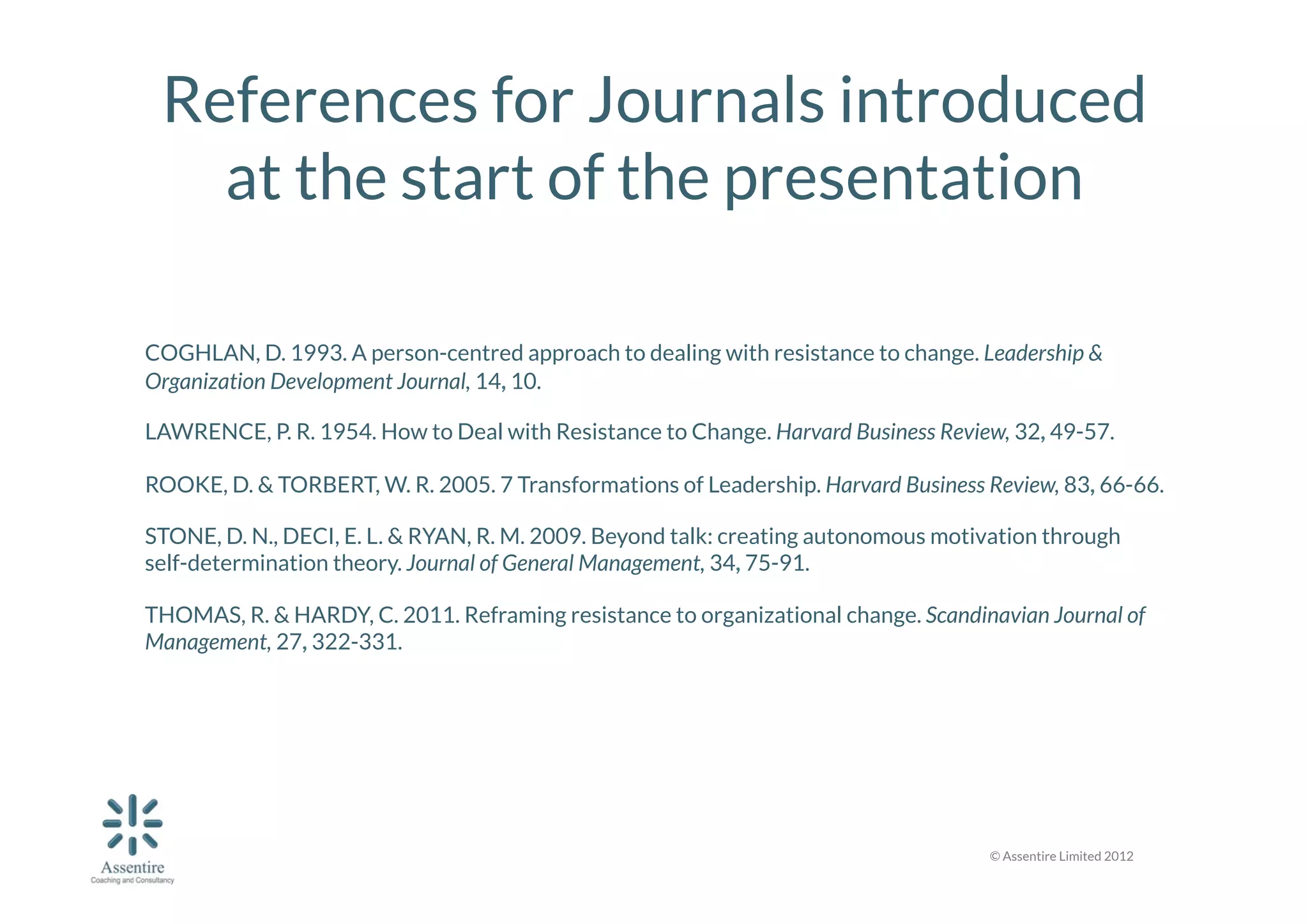
References for Journals introduced
at the start of the presentation


COGHLAN, D. 1993. A person-centred approach to dealing with resistance to change. Leadership &
Organization Development Journal, 14, 10.
LAWRENCE, P. R. 1954. How to Deal with Resistance to Change. Harvard Business Review, 32, 49-57.
ROOKE, D. & TORBERT, W. R. 2005. 7 Transformations of Leadership. Harvard Business Review, 83, 66-66.
STONE, D. N., DECI, E. L. & RYAN, R. M. 2009. Beyond talk: creating autonomous motivation through
self-determination theory. Journal of General Management, 34, 75-91.
THOMAS, R. & HARDY, C. 2011. Reframing resistance to organizational change. Scandinavian Journal of
Management, 27, 322-331.

© Assentire Limited 2012
To close


   ‘Insanity is doing the same thing, over and

over again, but expecting different
results’ (Albert Einstein)


Thank you for your time

© Assentire Limited 2012

Grow through change research overview

  • 1.
    What Drives Resistanceto Change? A Leader’s Perspective Research conducted at Henley Business School as part of a post graduation qualification in Behavioral Change Researcher: Rod Willis rod.willis@assentire.net Electronics Manufacturing and Test, then Mergers and Acquisitions since 1985. Sponsor: Assentire Ltd www.assentire.net Engineering skills applying Enabling Technology, then moved to Process Improvement and organisational change. Now focused on the People side of the equation enabling Behavioural Change © Assentire Limited 2012
  • 2.
    Reflecting why arewe here today? Here are some thoughts •  Find ways of being better at what we do •  Be free to bring new ideas to the table •  Be able to frame new ideas contextually © Assentire Limited 2012
  • 3.
    POLL  Ques)ons  #1   •  Which  one  is  your  interest?   –  Find  ways  of  being  be=er  at  what  we  do   –  Be  free  to  bring  new  ideas  to  the  table   –  Be  able  to  frame  new  ideas  contextually     n=169 Select  only  one  
  • 4.
    Is this researchImportant? •  70% of all change initiatives fail (HBR). http://hbr.org/product/hbr-s-10-must-reads-on-change-management-with-feat/an/12599-PBKENG •  Resistance to Change is often cited as the number one reason why a change program has not delivered to the level that was anticipated. •  Organisations need to respond to turbulent market conditions. •  Needing to achieve more with fewer resources is a common theme we hear daily in the media, be this public, private or non-profit sectors. © Assentire Limited 2012
  • 5.
    Is this researchImportant? •  70% of all change initiatives fail (HBR). http://hbr.org/product/hbr-s-10-must-reads-on-change-management-with-feat/an/12599-PBKENG •  Resistance to Change is often cited as the number one reason why a change program has not delivered to the level that was anticipated. •  Organisations need to respond to turbulent market conditions. •  Needing to achieve more with fewer resources is a common theme we hear daily in the media, be n=154 this public, private or non-profit sectors. © Assentire Limited 2012
  • 6.
    The Prime Researchcontext •  Sixteen change leaders (past and present) via semi-structured interviews provided the prime data. •  Combined experiences spanning > 55 organisations. •  Operating within Oil and Gas, Professional and Financial Services, Public sector, including two District Councils and a Police Collaboration Programme. © Assentire Limited 2012
  • 7.
    The Problem ofChange “Change is occurring at an ever increasing pace in all phases of man’s life. People fear change because it upsets their way of doing things and threatens their security. This feeling is balanced by a desire for new experiences and for the benefits that come as a result of change” (BURNS, J. E. 1966. THE PROBLEM OF CHANGE. Industrial Management, 8, 1.) © Assentire Limited 2012
  • 8.
    Some of thequestions asked •  When you think of the term "RESISTANCE TO CHANGE", what comes to mind? •  Is this the term you have used in the past or do you use any other terms? •  As you think of examples of Resistance to Change, do you perceive…? –  Only Negative activity, if so why? –  Only Positive activity, if so why? –  Both Negative and Positive activities if so why? Neither, please comment further © Assentire Limited 2012
  • 9.
    POLL  Ques)ons  #2   •  As  you  think  of  examples  of  Resistance  to   Change,  do  you  perceive…?   –  Only  Nega)ve  ac)vity?     –  Only  Posi)ve  ac)vity?     –  Both  Nega)ve  and  Posi)ve  ac)vi)es?     –  Neither  Nega)ve  nor  Posi)ve  ac)vi)es?     n=162 Select  only  one  
  • 10.
    We found 17symptoms Ensuring a safe environment to enable Learning and Change Culture of the Organization Leading and Managing Change Symptoms by level Purpose, Comm’s Individual + Group Transition 1 off Level 1 1 Change Dynamics Symptom by level Personal Dynamics 3 off3 Level 2 4 symptoms 2 off Level 1 2 3 off3Level 2 Group Dynamics Symptoms by level 3 off Level 1 3 5 5 off Level 2 5 symptoms 8 symptoms Behavioural/Psychological Levels used to categorise ‘Symptom by level’ Level 1: Environmental, Behavioural or Capability Level 2: Values, Beliefs, sense of Identity and Personal Purpose © Assentire Limited 2012
  • 11.
    Leaders and Managersability, and Resistance to Change Ensuring a safe environment to enable Learning and Change Symptom Theme: Culture of the Organization Leading and Managing Change Symptom Themes: Purpose, Communication Individual and Group Transition Symptoms by level 1 off Level 1 Symptom Themes: Is there a relationship between Leaders and Change Dynamics Personal 3 off Level 2 Managers abilitylevel work at a deeper Dynamics Symptom by to Group Dynamics psychological level (consciously or otherwise), 2 off Level 1 Symptoms by level and beingoff Level 2 bring about successful 3 able to 3 off Level 1 change? 5 off Level 2 Behavioural/Psychological Levels used to categorise ‘Symptom by level’ Level 1: Environmental, Behavioural or Capability Level 2: Values, Beliefs, sense of Identity and Personal Purpose © Assentire Limited 2012
  • 12.
    Resistance in theEye of the Beholder Level 1 Level 1: Environmental, Behavioural or Capability Level 2 © Assentire Limited 2012
  • 13.
    Resistance in theEye of the Beholder How  will  we  gain  access   to  this  knowledge  on  a   broader  basis  ?   Level 1: Environmental, Behavioural or Capability © Assentire Limited 2012
  • 14.
    Change Programs under-performing Itwould seem the majority of Could this be why? deliver change programs fail to what is wanted, is there a link Ensuring a safe environment to enable Learning and Change here? Symptom Theme: Culture of the Organization Symptoms by level 1 off Level 1 Leading and Managing Change Symptom Themes: Purpose, Communication Change Dynamics 3 off Level 2 What are the implications if you, or Symptom by level your Leaders and Managers are 2 off Level 1 NOT able to work at a deeper level 3 off Level 2 than Capability? Individual and Group Transition Symptom Themes: Personal Dynamics Group Dynamics Symptoms by level 3 off Level 1 5 off Level 2 Behavioural/Psychological Levels used to categorise ‘Symptom by level’ Level 1: Environmental, Behavioural or Capability Level 2: Values, Beliefs, sense of Identity and Personal Purpose © Assentire Limited 2012
  • 15.
    POLL  Ques)ons  #3   •  Please  select  the  one  you  feel  is  hardest  to   work  with.     –  Capabili)es   –  Environment   –  Values  and/or  Beliefs   –  Behaviours   –  Sense  of  Iden)ty     Select  only  one   n=165
  • 16.
    The ‘Grow ThroughChange’ framework and the Research findings Low awareness regarding Leadership of Transformation and Individual Transition Appropriate Process, Timing & Content Fear of failure, Personal “ROI”, conflict with an individual’s “System” and/or career objectives Self-Determination Theory (SDT) Purpose, Mastery, Autonomy Lack of a clear Purpose Staff involvement, Tipping Point, Assimilation capacity and Changecycle (Transition Psychology) Old habits die hard, perceived excessive work, present system is OK, outdated life-cycle view “Group-Think” Sins of the past, low trust in the leadership, limited “soft skills” awareness in the leadership, inadequate training or support provided Transition: Origin: mid 16th century: from French, or from Latin transitio(n-), from transire 'go across’ Definition: The process or a period of changing from one state or condition to another © Assentire Limited 2012
  • 17.
    What next? ‘GrowThrough Change’, working with other frameworks How to engage in this space •  Funded Research •  Workshops •  Professional Coaching •  Professional Supervision Rod Willis rod.willis@assentire.net assentire.net/supervision/ apm.org.uk/BOK6 APM Body of Knowledge ISO 9004 goo.gl/xPlbm6 And Adult Development & Leadership Theory
  • 18.
    Thoughts for theday   Resistance to Change, has our view actually changed in 50 year? ‘Real-life leaders: closing the knowing-doing gap’ (CIPD Research report September 2013) ‘New research finds 'reality gap’ in the capability of UK plc's 8 million managers, undermining attempts to boost economic growth’ (CIPD 3rd of May 2012) © Assentire Limited 2012
  • 19.
    It’s not newafter all! Books for consideration Leading and Managing Change 1: Purpose (Heron, 1999, Pink, 2011, Jung, 1995, Sinek, 2011) 3: Communication (Patterson, 2002, Wright, 2009, Gallwey, 1986) 4: Change Dynamic (Black, 2008, Conner, 2006, Hurst, 2002, *Kim and Mauborgne, 2003) Ensure a safe environment to enable learning and change 2: Culture (Covey, 2006, Kotter and Cohen, 2002, *Welsh NHS Confederation, 2008, Schutz, 1994) Leading and Managing Individual and Group Transition 6: Group Dynamic (Jaques and Salmon, 2008, Senge, 1994, Senge, 2006, Thornton, 2010) 5: Personal Dynamic (Argyris, 2008, Cartwright, 2004, Deci, 1997, Hawkins and Smith, 2006, Lawrence and Nohria, 2002) Transformational Leadership Frameworks (*Rooke and Torbert, 2005, *Jr., 2006, Collins, 2005, *Michael J. Zickar, 2008) A link for the books available from Amazon is available at http://goo.gl/5DfUh5 References prefixed with an * are Papers, please contact me for more details if you would like the full reference. © Assentire Limited 2012
  • 20.
    References for Journalsintroduced at the start of the presentation COGHLAN, D. 1993. A person-centred approach to dealing with resistance to change. Leadership & Organization Development Journal, 14, 10. LAWRENCE, P. R. 1954. How to Deal with Resistance to Change. Harvard Business Review, 32, 49-57. ROOKE, D. & TORBERT, W. R. 2005. 7 Transformations of Leadership. Harvard Business Review, 83, 66-66. STONE, D. N., DECI, E. L. & RYAN, R. M. 2009. Beyond talk: creating autonomous motivation through self-determination theory. Journal of General Management, 34, 75-91. THOMAS, R. & HARDY, C. 2011. Reframing resistance to organizational change. Scandinavian Journal of Management, 27, 322-331. © Assentire Limited 2012
  • 21.
    To close  ‘Insanity is doing the same thing, over and over again, but expecting different results’ (Albert Einstein) Thank you for your time © Assentire Limited 2012