RESUME WRITING
Ahmad Faraz Khan
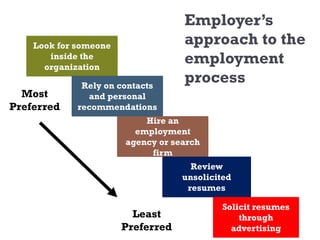
Look for someone
inside the
organization
Rely on contacts
and personal
recommendations
Hire an
employment
agency or search
firm
Review
unsolicited
resumes
Solicit resumes
through
advertising
Employer’s
approach to the
employment
process
Most
Preferred
Least
Preferred
MakingYour Resume Pop
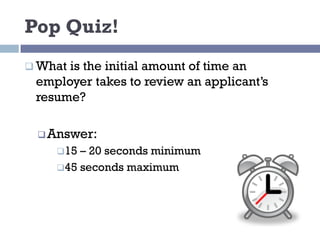
Pop Quiz!
q What is the initial amount of time an
employer takes to review an applicant’s
resume?
qAnswer:
q15 – 20 seconds minimum
q45 seconds maximum
The Resume and Its Purpose
¨ A resume is a short descriptive document.
¨ It is an account of work experience, education,
qualifications, objectives, personal qualities and special
skills.
¨ It is usually the first item a potential employer sees
about you and therefore is very important!
¨ The resume’s main purpose is to get you an
interview!
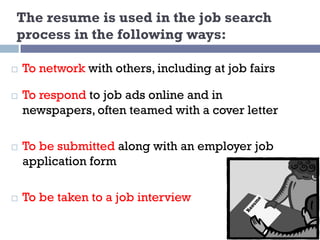
The resume is used in the job search
process in the following ways:
¨ To network with others, including at job fairs
¨ To respond to job ads online and in
newspapers, often teamed with a cover letter
¨ To be submitted along with an employer job
application form
¨ To be taken to a job interview
Resume- hidden messages
q Neat
q Well-organized
q Error free
q Professional
appearance
q Neat
q Well-organized
q Attention to detail
q Careful &
Competent
Resume You
Resumes
Targeted
¨ Addresses Specific
Needs
Tailored
¨ ShowsYou’re a Good
Fit
Standard Resume Formats
Chronological
Functional
Combination
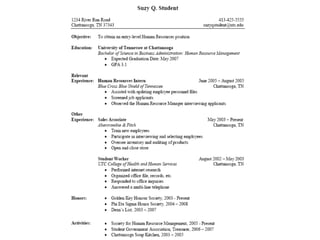
1. Chronological resume
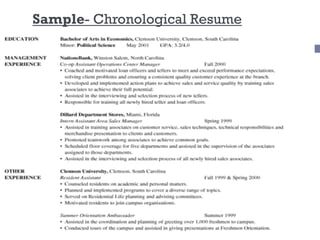
This resume type focuses on your work
experience, listing your current job first and
going back in time chronologically.
This resume highlights steady employment
and progression in job responsibility.
Sample- Chronological Resume
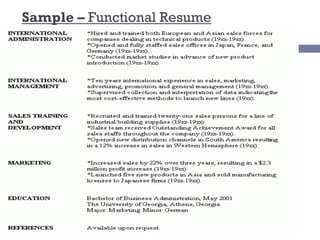
2. Functional Resume
This resume concentrates on general and
specialized skills and abilities, rather than lengthy
descriptions of each individual job.
This resume can hide gaps between jobs (because
dates can be deleted).
Job candidates who are entering new fields or
have experience unrelated to their career goals
might want to choose this format.
Sample – Functional Resume
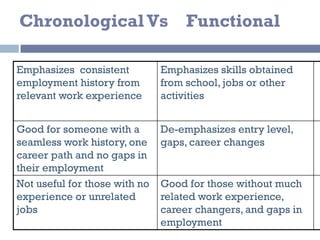
ChronologicalVs Functional
Emphasizes consistent
employment history from
relevant work experience
Emphasizes skills obtained
from school, jobs or other
activities
Good for someone with a
seamless work history, one
career path and no gaps in
their employment
De-emphasizes entry level,
gaps, career changes
Not useful for those with no
experience or unrelated
jobs
Good for those without much
related work experience,
career changers, and gaps in
employment
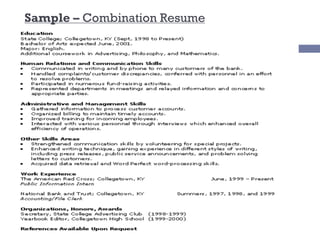
3. Combination Resume
The combination resume brings together
features of the reverse chronological and
the functional resumes.
Sample – Combination Resume
Sections of a Resume
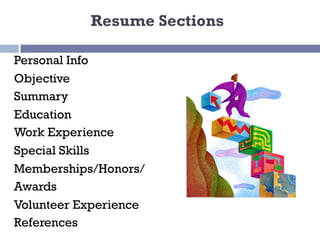
Resume Sections
Personal Info
Objective
Summary
Education
Work Experience
Special Skills
Memberships/Honors/
Awards
Volunteer Experience
References
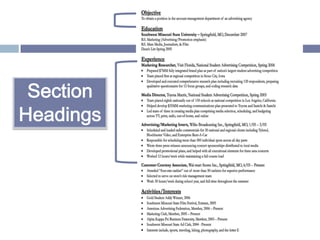
Section
Headings
Section Headings
1 or 2Words
•Additional information relating
to the section heading.
The Header
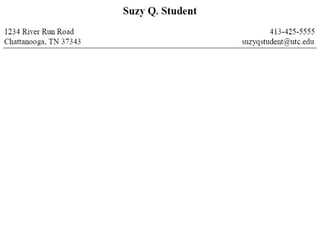
q What should be included?
q Name
q Permanent and present address
q E-mail address
q Telephone number
q LinkedIn Profile (A big add on)
q Where should contact information go?
q Top of the page
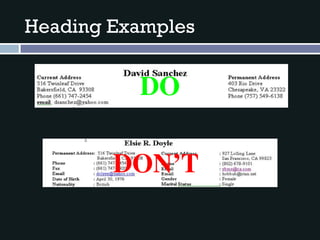
Heading Examples
DO
DON’T
Objective
¨ Focus on how you would benefit the
employer.
¨ Apply to a specific position if possible
¨ Short and to the point.
Relates to a specific
occupational title.
Objective Statement
q Purpose
q Communicate the type of position you are
interested in
q Examples
q Management trainee position with a specialty
retailer.
q Technical sales with an energy related industry
in the Southwest.
q To obtain a position as field service
representative with XYZ Software Corporation.
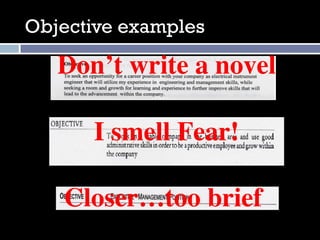
Objective examples
Closer…too brief
Don’t write a novel
I smell Fear!
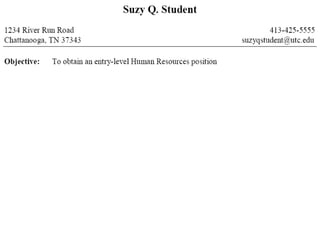
Objective
To obtain an entry level field
engineering position with L&T.
For job fairs-general
Professional
Summary
¨ Summary
¨ Career Summary
¨ Profile
¨ Professional Profile
¨ Professional Highlights
Can be rephrased
a number of ways.
All of these are
professional
summary
headings -
select the words
that best fit your
resume.
Summary
¨ Could also be called:
Profile, Qualifications,
Highlights
¨ Should be tailored to
the job in question via
the job description
¨ Example: “Extensive
knowledge of computer
hardware, computer
communications, and
systems engineering. Strong
team-building, multitasking
and communication skills
due to four years sales
experience. Quick learner
and effective decision-
maker.”
Education
¨ Education
¨ Related Education
¨ Related Coursework
¨ Training
¨ Related Certifications
List education &
training.
All of these are
education &
training
headings -
select the
words that best
fit your resume.
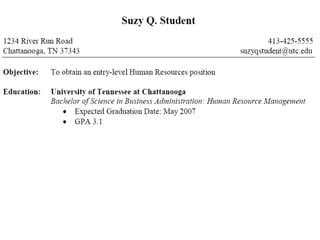
Education
q Name of Institution
q Include city and state if not part of the title
q Name of your degree and major
q Bachelor of _________ in ___________
qBachelor of Science in Business Administration:
Accounting
q List degrees in reverse chronological
order
q Most recent degree is listed first
Education
q Date or expected date of graduation
q Graduation Date: May 2014
q Expected Graduation Date: May 2015
q Percentage
q Major or overall
q High School Information
Work Experience
¨ Experience
¨ Related Experience
¨ Professional Experience
¨ Work History
¨ Related Work History
¨ Professional Work History
¨ Web Experience
(blogging)
All of these
are work
experience
headings -
select the
words that
best fit your
resume.
Experience
q What is considered experience?
qFull and part-time jobs
qSelf-employment
qVolunteer work
qPracticum, field, and cooperative education
q Information to include
qJob Title
qDates of employment
qCompany name
qCity & State
Listing Responsibilities
q Use bullet points
q Start of each line with an action verb
q Present tense if currently employed
q Past tense if no longer employed
q Vary your choice of verbs
q Tailor skills and experiences to the position
for which you are applying
q Be concise while providing enough detail
Use Accomplishment
Statements
Two models you
can use to help
craft your
accomplishment
statements.
¨ PAR
Problem, Action, Result
¨ A+B=R
Action + Benefit = Result
Work Experience
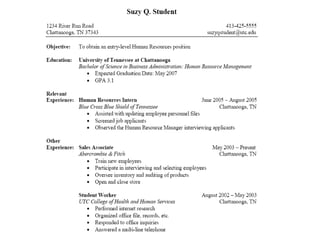
¨ Prioritize the order in which you describe job
duties, with the most impressive-sounding ones
listed first.
¨ Consider dividing your work experience
into “Related Experience” and “Other
Experience.”
¨ Remember to list internships if they are
related to your field. It doesn’t matter if you were
paid or not – good experience is good experience!
Honors & Awards
q Order by dates
q Reverse chronological
q Rank order by importance to the career
objective
Memberships/Honors/Awards
¨ Include memberships in
campus and community
organizations.
¨ Make special note if you
held an office.
¨ Dates are not required.
¨ If listing a
scholarship, indicate
its name and who
awarded it to you.
¨ Don’t forget to list
national associations.
¨ No high school stuff,
please!
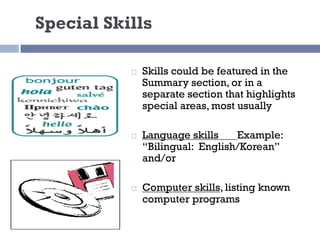
Special Skills
¨ Skills could be featured in the
Summary section, or in a
separate section that highlights
special areas, most usually
¨ Language skills Example:
“Bilingual: English/Korean”
and/or
¨ Computer skills, listing known
computer programs
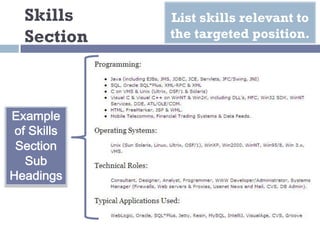
Skills
Section
List skills relevant to
the targeted position.
Example
of Skills
Section
Sub
Headings
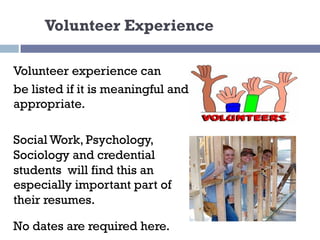
Volunteer Experience
Volunteer experience can
be listed if it is meaningful and
appropriate.
Social Work, Psychology,
Sociology and credential
students will find this an
especially important part of
their resumes.
No dates are required here.
References “available upon request”
¨ You should have at least 3 people agree to be
your reference.
¨ Do not ask family or friends, but consider
employers, professors, scout leaders, who
know you well enough to address your talents
and attributes as an employee, student or
good citizen.
References
¨ Give your references a copy of your
resume and keep them updated on your
job hunt.
¨ Employers may ask for your reference list.
(Never list your references on the resume).
¨ The list should include: reference name,
job title, place of employment, phone
number and email address.
Special Considerations
Resume Dos
q Use action verbs
q Use short, concise sentences
q Use #, %, $ amounts
q Keep resume easy to read
q Keep resume about one page
Action verbs
Achieved Adapted Advised Assisted
Built Controlled Convinced Coordinated
Created Delivered Developed Directed
Employed Equipped Established Expanded
Experienced Guided Handled Improved
Investigate Led Managed Operated
Organized Performed Persuaded Processed
Produced Repaired Researched Served
Sold Taught Treated Wrote
Avoid Weak Statements
¨ Responsible for developing a new filing system
or
¨ Developed a new filing system that reduced
paperwork by 50 percent.
¨ I was in charge of customer complaints and all
ordering problems.
or
¨ Handled all customer complaints and resolved all
product order discrepancies.
Resume Don’ts
q Do not use the pronouns such as I, me, my, etc.
q Do not include references
q Do not clutter your resume with nonessential
information
q Do not make any misrepresentations
q Do not include personal information
q height, weight, photograph, etc.
Tailor your resume
¨ Your resume should be targeted to the
specific job you are applying for.
¨ The job description helps you customize your
resume to the employer’s needs.
¨ Make sure the employer doesn’t miss out on your
most marketable assets: put them in priority
order in the top half or top two-thirds of the
resume.
Resume too skimpy?
¨ Use generous margins.
¨ Use 12 pt.
¨ Consider a heading called
“Major Coursework” or “Related
Coursework” – a listing of various
classes you have taken that may
impress the reader.
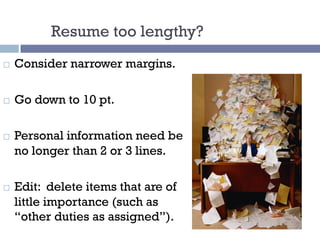
Resume too lengthy?
¨ Consider narrower margins.
¨ Go down to 10 pt.
¨ Personal information need be
no longer than 2 or 3 lines.
¨ Edit: delete items that are of
little importance (such as
“other duties as assigned”).
It’s all in the details
¨ Do not use personal pronouns
¨ Double check your spelling,
grammar and punctuation
¨ Print your resume on a good
printer and use heavy (18 to 24
pound) neutral-colored paper
The whole truth, and nothing but the truth . . .
Never ever include false
information on your resume.
With the technology that is
available today, employers can
easily check on your
background.
How to SubmitYour Resume
¨ It can be mailed. (Send it flat, unfolded, with
no staples, in large envelope).
¨ It can be faxed.
¨ It can be given to someone in person.
¨ It can be e-mailed as an attachment.
¨ It can be copied into the body of an email.
Electronic Resumes
Plain Text (E-mailable) Resumes
¨ Every job candidate needs a separate
plain text document version of his/her
resume ready to email to those employers
requiring them.
¨ Why not just email the traditional resume?
Because the employer’s computer may not
be able to fully translate it – and it could
look like a muddled mess when opened.
Things to Know about E-mailable Resumes
¨ This resume is left-justified with no enhancements – no
bold, bullets or tabbing.
¨ This version of your resume will probably be longer than
a page but that’s OK – the reader just scrolls down.
¨ When emailing this resume, always remember to put
something specific on the subject line
(such as,“Resume from Sue Scott for Museum Curator
Opening”) or it might not be opened.
Other Resume Options
¨ Your resume as a pdf file.
¨ HTML or web resumes. Can
include photos, links, streaming
video.
Scannable Resumes and Keywords
¨ Large companies may scan your resume, looking
for what they call “keywords.”
¨ You can identify keywords for your profession by
reviewing job postings for your target jobs and
noting qualifications, technical expertise,
industry jargon and personality traits that are
being sought after.
Scannable Resumes and Keywords Part 2
¨ Here is an example of a keyword-laden summary
statement for a Sales Representative:
Achievement-oriented sales professional with five years of
success in personal and commercial insurance. Skilled in
developing marketing strategies and providing excellent customer
service….bilingual – Spanish…team player…special
projects…increased sales.
¨ Keywords can be written in text or can be part of a list.
Cover Letters
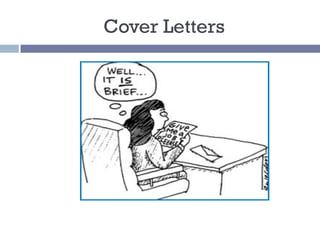
The Cover Letter
¨ The cover letter “covers” your resume and is an
additional opportunity to sell yourself.
¨ DON’T merely repeat what is on the resume.
¨ The cover letter must be tailored to the
employer and the job opening for which you are
applying.
¨ Realize that the employer may view this letter as a
writing sample, so your grammar, spelling,
punctuation and style must be perfect!
The Cover Letter
¨ 1st paragraph: Indicate the job title in question,
and you might add how you found out about the
job opening. (Introduction)
¨ 2nd paragraph: Write about how you would be
able to fit the job in question and bring special
value to the workplace. Show your knowledge of
the employer, and be enthusiastic about your
career field and the job for which you are
applying. (Sales Pitch)
The Cover Letter
¨ 3rd paragraph: Sum yourself up, thank the reader,
and let them know you will contact them directly
if you don’t hear anything within a prescribed
time period. (Close & Action steps)
¨ Use the same higher-quality paper you are using
for your resume, and remember to submit it with
your resume with no folds or staples.
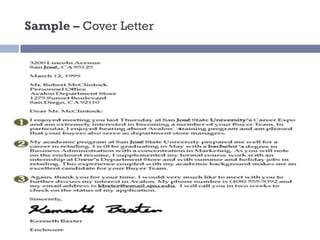
Sample – Cover Letter
Summary of the most important points
¨ Main purpose of the resume – to get an interview
¨ Choose a resume format – there are basically 3 types
¨ Required resume elements – personal info, objective,
education, work experience
¨ Tailor your resume to the particular job you are applying
for!
¨ Know how an e-mailable resume differs from the traditional
formats
¨ Use the cover letter to sell yourself and add value to your
resume
Thank you.

99994176.pdf

  • 1.
  • 2.
    Look for someone insidethe organization Rely on contacts and personal recommendations Hire an employment agency or search firm Review unsolicited resumes Solicit resumes through advertising Employer’s approach to the employment process Most Preferred Least Preferred
  • 3.
  • 4.
    Pop Quiz! q Whatis the initial amount of time an employer takes to review an applicant’s resume? qAnswer: q15 – 20 seconds minimum q45 seconds maximum
  • 5.
    The Resume andIts Purpose ¨ A resume is a short descriptive document. ¨ It is an account of work experience, education, qualifications, objectives, personal qualities and special skills. ¨ It is usually the first item a potential employer sees about you and therefore is very important! ¨ The resume’s main purpose is to get you an interview!
  • 6.
    The resume isused in the job search process in the following ways: ¨ To network with others, including at job fairs ¨ To respond to job ads online and in newspapers, often teamed with a cover letter ¨ To be submitted along with an employer job application form ¨ To be taken to a job interview
  • 7.
    Resume- hidden messages qNeat q Well-organized q Error free q Professional appearance q Neat q Well-organized q Attention to detail q Careful & Competent Resume You
  • 8.
  • 9.
  • 10.
    1. Chronological resume Thisresume type focuses on your work experience, listing your current job first and going back in time chronologically. This resume highlights steady employment and progression in job responsibility.
  • 11.
  • 12.
    2. Functional Resume Thisresume concentrates on general and specialized skills and abilities, rather than lengthy descriptions of each individual job. This resume can hide gaps between jobs (because dates can be deleted). Job candidates who are entering new fields or have experience unrelated to their career goals might want to choose this format.
  • 13.
  • 14.
    ChronologicalVs Functional Emphasizes consistent employmenthistory from relevant work experience Emphasizes skills obtained from school, jobs or other activities Good for someone with a seamless work history, one career path and no gaps in their employment De-emphasizes entry level, gaps, career changes Not useful for those with no experience or unrelated jobs Good for those without much related work experience, career changers, and gaps in employment
  • 15.
    3. Combination Resume Thecombination resume brings together features of the reverse chronological and the functional resumes.
  • 16.
  • 17.
  • 18.
    Resume Sections Personal Info Objective Summary Education WorkExperience Special Skills Memberships/Honors/ Awards Volunteer Experience References
  • 19.
  • 20.
    Section Headings 1 or2Words •Additional information relating to the section heading.
  • 21.
    The Header q Whatshould be included? q Name q Permanent and present address q E-mail address q Telephone number q LinkedIn Profile (A big add on) q Where should contact information go? q Top of the page
  • 22.
  • 24.
    Objective ¨ Focus onhow you would benefit the employer. ¨ Apply to a specific position if possible ¨ Short and to the point. Relates to a specific occupational title.
  • 25.
    Objective Statement q Purpose qCommunicate the type of position you are interested in q Examples q Management trainee position with a specialty retailer. q Technical sales with an energy related industry in the Southwest. q To obtain a position as field service representative with XYZ Software Corporation.
  • 26.
  • 27.
    Objective To obtain anentry level field engineering position with L&T. For job fairs-general
  • 29.
    Professional Summary ¨ Summary ¨ CareerSummary ¨ Profile ¨ Professional Profile ¨ Professional Highlights Can be rephrased a number of ways. All of these are professional summary headings - select the words that best fit your resume.
  • 30.
    Summary ¨ Could alsobe called: Profile, Qualifications, Highlights ¨ Should be tailored to the job in question via the job description ¨ Example: “Extensive knowledge of computer hardware, computer communications, and systems engineering. Strong team-building, multitasking and communication skills due to four years sales experience. Quick learner and effective decision- maker.”
  • 31.
    Education ¨ Education ¨ RelatedEducation ¨ Related Coursework ¨ Training ¨ Related Certifications List education & training. All of these are education & training headings - select the words that best fit your resume.
  • 32.
    Education q Name ofInstitution q Include city and state if not part of the title q Name of your degree and major q Bachelor of _________ in ___________ qBachelor of Science in Business Administration: Accounting q List degrees in reverse chronological order q Most recent degree is listed first
  • 33.
    Education q Date orexpected date of graduation q Graduation Date: May 2014 q Expected Graduation Date: May 2015 q Percentage q Major or overall q High School Information
  • 35.
    Work Experience ¨ Experience ¨Related Experience ¨ Professional Experience ¨ Work History ¨ Related Work History ¨ Professional Work History ¨ Web Experience (blogging) All of these are work experience headings - select the words that best fit your resume.
  • 36.
    Experience q What isconsidered experience? qFull and part-time jobs qSelf-employment qVolunteer work qPracticum, field, and cooperative education q Information to include qJob Title qDates of employment qCompany name qCity & State
  • 37.
    Listing Responsibilities q Usebullet points q Start of each line with an action verb q Present tense if currently employed q Past tense if no longer employed q Vary your choice of verbs q Tailor skills and experiences to the position for which you are applying q Be concise while providing enough detail
  • 38.
    Use Accomplishment Statements Two modelsyou can use to help craft your accomplishment statements. ¨ PAR Problem, Action, Result ¨ A+B=R Action + Benefit = Result
  • 39.
    Work Experience ¨ Prioritizethe order in which you describe job duties, with the most impressive-sounding ones listed first. ¨ Consider dividing your work experience into “Related Experience” and “Other Experience.” ¨ Remember to list internships if they are related to your field. It doesn’t matter if you were paid or not – good experience is good experience!
  • 41.
    Honors & Awards qOrder by dates q Reverse chronological q Rank order by importance to the career objective
  • 42.
    Memberships/Honors/Awards ¨ Include membershipsin campus and community organizations. ¨ Make special note if you held an office. ¨ Dates are not required. ¨ If listing a scholarship, indicate its name and who awarded it to you. ¨ Don’t forget to list national associations. ¨ No high school stuff, please!
  • 44.
    Special Skills ¨ Skillscould be featured in the Summary section, or in a separate section that highlights special areas, most usually ¨ Language skills Example: “Bilingual: English/Korean” and/or ¨ Computer skills, listing known computer programs
  • 45.
    Skills Section List skills relevantto the targeted position. Example of Skills Section Sub Headings
  • 46.
    Volunteer Experience Volunteer experiencecan be listed if it is meaningful and appropriate. Social Work, Psychology, Sociology and credential students will find this an especially important part of their resumes. No dates are required here.
  • 47.
    References “available uponrequest” ¨ You should have at least 3 people agree to be your reference. ¨ Do not ask family or friends, but consider employers, professors, scout leaders, who know you well enough to address your talents and attributes as an employee, student or good citizen.
  • 48.
    References ¨ Give yourreferences a copy of your resume and keep them updated on your job hunt. ¨ Employers may ask for your reference list. (Never list your references on the resume). ¨ The list should include: reference name, job title, place of employment, phone number and email address.
  • 49.
  • 50.
    Resume Dos q Useaction verbs q Use short, concise sentences q Use #, %, $ amounts q Keep resume easy to read q Keep resume about one page
  • 51.
    Action verbs Achieved AdaptedAdvised Assisted Built Controlled Convinced Coordinated Created Delivered Developed Directed Employed Equipped Established Expanded Experienced Guided Handled Improved Investigate Led Managed Operated Organized Performed Persuaded Processed Produced Repaired Researched Served Sold Taught Treated Wrote
  • 52.
    Avoid Weak Statements ¨Responsible for developing a new filing system or ¨ Developed a new filing system that reduced paperwork by 50 percent. ¨ I was in charge of customer complaints and all ordering problems. or ¨ Handled all customer complaints and resolved all product order discrepancies.
  • 53.
    Resume Don’ts q Donot use the pronouns such as I, me, my, etc. q Do not include references q Do not clutter your resume with nonessential information q Do not make any misrepresentations q Do not include personal information q height, weight, photograph, etc.
  • 54.
    Tailor your resume ¨Your resume should be targeted to the specific job you are applying for. ¨ The job description helps you customize your resume to the employer’s needs. ¨ Make sure the employer doesn’t miss out on your most marketable assets: put them in priority order in the top half or top two-thirds of the resume.
  • 55.
    Resume too skimpy? ¨Use generous margins. ¨ Use 12 pt. ¨ Consider a heading called “Major Coursework” or “Related Coursework” – a listing of various classes you have taken that may impress the reader.
  • 56.
    Resume too lengthy? ¨Consider narrower margins. ¨ Go down to 10 pt. ¨ Personal information need be no longer than 2 or 3 lines. ¨ Edit: delete items that are of little importance (such as “other duties as assigned”).
  • 57.
    It’s all inthe details ¨ Do not use personal pronouns ¨ Double check your spelling, grammar and punctuation ¨ Print your resume on a good printer and use heavy (18 to 24 pound) neutral-colored paper
  • 58.
    The whole truth,and nothing but the truth . . . Never ever include false information on your resume. With the technology that is available today, employers can easily check on your background.
  • 59.
    How to SubmitYourResume ¨ It can be mailed. (Send it flat, unfolded, with no staples, in large envelope). ¨ It can be faxed. ¨ It can be given to someone in person. ¨ It can be e-mailed as an attachment. ¨ It can be copied into the body of an email.
  • 60.
  • 61.
    Plain Text (E-mailable)Resumes ¨ Every job candidate needs a separate plain text document version of his/her resume ready to email to those employers requiring them. ¨ Why not just email the traditional resume? Because the employer’s computer may not be able to fully translate it – and it could look like a muddled mess when opened.
  • 62.
    Things to Knowabout E-mailable Resumes ¨ This resume is left-justified with no enhancements – no bold, bullets or tabbing. ¨ This version of your resume will probably be longer than a page but that’s OK – the reader just scrolls down. ¨ When emailing this resume, always remember to put something specific on the subject line (such as,“Resume from Sue Scott for Museum Curator Opening”) or it might not be opened.
  • 63.
    Other Resume Options ¨Your resume as a pdf file. ¨ HTML or web resumes. Can include photos, links, streaming video.
  • 64.
    Scannable Resumes andKeywords ¨ Large companies may scan your resume, looking for what they call “keywords.” ¨ You can identify keywords for your profession by reviewing job postings for your target jobs and noting qualifications, technical expertise, industry jargon and personality traits that are being sought after.
  • 65.
    Scannable Resumes andKeywords Part 2 ¨ Here is an example of a keyword-laden summary statement for a Sales Representative: Achievement-oriented sales professional with five years of success in personal and commercial insurance. Skilled in developing marketing strategies and providing excellent customer service….bilingual – Spanish…team player…special projects…increased sales. ¨ Keywords can be written in text or can be part of a list.
  • 66.
  • 67.
    The Cover Letter ¨The cover letter “covers” your resume and is an additional opportunity to sell yourself. ¨ DON’T merely repeat what is on the resume. ¨ The cover letter must be tailored to the employer and the job opening for which you are applying. ¨ Realize that the employer may view this letter as a writing sample, so your grammar, spelling, punctuation and style must be perfect!
  • 68.
    The Cover Letter ¨1st paragraph: Indicate the job title in question, and you might add how you found out about the job opening. (Introduction) ¨ 2nd paragraph: Write about how you would be able to fit the job in question and bring special value to the workplace. Show your knowledge of the employer, and be enthusiastic about your career field and the job for which you are applying. (Sales Pitch)
  • 69.
    The Cover Letter ¨3rd paragraph: Sum yourself up, thank the reader, and let them know you will contact them directly if you don’t hear anything within a prescribed time period. (Close & Action steps) ¨ Use the same higher-quality paper you are using for your resume, and remember to submit it with your resume with no folds or staples.
  • 70.
  • 71.
    Summary of themost important points ¨ Main purpose of the resume – to get an interview ¨ Choose a resume format – there are basically 3 types ¨ Required resume elements – personal info, objective, education, work experience ¨ Tailor your resume to the particular job you are applying for! ¨ Know how an e-mailable resume differs from the traditional formats ¨ Use the cover letter to sell yourself and add value to your resume
  • 72.