100 Concepts of AI
Neural Network in General
AI
Anupama Kate, Data scientist | SlideShare
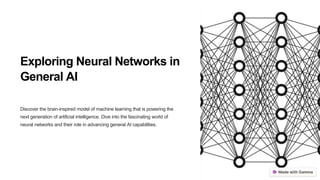
Exploring Neural Networks in
General AI
Discover the brain-inspired model of machine learning that is powering the
next generation of artificial intelligence. Dive into the fascinating world of
neural networks and their role in advancing general AI capabilities.
Introduction to Neural
Networks
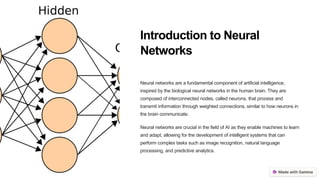
Neural networks are a fundamental component of artificial intelligence,
inspired by the biological neural networks in the human brain. They are
composed of interconnected nodes, called neurons, that process and
transmit information through weighted connections, similar to how neurons in
the brain communicate.
Neural networks are crucial in the field of AI as they enable machines to learn
and adapt, allowing for the development of intelligent systems that can
perform complex tasks such as image recognition, natural language
processing, and predictive analytics.
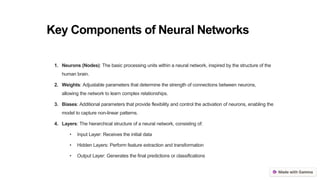
Key Components of Neural Networks
1. Neurons (Nodes): The basic processing units within a neural network, inspired by the structure of the
human brain.
2. Weights: Adjustable parameters that determine the strength of connections between neurons,
allowing the network to learn complex relationships.
3. Biases: Additional parameters that provide flexibility and control the activation of neurons, enabling the
model to capture non-linear patterns.
4. Layers: The hierarchical structure of a neural network, consisting of:
• Input Layer: Receives the initial data
• Hidden Layers: Perform feature extraction and transformation
• Output Layer: Generates the final predictions or classifications
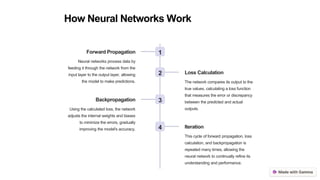
How Neural Networks Work
1
Forward Propagation
Neural networks process data by
feeding it through the network from the
input layer to the output layer, allowing
the model to make predictions.
2 Loss Calculation
The network compares its output to the
true values, calculating a loss function
that measures the error or discrepancy
between the predicted and actual
outputs.
3
Backpropagation
Using the calculated loss, the network
adjusts the internal weights and biases
to minimize the errors, gradually
improving the model's accuracy. 4 Iteration
This cycle of forward propagation, loss
calculation, and backpropagation is
repeated many times, allowing the
neural network to continually refine its
understanding and performance.
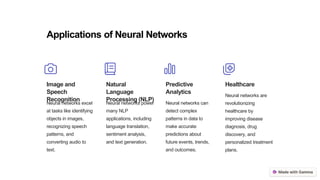
Applications of Neural Networks
Image and
Speech
Recognition
Neural networks excel
at tasks like identifying
objects in images,
recognizing speech
patterns, and
converting audio to
text.
Natural
Language
Processing (NLP)
Neural networks power
many NLP
applications, including
language translation,
sentiment analysis,
and text generation.
Predictive
Analytics
Neural networks can
detect complex
patterns in data to
make accurate
predictions about
future events, trends,
and outcomes.
Healthcare
Neural networks are
revolutionizing
healthcare by
improving disease
diagnosis, drug
discovery, and
personalized treatment
plans.
Advantages of Neural Networks
Adaptability
Neural networks
have the remarkable
ability to learn
complex, nonlinear
relationships from
data, allowing them
to model
sophisticated
patterns that
traditional algorithms
struggle with.
Generalization
Once trained, neural
networks can apply
the insights they've
learned to new,
previously unseen
data, enabling them
to make accurate
predictions and
classifications across
a wide range of
applications.
Scalability
Neural networks
excel at handling
large-scale, high-
dimensional data,
making them well-
suited for tackling
real-world problems
that involve massive
datasets, such as
image recognition,
natural language
processing, and
predictive analytics.
Continuous
Learning
Neural networks can
be fine-tuned and
retrained on new
data, allowing them
to continuously
improve their
performance and
adapt to changing
environments,
making them highly
versatile in dynamic
applications.
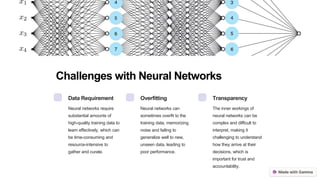
Challenges with Neural Networks
Data Requirement
Neural networks require
substantial amounts of
high-quality training data to
learn effectively, which can
be time-consuming and
resource-intensive to
gather and curate.
Overfitting
Neural networks can
sometimes overfit to the
training data, memorizing
noise and failing to
generalize well to new,
unseen data, leading to
poor performance.
Transparency
The inner workings of
neural networks can be
complex and difficult to
interpret, making it
challenging to understand
how they arrive at their
decisions, which is
important for trust and
accountability.
Future Trends in Neural Network
Development
Algorithm Efficiency
Researchers are developing
more efficient neural
network algorithms,
reducing computational
costs and enabling real-time
applications on mobile
devices.
Industry Expansion
Neural networks are being
applied in diverse fields,
from autonomous vehicles
and medical diagnosis to
financial forecasting and
cybersecurity.
Interpretability and
Ethics
Advancements in
explainable AI and ethical
considerations are crucial to
build trust and ensure
responsible deployment of
neural network models.
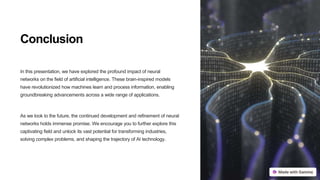
Conclusion
In this presentation, we have explored the profound impact of neural
networks on the field of artificial intelligence. These brain-inspired models
have revolutionized how machines learn and process information, enabling
groundbreaking advancements across a wide range of applications.
As we look to the future, the continued development and refinement of neural
networks holds immense promise. We encourage you to further explore this
captivating field and unlock its vast potential for transforming industries,
solving complex problems, and shaping the trajectory of AI technology.
Q&A Slide
We've covered a lot of material on neural networks and their role in general
AI. Now it's time to open the floor for your questions. I'm here to provide more
details and clarification on any aspects of the presentation. Feel free to ask
about the technical details, real-world applications, or future developments in
this exciting field.

100-Concepts-of-AI by Anupama Kate .pptx

  • 1.
    100 Concepts ofAI Neural Network in General AI Anupama Kate, Data scientist | SlideShare
  • 2.
    Exploring Neural Networksin General AI Discover the brain-inspired model of machine learning that is powering the next generation of artificial intelligence. Dive into the fascinating world of neural networks and their role in advancing general AI capabilities.
  • 3.
    Introduction to Neural Networks Neuralnetworks are a fundamental component of artificial intelligence, inspired by the biological neural networks in the human brain. They are composed of interconnected nodes, called neurons, that process and transmit information through weighted connections, similar to how neurons in the brain communicate. Neural networks are crucial in the field of AI as they enable machines to learn and adapt, allowing for the development of intelligent systems that can perform complex tasks such as image recognition, natural language processing, and predictive analytics.
  • 4.
    Key Components ofNeural Networks 1. Neurons (Nodes): The basic processing units within a neural network, inspired by the structure of the human brain. 2. Weights: Adjustable parameters that determine the strength of connections between neurons, allowing the network to learn complex relationships. 3. Biases: Additional parameters that provide flexibility and control the activation of neurons, enabling the model to capture non-linear patterns. 4. Layers: The hierarchical structure of a neural network, consisting of: • Input Layer: Receives the initial data • Hidden Layers: Perform feature extraction and transformation • Output Layer: Generates the final predictions or classifications
  • 5.
    How Neural NetworksWork 1 Forward Propagation Neural networks process data by feeding it through the network from the input layer to the output layer, allowing the model to make predictions. 2 Loss Calculation The network compares its output to the true values, calculating a loss function that measures the error or discrepancy between the predicted and actual outputs. 3 Backpropagation Using the calculated loss, the network adjusts the internal weights and biases to minimize the errors, gradually improving the model's accuracy. 4 Iteration This cycle of forward propagation, loss calculation, and backpropagation is repeated many times, allowing the neural network to continually refine its understanding and performance.
  • 6.
    Applications of NeuralNetworks Image and Speech Recognition Neural networks excel at tasks like identifying objects in images, recognizing speech patterns, and converting audio to text. Natural Language Processing (NLP) Neural networks power many NLP applications, including language translation, sentiment analysis, and text generation. Predictive Analytics Neural networks can detect complex patterns in data to make accurate predictions about future events, trends, and outcomes. Healthcare Neural networks are revolutionizing healthcare by improving disease diagnosis, drug discovery, and personalized treatment plans.
  • 7.
    Advantages of NeuralNetworks Adaptability Neural networks have the remarkable ability to learn complex, nonlinear relationships from data, allowing them to model sophisticated patterns that traditional algorithms struggle with. Generalization Once trained, neural networks can apply the insights they've learned to new, previously unseen data, enabling them to make accurate predictions and classifications across a wide range of applications. Scalability Neural networks excel at handling large-scale, high- dimensional data, making them well- suited for tackling real-world problems that involve massive datasets, such as image recognition, natural language processing, and predictive analytics. Continuous Learning Neural networks can be fine-tuned and retrained on new data, allowing them to continuously improve their performance and adapt to changing environments, making them highly versatile in dynamic applications.
  • 8.
    Challenges with NeuralNetworks Data Requirement Neural networks require substantial amounts of high-quality training data to learn effectively, which can be time-consuming and resource-intensive to gather and curate. Overfitting Neural networks can sometimes overfit to the training data, memorizing noise and failing to generalize well to new, unseen data, leading to poor performance. Transparency The inner workings of neural networks can be complex and difficult to interpret, making it challenging to understand how they arrive at their decisions, which is important for trust and accountability.
  • 9.
    Future Trends inNeural Network Development Algorithm Efficiency Researchers are developing more efficient neural network algorithms, reducing computational costs and enabling real-time applications on mobile devices. Industry Expansion Neural networks are being applied in diverse fields, from autonomous vehicles and medical diagnosis to financial forecasting and cybersecurity. Interpretability and Ethics Advancements in explainable AI and ethical considerations are crucial to build trust and ensure responsible deployment of neural network models.
  • 10.
    Conclusion In this presentation,we have explored the profound impact of neural networks on the field of artificial intelligence. These brain-inspired models have revolutionized how machines learn and process information, enabling groundbreaking advancements across a wide range of applications. As we look to the future, the continued development and refinement of neural networks holds immense promise. We encourage you to further explore this captivating field and unlock its vast potential for transforming industries, solving complex problems, and shaping the trajectory of AI technology.
  • 11.
    Q&A Slide We've covereda lot of material on neural networks and their role in general AI. Now it's time to open the floor for your questions. I'm here to provide more details and clarification on any aspects of the presentation. Feel free to ask about the technical details, real-world applications, or future developments in this exciting field.