Mastering Salesforce
Development: A
Comprehensive
Overview
Introduction to Salesforce Development: Explaining the role of Salesforce
Development in customizing and extending Salesforce CRM to meet
specific business needs. Overview of key development concepts including
Apex programming, REST API, and Apex Compiler.
by anupama
Apex Programming Language
Fundamentals of Apex
Understanding the fundamentals of Apex, Salesforce's proprietary programming language, is
essential for developers. It involves exploring Apex syntax, data types, variables, control structures,
and exception handling to build robust and efficient solutions.
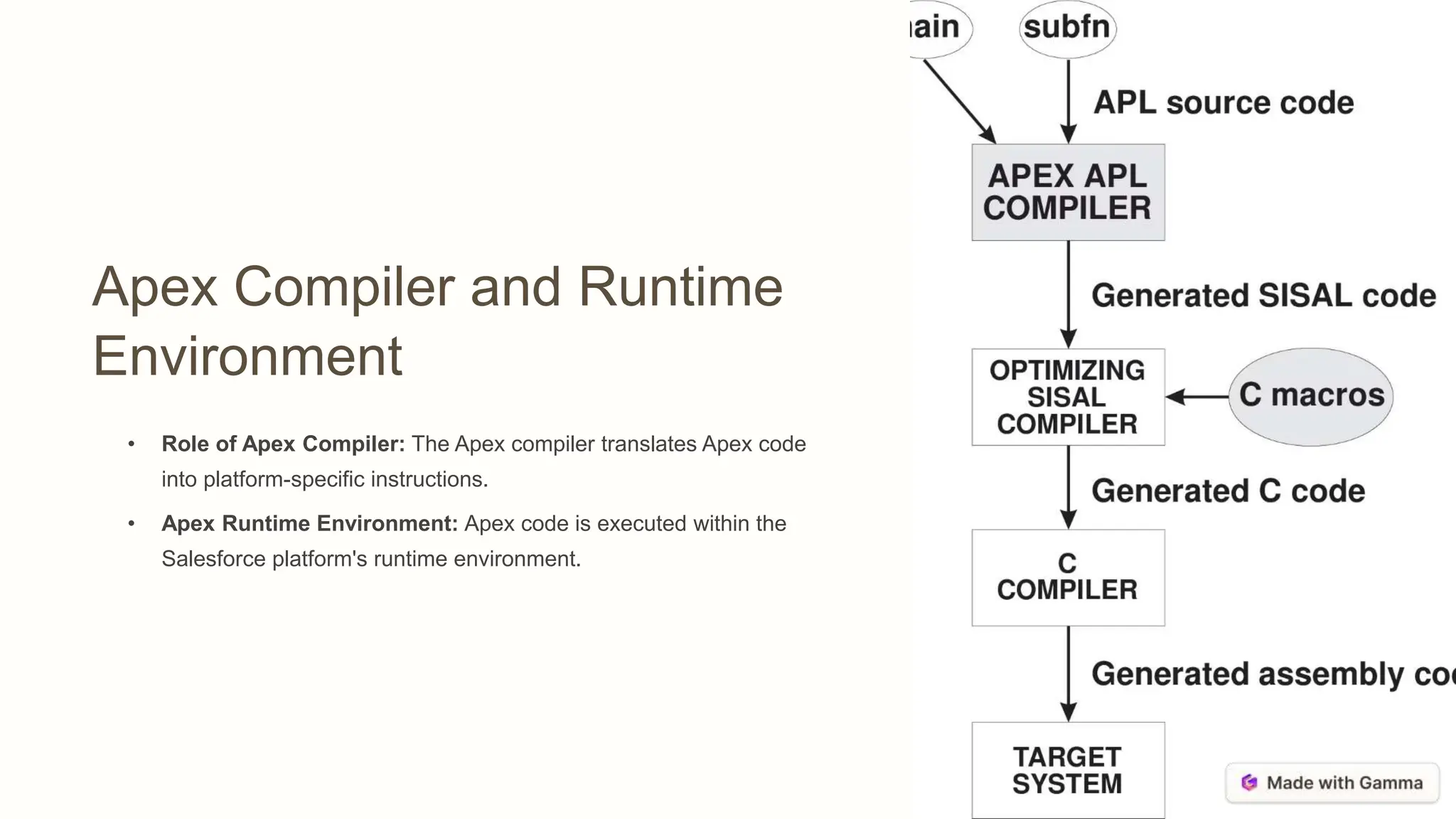
Apex Compiler and Runtime
Environment
• Role of Apex Compiler: The Apex compiler translates Apex code
into platform-specific instructions.
• Apex Runtime Environment: Apex code is executed within the
Salesforce platform's runtime environment.
Apex Class vs Primitive Data Types
Apex Class
Understanding the concept of Apex classes as
the building blocks of Apex code. Creating,
modifying, and organizing Apex classes to
encapsulate business logic and functionality.
Primitive Data Types
Exploring primitive data types in Apex, including
Integer, String, Boolean, Decimal, Date, and
Time. Discussing how primitive data types are
used to store and manipulate basic data values
in Apex.
SObject Data Type
Understanding the SObject data type in
Salesforce, which represents records in
Salesforce objects (sObjects).
Exploring how SObjects are used to interact with
Salesforce data through queries, DML
operations, and triggers.
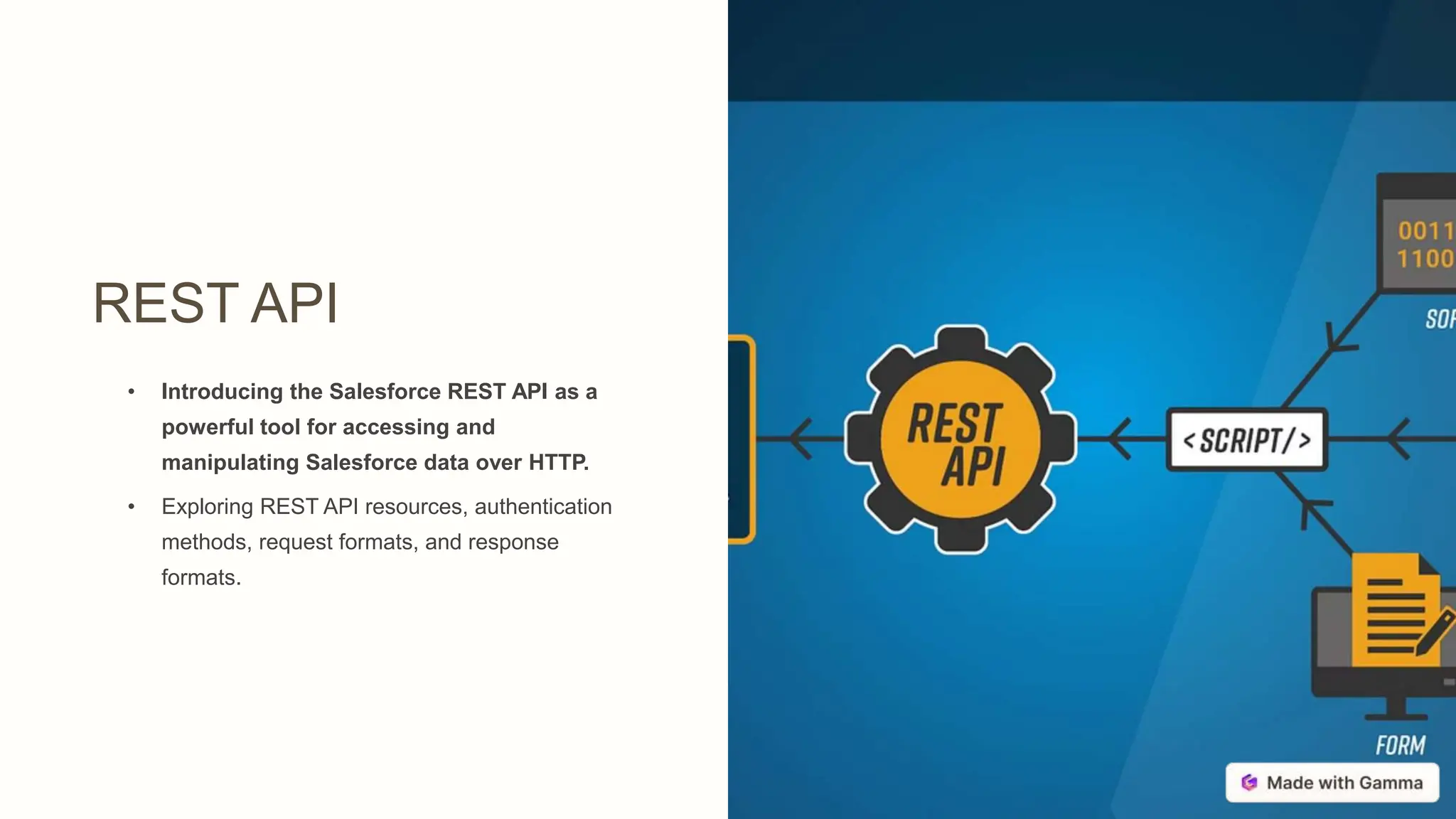
REST API
• Introducing the Salesforce REST API as a
powerful tool for accessing and
manipulating Salesforce data over HTTP.
• Exploring REST API resources, authentication
methods, request formats, and response
formats.
Apex REST Services
Leveraging Apex for Custom RESTful
Web Services
Apex can be leveraged to create custom
RESTful web services within the Salesforce
platform. This allows developers to expose
custom functionality and integrate with external
systems. By utilizing Apex, developers can build
REST endpoints to facilitate seamless
communication and data exchange between
Salesforce and external applications.
Building Apex REST Endpoints
Developers can build Apex REST endpoints to
expose custom functionality and integrate with
external systems. These endpoints serve as
gateways for external systems to interact with
Salesforce, enabling the seamless integration of
custom functionality and data exchange.
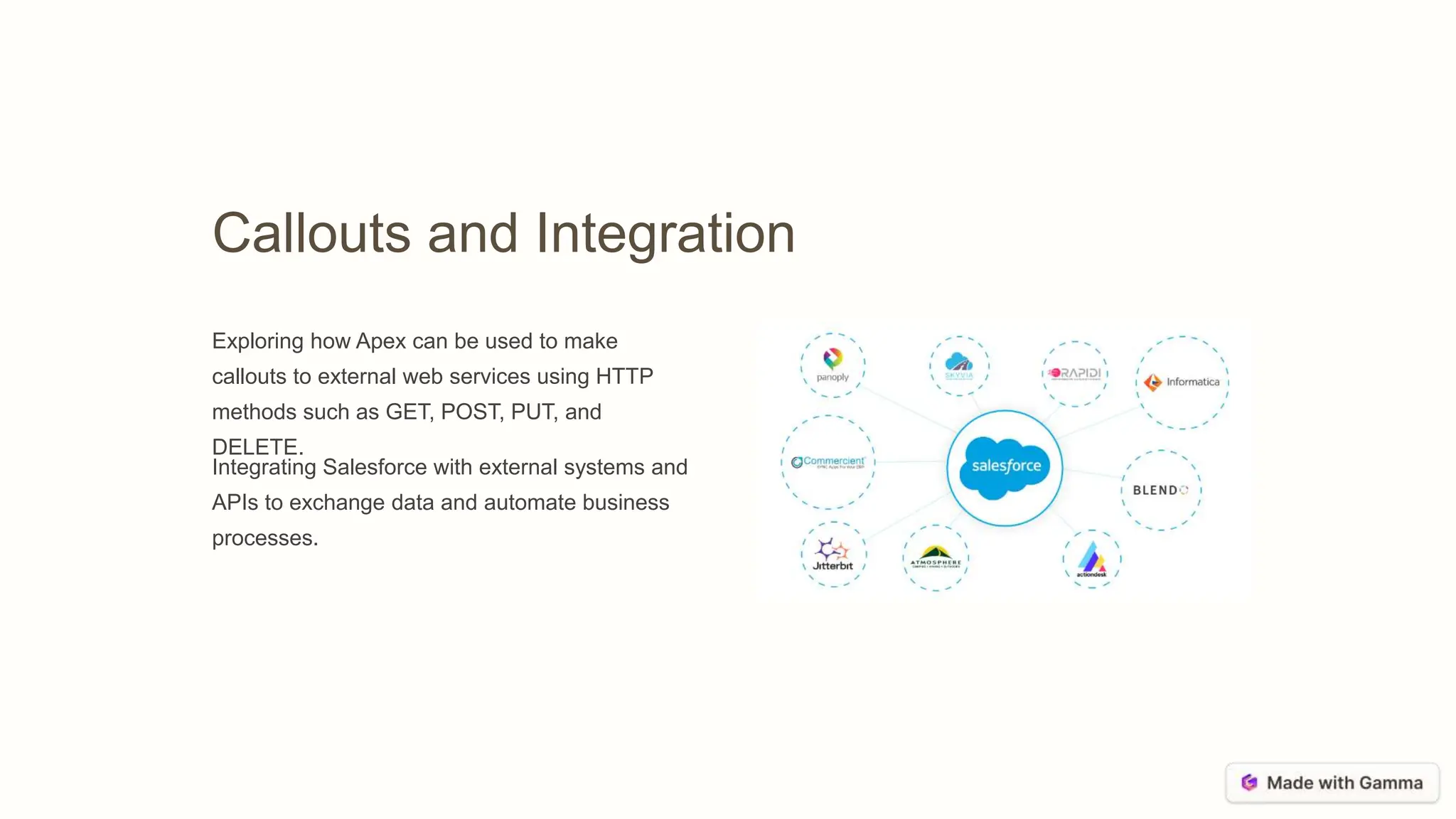
Callouts and Integration
Exploring how Apex can be used to make
callouts to external web services using HTTP
methods such as GET, POST, PUT, and
DELETE.
Integrating Salesforce with external systems and
APIs to exchange data and automate business
processes.
Governor Limits
• Understanding Salesforce governor limits: These limits are imposed on Apex code execution
to ensure platform stability and resource allocation.
• Optimizing code efficiency: Strategies for avoiding governor limit exceptions and optimizing
code efficiency are crucial for successful Salesforce development.
Asynchronous Apex
Batch Apex
Batch Apex is used for
processing large data
volumes by breaking the job
into manageable chunks. It
allows for the asynchronous
processing of records and is
ideal for tasks such as data
cleansing, archiving, or
calculations that need to be
performed on a large number
of records.
Queueable Apex
Queueable Apex is used to
perform background tasks in
Salesforce. It allows for the
execution of long-running
processes asynchronously,
making it suitable for tasks
that can be run at a later time
without impacting the user
experience. Queueable jobs
can be chained to run in a
specific order.
Scheduled Apex
Scheduled Apex allows for
the scheduling of Apex
classes to run at specific
times. It is commonly used for
automating repetitive tasks,
such as data backups, report
generation, or data
synchronization, providing a
way to perform tasks at
regular intervals without
manual intervention.
Mastering-Salesforce-Development-A-Comprehensive-Overview (1).pptx

Mastering-Salesforce-Development-A-Comprehensive-Overview (1).pptx

  • 1.
    Mastering Salesforce Development: A Comprehensive Overview Introductionto Salesforce Development: Explaining the role of Salesforce Development in customizing and extending Salesforce CRM to meet specific business needs. Overview of key development concepts including Apex programming, REST API, and Apex Compiler. by anupama
  • 2.
    Apex Programming Language Fundamentalsof Apex Understanding the fundamentals of Apex, Salesforce's proprietary programming language, is essential for developers. It involves exploring Apex syntax, data types, variables, control structures, and exception handling to build robust and efficient solutions.
  • 3.
    Apex Compiler andRuntime Environment • Role of Apex Compiler: The Apex compiler translates Apex code into platform-specific instructions. • Apex Runtime Environment: Apex code is executed within the Salesforce platform's runtime environment.
  • 4.
    Apex Class vsPrimitive Data Types Apex Class Understanding the concept of Apex classes as the building blocks of Apex code. Creating, modifying, and organizing Apex classes to encapsulate business logic and functionality. Primitive Data Types Exploring primitive data types in Apex, including Integer, String, Boolean, Decimal, Date, and Time. Discussing how primitive data types are used to store and manipulate basic data values in Apex.
  • 5.
    SObject Data Type Understandingthe SObject data type in Salesforce, which represents records in Salesforce objects (sObjects). Exploring how SObjects are used to interact with Salesforce data through queries, DML operations, and triggers.
  • 6.
    REST API • Introducingthe Salesforce REST API as a powerful tool for accessing and manipulating Salesforce data over HTTP. • Exploring REST API resources, authentication methods, request formats, and response formats.
  • 7.
    Apex REST Services LeveragingApex for Custom RESTful Web Services Apex can be leveraged to create custom RESTful web services within the Salesforce platform. This allows developers to expose custom functionality and integrate with external systems. By utilizing Apex, developers can build REST endpoints to facilitate seamless communication and data exchange between Salesforce and external applications. Building Apex REST Endpoints Developers can build Apex REST endpoints to expose custom functionality and integrate with external systems. These endpoints serve as gateways for external systems to interact with Salesforce, enabling the seamless integration of custom functionality and data exchange.
  • 8.
    Callouts and Integration Exploringhow Apex can be used to make callouts to external web services using HTTP methods such as GET, POST, PUT, and DELETE. Integrating Salesforce with external systems and APIs to exchange data and automate business processes.
  • 9.
    Governor Limits • UnderstandingSalesforce governor limits: These limits are imposed on Apex code execution to ensure platform stability and resource allocation. • Optimizing code efficiency: Strategies for avoiding governor limit exceptions and optimizing code efficiency are crucial for successful Salesforce development.
  • 10.
    Asynchronous Apex Batch Apex BatchApex is used for processing large data volumes by breaking the job into manageable chunks. It allows for the asynchronous processing of records and is ideal for tasks such as data cleansing, archiving, or calculations that need to be performed on a large number of records. Queueable Apex Queueable Apex is used to perform background tasks in Salesforce. It allows for the execution of long-running processes asynchronously, making it suitable for tasks that can be run at a later time without impacting the user experience. Queueable jobs can be chained to run in a specific order. Scheduled Apex Scheduled Apex allows for the scheduling of Apex classes to run at specific times. It is commonly used for automating repetitive tasks, such as data backups, report generation, or data synchronization, providing a way to perform tasks at regular intervals without manual intervention.