What is plagiarism? (And why you should care!)
Why should I bother? Glad you asked.  Plagiarism is a big deal, and it’s not something you want to find out about the hard way.
Definition: Plagiarism is the act of presenting the words, ideas, images, sounds, or the creative expression of others as your own.
Students.  If: you have included the words and ideas of others in your work that you neglected to cite, you have had help you wouldn’t want your teacher to know about, You have  probably  plagiarized!
Two types of plagiarism: Intentional Copying a friend’s work Buying or borrowing papers Cutting and pasting blocks of text from electronic sources without documenting Media “borrowing”without documentation Web publishing without permissions of creators  Unintentional Careless paraphrasing Poor documentation Quoting excessively Failure to use your own “voice”
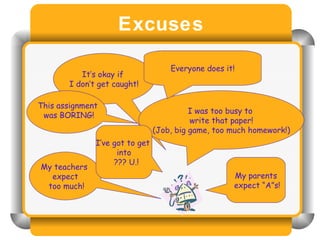
Excuses It’s okay if  I don’t get caught! I was too busy to  write that paper! (Job, big game, too much homework!) My teachers  expect too much! I’ve got to get  into ??? U.! My parents expect “A”s! This assignment  was BORING! Everyone does it!
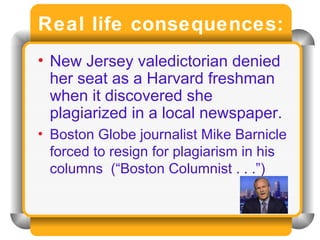
Real life consequences: New Jersey valedictorian denied her seat as a Harvard freshman when it discovered she plagiarized in a local newspaper. Boston Globe journalist Mike Barnicle forced to resign for plagiarism in his columns  (“Boston Columnist . . .”)
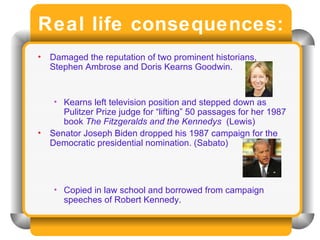
Real life consequences: Damaged the reputation of two prominent historians, Stephen Ambrose and Doris Kearns Goodwin. Kearns left television position and stepped down as Pulitzer Prize judge for “lifting” 50 passages for her 1987 book  The Fitzgeralds and the Kennedys  (Lewis) Senator Joseph Biden dropped his 1987 campaign for the Democratic presidential nomination. (Sabato) Copied in law school and borrowed from campaign speeches of Robert Kennedy.
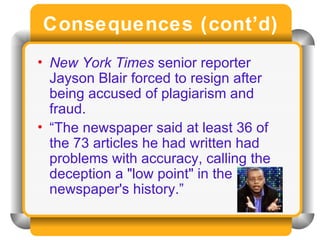
Consequences (cont’d) New York Times  senior reporter Jayson Blair forced to resign after being accused of plagiarism and fraud. “ The newspaper said at least 36 of the 73 articles he had written had problems with accuracy, calling the deception a "low point" in the newspaper's history.”
Possible school consequences: “ 0” on the assignment Parent notification Referral to administrators Suspension or dismissal from school activities--sports and extracurricular Note on student record Loss of reputation among the school community Is it worth the risk?
Is this important? What if: Your architect cheated his way through math class.  Will your new home be safe? Your lawyer paid for a copy of the bar exam to study.  Will the contract she wrote for you stand up in court? The accountant who does your taxes hired someone to write his papers and paid a stand-in to take his major tests? Does he know enough to complete your tax forms properly? (Lathrop and Foss 87)
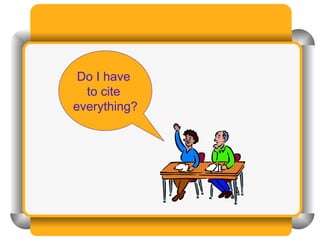
Do I have  to cite  everything?
Nope!  Facts that are widely known, or Information or judgments considered “common knowledge”  Do  NOT  have to be documented. Hooray for  common knowledge!
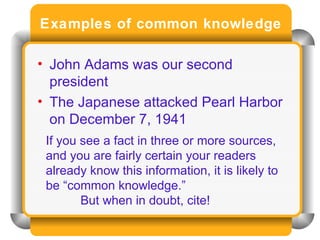
Examples of common knowledge John Adams was our second president The Japanese attacked Pearl Harbor on December 7, 1941 If you see a fact in three or more sources, and you are fairly certain your readers already know this information, it is likely to be “common knowledge.”  But when in doubt, cite!
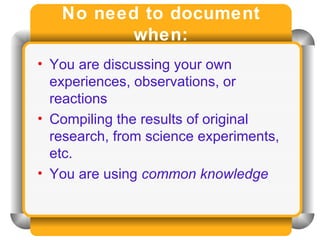
No need to document when: You are discussing your own experiences, observations, or reactions Compiling the results of original research, from science experiments, etc. You are using  common knowledge
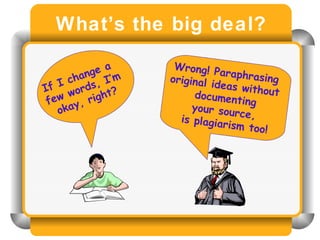
What’s the big deal? If I change a  few words, I’m okay, right? Wrong! Paraphrasing  original ideas without  documenting your source, is plagiarism too!
You can “borrow” from the works of others in your own work!
Use these three strategies, Quoting Paraphrasing  Summarizing To blend source materials in with your own, making sure your own voice is heard.
Quoting Quotations are the exact words of an author, copied directly from a source, word for word. Quotations must be cited!  Carol Rohrbach and Joyce Valenza
Paraphrasing Paraphrasing means putting someone else’s thoughts into your own words. Paraphrasing must be followed with in-text documentation and cited on your Works-Cited page.  Paraphrase when: You want to avoid overusing quotations You want to use your own voice to present information Carol Rohrbach and Joyce Valenza
Summarizing Summarizing involves putting the main idea(s) of one or several writers into your own words, including only the main point(s).  Summarize when:  You want to establish background or offer an overview of a topic You want to describe knowledge (from several sources) about a topic You want to determine the main ideas of a single source Carol Rohrbach and Joyce Valenza
As you take notes: Include any direct quotes or unique phrases in quotation marks or mark with a big  Q  and make sure the speaker’s /writer’s name is identified. Make sure you note a paraphrase with the writer’s name and mark it with a big  P Include page numbers and source references so you can go back and check for accuracy as you write.
Teachers won’t know Actually it is very easy for a teacher to know if parts of your paper are plaigerized. By typing in a few key phrases with quotations around the words in google will find the site just as easy as you did. The “voice” of the paper will be different than your own “voice”.
Let’s go visit: Let’s go visit with Maiko from the Vaughn Memorial Library at the Acadia University Site:  http://library.acadiau.ca/tutorials/plagiarism/
Let’s do some more practicing Identifying Plagiarism
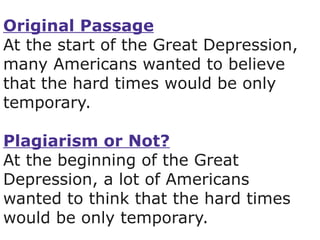
Original Passage At the start of the Great Depression, many Americans wanted to believe that the hard times would be only temporary. Plagiarism or Not? At the beginning of the Great Depression, a lot of Americans wanted to think that the hard times would be only temporary.
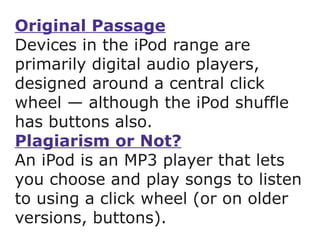
Original Passage Devices in the iPod range are primarily digital audio players, designed around a central click wheel — although the iPod shuffle has buttons also.  Plagiarism or Not? An iPod is an MP3 player that lets you choose and play songs to listen to using a click wheel (or on older versions, buttons).
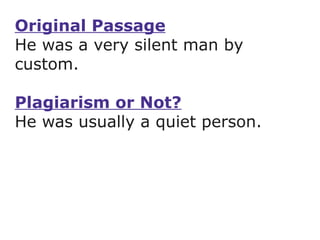
Original Passage He was a very silent man by custom.  Plagiarism or Not? He was usually a quiet person.
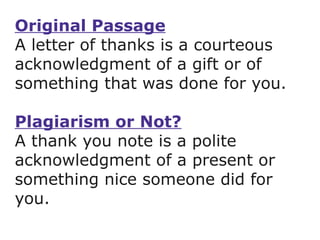
Original Passage A letter of thanks is a courteous acknowledgment of a gift or of something that was done for you. Plagiarism or Not? A thank you note is a polite acknowledgment of a present or something nice someone did for you.

Plagiarismfinal

  • 1.
    What is plagiarism?(And why you should care!)
  • 2.
    Why should Ibother? Glad you asked. Plagiarism is a big deal, and it’s not something you want to find out about the hard way.
  • 3.
    Definition: Plagiarism isthe act of presenting the words, ideas, images, sounds, or the creative expression of others as your own.
  • 4.
    Students. If:you have included the words and ideas of others in your work that you neglected to cite, you have had help you wouldn’t want your teacher to know about, You have probably plagiarized!
  • 5.
    Two types ofplagiarism: Intentional Copying a friend’s work Buying or borrowing papers Cutting and pasting blocks of text from electronic sources without documenting Media “borrowing”without documentation Web publishing without permissions of creators Unintentional Careless paraphrasing Poor documentation Quoting excessively Failure to use your own “voice”
  • 6.
    Excuses It’s okayif I don’t get caught! I was too busy to write that paper! (Job, big game, too much homework!) My teachers expect too much! I’ve got to get into ??? U.! My parents expect “A”s! This assignment was BORING! Everyone does it!
  • 7.
    Real life consequences:New Jersey valedictorian denied her seat as a Harvard freshman when it discovered she plagiarized in a local newspaper. Boston Globe journalist Mike Barnicle forced to resign for plagiarism in his columns (“Boston Columnist . . .”)
  • 8.
    Real life consequences:Damaged the reputation of two prominent historians, Stephen Ambrose and Doris Kearns Goodwin. Kearns left television position and stepped down as Pulitzer Prize judge for “lifting” 50 passages for her 1987 book The Fitzgeralds and the Kennedys (Lewis) Senator Joseph Biden dropped his 1987 campaign for the Democratic presidential nomination. (Sabato) Copied in law school and borrowed from campaign speeches of Robert Kennedy.
  • 9.
    Consequences (cont’d) NewYork Times senior reporter Jayson Blair forced to resign after being accused of plagiarism and fraud. “ The newspaper said at least 36 of the 73 articles he had written had problems with accuracy, calling the deception a "low point" in the newspaper's history.”
  • 10.
    Possible school consequences:“ 0” on the assignment Parent notification Referral to administrators Suspension or dismissal from school activities--sports and extracurricular Note on student record Loss of reputation among the school community Is it worth the risk?
  • 11.
    Is this important?What if: Your architect cheated his way through math class. Will your new home be safe? Your lawyer paid for a copy of the bar exam to study. Will the contract she wrote for you stand up in court? The accountant who does your taxes hired someone to write his papers and paid a stand-in to take his major tests? Does he know enough to complete your tax forms properly? (Lathrop and Foss 87)
  • 12.
    Do I have to cite everything?
  • 13.
    Nope! Factsthat are widely known, or Information or judgments considered “common knowledge” Do NOT have to be documented. Hooray for common knowledge!
  • 14.
    Examples of commonknowledge John Adams was our second president The Japanese attacked Pearl Harbor on December 7, 1941 If you see a fact in three or more sources, and you are fairly certain your readers already know this information, it is likely to be “common knowledge.” But when in doubt, cite!
  • 15.
    No need todocument when: You are discussing your own experiences, observations, or reactions Compiling the results of original research, from science experiments, etc. You are using common knowledge
  • 16.
    What’s the bigdeal? If I change a few words, I’m okay, right? Wrong! Paraphrasing original ideas without documenting your source, is plagiarism too!
  • 17.
    You can “borrow”from the works of others in your own work!
  • 18.
    Use these threestrategies, Quoting Paraphrasing Summarizing To blend source materials in with your own, making sure your own voice is heard.
  • 19.
    Quoting Quotations arethe exact words of an author, copied directly from a source, word for word. Quotations must be cited! Carol Rohrbach and Joyce Valenza
  • 20.
    Paraphrasing Paraphrasing meansputting someone else’s thoughts into your own words. Paraphrasing must be followed with in-text documentation and cited on your Works-Cited page. Paraphrase when: You want to avoid overusing quotations You want to use your own voice to present information Carol Rohrbach and Joyce Valenza
  • 21.
    Summarizing Summarizing involvesputting the main idea(s) of one or several writers into your own words, including only the main point(s). Summarize when: You want to establish background or offer an overview of a topic You want to describe knowledge (from several sources) about a topic You want to determine the main ideas of a single source Carol Rohrbach and Joyce Valenza
  • 22.
    As you takenotes: Include any direct quotes or unique phrases in quotation marks or mark with a big Q and make sure the speaker’s /writer’s name is identified. Make sure you note a paraphrase with the writer’s name and mark it with a big P Include page numbers and source references so you can go back and check for accuracy as you write.
  • 23.
    Teachers won’t knowActually it is very easy for a teacher to know if parts of your paper are plaigerized. By typing in a few key phrases with quotations around the words in google will find the site just as easy as you did. The “voice” of the paper will be different than your own “voice”.
  • 24.
    Let’s go visit:Let’s go visit with Maiko from the Vaughn Memorial Library at the Acadia University Site: http://library.acadiau.ca/tutorials/plagiarism/
  • 25.
    Let’s do somemore practicing Identifying Plagiarism
  • 26.
    Original Passage Atthe start of the Great Depression, many Americans wanted to believe that the hard times would be only temporary. Plagiarism or Not? At the beginning of the Great Depression, a lot of Americans wanted to think that the hard times would be only temporary.
  • 27.
    Original Passage Devicesin the iPod range are primarily digital audio players, designed around a central click wheel — although the iPod shuffle has buttons also. Plagiarism or Not? An iPod is an MP3 player that lets you choose and play songs to listen to using a click wheel (or on older versions, buttons).
  • 28.
    Original Passage Hewas a very silent man by custom. Plagiarism or Not? He was usually a quiet person.
  • 29.
    Original Passage Aletter of thanks is a courteous acknowledgment of a gift or of something that was done for you. Plagiarism or Not? A thank you note is a polite acknowledgment of a present or something nice someone did for you.