After Only a 20 Min Helicopter Ride
Autistic Artist Stephen Wiltshire Drew an
18ft Sketch of the NY Skyline from
Memory
https://www.youtub
e.com/watch?v=bsJ
bApZ5GF0
Learning objective
• To use rules of perspective drawing to draw a corridor
from OBSERVATION.
• To use understanding of ONE POINT PERSPECTIVE to
draw the corridor accurately.
• To use colour coding learnt previously to explore
stages of perspective drawing.
Starter: can you remember the keywords
and what they mean?
VANISHING
POINT
PARALLEL
PERPENDICULAR
ONE
POINT
TWO
POINT
HORIZON
LINE
ORTHOGONAL
Today you will be drawing an INTERIOR ONE
POINT PERSPECTIVE drawing of the art corridor…
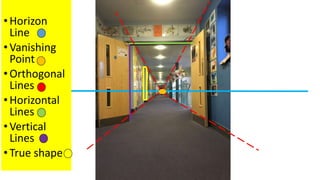
Orthogonal Lines
•Horizon
Line
•Vanishing
Point
•Orthogonal
Lines
•Horizontal
Lines
•Vertical
Lines
•True shape
Start by placing the horizon line.
Where would the horizon line be
placed?
EYE LEVEL
Then, place the Vanishing point.
Where would the vanishing point be
placed?
The vanishing point is that spot on
the horizon line to which the
receding parallel lines diminish.
It is the point at which something
that has been decreasing disappears
altogether.
Use the orthogonal (diagonals) lines to place all lines that travel
away from the vanishing point.
ALL ORTHOGONAL WILL CONVEREGE FROM THE VANISHING POINT
Surfaces that face the viewer are
drawn using their true shape. Can
you identify a true shape?
To begin placing door frames/walls
you use vertical lines.
ALL VERTICAL LINES RUN PARALLEL
If all vertical lines run parallel then
so do the horizontal lines.
When your guidelines are rubbed
away…
RULES AND EXPECTATIONS
• 12 students on top floor (art) , 12
students on lower floor (food tech).
• You stay in the pairs that have be
assigned to you. As a pair you SHARE
the pens. You as a PAIR are
RESPONSIBLE for these pens.
• MINIMUM NOISE. If there is too much
noise we will come back to the
classroom.
• NO LEAVING the floor/area you are
ASSIGNED to.
You will have to simplify some
areas – for example…
• I have left out the staircase
and columns.
• Do not attempt to draw any
artwork on the walls etc – NO
DETAIL
• Aim for SIMPLE OUTLINES.
• PLEASE MAKE SURE YOU USE
THE WORKSHEET and colour
coding.
Orthogonal Lines
•Horizon
Line
•Vanishing
Point
•Orthogonal
Lines
•Horizontal
Lines
•Vertical
Lines
•True shape
ONLY USE THE
SPECIFIC
COLOURS FOR
EVERY GUIDELINE
LISTED
Homework
•Parts 3 & 4 of ‘little and large worlds’
perspective project. Parts 1 & 2 are
optional
Due: 12th July
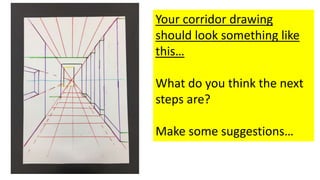
Your corridor drawing
should look something like
this…
What do you think the next
steps are?
Make some suggestions…
My Example
Learning objective
• To begin adding COLOUR and PATTERN to the corridor
drawing inspired by the work of David Hockney and
Patrick Caulfield.
• To effectively blend oil pastels to show GRADUATED
COLOUR and to block in areas using pen.
David Hockney is a
British painter, born in
Bradford he is famous
for painting Yorkshire
landscapes and LA
homes.
What do you notice about the way Hockney
uses COLOUR and PATTERN? Can you use any
descriptive words…
Paintings of
landscapes…
How does the colour
change towards the
vanishing point? Do
you know the
keyword for this
technique?
AERIAL
PERSPECTIVE
Inspired by Hockney
– how could you
incorporate COLOUR
into your drawing?
Suggest
materials/processes
/techniques
BLOCK
COLOUR
BRIGHT
COLOUR
USING
MARKMAKING
HARMONIOUS
PEN
PASTEL
Recently David
Hockney has produced
work using an Ipad…
English painter and
printmaker known
for his bold
canvases, which
often incorporated
elements of
photorealism
within a simplified,
often linear scene.
What do you notice about the way
Caulfield uses COLOUR and
PATTERN?
Inspired by
Caulfield – how
could you
incorporate
PATTERN into your
drawing?
Suggest
materials/processes/
techniques
GEOMETRIC
SHAPES AND
PATTERNS
PATTERNED
PAPER
HAND
DRAWN
REPEAT
PATTERN
You could use
LINEAR PATTERNS
on top of block
colour….
This could look
effective inside a
window space >>
REPEAT
PATTERN
BRIGHT
COLOUR
MARKMAKING
HARMONIOUS
PATTERN COLOUR
HARMONIOUS
YOUR TASK: Adding COLOUR:
• Using Berol pens add BLOCK
COLOUR to areas such as the
walls, ceiling and floor.
• Using oil pastels add
GRADUATED colour to areas
such as the ceiling, walls and
floor – this will look effective
for creating AERIAL perspective.
• Work within the chequered
ceiling and floor pattern boxes
to create contrast between
colours.
Adding PATTERN:
• Using the patterned papers add
areas of PATTERN to walls,
ceiling, floors and doors.
• Using the coloured paper add
smaller areas of BLOCK COLOUR.
• Consider outlining window
frames/objects/door panels in
black pen to achieve Caulfield’s
style.
FILL THE PAGE WITH PATTERN AND COLOUR
This is the
stage you
should be at…
Leave areas
white for
placement of
FROTTAGE and
COLLAGE
Learning objective
• To consider SURREAL elements in order to add
objects/figures to the corridor outcome.
• To use COLLAGE technique in order to paste SURREAL
and REAL elements inside the corridor IN
PERPSECTIVE.
Canadian artist
Rob Gonsalves
produces
perspective
paintings
inspired by
surrealism and
architecture.
Gonsalves cleverly uses
perspective to incorporate
his surreal illusions.
What do you notice
about the way Gonsalves
is introducing the surreal
elements? Can you use
any keywords
Inspired by Cheval
and Gonsalves
ideas – how could
you incorporate
SURREALISM into
your outcome?
Suggest
materials/processes
/techniques
COLLAGE DISTORTION
JUXTAPOSITION
• Although your outcomes are different to
these examples…
• You can incorporate SOME SURREAL
ELEMENTS –
• For example making a hole in the floor to
reveal sky – the sky could then be collaged in
COLLAGE –
•Adding REALISTIC
or SURREAL
people, objects IN
PERSPECTIVE.
•Using
juxtaposition to
add surreal
elements.
Looking at the work you have
produced so far, how is
Mach’s work going to
influence your development?
LAYERS
How would you describe
Measure’s work?
BLOCKS
PHOTOGRAPHIC
ENLARGEMENTS
YOUR TASK:
Adding COLLAGE:
• Use the images and magazine
clippings to incorporate
REALISTIC or SURREAL elements
into your outcome.
• These elements MUST BE IN
PERSPECTIVE (e.g smaller objects
towards the back)
• Be creative with the placement –
e.g the collage could be placed
inside of a window to show the
outside.
E.g.
Learning objective
• To use FROTTAGE technique in lead pencil and oil
pastel in order to add TEXTURE to the corridor walls,
ceilings, floors, door frames.
• To carefully cut and arrange pieces using COLLAGE
technique.
Self-Assessment
Look at your CREATIVE PERSPECTIVE drawing (1 or 2 point) set for
homework and consider…
• Have you accurately used one/two point perspective achieving
DEPTH? Ensuring correct placement and use of HORIZON LINE,
VANISHING POINT/S and ORTHOGONAL LINES.
• Have you been CREATIVE using shapes, letters or creating an
image?
• Have you considered COLOUR and/or TONAL VALUES to add
DEPTH and REALISM?
Peer-Assessment
Look at your partners EDUARDO RECIFFE collage and
consider…
• Have they considered a CREATIVE COMPOSITION?
• Have they used a range of PAPER COLOURS and PATTERNS
the backgrounds and collaged shapes/areas?
• Have they included TEXT? Does this realte to surrealist key
terms or ideas?
• Have they included any hand drawn elements?
• Have they included an image or more of a person e.g.
baby, child or adult?
• How SURREAL is the outcome? – ideas of
DISTORTION/JUXTAPOSITION?
• Frottage involves
creating a rubbing of
a textured surface
using a pencil or
other
drawing material.
• German born artist
Max Ernst discovered
the technique of
Frottage.
• German born
architect (1886-1969)
• He reveals the
industrial materials
used in construction
through his drawing
techniques.
Step 1 – find a range of textured surfaces – the embossed
wall paper samples.
Step 2 – take some tracing paper and a pencil/oil pastel.
Place the paper over the surface and begin to rub the
pencil/pastel over the paper using the width of the
lead/pastel.
Step 3 – ensure you press with the right amount of
pressure so that the texture surfaces. CREATE A RANGE OF
BOTH PENCIL SAMPLES AND OIL PASTEL SAMPLES.
YOUR TASK: FROTTAGE
YOUR TASK:
Adding TEXTURE:
• Using your range of FROTTAGE SAMPLES in
both LEAD PENCIL and OIL PASTEL you need
to fill areas of walls, ceilings, floors and door
frames with TEXTURE.
• You can place OVER PEN WORK to reveal
colour underneath OR work over any white
spaces.
Learning objective
• To explore hand-drawn skills by TRACING figures and
objects to place inside the corridor IN PERPSECTIVE.
• To explore tone through cross-hatching technique.
YOUR TASK:
Adding FINELINER OBJECTS/FIGURES:
• Use the images and magazine clippings to
trace FIGURES/OBJECTS from.
• Trace over in FINELINER PEN and use CROSS-
HATCHING to show TONE.
• Pritt stick onto a colour paper background,
cut out and place onto the collage IN
PERSPECTIVE.
Please remember the
RULES OF
PERSPECTIVE.
Small figure
Large figure
Use the images and magazine
clippings to trace
FIGURES/OBJECTS from. Measure
against the background (IN
PERSPECTIVE).
Trace over in FINELINER PEN and
use CROSS-HATCHING to show
TONE.
Pritt stick onto a colour paper
background, cut out and place
onto the collage IN PERSPECTIVE.

What is Perspective Drawing?

  • 2.
    After Only a20 Min Helicopter Ride Autistic Artist Stephen Wiltshire Drew an 18ft Sketch of the NY Skyline from Memory https://www.youtub e.com/watch?v=bsJ bApZ5GF0
  • 3.
    Learning objective • Touse rules of perspective drawing to draw a corridor from OBSERVATION. • To use understanding of ONE POINT PERSPECTIVE to draw the corridor accurately. • To use colour coding learnt previously to explore stages of perspective drawing.
  • 4.
    Starter: can youremember the keywords and what they mean? VANISHING POINT PARALLEL PERPENDICULAR ONE POINT TWO POINT HORIZON LINE ORTHOGONAL
  • 5.
    Today you willbe drawing an INTERIOR ONE POINT PERSPECTIVE drawing of the art corridor…
  • 6.
  • 7.
    Start by placingthe horizon line. Where would the horizon line be placed? EYE LEVEL
  • 8.
    Then, place theVanishing point. Where would the vanishing point be placed? The vanishing point is that spot on the horizon line to which the receding parallel lines diminish. It is the point at which something that has been decreasing disappears altogether.
  • 9.
    Use the orthogonal(diagonals) lines to place all lines that travel away from the vanishing point. ALL ORTHOGONAL WILL CONVEREGE FROM THE VANISHING POINT
  • 10.
    Surfaces that facethe viewer are drawn using their true shape. Can you identify a true shape?
  • 11.
    To begin placingdoor frames/walls you use vertical lines. ALL VERTICAL LINES RUN PARALLEL
  • 12.
    If all verticallines run parallel then so do the horizontal lines.
  • 13.
    When your guidelinesare rubbed away…
  • 14.
    RULES AND EXPECTATIONS •12 students on top floor (art) , 12 students on lower floor (food tech). • You stay in the pairs that have be assigned to you. As a pair you SHARE the pens. You as a PAIR are RESPONSIBLE for these pens. • MINIMUM NOISE. If there is too much noise we will come back to the classroom. • NO LEAVING the floor/area you are ASSIGNED to.
  • 15.
    You will haveto simplify some areas – for example… • I have left out the staircase and columns. • Do not attempt to draw any artwork on the walls etc – NO DETAIL • Aim for SIMPLE OUTLINES. • PLEASE MAKE SURE YOU USE THE WORKSHEET and colour coding.
  • 16.
  • 18.
    Homework •Parts 3 &4 of ‘little and large worlds’ perspective project. Parts 1 & 2 are optional Due: 12th July
  • 19.
    Your corridor drawing shouldlook something like this… What do you think the next steps are? Make some suggestions…
  • 20.
  • 21.
    Learning objective • Tobegin adding COLOUR and PATTERN to the corridor drawing inspired by the work of David Hockney and Patrick Caulfield. • To effectively blend oil pastels to show GRADUATED COLOUR and to block in areas using pen.
  • 23.
    David Hockney isa British painter, born in Bradford he is famous for painting Yorkshire landscapes and LA homes.
  • 24.
    What do younotice about the way Hockney uses COLOUR and PATTERN? Can you use any descriptive words…
  • 25.
    Paintings of landscapes… How doesthe colour change towards the vanishing point? Do you know the keyword for this technique? AERIAL PERSPECTIVE
  • 26.
    Inspired by Hockney –how could you incorporate COLOUR into your drawing? Suggest materials/processes /techniques BLOCK COLOUR BRIGHT COLOUR USING MARKMAKING HARMONIOUS PEN PASTEL
  • 27.
    Recently David Hockney hasproduced work using an Ipad…
  • 28.
    English painter and printmakerknown for his bold canvases, which often incorporated elements of photorealism within a simplified, often linear scene.
  • 29.
    What do younotice about the way Caulfield uses COLOUR and PATTERN?
  • 30.
    Inspired by Caulfield –how could you incorporate PATTERN into your drawing? Suggest materials/processes/ techniques GEOMETRIC SHAPES AND PATTERNS PATTERNED PAPER HAND DRAWN REPEAT PATTERN
  • 31.
    You could use LINEARPATTERNS on top of block colour…. This could look effective inside a window space >>
  • 32.
  • 33.
  • 34.
    YOUR TASK: AddingCOLOUR: • Using Berol pens add BLOCK COLOUR to areas such as the walls, ceiling and floor. • Using oil pastels add GRADUATED colour to areas such as the ceiling, walls and floor – this will look effective for creating AERIAL perspective. • Work within the chequered ceiling and floor pattern boxes to create contrast between colours. Adding PATTERN: • Using the patterned papers add areas of PATTERN to walls, ceiling, floors and doors. • Using the coloured paper add smaller areas of BLOCK COLOUR. • Consider outlining window frames/objects/door panels in black pen to achieve Caulfield’s style. FILL THE PAGE WITH PATTERN AND COLOUR
  • 35.
    This is the stageyou should be at… Leave areas white for placement of FROTTAGE and COLLAGE
  • 36.
    Learning objective • Toconsider SURREAL elements in order to add objects/figures to the corridor outcome. • To use COLLAGE technique in order to paste SURREAL and REAL elements inside the corridor IN PERPSECTIVE.
  • 38.
  • 39.
    Gonsalves cleverly uses perspectiveto incorporate his surreal illusions. What do you notice about the way Gonsalves is introducing the surreal elements? Can you use any keywords
  • 40.
    Inspired by Cheval andGonsalves ideas – how could you incorporate SURREALISM into your outcome? Suggest materials/processes /techniques COLLAGE DISTORTION JUXTAPOSITION
  • 42.
    • Although youroutcomes are different to these examples… • You can incorporate SOME SURREAL ELEMENTS – • For example making a hole in the floor to reveal sky – the sky could then be collaged in
  • 43.
    COLLAGE – •Adding REALISTIC orSURREAL people, objects IN PERSPECTIVE. •Using juxtaposition to add surreal elements.
  • 44.
    Looking at thework you have produced so far, how is Mach’s work going to influence your development?
  • 46.
    LAYERS How would youdescribe Measure’s work? BLOCKS PHOTOGRAPHIC ENLARGEMENTS
  • 48.
    YOUR TASK: Adding COLLAGE: •Use the images and magazine clippings to incorporate REALISTIC or SURREAL elements into your outcome. • These elements MUST BE IN PERSPECTIVE (e.g smaller objects towards the back) • Be creative with the placement – e.g the collage could be placed inside of a window to show the outside. E.g.
  • 49.
    Learning objective • Touse FROTTAGE technique in lead pencil and oil pastel in order to add TEXTURE to the corridor walls, ceilings, floors, door frames. • To carefully cut and arrange pieces using COLLAGE technique.
  • 50.
    Self-Assessment Look at yourCREATIVE PERSPECTIVE drawing (1 or 2 point) set for homework and consider… • Have you accurately used one/two point perspective achieving DEPTH? Ensuring correct placement and use of HORIZON LINE, VANISHING POINT/S and ORTHOGONAL LINES. • Have you been CREATIVE using shapes, letters or creating an image? • Have you considered COLOUR and/or TONAL VALUES to add DEPTH and REALISM?
  • 51.
    Peer-Assessment Look at yourpartners EDUARDO RECIFFE collage and consider… • Have they considered a CREATIVE COMPOSITION? • Have they used a range of PAPER COLOURS and PATTERNS the backgrounds and collaged shapes/areas? • Have they included TEXT? Does this realte to surrealist key terms or ideas? • Have they included any hand drawn elements? • Have they included an image or more of a person e.g. baby, child or adult? • How SURREAL is the outcome? – ideas of DISTORTION/JUXTAPOSITION?
  • 53.
    • Frottage involves creatinga rubbing of a textured surface using a pencil or other drawing material. • German born artist Max Ernst discovered the technique of Frottage.
  • 54.
    • German born architect(1886-1969) • He reveals the industrial materials used in construction through his drawing techniques.
  • 56.
    Step 1 –find a range of textured surfaces – the embossed wall paper samples. Step 2 – take some tracing paper and a pencil/oil pastel. Place the paper over the surface and begin to rub the pencil/pastel over the paper using the width of the lead/pastel. Step 3 – ensure you press with the right amount of pressure so that the texture surfaces. CREATE A RANGE OF BOTH PENCIL SAMPLES AND OIL PASTEL SAMPLES. YOUR TASK: FROTTAGE
  • 57.
    YOUR TASK: Adding TEXTURE: •Using your range of FROTTAGE SAMPLES in both LEAD PENCIL and OIL PASTEL you need to fill areas of walls, ceilings, floors and door frames with TEXTURE. • You can place OVER PEN WORK to reveal colour underneath OR work over any white spaces.
  • 58.
    Learning objective • Toexplore hand-drawn skills by TRACING figures and objects to place inside the corridor IN PERPSECTIVE. • To explore tone through cross-hatching technique.
  • 60.
    YOUR TASK: Adding FINELINEROBJECTS/FIGURES: • Use the images and magazine clippings to trace FIGURES/OBJECTS from. • Trace over in FINELINER PEN and use CROSS- HATCHING to show TONE. • Pritt stick onto a colour paper background, cut out and place onto the collage IN PERSPECTIVE.
  • 61.
    Please remember the RULESOF PERSPECTIVE. Small figure Large figure
  • 62.
    Use the imagesand magazine clippings to trace FIGURES/OBJECTS from. Measure against the background (IN PERSPECTIVE). Trace over in FINELINER PEN and use CROSS-HATCHING to show TONE. Pritt stick onto a colour paper background, cut out and place onto the collage IN PERSPECTIVE.