Non
Objective
Art
Non
Objective
Art
Non
Objective
Non
Objective
Non
Objective
Non
Objective
Non
Objective
Non
Objective
Non
Objective
Non
Objective
Non
bjective
Art
Non
Objective
Non
Objectiv
Non
Objective
Art
Non
Objective
Non
Objective
Non
Objective
Non
Objective
Non
Objective
Non
Objective
Non
jective
Art
Non
jective
Art
Non
bjective
Art
Non
bjective
Art
Non
bjective
Non
bjective
Non
bjective
Non
bjective
Non
bjective
Non
Objective
Non
Objective
Non
Objective
Non
Objective
Non
Objective
Non
Objective
Non
Objective
Non
Objective
Non
Objective
Non
Objective
Non
Objective
NonNonNonNonNon
Non Objective Art
ABSTRACT / abstraction
Non Objective Art.
[progress abstraction]
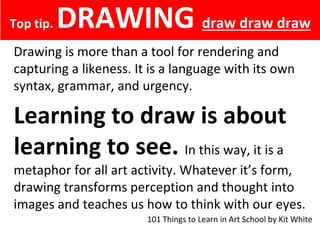
Top tip. DRAWING
Drawing is more than a tool for rendering and
capturing a likeness. It is a language with its own
syntax, grammar, and urgency.
Learning to draw is about
learning to see. In this way, it is a
metaphor for all art activity. Whatever it’s form,
drawing transforms perception and thought into
images and teaches us how to think with our eyes.
Top tip. DRAWING draw draw draw
101 Things to Learn in Art School by Kit White
Artists, ideas,
place, critics etc…
Everything you know
and everything you
think you know about
Abstract Art here.
Task 1a
We’ll come back to the list later
Listen and follow
the instructions.
List.
mini task 1b
You die and you’re going
to come back as an
abstract artwork of your
choice, what art work are
you going to be and why?
Teacher instructions: For this bit you’re going to need some books on Abstract Art to help
establish a pool of artists and their work to choose from. HOMEWORK ELEMENT TO THIS TASK.
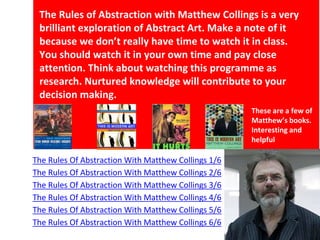
The Rules Of Abstraction With Matthew Collings 1/6
The Rules Of Abstraction With Matthew Collings 2/6
The Rules Of Abstraction With Matthew Collings 3/6
The Rules Of Abstraction With Matthew Collings 4/6
The Rules Of Abstraction With Matthew Collings 5/6
The Rules Of Abstraction With Matthew Collings 6/6
The Rules of Abstraction with Matthew Collings is a very
brilliant exploration of Abstract Art. Make a note of it
because we don’t really have time to watch it in class.
You should watch it in your own time and pay close
attention. Think about watching this programme as
research. Nurtured knowledge will contribute to your
decision making.
These are a few of
Matthew’s books.
Interesting and
helpful
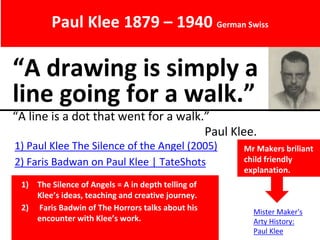
“A drawing is simply a
line going for a walk.”
“A line is a dot that went for a walk.”
Paul Klee.
Paul Klee 1879 – 1940 German Swiss
1) Paul Klee The Silence of the Angel (2005)
2) Faris Badwan on Paul Klee | TateShots
Mr Makers briliant
child friendly
explanation.
1) The Silence of Angels = A in depth telling of
Klee’s ideas, teaching and creative journey.
2) Faris Badwin of The Horrors talks about his
encounter with Klee’s work.
Mister Maker's
Arty History:
Paul Klee
“The history of
abstract art is
routed in a history
of
experimentation.”
TASK 2a: [IN THE EVENT OF A Sunny day]
SOMETIMES DOING SOMETHING POETICAL CAN
BECOME POLITICAL and SOMETIMES DOING
SOMETHING POLITICAL CAN BECOME POETICAL.
Francis Alys The Greenline
17.45 minutes
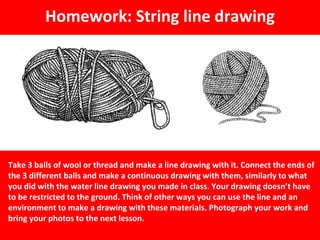
Homework: String line drawing
Take 3 balls of wool or thread and make a line drawing with it. Connect the ends of
the 3 different balls and make a continuous drawing with them, similarly to what
you did with the water line drawing you made in class. Your drawing doesn’t have
to be restricted to the ground. Think of other ways you can use the line and an
environment to make a drawing with these materials. Photograph your work and
bring your photos to the next lesson.
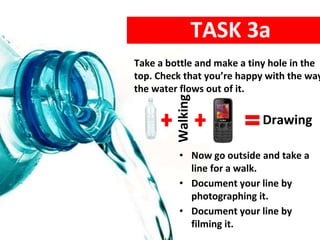
Take a bottle and make a tiny hole in the
top. Check that you’re happy with the way
the water flows out of it.
TASK 3a
• Now go outside and take a
line for a walk.
• Document your line by
photographing it.
• Document your line by
filming it.
Walking
Drawing
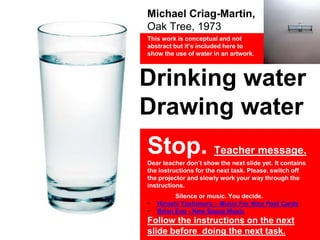
Michael Criag-Martin,
Oak Tree, 1973
This work is conceptual and not
abstract but it’s included here to
show the use of water in an artwork.
Drinking water
Drawing water
Stop. Teacher message.
Dear teacher don’t show the next slide yet. It contains
the instructions for the next task. Please, switch off
the projector and slowly work your way through the
instructions.
Silence or music. You decide.
• Hiroshi Yoshimura – Music For Nine Post Cards
• Brian Eno - New Space Music
Follow the instructions on the next
slide before doing the next task.
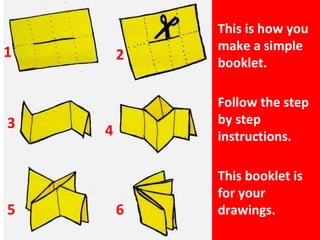
This is how you
make a simple
booklet.
Follow the step
by step
instructions.
This booklet is
for your
drawings.
1 2
3 4
5 6
Mouth and Meaning Workshop
Materials /Drawing tools, ink, paper, cup of drinking water.
This workshop will work best if everyone involved is prepared to participate
quietly and refrain from speaking during activities.
This activity invites contemplations and the gathering of sensory awareness.
3b Slow drinking of water
• Look at the water. DRAW THE SURFACE OF THE WATER.
• Slowly pick up the cup, hold it in your hand and smell the water. DRAW.
• Put the tip of your tongue in the water and taste it. DRAW THE EXPERIENCE.
• Slowly take a sip of water. DRAW THE JOURNEY THE WATER MAKES
• Feel the water in your mouth, against your tongue and inside your mouth.
Hold this water in your mouth, before swallowing it.
DRAW THE SPACE THE WATER CURRENTLY OCCUPIES.
• When you choose to swallow, see if you can observe the nature of the
experience. DRAW IT.
• Continue to contemplate, sense, sip the water and appreciate the experience
for approximately 5 minutes. DRAW THE WHOLE THING. ADD ONE OTHER
COLOUR.
Instructions
1. Choose three of the dry media available.
2. Feel the inside of your mouth with your tongue.
3. Get a sense of shapes and textures, proportions, subtle changes of surface.
4. Close your eyes and use the media you have chosen to create a one minute
drawing of what you feel. Only think about the contour shape and texture of
your mouth, no detail.
5. Change your media and focus on a different sensation in your mouth to draw
for another minute. It’s fine if your second drawing overlaps the first one.
6. Repeat the process again one last time.
3c:
Teacher, change where people are sat in the room.
SIT COMFORTABLY, WITH SPACE AROUND YOU.
EXPLAIN THAT FOR THIS ACTIVITY THERE IS ONLY DOING.
Feel the inside of your mouth with your tongue.
Get a sense of shapes and textures, proportions, subtle changes of surface.
Homework: Drawing Tools
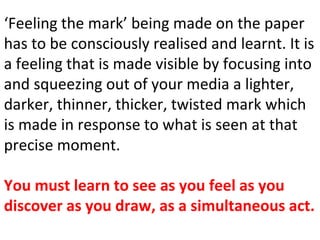
‘Feeling the mark’ being made on the paper
has to be consciously realised and learnt. It is
a feeling that is made visible by focusing into
and squeezing out of your media a lighter,
darker, thinner, thicker, twisted mark which
is made in response to what is seen at that
precise moment.
You must learn to see as you feel as you
discover as you draw, as a simultaneous act.
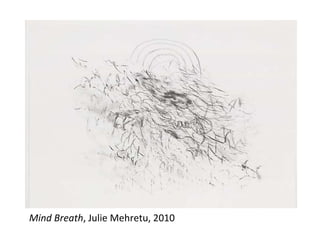
Mind Breath, Julie Mehretu, 2010
3d: Mouth Interior Revisited
Repeat the activity:
• With your eyes open
• With your less dominant hand
• On different types of paper
• In different media
• At a faster or slower pace
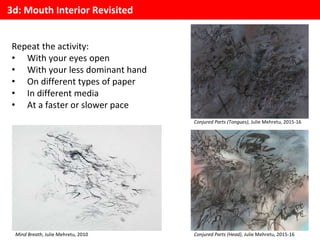
Mind Breath, Julie Mehretu, 2010
Conjured Parts (Tongues), Julie Mehretu, 2015-16
Conjured Parts (Head), Julie Mehretu, 2015-16

Year 12 abstraction 1

  • 1.
  • 2.
    Top tip. DRAWING Drawingis more than a tool for rendering and capturing a likeness. It is a language with its own syntax, grammar, and urgency. Learning to draw is about learning to see. In this way, it is a metaphor for all art activity. Whatever it’s form, drawing transforms perception and thought into images and teaches us how to think with our eyes. Top tip. DRAWING draw draw draw 101 Things to Learn in Art School by Kit White
  • 3.
    Artists, ideas, place, criticsetc… Everything you know and everything you think you know about Abstract Art here. Task 1a We’ll come back to the list later Listen and follow the instructions. List.
  • 4.
    mini task 1b Youdie and you’re going to come back as an abstract artwork of your choice, what art work are you going to be and why? Teacher instructions: For this bit you’re going to need some books on Abstract Art to help establish a pool of artists and their work to choose from. HOMEWORK ELEMENT TO THIS TASK.
  • 5.
    The Rules OfAbstraction With Matthew Collings 1/6 The Rules Of Abstraction With Matthew Collings 2/6 The Rules Of Abstraction With Matthew Collings 3/6 The Rules Of Abstraction With Matthew Collings 4/6 The Rules Of Abstraction With Matthew Collings 5/6 The Rules Of Abstraction With Matthew Collings 6/6 The Rules of Abstraction with Matthew Collings is a very brilliant exploration of Abstract Art. Make a note of it because we don’t really have time to watch it in class. You should watch it in your own time and pay close attention. Think about watching this programme as research. Nurtured knowledge will contribute to your decision making. These are a few of Matthew’s books. Interesting and helpful
  • 6.
    “A drawing issimply a line going for a walk.” “A line is a dot that went for a walk.” Paul Klee. Paul Klee 1879 – 1940 German Swiss 1) Paul Klee The Silence of the Angel (2005) 2) Faris Badwan on Paul Klee | TateShots Mr Makers briliant child friendly explanation. 1) The Silence of Angels = A in depth telling of Klee’s ideas, teaching and creative journey. 2) Faris Badwin of The Horrors talks about his encounter with Klee’s work. Mister Maker's Arty History: Paul Klee
  • 7.
    “The history of abstractart is routed in a history of experimentation.”
  • 8.
    TASK 2a: [INTHE EVENT OF A Sunny day] SOMETIMES DOING SOMETHING POETICAL CAN BECOME POLITICAL and SOMETIMES DOING SOMETHING POLITICAL CAN BECOME POETICAL. Francis Alys The Greenline 17.45 minutes
  • 9.
    Homework: String linedrawing Take 3 balls of wool or thread and make a line drawing with it. Connect the ends of the 3 different balls and make a continuous drawing with them, similarly to what you did with the water line drawing you made in class. Your drawing doesn’t have to be restricted to the ground. Think of other ways you can use the line and an environment to make a drawing with these materials. Photograph your work and bring your photos to the next lesson.
  • 10.
    Take a bottleand make a tiny hole in the top. Check that you’re happy with the way the water flows out of it. TASK 3a • Now go outside and take a line for a walk. • Document your line by photographing it. • Document your line by filming it. Walking Drawing
  • 11.
    Michael Criag-Martin, Oak Tree,1973 This work is conceptual and not abstract but it’s included here to show the use of water in an artwork. Drinking water Drawing water Stop. Teacher message. Dear teacher don’t show the next slide yet. It contains the instructions for the next task. Please, switch off the projector and slowly work your way through the instructions. Silence or music. You decide. • Hiroshi Yoshimura – Music For Nine Post Cards • Brian Eno - New Space Music Follow the instructions on the next slide before doing the next task.
  • 12.
    This is howyou make a simple booklet. Follow the step by step instructions. This booklet is for your drawings. 1 2 3 4 5 6
  • 13.
    Mouth and MeaningWorkshop Materials /Drawing tools, ink, paper, cup of drinking water. This workshop will work best if everyone involved is prepared to participate quietly and refrain from speaking during activities. This activity invites contemplations and the gathering of sensory awareness. 3b Slow drinking of water • Look at the water. DRAW THE SURFACE OF THE WATER. • Slowly pick up the cup, hold it in your hand and smell the water. DRAW. • Put the tip of your tongue in the water and taste it. DRAW THE EXPERIENCE. • Slowly take a sip of water. DRAW THE JOURNEY THE WATER MAKES • Feel the water in your mouth, against your tongue and inside your mouth. Hold this water in your mouth, before swallowing it. DRAW THE SPACE THE WATER CURRENTLY OCCUPIES. • When you choose to swallow, see if you can observe the nature of the experience. DRAW IT. • Continue to contemplate, sense, sip the water and appreciate the experience for approximately 5 minutes. DRAW THE WHOLE THING. ADD ONE OTHER COLOUR.
  • 14.
    Instructions 1. Choose threeof the dry media available. 2. Feel the inside of your mouth with your tongue. 3. Get a sense of shapes and textures, proportions, subtle changes of surface. 4. Close your eyes and use the media you have chosen to create a one minute drawing of what you feel. Only think about the contour shape and texture of your mouth, no detail. 5. Change your media and focus on a different sensation in your mouth to draw for another minute. It’s fine if your second drawing overlaps the first one. 6. Repeat the process again one last time. 3c: Teacher, change where people are sat in the room. SIT COMFORTABLY, WITH SPACE AROUND YOU. EXPLAIN THAT FOR THIS ACTIVITY THERE IS ONLY DOING. Feel the inside of your mouth with your tongue. Get a sense of shapes and textures, proportions, subtle changes of surface. Homework: Drawing Tools
  • 15.
    ‘Feeling the mark’being made on the paper has to be consciously realised and learnt. It is a feeling that is made visible by focusing into and squeezing out of your media a lighter, darker, thinner, thicker, twisted mark which is made in response to what is seen at that precise moment. You must learn to see as you feel as you discover as you draw, as a simultaneous act.
  • 16.
    Mind Breath, JulieMehretu, 2010
  • 17.
    3d: Mouth InteriorRevisited Repeat the activity: • With your eyes open • With your less dominant hand • On different types of paper • In different media • At a faster or slower pace Mind Breath, Julie Mehretu, 2010 Conjured Parts (Tongues), Julie Mehretu, 2015-16 Conjured Parts (Head), Julie Mehretu, 2015-16