What is news?

Thinking about journalism and
 the decision-making process
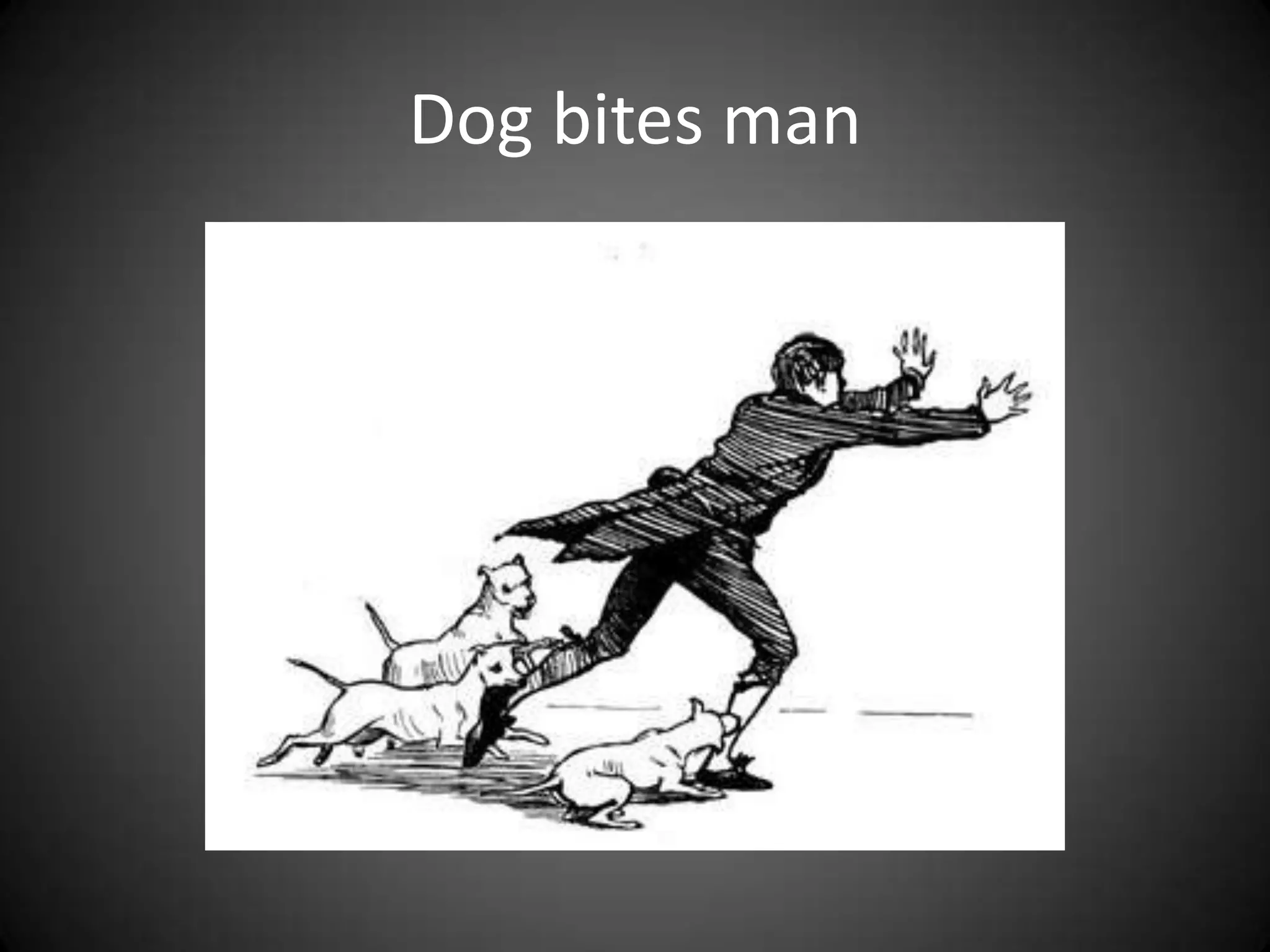
Dog bites man
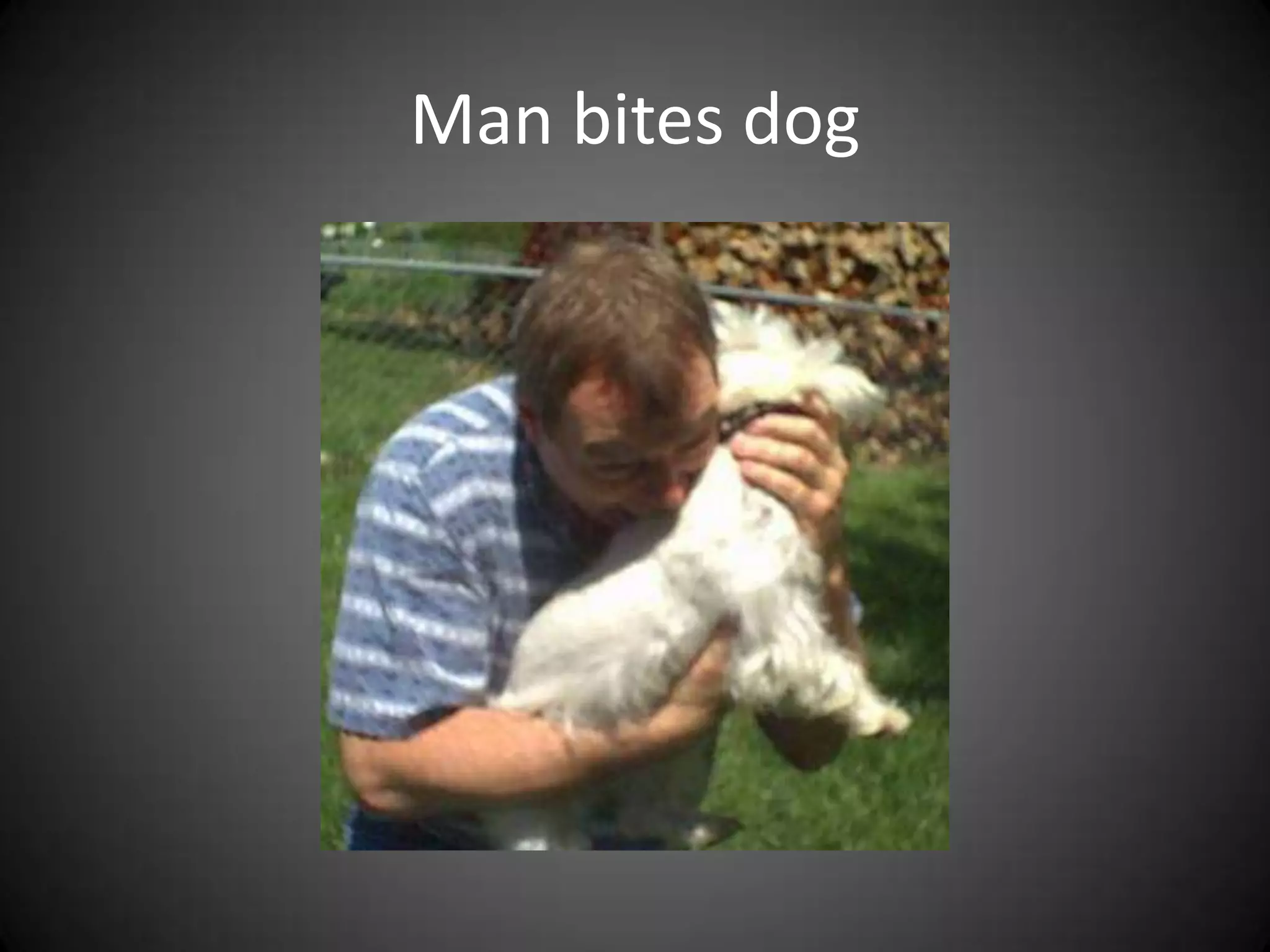
Man bites dog
Characteristics of news
• Timeliness
Characteristics of news
• Timeliness
• Impact
Characteristics of news
• Timeliness
• Impact
• Prominence
Characteristics of news
•   Timeliness
•   Impact
•   Prominence
•   Proximity
Characteristics of news
•   Timeliness
•   Impact
•   Prominence
•   Proximity
•   Singularity
Characteristics of news
•   Timeliness
•   Impact
•   Prominence
•   Proximity
•   Singularity
•   Conflict or controversy
Types of news
• What is hard news?
Types of news
• What is hard news?
  – Police and fire reporting
Types of news
• What is hard news?
  – Police and fire reporting
  – Government
Types of news
• What is hard news?
  – Police and fire reporting
  – Government
  – Disasters
Types of news
• What is hard news?
  – Police and fire reporting
  – Government
  – Disasters
• What is soft news?
Types of news
• What is hard news?
  – Police and fire reporting
  – Government
  – Disasters
• What is soft news?
  – Human-interest feature stories
Types of news
• What is hard news?
  – Police and fire reporting
  – Government
  – Disasters
• What is soft news?
  – Human-interest feature stories
  – Not necessarily tied to the news cycle
Types of news
• What is hard news?
  – Police and fire reporting
  – Government
  – Disasters
• What is soft news?
  – Human-interest feature stories
  – Not necessarily tied to the news cycle
  – Often aimed at tugging on the emotions
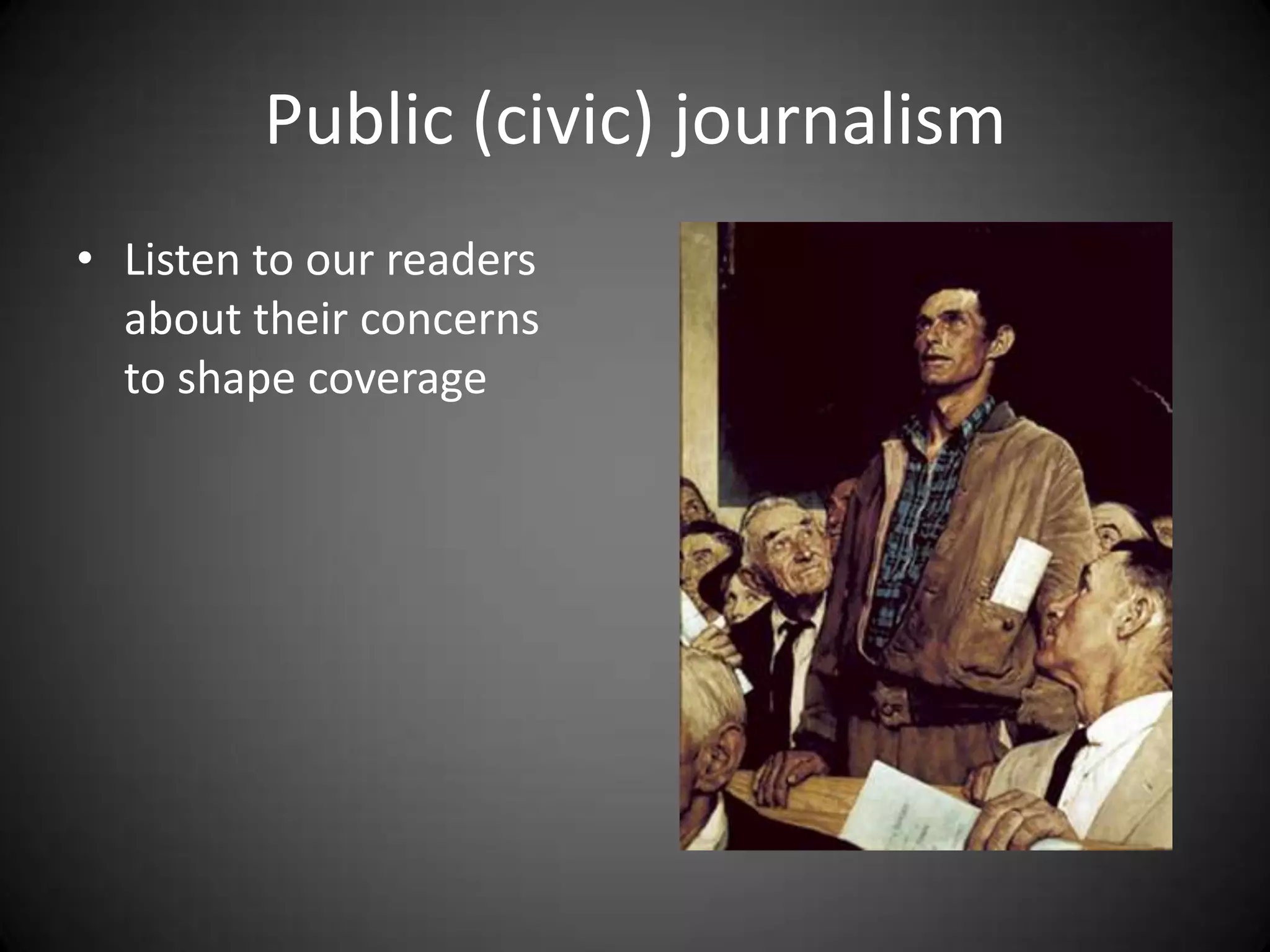
Public (civic) journalism
• Listen to our readers
  about their concerns
  to shape coverage
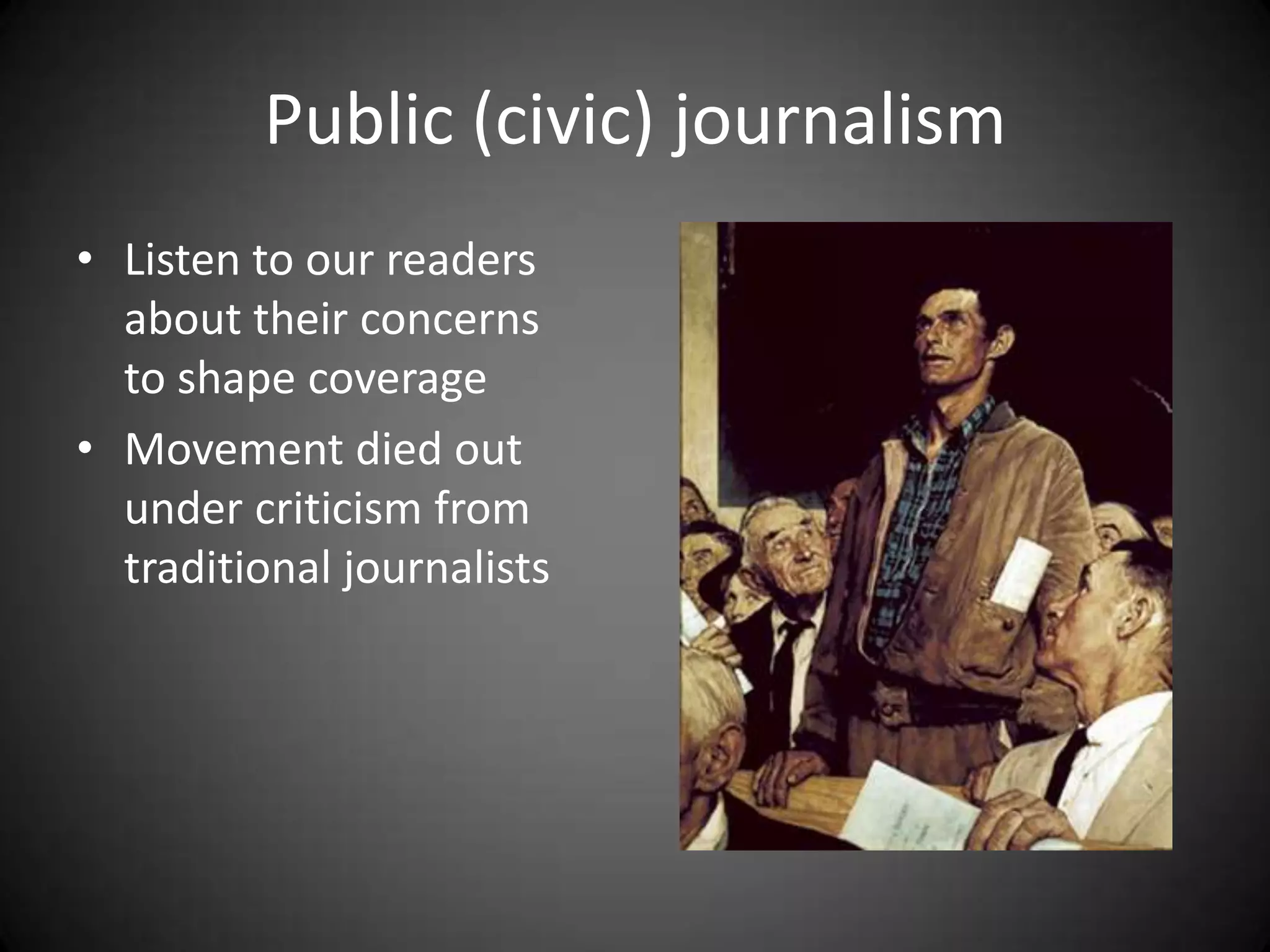
Public (civic) journalism
• Listen to our readers
  about their concerns
  to shape coverage
• Movement died out
  under criticism from
  traditional journalists
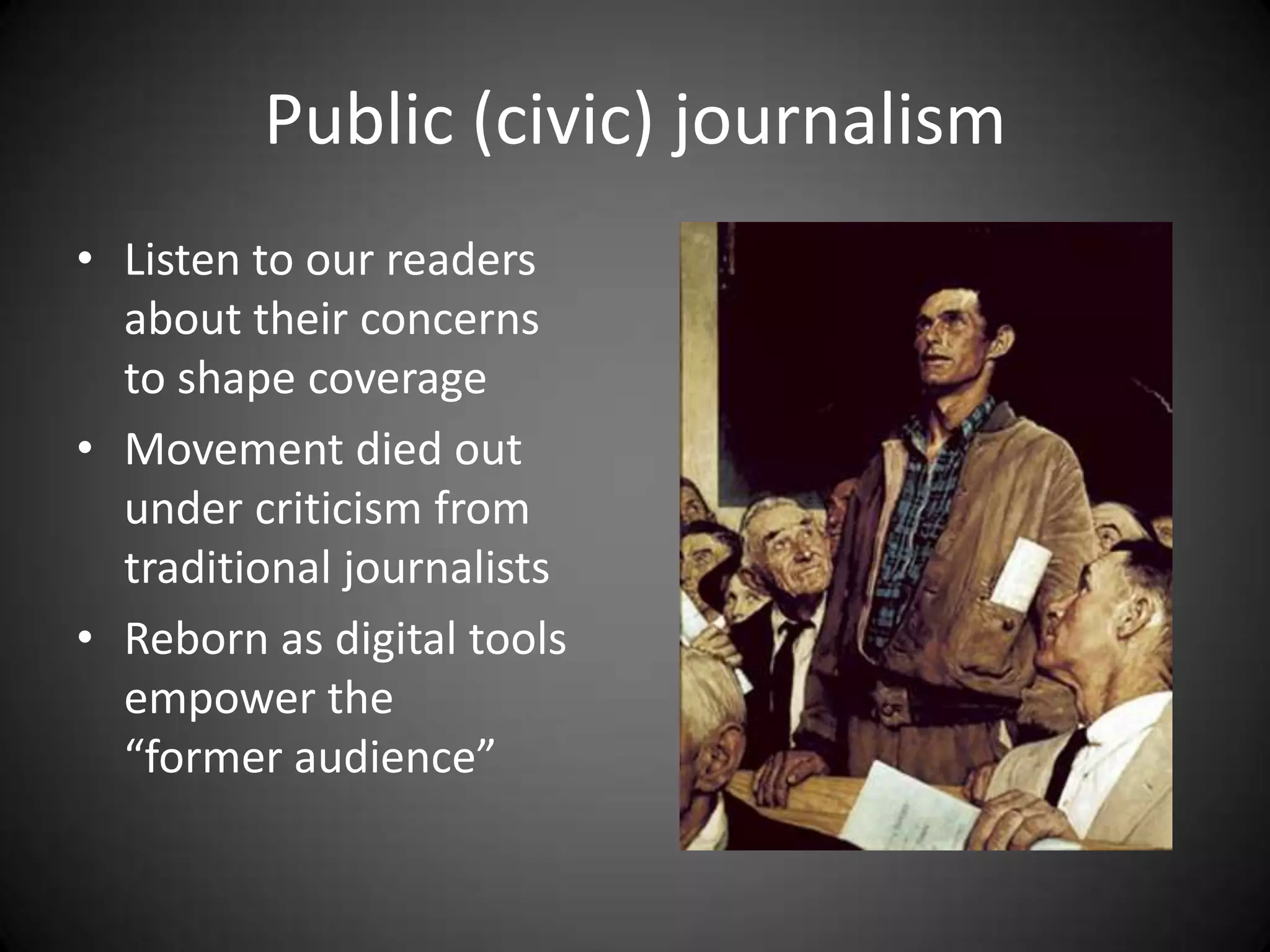
Public (civic) journalism
• Listen to our readers
  about their concerns
  to shape coverage
• Movement died out
  under criticism from
  traditional journalists
• Reborn as digital tools
  empower the
  “former audience”
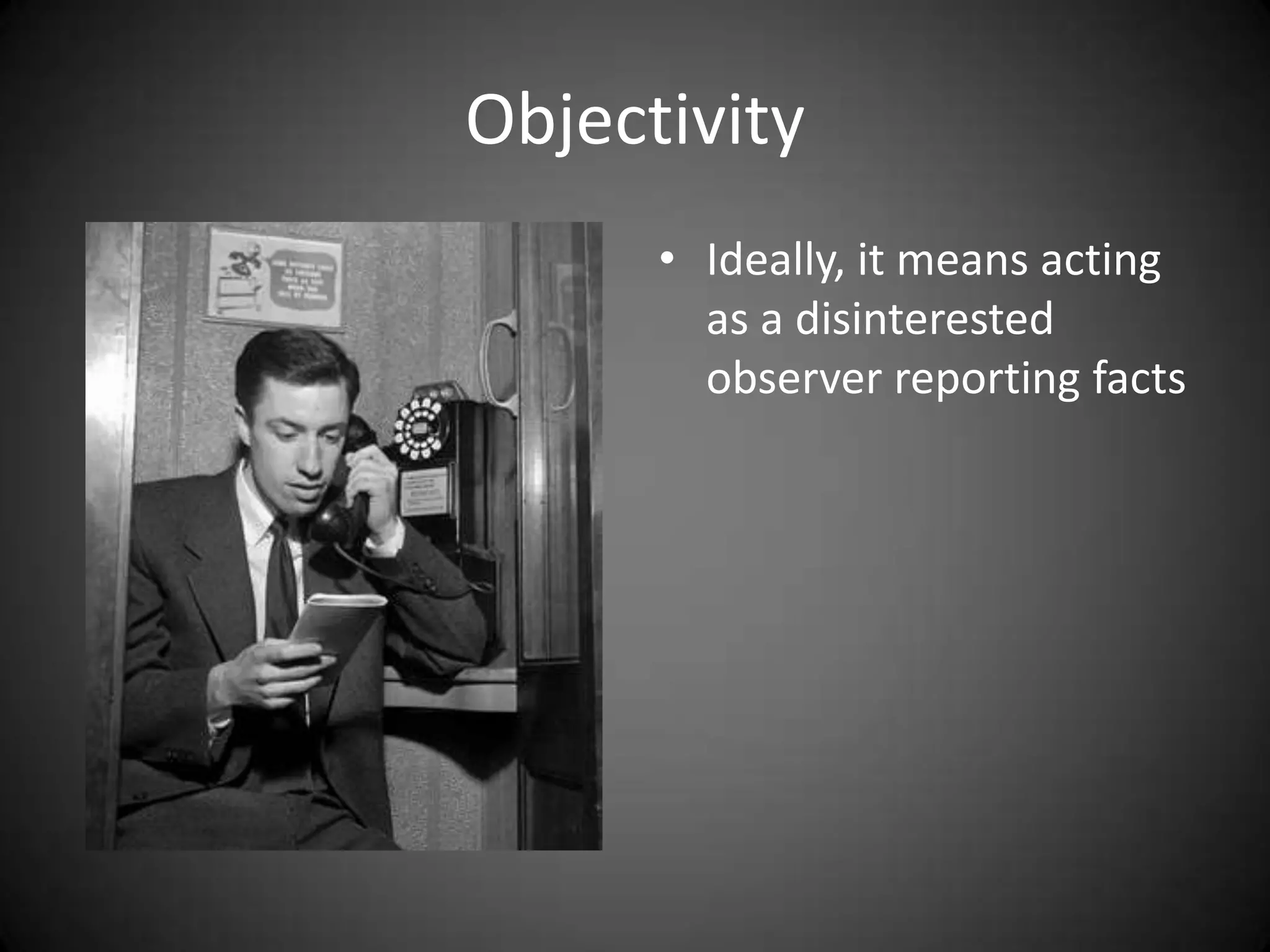
Objectivity
      • Ideally, it means acting
        as a disinterested
        observer reporting facts
Objectivity
      • Ideally, it means acting
        as a disinterested
        observer reporting facts
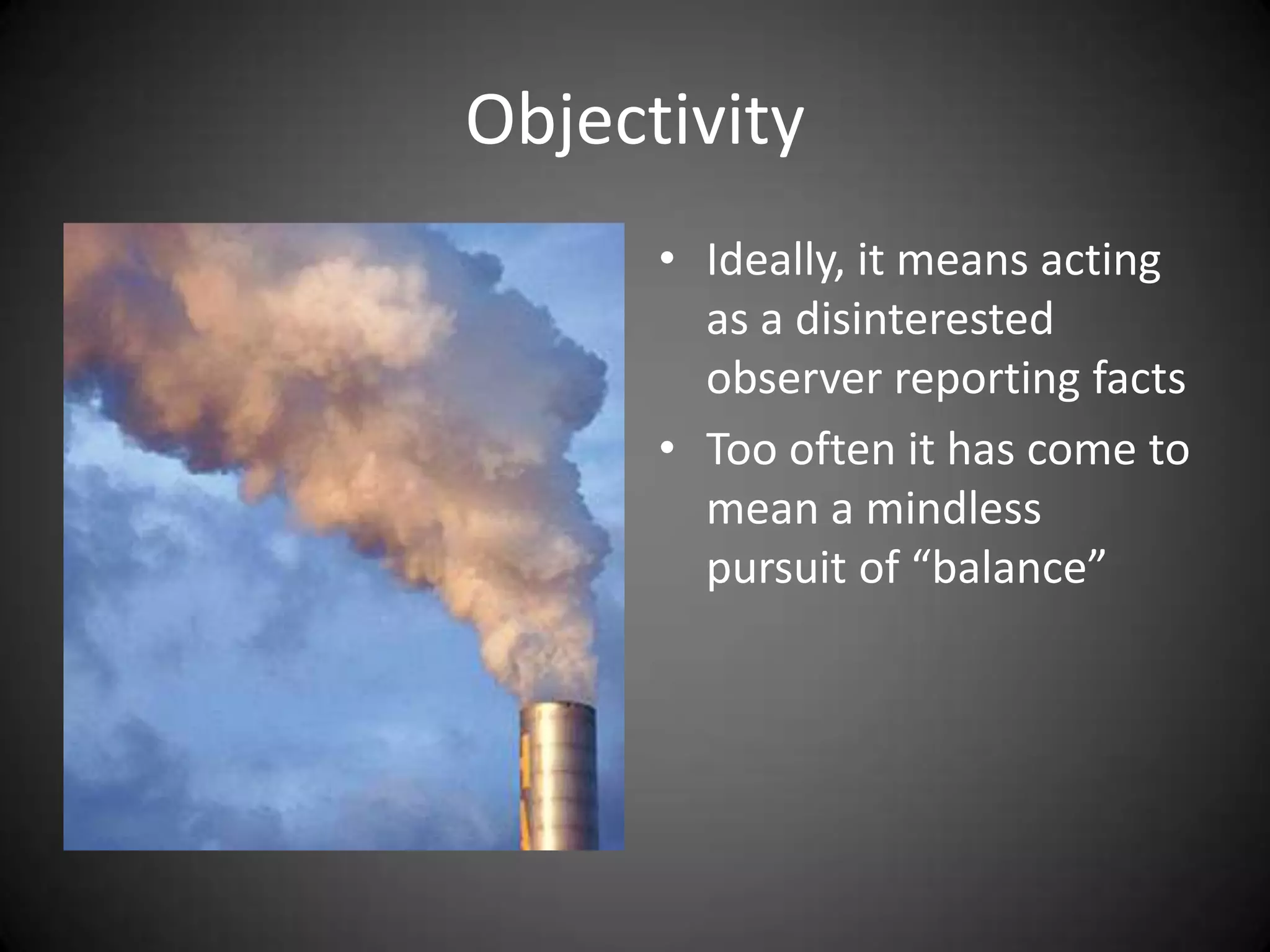
      • Too often it has come to
        mean a mindless
        pursuit of “balance”
Objectivity
      • Ideally, it means acting
        as a disinterested
        observer reporting facts
      • Too often it has come to
        mean a mindless
        pursuit of “balance”
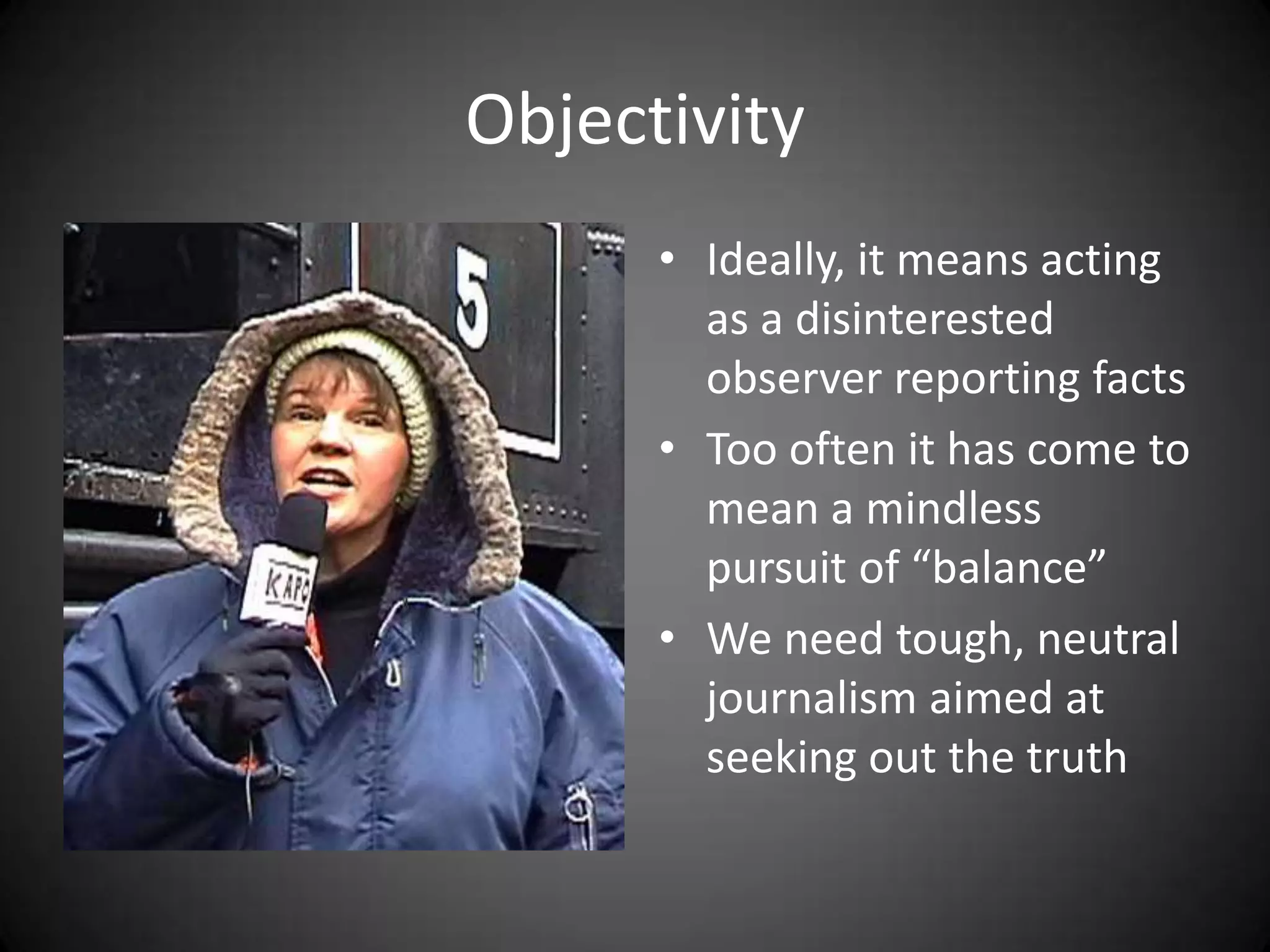
      • We need tough, neutral
        journalism aimed at
        seeking out the truth
Special considerations
• Offensive details, especially in photos
Special considerations
• Offensive details, especially in photos
• Sensationalism for its own sake
Special considerations
• Offensive details, especially in photos
• Sensationalism for its own sake
• Rumors — sometimes yes, sometimes no
Special considerations
•   Offensive details, especially in photos
•   Sensationalism for its own sake
•   Rumors — sometimes yes, sometimes no
•   Names of rape victims are usually withheld
Special considerations
•   Offensive details, especially in photos
•   Sensationalism for its own sake
•   Rumors — sometimes yes, sometimes no
•   Names of rape victims are usually withheld
•   Names of juvenile offenders withheld
Accuracy
• If a person says his name is “John Smith,” ask
  him to spell “John” and “Smith”
Accuracy
• If a person says his name is “John Smith,” ask
  him to spell “John” and “Smith”
• It could be “Jon Smythe”
Accuracy
• If a person says his name is “John Smith,” ask
  him to spell “John” and “Smith”
• It could be “Jon Smythe”
• Keep asking questions until you understand
  what’s going on
  – Passing along information that you don’t quite
    understand leads to fuzziness and errors
Credits
• This presentation is a summary of Chapter 5 in
  “Reporting for the Media,” by John R. Bender,
  Lucinda D. Davenport, Michael W. Drager and
  Fred Fedler (10th edition)

What is news?

  • 1.
    What is news? Thinkingabout journalism and the decision-making process
  • 2.
  • 3.
  • 4.
  • 5.
    Characteristics of news •Timeliness • Impact
  • 6.
    Characteristics of news •Timeliness • Impact • Prominence
  • 7.
    Characteristics of news • Timeliness • Impact • Prominence • Proximity
  • 8.
    Characteristics of news • Timeliness • Impact • Prominence • Proximity • Singularity
  • 9.
    Characteristics of news • Timeliness • Impact • Prominence • Proximity • Singularity • Conflict or controversy
  • 10.
    Types of news •What is hard news?
  • 11.
    Types of news •What is hard news? – Police and fire reporting
  • 12.
    Types of news •What is hard news? – Police and fire reporting – Government
  • 13.
    Types of news •What is hard news? – Police and fire reporting – Government – Disasters
  • 14.
    Types of news •What is hard news? – Police and fire reporting – Government – Disasters • What is soft news?
  • 15.
    Types of news •What is hard news? – Police and fire reporting – Government – Disasters • What is soft news? – Human-interest feature stories
  • 16.
    Types of news •What is hard news? – Police and fire reporting – Government – Disasters • What is soft news? – Human-interest feature stories – Not necessarily tied to the news cycle
  • 17.
    Types of news •What is hard news? – Police and fire reporting – Government – Disasters • What is soft news? – Human-interest feature stories – Not necessarily tied to the news cycle – Often aimed at tugging on the emotions
  • 18.
    Public (civic) journalism •Listen to our readers about their concerns to shape coverage
  • 19.
    Public (civic) journalism •Listen to our readers about their concerns to shape coverage • Movement died out under criticism from traditional journalists
  • 20.
    Public (civic) journalism •Listen to our readers about their concerns to shape coverage • Movement died out under criticism from traditional journalists • Reborn as digital tools empower the “former audience”
  • 21.
    Objectivity • Ideally, it means acting as a disinterested observer reporting facts
  • 22.
    Objectivity • Ideally, it means acting as a disinterested observer reporting facts • Too often it has come to mean a mindless pursuit of “balance”
  • 23.
    Objectivity • Ideally, it means acting as a disinterested observer reporting facts • Too often it has come to mean a mindless pursuit of “balance” • We need tough, neutral journalism aimed at seeking out the truth
  • 24.
    Special considerations • Offensivedetails, especially in photos
  • 25.
    Special considerations • Offensivedetails, especially in photos • Sensationalism for its own sake
  • 26.
    Special considerations • Offensivedetails, especially in photos • Sensationalism for its own sake • Rumors — sometimes yes, sometimes no
  • 27.
    Special considerations • Offensive details, especially in photos • Sensationalism for its own sake • Rumors — sometimes yes, sometimes no • Names of rape victims are usually withheld
  • 28.
    Special considerations • Offensive details, especially in photos • Sensationalism for its own sake • Rumors — sometimes yes, sometimes no • Names of rape victims are usually withheld • Names of juvenile offenders withheld
  • 29.
    Accuracy • If aperson says his name is “John Smith,” ask him to spell “John” and “Smith”
  • 30.
    Accuracy • If aperson says his name is “John Smith,” ask him to spell “John” and “Smith” • It could be “Jon Smythe”
  • 31.
    Accuracy • If aperson says his name is “John Smith,” ask him to spell “John” and “Smith” • It could be “Jon Smythe” • Keep asking questions until you understand what’s going on – Passing along information that you don’t quite understand leads to fuzziness and errors
  • 32.
    Credits • This presentationis a summary of Chapter 5 in “Reporting for the Media,” by John R. Bender, Lucinda D. Davenport, Michael W. Drager and Fred Fedler (10th edition)