Codes of ethics
Defining and describing
standards and best practices
Professions with ethical codes
• Doctors
Professions with ethical codes
• Doctors
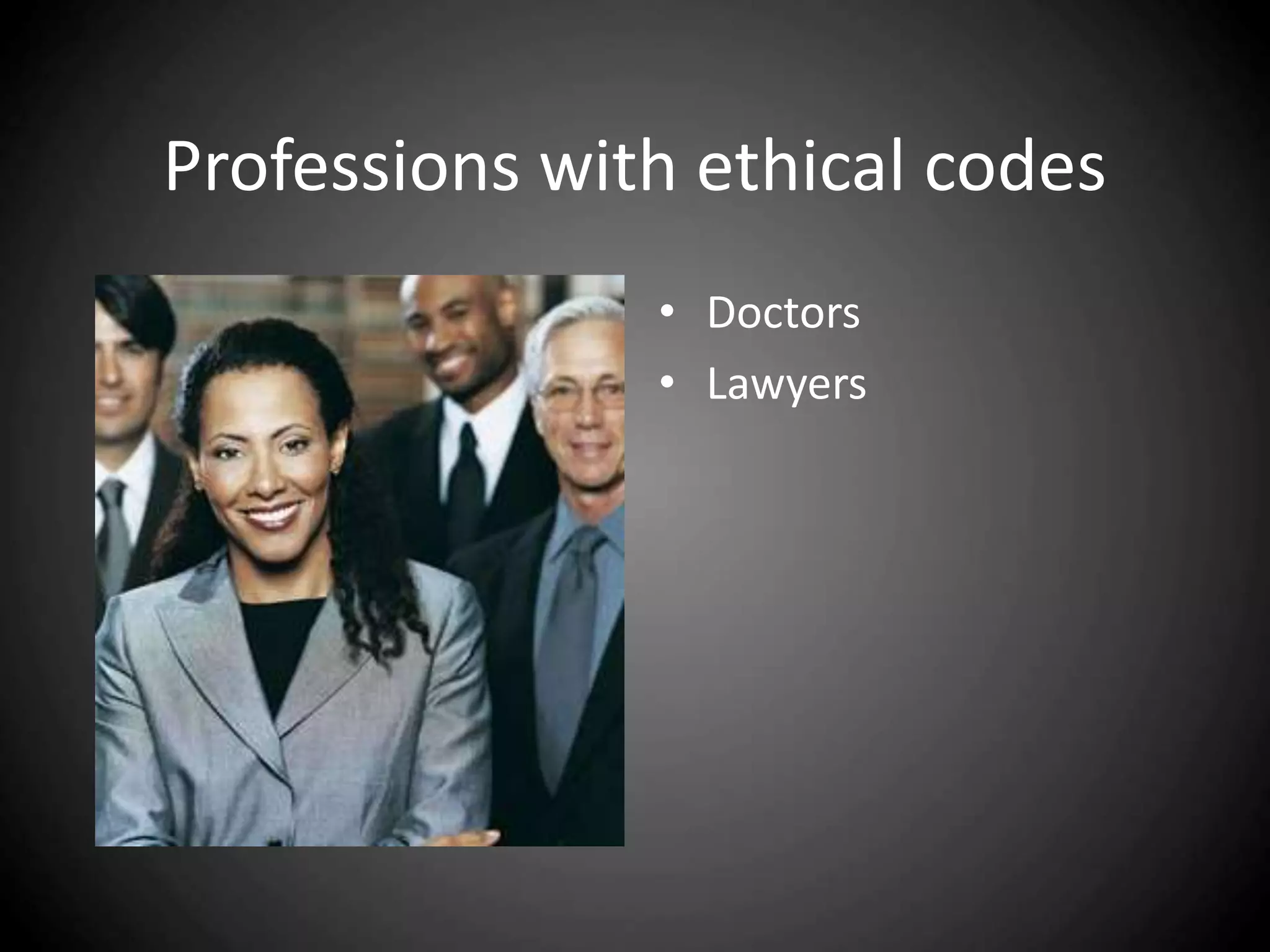
• Lawyers
Professions with ethical codes
• Doctors
• Lawyers
• Engineers, etc.
Sanctions for violations
• Loss of license
Sanctions for violations
• Loss of license
• What is to stop someone from setting up practice
without a license?
Sanctions for violations
• Loss of license
• What is to stop someone from setting up practice
without a license?
• Government enforcement
The great debate
• Is journalism a
profession?
The great debate
• Is journalism a
profession?
• Can it be a profession
without violating the
First Amendment?
The great debate
• Is journalism a
profession?
• Can it be a profession
without violating the
First Amendment?
• Can we have a binding
code of ethics?
The rise of professionalism
• Adolph Ochs and
The New York Times
The rise of professionalism
• Adolph Ochs and
The New York Times
• Yellow journalist
Joseph Pulitzer seeks a
legacy
The rise of professionalism
• Adolph Ochs and
The New York Times
• Yellow journalist
Joseph Pulitzer seeks a
legacy
• Sigma Delta Chi (now
SPJ) founded in 1909
Walter Lippmann
• Argues for educated
journalists and a
reliance on experts
Walter Lippmann
• Argues for educated
journalists and a
reliance on experts
• Conceived of objectivity
as a disinterested
pursuit of the truth
Walter Lippmann
• Argues for educated
journalists and a
reliance on experts
• Conceived of objectivity
as a disinterested
pursuit of the truth
• “There can be no liberty
for a community which
lacks the information by
which to detect lies”
“Canons of Journalism” (1922)
• Developed by the American Society of
Newspaper Editors
• Revised in 1975, now called the “Statement of
Principles”
“Canons of Journalism” (1922)
• Article 1: Responsibility
“Canons of Journalism” (1922)
• Article 1: Responsibility
• Article 2: Freedom of the press
“Canons of Journalism” (1922)
• Article 1: Responsibility
• Article 2: Freedom of the press
• Article 3: Independence
“Canons of Journalism” (1922)
• Article 1: Responsibility
• Article 2: Freedom of the press
• Article 3: Independence
• Article 4: Truth and accuracy
“Canons of Journalism” (1922)
• Article 1: Responsibility
• Article 2: Freedom of the press
• Article 3: Independence
• Article 4: Truth and accuracy
• Article 5: Impartiality
“Canons of Journalism” (1922)
• Article 1: Responsibility
• Article 2: Freedom of the press
• Article 3: Independence
• Article 4: Truth and accuracy
• Article 5: Impartiality
• Article 6: Fair play
Discussion
• Where is objectivity?
Discussion
• Where is objectivity?
• If the code isn’t
binding, what good is
it?
Discussion
• Where is objectivity?
• If the code isn’t
binding, what good is
it?
• If the code is common
sense, why have there
been so many
scandals?
SPJ Code of Ethics
• Borrowed from ASNE in 1926
• Current code adopted in 1996
• Four broad areas
SPJ Code of Ethics
• Borrowed from ASNE in 1926
• Current code adopted in 1996
• Four broad areas
– Seek Truth and Report It
SPJ Code of Ethics
• Borrowed from ASNE in 1926
• Current code adopted in 1996
• Four broad areas
– Seek Truth and Report It
– Minimize Harm
SPJ Code of Ethics
• Borrowed from ASNE in 1926
• Current code adopted in 1996
• Four broad areas
– Seek Truth and Report It
– Minimize Harm
– Act Independently
SPJ Code of Ethics
• Borrowed from ASNE in 1926
• Current code adopted in 1996
• Four broad areas
– Seek Truth and Report It
– Minimize Harm
– Act Independently
– Be Accountable

Codes of Ethics

  • 1.
    Codes of ethics Definingand describing standards and best practices
  • 2.
  • 3.
    Professions with ethicalcodes • Doctors
  • 4.
    Professions with ethicalcodes • Doctors • Lawyers
  • 5.
    Professions with ethicalcodes • Doctors • Lawyers • Engineers, etc.
  • 6.
  • 7.
    Sanctions for violations •Loss of license • What is to stop someone from setting up practice without a license?
  • 8.
    Sanctions for violations •Loss of license • What is to stop someone from setting up practice without a license? • Government enforcement
  • 9.
    The great debate •Is journalism a profession?
  • 10.
    The great debate •Is journalism a profession? • Can it be a profession without violating the First Amendment?
  • 11.
    The great debate •Is journalism a profession? • Can it be a profession without violating the First Amendment? • Can we have a binding code of ethics?
  • 12.
    The rise ofprofessionalism • Adolph Ochs and The New York Times
  • 13.
    The rise ofprofessionalism • Adolph Ochs and The New York Times • Yellow journalist Joseph Pulitzer seeks a legacy
  • 14.
    The rise ofprofessionalism • Adolph Ochs and The New York Times • Yellow journalist Joseph Pulitzer seeks a legacy • Sigma Delta Chi (now SPJ) founded in 1909
  • 15.
    Walter Lippmann • Arguesfor educated journalists and a reliance on experts
  • 16.
    Walter Lippmann • Arguesfor educated journalists and a reliance on experts • Conceived of objectivity as a disinterested pursuit of the truth
  • 17.
    Walter Lippmann • Arguesfor educated journalists and a reliance on experts • Conceived of objectivity as a disinterested pursuit of the truth • “There can be no liberty for a community which lacks the information by which to detect lies”
  • 18.
    “Canons of Journalism”(1922) • Developed by the American Society of Newspaper Editors • Revised in 1975, now called the “Statement of Principles”
  • 19.
    “Canons of Journalism”(1922) • Article 1: Responsibility
  • 20.
    “Canons of Journalism”(1922) • Article 1: Responsibility • Article 2: Freedom of the press
  • 21.
    “Canons of Journalism”(1922) • Article 1: Responsibility • Article 2: Freedom of the press • Article 3: Independence
  • 22.
    “Canons of Journalism”(1922) • Article 1: Responsibility • Article 2: Freedom of the press • Article 3: Independence • Article 4: Truth and accuracy
  • 23.
    “Canons of Journalism”(1922) • Article 1: Responsibility • Article 2: Freedom of the press • Article 3: Independence • Article 4: Truth and accuracy • Article 5: Impartiality
  • 24.
    “Canons of Journalism”(1922) • Article 1: Responsibility • Article 2: Freedom of the press • Article 3: Independence • Article 4: Truth and accuracy • Article 5: Impartiality • Article 6: Fair play
  • 25.
  • 26.
    Discussion • Where isobjectivity? • If the code isn’t binding, what good is it?
  • 27.
    Discussion • Where isobjectivity? • If the code isn’t binding, what good is it? • If the code is common sense, why have there been so many scandals?
  • 28.
    SPJ Code ofEthics • Borrowed from ASNE in 1926 • Current code adopted in 1996 • Four broad areas
  • 29.
    SPJ Code ofEthics • Borrowed from ASNE in 1926 • Current code adopted in 1996 • Four broad areas – Seek Truth and Report It
  • 30.
    SPJ Code ofEthics • Borrowed from ASNE in 1926 • Current code adopted in 1996 • Four broad areas – Seek Truth and Report It – Minimize Harm
  • 31.
    SPJ Code ofEthics • Borrowed from ASNE in 1926 • Current code adopted in 1996 • Four broad areas – Seek Truth and Report It – Minimize Harm – Act Independently
  • 32.
    SPJ Code ofEthics • Borrowed from ASNE in 1926 • Current code adopted in 1996 • Four broad areas – Seek Truth and Report It – Minimize Harm – Act Independently – Be Accountable