What is news?
Elements of Newsworthiness
Is news dead?
No, news just morphed into another form.
• A new study finds millenials (18-34) are strong news consumers, they
just take an indirect path. Instead of newspapers or digital home pages,
they use social media and search as the two top avenues for finding
news. Facebook is the top way of encountering news.
More than 6 in 10
Millennials
regularly keep up
with news and
information when
online
News ranks
third among
Millennials'
most frequent
online
activities
What is newsworthiness?
Traditional elements of news (news
determinants)
1. Timeliness — News is perishable.
It loses value as it ages. It has to be
current and new.
2. Prominence — Important people
are more newsworthy than others.
Celebrity and high ranking official
are more valuable sources.
3. Proximity — News closer to home
has more news value than that from
far away. This includes cultural
distance as well as physical distance.
Traditional determinants-continued
4. Consequence — That which directly
affects readers has more news value.
5. Oddity - Readers are intrigued by the
unusual or out-of-the-ordinary. Man bites a
dog.
6. Conflict - Readers want to know who will
win in elections, wars, sports, etc.
7. Emotion — Stories that can evoke anger,
sorrow, joy, sympathy, and even disgust are
powerful.
8. Public significance – Stories that has civic
importance.
New elements of digital media
1. Evolving news: Sickness can be
more powerful than death. Doubt
can be more powerful than truth.
Ex) Watergate.
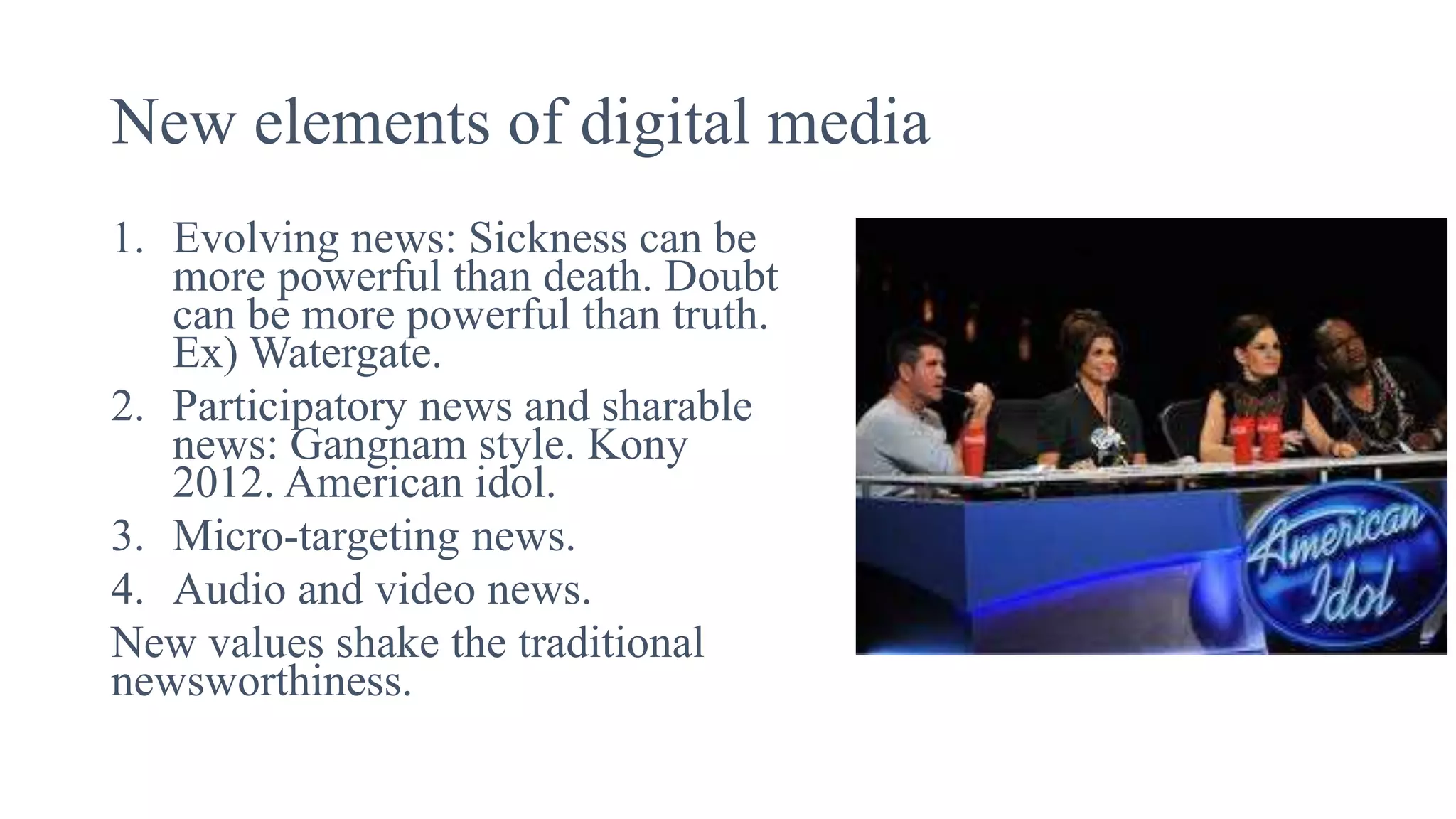
2. Participatory news and sharable
news: Gangnam style. Kony
2012. American idol.
3. Micro-targeting news.
4. Audio and video news.
New values shake the traditional
newsworthiness.
Participatory news may be the revival of
coffee shop days of news.
• People consume news. But at the
same time they want to be
storytellers too.
• Now, they have means of
expressing themselves in the
digital age.
• Audience participation may be
strongest value of news in digital
age.
Let’s think about Kony 2012
• Case of Kony 2012
• Campaign group Invisible
Children Inc. and Jason
Russell released a 30-minute
documentary titled Kony 2012.
• More than half of young adult
Americans heard about Kony
2012 in the days following the
video's release.
Controversy over Cony 2012
• Hypocrisy?
• Slacktivism?
• Justification of military intervention?
• Even an embezzlement accusation.
Global awareness? Global citizenship?
News was controversial but powerful
Areas of news
• Lifestyle
• Politics
• Sports
• Entertainment
• International
• Activism.
You will each select two areas of interest, start tweets, and gather online
stories. You will curate your own tweet and other online stories with Storify.
Include Tweets, Texts, Images and Videos.
Tips: Localize and personalize large issues
• Example story: Robert Krulwich and Will Hoffman, NPR Online
• To tell the complicated story of health care for NPR Online, Krulwich
and Hoffman zeroed in on the personal tales of a few individuals.
• http://www.npr.org/sections/krulwich/2011/06/01/121158190/a-
locksmith-s-tale-and-other-health-care-stories
Tips: Generalize what you see around you
• Student example.
• http://pgmediaandproductionco.businesscatalyst.com/index.html
• A Storify story about racial hate sign on SUNY Cortland campus.
• This story is like a prototype. Has huge potential to be in-depth news
with reactions or contexts added.
• What follow up coverage would you do if you were the author?
What people have said about news
• “The real news is bad news”. Marshall Mcluhan, Canadian
communications theorist, 1911-1980
• “Never awake me when you have good news to announce, because
with good news nothing presses; but when you have bad news, arouse
me immediately, for then there is not an instant to be lost”.
Napoleon Bonaparte, French Emperor, 1769-1821
• “News is what a chap who doesn't care much about anything wants to
read. And it's only news until he's read it. After that it's dead”.
Evelyn Waugh, British author, 1903-1966
• http://www.jibjab.com/originals/what_we_call_the_news
You may find ideas but they are not stories
• Stories are presented in narrative styles. Typically they have beginning
–middle – end.
• You need to set up your story, characters, issues, location
-in a way that allows events to unfold so that audience wants to know
more and more about it
-tell how are your characters are affected
-how they develop a solution (or not) and finally where they go from
there.

What is news? Elements of Newsworthiness

  • 1.
    What is news? Elementsof Newsworthiness
  • 2.
  • 3.
    No, news justmorphed into another form. • A new study finds millenials (18-34) are strong news consumers, they just take an indirect path. Instead of newspapers or digital home pages, they use social media and search as the two top avenues for finding news. Facebook is the top way of encountering news.
  • 4.
    More than 6in 10 Millennials regularly keep up with news and information when online
  • 5.
    News ranks third among Millennials' mostfrequent online activities
  • 6.
    What is newsworthiness? Traditionalelements of news (news determinants) 1. Timeliness — News is perishable. It loses value as it ages. It has to be current and new. 2. Prominence — Important people are more newsworthy than others. Celebrity and high ranking official are more valuable sources. 3. Proximity — News closer to home has more news value than that from far away. This includes cultural distance as well as physical distance.
  • 7.
    Traditional determinants-continued 4. Consequence— That which directly affects readers has more news value. 5. Oddity - Readers are intrigued by the unusual or out-of-the-ordinary. Man bites a dog. 6. Conflict - Readers want to know who will win in elections, wars, sports, etc. 7. Emotion — Stories that can evoke anger, sorrow, joy, sympathy, and even disgust are powerful. 8. Public significance – Stories that has civic importance.
  • 8.
    New elements ofdigital media 1. Evolving news: Sickness can be more powerful than death. Doubt can be more powerful than truth. Ex) Watergate. 2. Participatory news and sharable news: Gangnam style. Kony 2012. American idol. 3. Micro-targeting news. 4. Audio and video news. New values shake the traditional newsworthiness.
  • 9.
    Participatory news maybe the revival of coffee shop days of news. • People consume news. But at the same time they want to be storytellers too. • Now, they have means of expressing themselves in the digital age. • Audience participation may be strongest value of news in digital age.
  • 10.
    Let’s think aboutKony 2012 • Case of Kony 2012 • Campaign group Invisible Children Inc. and Jason Russell released a 30-minute documentary titled Kony 2012. • More than half of young adult Americans heard about Kony 2012 in the days following the video's release.
  • 11.
    Controversy over Cony2012 • Hypocrisy? • Slacktivism? • Justification of military intervention? • Even an embezzlement accusation. Global awareness? Global citizenship? News was controversial but powerful
  • 12.
    Areas of news •Lifestyle • Politics • Sports • Entertainment • International • Activism. You will each select two areas of interest, start tweets, and gather online stories. You will curate your own tweet and other online stories with Storify. Include Tweets, Texts, Images and Videos.
  • 13.
    Tips: Localize andpersonalize large issues • Example story: Robert Krulwich and Will Hoffman, NPR Online • To tell the complicated story of health care for NPR Online, Krulwich and Hoffman zeroed in on the personal tales of a few individuals. • http://www.npr.org/sections/krulwich/2011/06/01/121158190/a- locksmith-s-tale-and-other-health-care-stories
  • 14.
    Tips: Generalize whatyou see around you • Student example. • http://pgmediaandproductionco.businesscatalyst.com/index.html • A Storify story about racial hate sign on SUNY Cortland campus. • This story is like a prototype. Has huge potential to be in-depth news with reactions or contexts added. • What follow up coverage would you do if you were the author?
  • 15.
    What people havesaid about news • “The real news is bad news”. Marshall Mcluhan, Canadian communications theorist, 1911-1980 • “Never awake me when you have good news to announce, because with good news nothing presses; but when you have bad news, arouse me immediately, for then there is not an instant to be lost”. Napoleon Bonaparte, French Emperor, 1769-1821 • “News is what a chap who doesn't care much about anything wants to read. And it's only news until he's read it. After that it's dead”. Evelyn Waugh, British author, 1903-1966 • http://www.jibjab.com/originals/what_we_call_the_news
  • 16.
    You may findideas but they are not stories • Stories are presented in narrative styles. Typically they have beginning –middle – end. • You need to set up your story, characters, issues, location -in a way that allows events to unfold so that audience wants to know more and more about it -tell how are your characters are affected -how they develop a solution (or not) and finally where they go from there.