Department of Psychiatry, SLNMWC
Dr. L. Reyes
Psychiatrist
 Psychiatry studies the causes of mental disorders, gives
their description, predicts their future course and
outcome, looks for prevention of their appearance and
presents the best ways of their treatment
 Psychopathology describes symptoms of mental
disorders
 Special psychiatry is devoted to individual mental
diseases
 General psychiatry studies psychopathological
phenomena, symptoms of abnormal states of mind:
1. consciousness 5. mood (emotions)
2. perception 6. intelligence
3. thinking 7. motor
4. memory 8. personality
 Consciousness is awareness of the self and
the environment
 Disorders of consciousness:
◦ qualitative
◦ quantitative
 short-term
 long-term
 Hypnosis – artificially incited change of
consciousness
 Syncope – short-term unconsciousness
 Quantitative changes of consciousness mean reduced
vigility (alertness):
◦ somnolence
◦ sopor
◦ coma
 Qualitative changes of consciousness mean disturbed
perception, thinking, affectivity, memory and
consequent motor disorders:
◦ delirium (confusional state) – characterized by disorientation,
distorted perception, enhanced suggestibility,
misinterpretations and mood disorders
◦ obnubilation (twilight state) – starts and ends abruptly,
amnesia is complete; the patient is disordered, his acting is
aimless, sometimes aggressive, hard to understood
 stuporous
 vigilambulant
 delirious
 Ganser syndrome
 Perception is a process of becoming aware of what
is presented through the sense organs
 Imagery means an experience within the mind,
usually without the sense of reality that is part of
reality
 Pseudoillusions – distorted perception of objects
which may occur when the general level of sensory
stimulation is reduced
 Illusions are psychopathological phenomena; they
appear mainly in conditions of qualitative
disturbances of consciousness (missing insight)
 Hallucination are percepts without any obvious
stimulus to the sense organs; the patient is unable
to distinguish it from reality
Hallucinations:
 auditory (acousma)
 visual
 olfactory
 gustatory
 tactile (or deep somatic)
 extracampine, inadequate
 intrapsychic (belong rather to disturbances of
thinking)
 hypnagogic and hypnopompic (hypnexagogic)
Pseudohallucinations - patient can distinguish
them from reality
 Thinking
 Cognitive functions
 Disorders of thinking:
◦ quantitative
◦ qualitative
Quantitative (formal) disorders of thinking:
 pressure of thought
 poverty of thought
 thought blocking
 flight of ideas
 perseveration
 loosening of associations
 word salad - incoherent thinking
 neologisms
 verbigeration
Qualitative disorders of thought (content thought
disorders):
 Delusions:
a)belief firmly held on inadequate grounds,
b)not affected by rational arguments
c)not a conventional belief
 Obsessions (obsessive thought) are recurrent persistent
thoughts, impulses or images entering the mind despite
the person's effort to exclude them. Obsessive
phenomena in acting (usual as senseless rituals –
cleaning, counting, dressing) are called compulsions.
Division of delusions:
 according to onset
a)primary (delusion mood, perception)
b)secondary (systematized)
c)shared (folie a deux)
 according to theme
a)paranoid (persecutory) - d. of reference, d. of jealousy, d. of
control, d. concerning possession of thought
b)megalomanic (grandiose, expansive) – d. of power, worth,
noble origin, supernatural skills and strength, amorous d.
c)depressive (micromanic, melancholic) – d. of guilt and
worthlessness, nihilistic d., hypochondriacal d.
d)concerning the possession of thoughts
 thought insertion
 thought withdrawal
 thought broadcasting
 Sensory stores - retains sensory
information for 0.5 sec.
 Short - term memory (working memory) -
for verbal and visual information, retained
for 15-20 sec., low capacity
 Long-term memory – wide capacity and
more permanent storage
◦ declarative (explicit) memory – episodic (for
events) or semantic (for language and knowledge)
◦ procedural memory – for motor arts
◦ priming – unconscious memory
◦ conditioning – classic or emotional
Disorders of memory:
 Amnesia – inability to recall past events
 Jamais vu, déja vu
 Confabulation, amnesic disorientation,
Korsakov’s syndrome
 Pseudologia phantastica
 Hypomnesia
 Hypermnesia
 Concentration
 Capacity
 Tenacity
 Irritability
 Vigility
 Hypoprosexia (global, selective)
 Hyperprosexia
 Paraprosexia
Normal affect – brief and strong emotional
response
Normal mood – subjective and for a longer
time lasting disposition to appear affects
adequate to a surrounding situation and
matters discussed
Higher emotions:
◦ intellectual
◦ aesthetic
◦ ethic
◦ social
Pathological affect – very strong, abrupt affect with a short
change of consciousness on its peak
Pathological mood – two poles:
 manic
 depressive
Phobia – persistent irrational fear and wish to avoid a
specific situation, object, activity:
 agoraphobia
 claustrophobia
 social phobias
 hipsophobia
 aichmophobia
 keraunophobia
Depersonalization – change of self-awareness, the person
feels unreal, unable to feel emotion
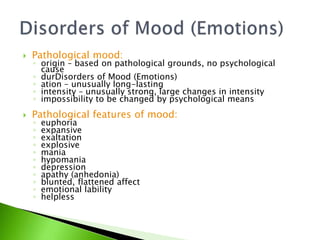
 Pathological mood:
◦ origin – based on pathological grounds, no psychological
cause
◦ durDisorders of Mood (Emotions)
◦ ation – unusually long-lasting
◦ intensity – unusually strong, large changes in intensity
◦ impossibility to be changed by psychological means
 Pathological features of mood:
◦ euphoria
◦ expansive
◦ exaltation
◦ explosive
◦ mania
◦ hypomania
◦ depression
◦ apathy (anhedonia)
◦ blunted, flattened affect
◦ emotional lability
◦ helpless
 Intelligence:
◦ abstract
◦ practical
◦ social
 Intelligence quotient (IQ):
IQ = (mental age : calendar age) x 100
 Disorders of intellect:
◦ mental retardation
◦ dementia
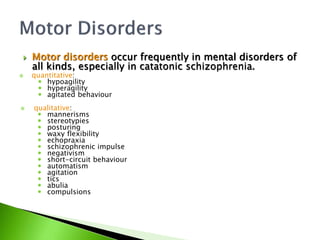
 Motor disorders occur frequently in mental disorders of
all kinds, especially in catatonic schizophrenia.
 quantitative:
 hypoagility
 hyperagility
 agitated behaviour
 qualitative:
 mannerisms
 stereotypies
 posturing
 waxy flexibility
 echopraxia
 schizophrenic impulse
 negativism
 short-circuit behaviour
 automatism
 agitation
 tics
 abulia
 compulsions
Disorders of volition:
◦ hypobulia
◦ abulia
◦ hyperbulia
 Personality means a complex of persistent
mental and physical traits of a person
 Disturbances of personality:
◦ transformation of personality
◦ appersonalization
◦ multiple personality (alteration of personality)
◦ specific personality disorder
◦ deprived personality

1-1-1General Psychopathology.pptx

  • 1.
    Department of Psychiatry,SLNMWC Dr. L. Reyes Psychiatrist
  • 2.
     Psychiatry studiesthe causes of mental disorders, gives their description, predicts their future course and outcome, looks for prevention of their appearance and presents the best ways of their treatment  Psychopathology describes symptoms of mental disorders  Special psychiatry is devoted to individual mental diseases  General psychiatry studies psychopathological phenomena, symptoms of abnormal states of mind: 1. consciousness 5. mood (emotions) 2. perception 6. intelligence 3. thinking 7. motor 4. memory 8. personality
  • 3.
     Consciousness isawareness of the self and the environment  Disorders of consciousness: ◦ qualitative ◦ quantitative  short-term  long-term  Hypnosis – artificially incited change of consciousness  Syncope – short-term unconsciousness
  • 4.
     Quantitative changesof consciousness mean reduced vigility (alertness): ◦ somnolence ◦ sopor ◦ coma  Qualitative changes of consciousness mean disturbed perception, thinking, affectivity, memory and consequent motor disorders: ◦ delirium (confusional state) – characterized by disorientation, distorted perception, enhanced suggestibility, misinterpretations and mood disorders ◦ obnubilation (twilight state) – starts and ends abruptly, amnesia is complete; the patient is disordered, his acting is aimless, sometimes aggressive, hard to understood  stuporous  vigilambulant  delirious  Ganser syndrome
  • 5.
     Perception isa process of becoming aware of what is presented through the sense organs  Imagery means an experience within the mind, usually without the sense of reality that is part of reality  Pseudoillusions – distorted perception of objects which may occur when the general level of sensory stimulation is reduced  Illusions are psychopathological phenomena; they appear mainly in conditions of qualitative disturbances of consciousness (missing insight)  Hallucination are percepts without any obvious stimulus to the sense organs; the patient is unable to distinguish it from reality
  • 6.
    Hallucinations:  auditory (acousma) visual  olfactory  gustatory  tactile (or deep somatic)  extracampine, inadequate  intrapsychic (belong rather to disturbances of thinking)  hypnagogic and hypnopompic (hypnexagogic) Pseudohallucinations - patient can distinguish them from reality
  • 7.
     Thinking  Cognitivefunctions  Disorders of thinking: ◦ quantitative ◦ qualitative
  • 8.
    Quantitative (formal) disordersof thinking:  pressure of thought  poverty of thought  thought blocking  flight of ideas  perseveration  loosening of associations  word salad - incoherent thinking  neologisms  verbigeration
  • 9.
    Qualitative disorders ofthought (content thought disorders):  Delusions: a)belief firmly held on inadequate grounds, b)not affected by rational arguments c)not a conventional belief  Obsessions (obsessive thought) are recurrent persistent thoughts, impulses or images entering the mind despite the person's effort to exclude them. Obsessive phenomena in acting (usual as senseless rituals – cleaning, counting, dressing) are called compulsions.
  • 10.
    Division of delusions: according to onset a)primary (delusion mood, perception) b)secondary (systematized) c)shared (folie a deux)  according to theme a)paranoid (persecutory) - d. of reference, d. of jealousy, d. of control, d. concerning possession of thought b)megalomanic (grandiose, expansive) – d. of power, worth, noble origin, supernatural skills and strength, amorous d. c)depressive (micromanic, melancholic) – d. of guilt and worthlessness, nihilistic d., hypochondriacal d. d)concerning the possession of thoughts  thought insertion  thought withdrawal  thought broadcasting
  • 11.
     Sensory stores- retains sensory information for 0.5 sec.  Short - term memory (working memory) - for verbal and visual information, retained for 15-20 sec., low capacity  Long-term memory – wide capacity and more permanent storage ◦ declarative (explicit) memory – episodic (for events) or semantic (for language and knowledge) ◦ procedural memory – for motor arts ◦ priming – unconscious memory ◦ conditioning – classic or emotional
  • 12.
    Disorders of memory: Amnesia – inability to recall past events  Jamais vu, déja vu  Confabulation, amnesic disorientation, Korsakov’s syndrome  Pseudologia phantastica  Hypomnesia  Hypermnesia
  • 13.
     Concentration  Capacity Tenacity  Irritability  Vigility  Hypoprosexia (global, selective)  Hyperprosexia  Paraprosexia
  • 14.
    Normal affect –brief and strong emotional response Normal mood – subjective and for a longer time lasting disposition to appear affects adequate to a surrounding situation and matters discussed Higher emotions: ◦ intellectual ◦ aesthetic ◦ ethic ◦ social
  • 15.
    Pathological affect –very strong, abrupt affect with a short change of consciousness on its peak Pathological mood – two poles:  manic  depressive Phobia – persistent irrational fear and wish to avoid a specific situation, object, activity:  agoraphobia  claustrophobia  social phobias  hipsophobia  aichmophobia  keraunophobia Depersonalization – change of self-awareness, the person feels unreal, unable to feel emotion
  • 16.
     Pathological mood: ◦origin – based on pathological grounds, no psychological cause ◦ durDisorders of Mood (Emotions) ◦ ation – unusually long-lasting ◦ intensity – unusually strong, large changes in intensity ◦ impossibility to be changed by psychological means  Pathological features of mood: ◦ euphoria ◦ expansive ◦ exaltation ◦ explosive ◦ mania ◦ hypomania ◦ depression ◦ apathy (anhedonia) ◦ blunted, flattened affect ◦ emotional lability ◦ helpless
  • 17.
     Intelligence: ◦ abstract ◦practical ◦ social  Intelligence quotient (IQ): IQ = (mental age : calendar age) x 100  Disorders of intellect: ◦ mental retardation ◦ dementia
  • 18.
     Motor disordersoccur frequently in mental disorders of all kinds, especially in catatonic schizophrenia.  quantitative:  hypoagility  hyperagility  agitated behaviour  qualitative:  mannerisms  stereotypies  posturing  waxy flexibility  echopraxia  schizophrenic impulse  negativism  short-circuit behaviour  automatism  agitation  tics  abulia  compulsions
  • 19.
    Disorders of volition: ◦hypobulia ◦ abulia ◦ hyperbulia
  • 20.
     Personality meansa complex of persistent mental and physical traits of a person  Disturbances of personality: ◦ transformation of personality ◦ appersonalization ◦ multiple personality (alteration of personality) ◦ specific personality disorder ◦ deprived personality