Medical devices are regulated mainly by multiple regulatory bodies and have to satisfy a set
of compliances and standardizations. Moreover, they should deliver effective performance,
accurate readings and should be safe while at use.
Therefore, it is essential for medical devices to have a proper device testing strategy in
place. The approach consists of maintaining compliance processes and planned software
testing to deliver device effectiveness.
Medical Device testing ensures the product’s software and devices are fully compatible and
compliant with various regulations and functionality. This testing ensures that these devices
fulfill all quality-related aspects successfully for which QA plays an important role.
Hence, medical device manufacturers should adopt quality assurance(QA) for thorough
verification and validation of devices. It ensures to deliver the proper quality and reliability of
these devices.
Further, glitches in medical device software may lead to false diagnosis and hence QA is
essential to ensure proper performance and functioning of medical devices
Functionality Testing
It focuses on test efforts to evaluate how the device is supposed to perform under various
scenarios. It involves the actual process of verification and validation of devices. Each of
the functions is exhaustively tested with a combination of parameter values to know the
device’s functionality.
Device Verification Testing
This process confirms whether the examination of any objective evidence with specified
requirements of the device has been fulfilled or not. The process starts with clear and
well-defined product requirements which must be measurable in order to verify them. The
process follows certain protocols and uses a standard methodology that compares current
product requirements with already approved requirements.
Device Validation (Software/Hardware) Testing
After the entire system is in place, then medical devices should be validated for both
software & hardware. The primary purpose of this validation process is to test if the device
meets specific user needs or not. It can be tested under simulated or under actual
environment conditions to know how the software and hardware function.
Device Compatibility & Error Handling Testing
Medical device’s compatibility across various devices has to be tested to prove its
success. It is essential to test how the device responds under various error conditions
especially under power fluctuations, internal failures or for any peripheral device failure.
The devices should deliver proper error messages to notify users.
Automated Testing
This form of testing is taken up to ease testing process and overcome manual tasks to
ensure quality at speed. Automation process makes the testing process faster, more
accurate and complete. Primarily, the process includes stimulating the target device,
monitor the device response, record the results, control the entire process using
automation and declare results.
White-Box Testing
Automation of white-box testing is essential as it ensures the testing process to be closer
to the design and coding phases of the project. It is necessary to introduce an automated
test system that enables an inside look at medical device software. Tests are devised to
monitor various parts to check any overflow conditions, timing interactions, interrupt
handling, error counts, etc.
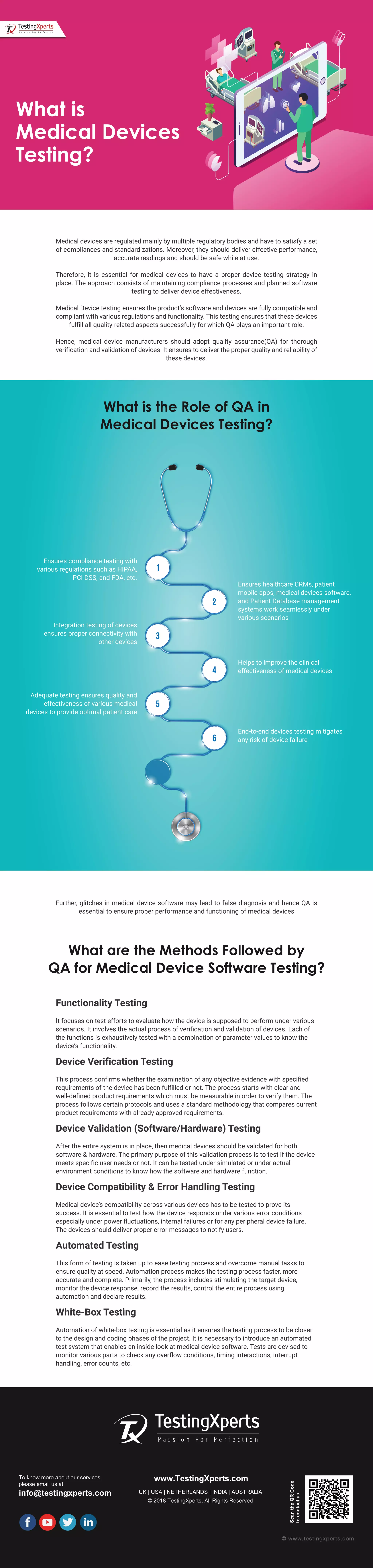
Ensures compliance testing with
various regulations such as HIPAA,
PCI DSS, and FDA, etc.
Integration testing of devices
ensures proper connectivity with
other devices
Adequate testing ensures quality and
effectiveness of various medical
devices to provide optimal patient care
Ensures healthcare CRMs, patient
mobile apps, medical devices software,
and Patient Database management
systems work seamlessly under
various scenarios
Helps to improve the clinical
effectiveness of medical devices
End-to-end devices testing mitigates
any risk of device failure
What is the Role of QA in
Medical Devices Testing?
What are the Methods Followed by
QA for Medical Device Software Testing?
To know more about our services
please email us at
info@testingxperts.com
www.TestingXperts.com
UK | USA | NETHERLANDS | INDIA | AUSTRALIA
© 2018 TestingXperts, All Rights Reserved
ScantheQRCode
tocontactus
© www.testingxperts.com
What is
Medical Devices
Testing?

What is Medical Devices Testing

  • 1.
    Medical devices areregulated mainly by multiple regulatory bodies and have to satisfy a set of compliances and standardizations. Moreover, they should deliver effective performance, accurate readings and should be safe while at use. Therefore, it is essential for medical devices to have a proper device testing strategy in place. The approach consists of maintaining compliance processes and planned software testing to deliver device effectiveness. Medical Device testing ensures the product’s software and devices are fully compatible and compliant with various regulations and functionality. This testing ensures that these devices fulfill all quality-related aspects successfully for which QA plays an important role. Hence, medical device manufacturers should adopt quality assurance(QA) for thorough verification and validation of devices. It ensures to deliver the proper quality and reliability of these devices. Further, glitches in medical device software may lead to false diagnosis and hence QA is essential to ensure proper performance and functioning of medical devices Functionality Testing It focuses on test efforts to evaluate how the device is supposed to perform under various scenarios. It involves the actual process of verification and validation of devices. Each of the functions is exhaustively tested with a combination of parameter values to know the device’s functionality. Device Verification Testing This process confirms whether the examination of any objective evidence with specified requirements of the device has been fulfilled or not. The process starts with clear and well-defined product requirements which must be measurable in order to verify them. The process follows certain protocols and uses a standard methodology that compares current product requirements with already approved requirements. Device Validation (Software/Hardware) Testing After the entire system is in place, then medical devices should be validated for both software & hardware. The primary purpose of this validation process is to test if the device meets specific user needs or not. It can be tested under simulated or under actual environment conditions to know how the software and hardware function. Device Compatibility & Error Handling Testing Medical device’s compatibility across various devices has to be tested to prove its success. It is essential to test how the device responds under various error conditions especially under power fluctuations, internal failures or for any peripheral device failure. The devices should deliver proper error messages to notify users. Automated Testing This form of testing is taken up to ease testing process and overcome manual tasks to ensure quality at speed. Automation process makes the testing process faster, more accurate and complete. Primarily, the process includes stimulating the target device, monitor the device response, record the results, control the entire process using automation and declare results. White-Box Testing Automation of white-box testing is essential as it ensures the testing process to be closer to the design and coding phases of the project. It is necessary to introduce an automated test system that enables an inside look at medical device software. Tests are devised to monitor various parts to check any overflow conditions, timing interactions, interrupt handling, error counts, etc. Ensures compliance testing with various regulations such as HIPAA, PCI DSS, and FDA, etc. Integration testing of devices ensures proper connectivity with other devices Adequate testing ensures quality and effectiveness of various medical devices to provide optimal patient care Ensures healthcare CRMs, patient mobile apps, medical devices software, and Patient Database management systems work seamlessly under various scenarios Helps to improve the clinical effectiveness of medical devices End-to-end devices testing mitigates any risk of device failure What is the Role of QA in Medical Devices Testing? What are the Methods Followed by QA for Medical Device Software Testing? To know more about our services please email us at info@testingxperts.com www.TestingXperts.com UK | USA | NETHERLANDS | INDIA | AUSTRALIA © 2018 TestingXperts, All Rights Reserved ScantheQRCode tocontactus © www.testingxperts.com What is Medical Devices Testing?