Medical Electronics ELEC5650M


The Product Development Cycle in
the Medical Device Industry


Overview

•  Context in which medical electronics products are used
•  Implications for product development
•  The Medical Devices Directive and other regulatory issues
•  Practicalities and the product development cycle
•  Practical examples
•  A few comments on wider (business/marketing) issues
What is a medical device?

  Any instrument, apparatus, appliance, software, material or other article,
  whether used alone or in combination, including the software intended by its
  manufacturer to be used specifically for diagnostic and/or therapeutic
  purposes and necessary for its proper application, intended by the
  manufacturer to be used for human beings for the purpose of:
  •  Diagnosis, prevention, monitoring, treatment or alleviation of disease
  •  Diagnosis, monitoring, treatment, alleviation of or compensation for an injury or
     handicap
  •  Investigation, replacement or modification of the anatomy or of a physiological
     process
  •  Control of conception
  and which does not achieve its principal intended action in or on the human body by
     pharmacological, immunological or metabolic means, but which may be assisted in
     its function by such means.
  EU Medical Devices Directive (93/42/EEC)


Simplified definition

Any product used for diagnosis, treatment or prevention of an
illness
But not drug-based…at least not solely
•  Drug-device combinations exist and will increase in prevalence.
Includes software and software/hardware combinations.
Scope and examples

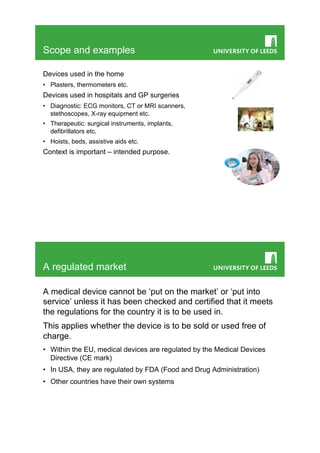
Devices used in the home
•  Plasters, thermometers etc.
Devices used in hospitals and GP surgeries
•  Diagnostic: ECG monitors, CT or MRI scanners,
   stethoscopes, X-ray equipment etc.
•  Therapeutic: surgical instruments, implants,
   defibrillators etc.
•  Hoists, beds, assistive aids etc.
Context is important – intended purpose.


A regulated market

A medical device cannot be ‘put on the market’ or ‘put into
service’ unless it has been checked and certified that it meets
the regulations for the country it is to be used in.
This applies whether the device is to be sold or used free of
charge.
•  Within the EU, medical devices are regulated by the Medical Devices
   Directive (CE mark)
•  In USA, they are regulated by FDA (Food and Drug Administration)
•  Other countries have their own systems
Principles of regulatory system

Risk management
•  It must not cause any unnecessary risk to the patient, users, or anyone
   else (eg. general public)
Verification
•  It should ‘do what it says on the tin’
•  In other words it should perform as claimed by the manufacturer
Validation
•  It must be independently evaluated by a person with appropriate clinical
   qualifications
•  If necessary, clinical testing or trials should be done.


Product development

What does this mean for product development of medical
devices?
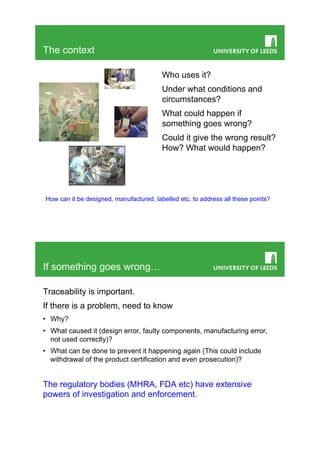
The context

                                         Who uses it?
                                         Under what conditions and
                                         circumstances?
                                         What could happen if
                                         something goes wrong?
                                         Could it give the wrong result?
                                         How? What would happen?


How can it be designed, manufactured, labelled etc. to address all these points?


If something goes wrong…

Traceability is important.
If there is a problem, need to know
•  Why?
•  What caused it (design error, faulty components, manufacturing error,
   not used correctly)?
•  What can be done to prevent it happening again (This could include
   withdrawal of the product certification and even prosecution)?


The regulatory bodies (MHRA, FDA etc) have extensive
powers of investigation and enforcement.
Product lifecycle

The whole product lifecycle is regulated by different bodies.


Key to next slide:
MHRA – Medicines and Healthcare products Regulatory Agency
(www.mhra.gov.uk)
NICE – National Institute for Health and Clinical Excellence
(www.nice.org.uk)
WEEE – Waste Electrical and Electronic Equipment Directive


Who regulates what?
Stage of product lifecycle     Who regulates

Product design                 MHRA

Approvals testing, clinical    MHRA
evaluation
User protocol development      MHRA, NICE, NHS

Manufacturing                  MHRA

Use phase                      MHRA, NICE

Adverse incidents              MHRA

Disposal – end of life         Not currently regulated specifically for
                               medical devices – other regulations may
                               apply, eg. WEEE
Classification

How stringent is all this accreditation process?
It depends on
•  The degree of ‘invasiveness’
•  The level of risk
•  Whether there is a measuring or diagnostic function
•  Active or passive device
Each device is judged against a number of criteria to decide which class it is and
the rules are applied accordingly.
            Class I              Class IIa   Class IIb   Class III
            Limited scrutiny,                            High scrutiny, more
            simpler processes,                           clinical evaluation,
            can self certify                             trials, testing,
                                                         closer monitoring.


What about medical electronic
devices?

Likely to be an active device
May include software
May have a measuring or diagnostic function


…so likely to be Class IIa or IIb
Medical Devices Directive

To be CE marked (under 93/42/EEC)
•  The company (or ‘organisation placing the device on the market’) must
   be ISO 13485 compliant (or occasionally some other equivalent)
•  There should be a ‘technical file’ for each product showing how it
   complies with the Medical Device Directive, performance requirements
   and product standards (ISO etc).
•  Information about the product’s development, acceptance testing and
   information needed to manufacture, including user instructions and
   labelling


Essential requirements

The main technical section of the directive
•  A generic checklist of potential hazards
•  Every device must be address all these points
Essential requirements -
electronics

Some example sections:
‘Devices incorporating electronic programmable systems must be designed to
ensure repeatability, reliability and performance of these systems according to the
intended use’
‘In the event of a single fault condition…appropriate means should be adopted to
eliminate and reduce …risks’
‘…the software must be validated according to the state of the art taking into
account the principles of the development lifecycle, risk management, validation
and verification’
‘Devices intended to monitor one or more clinical parameters of a patient must be
equipped with appropriate alarm systems to alert the user of situations which could
lead to death or severe deterioration of the patient’s state of health’


Focus on users and ‘use case’

A medical device is certified (CE marked) for a defined
‘intended purpose’
•  The manufacturer is specifically responsible for it working if used (only)
   in this way
A clinical evaluation is required to show that it works the way it
is described
•  At the very least this must be a ‘critical evaluation of the relevant
   scientific literature’
•  Can be on similar products if you can demonstrate ‘equivalence’
The user in the design process

Iterative model (eg. Greenberg 1996)
Requirements


            Design


                         Implementation


                                       Verification


                   User evaluation                    Maintenance


ISO 13485

Quality management system for medical device
manufacturers/developers
Analogous to ISO 9000
Covers company processes for ensuring good practice
Must be applied to each product development project (also
covers purchasing, production, quality assurance, continuous
improvement, training etc)
States framework or policy – each company sets up own
procedures and documentation structure to comply
Product specific standards

If there is one (or more than one) for your product you need to
comply with it
•  You can do a search for standards eg. on BSI Online


Other important standards

BS EN ISO 14971: 2001 Medical devices – application of risk management
to medical devices
•  Includes flowcharts for risk analysis process, medical-specific hazard checklist
BS EN ISO 60601-1-1:2006 Medical electrical equipment – General
requirements for basic safety and essential performance
•  More stringent specifications than for consumer products
BS EN ISO 60601-1-6: 2007 Medical electrical equipment – Usability
•  Verification and validation requirements for user interfaces
BS EN ISO 60601-1-4: 1997 Medical electrical equipment – Programmable
electrical medical systems
•  Risk management for software and embedded systems
Risk management

Must be built into all the company’s processes
Must be specifically addressed for each product
•  Risk analysis
•  Mitigation
•  Regular reviews and updates of risk analysis
Comprehensive checklists in MDD Essential Requirements
and in Medical devices risk management standard 14971.


Patient involvement

If the product is to be used by/on a patient to assess the clinical benefits,
this is a clinical trial. It is usually best for device to be CE marked first
UNLESS you need to do the trials to validate it (in which case permission
from MHRA for a ‘clinical investigation’ is required)
Trials require ethical approvals
http://www.nres.npsa.nhs.uk/
Alternatively, patients may be asked to comment on a design in a focus
group, or through a questionnaire etc.
Nurses often have significant insights into patient behaviour. In the case of
certain patient groups (eg. children, patients with dementia) this may be
more reliable.
It is usually possible to observe clinics to get information about patient
behaviour.
Manufacturing stage

Compliance requirements continue
•  Quality assurance – ensure products conform with own specifications
  •  Assessment of supplied components
  •  Test/inspection of own products
•  Monitoring of customer feedback (post market surveillance) – root cause
   analysis, corrective action, preventative action
•  Periodic design review, updating
•  Respond to external changes, eg. obsolete components, legislative changes
  •  Repeat risk analysis
  •  Decide action, implement, monitor
  •  Document everything


Practicalities

Manufacturers are audited and monitored by ‘notified bodies’
who are regulated by MHRA
The notified bodies are private sector bodies who charge a fee
to the manufacturer
•  Initial accreditation to ISO 13485
•  Annual audit to maintain certification
•  Additional charges to CE mark each product
Exercise

Consider a medical electronic device
•  What is its intended purpose? By what kind of user and in what context?
•  What are the possible hazards in using it?
  •  Include general hazards and risks of it giving ‘wrong’ results
•  How do these affect the product design?
  •  What are the design issues?
  •  How can some of the risks be managed?
  •  How can it be made easier to use?


Some more general issues

Product design is not all about regulations, even for medical
devices…
Product development in context

To develop a good product, it is necessary to understand the
use model
This is particularly true in medical device development
•  Even more complicated for future e-health medical devices


And…we have not yet talked about marketing, business,
 purchasing, financial issues.
A major target for the NHS is ‘efficiency’ – which tends to
  mean ‘cost reduction’


Multiple stakeholders

Depending on the product, a number of people may be involved:
•  Consultant clinician
•  Senior nurse
•  Allied health professionals – physiotherapists, occupational therapists etc.
•  Patient (consumer/customer)
•  Patient’s family/carers
•  NHS procurement staff
•  NHS managers and accountants
•  Other service providers (public or private sector)
  •  Call centre
  •  Personal trainers/gyms
  •  Social services
Influencing opinion leaders

Risk averse market
But opinion leaders easy to identify
•  Professional structures (BMA, RCN, other professional institutions)
•  Conferences and journals
Clinical evaluation should be done by someone with good
reputation
Work with NHS procurement agency PASA
http://www.pasa.nhs.uk/PASAweb


NHS Technology Adoption Centre

The NHS Technology Adoption Centre, based in Manchester,
was launched in September 2007 with the following key aims:
•  To increase the uptake of new technology in all areas of the NHS.
•  To work with partners to identify excellent technologies which will
   improve healthcare in the NHS.
•  To promote greater cooperation between all organisations involved in
   the development and use of healthcare technologies in the NHS.


http://www.technologyadoptioncentre.nhs.uk/home.html
Criteria for adoption

A set of criteria have been established by the Technology
Adoption Centre, against which all the technologies are
evaluated.
•  Has to involve step change innovation.
•  Has to have an adoption issue. The technology must have strong
   independently reviewed evidence (possibly NICE, HTA, CEP) of
   improved patient outcomes and / or systems efficiencies but still minimal
   uptake in the NHS.
•  Supports NHS national policy priorities.
•  Should be in a clinical area of major focus for the NHS.


The private sector in UK

Conventional private healthcare sector (BUPA, Nuffield) offer
same services as NHS
•  Major innovation will not be adopted
•  May be more receptive to step change innovation
Growth in consumer healthcare may change this
•  Sales direct to customer – self care, self diagnosis, self monitoring
•  More freedom within allied professions – dentists, opticians,
   audiologists?
•  Products are there, service sector still immature

Medical Product Development cycle

  • 1.
    Medical Electronics ELEC5650M TheProduct Development Cycle in the Medical Device Industry Overview •  Context in which medical electronics products are used •  Implications for product development •  The Medical Devices Directive and other regulatory issues •  Practicalities and the product development cycle •  Practical examples •  A few comments on wider (business/marketing) issues
  • 2.
    What is amedical device? Any instrument, apparatus, appliance, software, material or other article, whether used alone or in combination, including the software intended by its manufacturer to be used specifically for diagnostic and/or therapeutic purposes and necessary for its proper application, intended by the manufacturer to be used for human beings for the purpose of: •  Diagnosis, prevention, monitoring, treatment or alleviation of disease •  Diagnosis, monitoring, treatment, alleviation of or compensation for an injury or handicap •  Investigation, replacement or modification of the anatomy or of a physiological process •  Control of conception and which does not achieve its principal intended action in or on the human body by pharmacological, immunological or metabolic means, but which may be assisted in its function by such means. EU Medical Devices Directive (93/42/EEC) Simplified definition Any product used for diagnosis, treatment or prevention of an illness But not drug-based…at least not solely •  Drug-device combinations exist and will increase in prevalence. Includes software and software/hardware combinations.
  • 3.
    Scope and examples Devicesused in the home •  Plasters, thermometers etc. Devices used in hospitals and GP surgeries •  Diagnostic: ECG monitors, CT or MRI scanners, stethoscopes, X-ray equipment etc. •  Therapeutic: surgical instruments, implants, defibrillators etc. •  Hoists, beds, assistive aids etc. Context is important – intended purpose. A regulated market A medical device cannot be ‘put on the market’ or ‘put into service’ unless it has been checked and certified that it meets the regulations for the country it is to be used in. This applies whether the device is to be sold or used free of charge. •  Within the EU, medical devices are regulated by the Medical Devices Directive (CE mark) •  In USA, they are regulated by FDA (Food and Drug Administration) •  Other countries have their own systems
  • 4.
    Principles of regulatorysystem Risk management •  It must not cause any unnecessary risk to the patient, users, or anyone else (eg. general public) Verification •  It should ‘do what it says on the tin’ •  In other words it should perform as claimed by the manufacturer Validation •  It must be independently evaluated by a person with appropriate clinical qualifications •  If necessary, clinical testing or trials should be done. Product development What does this mean for product development of medical devices?
  • 5.
    The context Who uses it? Under what conditions and circumstances? What could happen if something goes wrong? Could it give the wrong result? How? What would happen? How can it be designed, manufactured, labelled etc. to address all these points? If something goes wrong… Traceability is important. If there is a problem, need to know •  Why? •  What caused it (design error, faulty components, manufacturing error, not used correctly)? •  What can be done to prevent it happening again (This could include withdrawal of the product certification and even prosecution)? The regulatory bodies (MHRA, FDA etc) have extensive powers of investigation and enforcement.
  • 6.
    Product lifecycle The wholeproduct lifecycle is regulated by different bodies. Key to next slide: MHRA – Medicines and Healthcare products Regulatory Agency (www.mhra.gov.uk) NICE – National Institute for Health and Clinical Excellence (www.nice.org.uk) WEEE – Waste Electrical and Electronic Equipment Directive Who regulates what? Stage of product lifecycle Who regulates Product design MHRA Approvals testing, clinical MHRA evaluation User protocol development MHRA, NICE, NHS Manufacturing MHRA Use phase MHRA, NICE Adverse incidents MHRA Disposal – end of life Not currently regulated specifically for medical devices – other regulations may apply, eg. WEEE
  • 7.
    Classification How stringent isall this accreditation process? It depends on •  The degree of ‘invasiveness’ •  The level of risk •  Whether there is a measuring or diagnostic function •  Active or passive device Each device is judged against a number of criteria to decide which class it is and the rules are applied accordingly. Class I Class IIa Class IIb Class III Limited scrutiny, High scrutiny, more simpler processes, clinical evaluation, can self certify trials, testing, closer monitoring. What about medical electronic devices? Likely to be an active device May include software May have a measuring or diagnostic function …so likely to be Class IIa or IIb
  • 8.
    Medical Devices Directive Tobe CE marked (under 93/42/EEC) •  The company (or ‘organisation placing the device on the market’) must be ISO 13485 compliant (or occasionally some other equivalent) •  There should be a ‘technical file’ for each product showing how it complies with the Medical Device Directive, performance requirements and product standards (ISO etc). •  Information about the product’s development, acceptance testing and information needed to manufacture, including user instructions and labelling Essential requirements The main technical section of the directive •  A generic checklist of potential hazards •  Every device must be address all these points
  • 9.
    Essential requirements - electronics Someexample sections: ‘Devices incorporating electronic programmable systems must be designed to ensure repeatability, reliability and performance of these systems according to the intended use’ ‘In the event of a single fault condition…appropriate means should be adopted to eliminate and reduce …risks’ ‘…the software must be validated according to the state of the art taking into account the principles of the development lifecycle, risk management, validation and verification’ ‘Devices intended to monitor one or more clinical parameters of a patient must be equipped with appropriate alarm systems to alert the user of situations which could lead to death or severe deterioration of the patient’s state of health’ Focus on users and ‘use case’ A medical device is certified (CE marked) for a defined ‘intended purpose’ •  The manufacturer is specifically responsible for it working if used (only) in this way A clinical evaluation is required to show that it works the way it is described •  At the very least this must be a ‘critical evaluation of the relevant scientific literature’ •  Can be on similar products if you can demonstrate ‘equivalence’
  • 10.
    The user inthe design process Iterative model (eg. Greenberg 1996) Requirements Design Implementation Verification User evaluation Maintenance ISO 13485 Quality management system for medical device manufacturers/developers Analogous to ISO 9000 Covers company processes for ensuring good practice Must be applied to each product development project (also covers purchasing, production, quality assurance, continuous improvement, training etc) States framework or policy – each company sets up own procedures and documentation structure to comply
  • 11.
    Product specific standards Ifthere is one (or more than one) for your product you need to comply with it •  You can do a search for standards eg. on BSI Online Other important standards BS EN ISO 14971: 2001 Medical devices – application of risk management to medical devices •  Includes flowcharts for risk analysis process, medical-specific hazard checklist BS EN ISO 60601-1-1:2006 Medical electrical equipment – General requirements for basic safety and essential performance •  More stringent specifications than for consumer products BS EN ISO 60601-1-6: 2007 Medical electrical equipment – Usability •  Verification and validation requirements for user interfaces BS EN ISO 60601-1-4: 1997 Medical electrical equipment – Programmable electrical medical systems •  Risk management for software and embedded systems
  • 12.
    Risk management Must bebuilt into all the company’s processes Must be specifically addressed for each product •  Risk analysis •  Mitigation •  Regular reviews and updates of risk analysis Comprehensive checklists in MDD Essential Requirements and in Medical devices risk management standard 14971. Patient involvement If the product is to be used by/on a patient to assess the clinical benefits, this is a clinical trial. It is usually best for device to be CE marked first UNLESS you need to do the trials to validate it (in which case permission from MHRA for a ‘clinical investigation’ is required) Trials require ethical approvals http://www.nres.npsa.nhs.uk/ Alternatively, patients may be asked to comment on a design in a focus group, or through a questionnaire etc. Nurses often have significant insights into patient behaviour. In the case of certain patient groups (eg. children, patients with dementia) this may be more reliable. It is usually possible to observe clinics to get information about patient behaviour.
  • 13.
    Manufacturing stage Compliance requirementscontinue •  Quality assurance – ensure products conform with own specifications •  Assessment of supplied components •  Test/inspection of own products •  Monitoring of customer feedback (post market surveillance) – root cause analysis, corrective action, preventative action •  Periodic design review, updating •  Respond to external changes, eg. obsolete components, legislative changes •  Repeat risk analysis •  Decide action, implement, monitor •  Document everything Practicalities Manufacturers are audited and monitored by ‘notified bodies’ who are regulated by MHRA The notified bodies are private sector bodies who charge a fee to the manufacturer •  Initial accreditation to ISO 13485 •  Annual audit to maintain certification •  Additional charges to CE mark each product
  • 14.
    Exercise Consider a medicalelectronic device •  What is its intended purpose? By what kind of user and in what context? •  What are the possible hazards in using it? •  Include general hazards and risks of it giving ‘wrong’ results •  How do these affect the product design? •  What are the design issues? •  How can some of the risks be managed? •  How can it be made easier to use? Some more general issues Product design is not all about regulations, even for medical devices…
  • 15.
    Product development incontext To develop a good product, it is necessary to understand the use model This is particularly true in medical device development •  Even more complicated for future e-health medical devices And…we have not yet talked about marketing, business, purchasing, financial issues. A major target for the NHS is ‘efficiency’ – which tends to mean ‘cost reduction’ Multiple stakeholders Depending on the product, a number of people may be involved: •  Consultant clinician •  Senior nurse •  Allied health professionals – physiotherapists, occupational therapists etc. •  Patient (consumer/customer) •  Patient’s family/carers •  NHS procurement staff •  NHS managers and accountants •  Other service providers (public or private sector) •  Call centre •  Personal trainers/gyms •  Social services
  • 16.
    Influencing opinion leaders Riskaverse market But opinion leaders easy to identify •  Professional structures (BMA, RCN, other professional institutions) •  Conferences and journals Clinical evaluation should be done by someone with good reputation Work with NHS procurement agency PASA http://www.pasa.nhs.uk/PASAweb NHS Technology Adoption Centre The NHS Technology Adoption Centre, based in Manchester, was launched in September 2007 with the following key aims: •  To increase the uptake of new technology in all areas of the NHS. •  To work with partners to identify excellent technologies which will improve healthcare in the NHS. •  To promote greater cooperation between all organisations involved in the development and use of healthcare technologies in the NHS. http://www.technologyadoptioncentre.nhs.uk/home.html
  • 17.
    Criteria for adoption Aset of criteria have been established by the Technology Adoption Centre, against which all the technologies are evaluated. •  Has to involve step change innovation. •  Has to have an adoption issue. The technology must have strong independently reviewed evidence (possibly NICE, HTA, CEP) of improved patient outcomes and / or systems efficiencies but still minimal uptake in the NHS. •  Supports NHS national policy priorities. •  Should be in a clinical area of major focus for the NHS. The private sector in UK Conventional private healthcare sector (BUPA, Nuffield) offer same services as NHS •  Major innovation will not be adopted •  May be more receptive to step change innovation Growth in consumer healthcare may change this •  Sales direct to customer – self care, self diagnosis, self monitoring •  More freedom within allied professions – dentists, opticians, audiologists? •  Products are there, service sector still immature