1
Embedded: Specific of Medical projects
Volodymyr Palamar
Engineering Manager
23 Nov 2017
2
Agenda
1. Intro
2. Medical Device
3. FDA
4. Let’s get started
5. Q&A
33
Intro
44
Medical devices
55
What is a medical device?
• A medical device is "an instrument, apparatus, implement, machine,
contrivance, implant, in vitro reagent, or other similar or related article,
including a component part, or accessory which is:
- recognized in the official National Formulary, or the United States
Pharmacopoeia, or any supplement to them
- intended for use in the diagnosis of disease or other conditions, or in the cure,
mitigation, treatment, or prevention of disease, in man or other animals, or
- intended to affect the structure or any function of the body of man or other
animals, and which does not achieve any of its primary intended purposes
through chemical action within or on the body of man or other animals and which
is not dependent upon being metabolized for the achievement of any of its
primary intended purposes.
66
Medical device classes
• Classes of devices:
- Class I (or A)
• Class I devices are deemed to be low risk and are therefore subject to the least
regulatory controls.
- Class II (or B)
• Class II devices are higher risk devices than Class I and require greater regulatory
controls to provide reasonable assurance of the device’s safety and effectiveness
- Class III (or C)
• Class III devices are generally the highest risk devices and are therefore subject to
the highest level of regulatory control. Class III devices must typically be approved by FDA
before they are marketed.
77
FDA (US Food and Drug Administration),
Standards
88
FDA is responsible for
• Protecting the public health by assuring that foods (except for meat from
livestock, poultry and some egg products which are regulated by the U.S.
Department of Agriculture) are safe, wholesome, sanitary and properly
labeled; ensuring that human and veterinary drugs, and vaccines and other
biological products and medical devices intended for human use are safe
and effective
• Protecting the public from electronic product radiation
• Assuring cosmetics and dietary supplements are safe and properly labeled
• Regulating tobacco products
• Advancing the public health by helping to speed product innovations
99
FDA (US Food and Drug Administration)
FDA regulates a broad range of medical devices, including complicated,
high-risk medical devices, like artificial hearts, and relatively simple, low-risk
devices, like tongue depressors, as well as devices that fall somewhere in
between, like sutures. FDA has authority to regulate medical devices before
and after they reach the marketplace
*Class III devices must typically be approved by FDA before they are marketed.
1010
Standarts
• ISO 13485 Medical devices -- Quality management systems
- Requirements for a comprehensive quality management system for the
design and manufacture of medical devices
• IEC 60601
- Series of technical standards for the safety and effectiveness of medical
electrical equipment
•and others...
1111
Let’s get started
1212
Feasibility studies
• Processor(s) selection
- Initial requirement, performance/cost…. (in few years they still will be on the
production line?)
• OS selection
- Based on requirements (but official support should be available during lifetime
of product!)
- Testing frameworks availability, libraries, etc
•Other components
1313
Device classes, does they matter?
• Documentation
• Development
• Testing
14
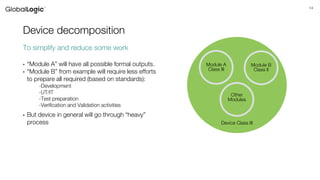
Device decomposition
• “Module A” will have all possible formal outputs.
• “Module B” from example will require less efforts
to prepare all required (based on standards):
-Development
-UT/IT
-Test preparation
-Verification and Validation activities
• But device in general will go through “heavy”
process
To simplify and reduce some work
Content
Module A
Class III
Device Class III
Module B
Class II
Other
Modules
15
SOUP (Software Of Unknown Provenance)
• You want to use some third party libraries
• The type and quality of documentation that
accompanies this software can vary
considerably.
• Software for which adequate documentation
may be difficult to obtain
• You can, but your Hazard Analysis should
encompass the risks associated with the SOUP,
regarding missing or incomplete documentation
or lack of documentation of prior testing.
• The responsibility for adequate testing remains
with you
16
Side tools/application development
• Test team tools (to support testing activities)
• Initial Hardware validation
• Initial device validation in Manufacturing Line
• Translations
• Mobile application (User interaction)
• Web based solution (Data collectors, other)
• and others...
Different application can be developed to support different client’s activities and user
needs (using different programing languages):
1717
Few words about testing...
• That’s medical devices - we have a lot of testing with formal evidences
18
Testing types and techniques
• User Acceptance Test
• Exploratory Testing
• Experienced Based Testing
• Risk-Based Testing
• Ad-hoc testing
• Black Box testing
• White Box testing
• Functional testing
• and a lot of others...
During testing of Medical devices variety
of different testing types and techniques
are used:
19
Manual vs Automation
• Lifeline (long or short term project)
• Money
• Regression (next releases, fixes, new features)
• Time for full scope run
20
Thank you

Embedded: Specific of Medical Projects

  • 1.
    1 Embedded: Specific ofMedical projects Volodymyr Palamar Engineering Manager 23 Nov 2017
  • 2.
    2 Agenda 1. Intro 2. MedicalDevice 3. FDA 4. Let’s get started 5. Q&A
  • 3.
  • 4.
  • 5.
    55 What is amedical device? • A medical device is "an instrument, apparatus, implement, machine, contrivance, implant, in vitro reagent, or other similar or related article, including a component part, or accessory which is: - recognized in the official National Formulary, or the United States Pharmacopoeia, or any supplement to them - intended for use in the diagnosis of disease or other conditions, or in the cure, mitigation, treatment, or prevention of disease, in man or other animals, or - intended to affect the structure or any function of the body of man or other animals, and which does not achieve any of its primary intended purposes through chemical action within or on the body of man or other animals and which is not dependent upon being metabolized for the achievement of any of its primary intended purposes.
  • 6.
    66 Medical device classes •Classes of devices: - Class I (or A) • Class I devices are deemed to be low risk and are therefore subject to the least regulatory controls. - Class II (or B) • Class II devices are higher risk devices than Class I and require greater regulatory controls to provide reasonable assurance of the device’s safety and effectiveness - Class III (or C) • Class III devices are generally the highest risk devices and are therefore subject to the highest level of regulatory control. Class III devices must typically be approved by FDA before they are marketed.
  • 7.
    77 FDA (US Foodand Drug Administration), Standards
  • 8.
    88 FDA is responsiblefor • Protecting the public health by assuring that foods (except for meat from livestock, poultry and some egg products which are regulated by the U.S. Department of Agriculture) are safe, wholesome, sanitary and properly labeled; ensuring that human and veterinary drugs, and vaccines and other biological products and medical devices intended for human use are safe and effective • Protecting the public from electronic product radiation • Assuring cosmetics and dietary supplements are safe and properly labeled • Regulating tobacco products • Advancing the public health by helping to speed product innovations
  • 9.
    99 FDA (US Foodand Drug Administration) FDA regulates a broad range of medical devices, including complicated, high-risk medical devices, like artificial hearts, and relatively simple, low-risk devices, like tongue depressors, as well as devices that fall somewhere in between, like sutures. FDA has authority to regulate medical devices before and after they reach the marketplace *Class III devices must typically be approved by FDA before they are marketed.
  • 10.
    1010 Standarts • ISO 13485Medical devices -- Quality management systems - Requirements for a comprehensive quality management system for the design and manufacture of medical devices • IEC 60601 - Series of technical standards for the safety and effectiveness of medical electrical equipment •and others...
  • 11.
  • 12.
    1212 Feasibility studies • Processor(s)selection - Initial requirement, performance/cost…. (in few years they still will be on the production line?) • OS selection - Based on requirements (but official support should be available during lifetime of product!) - Testing frameworks availability, libraries, etc •Other components
  • 13.
    1313 Device classes, doesthey matter? • Documentation • Development • Testing
  • 14.
    14 Device decomposition • “ModuleA” will have all possible formal outputs. • “Module B” from example will require less efforts to prepare all required (based on standards): -Development -UT/IT -Test preparation -Verification and Validation activities • But device in general will go through “heavy” process To simplify and reduce some work Content Module A Class III Device Class III Module B Class II Other Modules
  • 15.
    15 SOUP (Software OfUnknown Provenance) • You want to use some third party libraries • The type and quality of documentation that accompanies this software can vary considerably. • Software for which adequate documentation may be difficult to obtain • You can, but your Hazard Analysis should encompass the risks associated with the SOUP, regarding missing or incomplete documentation or lack of documentation of prior testing. • The responsibility for adequate testing remains with you
  • 16.
    16 Side tools/application development •Test team tools (to support testing activities) • Initial Hardware validation • Initial device validation in Manufacturing Line • Translations • Mobile application (User interaction) • Web based solution (Data collectors, other) • and others... Different application can be developed to support different client’s activities and user needs (using different programing languages):
  • 17.
    1717 Few words abouttesting... • That’s medical devices - we have a lot of testing with formal evidences
  • 18.
    18 Testing types andtechniques • User Acceptance Test • Exploratory Testing • Experienced Based Testing • Risk-Based Testing • Ad-hoc testing • Black Box testing • White Box testing • Functional testing • and a lot of others... During testing of Medical devices variety of different testing types and techniques are used:
  • 19.
    19 Manual vs Automation •Lifeline (long or short term project) • Money • Regression (next releases, fixes, new features) • Time for full scope run
  • 20.