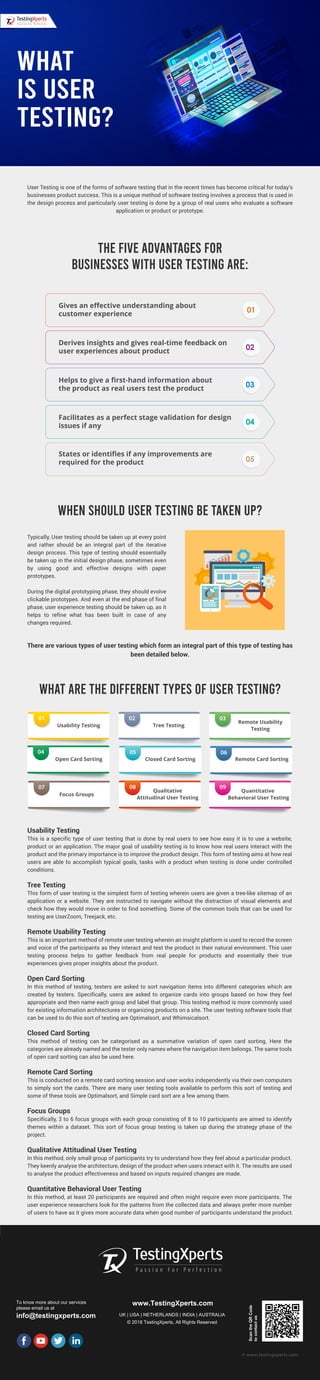
User Testing is one of the forms of software testing that in the recent times has become critical for today’s
businesses product success. This is a unique method of software testing involves a process that is used in
the design process and particularly user testing is done by a group of real users who evaluate a software
application or product or prototype.
Typically, User testing should be taken up at every point
and rather should be an integral part of the iterative
design process. This type of testing should essentially
be taken up in the initial design phase, sometimes even
by using good and effective designs with paper
prototypes.
During the digital prototyping phase, they should evolve
clickable prototypes. And even at the end phase of final
phase, user experience testing should be taken up, as it
helps to refine what has been built in case of any
changes required.
Usability Testing
This is a specific type of user testing that is done by real users to see how easy it is to use a website,
product or an application. The major goal of usability testing is to know how real users interact with the
product and the primary importance is to improve the product design. This form of testing aims at how real
users are able to accomplish typical goals, tasks with a product when testing is done under controlled
conditions.
Tree Testing
This form of user testing is the simplest form of testing wherein users are given a tree-like sitemap of an
application or a website. They are instructed to navigate without the distraction of visual elements and
check how they would move in order to find something. Some of the common tools that can be used for
testing are UserZoom, Treejack, etc.
Remote Usability Testing
This is an important method of remote user testing wherein an insight platform is used to record the screen
and voice of the participants as they interact and test the product in their natural environment. This user
testing process helps to gather feedback from real people for products and essentially their true
experiences gives proper insights about the product.
Open Card Sorting
In this method of testing, testers are asked to sort navigation items into different categories which are
created by testers. Specifically, users are asked to organize cards into groups based on how they feel
appropriate and then name each group and label that group. This testing method is more commonly used
for existing information architectures or organizing products on a site. The user testing software tools that
can be used to do this sort of testing are Optimalsort, and Whimsicalsort.
Closed Card Sorting
This method of testing can be categorised as a summative variation of open card sorting. Here the
categories are already named and the tester only names where the navigation item belongs. The same tools
of open card sorting can also be used here.
Remote Card Sorting
This is conducted on a remote card sorting session and user works independently via their own computers
to simply sort the cards. There are many user testing tools available to perform this sort of testing and
some of these tools are Optimalsort, and Simple card sort are a few among them.
Focus Groups
Specifically, 3 to 6 focus groups with each group consisting of 8 to 10 participants are aimed to identify
themes within a dataset. This sort of focus group testing is taken up during the strategy phase of the
project.
Qualitative Attitudinal User Testing
In this method, only small group of participants try to understand how they feel about a particular product.
They keenly analyse the architecture, design of the product when users interact with it. The results are used
to analyse the product effectiveness and based on inputs required changes are made.
Quantitative Behavioral User Testing
In this method, at least 20 participants are required and often might require even more participants. The
user experience researchers look for the patterns from the collected data and always prefer more number
of users to have as it gives more accurate data when good number of participants understand the product.
There are various types of user testing which form an integral part of this type of testing has
been detailed below.
To know more about our services
please email us at
info@testingxperts.com
www.TestingXperts.com
UK | USA | NETHERLANDS | INDIA | AUSTRALIA
© 2018 TestingXperts, All Rights Reserved
ScantheQRCode
tocontactus
© www.testingxperts.com
THE FIVE ADVANTAGES FOR
BUSINESSES WITH USER TESTING ARE:
WHEN SHOULD USER TESTING BE TAKEN UP?
WHAT ARE THE DIFFERENT TYPES OF USER TESTING?
WHAT
IS USER
TESTING?
Gives an effective understanding about
customer experience
Derives insights and gives real-time feedback on
user experiences about product
Helps to give a first-hand information about
the product as real users test the product
Facilitates as a perfect stage validation for design
issues if any
States or identifies if any improvements are
required for the product
01
02
03
04
05
Usability Testing Tree Testing
Remote Usability
Testing
Open Card Sorting
Focus Groups
Qualitative
Attitudinal User Testing
Quantitative
Behavioral User Testing
Closed Card Sorting Remote Card Sorting

Types of User Testing

  • 1.
    User Testing isone of the forms of software testing that in the recent times has become critical for today’s businesses product success. This is a unique method of software testing involves a process that is used in the design process and particularly user testing is done by a group of real users who evaluate a software application or product or prototype. Typically, User testing should be taken up at every point and rather should be an integral part of the iterative design process. This type of testing should essentially be taken up in the initial design phase, sometimes even by using good and effective designs with paper prototypes. During the digital prototyping phase, they should evolve clickable prototypes. And even at the end phase of final phase, user experience testing should be taken up, as it helps to refine what has been built in case of any changes required. Usability Testing This is a specific type of user testing that is done by real users to see how easy it is to use a website, product or an application. The major goal of usability testing is to know how real users interact with the product and the primary importance is to improve the product design. This form of testing aims at how real users are able to accomplish typical goals, tasks with a product when testing is done under controlled conditions. Tree Testing This form of user testing is the simplest form of testing wherein users are given a tree-like sitemap of an application or a website. They are instructed to navigate without the distraction of visual elements and check how they would move in order to find something. Some of the common tools that can be used for testing are UserZoom, Treejack, etc. Remote Usability Testing This is an important method of remote user testing wherein an insight platform is used to record the screen and voice of the participants as they interact and test the product in their natural environment. This user testing process helps to gather feedback from real people for products and essentially their true experiences gives proper insights about the product. Open Card Sorting In this method of testing, testers are asked to sort navigation items into different categories which are created by testers. Specifically, users are asked to organize cards into groups based on how they feel appropriate and then name each group and label that group. This testing method is more commonly used for existing information architectures or organizing products on a site. The user testing software tools that can be used to do this sort of testing are Optimalsort, and Whimsicalsort. Closed Card Sorting This method of testing can be categorised as a summative variation of open card sorting. Here the categories are already named and the tester only names where the navigation item belongs. The same tools of open card sorting can also be used here. Remote Card Sorting This is conducted on a remote card sorting session and user works independently via their own computers to simply sort the cards. There are many user testing tools available to perform this sort of testing and some of these tools are Optimalsort, and Simple card sort are a few among them. Focus Groups Specifically, 3 to 6 focus groups with each group consisting of 8 to 10 participants are aimed to identify themes within a dataset. This sort of focus group testing is taken up during the strategy phase of the project. Qualitative Attitudinal User Testing In this method, only small group of participants try to understand how they feel about a particular product. They keenly analyse the architecture, design of the product when users interact with it. The results are used to analyse the product effectiveness and based on inputs required changes are made. Quantitative Behavioral User Testing In this method, at least 20 participants are required and often might require even more participants. The user experience researchers look for the patterns from the collected data and always prefer more number of users to have as it gives more accurate data when good number of participants understand the product. There are various types of user testing which form an integral part of this type of testing has been detailed below. To know more about our services please email us at info@testingxperts.com www.TestingXperts.com UK | USA | NETHERLANDS | INDIA | AUSTRALIA © 2018 TestingXperts, All Rights Reserved ScantheQRCode tocontactus © www.testingxperts.com THE FIVE ADVANTAGES FOR BUSINESSES WITH USER TESTING ARE: WHEN SHOULD USER TESTING BE TAKEN UP? WHAT ARE THE DIFFERENT TYPES OF USER TESTING? WHAT IS USER TESTING? Gives an effective understanding about customer experience Derives insights and gives real-time feedback on user experiences about product Helps to give a first-hand information about the product as real users test the product Facilitates as a perfect stage validation for design issues if any States or identifies if any improvements are required for the product 01 02 03 04 05 Usability Testing Tree Testing Remote Usability Testing Open Card Sorting Focus Groups Qualitative Attitudinal User Testing Quantitative Behavioral User Testing Closed Card Sorting Remote Card Sorting