Linked data: Opening Scotland’s
library content to the world
Dr Diane Rasmussen Pennington MS PhD PgDip FHEA FRSA
Lecturer in Information Science, University of Strathclyde
Editor-in-Chief, Library and Information Research
@infogamerist
diane.pennington@strath.ac.uk
The evolution of the Web (1989-now)
• Web 1.0: hand-coded HTML pages; accessible
and readable, but not interactive
• Web 2.0: Facebook and Twitter; everyone can
post, share, and respond without extensive
technical knowledge
• Web 3.0: the Semantic Web
– “Semantic” is “meaning in language”
– “Semantic Web” communicates “the meaning of the content on
web pages in a way that computers can understand. If they can
process these meanings, they can then make and convey
relationships between related web pages. This leads to improved
– and more meaningful – information retrieval.” (p. 34)
Source: Rasmussen Pennington, D. (2016, July/August). Demystifying linked data:
Are you ready for what's next? CILIP Update, 34-36.
3
Linked open data principles
1. Use URIs as names for things
2. Use HTTP URIs so that people can
look up those names
3. When someone looks up a name,
provide useful Resource
Description Framework [RDF]
information, using the standards
(RDF*, SPARQL)
4. Include links to other URIs so that
they can discover more things
Source: http://www.w3.org/DesignIssues/LinkedData.html
1. Use URIs as names for things
2. Use HTTP URIs so that people can
look up names
4
• The Hypertext Transfer Protocol (HTTP) is a
networking protocol for distributed, collaborative,
hypermedia information systems.
• HTTP is the foundation of data communication for
the World Wide Web.
• Use URIs to name people, for institutions,
concepts, topics, and geographical places.
Examples:
• http://www.strath.ac.uk (a university)
• https://www.facebook.com/CILIPinfo (a professional association)
• https://personal.cis.strath.ac.uk/diane.pennington (a lecturer)
• https://www.flickr.com/photos/chandlerinok/6168389622 (a
Chihuahua)
3. When someone looks up a name,
provide useful [RDF] information
5
• Use RDF subject-predicate-object ‘triples’ to describe a thing
• Reciprocate triples to show relationships between things
Emma Watson → StarredInMovie → Harry Potter and the Half-Blood Prince
Emma Watson is the subject, StarredInMovie is the predicate, and Harry Potter
and the Half-Blood Prince is the object.
This relationship also needs to be reciprocated:
Harry Potter and the Half-Blood Prince → Has Movie Star → Emma Watson
RDF, or Resource Description Framework, is
the language of the Semantic Web
predicate objectsubject
6
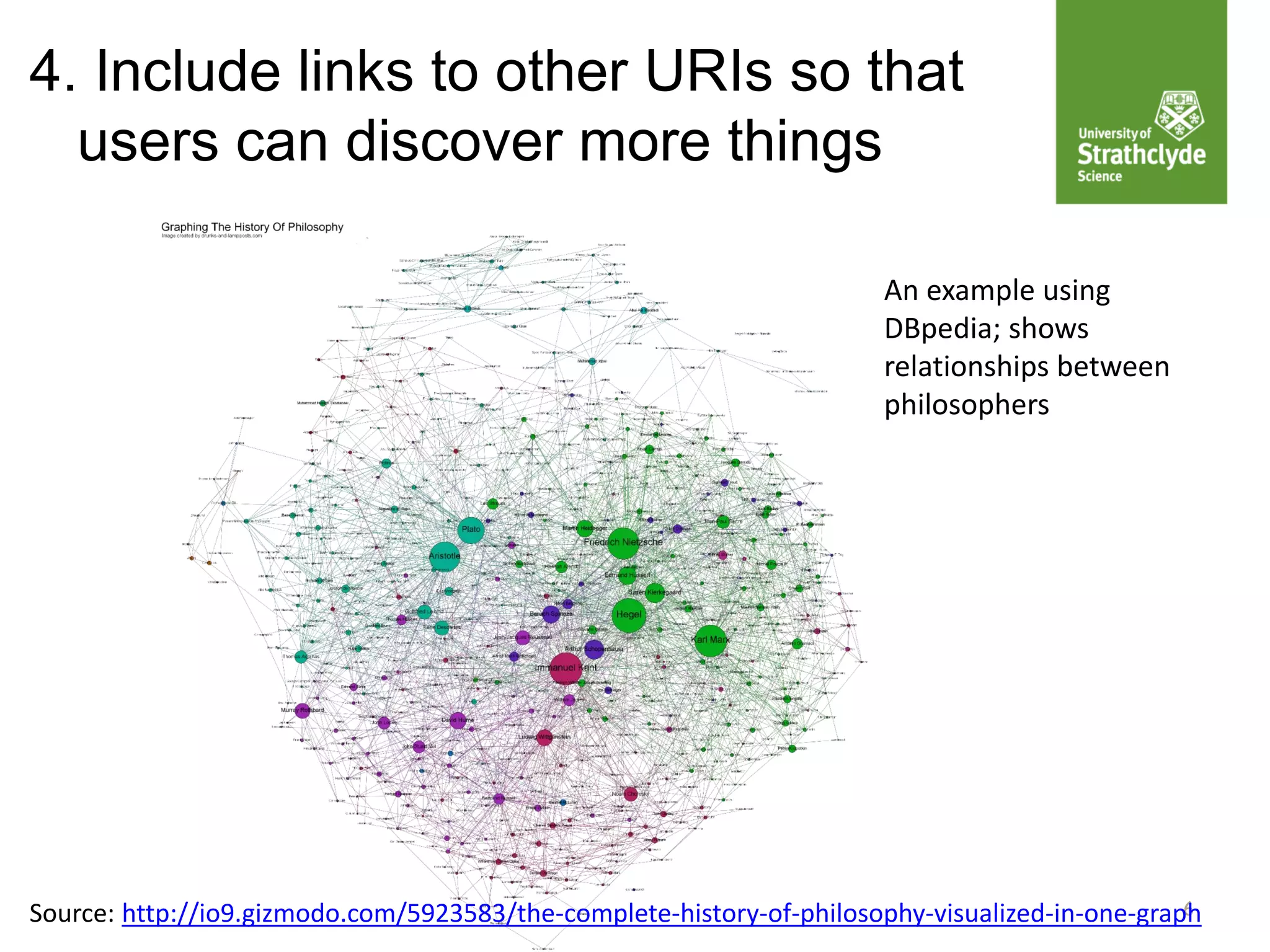
4. Include links to other URIs so that
users can discover more things
An example using
DBpedia; shows
relationships between
philosophers
Source: http://io9.gizmodo.com/5923583/the-complete-history-of-philosophy-visualized-in-one-graph
7
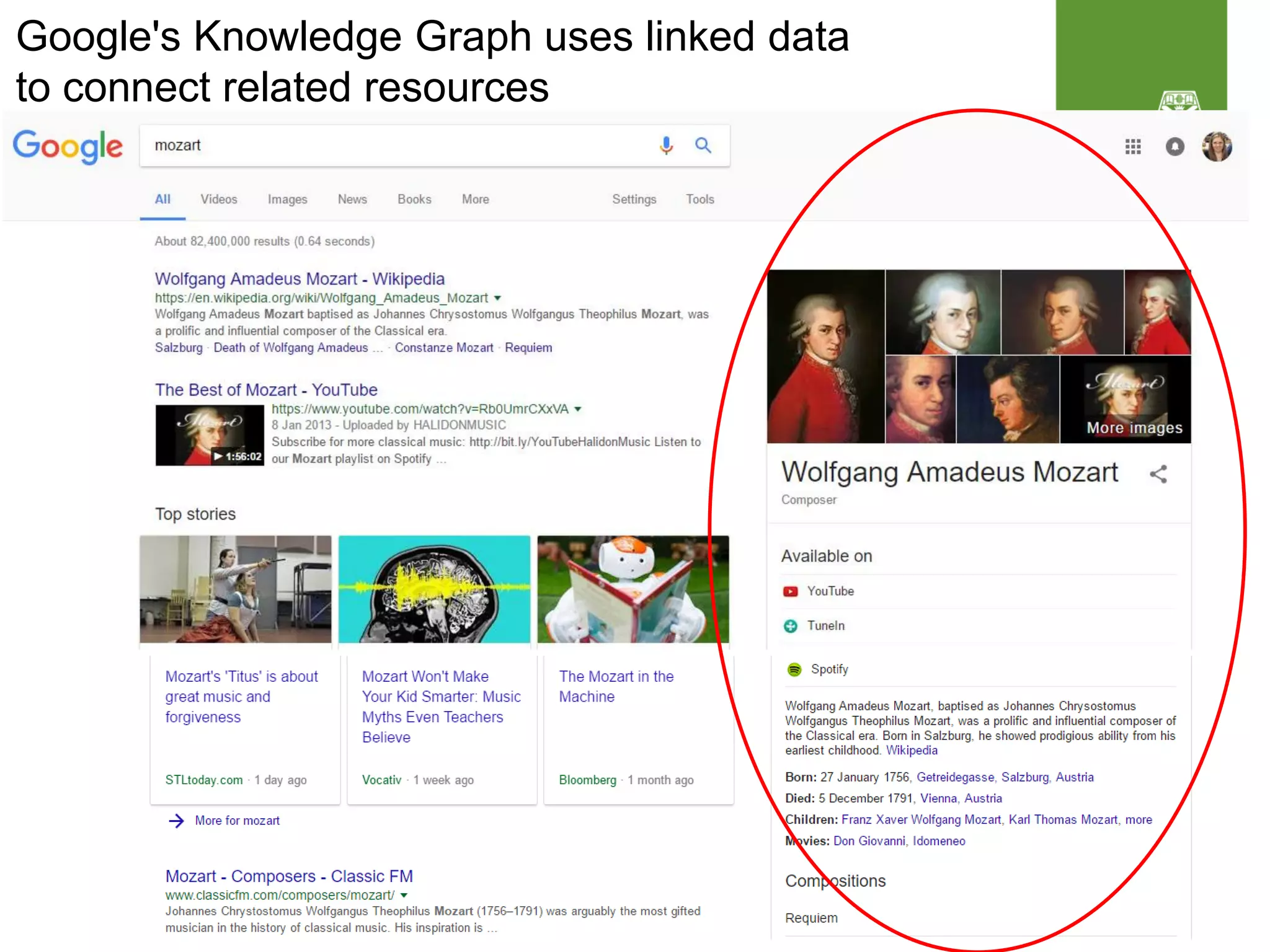
Google's Knowledge Graph uses linked data
to connect related resources
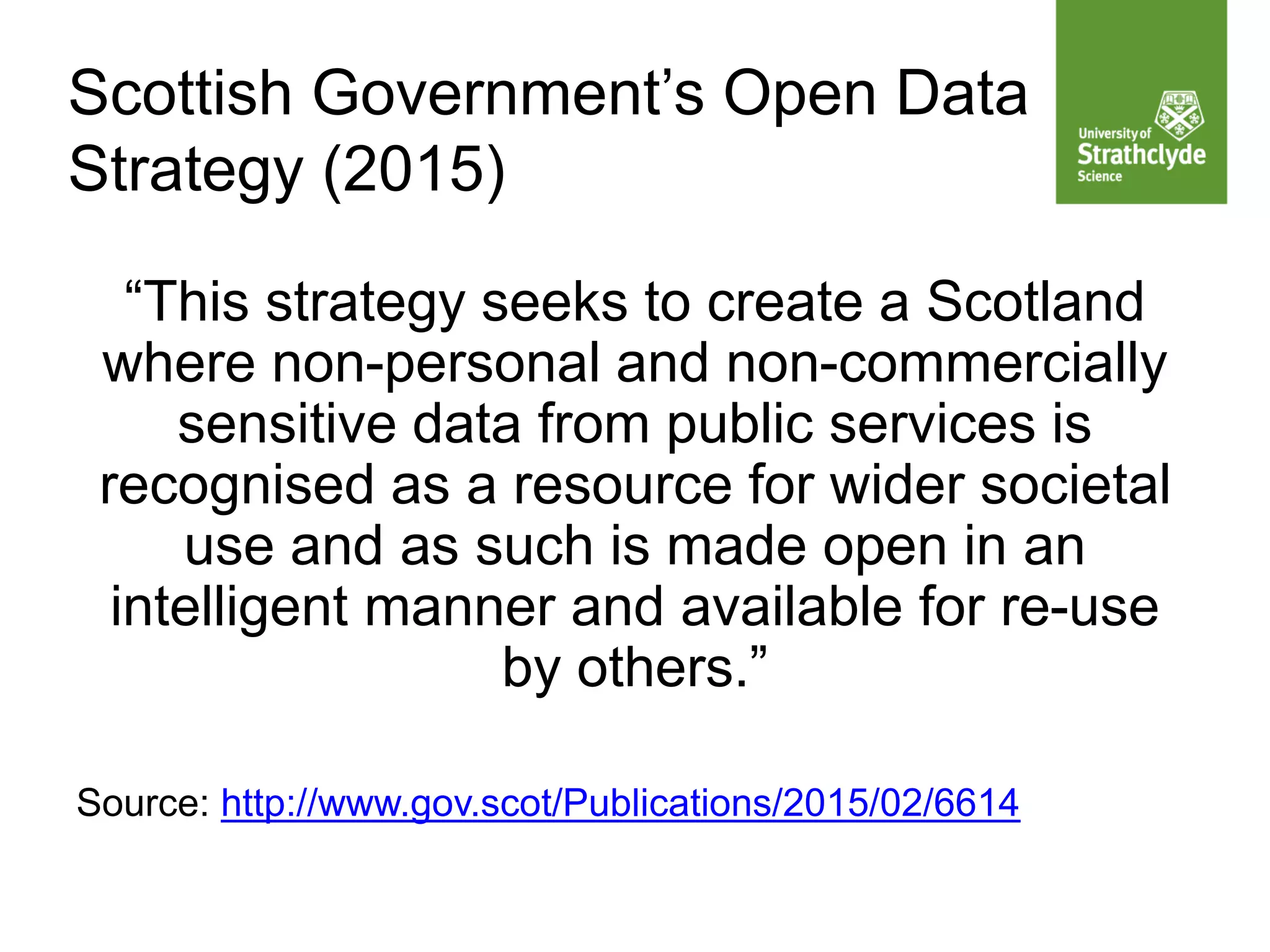
Scottish Government’s Open Data
Strategy (2015)
“This strategy seeks to create a Scotland
where non-personal and non-commercially
sensitive data from public services is
recognised as a resource for wider societal
use and as such is made open in an
intelligent manner and available for re-use
by others.”
Source: http://www.gov.scot/Publications/2015/02/6614
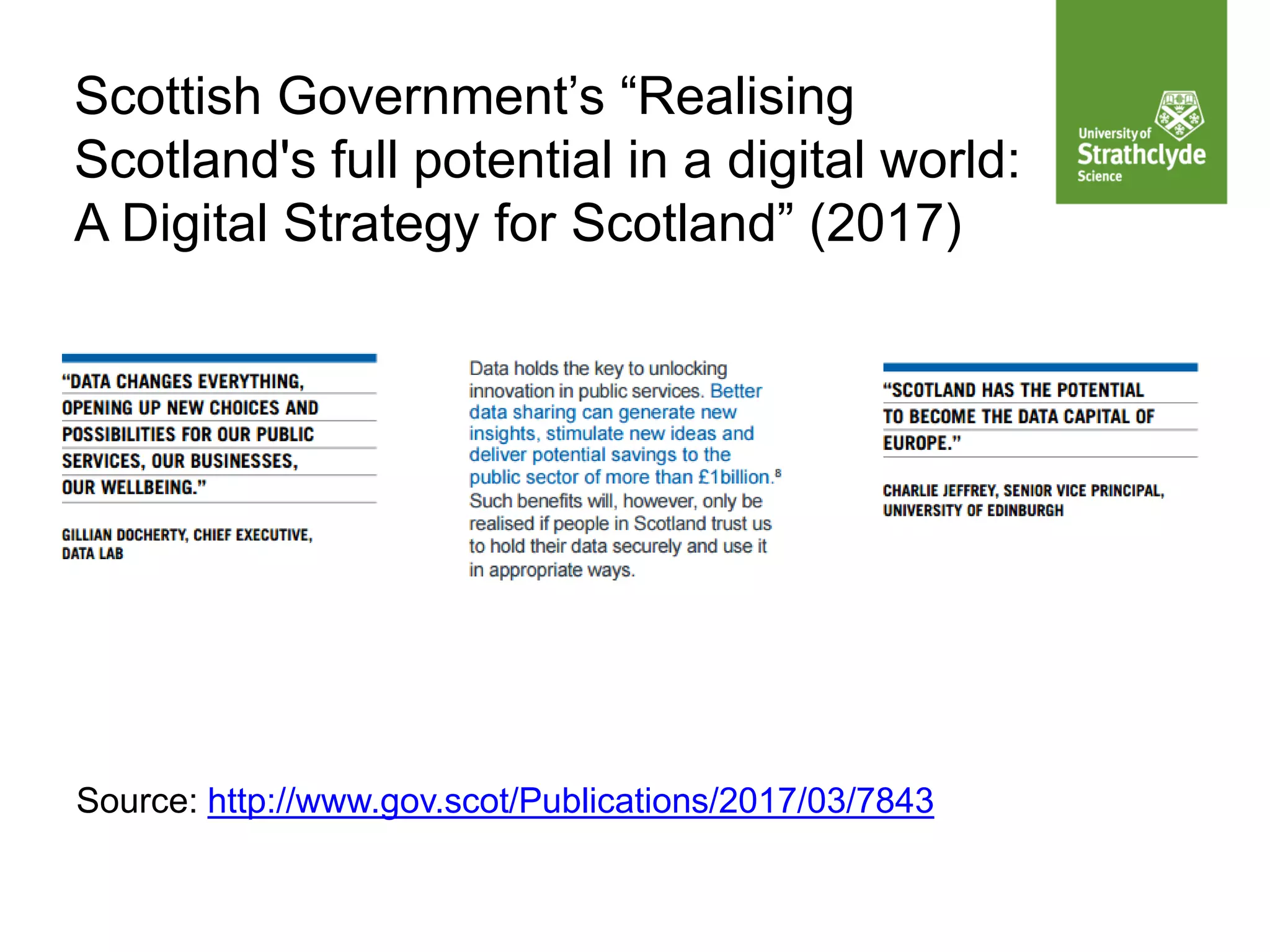
Source: http://www.gov.scot/Publications/2017/03/7843
Scottish Government’s “Realising
Scotland's full potential in a digital world:
A Digital Strategy for Scotland” (2017)
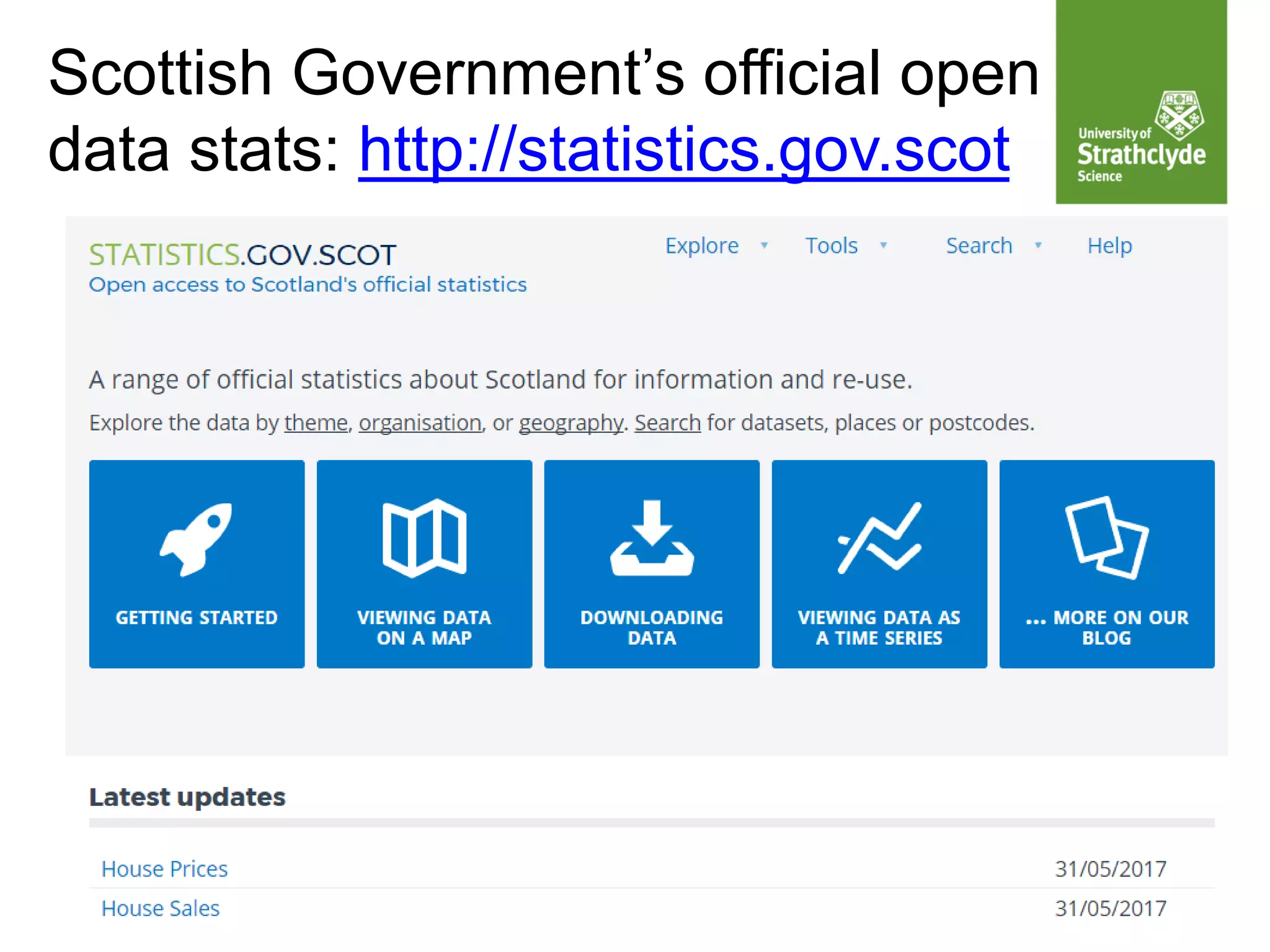
Scottish Government’s official open
data stats: http://statistics.gov.scot
Libraries implementing linked data:
Why should we do it?
• People can more easily find library
resources on the web
• More creative applications based on
library metadata
• Opportunities for cataloguing efficiency
and innovation
Source: Rasmussen Pennington, 2016, pp. 35-36
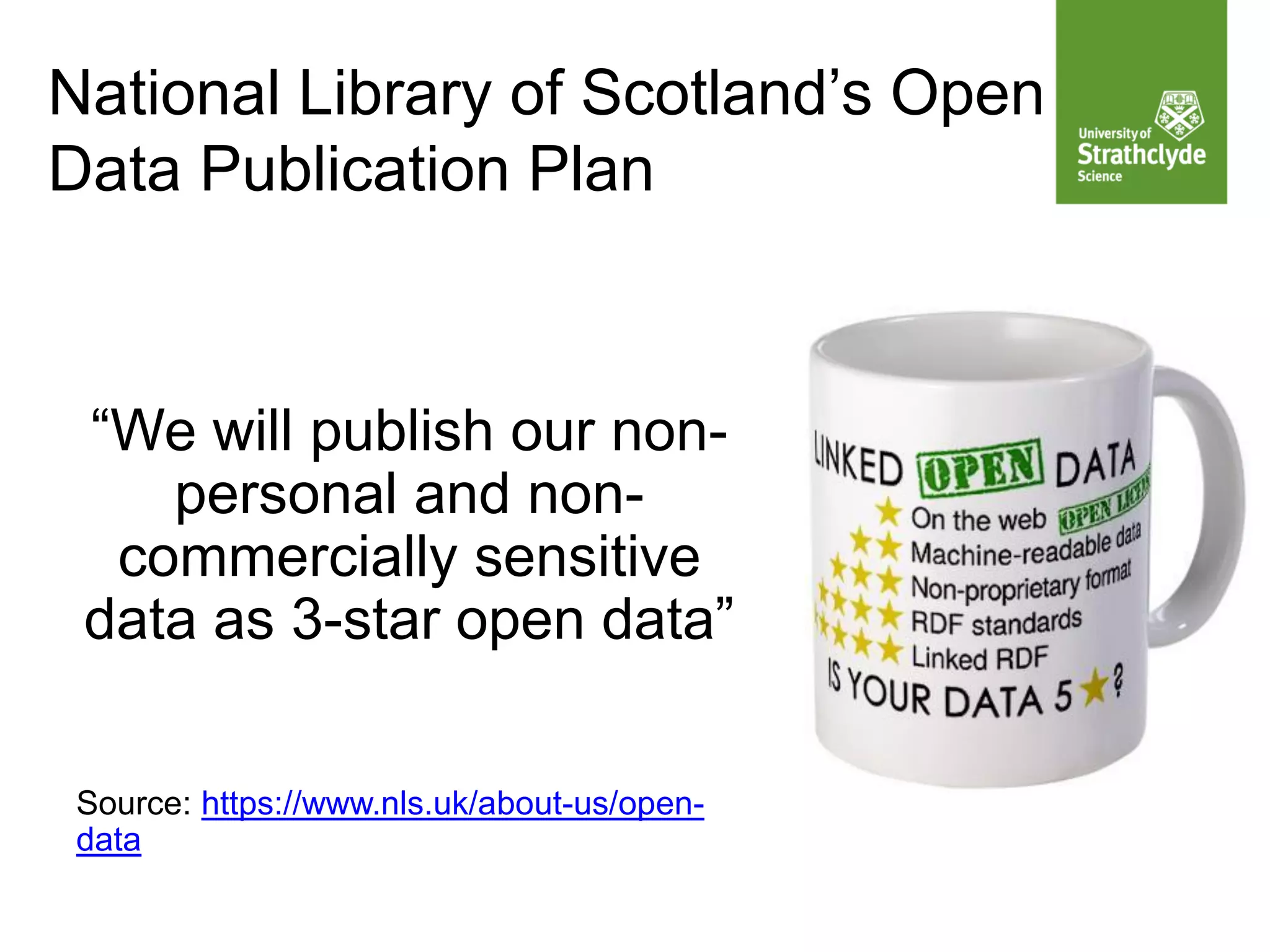
National Library of Scotland’s Open
Data Publication Plan
“We will publish our non-
personal and non-
commercially sensitive
data as 3-star open data”
Source: https://www.nls.uk/about-us/open-
data
Survey of Scotland’s library staff:
Design and recruitment
• Short online Qualtrics survey
• Departmental ethics approval
• Recruitment through Twitter, SLIC, CILIPS
• Open from 03/05/17 to 18/05/2017
• n=113 completed responses
Library types of
participants
Public School Academic
Other National Did not specify
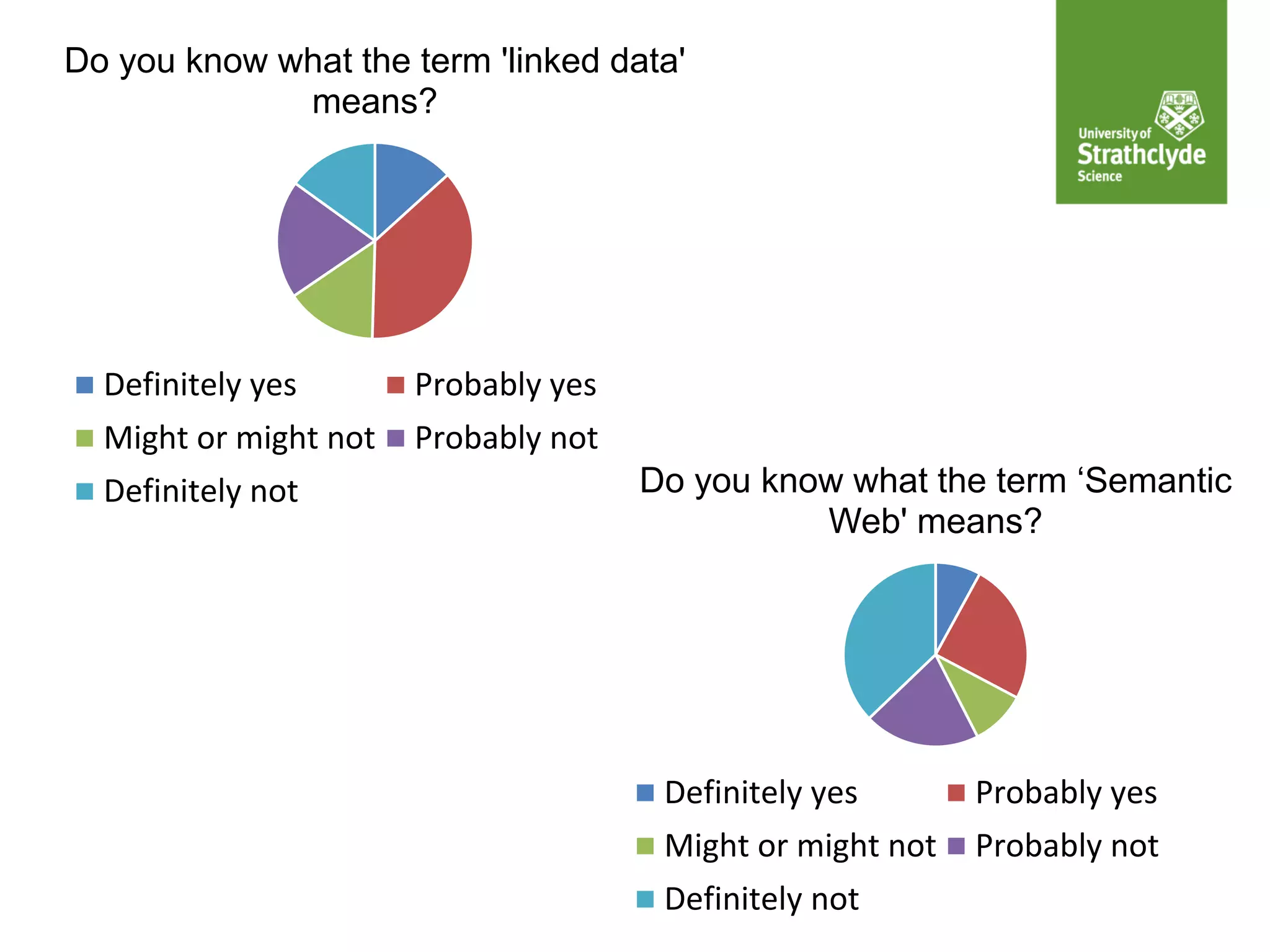
Do you know what the term ‘Semantic
Web' means?
Definitely yes Probably yes
Might or might not Probably not
Definitely not
Do you know what the term 'linked data'
means?
Definitely yes Probably yes
Might or might not Probably not
Definitely not
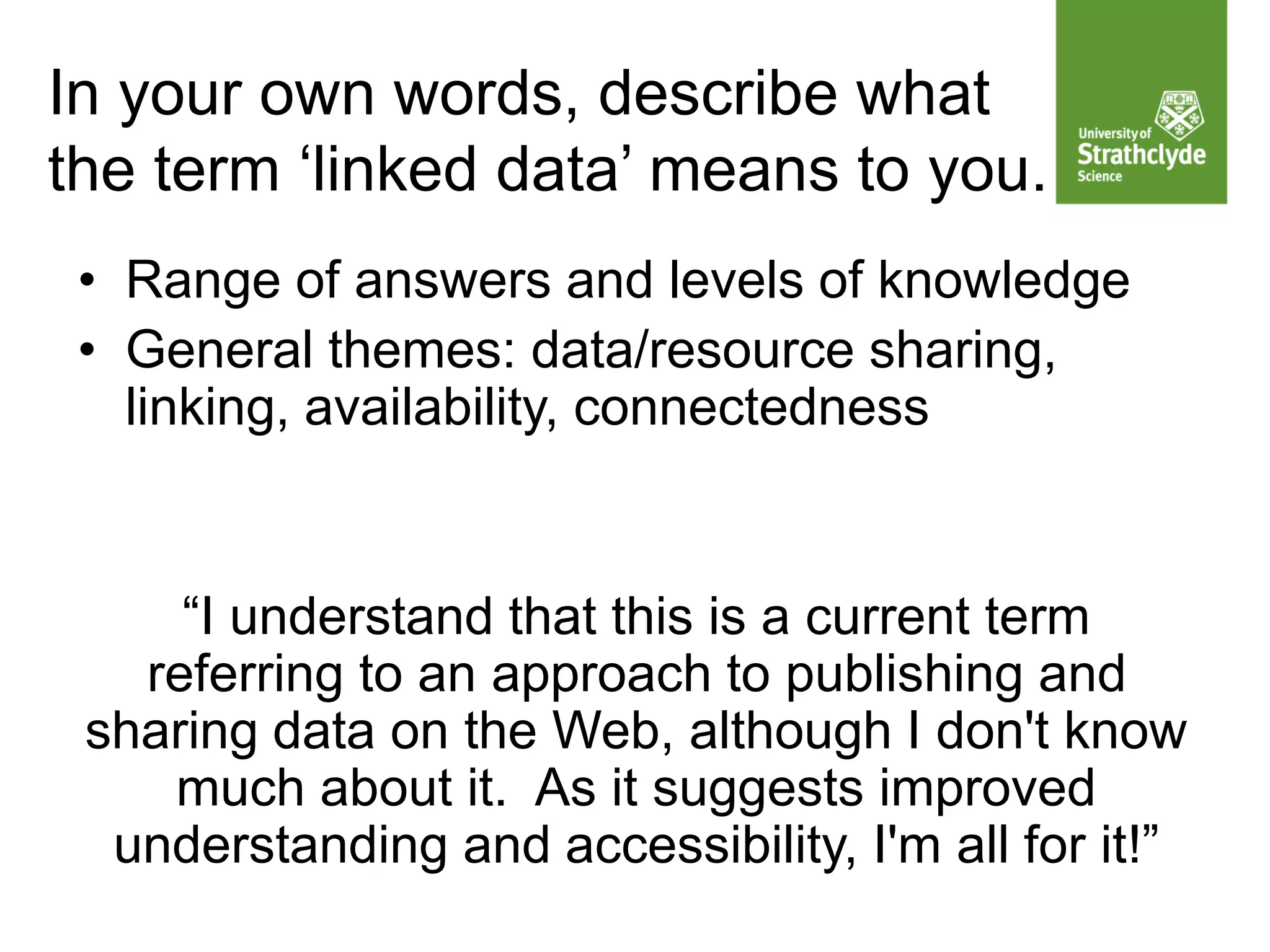
• Range of answers and levels of knowledge
• General themes: data/resource sharing,
linking, availability, connectedness
“I understand that this is a current term
referring to an approach to publishing and
sharing data on the Web, although I don't know
much about it. As it suggests improved
understanding and accessibility, I'm all for it!”
In your own words, describe what
the term ‘linked data’ means to you.
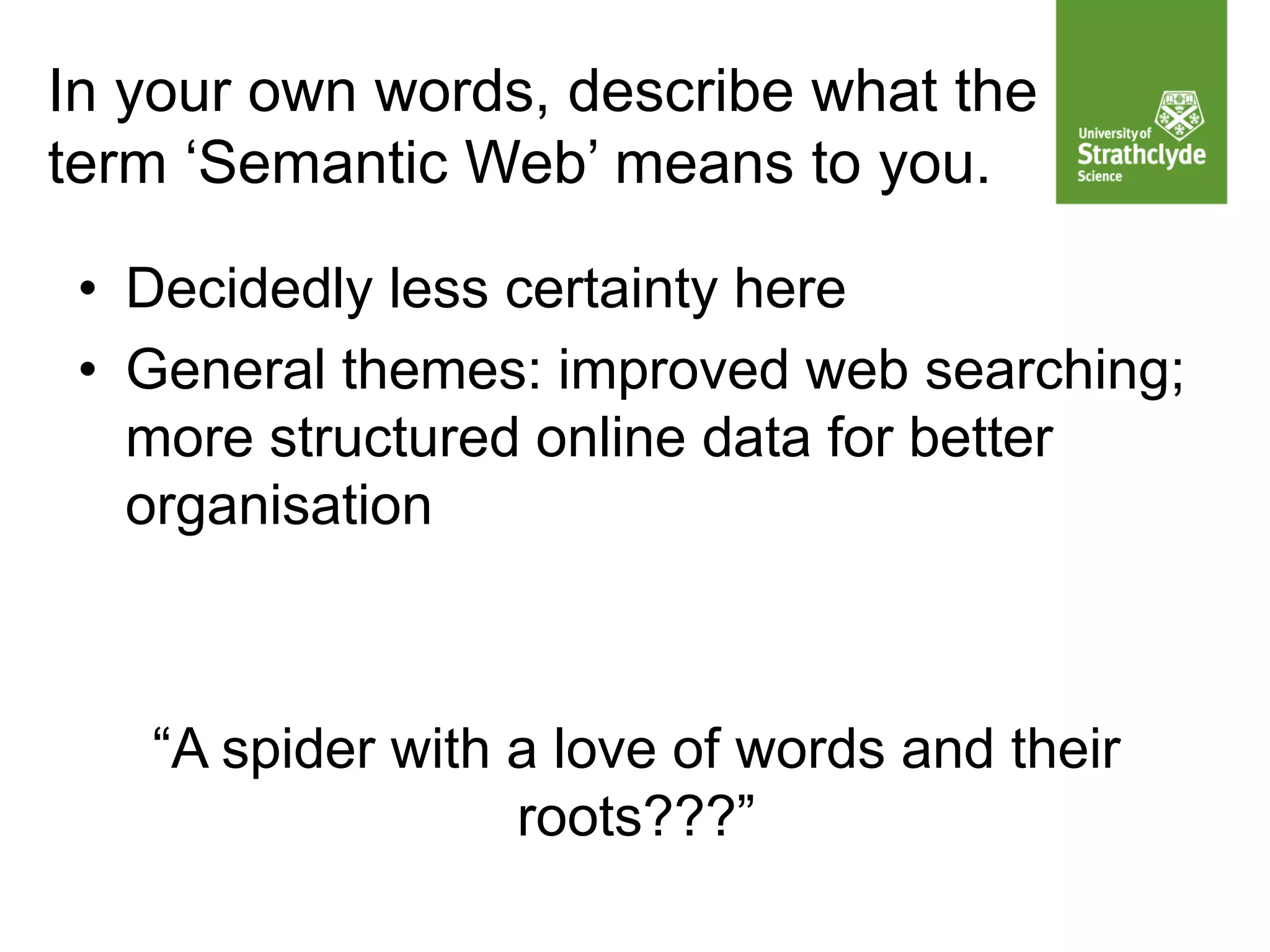
• Decidedly less certainty here
• General themes: improved web searching;
more structured online data for better
organisation
“A spider with a love of words and their
roots???”
In your own words, describe what the
term ‘Semantic Web’ means to you.
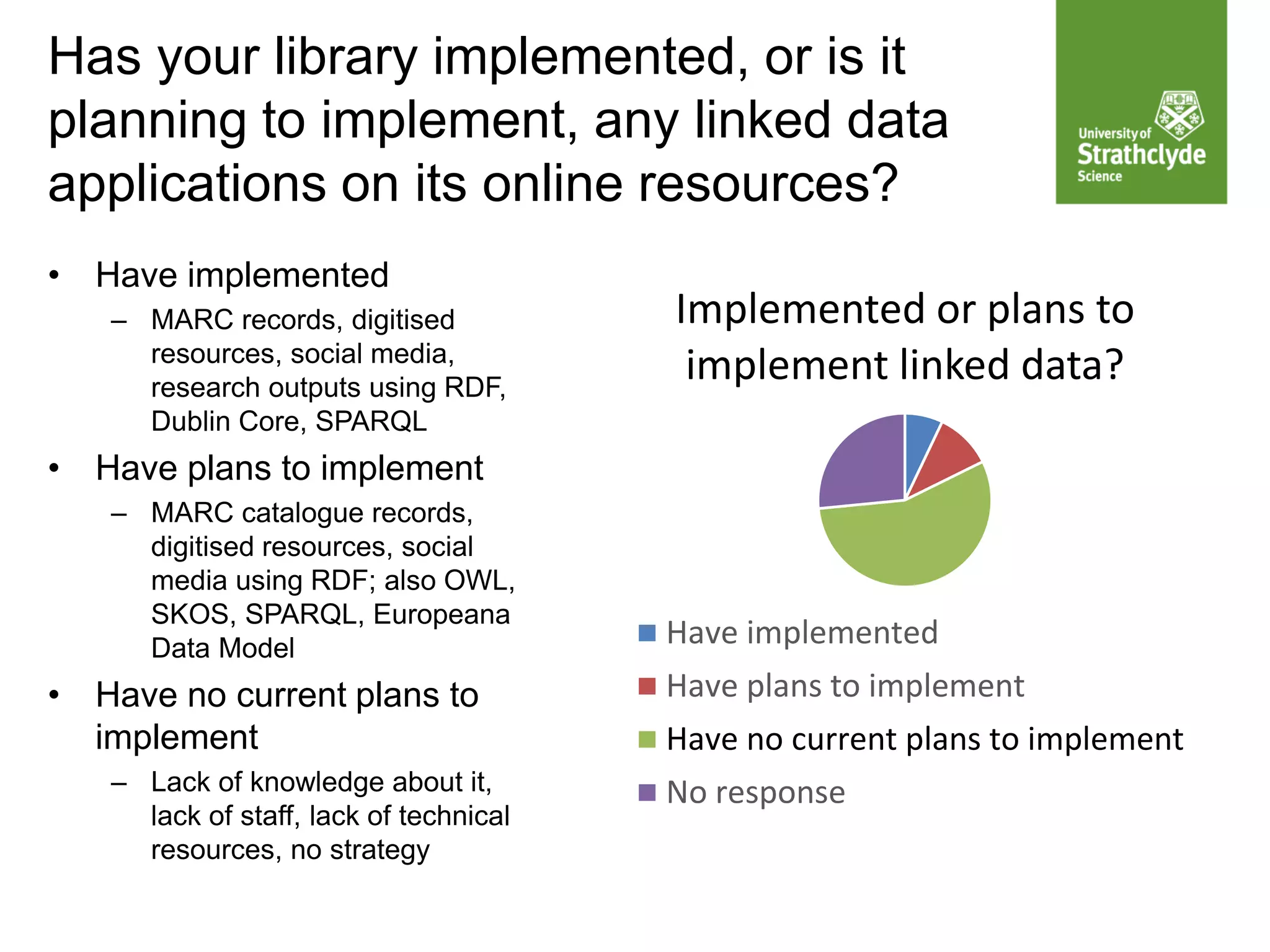
• Have implemented
– MARC records, digitised
resources, social media,
research outputs using RDF,
Dublin Core, SPARQL
• Have plans to implement
– MARC catalogue records,
digitised resources, social
media using RDF; also OWL,
SKOS, SPARQL, Europeana
Data Model
• Have no current plans to
implement
– Lack of knowledge about it,
lack of staff, lack of technical
resources, no strategy
Has your library implemented, or is it
planning to implement, any linked data
applications on its online resources?
Implemented or plans to
implement linked data?
Have implemented
Have plans to implement
Have no current plans to implement
No response
• Licencing constraints (permission needed
from database providers to link)
• Teach practitioners what linked data can
concretely achieve
• Lack of knowledge; decisions made further
up the chain?
• Potential loss of control of data
• Digitisation means monetisation?
• How should collections be linked?
Suggestions and concerns…
• Despite government directives for open
data and NLS actions, barriers exist to
implementation
– Lack of awareness
– Lack of staff/time/resources
– Licencing
– Beliefs of the profession at stake?
(Commercialisation, loss of control…)
• Interest in learning more, for some
Preliminary thoughts from survey
• Finish survey data analysis
• Evaluate online content of Scottish libraries for
linked/open data existence
• Conduct interviews in libraries and other
information centres at different stages of linked
data planning/implementation
• Increase awareness among the ILS community
about linked data/Semantic Web in order to
(potentially) increase interest in uptake
• Determine how to overcome barriers to help open
and share Scottish library content to the world
Ongoing research and other actions
References/further resources
• Rasmussen Pennington, D. (2016, July/August). Demystifying linked
data: Are you ready for what's next? CILIP Update, 34-36.
• What is linked data? https://www.youtube.com/watch?v=4x_xzT5eF5Q
• Linked data for libraries (by OCLC):
https://www.youtube.com/watch?v=fWfEYcnk8Z8
• The Linking Open Data cloud diagram:
http://lod-cloud.net/
• Linked Data – Connect Distributed Data across the Web:
http://linkeddata.org/
• Tim Berners-Lee, Linked Data:
http://www.w3.org/DesignIssues/LinkedData.html
• About the linked data movement
– http://www.ted.com/talks/hans_rosling_shows_the_best_stats_you_v
e_ever_seen.html
– http://www.ted.com/index.php/talks/tim_berners_lee_on_the_next_we
b.html
– http://www.youtube.com/watch?v=3YcZ3Zqk0a8
22

Linked Data: opening Scotland’s library content to the world

  • 1.
    Linked data: OpeningScotland’s library content to the world Dr Diane Rasmussen Pennington MS PhD PgDip FHEA FRSA Lecturer in Information Science, University of Strathclyde Editor-in-Chief, Library and Information Research @infogamerist diane.pennington@strath.ac.uk
  • 2.
    The evolution ofthe Web (1989-now) • Web 1.0: hand-coded HTML pages; accessible and readable, but not interactive • Web 2.0: Facebook and Twitter; everyone can post, share, and respond without extensive technical knowledge • Web 3.0: the Semantic Web – “Semantic” is “meaning in language” – “Semantic Web” communicates “the meaning of the content on web pages in a way that computers can understand. If they can process these meanings, they can then make and convey relationships between related web pages. This leads to improved – and more meaningful – information retrieval.” (p. 34) Source: Rasmussen Pennington, D. (2016, July/August). Demystifying linked data: Are you ready for what's next? CILIP Update, 34-36.
  • 3.
    3 Linked open dataprinciples 1. Use URIs as names for things 2. Use HTTP URIs so that people can look up those names 3. When someone looks up a name, provide useful Resource Description Framework [RDF] information, using the standards (RDF*, SPARQL) 4. Include links to other URIs so that they can discover more things Source: http://www.w3.org/DesignIssues/LinkedData.html
  • 4.
    1. Use URIsas names for things 2. Use HTTP URIs so that people can look up names 4 • The Hypertext Transfer Protocol (HTTP) is a networking protocol for distributed, collaborative, hypermedia information systems. • HTTP is the foundation of data communication for the World Wide Web. • Use URIs to name people, for institutions, concepts, topics, and geographical places. Examples: • http://www.strath.ac.uk (a university) • https://www.facebook.com/CILIPinfo (a professional association) • https://personal.cis.strath.ac.uk/diane.pennington (a lecturer) • https://www.flickr.com/photos/chandlerinok/6168389622 (a Chihuahua)
  • 5.
    3. When someonelooks up a name, provide useful [RDF] information 5 • Use RDF subject-predicate-object ‘triples’ to describe a thing • Reciprocate triples to show relationships between things Emma Watson → StarredInMovie → Harry Potter and the Half-Blood Prince Emma Watson is the subject, StarredInMovie is the predicate, and Harry Potter and the Half-Blood Prince is the object. This relationship also needs to be reciprocated: Harry Potter and the Half-Blood Prince → Has Movie Star → Emma Watson RDF, or Resource Description Framework, is the language of the Semantic Web predicate objectsubject
  • 6.
    6 4. Include linksto other URIs so that users can discover more things An example using DBpedia; shows relationships between philosophers Source: http://io9.gizmodo.com/5923583/the-complete-history-of-philosophy-visualized-in-one-graph
  • 7.
    7 Google's Knowledge Graphuses linked data to connect related resources
  • 8.
    Scottish Government’s OpenData Strategy (2015) “This strategy seeks to create a Scotland where non-personal and non-commercially sensitive data from public services is recognised as a resource for wider societal use and as such is made open in an intelligent manner and available for re-use by others.” Source: http://www.gov.scot/Publications/2015/02/6614
  • 9.
    Source: http://www.gov.scot/Publications/2017/03/7843 Scottish Government’s“Realising Scotland's full potential in a digital world: A Digital Strategy for Scotland” (2017)
  • 10.
    Scottish Government’s officialopen data stats: http://statistics.gov.scot
  • 11.
    Libraries implementing linkeddata: Why should we do it? • People can more easily find library resources on the web • More creative applications based on library metadata • Opportunities for cataloguing efficiency and innovation Source: Rasmussen Pennington, 2016, pp. 35-36
  • 12.
    National Library ofScotland’s Open Data Publication Plan “We will publish our non- personal and non- commercially sensitive data as 3-star open data” Source: https://www.nls.uk/about-us/open- data
  • 13.
    Survey of Scotland’slibrary staff: Design and recruitment • Short online Qualtrics survey • Departmental ethics approval • Recruitment through Twitter, SLIC, CILIPS • Open from 03/05/17 to 18/05/2017 • n=113 completed responses
  • 14.
    Library types of participants PublicSchool Academic Other National Did not specify
  • 15.
    Do you knowwhat the term ‘Semantic Web' means? Definitely yes Probably yes Might or might not Probably not Definitely not Do you know what the term 'linked data' means? Definitely yes Probably yes Might or might not Probably not Definitely not
  • 16.
    • Range ofanswers and levels of knowledge • General themes: data/resource sharing, linking, availability, connectedness “I understand that this is a current term referring to an approach to publishing and sharing data on the Web, although I don't know much about it. As it suggests improved understanding and accessibility, I'm all for it!” In your own words, describe what the term ‘linked data’ means to you.
  • 17.
    • Decidedly lesscertainty here • General themes: improved web searching; more structured online data for better organisation “A spider with a love of words and their roots???” In your own words, describe what the term ‘Semantic Web’ means to you.
  • 18.
    • Have implemented –MARC records, digitised resources, social media, research outputs using RDF, Dublin Core, SPARQL • Have plans to implement – MARC catalogue records, digitised resources, social media using RDF; also OWL, SKOS, SPARQL, Europeana Data Model • Have no current plans to implement – Lack of knowledge about it, lack of staff, lack of technical resources, no strategy Has your library implemented, or is it planning to implement, any linked data applications on its online resources? Implemented or plans to implement linked data? Have implemented Have plans to implement Have no current plans to implement No response
  • 19.
    • Licencing constraints(permission needed from database providers to link) • Teach practitioners what linked data can concretely achieve • Lack of knowledge; decisions made further up the chain? • Potential loss of control of data • Digitisation means monetisation? • How should collections be linked? Suggestions and concerns…
  • 20.
    • Despite governmentdirectives for open data and NLS actions, barriers exist to implementation – Lack of awareness – Lack of staff/time/resources – Licencing – Beliefs of the profession at stake? (Commercialisation, loss of control…) • Interest in learning more, for some Preliminary thoughts from survey
  • 21.
    • Finish surveydata analysis • Evaluate online content of Scottish libraries for linked/open data existence • Conduct interviews in libraries and other information centres at different stages of linked data planning/implementation • Increase awareness among the ILS community about linked data/Semantic Web in order to (potentially) increase interest in uptake • Determine how to overcome barriers to help open and share Scottish library content to the world Ongoing research and other actions
  • 22.
    References/further resources • RasmussenPennington, D. (2016, July/August). Demystifying linked data: Are you ready for what's next? CILIP Update, 34-36. • What is linked data? https://www.youtube.com/watch?v=4x_xzT5eF5Q • Linked data for libraries (by OCLC): https://www.youtube.com/watch?v=fWfEYcnk8Z8 • The Linking Open Data cloud diagram: http://lod-cloud.net/ • Linked Data – Connect Distributed Data across the Web: http://linkeddata.org/ • Tim Berners-Lee, Linked Data: http://www.w3.org/DesignIssues/LinkedData.html • About the linked data movement – http://www.ted.com/talks/hans_rosling_shows_the_best_stats_you_v e_ever_seen.html – http://www.ted.com/index.php/talks/tim_berners_lee_on_the_next_we b.html – http://www.youtube.com/watch?v=3YcZ3Zqk0a8 22