Linked Data: What it Means
for the Future of Libraries
Robin Fay @georgiawebgurl
Head, DBM/Cataloging / UGA Libraries
Peter Murray
Lyrasis
Draft Content for Discussion group 04.30.2013 / robinfay
Agenda
• Overview of linked data
▫ What is linked data?
▫ What are linked data concepts?
▫ Background: Alistair Croll talk at ALA Midwinter
http://www.youtube.com/watch?v=Ic_BlPesEls
• Discussion
Draft Content for Discussion group 04.30.2013
•Linked data is: “about using the Web
to connect related data that wasn't
previously linked, or using the Web to
lower the barriers to linking data.”
•Think> related, series records,
authority files
•Libraries already using linking
behavior.
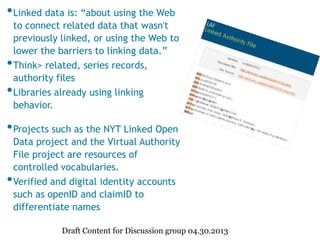
•Projects such as the NYT Linked Open
Data project and the Virtual Authority
File project are resources of
controlled vocabularies.
•Verified and digital identity accounts
such as openID and claimID to
differentiate names
Draft Content for Discussion group 04.30.2013
Basic principles of linked data
It keeps us from having to re-enter or copy information
▫ Making our data:
 reusable
 easy to correct (correct one record instead of
multiples)
 efficient
 and potentially useful to others
It can build relationships in different ways - allowing us to
create temporary collections (a user could organize their
search results in a way that makes sense to them) or more
permanent (collocating ALL works by a particular author
more easily; pulling together photographs more easily)
Draft Content for Discussion group 04.30.2013
• Advantages (reusable data, potential to provide and
built relationships, discoverability)
• How library data fits into linked data
o FRBR ( a bibliographic FRAMEWORK which is more
semantic by nature) RDA (Resource Description &
Access metadata rules which are not tied to a
programming language such as MARC but can work
with semantic web standards like XML); IRs, and
CMS like Drupal which have semantic web
capabilities
• RDA expressed as RDFa
Draft Content for Discussion group 04.30.2013
• What is linked data and open data
o Linked data is about reusing data
o We already do some linked data in our library catalogs
and even in our daily lives
o The link in a bibliographic record (like an authority
record link) is linking data behavior
o A link that we share to our friends on facebook is
linked data (of sorts)
• Linked data is a link to a record/data/content that can
then be utilized in some way
• Open data is data that available to be used in some
way with no barriers to access (licensing, etc.)
Draft Content for Discussion group 04.30.2013
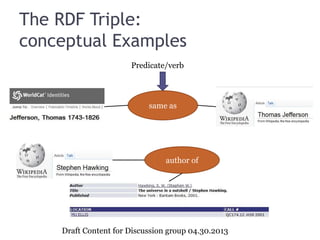
The RDF Triple:
conceptual Examples
same as
author of
Predicate/verb
Draft Content for Discussion group 04.30.2013
Tim Berners-Lee’s Four Rules
1. Use URIs as names for things
2. Use HTTP URIs so that people can look up
those names
3. When someone looks up a URI, provide useful
information, using the standards
4. Include links to other URIs, so they can
discover more things
URIs = Uniform Resource Identifier
Draft Content for Discussion group 04.30.2013
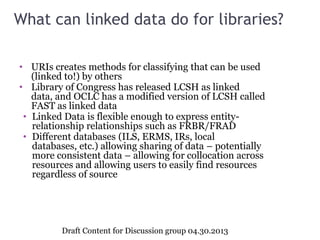
What can linked data do for libraries?
• URIs creates methods for classifying that can be used
(linked to!) by others
• Library of Congress has released LCSH as linked
data, and OCLC has a modified version of LCSH called
FAST as linked data
• Linked Data is flexible enough to express entity-
relationship relationships such as FRBR/FRAD
• Different databases (ILS, ERMS, IRs, local
databases, etc.) allowing sharing of data – potentially
more consistent data – allowing for collocation across
resources and allowing users to easily find resources
regardless of source
Draft Content for Discussion group 04.30.2013
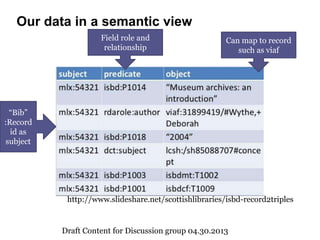
Our data in a semantic view
SOURCE: Getting triples from records: the role of ISBD
http://www.slideshare.net/scottishlibraries/isbd-record2triples
“Bib”
:Record
id as
subject
Field role and
relationship
Can map to record
such as viaf
Draft Content for Discussion group 04.30.2013
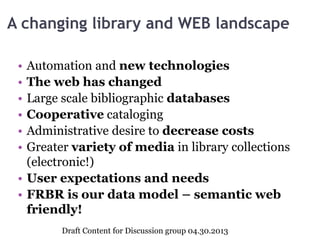
A changing library and WEB landscape
• Automation and new technologies
• The web has changed
• Large scale bibliographic databases
• Cooperative cataloging
• Administrative desire to decrease costs
• Greater variety of media in library collections
(electronic!)
• User expectations and needs
• FRBR is our data model – semantic web
friendly!
Draft Content for Discussion group 04.30.2013
• Our future systems will most likely not use MARC, but
a semantic web friendly schema.
• Currently, the Library of Congress has started a
project called the Bibliographic Framework
Transition Initiative
• Why?
• We need something that is more flexible, not flat
in file structure, yet works with a semantic
framework.
• We need something that works better with
different metadata schemas.
• This new framework will provide us with enormous
functionality in our catalogs and allow us to fully use
RDA. It will allow us to move forward into the
semantic web world.
RDA, FRBR, and MARC
Draft Content for Discussion group 04.30.2013
Discussion points
• How will using linked data change our
workflows, and how will this challenge us?
• Who will be responsible for maintaining the
provenance of information?
• How will linked data be graphed? Will a
standard bearer like OCLC or LC provide this,
or will this be something that libraries will
provide?
Draft Content for Discussion group 04.30.2013

Linked data for Libraries

  • 1.
    Linked Data: Whatit Means for the Future of Libraries Robin Fay @georgiawebgurl Head, DBM/Cataloging / UGA Libraries Peter Murray Lyrasis Draft Content for Discussion group 04.30.2013 / robinfay
  • 2.
    Agenda • Overview oflinked data ▫ What is linked data? ▫ What are linked data concepts? ▫ Background: Alistair Croll talk at ALA Midwinter http://www.youtube.com/watch?v=Ic_BlPesEls • Discussion Draft Content for Discussion group 04.30.2013
  • 3.
    •Linked data is:“about using the Web to connect related data that wasn't previously linked, or using the Web to lower the barriers to linking data.” •Think> related, series records, authority files •Libraries already using linking behavior. •Projects such as the NYT Linked Open Data project and the Virtual Authority File project are resources of controlled vocabularies. •Verified and digital identity accounts such as openID and claimID to differentiate names Draft Content for Discussion group 04.30.2013
  • 4.
    Basic principles oflinked data It keeps us from having to re-enter or copy information ▫ Making our data:  reusable  easy to correct (correct one record instead of multiples)  efficient  and potentially useful to others It can build relationships in different ways - allowing us to create temporary collections (a user could organize their search results in a way that makes sense to them) or more permanent (collocating ALL works by a particular author more easily; pulling together photographs more easily) Draft Content for Discussion group 04.30.2013
  • 5.
    • Advantages (reusabledata, potential to provide and built relationships, discoverability) • How library data fits into linked data o FRBR ( a bibliographic FRAMEWORK which is more semantic by nature) RDA (Resource Description & Access metadata rules which are not tied to a programming language such as MARC but can work with semantic web standards like XML); IRs, and CMS like Drupal which have semantic web capabilities • RDA expressed as RDFa Draft Content for Discussion group 04.30.2013
  • 6.
    • What islinked data and open data o Linked data is about reusing data o We already do some linked data in our library catalogs and even in our daily lives o The link in a bibliographic record (like an authority record link) is linking data behavior o A link that we share to our friends on facebook is linked data (of sorts) • Linked data is a link to a record/data/content that can then be utilized in some way • Open data is data that available to be used in some way with no barriers to access (licensing, etc.) Draft Content for Discussion group 04.30.2013
  • 7.
    The RDF Triple: conceptualExamples same as author of Predicate/verb Draft Content for Discussion group 04.30.2013
  • 8.
    Tim Berners-Lee’s FourRules 1. Use URIs as names for things 2. Use HTTP URIs so that people can look up those names 3. When someone looks up a URI, provide useful information, using the standards 4. Include links to other URIs, so they can discover more things URIs = Uniform Resource Identifier Draft Content for Discussion group 04.30.2013
  • 9.
    What can linkeddata do for libraries? • URIs creates methods for classifying that can be used (linked to!) by others • Library of Congress has released LCSH as linked data, and OCLC has a modified version of LCSH called FAST as linked data • Linked Data is flexible enough to express entity- relationship relationships such as FRBR/FRAD • Different databases (ILS, ERMS, IRs, local databases, etc.) allowing sharing of data – potentially more consistent data – allowing for collocation across resources and allowing users to easily find resources regardless of source Draft Content for Discussion group 04.30.2013
  • 10.
    Our data ina semantic view SOURCE: Getting triples from records: the role of ISBD http://www.slideshare.net/scottishlibraries/isbd-record2triples “Bib” :Record id as subject Field role and relationship Can map to record such as viaf Draft Content for Discussion group 04.30.2013
  • 11.
    A changing libraryand WEB landscape • Automation and new technologies • The web has changed • Large scale bibliographic databases • Cooperative cataloging • Administrative desire to decrease costs • Greater variety of media in library collections (electronic!) • User expectations and needs • FRBR is our data model – semantic web friendly! Draft Content for Discussion group 04.30.2013
  • 12.
    • Our futuresystems will most likely not use MARC, but a semantic web friendly schema. • Currently, the Library of Congress has started a project called the Bibliographic Framework Transition Initiative • Why? • We need something that is more flexible, not flat in file structure, yet works with a semantic framework. • We need something that works better with different metadata schemas. • This new framework will provide us with enormous functionality in our catalogs and allow us to fully use RDA. It will allow us to move forward into the semantic web world. RDA, FRBR, and MARC Draft Content for Discussion group 04.30.2013
  • 13.
    Discussion points • Howwill using linked data change our workflows, and how will this challenge us? • Who will be responsible for maintaining the provenance of information? • How will linked data be graphed? Will a standard bearer like OCLC or LC provide this, or will this be something that libraries will provide? Draft Content for Discussion group 04.30.2013

Editor's Notes

  • #8 For each part a URI.
  • #9 URIs are kind of like a hook – they allow us to connect things together.